verysmallkitchen

Archive for the ‘Uncategorized’ Category

DEMOTIC ARCHIVES OF ART WRITING (1): RICHARD FOREMAN’S ONTOLOGICAL HYSTERIC THEATER: A MANIFESTO

In Uncategorized on April 22, 2010 at 10:53 am

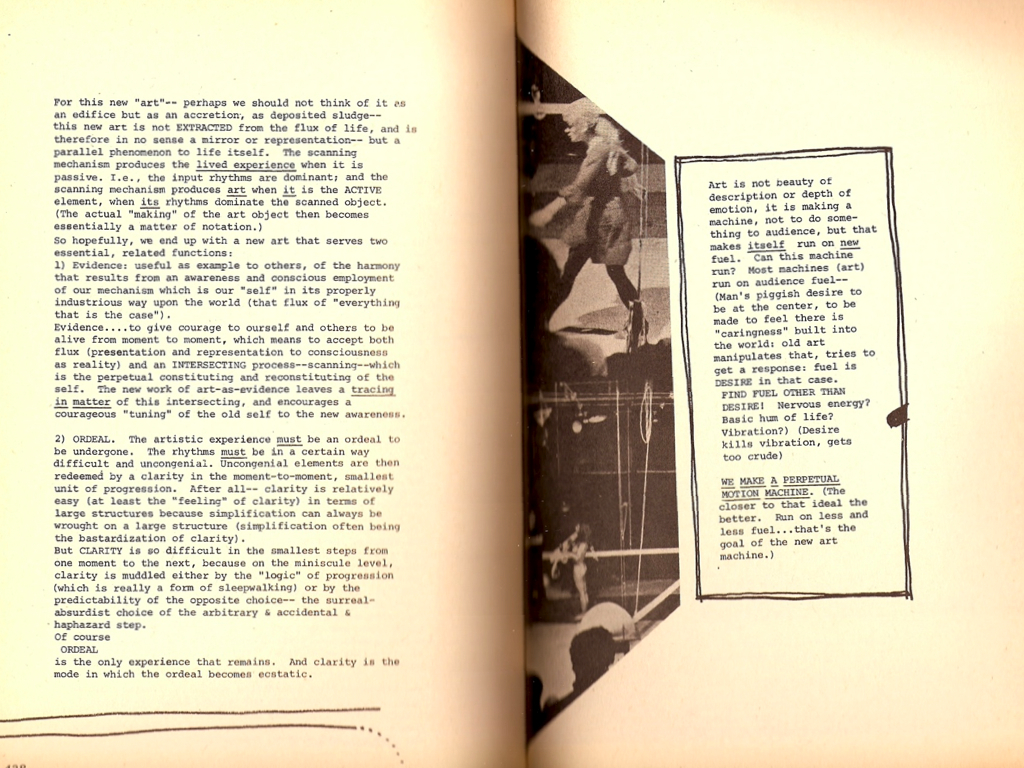
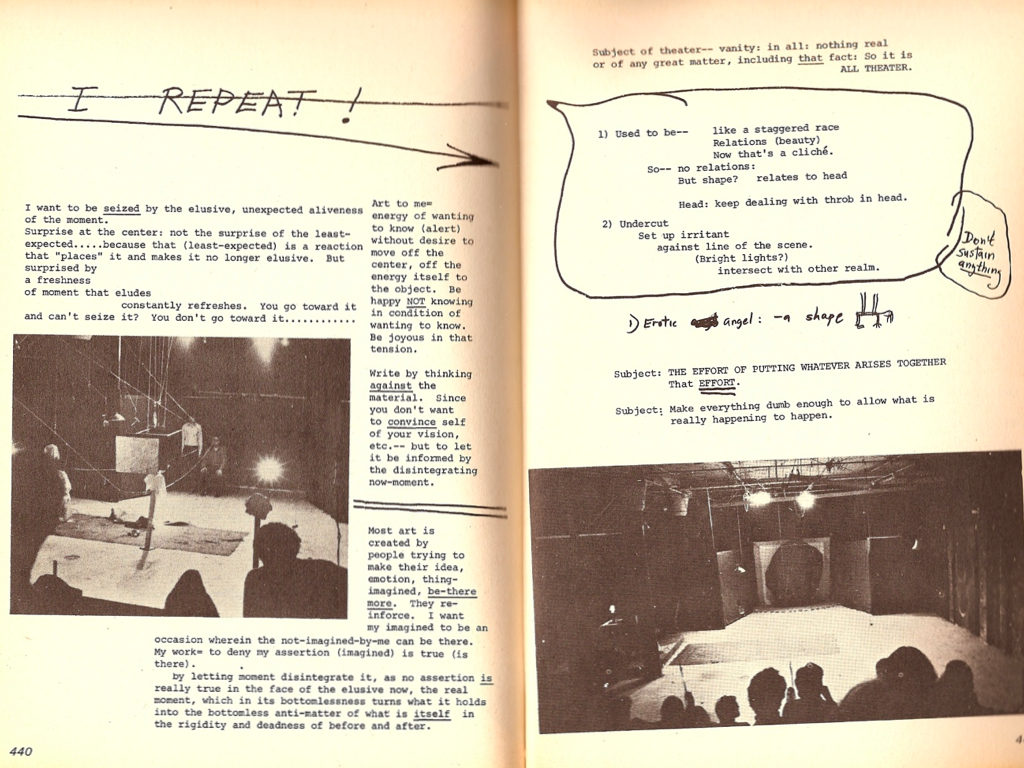
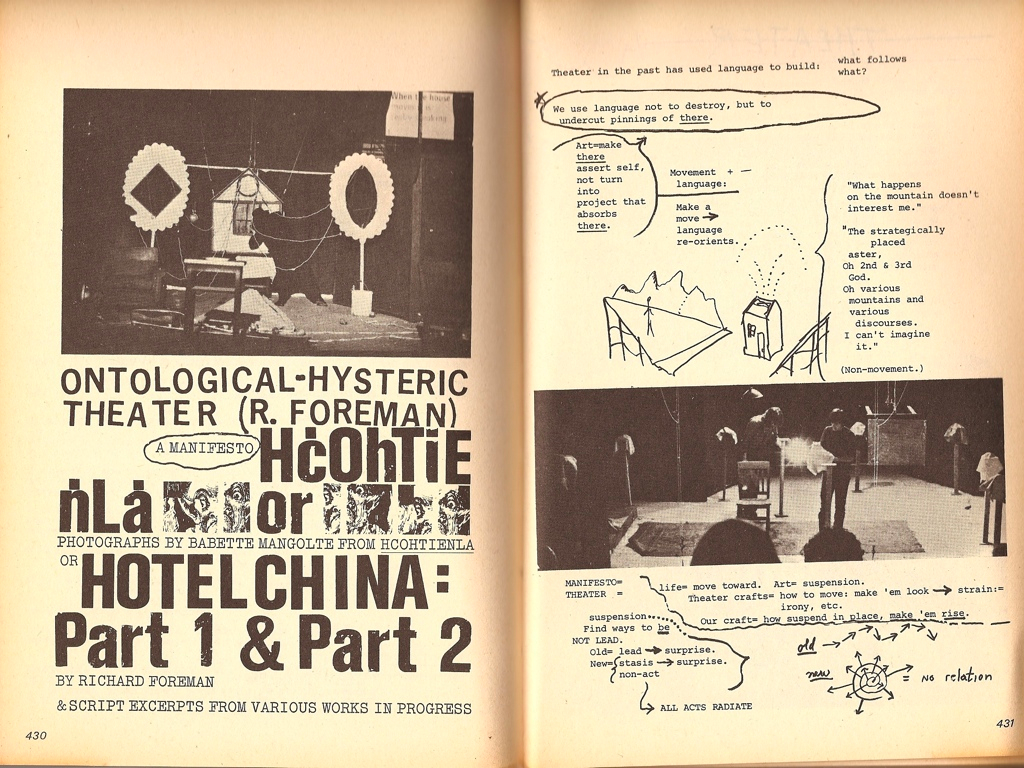
A NOTE: I first encountered Richard Foreman’s ONTOLOGICAL HYSTERIC THEATER: A MANIFESTO in Kate Davey ed. Richard Foreman Plays and Manifestoes, published by NYU Press in 1976. It also appeared in Richard Kostelanetz anthology ESSAYING ESSAYS: ALTERNATIVE FORMS OF EXPOSITION (Out of London Press, 1975), from which the above images are scanned.  

I have included the essay in several workshops and gatherings of material – such as CRITICISM TOWARDS PERFORMANCE NOTATION, a short presentation as part of SPILL: OVERSPILL, and a workshop on the visual essay as part of the FREE PRESS workshop, some notes on which can be seen here.

Most recently, I returned to it as part of a presentation on artist uses of the diagram at London’s FormContent. I showed slides of Foreman’s essay at the point in my talk where I was trying to suggest what a diagrammatic artistic practice might be, thinking less about a practice of literally making diagrams and more about a practical and conceptual arrangement of a working practice as a diagrammatic spatial unfolding.

I also find myself thinking about this text in the light of current art debates on alternative forms of education. 

Foreman’s text remains vital for me in how it links together together traditions of essay, performance script, and open field poetics, as well as its establishing of a creative interchange between spaces of page, mind, and stage.

I find here writing that comes before, during and after the act of theatre making itself, that is about an event and process, but also an intensity of experience now (a “now” that is ever adaptable: the moment of writing, the moment of reading both pulsate in this text), as well as being a projection and prosthesis for a theatre activity that will take place in the future.

An essay shifting between registers – reflective and impetuous, handwritten, typed, photographed and drawn – to create a space in which thought is actively taking place, or at least is a possibility.

Foreman has written essays like this throughout his career, although not perhaps with the eclecticism of approach evidenced here. See, for example, “How to Write a Play” and “The Carrot and the Stick” (both 1976), reprinted (along with Ontologic Hysteric Manifesto) in the PAJ Art + Performance anthology of essays on Foreman.

I’m struck, looking at these texts, by Foreman’s observation in interviews that his texts are far ahead of his directing, that the texts evidence a spatial and thematic complexity his theatre productions themselves lack.

I’m also thinking of his scenographic sense of the multiplicity of space, always creating multiple points of focus and intention, anti-absorptively interrupting a moment – strings criss-crossing the stage in photos of many early Foreman productions –  how such forms of stage composition apply to the page and writing.

DEEP TRANCE BEHAVIOR IN POTATOLAND Photo @ Paula Court


I’ve not seen Foreman’s work live, his work the prime exemplar for me of a practice whose relevancy and urgency to my own work is a reconstruction through text and image.  

By re-printing the texts here, perhaps I’m hoping for the same effect as Foreman, when he posted his notebooks online with the invitation for others to use them in the making of a piece of theatre.

If those notebooks seem too close to Foreman’s own process to initiate an autonomous theatrical interpretation, perhaps the essay form – conceived by Foreman as an active think-performance-writing-space – can be prompt and tool for very different forms of writing, performance and other creative practice.

Regarding Foreman’s own practice, the manifesto re-printed here is testimony to an engagement with theatrical experience and space which now appears to be over.

READING NOTES: FOUR AFTER-QUOTATIONS AND SAMUEL BECKETT ON HOLIDAY

In Uncategorized on April 21, 2010 at 6:41 am


Reading as Publishing: Samuel Beckett on Holiday


In the week after READING FOR READING’S SAKE I came across a number of quotations that developed and nuanced the space of “reading as activity” opened up by that event. 

(1) “the artist, the work of art, and its viewers are connected through an intricate web of correspondences, and if one if really inside of that relation, everything corresponds. And one cannot really deal with a work of art without dealing with its correspondences, including one’s own life and its relation to others. It is a simple truth, but one that is so regularly obscured in practice that it has become a kind of mystery to us. ”  

David Levi Strauss, From Head to Hand: Art and the Manual (Oxford University Press, 2010), 165.  Read in Gordon Square WC1London, 12 April, 2010, instantaneously applying quotation to a networked “everything corresponds” model of reading. 

(2)”There is something about the way you put together – compose – your sentences, a deliberate effort to create moments of silence, of stillness, full stops, as though there would be rest marks in a musical score, or an end of bar that forces the reader to go back and start from the beginning.”

Joan Richardson, question to Stanley Cavell, “The Transcendental Strain: Stanley Cavell Talks with Bookforum”, Bookforum, April-May 2010, 5-6. Read on 15.55 train from Leeds to London, 11 April, 2010. 

Thinking here about the musical spaces between books, also how books could resist a linear read-through and consumption, shifting attention into a broader engagement with all levels of their material architecture. 

(3) “Surrealism is an honest, beautiful resilient tonic fermented into a delicately volatile mixture of liberty, sensuous play, psychic automatism, chance, humor and a biting critique of corrupt power in all its manifestations, from bourgeois miserablism to fascism.”

Jesse Gentes, quote from “Impossible Emancipation” (2009), cited in Patricide: Issue One: Documentary Surrealism , purchased and read at Cornerhouse, Manchester, 9th May 2010. 

Patricide posits continued presence of surrealism as grass roots, non-institutional praxis. Issue Two will be on “seaside surrealism.”

I made some notes for a possible contribution, but they lacked the sense of project I remembered from Paul Nash’s writings on the subject (first published in the 1938 issue of Architectural Review).   PROJECT: read widely in surrealist literature, but without concept of unconscious. 

 (4)”Reading is a favorite activity, and I often ponder its phenomenology. As I write this essay, the reading I do for it is a mitigated pleasure. Sometimes it feels like a literal ingestion, a bulimic gobbling up of words as thought they were fast food. At other times I read and take notes in a desultory, halting, profoundly unsatisfying way. And my eyes hurt.” 

Moyra Davey, Long Life Cool White: Photographs and Essays by Moyra Davey, (Yale University Press, 2008), 85. At home, evening, Whitechapel, London 12 April 2010. 

Photo: Moyra Davey


Davey talks of the flanerie of reading – a concept which captures the entwining intention between reading as WORK and as indulgence, and what circumstances determine the readers self-positioning on this spectrum of value.

For Davey herself the (w)readerly result is an associative, diaristic, unfolding essaying, and a photograph practice where a formal materiality of reading (and other activities – see image below) acquires its own (irr-)resonant psychology. 

Photo: Moyra Davey


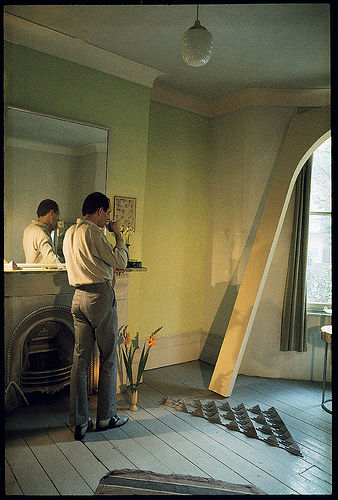
SAMUEL BECKETT ON HOLIDAY: Walking into the Cornerhouse bookshop on 9th May 2010 I immediately noticed the photo of Samuel Beckett. It’s from Beckett: Photographs by François-Marie Baniera , including several, like those here,  of SB on holiday in Tangiers. I liked how this liberated Beckett’s texts from the moody black and white images that often appear on his books. 

In the context of “reading as publishing” I also liked how this photo appeared to published the emotion of my own experience of reading Beckett, finding a certain reassuring joy in the certain ontological ground (or non-ontological non-ground ground) that Beckett seemed to write. 

The photo also loosens up the relationship between Beckett’s life and work, suggesting a possibly more paradoxical and tangential relationship than the black and white icons which attempt to map Beckett’s physical image onto his writings and vice versa, like some primitive neo-Victorian science of physiognomy.

Thinking of the materiality of a book and its reading, that’s what I don’t want “reading as publishing” to be.

FROM BOA CONSTRICTOR TO FAT LADY FROM NORFOLK: CHARLES DICKENS AND THE ART OF READING ALOUD

In Uncategorized on April 20, 2010 at 7:13 am

On May 1st I will be presenting a reading as part of PREAMBLES AND PERAMBULATIONS, an exhibition at the Dickens House Museum curated by Island Projects. More about the event can be seen here

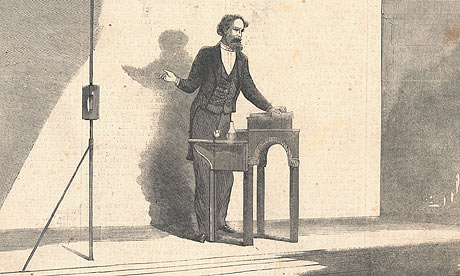
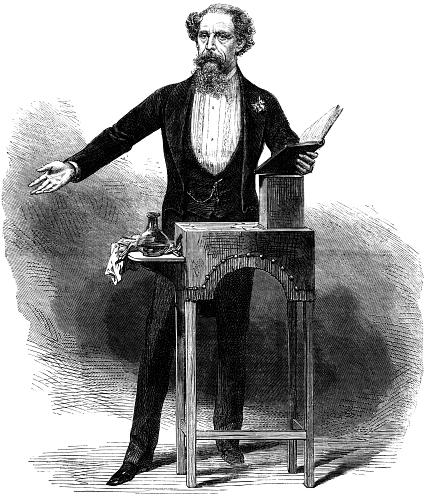
 On 13th April 2010, thinking about what I will read, I went to the Dickens Museum at 48 Doughty Street in Bloomsbury. On the top floor there was a small display dedicated to Dicken’s own practice of reading aloud. I noted Dickens specially built reading table that accompanied him on tour, particularly the small box placed on top and on which the hand holding the book would rest. 

 I wrote: This suggests that book reading is like a cumbersome prosthetic, how the act of reading in public is a complex act requiring a cumbersome architecture of body appendages and extensions. Rather than standing at the reading table, one crawls inside it to get more familiar with one’s own texts. 

I also examined a display case of the reading copies, from which Dickens read. These were subject to various methods of annotation, including pencil underlining and the highlighting of sections of text in red and blue. Inparticular I noted that Dickens sometimes crossed out paragraphs in the printed text, and replaced them with a handwritten alternative. I thought these might be slight rearrangements of grammar, possibly to bring out rhythms more striking for reading aloud. 

In the printed text of MR. CHOPS THE DWARF Dickens had crossed out a text which read:

There was the canvas representin the picter [sic] of a child of a British Planter, siezed by the two boa constricters…

and replaced it with the following: 

Then there was the canvas representing the fat lady from Norfolk, in a plaid frock and sash…

Whilst there may be some obvious reason for this shift apparent to Dickens scholars, I appropriated the shift between paragraphs as evidencing the demands of reading aloud, shifting from private absorption to public performance, and the transformations of matter, style, and story that necessitates. 

Coming downstairs into the library, I noticed in one corner a reproduction of Dickens reading table (the original upstairs had been in a glass case, which suggested a Dickens still reading, muffled, behind glass). But it lacked the small square – covered in the same dark red velvet – that Dickens rested hand and book upon (see image above). My response to the reading table had focussed upon that red square block. I wondered where it was, if the reproduction had ever included such a thing. 

I note some reasons for this fascination: its nature as building block, minimalist cube (fringed with a dark red tassle), mobility, wrist podium, something to be found hanging from every book like furry dice from a car window.

It is the block that fits the reading stand into the scale of Dicken’s body, giving form to a void space between human and object, reader and book, but such form is temporary/provisional/”blocked”. Hopefully, the block can levitate on its own if carrying around the reading stand proves difficult. 

In fact, I noted, the reconstruction [of the reading stand] is noticeable for its lack of animating props, its denial of the prosthetic nature of reading aloud. No ivory paper knife that functioned as a prop, never to cut paper; no jug of water; no cloth or towel. 

My image of how to use this reading table was becoming ever more physical. I IMAGINED DICKENS wiping his brow and the back of his neck with the towel like a boxer, sweat pouring onto the altered paragraphs of his page. I imagine a script of Dickens reading aloud that involves no books, just a choreography of sweat, box, jug, water, ivory paper knife.  From Boa Constrictor to Norfolk Fat Lady.

A few days after my visit to the Dickens House Museum I read the following quotation by Gertrude Stein:

She always said that that first visit had made London just like Dickens and Dickens had always frightened her. As she says anything can frighten her and London when it was like Dickens certainly did. 

SOURCE TEXT: Gertrude Stein, THE AUTOBIOGRAPHY OF ALICE B TOKLAS, (Penguin Books, London, 2001 [1933]), 92-3

*

Preambles and Perambulations: Past, Present and Future: Creative minds at 48 Doughty Street. Saturday 24th April 2010 – Saturday 8th May 2010.

ARTISTS: Larry Achiampong, Bram Thomas Arnold, David Berridge, Marco Cali, Maurice Carlin, Jeremy Evans, Anna Chapman, Pippa Koszerek, Yaron Lapid, Sophie Loss, Jane Madell, Penny Matheson, Aidan McNeill, Duane Moyle, Dermot O’Brien, Gary O’Connor, Claudia Passeri, Steve Perfect, Veronica Perez Karleson, Jonathan Trayner, Mary Yacoob.

Private View (entry free): Friday 23rd April 2010, 18.00 – 21.00. A conversation with the artists: Saturday 24th April 2010, 14.00 – 16.00. Performers and Readers: Saturday 1st May 2010, 14.00 – 16.00. Exhibition open: Monday – Sunday, 10.00 – 17.00. Normal museum admission charges apply. 

KAFKA THINKING STATIONS: A CHORA(L) SONG CYCLE

In Uncategorized on April 17, 2010 at 1:50 pm


KAFKA THINKING STATIONS: A CHORA(L) SONG CYCLE, performed at Testing Grounds, Permanent Gallery Brighton, July 18th 2009


KAFKA THINKING STATIONS: A CHORA(L) SONG CYCLE  is a text developed from five short sentences found in the notebooks of Franz Kafka. The piece was first developed and presented as part of TESTING GROUNDS at the Permanent Gallery, Brighton on July 18th 2009. On the 24th April it will be recorded in London as a choral radio play, directed by Joseph Thorpe. 

 The score is preceded by the following text, and for the performance on the 24th this is the only part of the text that performers will see prior to the event:

INSTRUCTIONS FOR PERFORMERS 

 This is a text for a chora(l)* recitation to be performed by any possible number of performers, who may or may not be physically present in the same space. 

The distribution of texts amongst performers should be decided by the performers themselves as a reflection of the desired or actual group process.  All parts of the text may be regarded as vocal music, stage instructions, process notes or documentation and be performed or not as deemed appropriate. 

No instructions are included as to pitch, rhythm, tone, or speed. These are determined by each performer as emergent through sequential acts of word-concentration.

 ______________ 

*CHORA: “a temporary articulation, essentially mobile, constituted of movements and their ephemeral stases.” 


At the Permament Gallery KAFKA THINKING STATIONS took the form of a three part vocal performance with myself, Olivia Armstrong and Johanna Linsley. The piece was rehearsed once, and I distributed the following quotation by Jackson MacLow:

Performers must become acutely conscious of both the sounds they themselves are producing and those arising from other performers, the audience, and/or the environment. It is essential to the realization of Asymmetries that all performers choose as many aspects and details as possible of their individual realizations within the context of as clear an awareness of the total aural situation at each moment as performance circumstances allow. In many circumstances  -as when performers are dispersed within the space (e.g. around or in the midst of an audience or when performers and audience are identical), a procedure often followed in performances I’ve directed – each performer’s impression of the total aural situation will necessarily differ from those of the others.  What is asked for is concentrated attention to all sounds perceptible to the individual and an attitude of receptivity and responsiveness such that choices are made spontaneously, often seeming to arise from the whole situation. 

Schematically, this “whole” can be represented by concentric spheres: the inmost is that of the individual performer; next, that of the whole performance group; next, that of the larger social group, including audience as well as performers; next, that of the performance space including room acoustics, electronics etc.; and finally, the larger spaces within which the performance situation is situated: the rest of the building, the surrounding streets, neighbourhood, city (or rural area), etc., all of which may affect significantly the aggregate of sounds heard by each individual at each moment. The spheres are best conceived as transparent and interpenetrating – not static shells but concentric ripples travelling simultaneously out from and  in toward each center.

SOURCE TEXT: Jackson MacLow, THING OF BEAUTY: NEW AND SELECTED WORKS (University of California Press, 2008), 80-81.


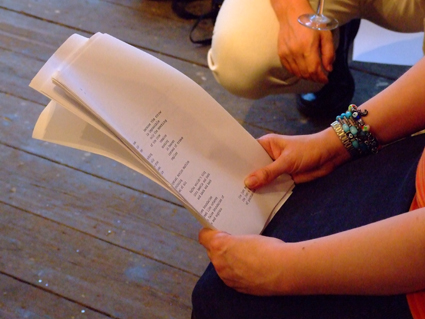
We agreed that we would read sequentially through the thirty pages of the script, reading what we wished from each page, in whatever order. We held our separate performances together by agreeing that we would turn the page at the same time.

One discovery of this process was how much more connected we felt when absorbed in our individual acts of reading than when we tried to read looking at each other,  making the script into a too obvious fake conversation.

For the performance on the 24th, ten performers, director, writer, and sound engineer will spend one day together. The script will be read at the beginning of the day, enabling everyone present to identify questions and issues that determine the contents and approach of the ensuing workshop. The afternoon will be given over to a series of performances, each unfolding out into group led discussions and explorations that inform further readings. The resulting sound recording will be broadcast online as part of the PLATFORM RADIO PLAY PROJECT. More details to follow. 

In preparation for this performance, I went through the original script and made a series of annotations and drawings in black marker pen. I was trying to focus on the materiality of the page itself, focussing on my presence as a writer within a collaborative performance project.  When I met with Joe it was fascinated how he translated this markings into his own concerns as director, developing a through-line for the text as a whole.  

Whilst invaluable preparation, both of us will be leaving aside these interpretations in order to experience what emerges from the collective workings on the 24th.

Marc Camille Chaimowicz


A WRITER IN THE REHEARSAL SPACE: I am currently thinking through what it means to be a writer in a rehearsal space, how I can function, not as a provider of meaning and interpretation in regard to the text, but as some sort of facilitator regarding how its language, space and propositions could  organise our time together. 

In an indirect and sometimes contradictory way, I have been thinking about this through the following text by Clémentine Deliss:

…there remains a tension between responding on the basis of background knowledge – a certain precision reconnaissance and intentionality and travelling in the mode of the flâneur with less structure at hand. In my case, I want to know exactly whom it is that I need to talk to if i’m somewhere new. I don’t want to change the language of my practice. I know the intelligentsia is there. I just have to find it. So the last thing I want to do is to float into a location. I have to generate a meeting of intentionality between the other person and myself and for that I do the research before I go out there and I don’t compromise. 

Later in the same book, an overlapping set of issues get formulated by Marc Camille Chaimowicz as follows:

I think the photograph that I happened to find in Nantes of the Café du Rêve was a good example of a simple visual form that said everything I wanted to say. It implied a kind of sociability in a place where you get a wide cross-section of people, all dealing with their own solitude. They go to the Café du Rêve for a number of reasons: to pick someone up, or to get drunk, or to find warmth, or to engage in social intercourse. But because the title is Café du Rêve it also implies something else: that one can transcend and actually go into reverie. That’s a very simple example of what you are hinting at. The everyday in this photograph is not any old café. It has specificity.

SOURCE TEXT:  Jacob Bee et al eds. FIELDWORK (A/S/N MUTUAL PRESS, Edinburgh, 2009).

ART WRITING FIELD NOTES (3): EMMA COCKER

In Uncategorized on April 16, 2010 at 11:14 am

This is the final set of notes from contributers to the ART WRITING FIELD STATION in Leeds on March 27th 2010. It first appeared on Emma Cocker’s Not Yet There blog, which is prefaced by the following methodological statement: 

Operating under the title ‘Not Yet There’, my practice is characterised by a mode of restlessness – or wandering – that functions as both the subject of and motivation for my enquiries. Writing/text-based work (often developed dialogically through conversations with other artists) interrogates the critical and creative potential within experiences or conditions such as failure, doubt, deferral, uncertainty, boredom, hesitation, indecision, immobility & inconsistency, by exploring models of practice – and subjectivity – which resist or refuse the pressure of a single or stable position by remaining willfully unresolved. I am interested in exploring the ‘thinking space’ of practice by shifting attention from the notion of the ‘deliberate’ towards the process of ‘deliberation’; by insisting that purpose or meaning is not synonymous with the notion of achieving a ‘goal’.

Emma’s field notes are below. Notes by Rachel Lois Clapham and Mary Paterson are here and here

A hard copy edition of this text work will shortly be published. The project will be developed for VSK’s exhibition at The Pigeon Wing in September. 

FIELD PROPOSALS

In terms of responding to the David Berridge’s proposition of ‘Field Station’  I have attempted to map a field and propose it as a field station; the text/objects that I presented are both reflective and prospective, (like Breton’s ‘double headed-arrow’) they mark the territory of what has come before but also suggest a possible future use. 

I wanted to propose a series of maps as a response to the idea of fieldfield-maps: My hope is to use these ‘field-maps’ to help me to better understand what might constitute the ‘field’ of my own practice, and the method of my own writing, which I am increasingly coming to see as a restless practice, or a practice that uses the idea of restlessness as itsmethod. Thinking through field-station has forced me to think about ‘the field’ in terms of the architecture of my own art-writing practice, thinking about architecture as:

*  A spatial structure or model (what is its shape)

* Verb: The action or process of building (of assemblage) (how is it produced, what is it methods). Field as an act or of doing something: a sphere of activity, to put into action, a complex of forces that serve as causative agents in human behaviour.

*  Network: the way components fit together (how are connections made and re-made)

The maps correspond to:

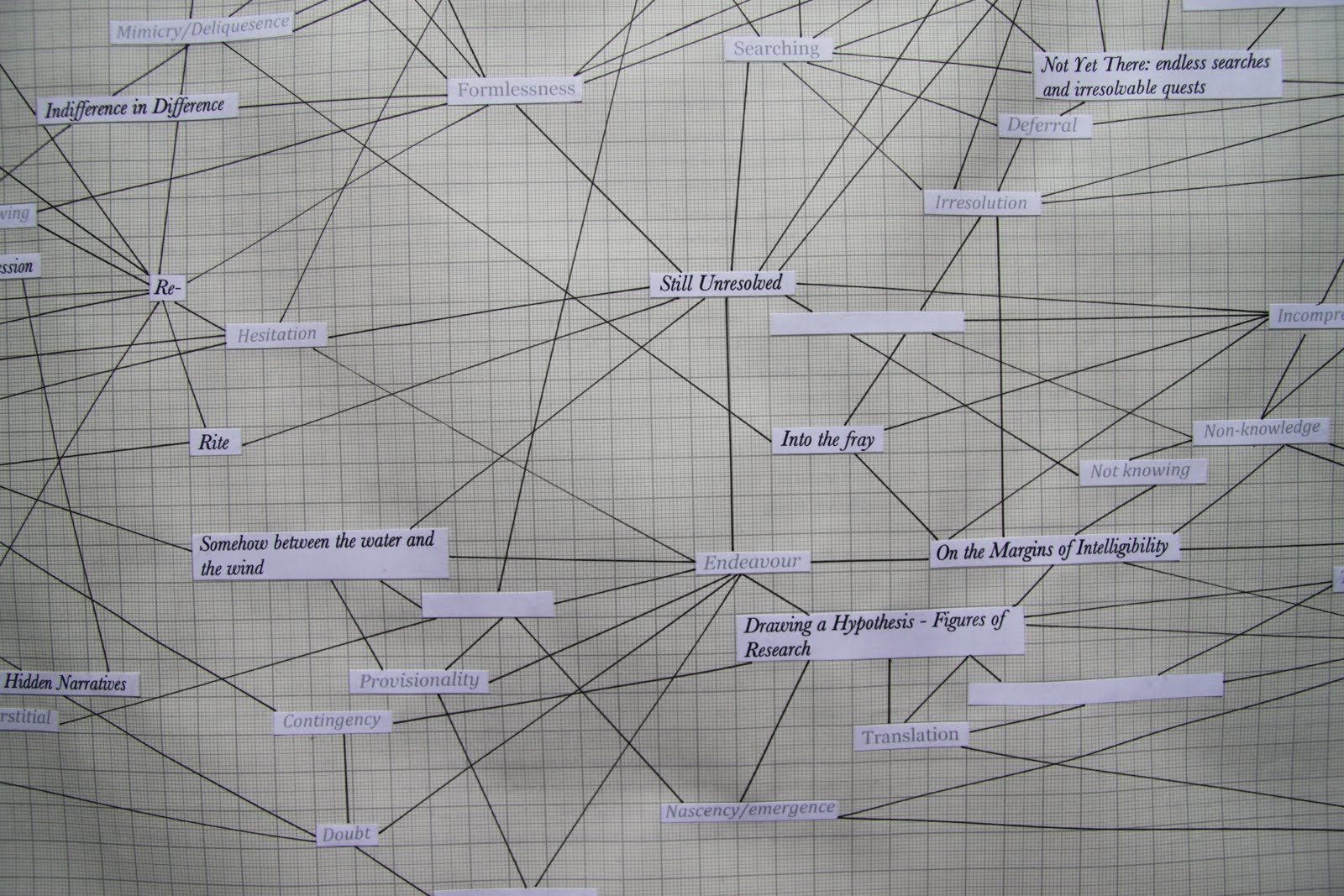
* A mapping or rhizomatic field (the network of ideas, practice, bodies – field ascommunity). An attempt to articulate or map or chart or diagram a sense of my writing practice, which operates under the title, Not Yet There. The tension between or field created between different practices (art/encyclopedia; ‘knowing’/knowledge; the gallery/the academy).

Field Station – what constitutes a (art-writing) studio and how can this be made portable or mobile or taken to the ‘field’. Studio as constituted by a set of practices (produced); by the physical surroundings (belongings) and by what it affords (thinking space). NB) In order to build in spaces that are more speculative you have to build in spaces that are more speculative. Mind-mapping habitually presupposes a starting point, a point of original. Here my attempt is to remove the need for a fixed or determined start, or rather to replace the propositional of the conventional starting point with the notion of a potential Macguffin.

Open Field (as open space – thinking space)  – a template, work and tool. An imaginative proposition and an operational model. An attempt to articulate or map or chart or diagram the idea of the ‘field’ as open space, a space of thinking, a germinal terrain. Mapping the process of thinking, without this being about what that thinking is about; a mapping of a process and the producing of a map that corresponds to that process.

* An operational model: using the ‘field’ model as a device through which to explore my field of art-writing practice. A proposition of an essay as map, the essay as a network or proposed community of ideas. The field as essay.  Visual essaying (essay as rhizome). An attempt to use this open field as a device to lay down (or seed or plant) a few specific ideas. A model to be used: what is the field of this event?

Thinking through field:

* Clearing: an expanse of open or cleared ground

* Event: the area in which (field) events are held

* Space of Contestation: a battleground.

* Force/Agency: (physics) the influence of some agent, as electricity or gravitation, considered as existing at all points in space and   defined by the force it would exert on an object placed at any point in space.

 * Horizon: (optics) the entire angular expanse visible through an optical instrument at a given time or (photography) the area of a subject that is taken in by a lens at a particular diaphragm opening.

* Interconnectedness: (psychology) the total complex of interdependent factors within which a psychological event occurs and is perceived as occurring.

* Record: (in a punch card) any number of columns regularly used for recording the same information

* Playing the field – to vary one’s activities, a kind of promiscuous practice, “avoid commitment” – a restlessness

* Flat land – a non-hierarchical playing field

* Skilfulness: To respond to

* Incisive: the site of a surgical operation

* Classification: a data structure

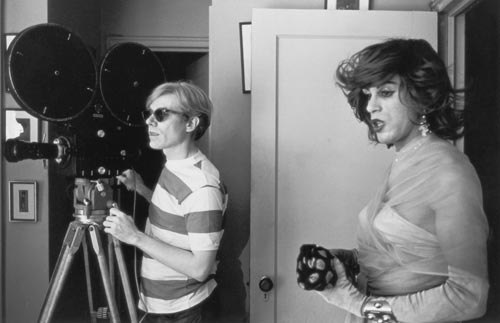
THE ALL EDIE ALL ANDY ALL ME ALL YOU ALICE IN WONDERLAND II

In Uncategorized on April 15, 2010 at 10:59 pm


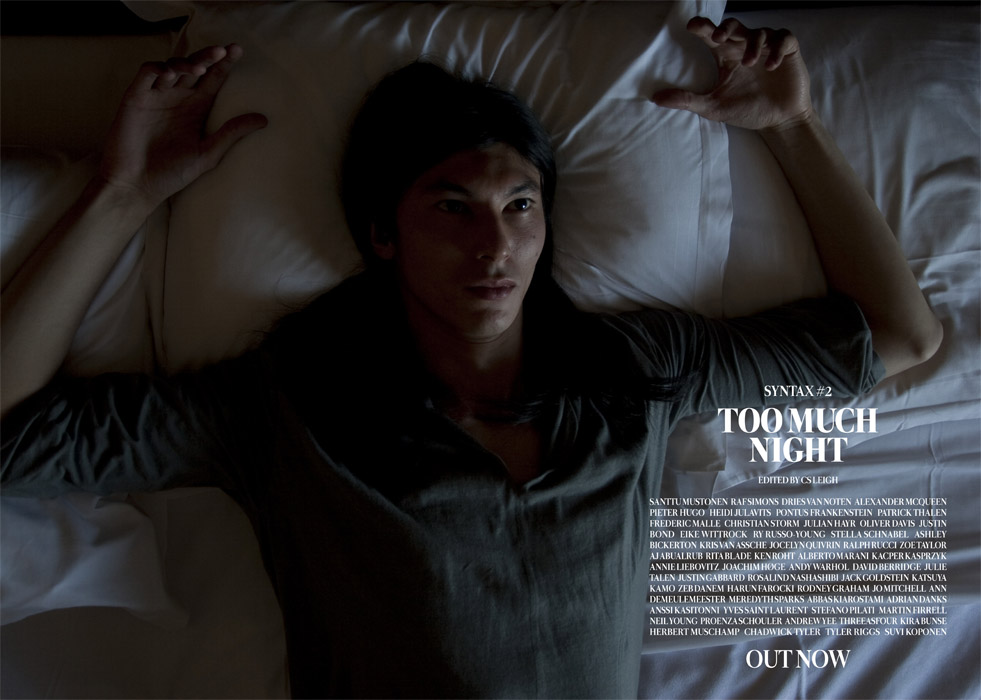
THE ALL EDIE ALL ANDY ALL ME ALL YOU ALICE IN WONDERLAND II  has just published in SYNTAX #2: TOO MUCH NIGHT edited by CS Leigh.  More information on Syntax Editions is available here 

 In its content, language and form, this essay explores my response both to Warhol’s 16mm film work, and the performance style of Mario Montez and Jack Smith. In the context of  VerySmallKitchen I am interested how the methodologies of these performers, the way they position themselves in regards to space, time, and notions of self, can be applied to the acts of expanded writing practice chronicled on this website.  

My interview with CS Leigh, around and out from his contribution to the exhibition WARHOL AND THE SHARED SUBJECT can be seen here. This is how the essay begins:


…This is rumours and whispers, started by Warhol himself, a delirious dream of a phone conversation with B, pieced together from pirated extracts on You TUBE. This is about Warhol’s 16mm films providing a working language for writers and artists in 2009. This is nothing new: once the 16mm films were talked about without being seen and that was their influence.

Well I’ve seen them all, I’ve forgotten much of them, and now I’m watching illegal bits, often filmed straight off the screen, legacy gone viral via atrocious image quality. I tried the DVD collections and 13 Most Beautiful… but now I’m back at my laptop, keyword “MARIO MONTEZ.” All with the same sense of self-collapse, impossible pose, as Henry Geldzahler on the sofa…

Before this, in January, I was in Other Voices, Other Rooms, the Warhol show at the Hayward gallery. Trying on headphones, watching cable TV shows, pleasurably, blankly bored, hopefully in the hyper-productive Warhol way. I pass a video fragment of Edie Sedgwick, where she remarks, slowly and thoughtfully, that Warhol should make a film of Alice in Wonderland, partly because of their shared AW initials.

Sedgwick laughs and says she knows that lots of things have those initials. She also emphasises how, unlike an earlier Disney version, Warhol’s AW would use real people because – I’m paraphrasing – there are so many fantastic people around who could play all the parts.

Other Voices Other Room was maybe a first draft towards AW’s AW. Confused, incoherent, and incomprehensible in its totality, it tried to treat Warhol’s oeuvre as a whole, without value judgements about film or video. It ended up as a microcosm of the issues faced by Warhol obsessives, curators or not, in 2009. In the Hayward I sat and watched whole episodes of cable TV shows, before heading through a room of digitally transferred 16mm work, noticing images but not stopping to experience the duration of what, in the cinema, had absorbed me.

Warhol never made AW, at least not literally, but not to worry. This article will propose a whole series of Alice in Wonderland’s. Because selves are multiple in 2009 in a way Warhol could only say “sure” about. The all Ondine  AW, the All-Edie, or The All-Andy, with Andy played by Marie Menken, two thirds over-exposed white out. You can hear Ronald Tavel shouting the lines. You too. The All-You AW. Sneeze if you forget your lines and I’ll whisper them to you, or look in the fridge. TASK: Map the structure of Alice in Wonderland onto Chelsea Girls, assuming the 1-1 scale of AW’s (both of thems) own maps…

A READING GROUP IN THE FIELD: THROW A LEFT THROW A RIGHT

In Uncategorized on April 15, 2010 at 10:49 pm

THROW A LEFT THROW A RIGHT was a collaborative project by David Berridge, Hyun Jin Cho, David Johnson and Pippa Koszerek. The project took the form of an essay and image based on a trip to the Langdon Hills plotlands site in Essex. The article first appeared in *Periphery, a printed newspaper and web publication produced and distributed in Great Yarmouth by YH485 Press. The original brief for the project was as follows:

Each contributor will be allocated one page, to include an image of their choosing plus 500 words of text. Both image and text may be found, appropriated or produced by the contributor. The text and image pairing may be related or incidental and the theme of periphery can be interpreted loosely. Contributors are welcome to collaborate with one or more persons.

*periphery will be launched to coincide with the opening of a four-day programme of moving image works by local artists to be broadcast on the giant televisions along Great Yarmouth seafront 17th-20th September 2009. *periphery will be printed on news rag as tabloid-sized edition of 1000 and made available to buy for the price of a Sunday paper in selected bookshops and online. Fifty editions will be used as chip wrapping in selected outlets throughout the town from Thursday 17th September 2009. 

The project was later presented and discussed as part of the London Fields project on 29th August 2009, curated by Harriet Blaise Mitchell.  Our contribution comprised the following/ text/score which is reproduced here with the intention of initiating further explorations of any kind that its words may prompt.

THROW A LEFT, THROW A RIGHT

*Substitute [text] with your own script.

Synopsis

 A reading group visit to the ruins of Dunton Plotlands [22 May 2009], a self-build community of holiday and permanent homes created by families from London’s East End between the 1870s and 1940s until the land was placed under compulsory purchase order.

 Actors

 GROUP MEMBERS  [Berridge, Cho, Johnson, and Koszerek], [DOG WALKER(S), MUSEUM ATTENDANT, EX PLOTLANDS DWELLER]

 Props

 Reading material [The conspiracy of good taste, Szczelkun; Cradle to Cradle, Braungart & McDonough; Arcadia for All, Hardy & Ward; Species of Spaces, Perec], empty food cartons, carrier bag, cameras, tripod.

Acts

1.

 (Centre stage – Farringdon Station, London.) – DAYBREAK

 A group [buy return tickets, coffee & baguette] and board (stage front) platform 1.

 (Backdrop- changing scenery.) (Audio – train rumble, conversation with four voices.) Discuss: how a reading group becomes a  text. What, where & how to read  (Context/ Place). [“We did not know what life was about, what work meant, how to find it, and how to behave or use our minds once we had found it. We were unequal to the task of fitting into an urban society.” (Hardy & Ward, 202)].

 2.

 (Traverse periphery of auditorium – Laindon Station – Dunton Visitor Centre)

 The group discover an unmarked shack that is falling apart. Between dilapidated shed and ruin it is reminiscent of allotments – those sanctioned urban-rural idylls.

 An antique Tesco carrier bag from 1988 is discovered (Re-vision scene: the plotlands, a history not only of its past inhabitants but also its transitory visitors.)

 The group continue onwards.

 GROUP MEMBER:  Excuse me , do you which way the visitor centre is?

 DOG WALKER:  Throw a left, throw a right, then straight ahead.

 3.

 (Stage right – Show home.)

 A prepared speech by the MUSEUM ATTENDANT at the one remaining and restored house, THE HAVEN, followed by an improvised conversation between the GROUP MEMBERS, MUSEUM ATTENDANT & EX PLOTLANDS DWELLER.

 4.

 (Off side – Accidental pulpit)

 GROUP MEMBER: Staircases. We don’t think enough about staircases. Nothing was more beautiful in old houses than staircases. Nothing is uglier, colder, more hostile, meaner, in today’s apartment buildings. We should learn to live more on staircases, but how? (Perec, 38)

5

 (Stage Left – Ampitheatre.)

The group stage their reading group [camera and tripod are set up, a series of packaging boxes are placed and replaced in time to several readings. “The tree is not an isolated entity cut off from the systems around it: it is inextricably and productively engaged with them. This is a key difference between the growth of industrial systems as they now stand and the growth of nature.” (Braungart & McDonough, 78 & 79)]

6.

(Curtain down – Laindon/ Fenchurch Street.) – EVENING

This new wave of East End inhabitants close their day’s holiday with conversations about their next projects.

 THE END**

 **Your enacting of this script may result in: an episode of dark tourism/ an expedition to a site of social history/ a stereotype of artistic activity/ ruin idolising/

ART WRITING FIELD NOTES (2): RACHEL LOIS CLAPHAM

In Uncategorized on April 13, 2010 at 11:37 am

This is the second in  a series of notes surrounding the ART WRITING FIELD STATION in Leeds on Mar 27 2010. As I wrote in an introduction for the previous posting by Mary Paterson – which can be read here –  I am fascinated by the form of the “note” that emerges in these writings: 

The notes are not what precedes the event, nor are they what comes during or afterwards, be that a written document, a sound recording, an oral tale or private memory. Rather, the notes are writings that, taking place at a fixed moment in the process they are part of, evidence all others. 

More about Rachel Lois’ work can be seen here.

Her VSK Project THE FINGER can be seen here

An instructional score for the NOTES for the ART WRITING FIELD STATION is here.
NOTES ON NOTES (FOR ART WRITING FIELD STATION) 

Here are some typed, online notes that mark my thinking for NOTES at ART WRITING FEILD STATION LEEDS, or NOTES ON NOTES.

Initially, in preparing for NOTES, I started reading David Berridge’s via Clayton Eshleman’s gloss on ‘Plan for Curriculum of the Soul’ a double page text work by Charles Olson, printed in 1968 (1). This lead me somewhat indirectly – by way of another commission I was writing at the same time (2) to Olson’s longer, more oratorical, ‘Projective Verse’ from 1950. (3).

Over the course of the previous weeks I have also been talking about other (related) work with a small group of collaborators David Berridge, Emma Cocker, Mary Paterson and Alex Eisenberg (4). Many of whom will be presenting at ART WRITING FIELD STATION and in proximity to NOTES on the day I perform it.

In the process of coming to NOTES – sporadic (often cursory) reading, collating various bits of online quotes, scraps of articles and materials – I have made copious notes in my usual system (5). Meanwhile, it has become difficult to delineate which things stem from these starting points; which ideas I encountered in the original texts, and which on various commissions, trips, artworks and conversations with friends. So by way of setting out an ecology for NOTES in the context of ART WRITING FIELD STATION, or delineating a certain ‘field’ for this particular work, I have concerned myself here with what is in these notes on NOTES (5b).

I have devised a very loose index.

* Things more clearly related to the idea of FIELD – geographic (and soil based), conceptual and/or systemic (technologic))

** Things that may be me citing something in a text by Olson, or perhaps picked up in conversation with Berridge, Cocker, Eisenberg or Paterson. (6)

*** Things that are my idea but can be tangentially related to the conversations or texts stated above.(7)
////

Grid Lexicon

I really liked geography classes at school. Visits to rundown inner city council estates in Warrington to look at bad examples of social housing (ill advised field trips), never once looking at a map of the world (or of any country) and using wooden set squares to collect data – for example, the number of daisy’s, types of grasses, certain insects – in a meter sq of field. It was usually a scraggy school field or fell bit of land that may or may not have magic mushrooms growing in it. We would later return and analyse these field findings back in the classroom. This is the only thing I remember from High School. That and arm wrestling boys (and often winning) which does not have anything to do with the idea of a field, grid or NOTES. Until now. * I remember thinking the method of the set sq seemed a brilliantly simple and cool (impartial) way to find, gather and sort things out. As a constraint the grid made sense, it imposed order. I remember thinking at the time that this all seemed very neutral and fair. Whatever grew or fell by chance into the set square as it was lay down was given attention, pored over.


In a way that says it all, or at least enough….

But I also want to transpose some other fragments/scribblings as they appear in my notes on NOTES:

Grid form as a field of composition * / **, as something worked by infamous mid Twentieth Century American minimalists, which leads me to Micheal Fried and his equally infamous essay on theatricality and ‘literal art’ (7b) – art which radically (and for Fried pejoratively) effected a drama(tization) of its object-hood and so implicated the viewer bodily in its completion. The notes go from the body, on to site specificity, through theatricality and neatly into performance. (This journey from grid to critical writing to performance does not look so neat in my handwritten notes.)

Mathematics *. X and Y axis *. Grid as productive constraint, grid as writing technology *, working with a different syntax *.

Grid as an unnatural way of working (my notebooks speak for the fact I don’t work like this), a constraint for the notes to push through.

The syllable rules and holds together lines **
Breaking writing down into component parts.
A serial(ization) of writing. *

Expanding the constraints of the page * where all marks, left hand/right hand, beginning and endings, are distributed with equal weight. They can only be pointed to or reinforced as different by the addition of more(equal) marks on the page; such as under linings, CAPS, exclamation marks. (Thinking of Olsons ‘Plan for Curriculum of the Soul’)

Form is never more than an extension of content * / **
(A wonderfully rich, aphoristic note/NOTE) (8)

/////

Field *

A writer in the open * / ***

Writing as +1 to the field * – as +1 to writing *, +1 to the event *

FIELD COMPOSITION/COMPOSITION OF FIELD in which movement from one perception to another….. **Writing that sticks close to its generative moment of perception/cognition. **

Page * as generative space, not receptacle for finished ideas.

Materials that are handled in a series of objects in a field in such a way that a sense of tensions are made to hold, and to hold exactly inside the content and context of the poem which has formed itself, through the poet, and then into being **/ *

///

Then there are some bits that relate more explicitly to the body in relation to FIELD, which features quite highly Olson’s thinking on the ROOM * / ** / *** of writing in both Plan for Curriculum of the Soul and Projective Verse. Also a strong fascination for me, if the notes in my folders can be judged qualitatively/quantifiably:

Percussive writing **

A physical composition **

Writing openly, presently, simultaneously

Moving index(ically)

A writing that maps lines walked * / **

One of the pressures of writing is bodily.

The FINGER and hands and pointing – diagramming physically

The breath of the author punctuating NOTES ** / ***

Breath is the speech force of language, writing is an object that the body has an impact upon. **

Amidst this I think about notes in the pejorative (8b) :

How writing notes always makes you look away from an event, the event- toward your notes/notebook (unless you write notes without looking at your page?)

Notes as unfaithful, unserious, un thought-ful.

Notes as a crutch to performance, to memory, to a practice.

Notes as unfinished, unimportant, unprepared, uncritical, un-publishable, work in progress, as private.

Notes as a learning device for a novice or anorak (Train Spotter) as opposed to notes of a scientist (an expert) – still unpublishable in a scientific / expert context?

Notes made from a performance that make a work mobile and divorce it from its site.

NOTES as pick-up sticks ** / *** ‘grabs’ from a practice – shallow grabs from something else, something deeper, something more sustained. NOTES as tips of icebergs (rather than the icebergs themselves?). (9)

Aspects of NOTES that I am currently experimenting with.

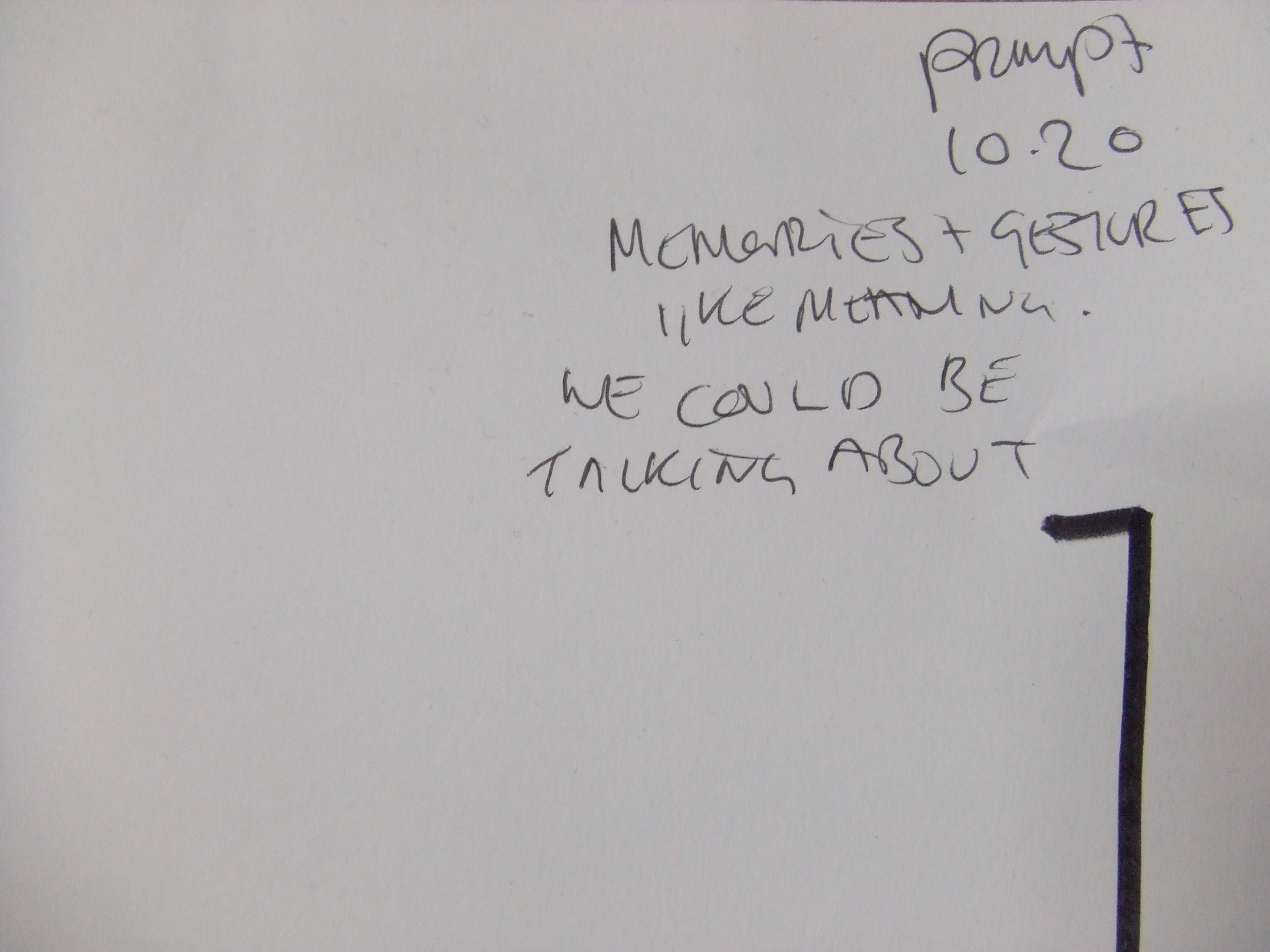
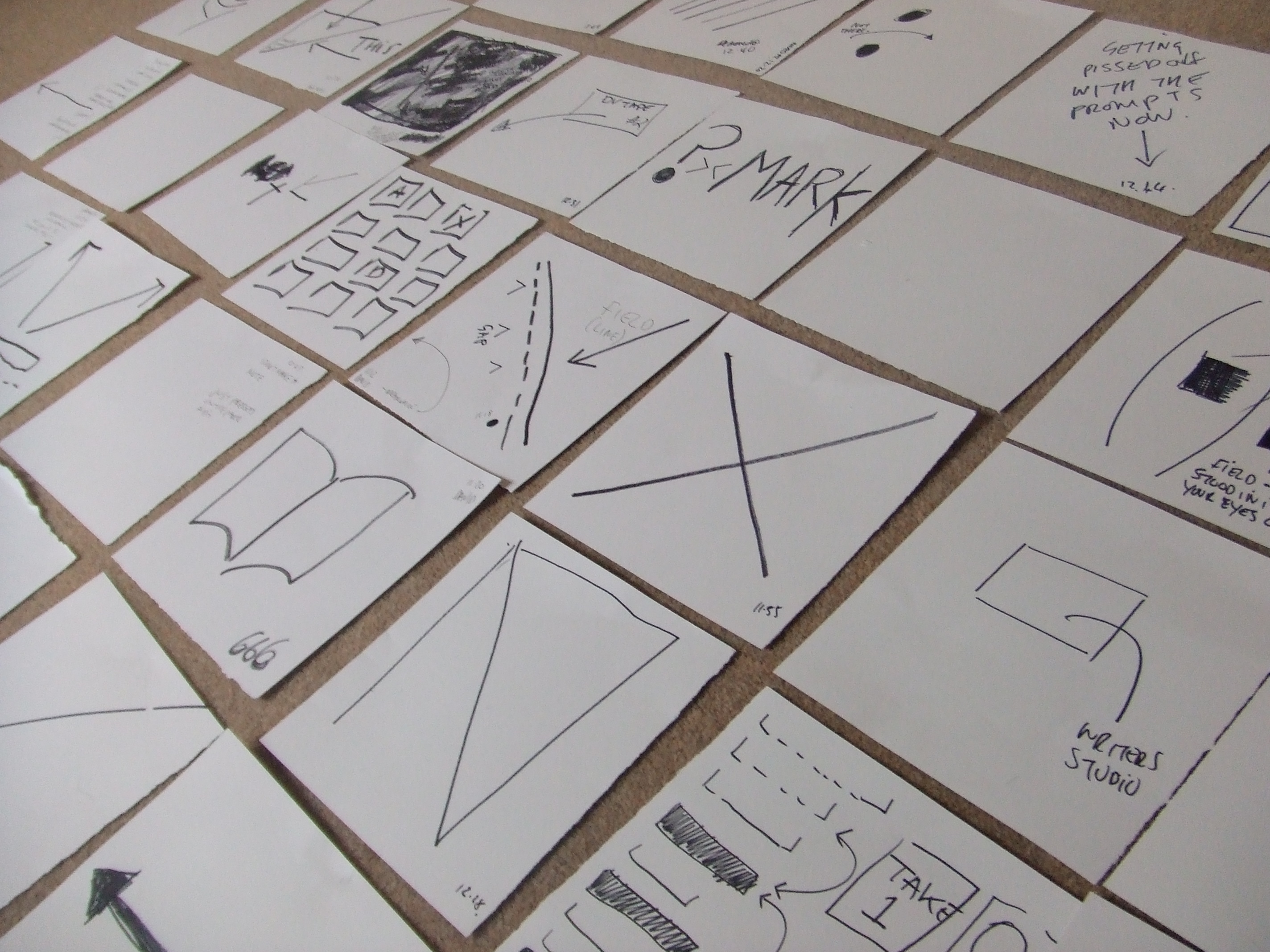
Scale- How important is it for the individual diagrams/gestures to be seen as such (by others should they wish in the moment of writing/performing?). What is the difference in scale between 3 x 3 yellow lined post its, 5 x 7 white fiches and 12 x 12 large pieces of white card? Could the elements be big things- like tablets or objects?

One element is fixed never moves – it is returned to (and marked over continually like a lexicon of the grid activity, a margin, a note of the NOTES). This could be groundwork *

Timings- I am drawn to regular moments over the course of NOTES by an external device. These moments are prompts. The prompts may or may not be marked as such in NOTES.

The hand of the author, pointing and the FINGER how it can diagram physically within the composition.

In what different ways one element that is continually returned to as blank.

How hesitancy or doubt might show itself in NOTES

How NOTES are unfathomable, and no-one can read them whole. They are fictional, unfaithful (to themselves and to the event). How they might be moved away from the event?

How the space outside the grid is important (Nb. 7b)

Underlining as pointing (Nb. FINGER)

Sound of NOTES being made (Nb. Percussive writing **)

How certain gestures will pre-scribe or anticipate the event/the conversation – and others will come during, or after. Others will not be related to the event. How to NOTE these differences.

///

Notes on NOTES (on NOTES)

(1) Taken from here.  

(2) (W)reading Performance Writing. A Live art Development Agency study guide. Downloadable at www.thisisliveart from April 2010. A brief introduction here.

(3) Available in full online  here.     

(4) ROOT with Mary Paterson and Re- with Emma Cocker as part of the RITE publication launch 2010 (RITE contributors are David Berridge, Alex Eisenberg, Mary Paterson, Emma Cocker, amongst others, but not Charles Olson), Writers House on the invitation of David Berridge and Pippa Koszerek (Hard copy notes only about this project at present. Dates May 29-31st ), Question Time with David Berridge, Alex Eisenberg, Mary Paterson as Open Dialogues. Nb. Pippa Koszerek is another collaborator of mine, our having worked on FREE PRESS together (with David Berridge, Karen Di Franco, Matthew MacKisack, Sophie Mellor and Ashkan Sepahvand).

(5) A modular system it could itself be a rumination on notes (although not necessarily the work NOTES I speak of here). It is a system regularly subject to change by the author, and under constant scrutiny as to regulate cost versus my needs in terms of flexibility, provisional dimensions, page capacity, efficiency of storage and ultimate archival (endpoint) quality. A5 black plain page moleskin notebooks are the most expensive experimented with so far at 13GBP for one hardback notebook. Lovely though these are they seem to be the notebook of choice amongst many of my peers. It can get confusing at meetings and seminars. An extra identical moleskin for the table, Sir? ** Cost also prohibitive for someone with potential compulsive note writing disorder. Also not flexible enough (removing pages seems wrong). Standard A4 paper in plastic wallets with homemade ‘titles’ is very flexible- notes changing sets (and so projects) on a regular basis – and is the cheapest by far (circa 1GBP per wallet note-set) but this is not very aesthetically satisfactory. Too redolent of pillaged communal stationary cupboards and WORK (not the good kind). Absolutely no precious archival qualities. The large white plain (I might go back to gridded soon)Fiches index cards I am currently using – 3.99GBP for 100 – seem to combine the optimum blend at present. Cheap, totally singular, as in modular, and pleasant to have/hold. Plenty apt for little diagrams. I wrote in them from a recent talk entitled ‘What is conversation for’ – an evening of conversation with the art writer Yve Lomax (in conversation with herself). Looking back on my Ficheborne note-cards, have a nice speculative (light) circular feel that would not have felt appropriate in any of the other note technologies discussed here.

(5b) I’ve done this in an altogether non Harvard style, in fact in a way much more akin to an exercise in which I randomly look out of my window with a pair of cheap binoculours and try really hard to ‘accurately’ chart the stars *.

(6) Do we use last names in notes?

(7) This charting* itself of course being endemic to noting, or having a certain note like quality to it, in terms of indexing, condensing or documenting. It’s a self conscious exercise transposing these much more scrappy notes into this clean blogpost. The reasons for it are multi-fold. For the before of NOTES = a making sense in advance, an anticipatory staking out the territory*, a speculative mapping* of the area for this work to come. For the after of NOTES = for the fact that you put work out there and it rarely ever comes back ** Notes then, by way of something to come back to. Being something like the splash-back (however unfaithful, unreadable or unlikely it might be) from the act of just throwing something out there *** or pissing in the wind ** that can be the experience of making work. (Although having nothing left is better than something sometimes, especially something like inane notes.). Coming back to the BEFORE for a minute, it feels like there is something at stake in making public the BEFORE (BEFORE NOTES) given the constellation* of ideas/texts here, also because this BEFORE is the crux of my note-taking, where I think my notes might matter most. (It makes me wonder in what way the notes I make are not usually public or published?) I also just made a note on my current Fiche(the one that I always have on the go entitled GENERAL – ie not project/commission specific- that this is the most speculative text I have written for this blog in some time.

(7b) Michael Fried, Art and Objecthood, Artforum 5(10) (1967): 12-23

(8) By now I have reconciled the salient difference between notes and NOTES. There is a difference. But it is constantly on the move.

(8b) I find there’s a lot in the pejorative.

(9) A question of quantity/quality. Is this weight issue, this mobility – if this is what the issue is, which is not to simplify it at all, if it is even an issue in the proper sense – endemic to all words/writing?
ART WRITING FIELD NOTES (1): MARY PATERSON

In Uncategorized on April 8, 2010 at 9:30 am

This is the first  in a series of “notes”  related to the ART WRITING FIELD STATION in Leeds on March 27th 2010. The notes are not what precedes the event, nor are they what comes during or afterwards, be that a written document, a sound recording, an oral tale or private memory.

Rather, the notes are writings that, taking place at a fixed moment in the process they are part of, evidence all others. This first set of notes, by Mary Paterson , is published under a title, below, that willfully demonstrates this transgressive chronology of notes.

More information about Mary’s work can be seen here

NOTES TOWARDS A NAVIGATION THROUGH UNBOUND: FROM U FOR UNBOUND TO A FOR AUTHORITY

In 2009 I began a residency at the Live Art Development Agency.


res•i•den•cy [rez-i-duh n-see] –noun,plural-cies.

1. residence (def. 3).

2. the position or tenure of a medical resident.

3. (formerly) the official residence of a representative of the British governor general at a native Indian court.

4. (formerly) an administrative division of the Dutch East Indies.

[[“residency.” Dictionary.com Unabridged. Random House, Inc. 31 Mar. 2010. .]

I have been looking at Unbound, which is the Agency’s online publication and distribution arm. Unbound is an online shop for books, documentation and the paraphernalia surrounding live art. It is also a commissioning platform for new works, and as such it stocks art historical text books like (for example) Body Art by Amelia Jones, as well as limited edition, commissioned artworks made to mark the Live Art Development Agency’s 10th birthday, which are exclusive to Unbound.

res•i•den•cy [‘re-z&-d&n-sE] –noun, plural -cies

1. an often official place of residence

2. the condition of being a resident of a particular place

[“residency.” Merriam-Webster’s Dictionary of Law. Merriam-Webster, Inc. 31 Mar. 2010. .]

At the Art Writing Field Station event in Leeds last week, I presented some notes towards the text I’m writing for the residency. I described Unbound as my field of study. “Imagine that we are looking.” I wrote, “Imagine that this is what we find – a series of resources labelled Unbound; a metaphorical sheaf of published and commissioned paraphernalia connected to the suggestion of live art. Imagine that this website Unbound is the field of study.”

But a field of study is normally a finite entity, and Unbound is not finite in two important ways. Firstly, it is effectual: unlike an archive, it does not simply claim to record a set of influences, but also to define those influences and shape the discipline. Secondly, it points to resources, but does not map their contents. You have to click on the elegant photographs, enter your credit card details, and wait for a parcel before you can access the knowledge described on Unbound.

res•i•den•cy [rez-əd-ən-sē] –n, pl -cies

: a period of advanced medical training and education that normally follows graduation from medical school and licensing to practice medicine and that consists of supervised practice of a specialty in a hospital and in its outpatient department and instruction from specialists on the hospital staff

[“residency.” Merriam-Webster’s Medical Dictionary. Merriam-Webster, Inc. 31 Mar. 2010. .]

But it is this oblique relationship to knowledge that interests me about Unbound.

residency: The position or term of a medical resident; The position of a musical artist who commonly performs at a particular venue; The condition of being a resident of a particular place; The home or residence of a person, especially in the colonies

http://en.wiktionary.org/wiki/residency accessed 31st March 2010

Unbound does not represent knowledge, but it does give information about it. And information is, of course, another kind of intellectual resource; arguably, one that is more relevant to contemporary living than the weighty facts of knowledge.

I remember sitting round the kitchen table when I was 11 or 12, helping my brother learn the capital cities of the world so that he could pass an exam. He was sliding round the kitchen in his socks and he learnt the capital cities by rote, to the rhythm of his body making laps of the table.

No-one needs this kind of knowledge anymore. It’s all available on the internet, and so accessing the internet is more important than being able to remember words or phrases. This amounts to a change in status that I think of as a change of location. The names of the capital cities of the world are no longer resident in the bodies of schoolchildren. Instead, they live in a shared, virtual system that everyone can access, but which no-one needs to possess. It is a change in status from knowledge to information.

residency: The location that a student is deemed to live for the purpose of funding.

www.learnnowbc.ca/course_finder/glossary.aspx accessed 31st March 2010

What does it mean to have access to “a shared, virtual system”? Is it the same thing as “virtual memory”? Or “cultural knowledge”? Or “common sense”?

residency: Please refer to the Residency Classification Guidelines.

www.umich.edu/~regoff/tuition/explanation.html accessed 31st March 2010

In Leeds, I asked Simon Zimmerman to read out the text I had written, which was about memory and meaning. I asked him to insert some of his memories into my text. He talked about childhood games with his sister, and about travelling on buses with his aunt. When he spoke his memories he lifted his head from the script, and the left corner of his mouth rose in a shy smile. Everyone in the room was captivated.

residency: they tax anyone who lives there, regardless of citizenship;

www.answers.com/topic/multiple-citizenship accessed 31st March 2010

It reminded me of the time when something traumatic happened to a friend of mine. The event was so traumatic, that to describe it was to hold an audience’s attention. After I had described the event to people, they would retell the story elsewhere. Soon, people who did not know my friend would tell the story of the traumatic event. Sometimes I would find myself in a crowd of people where I was known as the person who had a friend who had been affected by this traumatic event. One or two people admitted that they were jealous of me for being so close to such a shocking incident. Nevertheless, they restyled my feelings into their own language. The event had become “common knowledge”, or “cultural memory”, or perhaps “virtual sense.”

Main Entry: domicile/ Part of Speech: noun/ Definition: human habitat/ Synonyms: abode, accommodation, apartment, castle, co-op, commorancy, condo, condominium, crash pad, dump, dwelling, habitation, home, house, joint, legal residence, mansion, pad, rack, residence, residency, roof over head, roost, settlement

http://thesaurus.com/browse/residency, accessed 31st March 2010

After Simon had finished speaking at Art Writing Field Station, we had a short discussion. Emma Cocker (who made a presentation later that morning in relation to rhizomatic diagrams on graph paper that refer, obliquely, to the knowledge and information of her studio and her practice) said that she had been thinking about ‘residency.’ She said (rhetorically): ‘What does it mean to take residency inside someone else’s text?’ Simon said that he was interested in parasitic writing – writing that lives off another source.

Main Entry: dwelling/ Part of Speech: noun/ Definition: home/ Synonyms: abode, castle, commorancy, den, digs, domicile, dump, establishment, habitat, habitation, haunt, hole in the wall, house, lodging, pad, quarters, residence, residency

http://thesaurus.com/browse/residency, accessed 31st March 2010

Aren’t we all parasites? Quotations, definitions, references, libraries, archives, styles, fashions, networks, nods, winks … the building blocks of culture are other people’s ideas. Or, as it says on the gates of the British Library, ‘An original idea. That can’t be too hard. The library must be full of them’ (Stephen Fry). Or to put it another way, we’re all ‘standing on the shoulders of giants’ (Isaac Newton). Or, to put it another way, the moment when you know you are an adult, when you know that you are symbolically present and able to participate in your culture, is when you realise that everyone else is making it up as well (Mary Paterson). Authority is the relative value that we ascribe to cultural artefacts, which turns them into shared experience, implicit or otherwise.

par•a•site [par-uh-sahyt]–noun

1. an organism that lives on or in an organism of another species, known as the host, from the body of which it obtains nutriment.

2. a person who receives support, advantage, or the like, from another or others without giving any useful or proper return, as one who lives on the hospitality of others.

3. (in ancient Greece) a person who received free meals in return for amusing or impudent conversation, flattering remarks, etc.

Perhaps the difference between being a parasite and being a resident is ‘any useful or proper return.’ While a residency is defined by its location, a parasite is defined by its (lack of) production. My work in relation to Unbound is parasitical. It uses the resources to gain nutriment, without offering any of its own. But it is also about location – the location of knowledge, the location of information, and the location of meaning.

The Parasite is the name of several fictional characters that appears in Superman comic book stories published by DC Comics. …

http://en.wikipedia.org/wiki/Parasite_(comics) accessed 31st March 2010

ANNOUNCEMENT: READING AS PUBLISHING WORKSHOP IN SALFORD APRIL 10th 2010

In Uncategorized on April 7, 2010 at 8:34 pm

This Saturday April 10th 10.30- 12.30pm I will be presenting READING AS PUBLISHING, a workshop and presentation as part of READING FOR READING’S SAKE at the Islington Mill Academy. The full programme of the four day event can be seen here

The following is the description of the project I wrote for the website: 

Reading as Publishing explores how acts and moments of individual reading can be published, and what shifts occur as private moments of textual absorption are translated into public performances, conversations, stories, silences, and images.

READING AS PUBLISHING begins from the following assumptions: (1) texts are mobile and easily distributed, so site specificity belongs to the moment of writing, the act of reading and commentary; (2)writing and reading are private acts, which must be made be public in order to have political efficacy.

READING AS PUBLISHING will begin with a presentation of a range of printed, visual and oral materials that unfold how reading can be published and made public, proposing a preliminary set of techniques and possibilities. The rest of the session will be for participants to read privately, then consider how to publish that experience to the group.

The session will conclude with a sharing of our “publications.”

The READING AS PUBLISHING  project is being developed on this website. The script from the weekend will be posted next week. Already online are:

WOUND ROSES ROSES BLEED: A KURT SCRIPT FOR READING KURT SCHWITTERS, exploring the development of scripts and scores for reading particular texts. 

A COMPENDIUM OF STRATEGIES: RODNEY GRAHAM AND READING AS PUBLISHING, a reading of the catalogue for his recent MACBA show, highlighting engagements with reading, writing and the book. 

The presentation will explore “reading as publishing” through texts by, amongst others, F.Scott Fitzgerald, Joseph Joubert, Hélène Cixous and St. Augustine.


READING FOR READING’S SAKE is curated by Maurice Carlin, Helen Kaplinksy and Megan Wakefield. It will also feature contributions from Aesthetics and Politics Reading Group, Ruth Beale, Rachel Lois ClaphamDavid BerridgeKatie Brandon, Patrick Coyle, Lowri Evans, Ella Finer, Royston Futter, Stephen Kingston, Fraser MuggeridgeTamarin Norwood, Sam Playford, Lucy May Schofield, and Sebastian Willan.