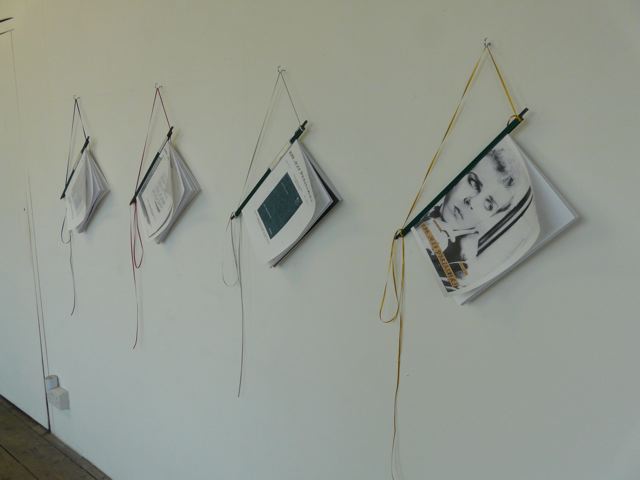
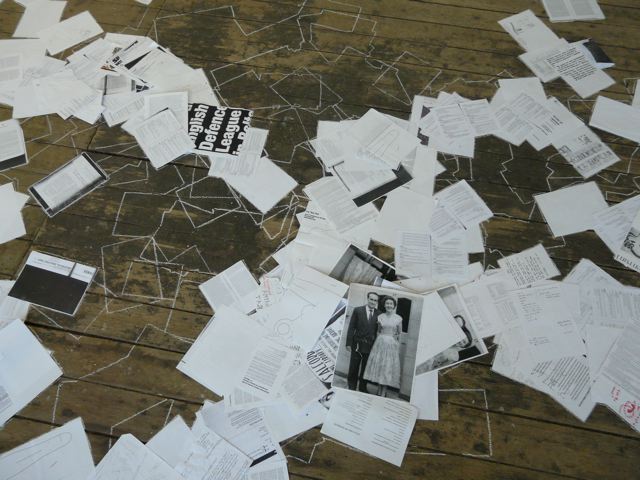
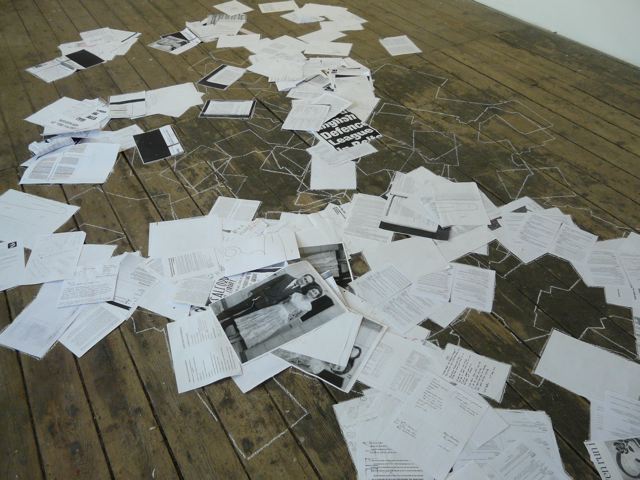
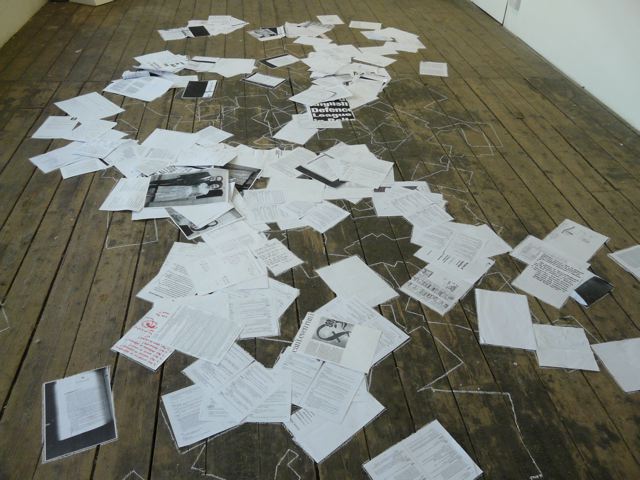
verysmallkitchen

Archive for 2011|Yearly archive page

VSK PROJECT MATTHEW MACKISACK: (A COMEDY OF) DANGER

In Uncategorized on October 15, 2011 at 1:30 pm


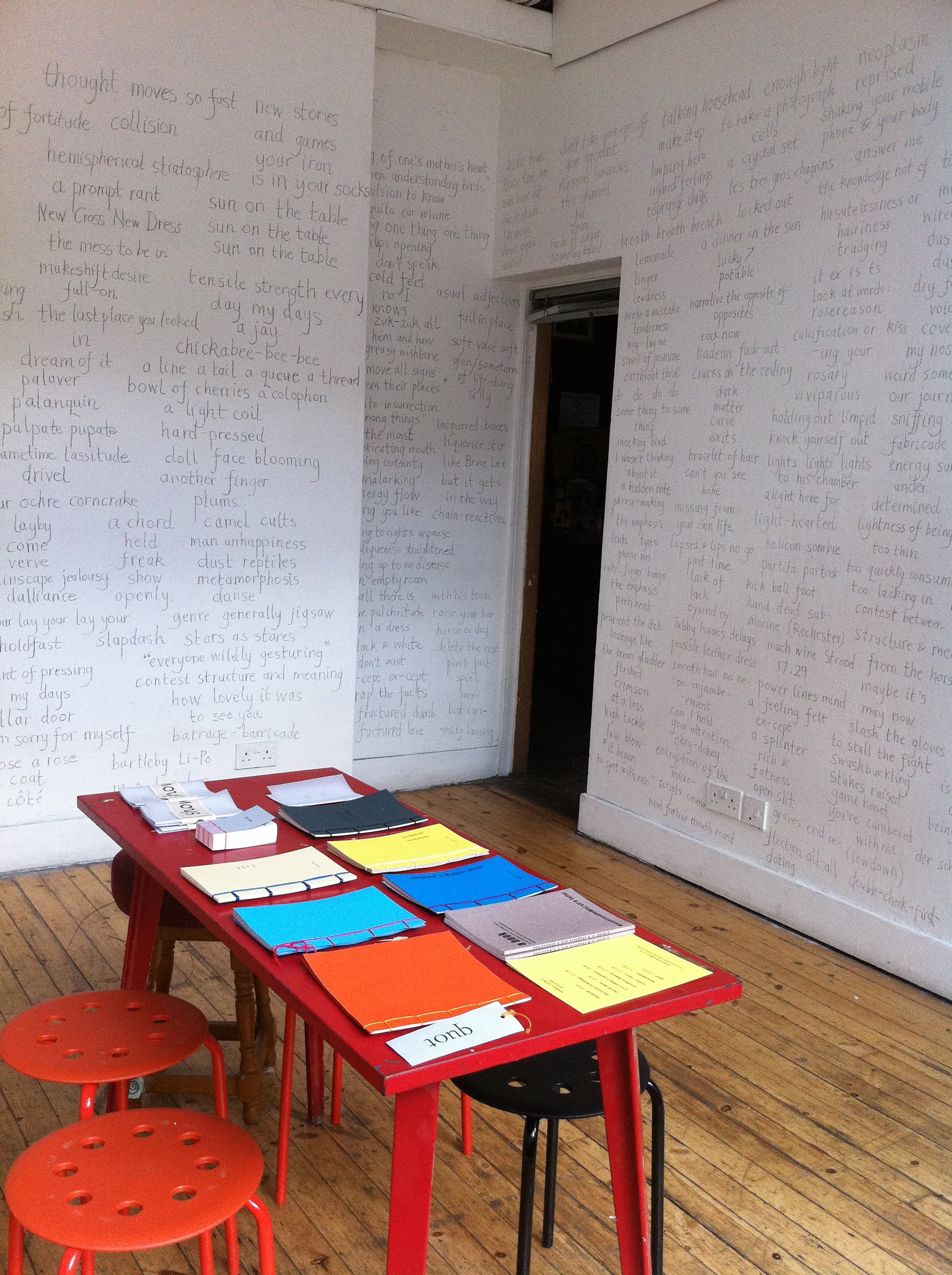
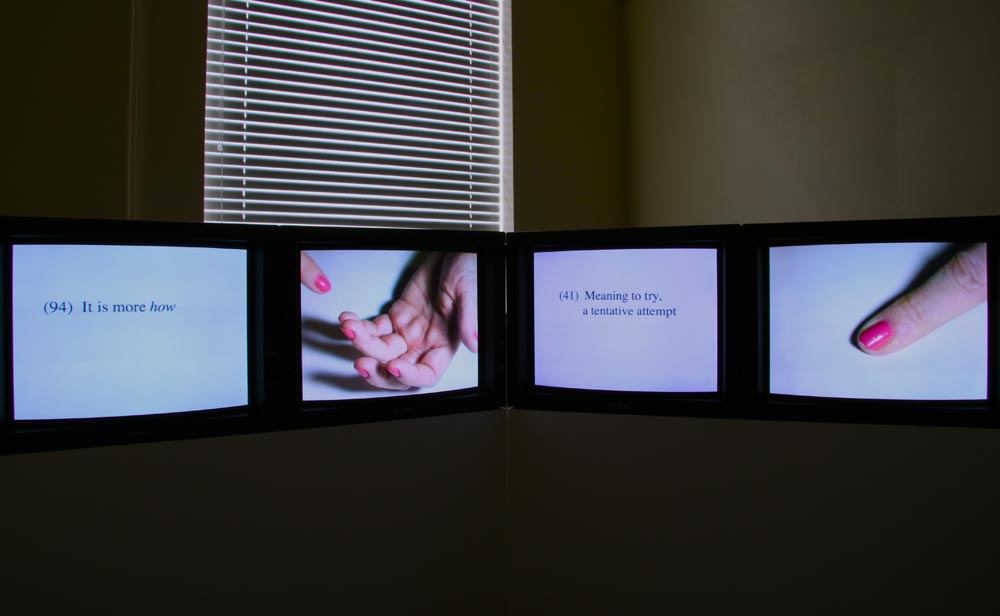
Matthew MacKisack, Initial & Reprise installation view, 2010


Matthew MacKisack writes: The Radio of the Future – the central tree of our consciousness – will inaugurate new ways to cope with our endless undertakings and will unite all mankind. … The main Radio station, that stronghold of steel, where clouds of wires cluster like strands of hair, will surely be protected by a sign with a skull and crossbones and the familiar word “Danger”, since the least disruption of Radio operations would produce a mental blackout over the entire country, and temporary loss of consciousness. [1]

The first play written for British radio was Richard Hughes’ Danger (1924), a one-act melodrama set in an unlit and flooding coal mine. As the author later remarked,

Our audience were used to using their eyes; this was a blind man’s world we were introducing them to. In time they would accept its conventions but how would they react on this first occasion? Better make it easy for them, just this once. Something which happens in the dark, for instance, so the characters themselves keep complaining they can’t see. Perhaps we could get the listener to turn out his lights and listen in the dark. [2]

‘Listen in the dark’ is exactly what the Radio Times advised its readers to do. In an attempt to foreground the ethics of making it ‘easy for them’, of the naturalistic illusion, and in the spirit of a Khlebnikovian ‘flight from the I’, Richard Hughes’ original script has been revised and edited according to contemporaneous Russian formalist theories – themselves a response to Futurist aesthetics – of ostranenie, or defamiliarization.


[1]  Velimir Khlebnikov, The Radio of the Future, 1921
[2] Richard Hughes, The Birth of Radio Drama, B.B.C. Home Service, 1956


(A COMEDY OF) DANGER


Cast:

A, B,C


Scene:

A gallery in a Welsh coal mine.


A. [sharply] What’s happened?

B. The lights have gone out!

C. Where are you?

A. Here.

B. Steps stumbling.

C. Where? I can’t find you.

A. Here. I’m holding my hand out.

B. I can’t find it.

C. Here!


[pause]


A. [startled] What’s that?

B. It’s all right: it’s me.

C. You frightened me, touching me suddenly like that in the dark. I’d no idea you were so close.

A. Catch hold of my hand. Whatever happens, we mustn’t lose each other.

B. That’s better. – But the lights! Why have they gone out?

C. I don’t know. I suppose something has gone wrong with the dynamo. They’ll turn them on again in a minute.

A. I hate the dark!

B. It’ll be alright in a minute or two.

C. It’s so dark down here.

A. No wonder! There must be nearly a thousand feet between us and the daylight.

B. I didn’t know there could be such utter darkness as this, ever. It’s so dark, it’s as if there never was such a thing as light anywhere. It’s like being blind!

C. They’ll turn the lights up again soon.

A. I wish we’d never come down this mine! I knew something would go wrong.

B. Where are the others?

C. They’re just on ahead, not far.

A. Suppose we get lost!

B. We can’t get lost.

C. I wish you hadn’t wanted to drop the others! I’m afraid of the dark.

A. It’ll soon be over.

B. And I wish we hadn’t left behind those lamps they gave us! [Pause] Listen!

C. Steps heard.

A. There’s someone coming!

B. [Distant, muttering] Of all the incompetent idiots, turning the lights off just when a party of visitors were seeing the place! Call this a coal-mine!

C. Hello?

A. Hello? Who’s there? Of all the stupid –

B. What’s happened? Is it all right?

C. Is it all right, indeed! Leaving us suddenly in the dark like this!

A. But has there been an accident?

B. God knows! I’d expect anything of a country like this! They’ve got a climate like the flood and a language like the Tower of Babel, and then they go and lureus into the bowels of the earth and turn the lights off! Wretched, incompetent –

C. Well, I suppose the only thing to do is to sit and wait for the lights to go up again.

A. There’s no danger, is there?

B. No, there’s no danger.

C. I’m beginning to think it’s quite fun.

A. Well, if you can find any fun in breaking your shins in the dark –

B. Why, don’t you call it fun, being in a pit disaster?

C. But this isn’t a disaster, it’s only the lights –

A. Of course! You don’t think it would be fun if it were a real disaster, do you? But the lights going out might have meant a disaster – and imagine telling everyone afterward! Let’s –

B. Yes?

C. Let’s pretend it’s serious.

A. What do you mean?

B. Let’s pretend it’s a real disaster, and we’re cooped up here for ever and will never be able to get out.

C. Don’t joke about it.

A. Why not? There’s no real danger, is there?

B. Well of all the morbid –

C. Let’s pretend the roof has fallen in, and they can’t get to us.

A. [Uncomfortably] Very well … [In mock solemnity] Here we are, my dear, buried alive! Alas, they’ll never find us! [Reverting] Well?

B. I’m so frightened!

C. What of?

A. About the roof falling in.

B. But it hasn’t; it’s only pretense.

C. Yes, but when I pretend, it seems so real.

A. Then don’t pretend!

B. But I want to pretend! I want to be frightened!

C. [In mock solemnity again] We shall suffocate, or starve, or both, my dear, in each other’s arms.

A. Even death shall not part us.

B. Don’t! It’s too awful.

C. There’ll be articles in the newspapers.

A. [Delighted] I wish I could read them!

B. You can’t have your funeral and watch it.

C. A distant explosion, with a long echo, swelling in volume.

A. Good God!

B. Let go! You’re throttling me! Let go of me!

C. Another explosion, nearer, followed by the hiss of water.

A. The dust! It’s choking me! I can’t breathe!

B. Stop screaming! How do you expect to be able to breathe if you’re screaming all your breath out?

C. Pull yourself together! We’re alright; we’re not hurt.

A. We’re not hurt. But listen!

B. Water heard louder.

C. Water!

A. [Sotto voce] Be quiet. Don’t let her hear!

B. What’s that roaring?

C. It’s only the echo.

A. Can’t we find the others?

B. I don’t think we could; it wouldn’t be much use to us if we did.

C. [quietly and sharply]. Oh, good God! Good God!

A. They’re no better off than we are.

B. Listen! That must be them!

C. Voices heard singing.


A, B and C:


Hlaha! Uthlofan, lauflings!
Hlaha! Ufhlofan, lauflings!
Who lawghen with lafe, who hlaehen lewchly,
Hlaha! Uflofan hlouly!
Hlaha! Hloufish lauflings lafe uf beloght lauchlorum!


A. That must be the others. They can’t be very far off. Let’s call to them.

B. Sound carries a long way in a tunnel.  But listen.

C. The roar gets louder.

A. The echo’s getting louder! It isn’t an echo! It’s water! The mine’s flooding! We’re going to drown!

B. The voices are again heard singing, closer this time.


C, A and B:


Hlaha! Loufenish lauflings lafe, hlohan utlaufly!
Lawfen, lawfen,
Hloh, hlouh, hlou! Luifekin, luifekin,
Hlofeningum, hlofeningum.
Hlaha! Uthlofan, lauflings!
Hlaha! Ufhlofan, lauflings! *


C. I wish I had their faith. It’d make dying easy.

A. I don’t want to die yet! I won’t, I won’t!

B. It has got to come some time; isn’t it better for it to happen now, in your lover’s arms? Death might have parted you – but instead he’s joining you closer together.

C. I want to live!

A. Do you think I don’t? Do you think they don’t? They’re singing hymns!

B. Look, instead of talking like this, let’s do something; let’s make some sort of an attempt at escape!

C. What do you propose?

A. Look for some way out. We can’t stay here and drown, like rats in a cage.

B. But if you start to walk, you’ll start to run; and if you start to run, you’ll panic, and go mad in the dark. I’d rather die with my wits about me!

C. I’d rather not die at all!

A. Keeping still is the only thing for us, if we don’t want to lose our heads. Remember how far into the side of the hill we are. What earthly hope do you thinkthere is of finding our way out?

B. Here it comes! Listen!

C. Rush of water quite close now.

A. Yes, it will be on us in another five minutes.

B. Pray Heaven it finishes us off quickly.

C. Think of dying somewhere out in the open, in the sunlight! Me able to see you, and you able to see me! What bliss it would be!

A. It’s strange how little we wonder what will happen to us. In five minutes we’ll know ourselves, all three of us. I’ve always wanted to travel. Now I’m going to.

B. My poor dear!

C. I’m beginning to feel excited about it, like a child going to the seaside for the first time. Aren’t you?

A. I never looked at it like that.

B. The water’s coming! It’s over my feet!

C. Courage, courage.

A. I don’t want to die – I hate it! I want to live!

B. Don’t make it harder.

C. Only for an hour more! There was something I wanted to say to you, and I can’t remember it … I must remember… it’ll be too late soon.

A. Do you think you’re the only one dying before his time? I tell you, every man dies before his time, even if he lives to be as old as Methuselah!

B. It’s up to my knees!

C. [Very quietly] Don’t clutch at me like that, it won’t do any good.

A. But the water – the current’s washing me away –

B. I’ve got you! And I’ve got my other arm round the wooden thing!

C. Hold tight then!

A. If only I could see you!

B. Just think of the things I had meant to do!

C. Shut up about the things you had meant to do! Will you realize we’re all in the same boat, and it’s as hard on me as you – or worse, a thousand times worse!

A. You hoary old sinner, why can’t you prepare to get out of the world?

B. Let’s pray.

C. Pray if you like – I can’t.

A. [Hoarsely] Help! Help!

B. Hold your self in.

C. It’s so close.

A. Help me!

B. It’s no good; no one can possibly hear us. The only thing is to keep calm. It won’t be long now.

C. Tapping heard.

A. What’s that? Listen!

B. Help!

C. Shut up. We need to listen.

A. Tap, tap.

B. It’s up to my waist now.

C. My God! It’s someone tapping. [Shouts] We’re here! Further along!

A. [Calmly] Is it? They’ll find our bodies, that’s all.

B. They’ll find us if they’re quick enough! [Shouts] Further along – that’s right!

C. They can’t possibly be quick enough.

A. Help! Dig quicker! We’re drowning!

B. Stop it; they won’t be in time.

C. [Quietly] I won’t leave you.

A. How do you know they’ll let you stay with him? What do you know about death? I tell you death isn’t heaven and it isn’t hell. Death’s dying. Death’s being nothing.

B. Knocking grows louder.

C. It’s up to my chin! Help me!

A. Let me lift you.

B. [In a childlike voice] Say it isn’t true, what he’s been saying.

C. Hurry up – smash your way in! We’re drowning!

A. They must be nearly through! God, this suspense! How much longer?

B. Look! There’s a light! A hole in the roof! Quick, quick!

C. Sound of strong blows, then sound of coal falling; sound of cheering.

A. They’re though!

B. Quick, below there! Catch on to the rope!

C. I’m an old man!

A. There’s a girl here!

B. I’ve got the rope.

C. She’s fainted.

A. Pass her up – she’ll be alright.

B. Pass the bight of the rope round her shoulders!

C. All right up there? Have you got her?

A. Got her. Now the next.

B. Up you go – the water’s still rising!

C. No, after you; you’re more value in the world than I am.

A. Nonsense, you first! Quick, or there won’t be time!

B. You’ve got her to think of – now, haul away up there!

C. No, no! Lower me!

A. We’ll have you up first; there’s no time to waste. Right?

B. I’m all right. Lower away again. Down there, catch hold! Have you got it? [Pause] Hey! [Pause]  Have you got it? [Pause] He’s gone!


* Velimir Khlebnikov, Incantation by Laughter, trans. Paul Schmidt (1910 / 1985)


Script based on Richard Hughes’ A Comedy of Danger, written and first broadcast 1924, published as Danger in ‘Plays’, London: Chatto and Windus, 1966; revised by Matthew MacKisack for performance in October 2011 at Soundfjord, Unit 3B – Studio 28, 28 Lawrence Road, London, N15 4ER .  Performed by Carla Espinoza,  Lauren McCullum and Leo Ashizawa as the Opening Event of Cast & Figment: Radio as Metaphor & As Such.


*


More about Matthew’s work is here.
THETEXTISTHETEXT: VISUAL POETRY VS TEXT ART AN EXHIBITION MATCH

In Uncategorized on October 14, 2011 at 2:05 am


thetextisthetext: an exhibition of word images, a self-styled smith/melville mash-up, is taking place at Patriothall Gallery, Edinburgh 8-18th October 2011.  Asked about the origin of the project Gerry Smith writes:


There was no original (written)proposal as such, just a series of events… Tom Leonard  put me in touch with nick-e melville, much in common but coming at it from different positions, and I mention the possibility of doing a text show.: around that time, Catherine Sargeant left a positive note in my comments book at the MFA degree show ( I had known her work from seeing it over the last few years at the SSA Annual Exhibitions, and I had been impressed with it) and I decided that if we were doing a text show she would have to be on board – so I contacted her…


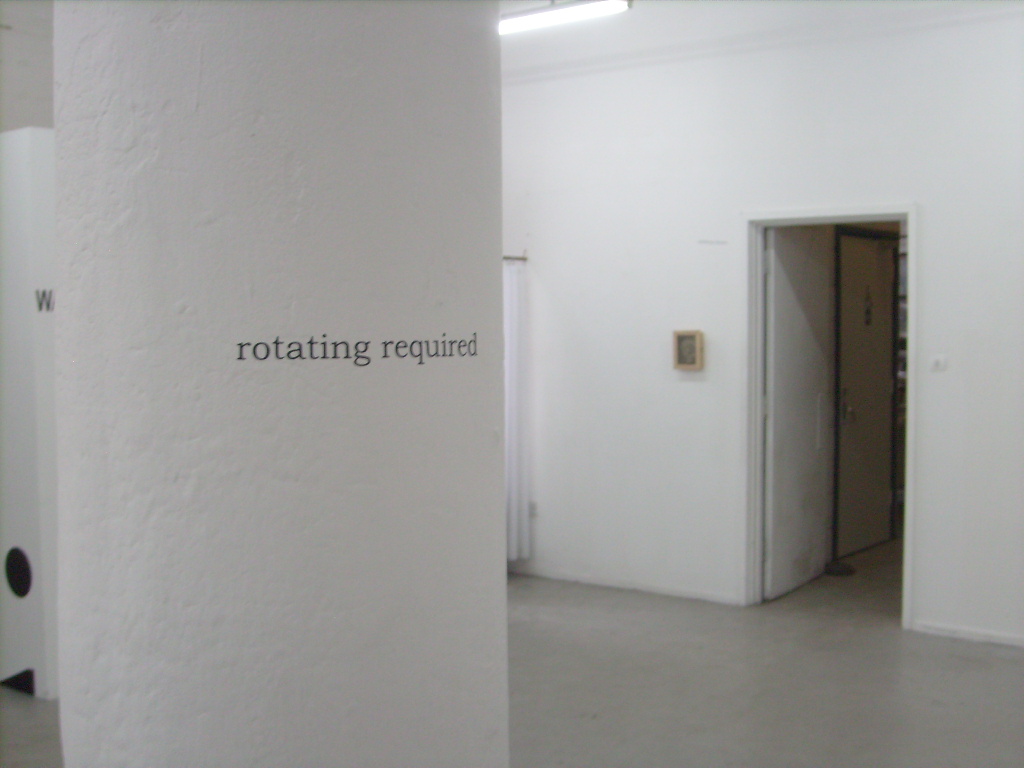
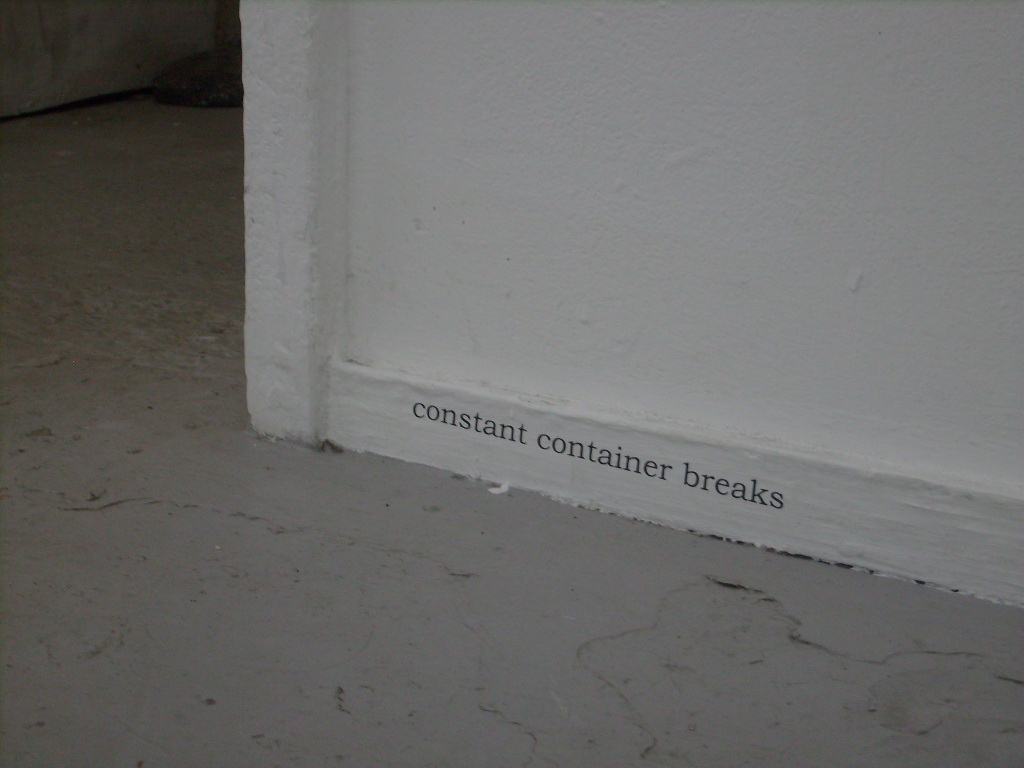
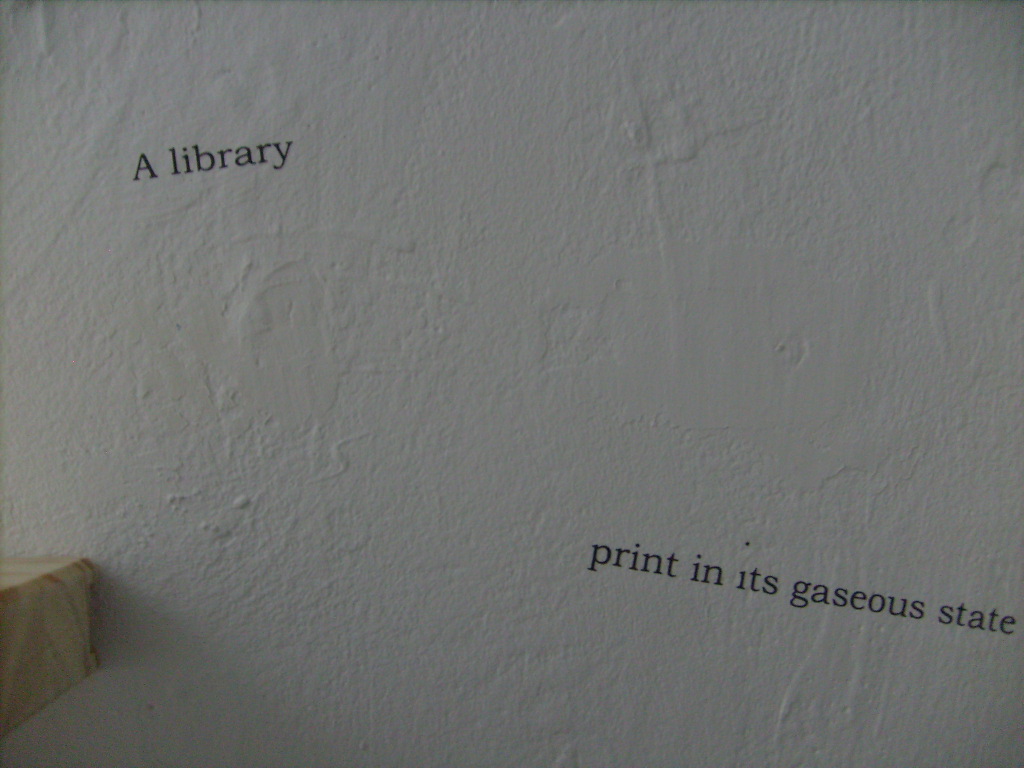
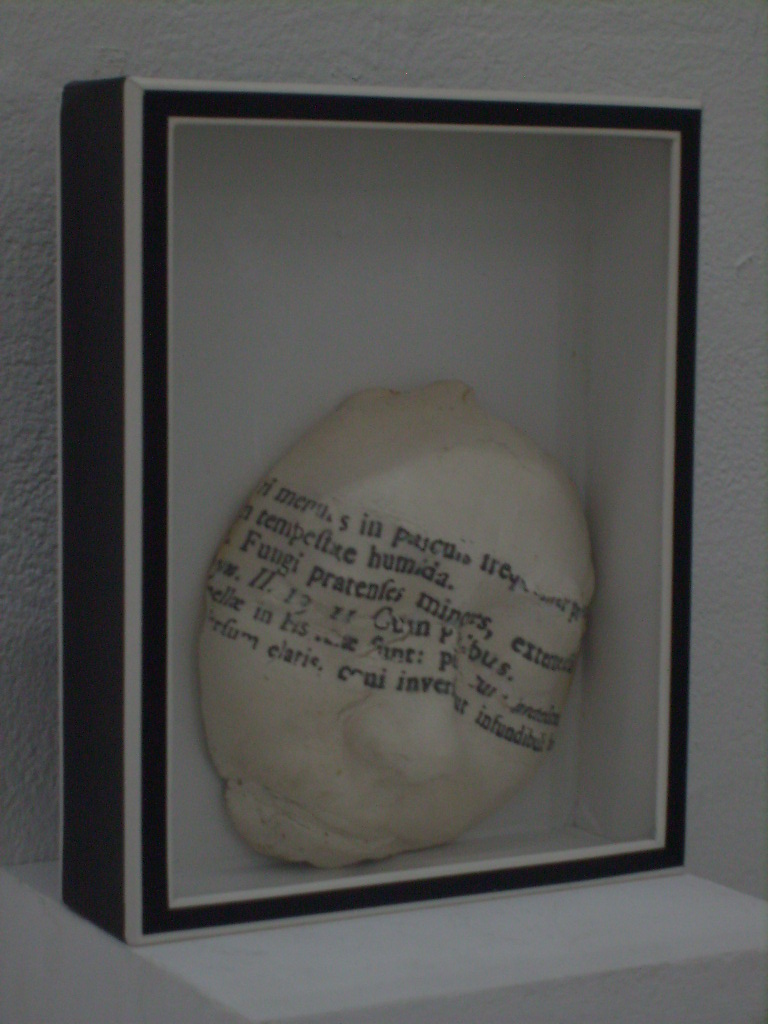
From top: Lisa Temple-Cox, Moulages; Gerry Smith A Library Is Print In Its Gaseous State; Catherine Sargeant/ Dorothy Alexander, Lift Riffs.


… nicky and I drew up a list of who we should invite to participate and a series of meetings took place /invites were sent. Once I final secured a venue, we all met to discuss our work and what we could do – the criteria for the show was that it was to be experimental; either collaborations or working outwith or normal media (which is why I chose to do an animation piece). The only person who wasn’t working with text in some way was Becky Campbell – I happen to like the work that she was doing and thought it might be interesting to see what she could do with text ( a few years ago, my Art School Lift – see website – was an attempt at a text-based work adopting an “unobtrusive” approach similar to her own ).

Over the duration, a couple of people dropped out and they were replaced with Shandra Lamaute and Greg Thomas.  I’ve taken a somewhat organic approach to the project, letting the collaborations and works develop… I helped out with some practical things regarding the use of PVC texts, but that was about it


VerySmallKitchen writes: Thetextisthetext is reconfigured here through materials supplied by Gerry Smith. Experiencing the exhibition in this way prompts a realignment of relationships between art work, artist statement, email, press release, and installation. Some works and ideas of the exhibition at Patriothall are lost as the show fits into this new format, whilst others attain new form and prominence…


*


a series of commas – arranged almost like parenthesis (in response to the question “what is it like to be stationary?”)

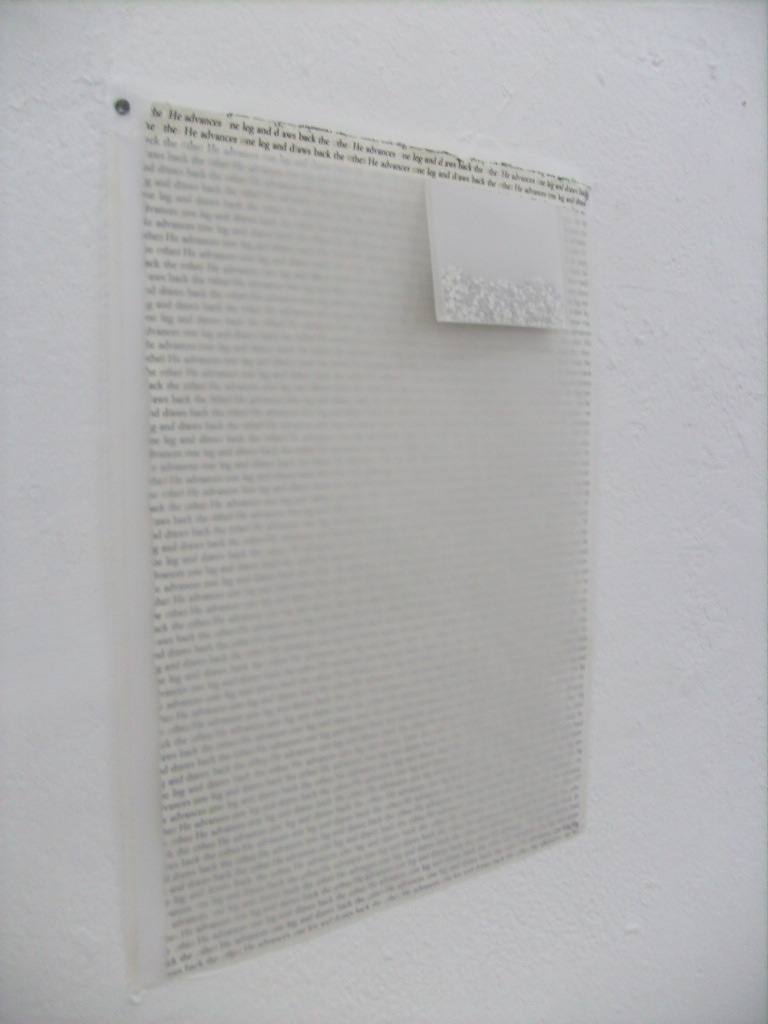
an Arabic phrase: he advances one leg and draws back the other (in response to question “or or or?”)


Shandra Lamaute, Belong

show & untell

The collaboration between Becky Campbell and Shandra Lamaute is about process, communication, and interpretation. The project involved a series of dialogues, in person and by post, which finally culminated in a question that each person asked of the other. The display of the answers to these questions represents the process of their correspondence.

The project was developed as an exploration of how they could connect and collaborate with each other while still retaining their own artistic autonomy and identity. They approached the work with an understanding that they each came from different places (Scotland and the United States, respectively), they each have different modes of representation, and they explore different conceptual bases/subject matter. Through all these differences, there was a thread that connected both of their practices to one another: process.

It is through the similarities of their modes making that enabled them to create and allow their collaboration to manifest. Once they explored this connection, they decided to push the boundaries further, at the same time solidifying the concept and act of a collaboration, by allowing the other person to decide how their final letter should be presented within the show.


*


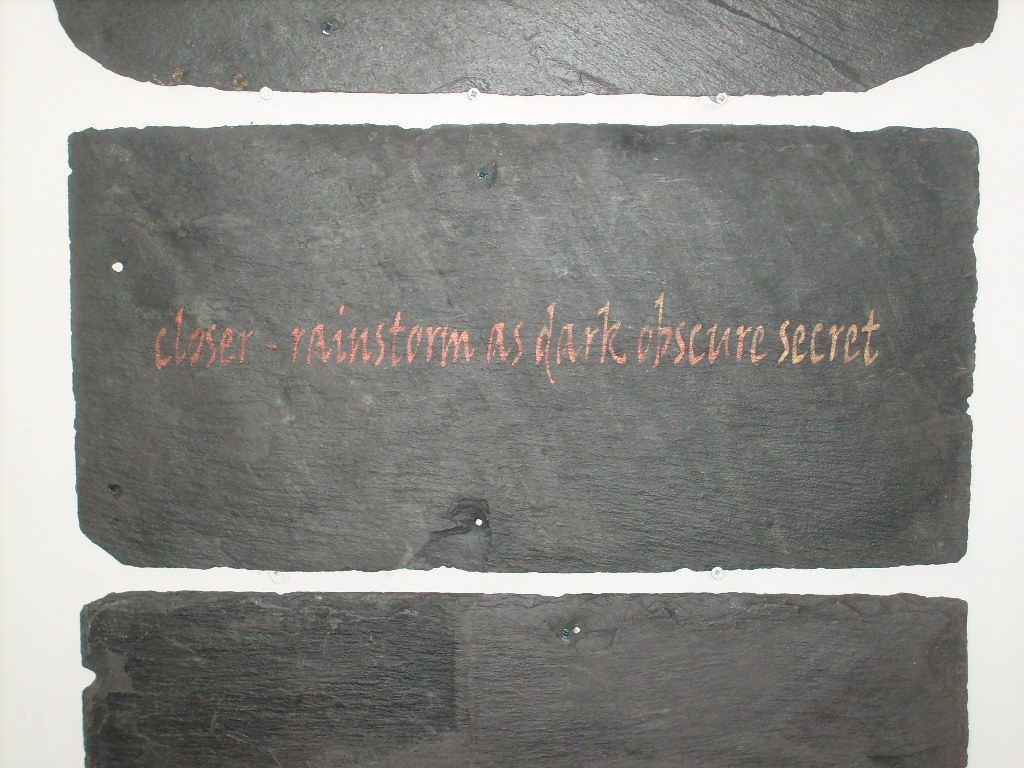
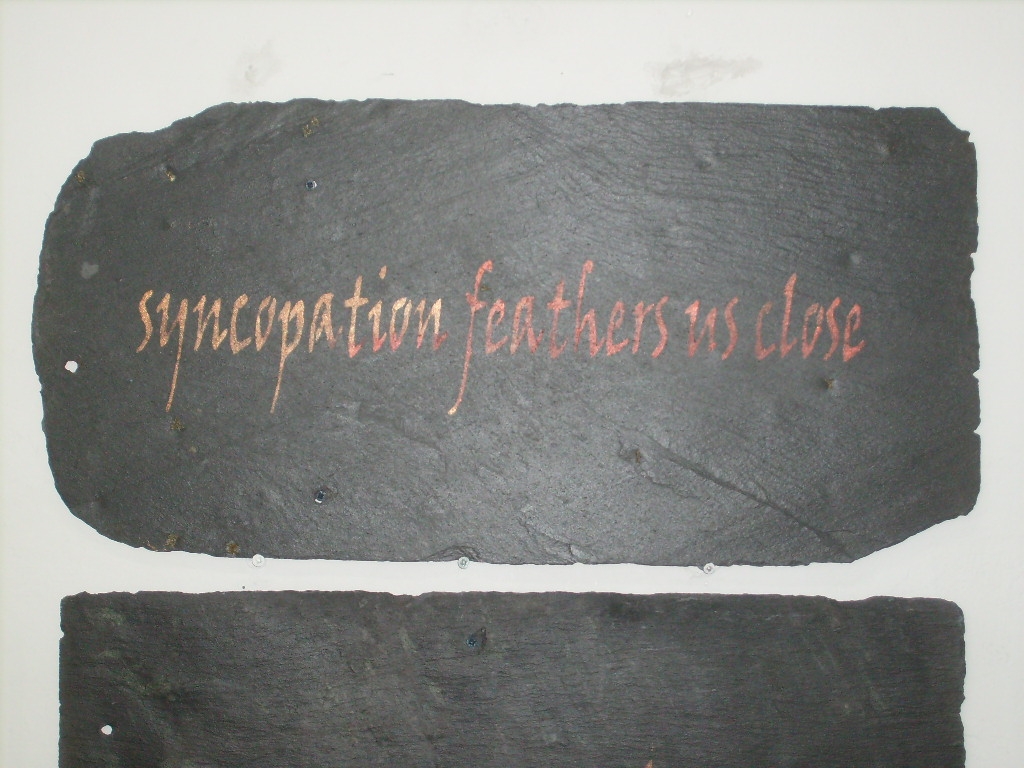
Catherine Sargeant and Dorothy Alexander write: Patriothall Stanzas are a collaborative work by Catherine Sargeant and Dorothy Alexander. The words/phrases used in these stanzas are taken from notes that artists in Patriothall leave to themselves around their studios.  Notes are left for many reasons: reminders of what is stored in a place, potential titles for paintings, things to do before leaving the studio at night etc.

Catherine gathered together this bizarre collection of words, which Dorothy turned into poetry.  Catherine then used found materials, slate and mirror to complement the poems.  These were chosen to imply the presence of the studio as a place of protection and also introspection.


*


Dorothy Alexander writes: FINAL WARNING is a series of poems in which techniques developed out of found poetry have been applied to an extract from the front page of a national newspaper. Poems were constructed from vocabularies formed by searching along and down through the paragraphs of the newspaper article. Letters, words, lines were then ‘re’placed in direct relation to their original positions within the base text.

Found is posited here as an ecopoetic, not only because of its inbuilt credentials as a recycler, but, more pertinently, for the non-hierarchical and inclusive nature of its processes. It invites acts of multiple attention (down to the smallest detail). It encourages heightened responsibility, in both writer and audience, for engagement with larger issues and strengthens resistance to notions of outside agency.


A PDF version of Sermons Hurt Curb Me from FINAL WARNING is here.


*


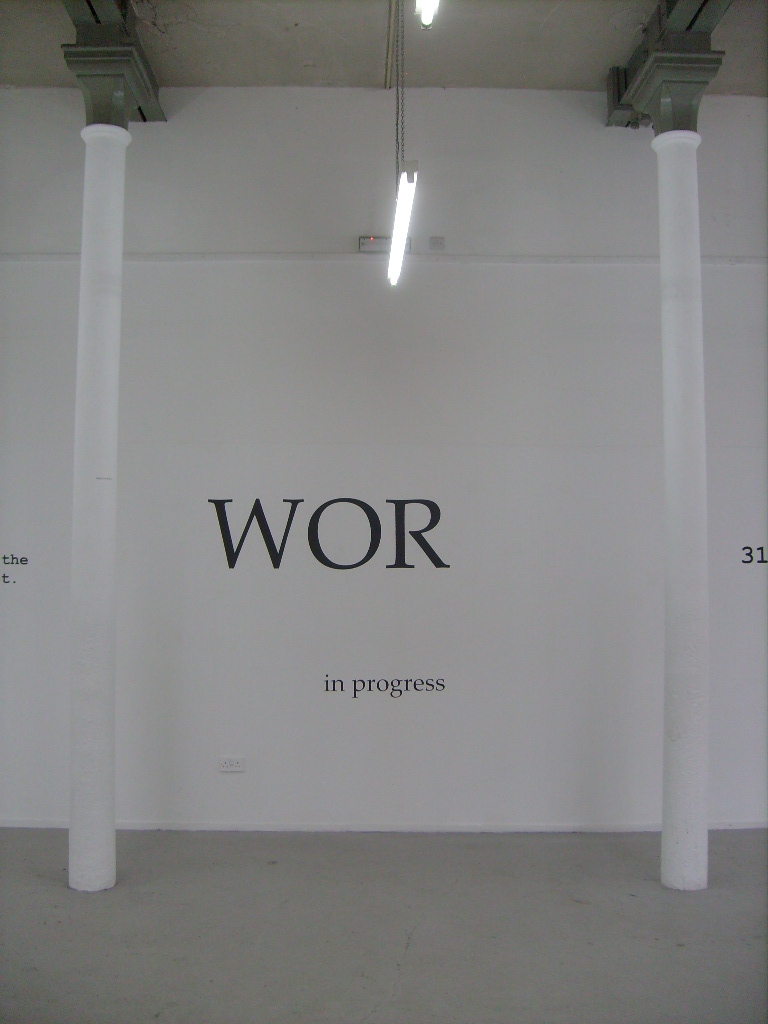
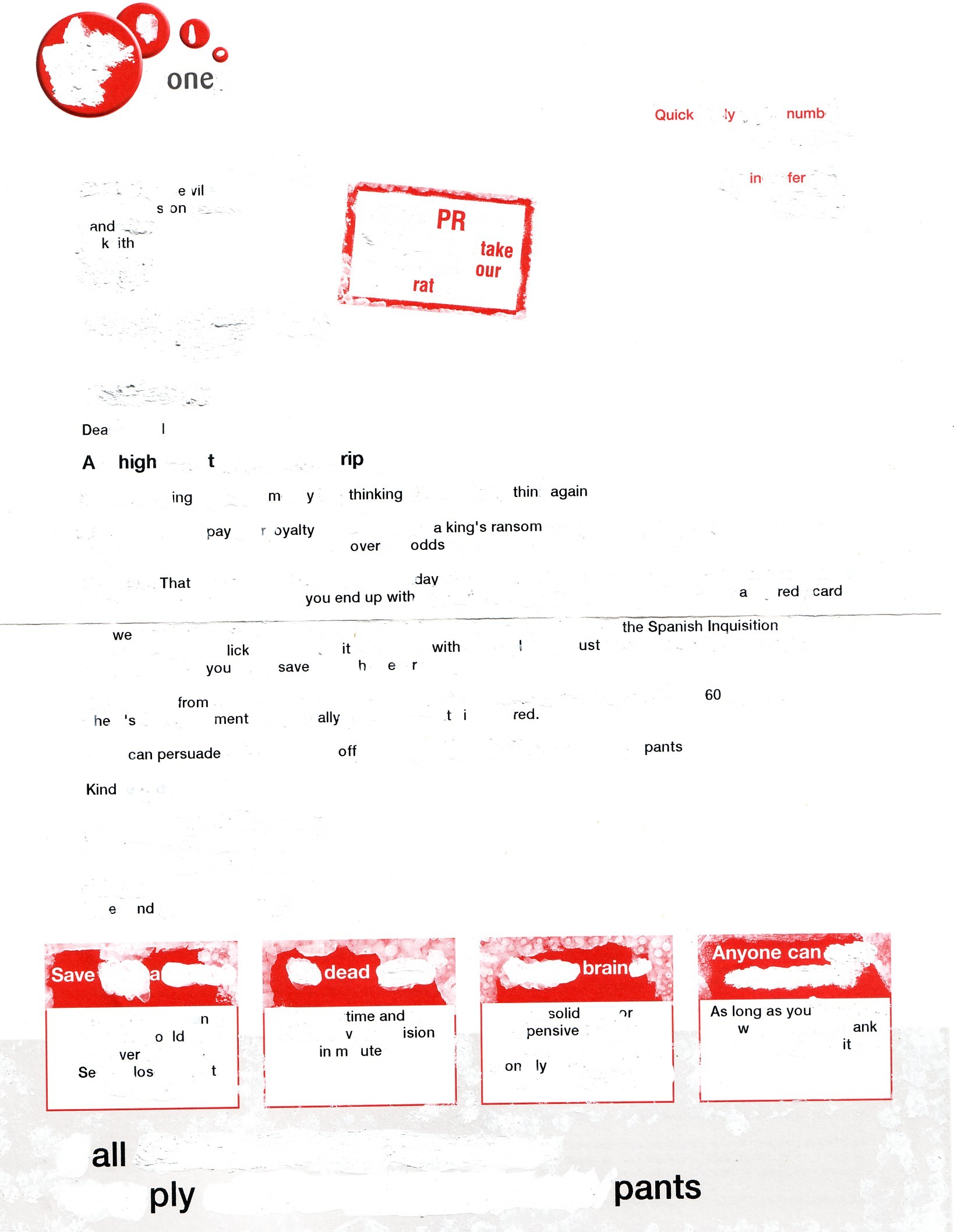
the pieces in this show typify what melville likes to do: erase, enlarge and examine.

there is a sentence, a bigger (incomplete) word, and an even bigger fragment.

he has also attempted to make worthless junk mail into commodities, with other tippex work available for closer scrutiny.


*


Greg Thomas writes: Articulation arranges the names of every bone in the human body by syllable count and stress position. It is concerned with the analogy between skeletal and phonetic articulation – consonants are bones, vowels are sinew, or blood or bile – and the idea that every act of naming and containing the body creates another body in sound, just like no act of social or cultural definition can defuse the essentially radical potential of being anything in time. Sing it to yourself.

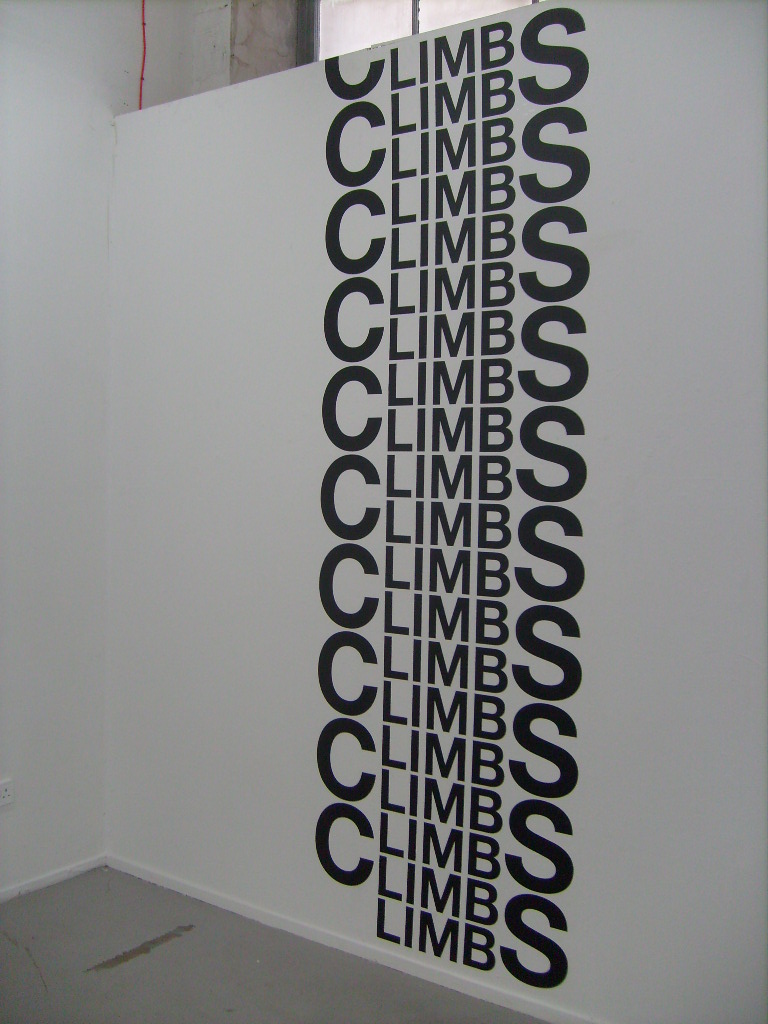
Limbs Climb is a neat, clean poem. It shows what it says (except it could be a tree or a tendril or a leg). This might make you happy.

BodyinsOUND; Liminalanimal; Virtue and Sinew (card poems) are the titles for other poems that didn’t need to be written.


*


Alexa Hare writes: Embers is a new work for “The Text Is The Text” which sets text/lyrics from some of the artists involved in the show to a piece of music written and performed by Hare.

Gerry Smith writes: Alexa Hare’s Embers is a vocalisation of text extracts I sent her. They were taken from Roubaud’s The Great Fire Of London (English translation of). Her original intention was to create a piece of music from texts supplied by all those taking part, but in the end she opted to do Embers as apiece on its own.


*


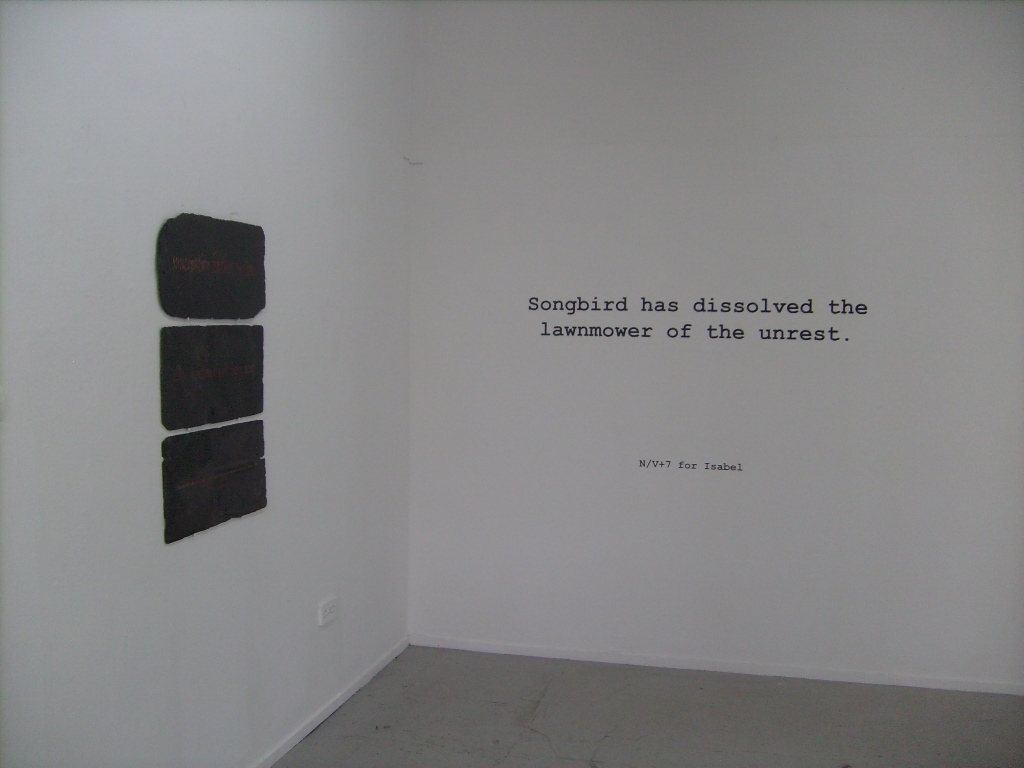
… The text used in NV+7 for Isabel, before the structured substitution of its nouns and verb, originally read: “Something has disrupted the laws of the Universe” (Kelly, The Book of Lost Books, p426). December 2009 was the last time two full moons appeared within the same calendar month. Finally, if Lost in Translation gets the better of you, Yahoo’s “Babel Fish” might come in handy!

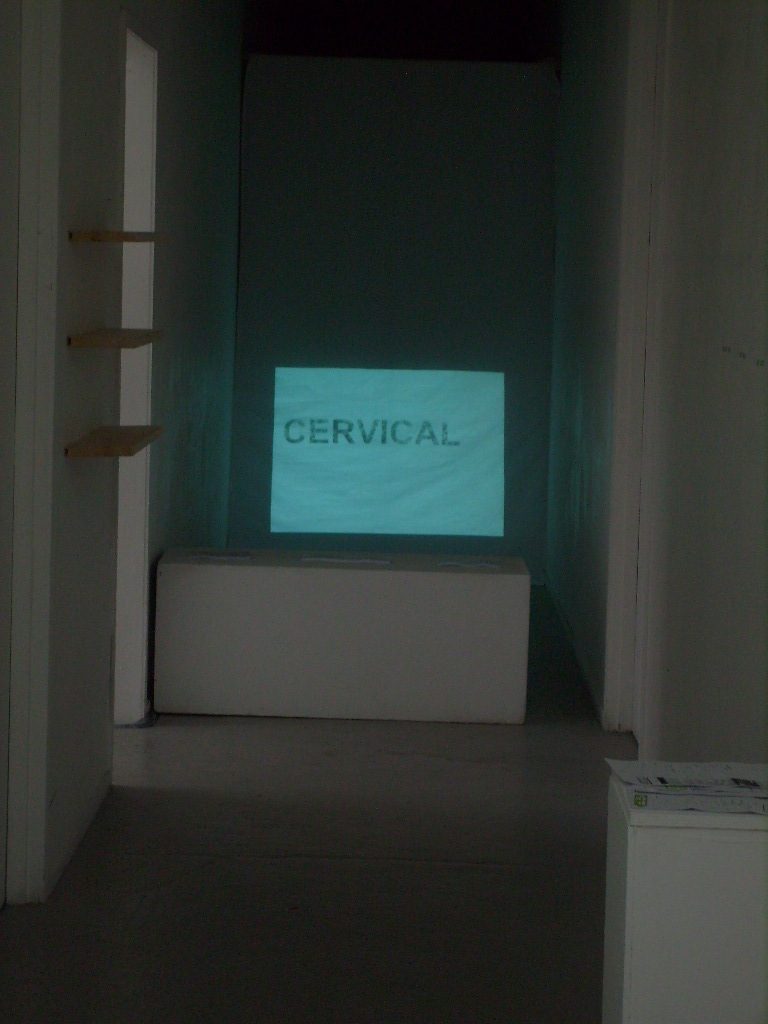
Noise is a concrete poem which attempts to represent computer noise.


*


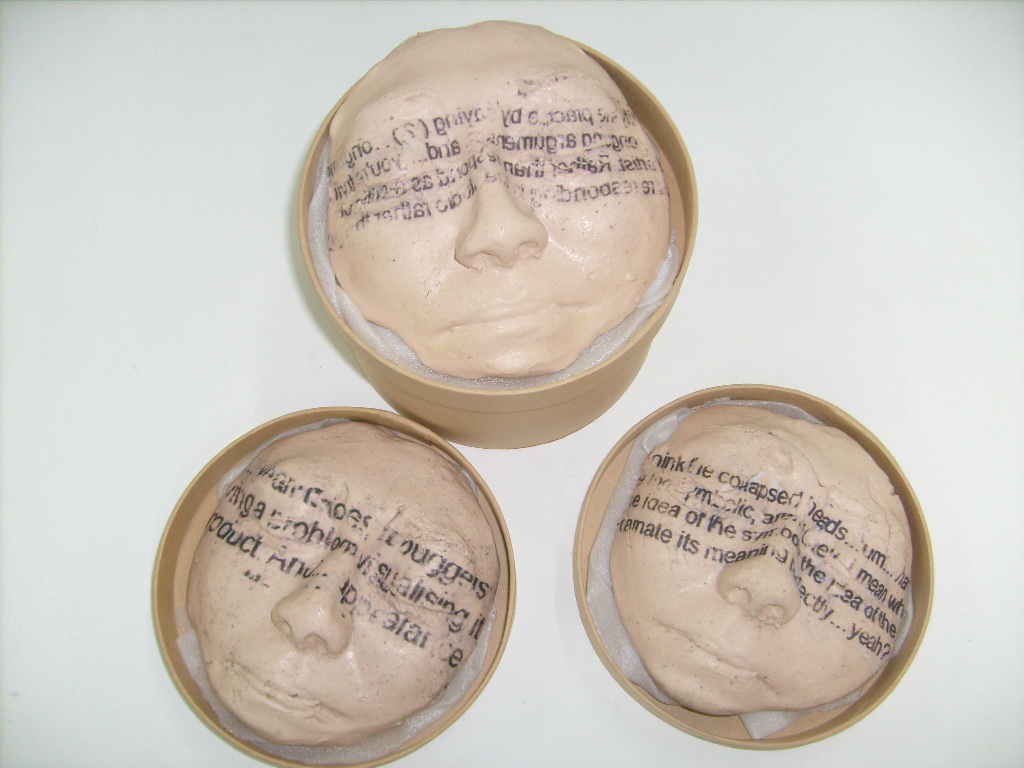
Lisa Temple-Cox writes: The work made for this exhibition is part of a series of experiments derived from a process of self-portraiture as medical specimen. Derived from the didactic cast, or medical moulage, still used in teaching hospitals today, they seek to explore notions of identity as seen through part-features or disembodied faces.

The language of self-implied in the masks is made explicit by the snippets of text: conversations, references, reversals. The language of self is written on the skin: the closure of the eyes blurs the boundaries between the living and the dead. These things are of us, but not us, and piece-meal are encapsulated, half-hidden before the medical gaze.


*


thetextisthetext is at Patriothall Gallery, 1 Patriothall (off Hamilton Place), Stockbridge, Edinburgh, 8th-18th October 2011. Tue-Sun 12noon-5.30pm (Closed Mondays).

NEW PROJECT: DRAFT PEDAGOGIES OF A VerySmallKitchenSTUDIO

In Uncategorized on October 10, 2011 at 12:12 am

seekers of lice, creamy language, installation for I AM NOT A POET, Totalkunst Gallery, Edinburgh, 2011


VerySmallKitchen writes: Recent talks, exhibitions and workshops have lead VerySmallKitchen to consider its relationships to teaching and pedagogy, how its explorations of writing, language and art practice can create and unfold within a diverse array of learning situations…

The following document is a draft that will be revised as appropriate over the coming months, as well as supplemented with other materials (book lists, essays, notes…).

The STUDIO project is also part of VerySmallKitchen’s residency at London’s X Marks the Bokship, an outline of which is here.


VERSION 1.0


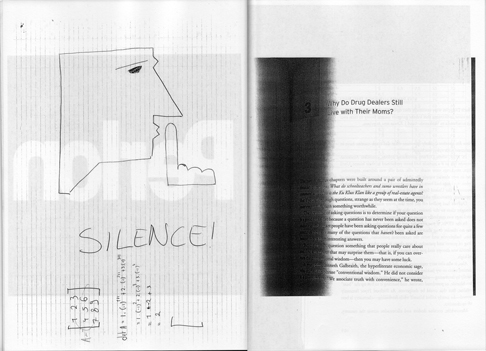
VerySmallKitchen is currently exploring ways of teaching connections of writing, language, and art practice. The work emerges out of a number of projects over the last year, notably Art Criticism Now and Art/ Writing/ Talks in Ireland, as well as sessions devised for MA Dance Practice at Laban in London, A FRANCIS PONGE POETRY STUDIO for Cannon magazine, the SUMMER SCHOOL OF SILENCE at I AM NOT A POET, and Writing (The) Space at The Wild Pansy Press project space/ University of Leeds.

Ongoing involvement with Free School projects organised by Edward Dorrian/ Five Years Gallery has also been key…

Like the projects on this blog, this teaching concerns distinctions and overlaps in/ between histories of conceptual writing, experimental poetics, fiction, criticism and the essay, both the content and forms of such work, how it is distributed and published, and the practical and theoretical understanding of the practice of writing itself.

If the project has a hunch it is that this focus on writing practice – and various histories of literature –  produces something related to but different from the recent “educational turn” in art practice or the re-consideration of publishing and writing principally within frameworks of graphic design…

… A focus upon acts of reading and responding, how the individual nature of these acts can also become communal, public forms, or private, idiosyncratic forms, as necessary….


*


VerySmallKitchenSTUDIO has several strands. A basic outlining of bibliographies and materials, often in areas for which there are no readily available resources of materials; the development of STUDIOS’s of such materials that can be used in different teaching contexts; a practical and theoretical exploration of distinct forms of pedagogy that emerge from this work. If such forms promote particular histories, in an educational context they also  offer supports and techniques for studying and working more broadly…


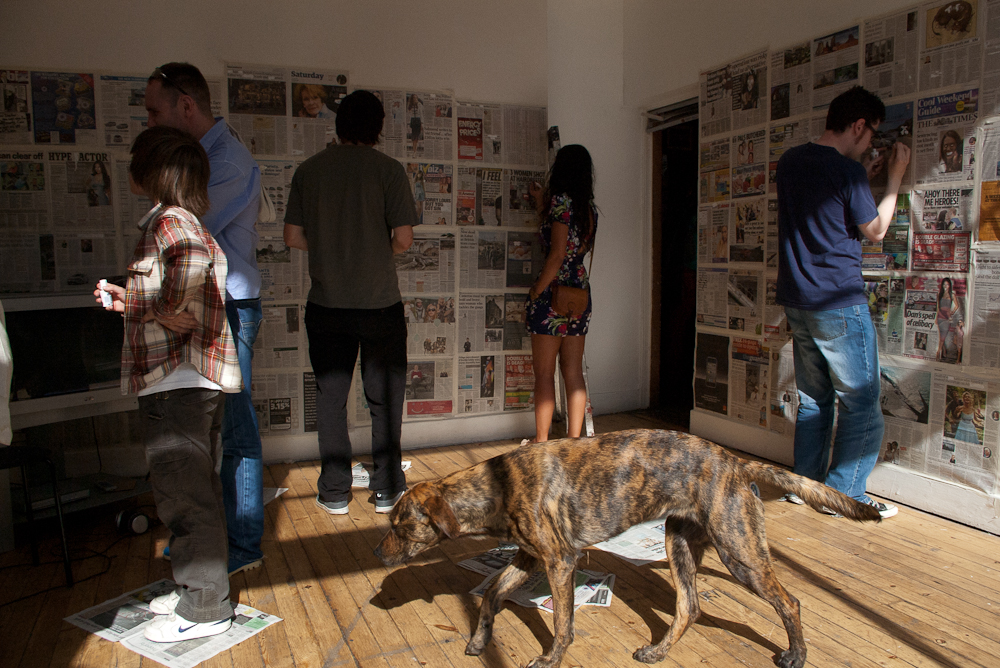
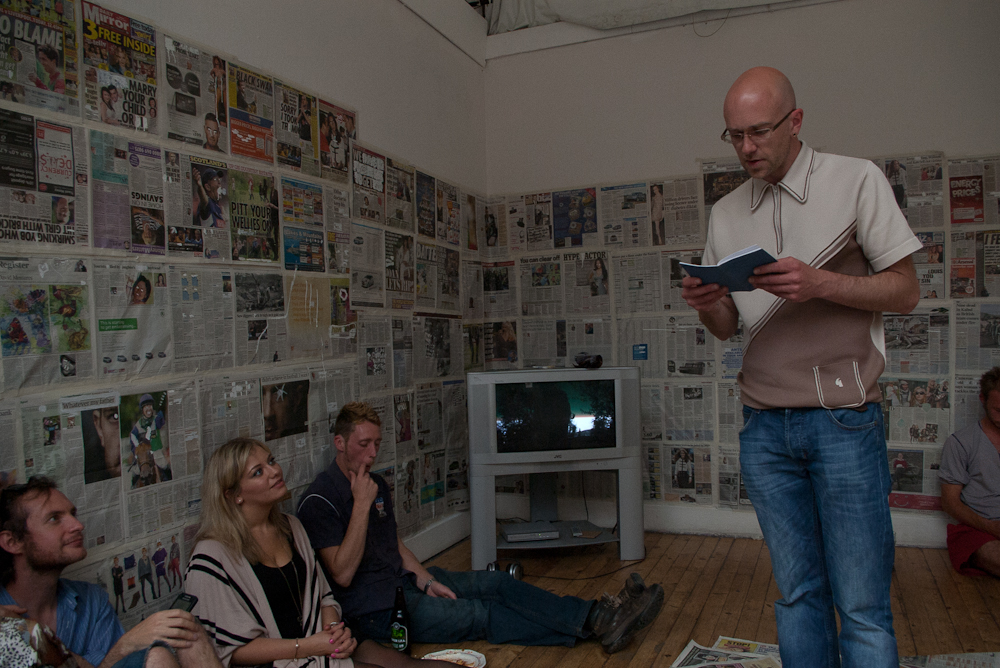
nick e-melville's EDITORIAL for I AM NOT A POET invited public alteration of the day's news...


Studios have so far been developed and used for workshops in Art Writing and Criticism, focussed particularly around notions of “Essaying”; Minimal Poetries; Olson’s Projective Verse; Artist Talking/ Lecture Performance. Between now and December – as part of a residency at X Marks The Bökship I am developing a  studio around scripts, scores and the re-print in contemporary art writing…

Materials will be published on this site as the project develops. For more information contact David on verysmallkitchen@gmail.com. Here is a brief outline of the various studios so far:


ART WRITING


A consideration of how writing relates to/ as/ around/ on/ about/ with art practice. The studio proposes histories and practices of the “essay” as a linkage between these different practices, exploring tactics of “essaying” across criticism, performance, fiction and poetics. It explores how writing functions at different stages in the life cycle (of itself, the art work, the exhibition…).

A key source here is Richard Kostelanetz’s Essaying Essays anthology, both as an actual gathering of texts, and (given the texts unavailability) a proposition about a way of working between various writing and art practices. The introduction to the text is here.


X

Tatiana Echeverri Fernandez Xerox on paper, 29.7 x 42 cm for XALPHABET / 26 Xs by 26 Artists

x

Thomas Jeppe Xerox on paper, 29.7 x 42 cm for XALPHABET / 26 Xs by 26 Artists


As it unfolds, the studio moves towards an erratics of writing, as a way of conceptualising both acts of writing themselves and the uncertain contexts of commission and publication of a writing practice at all stages of its life cycle, informed also by a “Literature of the No” as formulated in Enrique Vila-Matas Bartleby and Co.

In this studio the prevalence of (post-) conceptual notions of site, institutional critique and document, are utilised but also placed alongside histories of New Journalism, experimental poetics and fiction, which offer different and conflicting priorities and methods. Different forms of paradox as a structural principle of the studio is articulated in the following quotation by Nathanael:


“my own need to very aggressively resist, or think through, what an essay is or might be and to find my own way to a text that isn’t one, that isn’t one that’s compliant with a particular form, right? That doesn’t interest me. I understand these forms viscerally. They’ve been inculcated right? But I don’t want that. So in a sense, the thing that’s internalized, the sense of having to be kicked out again, even though we can sort of agree that there’s no outside, but somehow there’s that tearing or rending that has to happen – or breach out of which might emerge this thing. That is this particular text.”

SOURCE: Kate Eichorn and Heather Milne, Prismatic Publics: Innovative Canadian Women’s Poetry & Poetics (Coach House Books, Toronto, 2009), 64-5.


MINIMAL POETRIES


This studio explores the histories and contemporary practice of minimal writing, both as a practice in itself and as a way of thinking about writing and art practice more broadly. Starting points include the poetry of Aram Saroyan, concrete poems, scores by Yoko Ono and Alison Knowles, the small ads of Dieter Roth, and the one word poem issue of Ian Hamilton Finlay’s POTH.


Yoko Ono, Cloud Piece, 1963


Seen as historical progression, the studio moves through diverse histories of poetry, music, fluxus and conceptual work, to such current practices as (the pwoermds of) Geof Huth and Jonathan Jones, James Davies, and Márton Koppány. A preliminary consideration of some of this work is the essay SMALL AD SWEETHEARTS OF THE IMAGE VIRUS DO-POETRY which can be read here.


Márton Koppány, Csend (Silence)

The studio also explores projects such as Coracle, where minimalism can be observed not just as a page based textual form but as a wider aesthetic, a form of architectural intervention and curatorial methodology… See Thomas A.Clark’s 1989 essay “The Gallery and the Book” reprinted on VerySmallKitchen here.
…Epigram, aphorism, pun, (anti-) haiku, also become forms of compression under consideration, contributing to a constellation of concerns around thought, language, instruction, score, condensery, application…


In a teaching context, what characterises this studio is how a wide range of work can be presented to participants in a short time period. Whilst this must not oversimplify the work, it does offer a particular teaching situation regarding the relationship of material and class time, readings and responses, that should be experimented with.

… This VerySmallKitchenSTUDIO is also useful for exploring the boundaries between literary and art practices (minimal poetry. conceptual art, musical score…) particularly the notion of what is expected of texts, how they are read, published, distributed, what responses they invite or refuse…

For example, how such texts explore a relationship of writing and sculpture through their focus on materials and presence in space, is one focus that has emerged, drawing on this quotation from Ian Hamilton Finlay, talking about the relation of title and word in his formulation of the One Word Poem:


“I am a little fascinated just now by the idea of one-word poems… My idea is, that the one-word poem should be composed of a title plus  one word. All (true) poems have form, and in this case one should see the title and the word as being 2 straight lines, which come together to forming a corner: the corner is the form of this poem. Only, these corners must be so constructed as to be open (opening) in all directions. That is the paradox.”

SOURCE: Ian Hamilton Finlay, A Model of Order: Selected Letters On Poetry and Making (Glasgow: WAX366, 2009), 39.


CHARLES OLSON/ PHRASE POETICS


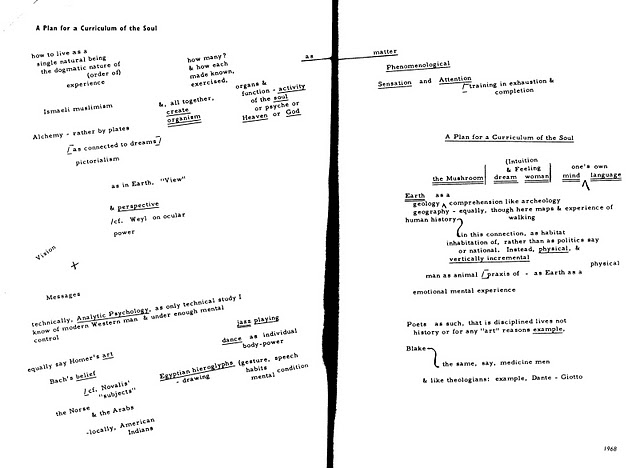
This double VerySmallKitchenSTUDIO began with a study of Charles Olson’s manifesto-diagram A CURRICULUM FOR THE SOUL (below) and a publication project after his death that saw words from the diagram allocated to different poets who wrote a chapbook with that title. The studio is interested in exploring the model of learning, publication, and economy that can be unfolded from this.


https://verysmallkitchen.com/wp-content/uploads/2010/02/plan-for-a-curriculum-of-the-soul-1.jpg


Subsequently, the studio has explored Olson’s teaching as demonstrated in texts such as “A Bibliography on American for Ed Dorn”, as well the implied and stated methodologies of numerous correspondence and poetics essays, principally “Projective Verse” (1950), an exploration that continues in collaboration with Open Dialogues Writing (The) Space project.

This studio involves lineages of writing and thinking which can be traced from Olson to 2011, considering, for example, the notion of a research-led practice, as well as gender focussed critques and readings of Olson by Susan Howe, Kathleen Fraser and Laura Mullen. It also considers related contemporary projects such as the Olson Now documents and the CHARLES OLSON: LANGUAGE AS PHYSICAL FACT section of EOAGH.

The studio has also sought to respond to a particular aspect of Olson’s practice – as it is distilled in a lexicon of “field poetics” or “projective verse” – by exploring the notion of a PHRASE POETICS.


Rachel Lois Clapham and Emma Cocker, re-. installation view, Wild Pansy Press Project Space, Leeds, 2010


… explores such lexicons and coinages alongside, for example, Brecht’s “alienation effect” and Artaud’s theatre of cruelty” or Harald Szeemann’s “self-institutionalisation” of himself as the Institute of Spiritual Guest Work. It explores how such working phrases function for their authors, as well as the independent life they then have, where they might be constructively misunderstood and reinterpreted…

Weaving between the two different aspects of this studio, we might ask how, for example, both methods relate to, for example, Jill Magi’s recent CADASTRAL MAP, which, whilst enacting an Olson-like research of place, also seems to start investigating from a position deliberately more defined, counter to, resistant of such a self-claiming expansionist poetics:


“The cadastral map is drawn as if from an aerial view, composed by surveyors to determine land ownership for the purpose of taxation. The cadastral map does not indicate where the land is fertile, swampy, or rocky. It does not indicate knolls, forests, valleys. Nor does it express the collaboration and exchange between farmers or those who move through the land. Its lines respect one purpose, one knowledge, state sponsored commoditization.


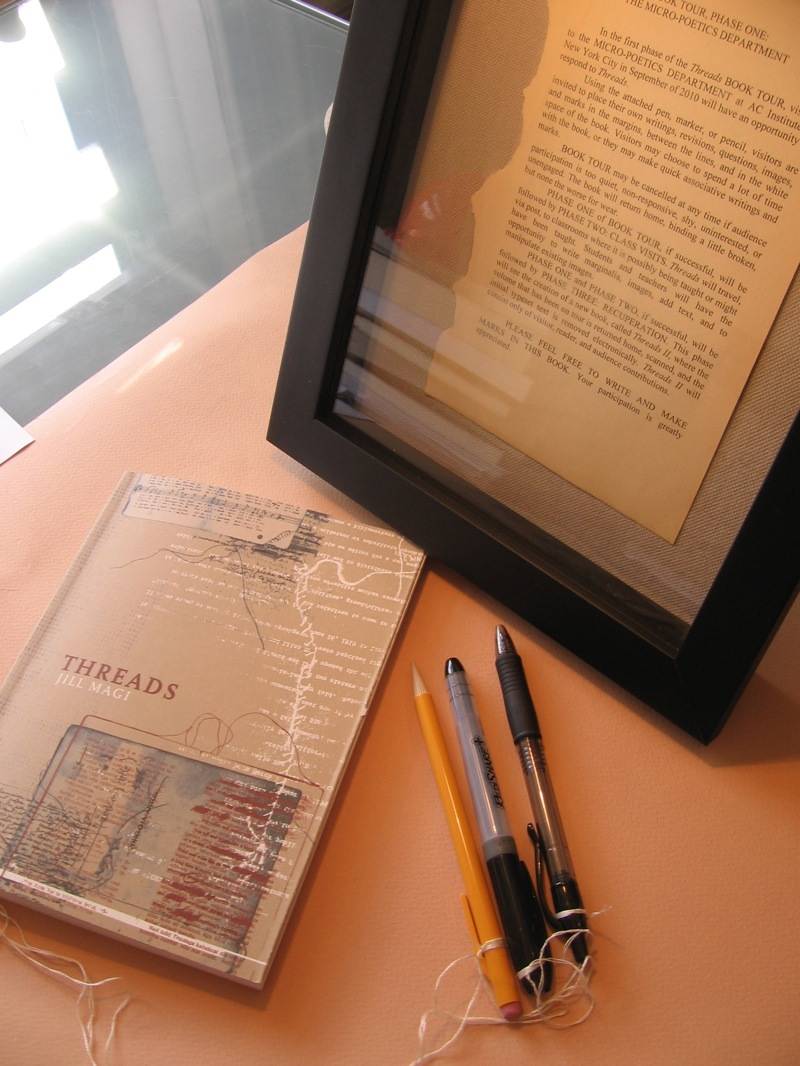
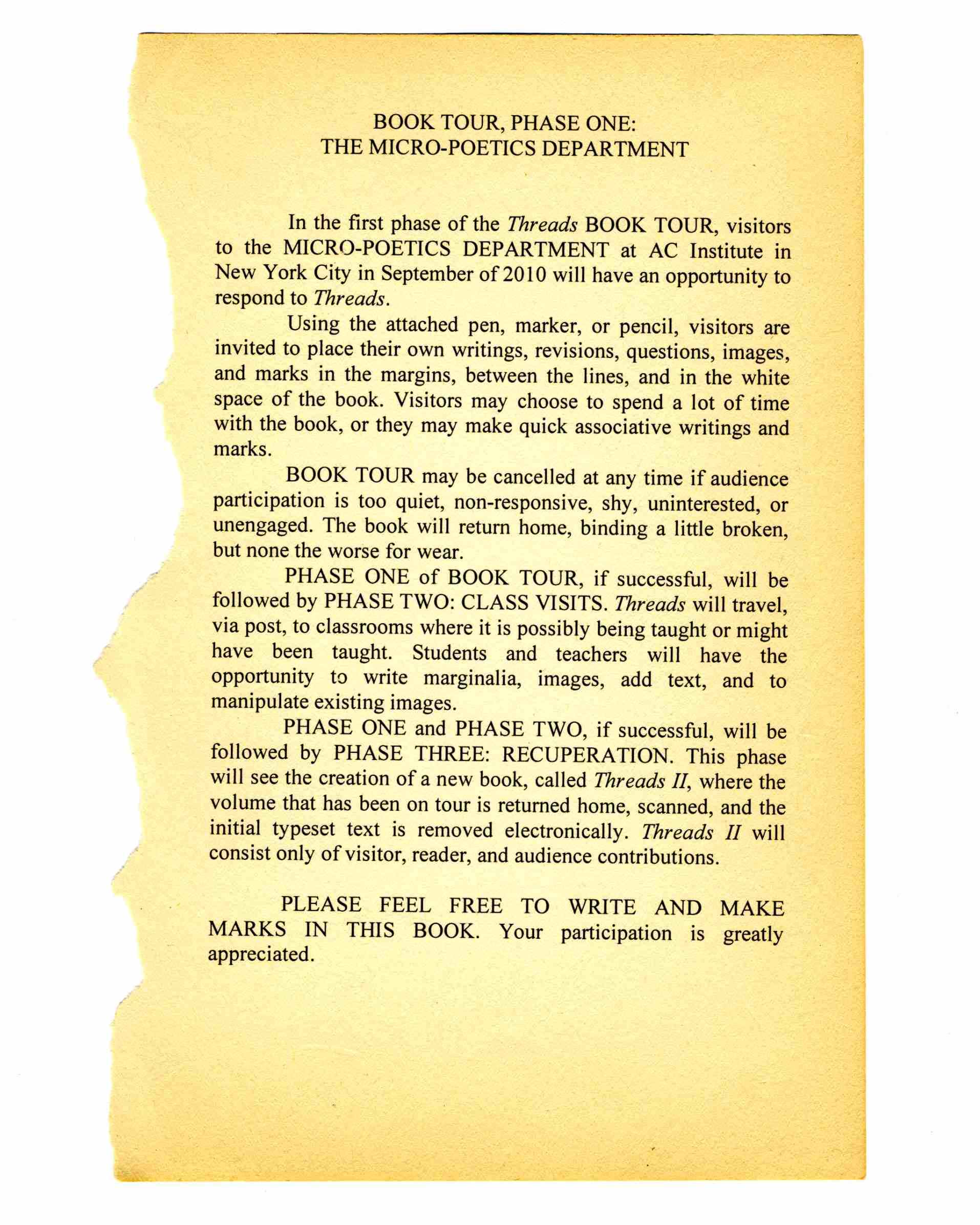
Jill Magi, installation for DEPARTMENT OF MICRO-POETICS, AC Institute, New York, 2010


“I enter as a writer, one kind of mapmaker, needing to ask, is traditional nature writing in English a cadastral map?… is “nature writing” still our flawed point of origin, creating ideas of the land and nature that tend to erase people and local knowledge as we go?” (108)


Magi’s essay offers an answer as its conclusion:


“At every turn, degrees of legibility, a focus that comes in and out, position-depending. Don’t look away. Listen, there is history. Earth and bones beneath your map give weight back with each authoring step.” (110)

SOURCE: Jill Magi, Cadastral Map (Bristol, Shearsman, 2011).


ARTIST TALKING/ LECTURE PERFORMANCE


Finally, this studio begins with a focus upon presence of talking among contemporary arts and writing practice. It explores the reliance upon models of stand-up and storytelling, and how these have come to replace early reliance upon the format of the academic lecture.

The studio is currently in a more embryonic form than the others and emerges as a direct response to recent events in London, including electra’s Dirty Literature festival, and Performance as Publishing at the South London Gallery.

The studio explores the interrelation of the talk and the printed text, focussing on the work of Steve Benson and David Antin, whose very different forms of “talking” attain published form as “poetry.”

How such talking poetry constitutes a particular form of talking and thinking is explored in the work of Leslie Scalapino and John Cage. As with the minimal poetry studio, this can be then related to different forms of art practice, and to talked based forms of scenography and choreography, such as in the work of Guy de Cointet and Tino Sehgal.


nick-e melville reading of collated interventions at the conclusion of EDITORIAL


… consideration of talking within the learning situation brings focus to the forms by which we engage with such material, conceptualise and enact discussion upon our own practices.

… The question of how a practice might itself explore and involve talking on many different levels is of central concern to this studio. Hence an interest in the following quotation from Chris Cheek on his own practice:


“The talks attempt(ed) to perform a variety of strategies for public-private discourse. Titles of the texts and therefore some more general enframing were announced in advance of the series. Otherwise what occurred was utterly in the moment, though each day had a provisional series of talk strategies. For example, whilst each talk was improvised and responsive to the site on each occasion, ideas of: scale, perspective, contradiction, deliberate misunderstanding, anecdote, vernacular obsession, fictive quoting, imposed character, cartoon depiction, carnivalesque interpretation, historicising, demonising, sports commentary, theoretical exposition, emergences (and emergencies) of catchprase, listening to prerecorded texts or previous talks on headphones whilst talking (thereby mobilising conflict between listening and uttering), overhearing fragements of passing conversations… and so on were mobilised. Sometimes I toyed with direct address to those I could see participating as listening watchers in the window, Sometimes I imagined that there was a friend there, when in fact there might well have been nobody present at all. Sometimes I thought I was talking to the taxi cab call operators, sometimes passers by. My guess was that this work would offer a doubting interface.” (191)

SOURCE: Chris Cheek, THE CHURCH- THE SCHOOL- THE BEER (Oxford Ohio, Critical Documents 2007).


John Cage, Lecture on Nothing(thanks to Tim Griffin for drawing this to my attention)

Opening page of John Cage, Lecture on Nothing, from SILENCE: Lectures & Writings (1961)


A GUIDE TO NAVIGATING


If the STUDIO is a gathering of books, and a gathering of ideas and methods that come out of those books…

…I have been thinking about how to translate this into teaching situations in the broadest sense, both planned and unforeseen, both to convey information about histories that inform the present, and construct teaching structures where that which is not to do with information can unfold…


Mary Paterson leads a silent memory walk of Edinburgh as part of the Summer School of Silence at I AM NOT A POET


Below, then, are a series of tests that appear at present to be useful ways of questioning this material, both the individual studios and how each reverberates through the others, towards an active pedagogy and practice of reading and (art-) writing:


how each studio can re-figure itself over varying time lengths (say, 1o minutes to 10 weeks and more) and formats (talk, lecture, seminar, workshop, event, performance, blog…).

how each studio records a particular historical and  contemporary practice, whilst providing tools for thinking about writing and artistic practice more broadly…

how each studio is a distinctive set of materials yet also open to exchange and dialogue between (the nature of its modularity)…

how the studio balances individual and chora(l),  consensual and agonistic, thematic and grammatical…  defines a moment and commits to an (open) unfolding…


*


Thanks to Mirja Koponen, both for co-curating I AM NOT A POET and for taking the photographs of that event here. As this project takes shape I note it as one part of a broader conversation in which other colleagues and collaborators are also engaged. See, for example, some notes on Open Dialogues critical model, NOTA Workshop.

VSK ESSAY: SMALL AD SWEETHEARTS OF THE IMAGE VIRUS DO-POETRY

In Uncategorized on October 4, 2011 at 8:59 pm


Emmett Williamssweethearts, first published in 1966, is an erotic love poem made entirely from permutations and arrangements of words and phrases found using the eleven letters of its title. Reprinted in 2010 in a facsimile of its original edition, it has to be in this square format so the reader can flick through the pages of its first section and see this coupled erotics of story and type unfolding through proto-cinematic letter patterns. Further on, declamations are found within a grid of sweethearts 11 letters wide and 11 repetitions deep. The swart seether that sears her wet wheat, or he heats her wee sweet ears.

I first read these pages, too, as typographical patterns, like those with which the book begins, words growing and shrinking, when suddenly the sears and wet wheat of it emerges, the proximity of Williams’ painstaking word search to flesh and sweat. Re-issued in 2010 sweethearts enters into and creates a history and practice of minimalism as one site where art and poetry converge. Not that this convergence is straightforward. sweethearts, with nested hearts of Marcel Duchamp’s Cœurs Volant on its black covers, has its back cover on its front and vice versa, highlighting the reversals and disruptions that such fusions may necessitate.

Aram Saroyan’s coffee coffee, another strictly lower case book title, is also recently republished, by New York based Primary Information. Many pages of coffee coffee comprise a single word centered on the page: though, for example, building, or ring, to quote three with which the book commences. Other times a word is repeated, Saroyan exploring how often a word needs to be repeated to get the balance of type and page, word, idea and space. Bird is a three line block of bird/bird/bird and cigarette needs four repeats. There’s the title, too, of course which, like sweethearts, is another poem.

In Saroyan’s Door To The River: Essays & Reviews from the 1960s into the Digital Age, poems in coffee coffee emerge as in part as a stoned poetics: “I was getting stoned and looking very hard at things because I was going too fast, I felt. I wanted my writing to slow up, and the one-word poem finally gave me the feeling that it wasn’t going by too fast.” This wasn’t, of course, the only way to response to the moment or practice a minimalist poetics. Saroyan’s close friend Clark Coolidge later commented: “I couldn’t understand how there could be just one word. One word always led to another in my mind, helplessly.” [1]

Then and now, coffee coffee articulates movements between scenes and practices of art and poetry. In 1967 coffee coffee was published by Vito Acconci and Bernadette Mayer’s 0-9 Press, an offshoot of 0-9 magazine, in which Saroyan also appeared, which in retrospect seems to function as an intersection between conceptual art, performance, New American poetry, and experimental music. In 2009 Primary Information republish coffee coffee, despite Saroyan’s books being downloadable online, and a hard copy publication of Complete Minimal Poems by Ugly Duckling Presse. For Primary Information it seems necessary to have a hard copy of this book, not to make its contents available, but as an object/ statement/ proposition about publishing and PI’s own practice.


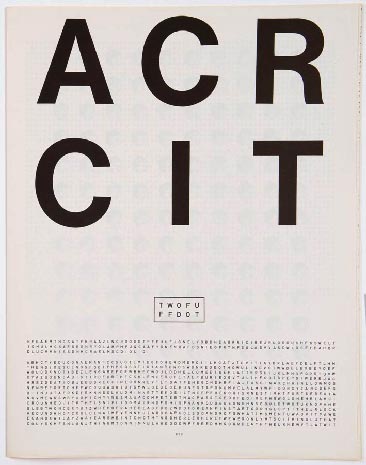
General Idea: AIDS Stamps (1988)

General Idea: AIDS Stamps (1988): Offset on perforated paper inserted in Parkett magazine, no. 15, 1988.


Reception changing decades after something is made is part of Gregg Bordowitz’s essay on General Idea’s Imagevirus in Afterall’s One Work book series. In 1987, General Idea rearranged the A-I-D-S acronym into a logo: a neat box with the first two letters on top of the second two, the format and the red, blue, and green colours appropriated from the LOVE logo of a 1966 Robert Indiana acrylic canvas. The negative space between colours could be varied and the logo reproduced in different formats and sizes. Between 1987 and 1994 it appeared in gallery exhibitions and the covers of medical journals, as wallpaper, on billboards and public transport, as street sculpture, jewellery, and on lottery tickets.

Simplicity contributed to its repeatability, Bordowitz highlights, although, in these early years of the AIDS crisis, the work functioned differently depending on the viewer’s proximity to the virus. If you had AIDS, Bordowitz writes, then Imagevirus “is an extension of you. You are the word made flesh, a representative of the virus, and your reach extends deep into the atmosphere. Breathe in, feel your powers.”
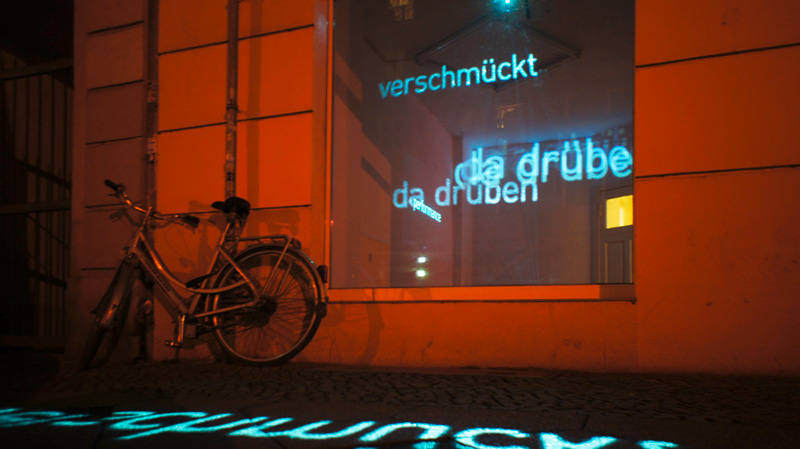
 

General Idea's famous AIDS logo, an appropriation of Robert Indiana's LOVE sign of the 1960s. The artists created the logo as a form of branding, and then applied it to media and advertising strategies, callign the infiltrations that followed Imagevirus.


In 1987, when Bordowitz was a direct activist with ACT-UP, Imagevirus and the relationships of art and politics it demonstrated, was harder for him to appreciate: “many of us felt like we had to abandon the conventions of modernism to better link our art directly to the protest movement against government inaction.” In 2011 Bordowitz can see how General Idea did not do this, but “re-figured the styles and tactics of a homosexual avant-garde using the threat of viral infection as their model for identity politics.”

Bordowitz also understands this shift of the last twenty years through a turn to poetry. He cites dictionary definitions of poetry without which, he says, Imagevirus cannot be understood. Poetry brings a “special intensity… to the to the expression of feelings and ideas by the use of distinctive style and rhythm… something regarded as comparable to poetry in its beauty.” Quoting Wallace Stevens ‘Anecdote of the Jar’ Bordowitz writes how poetry “plays with these varying positions to create constellations of experience.”

It is in a more general discussion of language that Bordowitz comes closer to the experimental devices of sweethearts and coffee coffee. AIDS could stand for other things, he observes, although habit and repetition “compels me to read this as the acronym for a fatal disease.” A minimal poem is where materials and means of language become inseparable from both the message and its own mechanics, potentially viral, code-like and tweet, a piece out of time embedded within it. If poetry is apposite for the age, let’s check with the poets.
Published by the Manchester based poetry press If P Then Q, ntst: the collected pwoermds of geof huth comprises 775 one word poems or pwoermds.  The form unfolds most directly out of Saroyan’s own explorations of the form, including – in his 1968 collection Aram Saroyan – lighght, eyeye, and morni,ng. Other sources include Ian Hamilton Finlay’s one word issue of Poor. Old. Tired. Horse magazine in 1967, in which the title could be any length, and Simon Cutts’ Coracle gallery and still-operative press, where minimalism becomes a utopian neo-pastoral proposition about fusions of form and content embracing book, space, and conviviality.


poth


Huth’s pwoermds have no need of titles. Mixing playfulness and studied manipulation, Huth adjusts the materiality of a word to bring together its sound, typographical presence, and felt meaning(s): twinns, say, mmssft, thingk, woeird, and voluptuouuousness. Humour of the individual words becomes a foil for a psychic intensity and ambition evident when pwoermds agglomerate into lists revealing the jagged ambitions of their entanglements and re-makings. Take this 2007 sequence which first appeared on Huth’s dbqp blog: thevolution, complext, educution, onwed, nelsewhere, couldn’t’ven’t, uition, questiong, ideaghless, nothingng, o)ught(s, emember, an/swer.

ntst mostly spurns the white space and one word per page of Saroyan’s coffee coffee, preferring archival lists of words organised by previous publication (mostly on Huth’s blog or in small press and self- published poetry chapbooks and magazines). Pwoermd has a sense of occasion, as in two sections that compile writing that ocurred during International Pwoermd Writing Month. Pwoermd is so immersed in manipulable printed language that this itself provides the most appropriate taxonomy. There are collections titled the woords and wreadings, for example, the sequence of the later fusing word and book form, by beginning foreward, then proceeding through pairs of narrarator/ readear and memeory/ kmowlwdgw.

Attuned to their own organicity, pwoermds also turn to nature, aware that their manipulations can offer new ways of perceiving that combine object, environment, and experience into sunbrook, toothwood, shadowl, toadmud and pondsun. Each pwoermd wants to be a tactile, literary-edible experience, providing the reader with their own wthrd woord phlesch pflesch wr;t:ing organasm, to summarise ntst via one quick reading-movement through it.

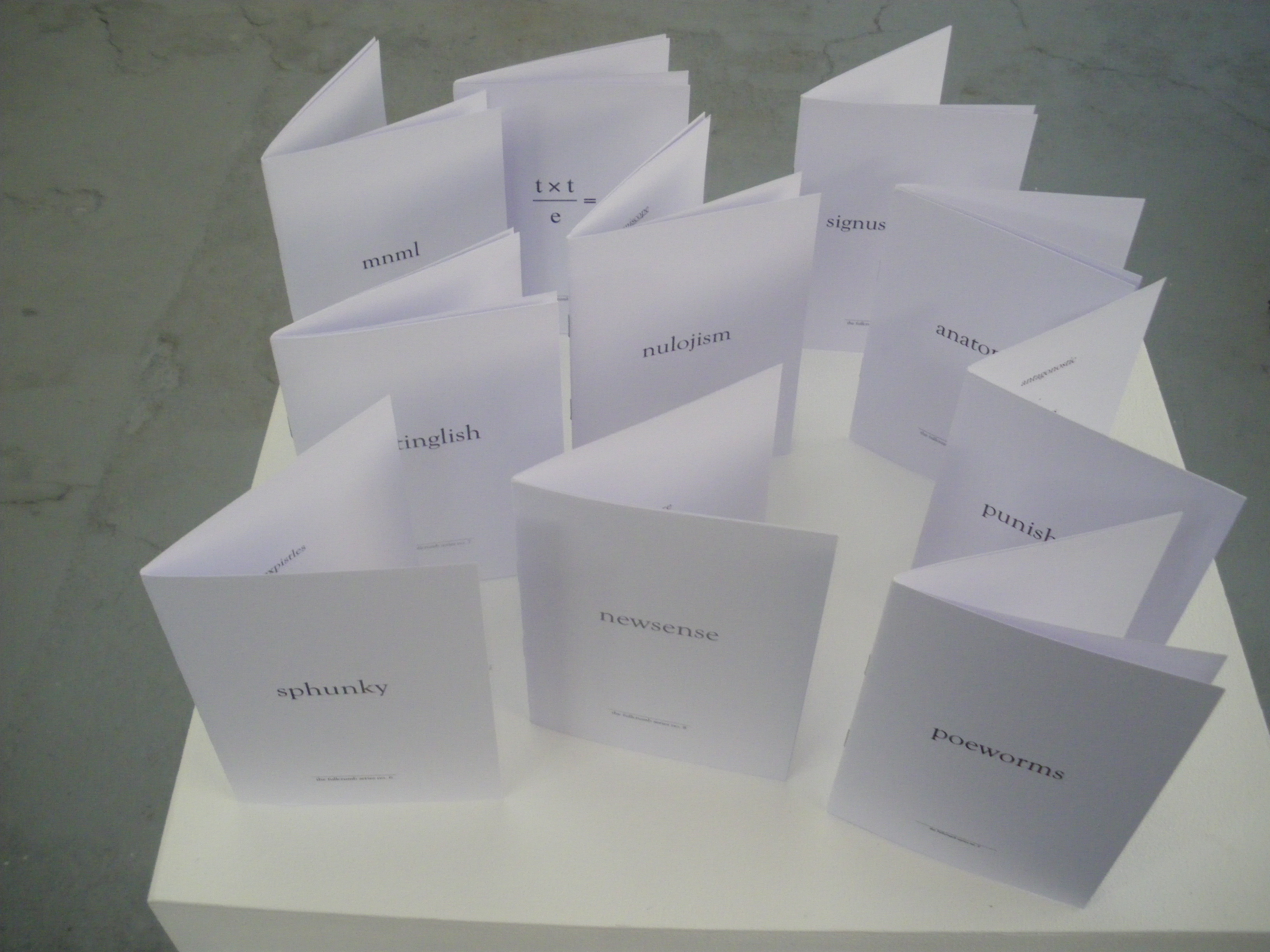
There’s a pwoermld out there. In April 2010, Jonathan Jones’ The Sticky Pages Press published from Brussels the fullcrumb series: 20 small booklets, some a single sheet of folded A5 card, others small 4-6 page chapbooks. All an arena for a particular category of near edible pwoermd. The pamphlet or/th/or, for example, offers pwoermdists excavations of literary history from shapesphere through wordthwordth via kakafkafka; whilst nulojism focuses on the errhotic – one page invites the reader into the intimid/ fungle/ nurdge/ sighz/ growns/ shuther. The poeworms booklet lists procedures, which can only be detailed via further pwoermds, paired methods of: un(ear)thed/ exwhom; sourceaura/skullership; psychedlicate/ inksense; vampyhrric/ extinkt.


The Sticky Pages Press, The Fullcrumb Series (2010)


Jones wrote a note on his Belgian Waffle blog in May 2010 which elucidates how he sees the pwoermd, and from which I’ve extracted the following: “The pwoermd is trespass… Frankenstein language… The pwoermd is disobedience… The pwoermd is physical. Skeleton language. Bonus letters. Work out! Flex and articulate those joints! The pwoermd is a word made of machines. But what makes it go? The pwoermd is old. Gnomic and riddled… The pwoermd is unspeakable… Think is to thong as tongue is to thing. The pwoermd is joyous. Textual excess… Language full tilt. The pwoermd is toothsome… Pop it in your mouth… The pwoermd is Now. And then. And still coming…. It forces you to do time. The pwoermd … IS.”

Heimrad Bäcker’s transcript, was published in German in 1986 and in English in 2010, and, presenting the holocaust through the language of its remaining archival documents, offers a more directly applicable example of minimalist methodologies. The text comprises fragments of this archive, each page of transcript a presentation of an archival fact: the first transport departs from the aspang train station on friday 10/20/39 at 22.00 hours. Another: later a man named kerper came as the authorized representative from berlin for the gold teeth.

Bäcker’s archival sources are numerous, including maps, letters,  minutes, legal documents, statistics and registers. In seeking an appropriate method of response, transcript rejects inventing language: “It is enough to quote the language of the perpetrators and the victims. It is enough just to stick to the language preserved in the documents. Concurrence of document and horror, of statistics and dread.” Bäcker accounts for the artistry of transcript as follows: “When I quote, there is nothing literary about the quotation (except in sequence, repetition, omission; except for the system of transcribing). This is what makes it different from narrative.”

Applied to other historical moments, the need to invent reappears. Jeff Derksen’s choreographed sequences of aphorisms model how these contrasting engagements with mnmlsm could be related, particularly as a part of a practice spanning art and poetry (Derksen is part of the art collective Urban Subjects). In Transnational Muscle Cars, the opening pages of “But Could I Make A Living From It” contain the following, among many others: “That’s a nice sunset you have there”; “I’m three years younger than the term Third World”; “Canadian dollar?”; “It’s the apex where the sexuality’s spiced in”; “Afghanistan, Angola, Bangladesh, Benin”; “1976: 0.0961.”

Like Bäcker, Derksen wants to present not describe, but his 21st century neo-capitalist Canadian world order finds documents warping between discursive categories, writing and speech, under pressures of position, mass media, sexuality and capital fluidity. Neither the white space of Saroyan or the condensed word manipulations of Huth seem possible strategies for Derksen. Transnational was published in 2003. In relation to Saroyan, Huth, Jones, and Williams, as well as our current financial crisis, its literary strategies both critique and elucidate.

Throughout all the texts here the minimal unfolds as a contradictory form: found-invented, formulaic-aesthetic, embedded-critical, rooted-nomadic, evidencing a (micro-) complexity that justifies the renewed appreciation and publication in 2011. A place to focus and act in discerning precise relations of art and poetry, word and thing, the pressures of being both meditative icon and tweet, pwoermd and corporate acronym, balancing extreme pwoermd condensation with uncertain linguistic flux.


New possibilities in the present unfold as new historical texts are brought back into distribution. Republished in 2010 Inserate/ Advertisements by Dieter Roth is a collection of texts that first appeared as small ads in the Anzeiger Stadt Luzern und Umgebung newspaper in 1971-2. Anzeiger published 114 ads before it decided to discontinue publication. Roth observed of the pages of advertising: “Those pages are brutal, they’re like a gigantic junkyard. So I thought I’d just stick a little tear in them.”

Roth’s “tears” put both possible readings of that word into play through combines of casual and affected, daily and sequenced, both an alternative to the selling all around and a transposition of such transactions into faux fabular lyricism and subjective opacity. To start at the beginning of the project, with texts appearing on 17, 19, 24, 26 and 31 Mar 1971 respectively: A tear is better than an evil word!; Two tears are better than one tear!; A word is almost as good as a tear!; A tear is not a word!; A stone is not a tear.


NOTES

[1] Clark Coolidge in Lee Bartlett ed. Talking Poetry: Conversations in the workshop with contemporary poets (University of New Mexico Press, 1987).


This essay first appeared in Issue 12 of Kilimanjaro magazine.  My CLOSE/ LANDSCAPE/ OPEN/ READING/ BOOK (REPEAT), an essay on Roni Horn, appears in Issue 13.

VSK PROJECT STEFAN RIEBEL: SOMETHINGS 07

In Uncategorized on October 3, 2011 at 2:15 am


07 / for verysmallkitchen


– one
– pleasingly
– didn’ts
– strings
– mindless
– webps
– two weeks
– <br>
– übrý
– Geschenke
– dave david davidson
– flanger
– techno
– murmur
– htsm
– hbc
– plainblack
– b sp
– hangovercity
– little myth
– a million shouldhaves a day
– plenty of time
– whitechapel
– five-o’clock-freak-out
– rainy
– TESCO (extra)
– an X from me
– that was nice
– (out)
– holding pencil, ready to for writing
– EAST
– 62127
– SLOW
– wwwwww wwwwwww
– cramped
– nervous
– feverly
– pass this on (knife)
– another
– sans serifs
– travelling list
– hyphen
– <br>
– piep.
– mit Quittung
– as soon as you go
– sit set sad
– offline
– mercystreet
– nackt
– unbound
– google lists
– backup service
– plan to follow
– things to forget
– September 14th 2011
– very small kitchen
– bigger bedroom
– systematic changes
– low
– highlighter
– zwergnase
– kidsnoharm
– endless endeavor
– lightbox
– extension
– lies
– for varying degrees
– download enhance
– getting close
– l@#1!
– beware
– nothing in particular
– rename
– renew
– ask me
– frowny
– ninetofive
– löä
– good luck
– list of lists
– milkymist
– quick coffee
– keyless
– aus
– tommorrow already
– lästig
– because i know
– maybe
– finishing
– lagos
– Mary.
– pheasant
– choosing
– paypal
– delayer
– so sorry
– dibelief
– conjunct
– Farbton / Sättigung
– raisin
– schreihals
– meadows
– Life’s Good ; )
– needokeep
– koppla
– anstrengend
– roman
– kloot
– only only
– 1:1
– hurt
– ggbfls
– bloß weg
– mops
– berlin
– even
– 5 am
– forcefully lowercased


VerySmallKitchen writes: Stefan Riebel visited X Marks The Bökship on September 5th, 2011, the first day of my four month writer-in-residency. He was visiting London to perform with Filipa Guimarães at the Wimbledon Collage of Art. A week later Stefan emailed the text above,  the seventh installment of his ongoing project somethings.

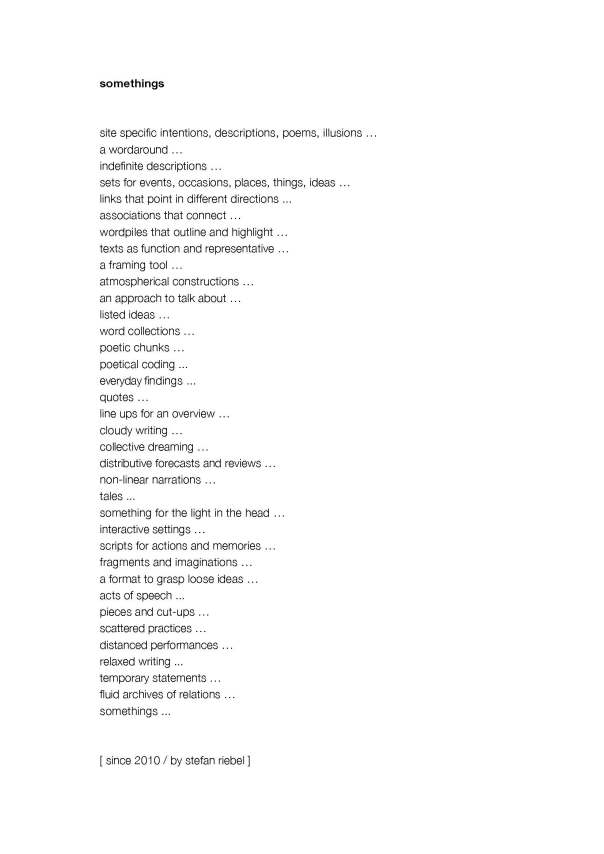
somethings is a series of language works Stefan sub-titles a gathering of “specific intentions, descriptions, poems and illusions.”  In a broader methodological statement this description turns prefaces a litany:

*


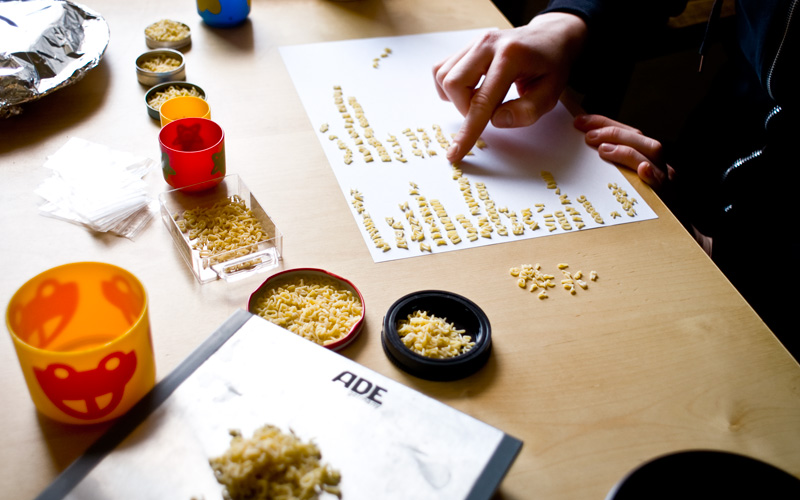
07/ for VerySmallKitchen was sent to me as a list in an .rtf file, as above but in Helvetica Neue. It appears on Stefan’s web site as a word grid that re-orders itself every 30 seconds . This mutability is evident in other works in the somethings series which, as well as their appearance on his web page, are realised by being projected and editioned as letter-seed kits/packets.

In an email, Stefan described the images in this VSK Project as “documentation of former realisations.” He noted “i do not have one illustrating the word set for verysmallkitchen, maybe you have an image for it ?”  I decided 02/10/11 to realise the following text:


… I recognise words/ entries as notations of things we talked about,  looked at, and moved amongst. Other words, which might also be transcriptions, remain mysterious. Perhaps the notation is in a language I/ both of us don’t know, which includes any English/ German.  Compared to transcription, notation accepts it has already forgotten. This gift holds in its distance-making.

Even as we talk together context is multiple (places/ languages/ moods/ times). This is only (politely) evident in the text, which could never be true to a single encounter, so is always layering infidelities upon infidelities. To try and trace its logic through a trail of referents is to admit the reader’s ridiculousness.

Error and Misspelling are not useful categories for reading. Punctuation or acronym are as immediate and vernacular here as speech and vice versa. Journal as data entry. Statements of emotion and mood might be html. Semi-colon and bracket make a smiley face.  The robot’s I remember is as funny as Joe Brainard’s.

This text holds close – through words and title – to (our) encounter.  It seems wrong to emphaise impersonality. Language’s non-personicity here (to invert a phrase Alain Robbe-Grillet uses of Roland Barthes’ texts in WHY I LOVE BARTHES)  is not smoothed by an evident constraint or system, nor known by its (appropriated) source. I should focus instead on the personicity your text offers evidence of.

To accommodate these tensions go empty the words into your city. This happens when words are projected in gallery or on a shop front or turned into seed-letter packets. When there are “only” the words – as in 07/ for VerySmallKitchen – it is the reader’s intelligence that becomes city via a meaning not threatened by sudden re-arrangements, ever attentive to the specifics of any multiple scaled event.

One example. Disblief ( I think) is dibelief.. .to (nearly) die keep the I but lose the plurality. Then blink. No internet. A conversation is an equality of berlin and raisin. Realise. If this is a new grammar then of course a proper name brings its own full stop as (almost) part of itself.


*


More info about Stefan’s work here. Co-founder of the institut für alles mögliche (institiute for all kinds of things) Stefan is now collaborating on the  Abteilung Für Alles Andere (department for everything else) which will run from September 2011- September 2012 as “a temporary office / laboratory / initiative for art and everything else.”

Films from Stefan’s UNTITLED project were included in I AM NOT A POET at the Totalkunst Gallery, Edinburgh  in August 2011 and are online here. View the complete series here.

VSK RESIDENCY PAUL ANTONY CARR: NATHANIEL’S PERPETUAL MOTION (3)

In Uncategorized on October 2, 2011 at 12:25 pm


“An individual need only possess a single sponge during the span of his or her lifetime. The sponges neither wear out nor diminish in absorbency. Most of the original models are still in circulation. Nathaniel inherited his from his father, who had previously acquired the sponge from Nathaniel’s grandfather. [ . . . ] The sponge compacts all that it absorbs into its core. Such is its efficiency that the area occupied by the compacted matter gains no measurable increase in volume during the course of a generation. Nathaniel envisions a future in which a sponge passed down a bloodline eventually accumulates, after many centuries, so much human detritus that it collapses into a shit singularity, and ultimately devours whole solar systems.”

2011. Ink on paper. 7 x 7.25 in.


*


“The extreme absorbency of these sponges guarantees that they are perpetually sterile. For this reason, it is common practice to both wipe up household messes and clean one’s genital and anal territories using the same sponge.”

2011. Ink on paper. 7.5 x 7 in.


*


“Nathaniel recalls his grandfather’s tales of toilet paper use; of how at times one could wipe and wipe and wipe after defecating with no indication of a progression toward cleanliness. Of course nowadays toilet paper has been replaced by superabsorbent synthetic sponges, which leave no trace of solid matter, nor liquid, nor even bacteria, upon their surfaces after wiping.”

2011. Ink on paper. 7 x 7 in.


*


This is the third post of Paul Antony Carr’s 3-month residency in the VerySmallKitchen. It follows Paul’s VSK Project here, which presented an aspect of his EXCERPTS project.

Nathaniel’s Perpetual Motion is a new strand of this project, and a series of image-text pairs have appeared on VerySmallKitchen since August. See part one here  and part two here.

DEMOTIC ARCHIVES OF ART WRITING: DICK HIGGINS: WHAT ARE LEGENDS: A CLARIFICATION

In Uncategorized on September 19, 2011 at 9:58 pm

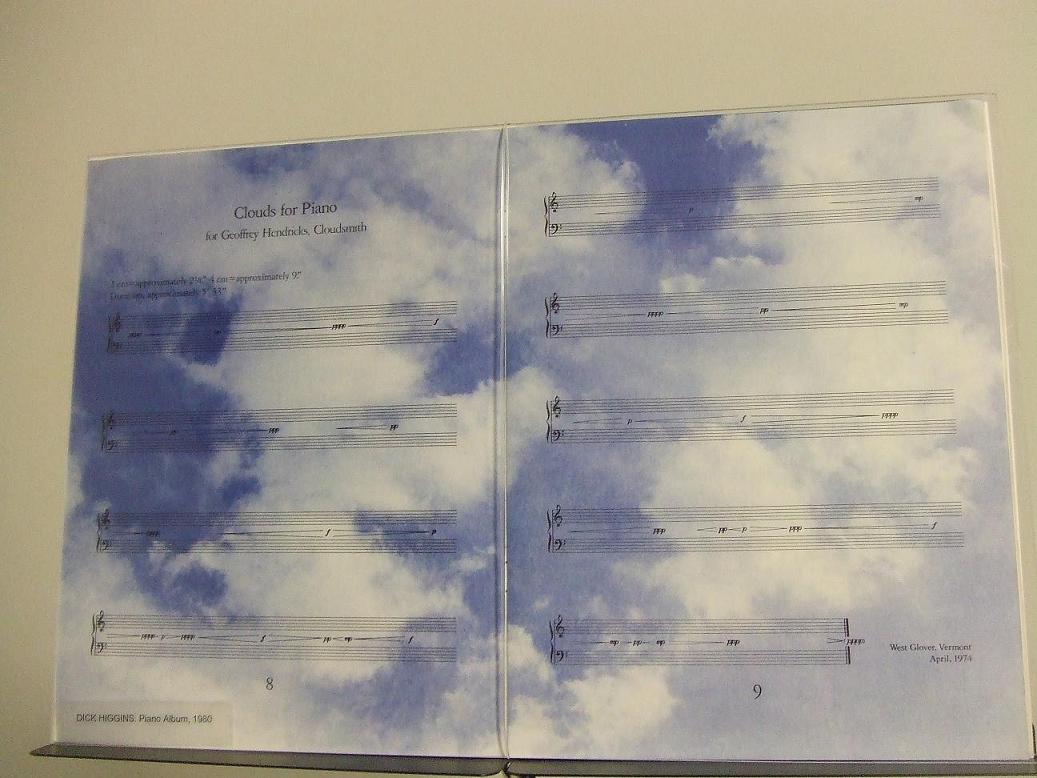
Dick Higgins: Sparks for Piano (1979) The darker, the louder: the lighter. the softer. Duration up to three minutes


What is a legend?

Dwight D.Eisenhower. Suppose Dwight D.Eisenhower. Impossible. Dwight D.Eisenhower an executive. Dwight D.Eisenhower a general not a general. Grant Grant. Grant Grant was a general and is a general and not a man.

Running against Eisenhower running against Santa Claus.

The depression exciting but not interesting. Not interesting. The depression not a legend.

Grant coming and going. Grant on a horse. Grant chewing cigars. Thank you Grant for everything.

1 2 Grant. 1 2 3 4 5 Grant. 1 2 3 4 5 6 7 8 9 0       1 2 3.

4 Grant I mean. Thank you Grant.

Sitting Bull famous. Sitting Bull very famous. Sitting Bull on tour. Chief Spotted Dear God Keep You. WIAL. Sitting Bull famous. Sitting Bull with his braves.

Sometimes more. Sometimes Sitting Bull climbing on a hill. Sometimes Sitting Bull calling the ghosts of his ancestors. Sitting Bull in action. Sitting Bull loving Mama Bull. Sitting Bull collecting. Was your Grandfather collected?

Sitting Bull if in action rapidly in action, having to be in action a need for being in thought in action happening in action. But not always in action.

Grant walking. Grant modest but chewing and walking and riding slow. Grant being walking and being drunk and just being and being and being and hurrying.

Sitting Bull being and more. Rapidity. City Bull moving. City Bull changing his mind and making war on the palefaces. City Bull and Al saying “Ugh. Mishugennah.” Sitting Bull possibly heroic, and City Bull certainly is heroic. Sitting Bull become heroic. Sitting Bull becoming. Eisenhower not becoming. Eisenhower hiding. Grant unbecoming but coming and going and being and working.

Is it possible when legends. Is it possible when legends being. Is it possible when history and legends being. History is nice. Can legends and spice be. Spicy bee in chocolate. Can you milk a cow. Can you offer. Offering is always legendary.

Legends and legends.

What legends and what horses and what indians and what soldiers. And what sages and what vegetables. And what meals there are and are being and have been.

Legends are grammar. Legends are the grammar of what we might be being. Hickory is not history. Sophistocation is the enemy of history. When there is no wind there is legend. When there is a big blow there is legend. Legend is hello. There are many legends that nobody has made. Sounds and legends growing like mushrooms in the night. Here we are, amazing. Are we amazing.

Can one be interesting. Can one be interested. Can one be history. Can one be legendary. Being is not historical. Being is history. Having been is history. Being having been. Having been being. That is legend. Legend means sometimes that you wear a hat when you go out of doors. Have you been wearing a hat.

Legend is smiling. Legend and seeing can be brothers.

Legend is donating. Legend is donating the present to the past. Legend is donating being to having been. To having been being. To having been present. To having been the present. Legend is grammatical. Legend is a pussycat and a catnip mouse.

One might have lived in a house. One might have been offering asparagus and tobacco and peas and donating is offering and trees and all the birds what what and what is seen.

Legend is without art. Legend is something else. Legend involves having seen. Legend rides to the moon on a hobby horse. Legend and Isaac. Legend the saints. Legend and dirt. Legend and Dr. Johnson. Legend and what painters are. Legend and what do you enjoy. Legend making action. Action making legend. Action is possible from legend.

Legend is what people do when they are almost asleep. Legend is what people do when they have hidden their minds. Legend is a garbage can, a sacred garbage can. Legend must be without art and with speed. Legend is in poor taste. Legend is without wit. Witlessness. Witlessness and form.

Wits make tables into tables. Then tables cease to be really tables. Tables turning into tables are not legendary. Tables and tables are legendary.

Tables and legends.

This is what tables and legends have done for you.

Abraham Lincoln.

This is called tables and legends.

This is what tables and legends have done for you.

Abraham Lincoln.

This is called tables and legends.

Tables and legends.

If an angel. If an angel dancing. If an angel dancing on a table. If an angel on a table dancing on an alter. Is an angel and altar. Is a table an altar. That is wit. This is not wit.

An angel on a table dancing on an altar.

Angels and tables. The life you save may be your own. Life guard.
If a bird. If a bird dies he lies in the bathtub.

Fat men. Fat men are ticklish.

It is bad luck to walk under a ladder.

Tie a knot and kill your enemy. Tie a knot and cure your ill. Abracadabra. Put in a nickle and out comes Butterfingers and Ray.

Ray.

Sneeze on Monday. Sneeze for danger. Sneeze on Tuesday. Love a stranger. Sneeze on Friday. Sneeze for sorrow. Sneeze on Saturday. See your own true love tomorrow.

What is the use of saving a small fish so that you can eat a large one. What is the use of having been Geographically a child.

These are all familiar having been thoughts. The thoughts of famous people.

But legends must be fast or they are not simple. Simple and true. Legends are wheels spinning and old automobiles coming. Legends are not geographies.

And so having been born was there but is.

I offer you a cigar.

Legend comes from places. Everything comes from the ocean. All the good words begin with C of which there are 7.

Thank you.

May I offer you a cigar.

Drop dead how sad.

What does it mean.

(                                       ) *

Ears.

Thank you.

Legending is done by ears. These ears are located in the center of the forehead, assuming that the C’s are in line. Lines do not curve. They sometimes swurve but they never curve. To see with your ears, what happens is not a line. Not if a legend. What happens is on the wall.

One might let the happenings happen.

One might not.

One might contribute.

1 and 1, and 1 in a box.

Being better.

1 might offer a fly his freedom. 1 might be clearly red. 1 might reflect the sun. 1 might not have enough air. 1 is many things.

Who are people anyway.

This is the most useless thought ever.

1 in a spaceship. What is 1 I will make 1. A little 1.

Here I am.

Once I climbed a hill, not a legend.

Here is a hill, not a legend.

A hill. Beginning. I climbing. Nous voyons …. no legend.

A hill. Climbing. I, fat, with grease in my hair.

A monkey’s cheek pouch. To damage. Abracadabra. Abstractly accessible. Banausic beans. Chug chug.

To the tune of twinkle twinkle little star.

Thanking and offering makes everything clear.

Somebody has ruined the soup.
The End

Here we come to the end.

Legends comes form the sixth sea, after everybody else has gone away.

Legends do not know.

Legends are what never know anything.

Legends move.

Ivor a legend. Everything is clear.

I thank you.

The End

Still not the end. I cannot call on the end.

Everything is clear.

I thank you.


Autumn, 1959

* Nobody home.


SOURCE: First published in 1960 by Bern Porter as a pamphlet. This text from Dick Higgins, Legends & Fishnets (Barton, Vermont & New York, New York: Unpublished Editions: 1976), 11 -17. For the original formatting see the PDF here. Spelling as in original.


APPENDIX


In his essay “The Strategy of Each of My Books,” Higgins writes:


What Are Legends (1960), my first book, is the theoretical text which goes with Legends and Fishnets (1958-60, 1969; published in 1976). It exemplifies my near-obsession with unifying my theory and practice, written as it is in my “legend” style; this style uses few verbs in the indicative mode, substituting participles wherever possible, in order to get a pictorial effect in words. Important conceptual models to me were certain late Latin poems in which strings of participles provide the movement of the poem (e.g., the “Stabat Mater”) and the last part of the De Quincey “English Mail Coach,” as well as the obvious modernist texts by Gertrude Stein and others. I printed it myself when I was at the Manhattan School of Printing, using a handlettered text and found-illustrations by Bern Porter, a highly original graphic artist and writer from Maine whose work I have admired for many years.


SOURCE: Dick Higgins, Horizons: The Poetics and Theory of the Intermedia (Carbondale: Southern Illinois University Press, 1984), 118.


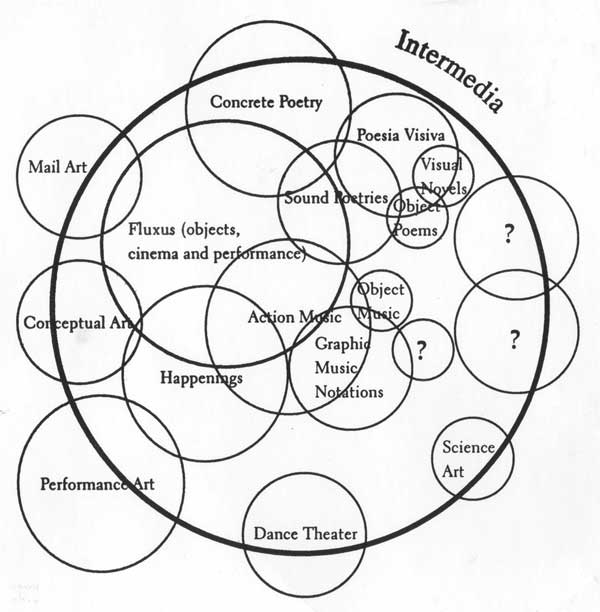
Dick Higgins, Intermedia Chart (1995)


Higgins was also a publisher of Unpublished Editions, so perhaps the cover blurb for Legends & Fishets can be seen as a further author’s note:


“Must a story consist only of what is told? Or can it also lie in the language? Or in the interplay among the ideas and images embodied in the words?

In Legends & Fishnets Dick Higgins sets out to use a whole bevy of unorthodox means of narrative. The legending idea is simply that the image of a person or thing can be reverberated in the mind to add to its stature – the man or woman may be small, but the shadow can be huge. These stories are told in terms of the shadows and afterimages of the subject. Higgins’s interest in this process is not a recent one – some of the stories were begun as early as 1957, and they were written on and off until 1970. The use of assemblages of participles (and its implicit avoidance of the verb to be) produces a strongly visual effect, heightened by very concrete language. The principle at work is William Carlos Williams’s formula “No ideas but in things!” more than some development out of Gertrude Stein’s concept of the continuous present, which these pieces superficially resemble in some ways, and to which Higgins feels sympathetic but unrelated. This the reader will discover when he comes up against Higgins’s emphasis on moral principle (in the lineage of Emerson) and interest in all stages of the time process, not just the present as with Stein.


These stories cover a full range of expression – from the farcical (“Sandals and Stars”) to the comic (“The Temptation of Saint Anthony”) to the nostalgic (“Ivor a Legend”) to the lyrical (“Women, like horses”) and more. If the expression is heightened by the form, then the form is justified. And it is here, on this assumption, that Higgins has hung his hat.”


*


Higgins’ work is still principally (un)available as second hand copies of books published through his own Something Else Press, Unpublished Editions, and Printed Editions, although Station Hill Press published a selected poems.

Higgins’ trilogy of critical essays remains a vital sourcebook of an artist thinking critically about practices of work with which they are themselves implicated as a practitioner. Ubu Editions have posted the second volume Horizons: The Poetics & Theory of the Intermedia (1984) online, and the third Modernism Since Postmodernism: Essays on Intermedia is still in print (scroll to bottom of page).

A READER that drew from the entirety of Higgins work would be a wonderful thing. Online sources for Higgins’ work include (at Ubuweb) his 1965 Great Bear Pamphlet A Book About Love, War & Death Canto One. The excellent Light & Dust have a complete collection of Higgins’ metadramas.


Trying to identify points of connection with contemporary practice, I illustrate this edition of the DEMOTIC ARCHIVES with, firstly, Higgins’ Intermedia Chart (1995), interested in how its proposition fits within the contemporary interconnections/ movement of language between formats/ contexts within art writing. It should be viewed within a history of diagrams in his practice, including “Some Poetry Intermedia” and “Five Traditions of Art History” (both 1976).

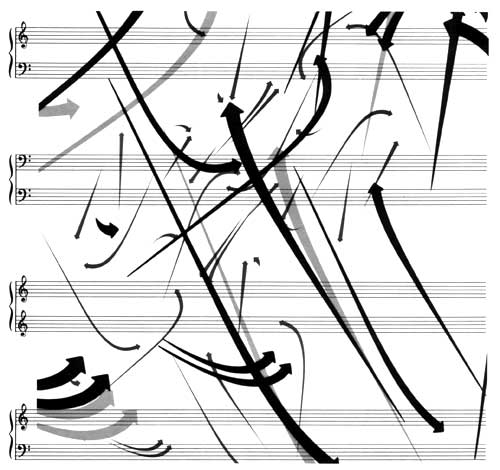
I also include examples of his musical scores, acknowledging Higgins’ own contention that “composer” remained a key identity for thinking through the entirety of his work across writing, performance, painting, book making and music (criticism?) (amongst others). As he told Nicholas Zurbrugg in an interview in 1993:


“I would say that I am indeed a composer, which is actually where I began, but that I compose with visual and with textual means. That’s a fairly accurate way of describing my approach. A composer is apt to work with more design in his approach than a prose writer, or a poet, or a visual artist, is apt to do. That is, the composer maps out the architectonics of a musical work. And that basic approach is the one I’ve carried on over all the areas that I’ve investigated.

I’m a person who sets out his form, usually in advance, and then follows it. It’s not that I don’t appreciate the spontaneous departure from that. But I’m usually happiest, and keep my best sense of proportion, when I allow the spontaneous to work on the details of things, but where the overall structure is one that has been preconceived and that I continue to use as a matrix. So I would say I was a composer, but not necessarily of music. Something like that is a good way to describe me.  And if people think of me as that, I’ll be quite happy. ” (211)


SOURCE: Nicholas Zurbrugg ed. ART, PERFORMANCE, MEDIA (University of Minnesota Press, 2004).


X MARKS THE BÖKSHIP RESIDENCY: ON Long hand BY SUE TOMPKINS

In Uncategorized on September 13, 2011 at 9:08 pm


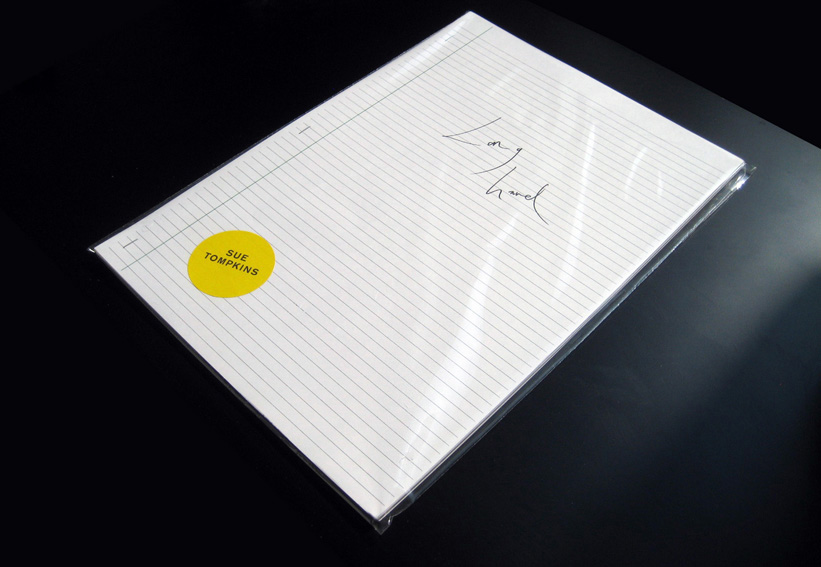
Long hand Sue Tompkins

LemonMelon 2011 \ £25 \ Softback \ 74pp \ 29.7 x 42 cm \ ISBN 978 1 908260 00 0 \ Limited edition of 250 copies


Involving music, performance, the typed, handwritten and exhibited word, Sue Tompkins practice has nonetheless remained resistant to the book. Although individual performances are formed from thick folders of loose pages, none of these have so far been bound and published in their entirety. If Tompkins gallery work can involve careful sequences of typed sheets, these too haven’t made the transition to chapbook or monograph.

When sequences have made it into print, they are often viewed in relation to performance. [1] The editors of F.R.David preface an extract from “Elephants Galore” by noting “the problematic nature of representing uttered words in space on a two dimensional page”, particularly when the page-stage relationship is “transitory” and any single  inflection is “instructed, or a matter of whim or chance.” Which asks whether Tompkins work – involving various stages of language on a page – can find a book form that doesn’t point forward and back, illustrative of both past and future vocalisations.

Such questions can now be explored through Long hand, the 76 page A3 publication published by LemonMelon, whose structure and contents were determined through a collaboration of the artist and LemonMelon publisher Marit Muenzberg, who together refined a fixed, bound sequence of pages out of an initial blue Blantex ring binder full of loose, handwritten notes. These “prototype” pages (typed up for gallery works or the folders used in performance) here become the end product.

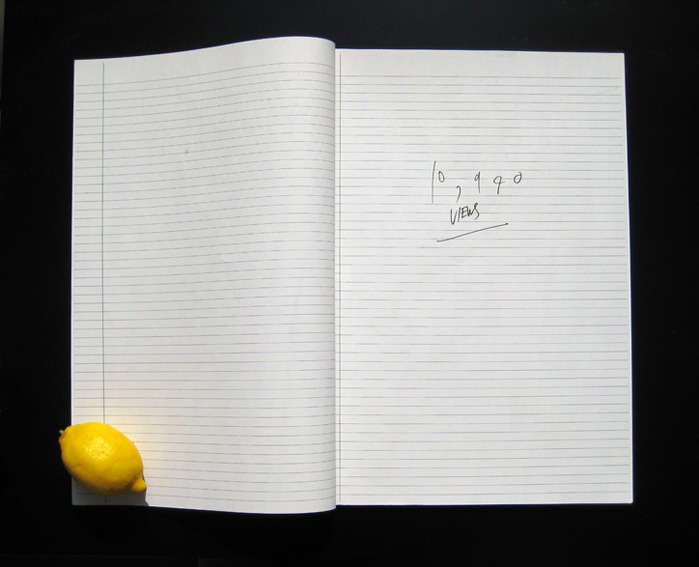
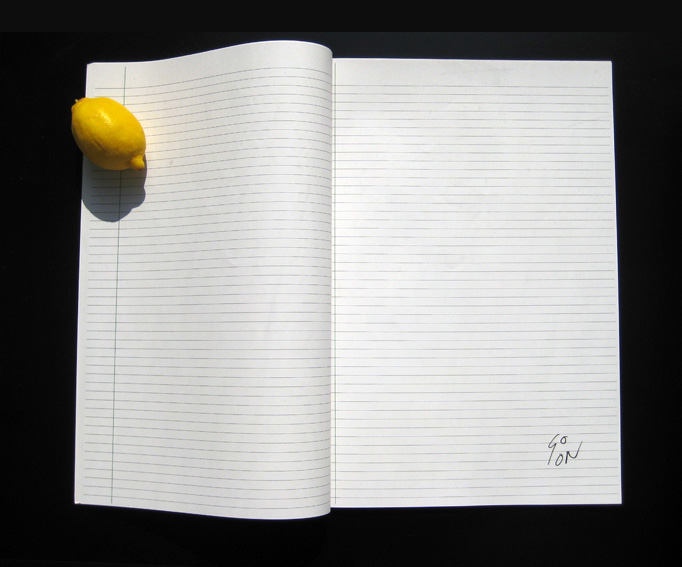
Open Long hand’s large pages and words appear on the recto only, excepting one appropriately turned around page on which is written “Reverse the System.” Green lined paper with a margin, although Tompkin always writes across lines. Scrawled texts, giving the impression of a swift, one take composition (actually some pages were re-written for legibility). Sometimes dense word patternings that, like the unwieldy book object and having to decipher handwriting, delay and uphold.


*


Whilst thinking about Long hand, I go and see Tompkins perform Hallo Welcome To Keith Street at the Hayward Gallery as part of the British Art Show, then later at the National Portrait Gallery for Electra’s Dirty Literature festival. The “same” piece in that the folder of sheets is the same, but each time a different set of decisions about what and how to read.


On a white plinth is a folder of pages each (it seems, we can’t see it) containing some written mark. Both performances see Tompkins work through the pages via an up-down bobbing rhythm of her body, forwards and away from/to plinth and text. At the Hayward inparticular, Tompkins is absorbed into her rhythm, but also open to the room, smiling at people she knows in the audience, checking who is coming in and moving around the busy space.

The spoken language unfolds out of the body, produced by its rhythms, but also having its own rhythm, which has to be mediated by the body. Maybe that tension explains the jerkiness of her physical movement. Language that, in the blurb for Long hand, Tompkins describes as “thoughts, statements, views, descriptions, feelings, emotions and things that are triggered by actual events.” In performance that also becomes a matter of timing, speech to song, formed thought and flickering synapses, mother and child…

Then Tompkins doesn’t move up and down, stands at the plinth, reads a few sentences for maybe 20 seconds. It would be a big surprise if such moments continued. Too fixed, too wholly written language, too Poetry, unmoving, which this has no desire to be, for long, if at all.


*


Long hand, then, elucidates Tompkins practice of the page by fixing it, closing it, however temporarily, for (her and our) consideration, doing this by not being a text that is comparable to a performance, so that language can itself be the focus (although if you go to a gig afterwards you will recognise a few pages, and there is an aspect of this book that is sampler, selected or reader).

I tried copying out texts as I read, but quickly wondered what exactly am I copying out? Each word and page is inseparable from its hand written shape, gesture, and rhythm, from its collaboration with that (long) hand (and there is a definite liking of lo———–ng letter strokes). Take two succeeding pages, both with the words Go and On, their written difference akin to two variant speakings.

Written in one take or not, the text as read asserts a present. It feels against this to go searching for art historical sources, seeing here the automatic, ascemic, found or spell (Hiller, Michaux, Porter, Artaud…), but I find them all inhabiting the space of these large pages (that perform for the reader idea of a notebook). Long hand as inhabiting Caroline Bergvall’s notion of “the midden, the middling, the middle, the meddle” of language. [2] Or, as on one page here would prefer to put it: “I know that sound/ HIYA.”


*


I’m listening to an online recording of a concert by Life Without Buildings, the Glasgow band for which Tompkins provided vocals. It is hard to make out the words of the vocals, but the tone seems clear. It sounds angrier, edgier than the two Tomkins performances I’ve seen, which have been friendly and open, the performer evidently pleased when the audience laughs, appealing to the audience through self-absorption not direct challenge.

This may be age (LWB folded in 2002) but it is also partly the band and the different dynamics of music gigs. Instead of the band there is now a lot of people in the National Portrait Gallery, uniformly sober, quiet, polite, and seated. Maybe the book is inbetween rock gig and NPG. Without an immediate audience to worry about texts can explore an unsociableness. There’s a life of this book, too, as object, sealed in its plastic wallet…


*


In an article on Karl Homlqvist, Melissa Gronlund argues the charisma of Homlqvist’s performances give his texts a coherence, whilst books and exhibitions reveal their fragmentary nature. [3]  In contrast, Tompkins performance style dissolves the text into an entwining of everyday discourses – overheard comments, half formed thoughts, lists, instructions, talking to oneself, questions – never settling at or allowing one page to overly determine the next, breaking off the sonic flow at points where Holmqvist continues.

In the less fleeting book, Tompkins gives up her control of what we encounter and at what rhythm and speed (such statements about the book immediately make me think if the opposite is also possible!). I am left to interpret the written marks themselves, which stresses a consistency of form, opens up an array of more literary interpretive procedures, although hand-ness cautions against this…


Long hand’s language includes: a celebration of a misalignment with the wor(l)d “pespi pespi pespi”; a working out -“BEAR HUG,” centred page bottom- of how the non-verbal moves into letter form and page space; repetition as  nervous tic, stop-start, careful working out of languages permutational possibilities “picking first/ stopping to pick first/ pick/ pick first.”


*


I took Long hand out of its plastic wallet, then stood trying to read it like a broadsheet newspaper. That scale is important – the size of the sheets would make them unwieldy and somewhat parodic in Tompkins usual performance style, page size and two staples deny such  return. (Large) Page as obstructive membrane, where sound and movement break apart “ha       aaa”.

The title explores this on the level of word and phrase, a familiarity whose weight and emphasis begins to be twisted (that capital L, both word forms rising), then encountering each reader’s varying assumptions about the meaning of capitals, line or placement. A totem of this new space declares, denies, celebrates, erases, sulks, escapes, clarifies, insists, protests, stops:


I wasn’t anywhere
I wasn’t being anywhere
I wasn’t


NOTES


[1]  See for example, Sue Tompkins, “Elephants Galore (extract)” in F.R.David, The ”Stuff and Nonsense” Issue, Winter 2008, 204-213, and “The London Section was in stereo” in Cathy Lane ed. Playing with words: The spoken word in artistic practice CR1SAP/ RGAP, 2008), 120-124.

[2] Caroline Bergvall, Meddle English: New and Selected Texts (Nightboat Books, 2011), 5.

[3] Melissa Gronlund, “Karl Holmqvist: Making Space” in Afterall 25, Autumn 2010,91-97.


This is the first of a series of essays written as part of VerySmallKitchen’s residency at X Marks the Bökship from Sep to Dec 2011.

DEMOTIC ARCHIVES OF ART WRITING: GUY DE COINTET ACRCIT (1971)

In Uncategorized on September 9, 2011 at 1:35 pm


This edition of the DEMOTIC ARCHIVES OF ART WRITING points elsewhere, holding itself like one of the studied poses in Guy de Cointet’s theatre pieces. Firstly, to the fantastic archives of Guy de Cointet’s work here. Secondly, to the slim, elegant monograph edited by Marie de Brugerolle.

Considering these resources, I wondered what aspects of de Cointet’s work could be most usefully presented on VerySmallKitchen. Perhaps the stills of performance works such as Tell Me (1979) and A New Life (1981) are most relevant…

In this mute form (only brief vimeo clips exists online), I find de Cointet’s stylised acts of reading and speaking alongside boldly coloured geometric shapes and furniture, articulate a scenography of art writing.

By this I mean a certain staging emergent from the workings of language within art practice, which can be traced from de Cointet’s work through to current lecture performances of, for example, Ruth Beale, Falke Pisano, and Francesco Pedraglio

I was also intrigued by de Cointet’s use of code, particularly TSNX C24VA7ME: A Play by Dr.Hun (1974, but recently published by New York’s 38th Street Publishers). If de Cointet’s theatre pieces suggest a scenography of art writing, then these works suggest writing (as a physical act but also as a form of publication, distribution and community) as code, both with and without key(s) for decoding.

Perhaps, for our purposes here, these come together in ACRCIT (1971), originally published by the artist in an edition of 700 copies. Stills of de Cointet’s Tell Me performance show ACRCIT being read and wielded as text and prop…


In her recent monograph Marie de Brugerolle describes ACRCIT as:


…a newspaper published in Los Angeles in 1971. Seven large pages, folded in two, made a newspaper of 14 recto-verso pages. It was silkscreen printed by Pierre Picot, a French artist who worked at the California Institute of the Arts. The title is printed in bold lettering; the page numbers are coded in letters. The paper includes texts encrypted in various manners: Morse Code, pyramids of figures, magic squares, and Mohammed’s signature of a double crescent (mirror writing mentions that the prophet traced his mark without lifting the point of his sword from the ground) all occupy the space like decorative motif’s, as do small palm trees.

This publication contains the principles at work in de Cointet’s other books and drawings: letters and figures function more as signs than as signifiers. De Cointet explores language by deconstructing it, in order to show that it is a question of systems. Reducing these systems to visual puzzles, he puts the reader in position of beholder, returning to a prelogical state when words were shapes and sounds. His anatomy of language is similar to experimental poetry of the early 20th century, influenced by Stéphane Mallarmé’s Un coup de dés jamais n’abolira le hasard (A Throw of the Dice Will Never Abolish Chance).

The early 1970s was also the heyday of structuralism and de Cointet was an informed reader of Barthes, whose essays deciphered systems and structures in order to reveal new relationships between form and meaning. With de Cointet the beauty and mathematical harmony of the world is translated into words and figures. This poetic alchemy relies on game-like systems, using chance as a creative principle. Language becomes a simultaneously mental, visual, auditory, and sensual experience.

De Cointet placed ACRCIT in free newspaper distributors on the street in Los Angeles. Passersby could thus procure an original if incomprehensible artwork, few of which were probably preserved. Jeffrey Perkins, the friend who was housing de Cointet at that time, recalls that the artist enjoyed the anonymity and “obvious invisibility” of things, which perhaps explains why the title itself, ACRCIT, remains mysterious. Several interpretations are possible. Homophony suggests the French word écrit (“written” or “writing”), or even ASII (American Standard Code for Information Interchange, one of the computer protocols that converts letters of the alphabet, punctuation marks, and other symbols into numbers).

Indeed, de Cointet used the binary system of 0 and 1 in his newspaper, although to indicate insignificant things.  “Only the small secrets need to be protected,” Marshall McLuhan reportedly said. “The big ones are kept secret by public incredulity.” We know that McLuhan bought one of de Cointet’s books in 1979, though there is no evidence that they ever met. But de Cointet certainly read McLuhan, and in ACRCIT he quoted the last paragraph of McLuhan’s Introduction to Understanding Media:


When radar was new it was found necessary to eliminate the balloon system for city protection that had preceded radar. The balloons got in the way of the electric feedback of the new radar information. Such may well prove to be the case with our existing school curriculum, to say nothing of the generality of the arts. We can afford to use only those portions of them that enhance the perception of our technologies, and their psychic and social consequences. Art as a radar environment takes on the function of indispensable perceptual training rather than the role of a privileged diet for the elite. While the arts as radar feedback provide a dynamic and changing corporate image, their purpose may not be to enable us to change but rather to maintain an even course toward permanent goals, even amidst the most disrupting innovation. We have already discovered the futility of changing our goals as often as we change our technologies.


At the dawn of the launch of the internet as a communications system devised by the US Army, de Cointet used coding methods that, although “low tech,” were equally sophisticated and widespread. What could be quicker and more direct than a free newspaper, openly available on the street, for passing information from hand to hand? Later, ACRCIT would be used in the theater pieces Iglu (1977) and Tell Me (1979).”

SOURCE: Marie de Brugerolle, Guy de Cointet (JRP Ringier, Zurich, 2011), 25-27.


Having copied this out I look back up at ACRCIT, considering again how de Cointet’s work offers sources both for scenographies of art writing, text as prop (held, pointed at, furniture) and codes as models for publication, distribution and practice more broadly.

I wonder how ACRCIT can be read in relation to its concrete poetry contemporary (also formed in relation with systems theory and communications technology), and how that too enters the present… different and combining… As game as enigma I note again Maria Fusco’s conception of art writing as riddle, the art object greeted by the writer as like for like, “essential obscurity with essential obscurity.”

As de Cointet begins and ends his contribution to the 1980 “Foreign Agents” issue of FILE magazine: “I can no longer find my way. / I wander about utterly confused./ Finally I stand still and engage in a short monologue…”


SOURCE: Maria Fusco, “Say Who I Am/ Or a Broad Private Wink,” in Jeff Khonsary and Melanie O’Brien, Judgement and Contemporary Art Criticism (Fillip Editions, 2010), pp73-80, p73. Image:  still from Tell Me, Rosamud Felsen Gallery, Los Angeles, 1979.


VSK PROJECT: MAURICE CARLIN: NOTES ON THE SELF PUBLISHER

In Uncategorized on September 8, 2011 at 3:18 pm


VerySmallKitchen writes: I first encountered The Self Publisher as part of  Preambles and Perambulations, an exhibition at The Charles Dickens museum in London, curated by Island Projects. Printed as folded and stapled A3 sheets, each issue comprised documents gathered from various copy shops throughout Manchester, later assembled and sequenced by Maurice Carlin.

As Maurice told the Shrieking Violets fanzine:


…I mistakenly took some stuff that had been left behind in a copy shop and I had it around for a while — I do tend to collect stuff. Sometimes you have something and you don’t know why you’re interested in it then later you realise why. Then later I thought ‘maybe all I need to do is present it differently.’.

…I’m interested in the photocopier as a format as it’s democratic — it reduces everything to a black and white image and flattens it all out. Even glossy magazine articles are reduced to a bit of text.

…It is accidental publishing. It would be quite different if I collected all the material I found on the street like scraps of paper — it is found in a place of publication and reproduction. Even if it is being reproduced for one person it is still being reproduced and published.

…I’m interested in how meaning is formed. The material I collect is both mundane and vital. A lot of it is things that are really important to people, for example propaganda — people copying 100 posters saying ‘Say no to the English Defence League’— or forms motivating people to do something.

…It’s a document of a moment just gone. I take all these different narratives and put them back to back.


See the full Shrieking Violets interview on The Self Publisher here.


The notes below are from an email exchange between VerySmallKitchen and Maurice in preparation for an installation of The Self Publisher at The Pigeon Wing in Sep/ Oct 2010 as part of WRITING/ EXHIBITION/ PUBLICATION.

From the beginning I had been fascinated by how the final magazines related to gathered materials. As well as making the publications available, I wondered if there was some way of showing the materials from which they were composed…


MAURICE: I do keep the copies that I find at the machines. I hadn’t thought of it before but yes, I think you’re right, there could be something interesting to explore between the ‘pile’ of documents (and it is a pile!) and the journals.


… It reminds me [the installations of Joseph Grigely] of a publication I attempted to make through collecting paper and other residue left behind from gig nights at Islington Mill. On the first occasion, I left paper and pens, pencils (in what I thought was quite a casual manner) around on the bar and on a few tables before people turned up for the event. In the main, I had zero responses. My guess was that the gig punters felt like they were being ‘set up’ for something.

On the other occasion, I didn’t do anything beforehand but simply collected what I found afterwards. There were some great things in there including a series of interesting/banal conversation notes written on the back of a few flyers amongst what I assumed to be 2 flat mates about an electricity meter reading earlier that day. Although, it was a small gig with only 30 – 40 people sat around at tables, the bands were incredibly loud and I assume the conversation notes were written though one of these loud sets where it would have been impossible to talk! So, I was able to make a publication for that one.

Grigelys piecing together of the notes to create narrative is interesting. I guess I do this also in the sense that I have the opportunity to choose the order in which each 2 months worth of collections will sit in the journal. My editing process stops there but I am interested in what happens when these multiple ‘discourses’ are brought together back to back. (Propaganda, personal appeals, official documents, academic texts, musical scores, letters, memo’s etc etc)


…The collections for July/Aug [2010] so far include a Primark pay advice slip, a Bar Mitzvah seating plan, ‘Sharon, the latest and greatest employee of the month’, pages from a Polish/English reading manual which contains questions like ‘ Q. Can we cut bread with the thick edge of a knife? A. No, we can’t’, ‘ Q. Why do factories put food in tins? A. Factories put food in tins to conserve it’, ‘Q. Can we balance a dinner plate on its edge? A. Yes, perhaps we can balance… but it’d be rather difficult and would depend on the type of plate’


Something I looked at was the concept of “agonistic democracy” as written about by Chantal Mouffe and Ernesto Laclau, the idea that democracy in the social sphere should ideally be based around dissensus rather than consensus, that we are a community of differences rather than bonds and by opting for one meaning or discourse, we potentially exclude a whole lot of others.


“Any discourse is constituted as an attempt to dominate the field of discursivity, to arrest the flow of differences, to construct a centre.” (Laclau & Mouffe, 1985, p112).

“The practice of articulation (…) consists in the construction of nodal points which partially fix meaning; and the partial character of this fixation proceeds from the openness of the social, a result, in its turn, of the constant overflowing of ever discourse by the infinitude of the field of discursivity.” (Laclau & Mouffe, 1985, p113).


…So, I’ve been having a play around with how the journals and the piles of collected material could be displayed in the Pigeon Wing exhibition. A few photos are attached…


I’ve been using parts from a collection of old 1980’s green Crystal ‘suspension files’ that I found recently in a skip. The green binder parts are a perfect fit for the journals. In the photograph here, I’ve left the tab on which says something like ‘Ass. Furniture’. These remind me of the victorian wooden binders to which newspapers in cafes and libraries would be attached to, I don’t have the name for them? I could attach some string or ribbon through the holes and these could simply be hung around the space. I guess there are links to be made with found materials and I also like the associations with ordering and redundant systems for ‘managing’ documents.

The 2 other pictures here are where I’ve been scattering the piles of collected papers around the floor. In some cases chalking out their outline, collecting them and dispersing them again, repeating this process to build up a series of outlines on the floor.


I’ve attached some images below showing some further ideas that I’ve been experimenting with for showing the work. I’ve put some text under each image to explain further.


Hanging the journals using builders ‘string line’ attached to the holes in the suspension files. The string line is coloured yellow for ease of visibility and I guess there are obvious associations with order, measure, standards, containment etc


As above


Using rejected pieces of buckram bookcloth (found and purchased in a bookbinding suppliers factory), I’ve wrapped the piles of collected material loosely and arranged on tables. I imagine that this is a presentation which would allow visitors to the exhibition to leaf through the material and it not being important if documents were put back in a different order, fell onto the ground etc.

There is a connection here with the photocopies, both being rejected materials not fit for purpose, although it may not be immediately obvious with either. There may also be a common theme in both the bookcloth wrapping and the use of the suspension files (and perhaps in the journals themselves) as being at the same time both an acceptance and a rejection of order.

Acceptance in the sense of going part way towards realising a system of classification which would attribute ‘meaning’.  Rejection in the halting of the binding/finishing/editing process part way leaving everything unresolved and open ended.


As above, laid out on 2 tables


The journals linked to each other using wire and hung from a central point. As a display or composition it has a cascading, tumbling effect which I like but perhaps is overly cumbersome to read..


….


DAVID: Are you still thinking of the chalk markings/ scatterings as a possibility for The Pigeon Wing?… I had been thinking of a central space in the centre of the room for your installation. Think of it as a rectangle in the middle of the space about a metre and a half wide and two metres long (roughly).

I like the images of the long tables a lot, but am slightly worried that there are several table projects already (projects that don’t adapt to another form)  and that anymore would make the space difficult to navigate. We also have an archive/ reading space at one end so I’d like to have some different form of engagement in how other projects are presented…


MAURICE:  I’ve had a look at the picture of the space again. There is a nice rectangular black patch to the centre of the floor which would probably make good ground for chalk lines. It looks as though there may have been a table or perhaps a piece of machinery sitting there before in a previous life of the building? with the footworn parts around the edges…


THE INSTALLATION


(1)


(2)


*


If each issue of The Self Publisher is a mapping of Manchester, as a concept it can be applied more widely.

One of the issues displayed at The Pigeon Wing had been made during the occupation in protest at the closure of Middlesex University philosophy department. After The Pigeon Wing, in December 2010, Maurice Carlin made an issue as part of Midnight Coffee Preview in Antwerp. As Maurice told the Shrieking Violets:


…I had no idea if it would translate into a different place. In Antwerp I had to make more of a choice when deciding which material to put in. There was more material in English than I had expected and I chose more in English than was perhaps representative.

…I was really surprised the things I found related so directly to the place. Lots of the material related to Antwerp, for example one person wrote an abstract about Antwerp as a port town.

…Someone suggested I should go ask copy shops for the material. I went in to shops and asked if they had any old paper they were going to dump. There’s less suspicion of that kind of thing there and they handed a pile over. I asked copy shops when I got back to Manchester and they said they couldn’t possibly give it out for confidentiality reasons.

…There is more openness and transparency in Antwerp.


As I compile these notes – in the process of writing an essay on Maurice’s work – he is artist in residence at Banner Repeater, the gallery and artists bookstore/ archive on platform 1 of Hackney Downs railway station.

When I first visit, copy shop findings are arranged on the wall. For the show’s opening the new issue is published. The design puts “PUBLISHER” on the front cover, and “THE SELF” on the back, which is a starting point for thinking how artist/ asssembler/ editor  both appears and disappears throughout the various stages of entwining between container and contents…


For more info and to purchase/ subscribe to The Self Publisher email Maurice at deaddigital@islingtonmill.com