verysmallkitchen

Archive for the ‘Uncategorized’ Category

EVENT: QUESTION TIME AT CAFE CARBON ON FRIDAY 19th MARCH

In Uncategorized on March 17, 2010 at 11:57 pm


On Friday 19th March, as part of the Question Time project, I will be reading with Rachel Lois Clapham, Alex Eisenberg and Mary Paterson at Cafe Carbon, an evening exploring art and climate change in the aftermath of COP15. The evening is curated by the The Gluts (Gina Birch, Kaffe Matthews, and Hayley Newman).

Part of our reading involves a representation and reconsideration of our Statements of Intent project. According to the original project description:

Each day Question Time hold a summit somewhere in Copenhagen- in cafes, street corners, domestic apartments, and train stations – after which a new statement of intent is produced towards an alternative declaration of the way forward on climate change. 

I previously wrote about this project  here.  The full archive of the project can be seen here.

Cafe Carbon is the third in a number of projects working with the Question Time archive to think through the implications of our time in Copenhagen. It follows on from two projects commissioned by CSPA (Centre for Sustainable Practice in the Arts): a curated transcript of our Copenhagen interviews for CSPA Quarterly  and three podcasts from our archive of interviews and encounters. 

My own project since December has been a fictional novella based on being in Copenhagen during COP15. This project uses fiction as a space for  exploring the relationships between politicians, activists, NGO’s, artists, and other groups that made their way to Copenhagen for the conference. It utilises fiction as proposition and provocation, creating a fantastical melding of these diverse groups, separated in actuality but endlessly intertwining in the novella’s never-conversation. We are organising a salon to present this work, and new writings  by Mary Paterson and Rachel Lois Clapham. More details available here soon.

The Ladies of the Press


Also on Friday night The Ladies of the Press will be creating a live magazine. I first worked with LOTP (Ana Čavić and Renée O’Drobinak) at the Permanent Gallery last year, as part of my Testing Grounds performance. In their own words: 

The Ladies of the Press* are Ana Čavić and Renée O’Drobinak: a performative publishing duo based on a contemporary art practice that re-imagines the role of the publisher into a theatrical persona. Each project focuses on ‘enacting’ a publication, extending the act of performance in to the realm of print by citing the page as the primary outlet for the work, thriving on a collaboration between the Ladies of the Press*, each participant and the space that surrounds the publication.

Friday’s Cafe Carbon will also include performance and presentations by  The Planetary Pledge Pyramid; Kristian Buus; The Laboratory of Insurrectionary Imagination; and Emily James .

AN ARCHITECTURE FOR AN ART WRITING FIELD STATION

In Uncategorized on March 10, 2010 at 12:16 am

FROM AN EMAIL: Hi Jin, here is A TIME LINE FOR A ONE MINUTE LECTURE: Introduction: 0-10  Art writing field station; 10-20 Project Poetics (after Tatlins Tower); Case Studies: 20-25 The Office for Soft Architecture; 25-30 Paul Thek’s 4-Dimensional Design; 30-40 Poet Talk Architecture: Meyerhold Lectures to Eisenstein; Methodologies: 40-45 Rothko’s studio; 45-50 Olafur Elliassons studio; Conclusions/ Possibilities: 50-55 Anti-Object; 55-60 The electromagnetic Infrared. All best, David.

THE ART WRITING FIELD STATION implies a built structure. What would that structure be, and what kind of structure (conceptual or actual) is brought into being by the discussions and ideas that occur at field station events? This set of materials by Hyun Jin Cho (images) and David Berridge (words) was first developed as a 1 minute presentation on this subject. After an initial conversation I  wrote the above outline, and text and images were then developed by each of us separately. 

NOTE: The following quotations are what I thought would make a 1 minute lecture if I talked very fast. After a run-through of this lecture was timed at 13 minutes, I read only those words in bold. 

Introduction

0-10  Art writing field station

the art writing field station implies a built structure…. maybe the actual structure in which the field station events are housed… or maybe a conceptual structure implied by the nature of those events… maybe we invent a machine that translates conversation into built form

 10-20 Project Poetics (after Tatlins Tower)

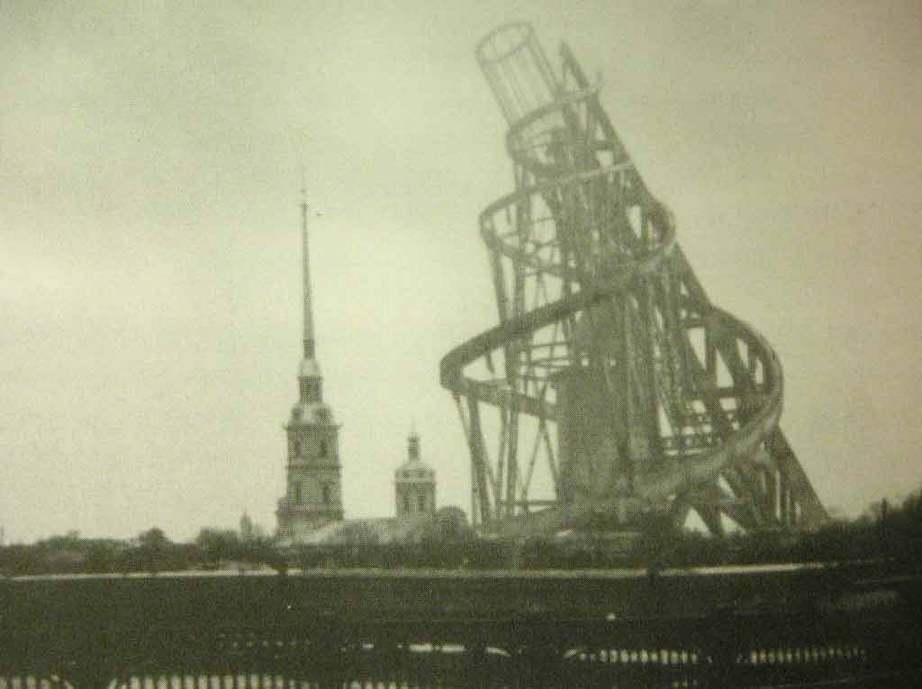
instead of speculating on the technical feasibility of its construction… it is more productive to think about the tower’s actual history as a model and a project that openned up a new dimension of this intermediary and transitional architecture, which also may be called an architecture of possibility… a crucible of possibilities and inspirations, not a utilitarian blueprint. 

Case Studies

 20-25 The Office for Soft Architecture

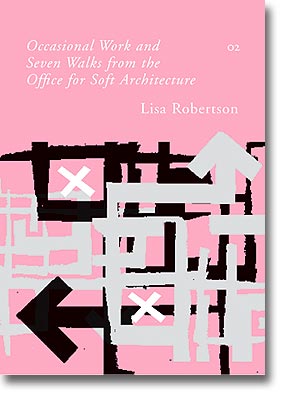
I tried to recall spaces, and what I remembered was surfaces. Here and there money had tarried. The result seemed emotional. I wanted to document this process. I began to research the history of surfaces. I included my own desires in the research. In this way, I became multiple. I became money.

 25-30 Paul Thek’s 4-Dimensional Design 

Design a labyrinth dedicated to Freud, using his photo and his writings.

Design a Torah.

Design a monstrance.

Design an abstract monument to Uncle Tom.

Design a feminist crucifixion scene.

Etc. Etc. Etc.

30-40 Poet Talk Architecture: Meyerhold Lectures to Eisenstein

His [Meyerhold’s] lectures were mirages and dreams. The listener would jot down something feverishly. But on waking up, he would find “the devil knows what” in the notebooks. One can recall in the finest detail how brilliantly Aksyonov analyzed The Merchant of Venice, what he said about Bartholomew Fair and the triple plots of the Elizabethan dramatists. But one cannot remember what Meyerhold said. Aromas, colours, sounds. A golden haze over everything. Elusiveness, intangibility, secret upon secret, veil upon veil – not seven of them but eight, twelve, thirty, fifty! 

Methodologies

40-45 Rothko’s studio

 Rothko’s work in the studio revolved around processes of trial and error: testing various mixtures of paint, drying times, hanging heights, and so on, and making adjustments. And, again, looking – for hours, days, even weeks. 

 45-50 Olafur Elliassons studio

 the studio as a place where things are made as well as administered… both the romantic idea of the workplace and the administrative notion of the office. The very act of naming the studio resembles both the ‘discovery’ of a new terrain and the gesture of creating a brand…. a “dyanmic aggregate of flows and productions (informational, material, economic) (…) a four-dimensional object in space-time… it is a microcosm, a “small city,” and a “model for community.” (173)

 Conclusions/ Possibilities

 50-55 Anti-Object

We no longer need to fist freeze time into an object… Today, we do not depend on the mediation of objects to intervene directly in time. Time has become something more immediate. Space has become continuous with time.

 55-60 The electromagnetic Infrared.

 The infrared is a shape that causes and inflects other shapes. Its presence is that of a morpholgical seed growing holographically within, and leaving its characteristic distorting signature on the shapes around us, within the world of concrete appearances.

BIBLIOGRAPHY

Svetlanya Boym, Architecture of the Off-Modern(FORuM Project, Princeton Architectural Press, 2008)

Paul Thek, selections from “Teaching Notes: 4-Dimensional Design”, in Harald Falckenberg & Peter Weibel, Paul Thek: Artist’s Artist (MIT Press, 2008), 393-395.

Lisa Robertson, Occasional work and Seven Walks from the Office for Soft Architecture (Vancouver, Clear Cut Press, 2003).

Sergei M.Eisenstein, Immoral Memories: An Autobiography (Peter Owen, 1985), 76-77, bold mine.

Morgan Thomas: “Studio Vertigo: Mark Rothko” in Wouter Davidts & Kim Paice eds. The fall of the studio: artists at work (Valiz, Amsterdam, 2009), 32-33.

Philip Ursprung, “Narcissistic Studio: Olafur Eliasson” in The fall of the studio: Artists at work, 175.

Kengo Kuma, Anti-Object (Architectural Association, London, 2008), 31-32.

Swanford Kwinter, Far From Equilibrium: Essays on Technology and Design Culture, (Actar, Barcelona), 162-3.

REPORT: ART WRITING FIELD STATION: THE LEXICON RETURNS

In Uncategorized on March 9, 2010 at 11:26 pm

Sara Lane Studios March 7th 2010

Last Sunday night the ART WRITING FIELD STATION met for a conversation about the meaning and possible applications of Marianne Holm Hansen’s lexicon of art writing. Actually, I probably shouldn’t call it a lexicon. One of the fascinating things about this project is how difficult it is to even find a short hand word for describing it in conversation. Score? List? Diagram? Drawing? Minutes? I have yet to find a word  that feels right.  

Given this difficulty it seemed useful to start with some definition. Helen Kaplinsky looked up each word in a large, hard backed dictionary. Each definition was read aloud, before being covered in glu and the page sealed. Several times we asked for clarification, to hear a definition again, but it was too late, glued and gone.  

Helen notes: “The reading process is a meeting between two bodies of knowledge, and in this meeting the pedagogical body of the book is destabilized by the subjective touch of the human body. This project allows for elaboration for further performances or to present the work in publication form. A further performance may include re-reading the pages where the definitions once were, most probably consisting of a jumbled nonsensical reading of various definitions which have coalesced.” A previous project enacted something similar upon the Encyclopedia Britannica.

Kaplinksy’s performance brought to mind a number of book-writing-art projects, where the textual encounter instigates a process of  book destruction or transformation, including John Latham’s 1966 digesting of Clement Greenburg and Marcel Broodthaers act two years earlier of embedding unsold copies of his books of poetry in plaster. 

All these works work with and against a fetishistic reverence for the book object, relating to the actual and implied content by rendering it as (devastated) form. So Latham’s act of book eating was focussed upon Clement Greenberg’s essay collection Art and Culture; whilst Broodthaers act was a personal ritual marking the shift from poet to artist.  Helen’s performance had a considered and meditative tone, but its  implications for the book itself were just as severe!  

In preparation for the evenings discussion, Marianne Holm Hansen had cut out all the words on her list from another dictionary and placed the small pieces of thin paper in a petri dish. This also balanced construction and erasure,  the small slips juxtaposed with a dictionary now composed of gaps and piecemeal pages,  where new words fitted into the skeletal gaps to create new orders. It was hard, if you needed to, to find a particular word in the petri dish, the definitions becoming lost in their new materiality. We noted the slip for POEM had the definition for PNEUMATIC fitting perfectly on its backside.  

After 15 or so minutes, Helen stopped reading and wondered what length her performance should be. It would have been good to read and paste the whole list, but it quickly felt like this would take several days! The time of listening to the definitions, made Marianne observe that only words that were emotions should be kept on the list. This was the original focus of the for the record project, but the Five Years session had expanded into more general minute taking, including phrases. This seemed now to have been a mistake, too akin to what would be Marianne’s own process of note making, and not true to  the rather different process required by for the record.

As for my own notes: I became aware of our own additions – often adding “ed” to words to shift language into a dynamic state. I noted the relation of a word to its definition seemed paralleled by the relation of the word to the whole list. I enjoyed the humor of focussing on the minutiae of language definitions (What should one do when words – mis- or alternatively spelled – are not in the dictionary?). I noted how, once the word became separated from its original context, all its other possible definitions became operative once again.  

Also on Sunday night I presented a text piece FROM SCORE TO HOUSE TO ISLAND TO DINNER TO STORY TO POEM. The text had been a series of writing experiments, in response to the leixcon, conducted throughout the preceding week. I’d proceeded through the experiment as they occurred to me, not sure what was taking shape, later editing the text and fragments into a new body, freely moving around and editing without fidelity to the original exercises. 

FROM SCORE… was interested in an ethics of relationship: what did it mean to write in relation to the Marianne’s list? Often I found the text itself offered the best language for its own description. For example, my own attempts to articulate the lists unfolding pattern gave way to a description drawn from the vocabulary itself:

it digests, it manifests, it misspells, it conducts

it backwards, it dreamed, it fixated, it forced

Starting from an interest in score and script I ended up trying out a number of poetic strategies – syllabics, for example – interested in the imposition of these fixed systems, perhaps an appreciate of the Oulipo strategies, but more flexible. For example, part of my text entitled  “A Short Adventure Story” corralled such words into genre, in doing so enabling them to function in multiple ways: 

 I scratched. The slippage was slippery. Suspended in reverie, relinquishing control, I rephrased. I turned into a transitional threshold. The coming together of two different things worked: Secure and writerly. Unconsciously influenced, I worked backwards. Under the weight of things, I shared and I spammed. 

Later, layer upon layer was malleable. I interrupted, patient and performative. Outside, interactioned, I needed poems. The multiplicity, incorporated, hammered on top of tools. I needed and mis-used, playful and hands on. I modeled. It was just how I liked it: practice was provisional and potential projected.

Wanting to think through the workings of constraint, I came upon this quotation by Vanessa Place: 

Because I do not believe in the parsing of condition and content, I think it is a false advantage not to reveal form, and that the more intentionally hidden the constraints, the more the work proves a coward’s coup, where the shot is not called, and responsibility dodged, but all credit taken for whatever’s dug up. I also think it equally pathetic to assume every constraint should be revealed, as many matters bubble beneath our meanings. Show all the cards you like, and then there’s the dealings of geography and psychology, matters of some fact and great fancy, there’s mutation and desecration, and the hope of better things, there’s candlesticks and sealing wax and the pink buds of a pig’s wings. 

We write now, are read then, and inbetween the writing and reading lies the incipient sublime and a future quite conditional. Whether we are reluctant gods, or those who elbow in, the consciousness of the concrete means our creations go on regardless of our intentions, willed free though wrought determinate. Rather than pretend not to be casting in clay, or trying to duck the consequences of conception, he author must lean in, attempting to force as much as possible from a form while constantly compressing its constituents. It’s candy-making and atom-splitting, fission with a toy surprise inside.

SOURCE: Vanessa Place, “Form: Revealing or Not Revealing” in Christine Wertheim and Matias Viegener eds. The Noulipian Analects (Los Angeles, Les Figues Press), 87-8.

For ten minutes I read FROM SCORE…. alongside, over the top, underneath and inbetween  Helen’s dictionary reading. Listening whilst reading turned the dictionary entries into novelistic narratives, that I couldn’t quite grasp, but which were rich in character and incident. There was a considerable energy generated by this juxtaposition of texts, each with its own mix of specificity and variation, something of which is captured in the photographs below: 


Hyun Jin Cho was interested in consequences of writing the lists twice. She discussed a proposal to cook two of the same food stuffs, as a way of highlighting the similarity, difference and impossibility of replication. But what food stuffs would best illustrate this? Jin suggested burgers. Later in the evening, Matthew Mackisack presented a series of responses to the lexicon, improvising around three words inparticular: (1) reverie, (2) control and (3) performative.  

Matthew talked around issues of the “picturable,” whether words conveyed a sense of the visual, and where and how there might be a space for thinking beyond the visual. In regards to Marianne’s list, control was a way of asking whether forms of writing were allowing some thoughts and disallowing others. One mental exercise for exploring this issue was to look at the chart without knowledge of where it came from and to ask, as Matthew did, “what situation could have given rise to these words?”

Matthew’s method highlighted the list as a score for a conversation, or a more formal spoken discourse. This evoked memory palaces – the list as mnemonic – as well as how talk figures as poetry in the work of, say, Steve Benson, David Antin and – on a more performative, self-styled “demotic” level – Chris Cheek.  Cheek’s description of his writing process is, like Antin and Benson, a further elucidation of a POET TALK ARCHITECTURE. I wonder, in this context, how much these words also apply to Marianne’s list:

 … models of poetic writing practice drawn out of engagement with demotic tensions between self, community, neighborhood and the public sphere. Documents in conversation with the demotics of attention, not to say at times mundane, but complex occasions of linguistic experience – open to off-the-cuff commentary and exquisite interference, uninvited intervention and reflection. Ways by which the ordinary can be rendered extraordinary. Writing thought through at every stage, full of decision and with a sense of mediated, conscious performance in every aspect of its making; a hang of interstices, jolts, between utterance and silence (given that both cod categories remain porous to the other).  

 TEXT SOURCE: Chis Cheeks preface from his recent collection part: short life housing (Toronto: The Gig, 2009), ix.

I write down another phrase from Matthew’s talk: “transfer idea across.” I unfold this into a tentative definition of  the process of for the record: to translate for and into unknown future(s).

THE EXHIBITION PROSTHETICS OF INVERNOMUTO

In Uncategorized on March 5, 2010 at 10:39 am


INVERNOMUTO describe themselves as an “audio-visual experimental group born in 2003 and based in the Italy countryside.” I first encountered Simone Bertuzzi and Simone Trabucci of INVERNOMUTO through their ffwd_mag project, each issue of which takes a different physical and conceptual form.  

The group have their first solo exhibition in Italy, entitled B.O.B, opening on April 8th 2010 at Gallerie Patricia Armocida in Milan and ahead of this they have been distributing a series of trailers – the first of which is above. The trailers don’t feature in the show themselves, and the TV series or film they seem to be announcing will never be shot.  

The trailer’s issues of fiction, personas, storytelling and projects that will never be realized, related to several projects here at VerySmallKitchen. I exchanged a few quick emails, and expect the questions to continue as trailers 2 and 3 coming along…

VSK: (1)Why fiction? (2)Why the storyteller? (3) Why B.O.B? 

INVERNOMUTO: 

(1) Well, it is not just a matter of fiction, but maybe an attempt to work on the borders of the real. The subject here is memory and its shape, the way it comes out from different degrees of reality.

So, narration is a safe place, it allows you to navigate through different objects, references and imaginaries; there’s a grey zone between fiction, dreams, memory and real, something really dense, like glue, that’s why it’s so necessary. You cannot escape from it.

(2) We thought it was so necessary to have an omniscient presence who drives you through the project. The voice is very terse, it sounds familiar but at the same time it is not so distant from the stereotyped documentaries voice-overs. Moreover, the storyteller is John Duncan (artist and musician from LA – living in Italy since a couple of years) and to us this add a further, extremely interesting, level to the project.

We couldn’t choose a professional speaker, we just didn’t need only a voice, but an articulated block of memories, imaginaries, and even fictions.

(3) It stand as Bob Over Bob.

VSK: (A minute or so after asking the other questions) …oh, am also curious how these ideas – of fiction/storyteller/ persona – become explored in the exhibition? Why is the exhibition form a good one for these explorations? Is the exhibition a form of fiction?

INVERNOMUTO: Absolutely it is. In a way it is the manifestation of fiction. We think at the exhibition as a kind of puzzle of objects, photographs and archive materials; the viewer can connect and construct his own image of narrative paths, characters and their actions, but he won’t be able to figure out a precise and detailed picture. In this sense trailers are extremely useful. But we decided not to include trailers in the show to give the audience more possibilities of reading.

____________

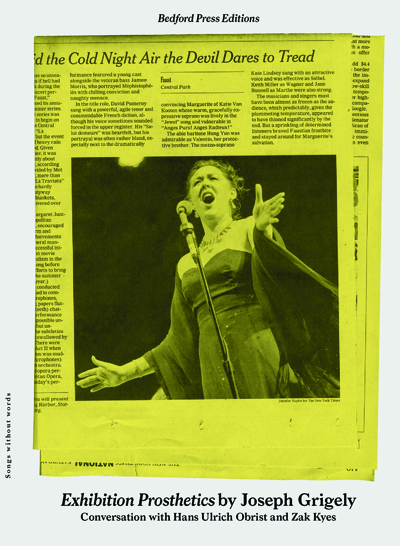
A READING NOTE: As I watched the trailer I was reading Exhibition Prosthetics by Joseph Grigely (Bedford Press Editions & Sternberg Press, 2010). Grigely is using the term “exhibition prosthetics” to describe an array of conventions that are part of  “the machinery of exhibiting” – such as titles, labels, and catalogues – but not conventionally seen as part of the art work.

Grigely proposes a new awareness of such spaces and materials, presenting numerous examples of artists working and re-working such forms, observing:

In this respect, moving closer to the artwork involves moving away from the artwork – to look closer at fringes and margins and representations, and ask what seems to me a very fundamental question: to what extent are these various exhibition conventions actually part of the art – and not merely an extension of it? (7)

Invernomuto’s trailer of course engages this attraction to “exhibition prosthetics” – the desire to extend  the “body” of the exhibition into forms outside of what it is conventionally composed. But, of course, their trailer is not really a convention of the art exhibition, it’s something more akin to TV or cinema.

In Invernomuto’s conception of “exhibition prosthetics” – as often with Grigely – the prosthetic explores the possibility of becoming the whole body, and there’s less sense of a custom-made prosthetic or a stable vocabulary of (exhibition) forms to be appropriated, more a melange of forms, adaptations, cross-circuitries…. 


POSSIBLE ARCHITECTURES OF THE ART WRITING FIELD STATION (2): POET TALK ARCHITECTURE

In Uncategorized on March 4, 2010 at 9:16 am


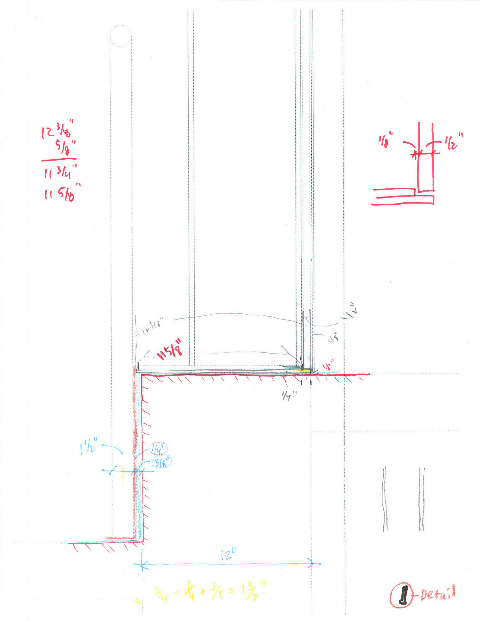
Robert Smithson, Towards the Development of a "Cinema Cavern" (1971) Pencil, photography, tape. 12 5/8" x 15 5/8".


In thinking through connections of poetics and architecture I keep returning to the phrase POET TALK ARCHITECTURE. I remain unsure of what the phrase means, but have gathered below several statements and explorations, eager to see if they can contribute to this new quest for the built form of the ART WRITING FIELD STATION. Like the field station project, POET TALK ARCHITECTURE is interested in the structures and forms of writing and conversation, and eager, if a in rather hallucinatory manner, to see them acquiring physical form. 

My first attempt to articulate a Poet Talk Architecture, influenced by the Diller & Scofidio blur building building (see image below), begins with the following narrative:

Imagine a building of talk. As you approach you are less aware of its physical structure than of a hive of voices, words, glottal clicks, and glossolalic hyperboles. You wonder what is happening and where you are. This, you decide, must be the site of some important activism, where ideas form 24 hours a day through fine tuned verbal, non-verbal, and environmental connectivity, every writers need satisfied, a Tower of (Art) Babel reconstructed somewhere in the Essex countryside. Sheep graze among the ruins of your CV before, invisible tongues swelling to become POET TALK MONORAIL, you are shuttled inside the voices themselves. Looking around, you think that the whole space seems to be… a bar… but no..

Some texts that seem to be of relevance here: Lisa Robertson’s Office for Soft Architecture; Ian Hamilton Finlay’s Little Sparta; Italo Calvino’s Invisible Cities; Kurt Schwitter’s Merzbau; Bernard Tschumi’s Architecture and Disjunction; Alison Knowles’ The Book of Bean; Robert Smithson’s Cavern Cinema; Robert Filliou’s République Géniale.


Dissatisfied with the over familiar art-architecture folklore of some of these texts, POET TALK ARCHITECTURE builds to find new influences. 

BECAUSE EISENSTEIN MET MEYERHOLD

POET TALK ARCHITECTURE began with the conviction that the following description – by Sergei Eisenstein of Meyerhold’s lectures – was actually a blueprint for POET TALK ARCHITECTURE:

I was unlucky with my fathers… Meyerhold’s lectures were like insidious songs: “He who these songs hears, will everything forget…” It seemed as though Sirin was on his right, Alkonst on his left.  He waved his arms. His eyes flashed. In his hands was a Javanese marionette. The master’s golden hands moved the little gilded arms of the puppet. The little white face with its slanting eyes twisted to the right and left. And now a puppet had brought to life Ida Rubinstein, whose profile we remembered from Serov’s portrait. And in Meyerhold’s hands it was not a marionette, but Ida Rubenstin in Pisanella. 

Throwing his hands up sharply, Meyerhold conjures up cascades of sparkling cloth in the seaside market scene on the boards of the Opéra in Paris. The hands freeze in the air… And the imagination conjures up the final “Waxworks” scene from The Inspector-General. There stand the waxwork dolls, and those who sparkled the whole evening in their images on the stage whirl past them in a wild dance. The inimitable master stands there like Gogol in silhouette. Now his hands have dropped… and we sense the very faintest applause from kid-gloved hands, signifying the approval of the guests after Nina’s song in Masquerade, on the Alexandrinksy stage on the eve of the February revolution in 1917.

Suddenly the sorcerer breaks the thread of enchantment! In his hands are sticks of gilded wood and a piece of colored cloth. The king of the elves has vanished, and at the desk sits the lifeless archivist Lindhorst.

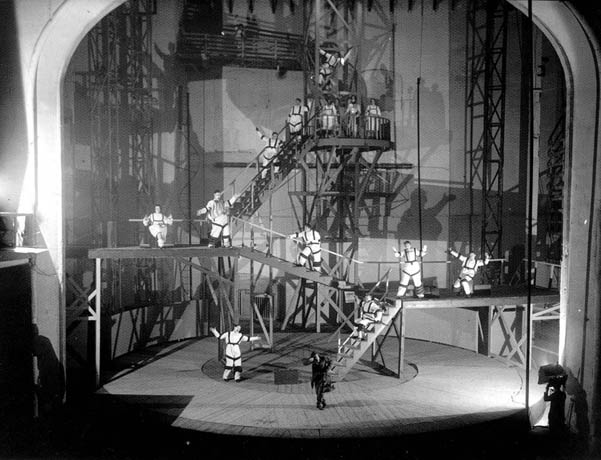
Poet Talk Architecture: Meyerhold's production of The Bathhouse by Mayakovsky, March 16 1930


His [Meyerhold’s] lectures were mirages and dreams. The listener would jot down something feverishly. But on waking up, he would find “the devil knows what” in the notebooks. One can recall in the finest detail how brilliantly Aksyonov analyzed The Merchant of Venice, what he said about Bartholomew Fair and the triple plots of the Elizabethan dramatists. But one cannot remember what Meyerhold said. Aromas, colours, sounds. A golden haze over everything. Elusiveness, intangibility, secret upon secret, veil upon veil – not seven of them but eight, twelve, thirty, fifty!

With their various nuances they flutter around the secrets in the magicians hands, but strangely. It still seems as if the wizard has been filmed in reverse motion… the subconscious waits, languishing somewhere, while the romantic “I” gets drunk on the lectures, and the rational “I” grumbles acidly – the one educated at the Institute of Civil Engineers in differential calculus and the integration of differential equations.

“When are the secrets going to be revealed? When shall we get on to the methods? And when will this strip tease à l’envers cease?“

SOURCE: Sergei M.Eisenstein, Immoral Memories: An Autobiography (Peter Owen, 1985), 76-77.

In trying to articulate something about the excitement this text prompted in me I arrived at the following:

ENTER AT YOUR OWN RISK

Poets are our buildings of talk, small microcosms where language uses the page as a first step towards full spatiality, less useful as poems per se than as sources  of architectural forms in the manner of Vitruvius or Owen Jones’ The Grammar of Ornament (1856). 

Owen Jones, Decorations for the Alhambra Court, South Kensington Museum, 1863


Jones moved into the Alhambra Palace in order to sketch the ornament within, and Poet Talk Architecture adopts a similar strategy, close to the contours of the Essex countryside, if also informed by JK Huysmans’ À Rebours (1884), its fantasy geography asserting supremacy over physical travel through fetishistic concoctions of domestic space. 

 Poet talk-space, then, with words and page woven into a blur building of Meyerhold talk, veil upon veil method of post contemporary never-shamanic building construction… 


AS OF 04/03/10. thinking through the possibilities for  POET TALK ARCHITECTURE in relation to the ART WRITING FIELD STATION, a new set of source texts have presented themselves:

Harald Szeemann, Tessin, Switzerland; Renee Gladman The Activist; the “snowflake” form of Dick Higgins; art strikes of Gustav Metzger; Matt Mullican’s codes, systems and cosmological architectures out of drawings; Falke Pissano A Lecture Turning Into A Conversation; drawing installations of Dan Perjovschi; Barbara Guest’s Rocks on a Platter; Mike Kelley’s Educational Complex (above); Céline Condorelli, Support Structures; Sabine Bitter, Helmut Weber and Jeff Derkson.

POSSIBLE ARCHITECTURES OF THE ART WRITING FIELD STATION (1)

In Uncategorized on March 3, 2010 at 5:28 pm


Paul Thek, installation view "Ark, Pyramid, Easter - a visiting group show", Museum of Art Lucerne, 1973 © Museum of Art Lucerne


Ahead of this weekend’s ART WRITING FIELD STATION I have been thinking about architecture. The title of this project implies some kind of purpose built structure, and although in practice the field station has so far been a nomadic affair, hosted by a number of gallery and studio spaces, the question of what kind of architecture the project implies, requires and brings into being remains for me a potent one. 

On Sunday we will launch the ART WRITING FIELD STATION ARCHITECTURAL OPPORTUNITY COMPETITION as a way of thinking through these issues over the coming months, gathering proposals and ideas that explore the conceptual, actual, fantastical, virtual, conversational and other architectures of the field station. Come along on the night to find out more. More details will be posted here next week.

Right now Hyun Jin Cho is making a 1 minute sequence of images, and I am making a 1 minute text that will introduce the project. We will put them together for the first time on Sunday night and see what happens. My own thinking has started from the possibilities opened up by the following three quotations:

(1)For many of Tatlin’s contemporaries, fellow avant-garde artists and writers, his tower exemplified the work of estrangement. The very fact that it was known primarily as a model or a project rather than a realized building reflected the possibilities and contradictions of the time. Thus, instead of speculating on the technical feasibility of its construction, a subject that has preoccupied many architects and others over the years, it is more productive to think about the tower’s actual history as a model and a project that opened up a new dimension of this intermediary and transitional architecture, which also may be called an architecture of possibility. 

“Project,” in the case of the tower, was not an end in itself, but neither was it an impasse. It was a crucible of possibilities and inspirations, not a utilitarian blueprint. Projects and models play a key part in the alternative history of the “off-modern.” In the context of the Russian avant-garde, artists and architects were frequently also writers. Their multifaceted production, often made “for the drawers” at a time when it was becoming increasingly difficult to build and publish, amounted to a different kind of a “total work,” one that was necessarily fragmented and came to constitute an avant-garde of dissent.

(2)Redesign a rainbow.
Design a labyrinth dedicated to Freud, using his photo and his writings. 
Design a Torah. 
Design a monstrance.
Design an abstract monument to Uncle Tom. 
Design a feminist crucifixion scene.
Design something to sell on the street corner.
Design something to sell to the government.
Design something to put on an altar.
Design something to put over a child’s bed. 
Design something to put over your bed when you make love.
Design a flying saucer as if it were The Ark. 
Design a black mass out of any materials you can find.
Design a work of art that fits in a matchbox, a shoebox.
Design a new clock face.
Design a box within a box to illustrate selfishness.
Design a throne.


(3)The Office for Soft Architecture came into being as I watched the city of Vancouver dissolve in the fluid called money. Buildings disappeared into newness. I tried to recall spaces, and what I remembered was surfaces. Here and there money had tarried. The result seemed emotional. I wanted to document this process. I began to research the history of surfaces. I included my own desires in the research. In this way, I became multiple. I became money.

…Soft Architecture will reverse the wrongheaded story of structural deepness. That institution is all doors but no entrances. The work of the SA paradoxically recompiles the metaphysics of surface, performing an horizontal research which greets shreds of fibre, pigment flakes, the bleaching of light, proofs of lint, ink, spore, liquid and pixilation, the strange, frail, leaky cloths and sketchings and gestures which we are.  The work of the SA, simultaneously strong and weak, makes new descriptions on the warp of former events. By descriptions, we mean mostly critical dreams, morphological thefts, authentic registers of pleasant customs, accidents posing as intentions. SA makes  up face-practices.

What if there is no “space”, only a permanent, slow-motion mystic takeover, an implausibly careening awning? Nothing is utopian. Everything wants to be, Soft Architects face the reaching middle.


SOURCES

(1) Svetlanya Boym, Architecture of the Off-Modern(FORuM Project, Princeton Architectural Press, 2008)

(2) Paul Thek, selections from “Teaching Notes: 4-Dimensional Design”, in Harald Falckenberg & Peter Weibel, Paul Thek: Artist’s Artist (MIT Press, 2008), 393-395.

(3) Lisa Robertson, Occasional work and Seven Walks from the Office for Soft Architecture (Vancouver, Clear Cut Press, 2003).

A CURATORIAL SCRIPT: A COLLABORATION WITH CONT3XT.NET

In Uncategorized on March 3, 2010 at 3:21 pm

An essay about my collaboration with the Vienna based collective CONT3XT. NET has just been published on the groups website here. As the introduction to the article explains: 

Writing Exhibitions was a two day event at the Stanley Picker Gallery in Kingston-Upon-Thames, on November 28 2009, exploring connections of language and exhibition making… For this event I curated a series of micro-exhibitions by artists and groups not present in the space – Jonathan Keats, Alexander Hetherington, and CONT3XT. NET.

Each was a different act of translation: Keats’ Experience Exchange was a participatory work originally designed for the commercial arena of the Berlin Art Fair; Hetherington’s A Million Lies; Once and Only Revealed After Death (Triangle of Need) involved adapting a large scale multi-screen performance installation for the spatial, temporal, technological and budgetary restrictions of the Writing Exhibitions event.

The project with CONT3XT sought to to create a new version of their exhibition You Own Me Now Until You Forget About Me. 

The process was as follows: out of our email exchange I developed a curatorial script, in which the exhibition (originally a group show at the Museum of Modern Art Ljublana, 16 May- 22 Jun 2008) became adapted as a 20 minute intervention in the 7.9 Cubic Metres space.

None of the original artists, art works, or curators were present in this new version, which, of course, raised many questions about where and in what form the original exhibition was present. Many of these questions, as the email dialogue explored, were ones CONT3XT.NET had themselves faced in exploring the role of a physical exhibition for digital and/or web based art works. 

Like any script, the eventual performance was somewhat different to what I intended. In the essay I try to explore some of the reasons for this, and offer some proposals about the role of script making in a curatorial process as it relates to (a) the materials of an exhibition, (b) the nature of the script; (c) the physical experience of the exhibition, and (d) its aftermath, legacy and memory. Regarding the script itself, the process led me to propose the following:

Once the exhibition is reduced to a set of materials, then the script becomes the architecture for those materials and a set of proposals concerning the relations between them. The script is a fantasy of relationality, its coercive intent a way of articulating often hidden power relations in the process of exhibition making.

The script has a range of possible relations to what is realized. It may be a closely followed set of actions, or something valuable for its contrast to what results; private working document or exhibited object. It may be adapted and changed at the last moment in response to changing circumstances, or be erased by the paradigm shift of the exhibition itself. As here, the exhibition is likely to necessitate the script’s re-writing.


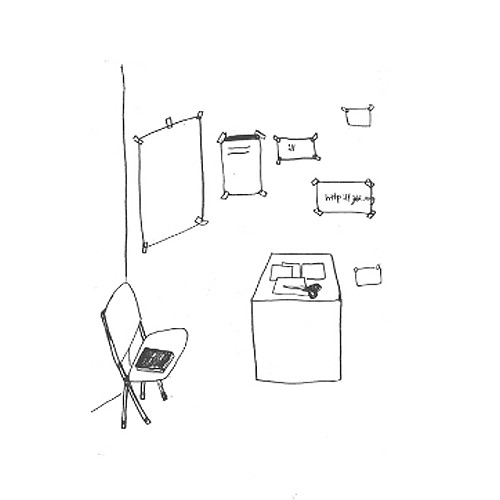
Of course, the essay itself becomes one further version of the exhibition. For this reason, I did not want to illustrate the essay with photo documentation of the event itself. I use an image of the empty cube, a drawing of the event (by Hyun Jin Cho, who produced a drawing of/for each micro-exhibition), and a series of black squares bearing the words “PHOTO DOCUMENTATION REMOVED.”

This explores what about the experience becomes communciated more broadly (as the exhibition is translated from form to form), and what remains specific to those who participated in the event. It is also a way of holding the exhibition itself to a script format, something that might be engaged with and realised elsewhere. 

Hyun Jin Cho, drawing of an exhibition by CONT3XT.NET (as presented by David Berridge), at Writing Exhibitions, Stanley Picker Gallery, 28 Nov 2009


One area the essay does not explicitly explore is the form of the micro-exhibition itself. For the Writing Exhibitions event, eight 20 minute exhibitions followed one after the other, the format meaning that the get-in and get-out of each show were part of the exhibition experience. A constant group of 12 shifted between being exhibiting artists, participants, critics and  exhibition goers.

Of course, in some ways this format made the exhibition into a performance. But there was also something particular that came from the (micro-) exhibition frame – a particular way of looking, and experiencing, and, possibly, remembering. 

Thanks to Sabine Hochrieser, Michael Kargl (aka carlos katastrofsky), Birgit Rinagl, and Franz Thalmair of CONT3XT.NET for their work on this project. VerySmallKitchen is developing a number of projects around the concept and practice of scripts for exhibitions (both by curators and artists) and welcomes information and submissions of relevant projects. Please contact verysmallkitchen@gmail.com.


VSK PROJECT (3): MATTHEW MACKISACK: LOVELOCKED

In Uncategorized on February 28, 2010 at 12:08 pm


___________

A PDF version of this text is available here. The first edition of VSK Projects will comprise 5 projects by artists whose work places language within visual systems of thought and understanding.  This project by-line is itself re-improvised by the curator after each project, to try and chart how each artists’ intervention changes my sense of the unfolding whole.  See previous projects by Rachel Lois Clapham and John Pinder.

ESSAY: THE NON-IMMERSIVE FICTIONS OF GARY O’CONNOR

In Uncategorized on February 27, 2010 at 3:06 pm


The following essay was written in response to Gary O’Connor’s installation at Northcabin, Bristol, 22nd Nov-15 Dec  2009, as a Northcabin/ [AN] Interface critical writing commission, and was first published on both these  sites. It is reprinted here with thanks. Critical responses to other Northcabin shows, by Colin Glen, Jeremy Walton, Isabella Streffen, and Emma Cocker, can be seen here. 

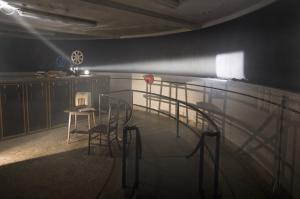
A disused operating cabin on a Bridge in Bristol. The windows are covered in black cloth. Three times a week, for a few hours at dusk, two curtains are parted and from an open window comes the sound of 1940’s music. Looking inside I see a book on an upturned chair next to an old fashioned cream radio. The whole is lit from below, casting large shadows on the cabin’s back wall. 

On a hulk of old harbour machinery another pile of musty hardbacks, spines splitting, marble covers coming loose. A projector makes a white square on the wall. Has the film ended or has, for those of an art-minded nature, the 1940’s paraphernalia – from the period when the bridge was constructed – given way to an impromptu screening of Nam June Paik’s Zen for Film half way to Redcliffe?

Gary O’Connor’s installation does not intend to offer too many easy answers to these questions. It doesn’t intend to be too forthcoming about being a Gary O’Connor installation. There is no signage on the bridge or gallery – only the single label saying “Northcabin” with a website address in tiny type underneath. The installation has no invigilators either. It’s running away on its own, door locked, explainable only through the viewers imaginings, or a later web search.

Or, rather – and this is what I’d like to explore in this essay –  Inherent Sin both provides us with a fictional world and makes immersion in that world impossible. So, for example, the music, highly specific to the 1940s, gets caught in the traffic noise and becomes, at times, random noise. The apparatus of chair, book, and radio set a scene but are minimal enough to be skeletal. A non-immersive fiction.

For those of a curious frame of mind the uncertainty does not stop here. From a moss covered wooden stump in the water below, a 10 foot tree has grown. Is this part of this new network of meaning Inherent Sin is positing as encounter, halfway between art, accident and daily life? 

Cross over the road to the second control room – still involved with the bridge’s working life and not available for art installations – and find thirty black rubbish sacks, weighted down with some heavy load, on a white sheet, next to three tins of carasol petrol and a huge chest covered in white bubble wrap. Not very 1940s, but possessed of a directness and opacity echoed back across the road.

Of course, writing about the show as I am, I get to go inside, sit on the chair, pick up and read the books, as Katie Daley-Yates, curator of northcabin, gets the installation ready. She takes  black cloths off table and projector, gets the smoke machine working, finally parting the curtains so passers by can look in. As she does all this, I look through the books. 

Perhaps I shouldn’t say? The book by the radio is Sigmund Freud’s The Interpretation of Dreams. The pile by the projector includes books by Enid Blyton, the Treasury of Knowledge, Little Women, and  a musty red hardback whose pages turn out to be entirely blank – Enid Blyton’s little known Perec precurser perhaps? This was how she wrote so many. One page torn.

Gary O’Connor writes in an email:

I have always been interested social/cultural history and how it is documented. I know from personal experience how easy it is for information to be forgotten or even exaggerated when passed down from one generation to the next, it’s this area that I’m interested in: in a very playful and at times humorous way, I subvert facts, stretch the truth.

When making work for an unusual space or situation, my first instinct is to investigate the history of the site: this early stage of research can be the most rewarding part of a project for me. As I pick my way through the facts I immediately begin to form narratives in my mind. It is hard to say which comes first: words or visual ideas, it pans out differently for each project I do.
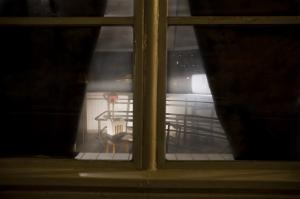

Looking in through the window, I cannot read the book titles. If the handrail to the cabin’s staircase is a prominent part of any installation, the stairs themselves – leading down to the water level – have been boarded up. In both installation and architecture, attention encounters a limit, and comes back, without anywhere else to go, to the viewers own thoughts and the traffic on the bridge. Sin promises narrative, but gives a suspended moment, moving but frozen.

All of which may be a way of thinking through how writing figures in this. Writing has been key to O’Connor’s work, particularly since his MA in Visual Writing in Norwich. Numerous projects – such as The Field (2009) at London’s Transition gallery – have involved both published text and installation. I am wondering what word best describes the relation between the two. Is the text script, scenario, storyboard, and/or companion? O’Connor’s own comments indicate a separate role for each:

I shy away from using text within an installation, although I have made artworks that have incorporated text in the past, I prefer to produce the writing as a separate component. This approach places distance between the two, allowing the viewer to digest the work in a more traditional way: this allows me more freedom to play with the context of the work. I also like the idea that someone can take a piece of the work home with them in their pocket.

I have approached the writing in various ways: in one case it was laid out as a stage play, with stage directions and detailed descriptions of each character, other pieces have been more fact based and presented as research or essay, but the majority of my work is written as a story in the first person, describing situations as and when they unfold.

For Inherent Sin, O’Connor wrote a story out of his research that provided the basis for the installation. The installation was made, and O’Connor went home to Cambridgeshire, to work, the northcabin website tells us, on the text. When the installation was taken down, only the promised text remains. Writing and installation seem to be in near-parallel, but out of synch worlds, each shifting from figure to ground and back and back.

Both text and installation mix grand illusion and poor theatre. There is also a sly transference between these very different media. The book readers act constructing worlds from the words alone does seem akin to what a deliberately limited installation asks of its viewers. I haven’t seen the full fiction yet, but I imagine it will enable me some gallery going pleasures the exhibition refused: going close to see what the book is made of, maybe even picking it up.

In the durational act of reading the installation’s moment gets unfolded into narrative. Of course the illusiveness of such publications, the erratics of their distribution, finds apt parallel in the occasional opening of curtains on a bridge, its undemonstrative claim on the attention of passers by.   

O’Connor has a somewhat different conception of how this limitation is operating:

I normally put myself through a rigorous reductive process when developing ideas and the work produced is fairly minimalist, but with the Cabin project I wanted to push things further. My initial response was to introduce a sense of theatre into the space, I wanted lights, movement, smoke and sound. I like the fact that there is no public access and the work can only be experienced through the windows and I wanted to play on this limitation: the division adds a voyeuristic aspect that again enforces the notion of theatrical spectacle.
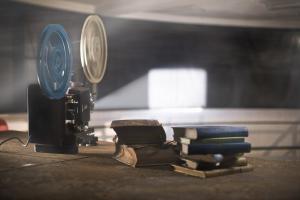

 This is the fourth and final installation to occupy the northcabin site. Not surprisingly, posed out there in the middle of the harbor bridge, previous exhibits have also played with the tension of looking in and looking out. The non-art cabin across the road plays with it too, with its creepy sacks and bubble wrap chest. As O’Connor blacks out the windows, Helen de Main, the previous incumbent, filled the space with her own construction. Both seem to have found site specificity through active removal. 

The projector and its endless square of light is a focal point for many of these concerns. It suggests the narrative of a finished film, left running in the absence of audience and projectionist, whilst also pointing formalistically to the materiality of the cinematic apparatus and experience. In a variant on the (non-) immersive it evokes the grand illusion of cinema, alongside the stark, clunking, non-digital presence of the equipment itself. 

A play of film and photography is evident, too, in how the whole installation suggests a camera obscura. This was emphasised when I went back to view the installation at night. In heavy rain and darkness the white screen was a decoy. There’s no film in the projector, so its white square becomes pretend, even as it becomes the lit moment itself, not projected scratch marks off white leader.

Furthermore, the black curtains along the curving back wall become a screen for showing the continual passage of busses and people across the bridge, topped by the reversed pink neon sign of the Mercure Hotel across the harbour. It’s not really on the curtain-screen of course – it’s reflections on the window – but there’s an appropriate play between planes, between illusion, reflection and actuality, appropriate to the perceptual character of Inherent Sin.

There’s a black hole in such a dioramic swirl too: the body of the viewer-critic, obscuring this theatre of light in the keenness to see in. I stood across the road and watched how people responded to the invitation of flickering white light and muffled sound. I got most intrigued in passers by that looked in, but continued on their journey without hesitation. All these 1940’s objects, it seemed, had escaped history to become an unremarkable part of December’s Bristol rush hour.

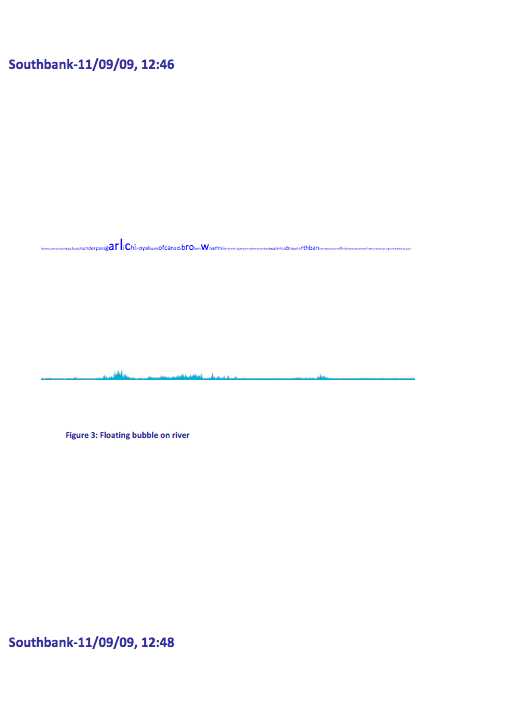
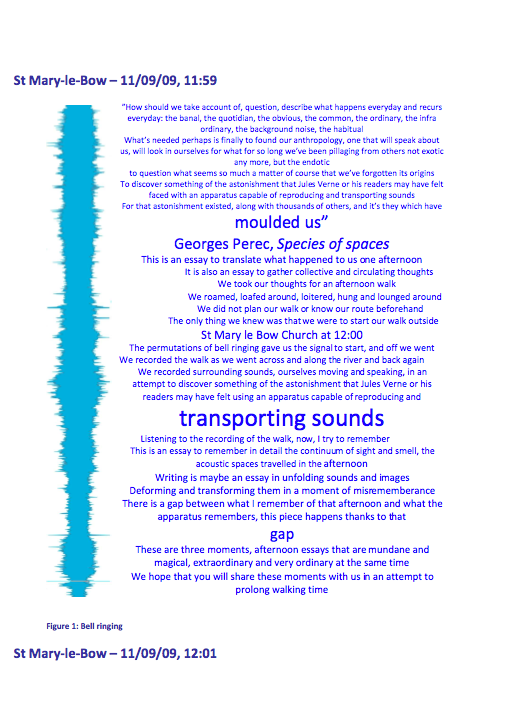
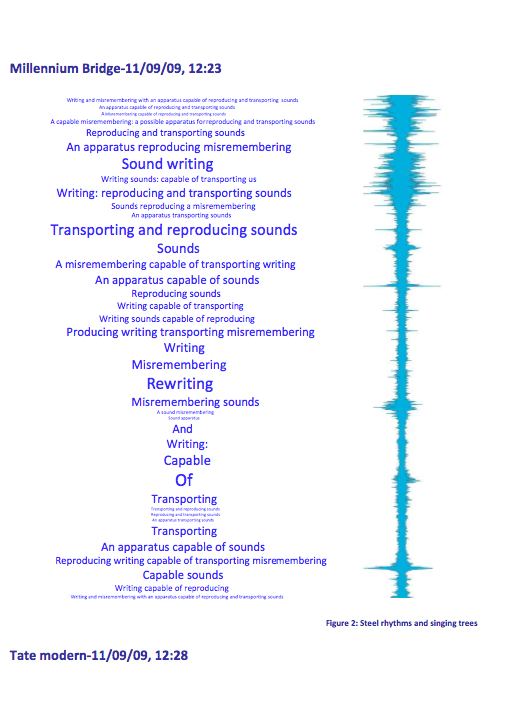
VSK PROJECT (2): BELLS BRIDGE BUBBLE: A SOUND WALK THROUGH LONDON by JOHN PINDER WITH PABLO CHEMOR

In Uncategorized on February 26, 2010 at 2:00 pm

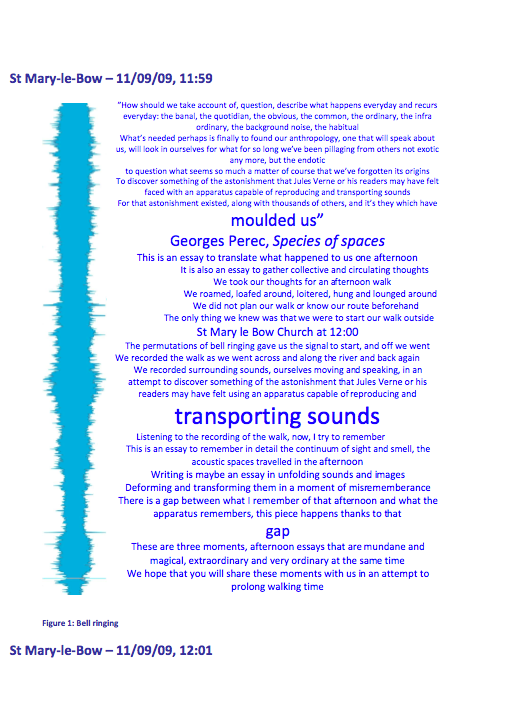
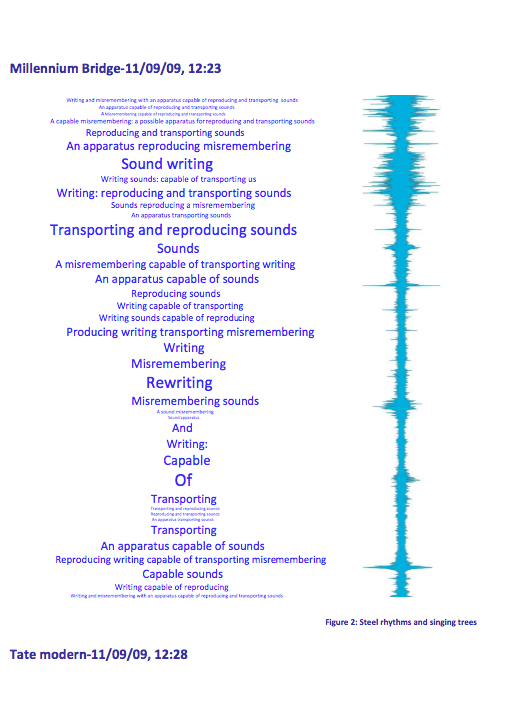
CURATOR’S NOTE: The following project by John Pinder (with Pablo Chemor) was first published as John’s contribution to Essaying Essays: An Assembling. The sound files of the project are published below for the first time.  The text is best viewed through a PDF  available here

______________

The first edition of VSK PROJECT will comprise 5 online explorations of language practices as they intersect with the visual, space, sound and performance. This project by-line will itself be improvised anew after each project, to try and map how my sense of the whole is altered by each artists’ intervention on this site.  For more about John’s work see here.