verysmallkitchen

Posts Tagged ‘art writing’

READING NOTES: A VSK HANDBOOK FOR PERVERTED CIRCUMSTANCES

In Uncategorized on July 4, 2011 at 4:40 pm
P is for Poodle, 1983


This latest VSK handbook offers an expanded PUBLICATIONS NOTED, a transcription notebook through recent readings that via extraction and sequence (may) become a form of commentary, and/or a determined neurosis of (mis-)use.

Each of the following texts could be positioned as a starting point that determines the themes of the others, with each such sequence posing different priorities and forms of travel.

MoreImmediateMotivation for such a method was Hans Dickel & Lisa Puyplat’s Reading Susanne Kriemann, for its exploration of reader/ reading involving both the practice (the reader and the art work) and the thought about it (by the artist and others. Reader as body and anthology in shifting multiplicity). As Axel John Wieder notes in “Reading Meanings”, his essay for Reading…:

“Reading” emerges here, perhaps in a more poetic understanding, as a process which itself produces meaning, which doesn’t only decipher, but constructs information in a performative sense through one’s own associations and ideas. We should start from this point, when we speak about the reading of images. (155-6)

1. Peter Friedl

“I think the more interesting part of the theater question for me is emphasizing the different between the stage and the public and how it works under perverted circumstances…”

“…. when everybody wants to be a spectator and a protagonist at the same time – certainly without any revolutionary romanticism – and even something like Pasolini’s despair looks like some role model to be picked up by any hysterical video artist (male or female); circumstances are definitely perverted. The real scandal is complicity.” (189)


[Peter+Friedl.JPG]


(2) Susanne Kriemann


“In attempting to formulate my narratives with all the images taken from other contexts, the clear structure of the book serves as a basis for the associative relationships inherent to my work.” (190)

“there is a striking difference between the formulation of the work in book form and its realization in the exhibition context. The latter is a transcription of sorts, which is an act of transposing the book into the exhibition space.” (190-2)

“Do we bring one language into another language into another language, I wonder? Revealing a fabric woven of languages in space? Could this be transcription as performance? I have mostly been thinking of my process as series of “transformations” from image to text to image again, from painting to physical installation, to virtual space, and back to text again and into image – in a long and transformative process.” (206)


“I also dislike the word “installation” but I cannot stop using it when describing what I do. Lately I have started to embrace the old term “exhibition” instead. I make exhibitions instead of installations. Installation is for me more of a thing in a space that can be seen as a whole  body. Exhibition is like a book with a beginning and an end.” (208)


3. General Idea

General Idea
is basically this:
a framing device
within which we
inhabit the role of
the artist as we see
the living legend

Showcard 1-001, General Idea, 1975

*

Degraded and humiliated,
the glamorous image
is brilliant in its vacancy,
glorious in its degradation.
The image retains
signs of a former purity.
The face of reality is
still evident beneath
the thin skin of Glamour.

Showcard 1-007, Brilliant in its Vacancy, 1975

*

Glamour, like myth,
miniaturizes reality,
making it visible
in a single glance.
All major characteristics
are retained.
Any “reali-life” context
may be simulated.
Glamour is the perfect
simluation technique
for on-going battles,
the perfect tool
for re-shaping history:
adding,  subtracting
indeed MAKING history.

Showcard 1-009, Battle Plans, 1975

*

Like all artists, s/he is
intent on the definition
of unoccupied territory.
S/he wants to describe
the background by
simplifying the foreground.
S/he wants to occupy
a central position in the
general state of affairs.

Showcard 1-071, The Artist Constructs a Model, 1977

Felix Partz models V.B. Gown #3 at City Hall, Toronto, 1975-1977

4. Paul Chan

“Reading Sade, one can’t help noticing something about the countless debaucheries: they are not real. What I mean is that they are physically impossible. There are situations that Sade depicts where bodies suck and fuck in ways that defy physics as much as morality. The world Sade portrays is even less representative of reality than pornography is of actual sex. But they are not mere fantasies. They possess the prodding movements a mind that imagines sex not merely as a pleasure, a job, or a weapon but as a form of reason. Here is where the spirit of Sade resides. If human freedom is expressed in the sovereignty of sex, then Sade is pushing to create a form of expression that can free the reason of sex from both nomos (human law) and physics (nature’s law).

In other words, the spirit of Sade is embodied in the idea of abstraction. Abstraction, as the power to create from empirical reality an essential composition outside the laws of what constitutes the real, has always been the emblem of a kind of freedom. If abstract art has any insight left beyond merely being an apologia for interior design, then it must find a new necessity to produce images and objects that follows laws unto themselves. Abstraction worthy of that word binds content to form in such a way that the process that directed its expression is indistinguishable form the idea that led it into being. In abstraction, the origin is the end.


Sex abstracts us from ourselves. In sex, the senses lose all sense and make one feel wholly other. It is a domain in which truth and rationality have no ground, a place where no one knows what to do with what is true. Sexuality, like art, makes reason unreasonable. Abstraction, as an aesthetic principle of essential separation, has the potential to redescribe sex by delinking it from the tortured legacy of a Western imaginary that ceaselessly tries to make  what we do to ourselves and to one another into a truth worth fighting and sometimes killing for. In a sense, erotica, pornography, and even secret military prisons are merely different ways we have sought to make sex truthful: by fixing its shape, determining its laws, making it useful, rendering it reasonable. They are material representations of what sex is supposed to be. But there is nothing less reasonable than sex. This unreasonableness must be given form, rhythm, movement, touch, feel, and more. In abstraction, sex reveals the intangible force of its own irreconcilability and becomes what it is in reality: a spell for togethering doubling as a boundary.” (103-4)


5. Glenn Ligon


“… one of the things about the paintings is that there’s always this question of whether I’m obscuring the text or highlighting it, whether the accumulation of material on the paintings is about actually withdrawing meaning and my ambivalence about language and its ability to communicate, or is it about this incredible faith in language which someone like Baldwin had. I feel like coming to this essay [ James Baldwin, “Stranger in the Village, ” in NOTES OF A NATIVE SON (1955)] fifty years later there’s always this sense that the world has changed, but not enough, and so what can language do in some ways? What are its limits? I think that’s part of what’s going into these paintings.” (115)

“My approach to the essay of these particular works is one of questioning. The paintings are fundamentally about language and an ambivalence and pessimism about the project of communicating, of going back and forth between really wanting to communicate with the viewer and also wanting to withhold things and the aggression of that withholding. There are several ways to view the paintings, and I feel that when I started doing these paintings that people’s relationship to Baldwin’s writing was one of just celebration, that there was this uncritical relationship to him, and they weren’t looking at the essays anymore and weren’t diving into the in the way that I thought they should. I didn’t want my paintings just to be re-presenting the text, saying “Baldwin is important, here’s the text, read it again.” I wanted to explore the more abstract level of why do certain things disappear or how they have become so known that they’re not visible anymore, and pushing the viewer to think about this visual object, and in the way I’ve rendered the text in terms of these more abstract questions that the paintings ask.” (115-6)


SOURCES

Frédéric Bonnet, General Idea: Haute Culture A Retrospective, 1969-1994 (JRP Ringier, 2011).

Paul Chan, The essential and incomplete sade for sade’s sake (Badlands Unlimited, 2010).

Peter Friedl, Secret Modernity: Selected Writings and Interviews 1981-2009 (Sternberg Press, 2010).

Susanne Kriemann and Matts Leiderstam, “Is this what we do?” in Hans Dickel & Lisa Puyplat eds. Reading Susanne Kriemann (Sternberg Press, 2011).

Scott Rothkopf ed. Glenn Ligon, Yourself in the World: Selected Writings and Interviews (Yale University Press, 2011).

*

This VSK HANDBOOK (2) is part of an ongoing project exploring forms of writing and essaying that stay in proximity to acts of reading and writing. Previous projects include the recent handbook on John Berger’s Bento’s Sketchbook, and a collaboration in January with the artist Jennie Guy, performed at the Galway Arts Centre.

All these projects operate variously in a zone of transcription, passing on, (W)reading and commenting. They propose a form of theatre out of that process, where the value of reading is staged, rather than left to a process of unconscious accretion.

Transcribing this handbook prompted various questions concerning such a staging. Are the quotations in order? Is an argument unfolding? Is there anyone out there reading from the bottom up? How does a voice read all these aloud, inhabiting them both for possible through-lines and refusals? This, it seems -4/-7/11,  is less about subjectivities than imagining an endlessly refracting being who could speak everything.

*

IMAGE CREDITS (From top:) General Idea, P is for Poodle, 1983; Peter Friedl, Corrupting the Absolute; Susanne Kriemann, Spying invisible acts (high-rise building Alexandria), 2006, 110 x 135 cm, c-print; Susanne Kriemann, Picknick am Wegesrand, 2011; General Idea Felix Partz models V.B. Gown #3 at City Hall, Toronto, 1975-1977; Paul Chan, sade for sade’s sake, 2009, digital projection, 5 hours, 45 minutes looped; Glenn Ligon, Figure #32, 2009, Acrylic, silkscreen and coal dust on canvas 60 x 48 inches (152.4 x 121.92 cm).

ART WRITING LANDSCAPE: WALKING (S)MILES THEREFORE AHM MARGINAL SOUND POET THEREFORE

In Uncategorized on July 1, 2011 at 7:22 pm

Patrick Coyle, Paul Auster Story (A2 Poster, 2011).

Four  art writing projects unfold relationships and possibilities of, for and about landscape. Strategies for observing then recording the results, or maybe the other way around; scores for intervention; missives for those in the field right now or chair- bed- page confined explorers of type/ book/ screen (e)scapes. Handbooks for weaving together art as life life as art art and life, or as yet un-thought combinations of neither.

A post like this implies such a focus might be something new. In such delusion I recall the title of the Jonathan Williams essay “Some speak of a/ Return to Nature/ I Wonder Where They/ Could Have Been “. I cite as further frame and reference  Leslie Scalapino’s talk-essay Eco-Logic in Writing, reprinted in the new Litmus Press edition of HOW PHENOMENA APPEAR TO UNFOLD where she writes:

Perhaps the start of a sense of ‘eco-logical writing,’ for myself, is the phrase “my mind is phenomena,” mind (as its phenomena/subjects and as its body), not the same as land but alongside it. Writing enables the making of that spatial relation (of land and mind-phenomena, the two placed beside each other). It’s a relation that’s going on in every instant but writing can also ‘make’ it (future) by altering space, allowing one to see one’s own (also) joyful movement in space (making that) as well as being one’s movement and seeing others’ movements as joyful. The text is the altered space, sometimes one’s to walk 3-D in it at jetting evening. (89)

Here are the publications:

(1)Rachel Lois Clapham and Present Attempt, A Prototype of Walking (S)miles

This text is  a collaboration based on the later’s performance Walking (S)miles for the Hazard festival in Manchester. They describe it as follows:

An incomplete textual sample that comes out of Walking (S)miles by Present Attempt.

Optional Instructions for Self-Assembly


1. Print the document


2. Cut each of the pages down the centre with the exception of the last page


3. Affix the cut pages to the last page


4. (W)read the document


(2)Patrick Coyle

Patrick’s Therefore (Something To Do With Stops) is the first text of his incarnation as Akerman Daly writer in residence for 2011, a text of reciprocities between acts of looking,  seeing, reading, talking,  and (mis-) remembering that suggests each as a way to get to the other, and style as a set of procedures for enabling a co-existence. The distinctiveness of each formed through luxuriating in its proximities to all the others. There are structures at work, believing essaying and poetics might become road movie…

I find myself reading the text thinking of performances like Remembering Ginsberg, which posit talking as  a mis-rembering, thinking as a negotiation between intention and the present,and writing as something that occupy either the before or the after, the source code or the error. Here is how the text begins:

0

Well erm therefore just have a look therefore the image therefore the first image is of a photo therefore the first image is a photo of therefore erm therefore a therefore bus window therefore I was looking thr- therefore I’ve been trying to write about looking through the bus window therefore and therefore then looking at the bus window at some point that I can’t really work out and then looking at the dots on the bus window which are a bit like therefore dots therefore in halftone printing therefore which means that therefore there are larger dots towards the bottom of the window therefore towards the bottom of the glass therefore erm therefore

1

and describing this reminds me of the performance I did a few therefore m- therefore maybe a month ago therefore at the Poetry Café in London where I attempted to recite therefore a therefore speech by Allen Ginsberg therefore where he talks about therefore I’m gonna try and remember it now where he says like therefore erm therefore something about therefore all the dots on the electric screen, he says ‘If you will keep your mind on the image in front of you which is my face in the camera therefore or in your TV tube or screen TV tube therefore and realise that I am therefore

2

looking from the other side of a c- therefore directly into like therefore a little black hole, imagining that you are there therefore and also imagining what would be possible to say therefore that would actually communicate therefore through all the electricity and all the glass and all the dots on the electric screen therefore so that don’t you, you’re not deceived by the image scene therefore but that we are therefore but that we are all therefore both on the same beam’ therefore or something like that so anyway he talks about that therefore and therefore that somehow was still in my head when I started looking at this window therefore on the bus in London therefore ahm therefore

3

and they reminded me of therefore I guess of halftone dots therefore and therefore of Lichtenstein using Ben-Day dots and therefore of Bridget Riley using similar dots therefore and therefore Sigmar Polke to some extent therefore but mainly of the printing process using halftone therefore dots therefore I therefore uhm I noticed a lot of things therefore this, this was just the beginning of erm therefore a trip therefore to Madrid therefore so therefore th- the next thing I noticed was erm therefore the therefore dots on my iPhone when my therefore

Continue reading here.

(3)Emma Cocker  and Sophie Mellor

I’m still absorbed in MANUAL FOR MARGINAL PLACES, which I also presented as part of the ART CRITICISM NOW event in Dublin, and whose notion of manual has also been generative for this blog since. A source book, then, documenting (1) letters sent by Sophie Mellor to Emma Cocker whilst the former was spending a short time living without money in Cumbrian towns and countryside; (2) Cocker’s replies in the form of a series of prose texts/ poems  on marginality. A dialogue, then, but one open to its breaches as much as its connections.

Initially, MANUAL reads as epistolary novel, with Emma and Sophie’s texts alternating, although Sophie’s soon disappear, and Emma unfolds her prose sequence solely in relation to (Sophies) images. This structure reflect’s how Sophie’s project (she was also a co-curator of the project) was itself a test to generate a set of ideas and practices for future work. It demonstrates the tricky status of such activities (briefly living rough as a funded artist), where art is both deprivation and privilege, the act itself both pretense and very real…

from Manual for Marginal Places (2011). Images Sophie Mellor and Simon Poulter

I wonder if these tensions – which are part of the project’s energy, not a critique of something it is unaware of – are also apparent in the text itself. Here is No.12 – Drift. I offer it here, out of context, as an example of a text that has drifted into this new context and location here, curious how in doing so it maintains or loses a sense of MANUAL:

Wandering operates tangentially; it detours, dallies, takes its time. To wander is to drift, becoming a little aimless or unanchored; it is a tactic for getting lost. Its disorientation subjects the commonplace or unnoticed elements of one’s familiar environment to the estrange scrutiny of a stranger’s glance. Navigational aids and maps might be misused for wilful disorientation; guidebooks becomes tools for defamiliarization and mis-direction as much for finding one’s way. Drifting is a mode of attention that lags behind the trajectory of more purposeful thought, yet other knowledge(s) become revealed in the slipstream of intention, in its shadows and asides. To catch the drift is to gauge the tenor of the subtext, to become attuned to what is left out or unspoken, to what is said in what remains unsaid. Become practiced in the art of wandering and of drifting thought. Follow in the footsteps of others who have wandered from the beaten track. Yet, remember too, that wandering necessarily wanders; its restlessness wills against the delimitation of any single genealogy or definitive theory of its dérive. To wander wills towards remaining unfixed, towards the condition of unbelonging. (40)

Sophie’s texts are reproduced handwritten notes sent from the field. Cocker’s are printed blocks of text on a white page, but their sense of removal is also evident in how their propositional nature removes particulars of person and place, even as it explores a landscape that is both a physical chronicle of nature’s edgelands and a conceptual territory indebted to certain histories of art practice and theory/ philosophy.

 Some of Emma’s texts have the feel of a list turning towards litany. The absence of gender or identity for the speaker or addressee, but their simultaneous confidence and stridency, allows a phantom “we” and “us” – maybe “I-thou” – to form alongside the text, one which may also seem absurd and with which we may disagree.

In other sections this subject is not “he” or ”she” but “one”, a subjectivity that is everyone and no one, self and other, confession and avoidance, a deliberate anachronism. Part of the texts own frame and music, it moves  uncertainly beyond it, another way these paragraphs fold back into themselves to better propose themselves as objects of use.

from Manual for Marginal Places (2011). Images Sophie Mellor and Simon Poulter

(4) Matt Dalby

Matt Dalby’s  @soundpoet  twitter project was declared at an end a few months ago, but has thankfully revived. Its temporary termination, however, raised issues about the motivation behind such a project, how and why it sustains itself, how it balances its “found” observations – dependent for their effect on a certain authentic surprise – with how their (artful/ skilled) transcription becomes a style that (it seems to me) may itself determine what later details are selected. Note that for many such details the 140 character limit of twitter is an unnecessary verbosity.

Sometimes, half seriously, I think of soundpoet as conceptual poetry for those who don’t like it. I wonder, too, about what the accumulation of these tweets (now more than 5,000) means, and how it translates into  a book form (if that is what/where it should translate itself into). There would undoubtedly be pleasure in such a compilation, but I wonder what another form would do with that sense of discovery and NOW that characterises the tweets, or how the book could live as archive and guide book for details both unique and gone but palpably knowable.

Here is @soundpoet:

https://i0.wp.com/a0.twimg.com/profile_images/1133258109/DSCF6676.JPG

Here are the last ten tweets as of today 01/07/11 18.10:

Torn-off corner from Nine of Hearts

Test tube on pavement

Wren lands on wall then flies into hedge

Red brick church being refurbished. Gates open to courtyard

Watery hiss of wind through trees

PCS picket at HSE in Trafford

Childs painting of a starry sky held to front passenger seat of car by seatbelt

Two men playing cricket in school grounds

Egerton Road North abbreviated to EDGE ROAD NORTH & ERN on addresses painted on wheeled bins

RHTUR RD

Shadow of letters from bus window across passenger’s face

Copying these out I wonder if this new post-Twitter identity (that is not necessary but may be) links to notions of PHRASE, perhaps, as Helene Cixous observes it, in proximity to aphorism and maxim through its brevity, but also doing something very different. Cixous writes:

So each one of them at once modest, urgent, respectful, unreserved. Extremely simple, the most difficult thing: a phrase that doesn’t resemble a phrase.

Sometimes @soundpoet uses twitpics as in this one linked to from the tweet “Ladybird on Pavement”:

CODA

(1)

As recently as the late eighteenth century, landscape paintings were commonly thought of as a species of journalism. Real art meant pictures of allegorical or biblical subjects. A landscape was a mere record or report. As such, it couldn’t be judged for its imaginative vision, its capacity to create and embody a world of complex meanings; instead it was measured on the rack of its “accuracy,” its dumb fidelity to the geography on which it was based. Which was ridiculous, as Turner proved, and as the nineteenth-century French painting went on to vindicate: realist painting focused on landscapes and “real” people rather than royalty. (14)

SOURCE: No.34 in David Shields, Reality Hunger (Penguin Books, 2011). The footnotes, which Shields asks readers to cut from the book without reading, identify this paragraph as Jonathan Raban in conversation.

(2)

Coming back again and again through this consideration to the essays of Leslie Scalapino’s HOW PHENOMENA APPEAR TO UNFOLD. Going back out from that to the work of poets that recur in many essays: Philip Whalen, Michael McClure, Robert Grenier and their practices of attention…

The texts included in Scalapino’s 2007 Green Integer book Day Ocean state of Stars’ Night: Poems & Writings 1989 and 1999-2006, are usefully read alongside all the work here. The essays in HOW unfold eco-logic’s of event, seamless antilandscape, event horizon, occurence, language as transient act. Practical urgencies, then, litanies for art writing landscapes, evidenced strongly in the curatorial form of the/ this book itself:

The intention in this book is that the unfolding structure of the book mime and demonstrate-be (and be seeing) the process and the instant of- the inside and the outside simultaneously creating each other.(1)

VSK PROJECT: AODÁN MCCARDLE ‘abair’ ANARCHEOLOGY(2)

In Uncategorized on June 17, 2011 at 1:18 pm

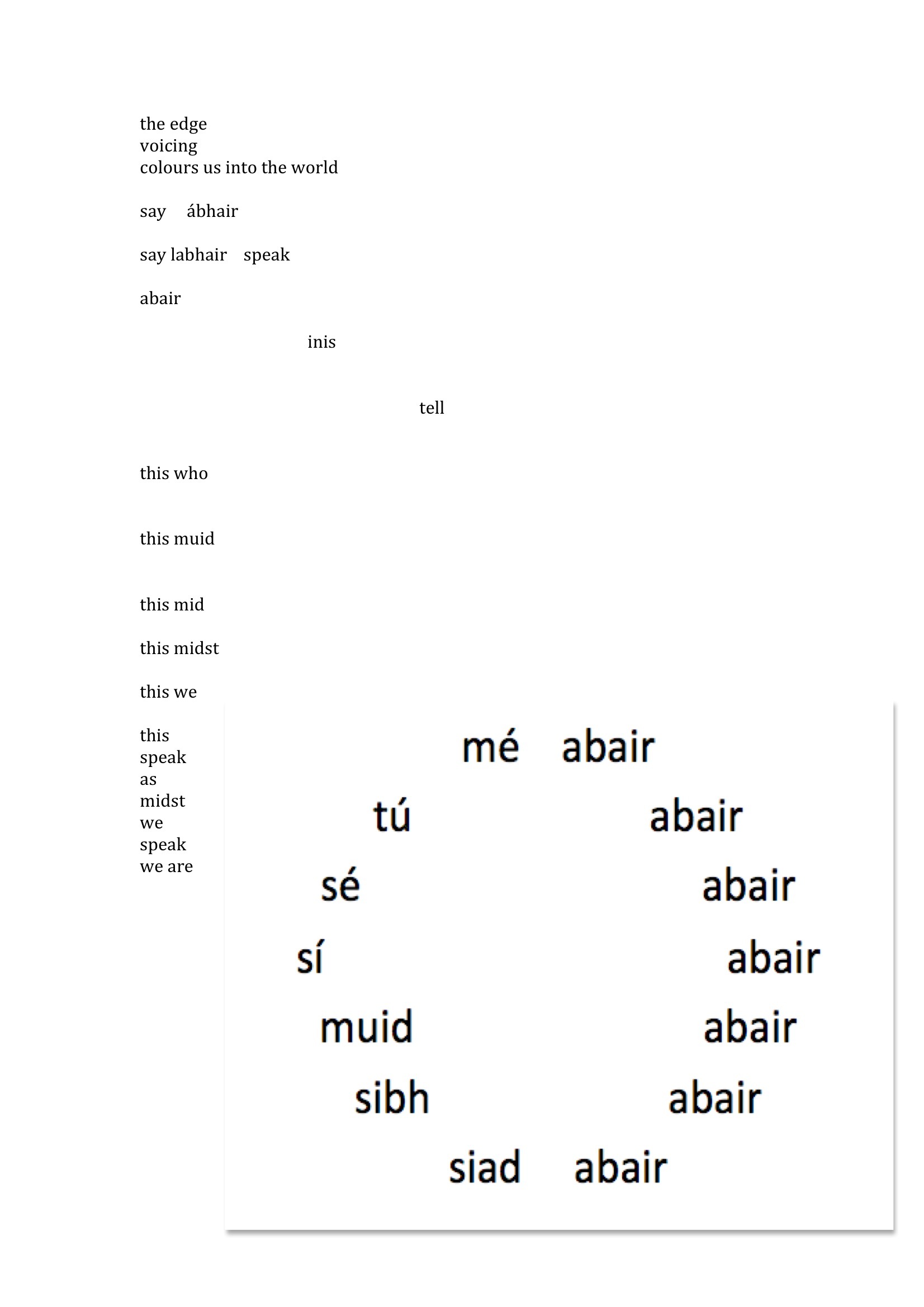
(1)

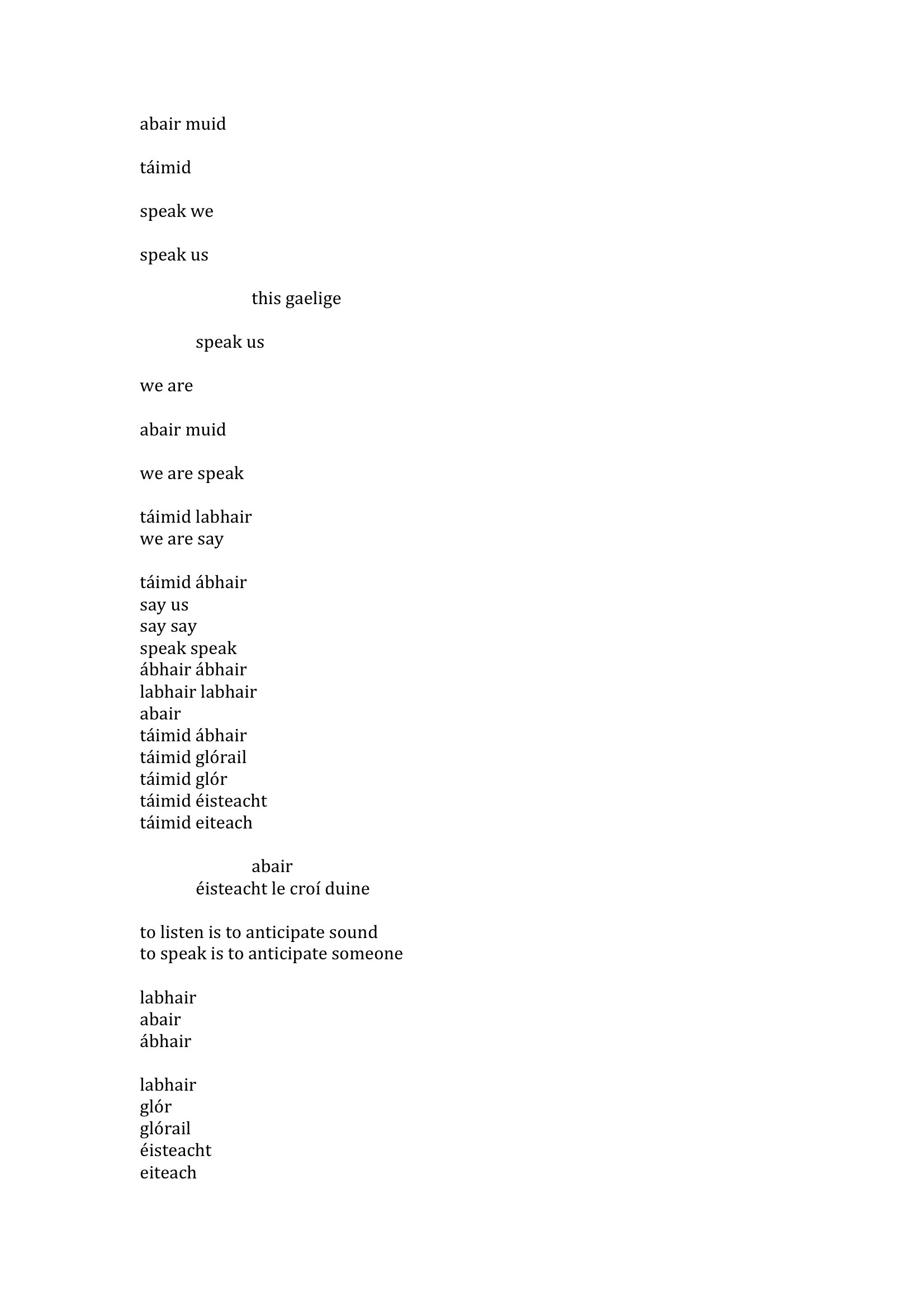
(2)

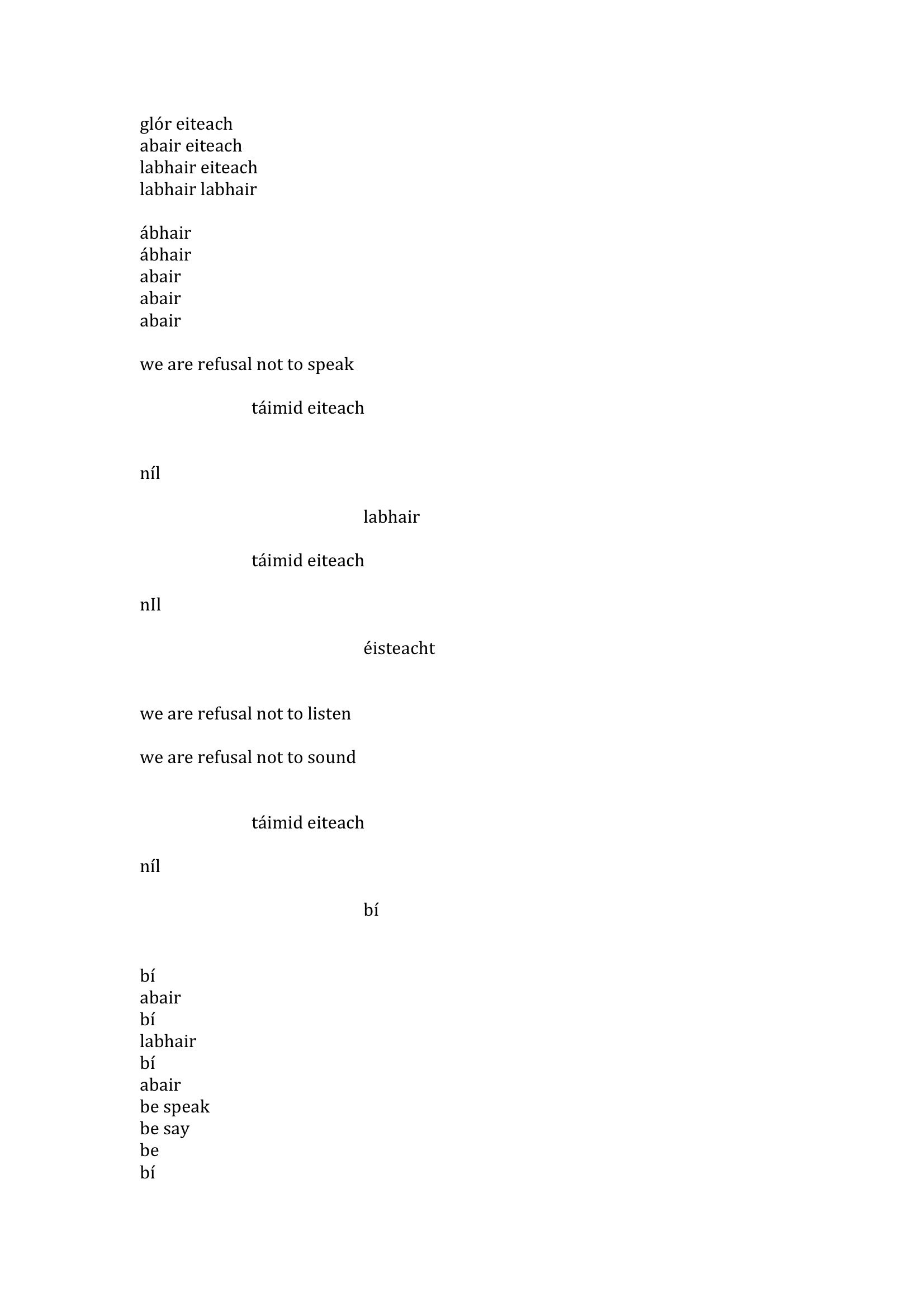
(3)

… In the book I’m launching next week [ ‘IS ing’ (Veer Books 038) launched at Prague Microfestival 2011] the improvised performances had to find a book form, for the most part they were improvised read/writing so didn’t make use of the visual but towards the end I started to introduce other resistances while reading in order to keep facility or a reliance on facility at bay…

… I’ll have to deal with how I can read from a book which is mainly a transcription of improvisations, we’ll see…

… There are questions I’d like to ask in bringing this performance to a blog, web, or vimeo version.  It may well be that very little needs done, a sense of archiving…

How is the host genre if you like or ‘platform’ to be considered when moving say from book to web, from performance to book, and i mean from your perspective, i have a sense of how i would ask questions of it as a poet/performer…

[4]

(5)

The use of Irish that in the words of Theo Dorgan, ‘places us out of the language set of the boat’ specifically appeals to speaking and identity.  It speaks to the individual ‘saying’, in the act of ‘saying’, not only in Irish but as an individual voice speaking out of its own boat.

The investigation for Ciall represented initially by this powerpoint presentation ‘abair’ points to the Gaeltacht sensibility depending in the end upon one premise that it keeps speaking that it keeps saying, that it keeps sounding.

Within my own register of voices the poet Maggie O’Sullivan speaks of growing up in Yorkshire with Irish Parents and how that has skewed her relationship to language. To paraphrase John Hall [1] this work places itself as a gerund ‘an action’ caught as a thing’.  A performance of it would anticipate itself as a thing in action. The sensibility of the Gaeltacht is or has to be that of an action, an anticipation of a ‘we’, of a making of a present. Otherwise it ceases to be.

This work will use ‘abair’ as a score for an improvised read/writing that anticipates a reader, a viewer, an other making a meaning.  That meaning is a present of activity. The Gaeltacht makes a present out of its own body of language, language of body, of I of mé, of tú, of muid.  The world exists as and how we sing it into existence, anticipate its present. While it reaches graphically towards voice this work must retain its link to writing and reading, its focus is on the making of meaning and identity through language and the material bodies present in that activity the graphic sign and the reader /viewers body in equal focus. Senses and sense as poetics of the body.

NOTES

[1] John Hall, Thirteen Ways of Talking About Performance Writing (Plymouth College of Art Press, 2007) p.27.

(6)

VERYSMALLKITCHEN writes: The anarcheology here does not have to follow the temporality of a project that concluded in the event at  An Gaileraí, Gweedore, Donegal, on 9th April 2011. Here, score comes after the documentation, and/or the proposal can be a conclusion.

Whilst the original purpose and function of each remaining fragment is in many cases evident, I think the opportunity of transition to a blog format like VerySmallKitchen is that these pieces can be (re-)figured into a sequence that offers new ideas about where and how the work is work is functioning.

Perhaps this is a non-hierarchical treatment of the different components that comprise, to adopt Joseph Grigely’s proposition [in his Exhibition Prosthetics (Bedford Press Editions, 2010)], the “prosthetic body” of language as it runs through all stages of the exhibition (and performance) process.

I have, though, whilst working with sequence and shifting temporalities, kept the various stages distinct, so that movement and adaptability also encounters and negotiates with the specificity of score, event, proposal, performance, document…

… with the further proviso, of course, that any transformation into a new context is a possibility embroiled with loss, gaps, (non-) human error, constellation up and down grade, deletions themselves erased by further dis-/re-/placements, provocations….

(7)

(8)

… the one thing missing and turned down a bit too much during the performance on the vimeo is the multi voice pieces during the métúsésímuidsibhsiad transitions, but i’m always open to interpretation, there is a direction of development in some investigative sense so the poem sort of digs towards an unknown goal considering the call by the gallery so the gaelic comes more at the end but very much in concordance with the poetics of the opening, that is the transgression of the grammar which nearly all gaelic work I’ve seen overly adheres to.

The breaking of the grammar, how that considers language is purposefully basic in part to allow space for performance but also to allow greater opening into the language as a future project…


*

Part 1 of this project is here.

VSK HANDBOOK: SOMETHING ESSENTIAL THAT IS HIDDEN: JOHN BERGER, SECRETS AND INCONSEQUENTIALITY

In Uncategorized on June 16, 2011 at 10:22 am


One reading of John Berger’s Bento’s Sketchbook (2011) is as a handbook elucidating a practice of the secret. Or, unfolding both from and into that, a workings, a politics, a poetics, of what his book identifies as generative, necessary and constructive about the secret, hidden and inconsequential.

This post is a notebook through Berger’s text, a commonplace book of the direct engagements with such ideas that appear in its 178 pages. Such ideas, of course, are also implicit in the essay-ings and drawings that comprise Berger’s book.

It’s the possibilities of this movement between explicit and implicit, fusions and specificities of writing/ reading/ drawing/ thinking/ talking/ looking/ experiencing/ understanding/ critiquing/ and/ self/ other that motivates here, spiraling off into examples and implications whilst aware of matter-resonance of word- lexicon’s themselves as conveyers and containers.

The secret resists attempts to understand it. This is how the practice of the secret commences, continues and conveys.

1. BEGINNINGS

(a)We who draw do so not only to make something visible to others, but also to accompany something invisible to its incalculable destination. (9)

(b)…we smiled and glanced at one another. And somewhere behind our agreement was the tacit recognition that any original political initiative has to start off as being clandestine, not through a love of secrecy, but because of the innate paranoia of the politically powerful. (42)

(c) Yet, if we imagine the stories being told across the world tonight and consider their outcome, I believe we’ll find two main categories: those whose narratives are emphasising something essential that is hidden [invisible,86], and those which emphasise the revealed. (72)

2.PROTEST

(a)Yet what one is warning and protesting continues unchecked and remorselessly [this essay is a letter to Arundhati Roy]. Continues irresistably. Continues as if in a permissive, unbroken silence. Continues as if nobody had written a single word. So one asks oneself: Do words count? And there must sometimes come back a reply something like this: Words here are like stones put into the pockets of roped prisoners before they are thrown into a river. (79)

(b)To protest is to refuse being reduced to zero and to an enforced silence. Therefore, at the very moment a protest is made, if it is made, there is a small victory. The moment, although passing like every moment, acquires a certain indelibility. It passes, yet it has been printed out. A protest is not principally a sacrifice made for some alternative, more just future; it is an inconsequential redemption of the present. The problem is how to live time and again with the adjective inconsequential. (80)

(c) When we are impressed and moved by a story, it engenders something that becomes, or may become, an essential part of us, and this part, whether it be small or extensive, is, as it were, the story’s descendent or offspring… those stories that shape us are our coincidental, as distinct from biological ancestors. (84)

3.STORIES

(a)Which of the two [introverted or extroverted stories] is likely to be more adapted to, more trenchant bout what is happening in the world today? I believe the first. (86)

(b)Because its stories remain unfinished. Because they involve sharing. Because in their telling a body refers as much to a body of people as to an individual. Because for them mystery is not something to be solved but to be carried. Because, although they may deal with sudden violence or loss or anger, they are long-sighted. And, above all, because there protagonists are not performers but survivors. (86)

(c)There are two forms of continuity: the acknowledged one of institutions and the unacknowledged one of clandestinity. (87)

(d)The heartfelt hopes, once exemplified in triumphant Hollywood stories, have now become obsolete and belong to another epoch. Hope today is a contraband passed from hand to hand and from story to story. (87)

4.SECRET SIGHTINGS

(a)The Prado in Madrid to look at Velasquez’s Buffoons

They have a secret which it has taken me years to fathom and which maybe still escapes me. (93)

Juan the Pumpkin’s still eyes look at the parade of life and at us through a peephole from eternity. This is the secret that a meeting in the Rambla suggested to me. (96)

Velasquez, Juan Calabazas (Juan the Pumpkin)

(b)A budget supermarket in a suburb of Paris

It’s the opposite of a street market, where the key secret is that of a bargain. In a street market everyone encourages everyone to believe they’ve just made a smart deal; here, every one of us is being considered as a potential thief. (104)

(c)Motorbikes and Drawing

for many years I’ve been fascinated by a certain parallel between the act of piloting  a bike and the act of drawing. The parallel fascinates me because it may reveal a secret. About what? Displacement and vision. Looking brings closer. (111)

Figure 1

Velasquez, Juan Calabazas (Juan the Pumpkin)


NOTE (1): Berger’s “secret” is the ________, _______ of __________ not yet thought through.  Learning as based around the secret, changes/charges pedagogy. Maybe something else has been told in lieu of the secret.  Learning depends on how likely you are believed (by the secret itself) to be a keeper.

Learning becomes removed from metaphors of “bringing into the light” or increased spatial intimacy. The learner is drawn further into the secret, trying to understand it through whispered, implied, hinted, invisible zones of mishearing.

NOTE (2):  The secret is present in/forms (learning) meetings with strangers. It is mediated and given physical form through the acknowledgement/ encouragement of gift giving and receiving.  “Gifts should affect the recipient so deeply as to startle him” writes Walter Benjamin.

2

5.ENDINGS OPENINGS HOPES

(a) I live in a state of habitual confusion. By confronting the confusion I sometimes achieve a certain lucidity. You  showed us how to do this. (139)

(b)When I’m drawing I feel a little close to the way birds navigate when flying, or to hares finding shelter if pursued, or to fish knowing where to spawn, or trees finding a way to the light, or bees constructing their cells. (149)

(c)There is a symbiotic desire to get closer and closer [Berger writes of his drawing of the Russian writer Andrei Platonov], to enter the self of what is being drawn and, simultaneously, there is the foreknowledge of immanent distance. Such drawings aspire to be both a secret rendezvous and an au revoir! Alternately and ad infinitum. (156)

1

CODA NOTES: LEXICONS/ BERGER/ WARHOL

(1)invisible incalculable destination clandestine something stories essential hidden small protest victory secret indelibility inconsequential engenders coincidental ancestors introverted unfinished sharing carried mystery survivors contraband

(2)particularly Photocopies and The Shape of a Pocket, how a writing so concerned with certain forms of attention, commitment, witness, comes to an essaying of people, places, paintings/-ers, the personal migrations, choices of biography, necessary to such a practice

(3)of Andy Warhol’s AMERICA, reissued 2011 as a Penguin Classics (images above). An affinity with Bento’s Sketchbook that can align both around a rejuvenated project of the inconsequential secret constrained neither to rural France or Manhattan

VSK PROJECT: AODÁN MCCARDLE ‘abair’ ANARCHEOLOGY(1)

In Uncategorized on June 12, 2011 at 1:19 pm

Aodán McCardle, ‘abair’, An Gaileraí, Gweedore, Donegal, for Ciall 2011

(1)

… it’s called ‘abair’ which is  the gaelic verb ‘to say’ though ironically in the end my performance was mute at least verbally, in part due to the type of attention a ‘formal’ art audience was prepared to give especially in the circumstances of this particular exhibition and its subject…

… it became quite different to what i was setting up originally, much more visual and less vocal other than the sounds recorded on the powerpoint, the joys of improvisation, it was very good for me from the experience point of view in that you tend to learn a lot more in that way…

… I’ll be working on a book version but that will take the next year off and on and will have to deal with the different materiality of experience just as Caroline Bergvall moved and changed between book, installation and web version for éclat

(2) ‘abair’

(3)

Aodán McCardle, ‘abair’, An Gaileraí, Gweedore, Donegal, for Ciall 2011

VERYSMALLKITCHEN writes: This VSK Project is anarcheology of a performance by aodán mccardle at An Gailearaí, Gweedore, Donegal in response to Ciall 2011.

It is compiled by VerySmallKitchen – not present at the event itself – in response to an invitation from aodán to work with the numerous traces of the event towards an online presence for the project.

These included: its written score, the event proposal, the performance and installation itself, and how it was documented in email, still, sound and moving image.

Or not, for as aodán observes in an email 05/05/11:

The subsequent improvised site specific performance is a conversation that has been lost as both video cameras failed for different reasons. It will hopefully be glimpsed in its still silence at VerySmallKitchen… The blog there will be an archeological dig of the remnants.

*

Parts 2  of this project is here.

VSK PROJECT: SUSAN THOMSON’S THE AUTHOR OF UNUSUAL PAPERS

In Uncategorized on June 5, 2011 at 9:54 am

Diana Caramaschi, 30 Days, Video animation, 5:50 mins.

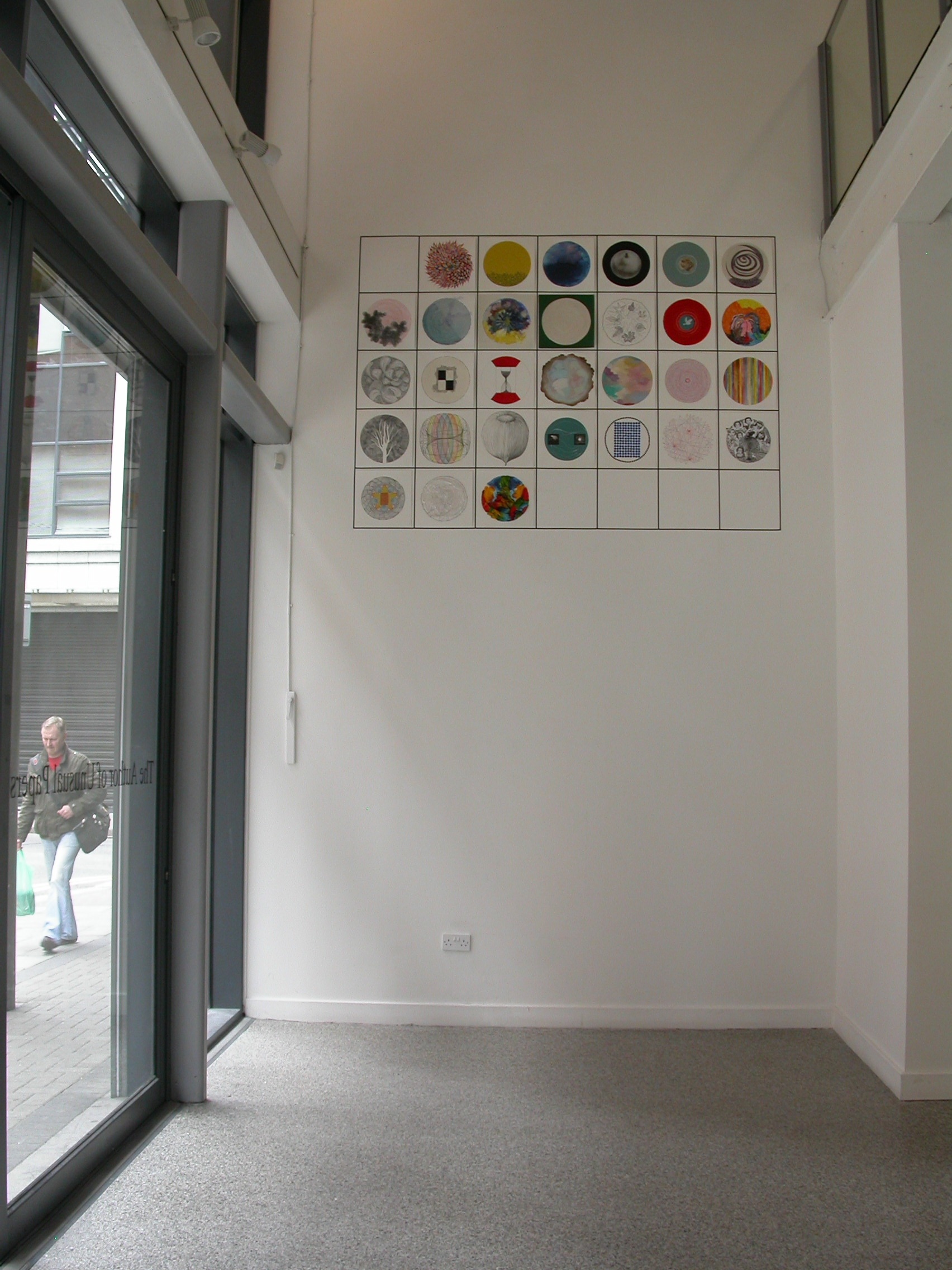
VERYSMALLKITCHEN writes: Susan Thomson’s THE AUTHOR OF UNUSUAL PAPERS is a wall text that opens an exhibition of the same title at Dublin’s The LAB (27 May- 25 June 2011). A row of headphones extend an invitation to hear the text read aloud.

The text also appears on the handout/ brochure for the show, which also includes work from Claire Behan, Diana Caramaschi, Monica Flynn, and Colleen Lambe. This informs me that “following several months discussions amongst the artists a body of work emerged in response to this text.”

Several projects and texts on VerySmallKitchen have explored the relationship of writing and exhibition. I was interested in how this text seemed to function variously as proposal, fiction, catalogue essay, and art work. I wondered how it would function in the further context of this blog.

THE AUTHOR OF UNUSUAL PAPERS is reprinted below, followed by a short essay from Susan in response to an email from VerySmallKitchen 31/05/11 asking how she understood the functions of such a text.

Diana Caramaschi, 30 Days, grid, mixed media on paper, 224 x 160cm

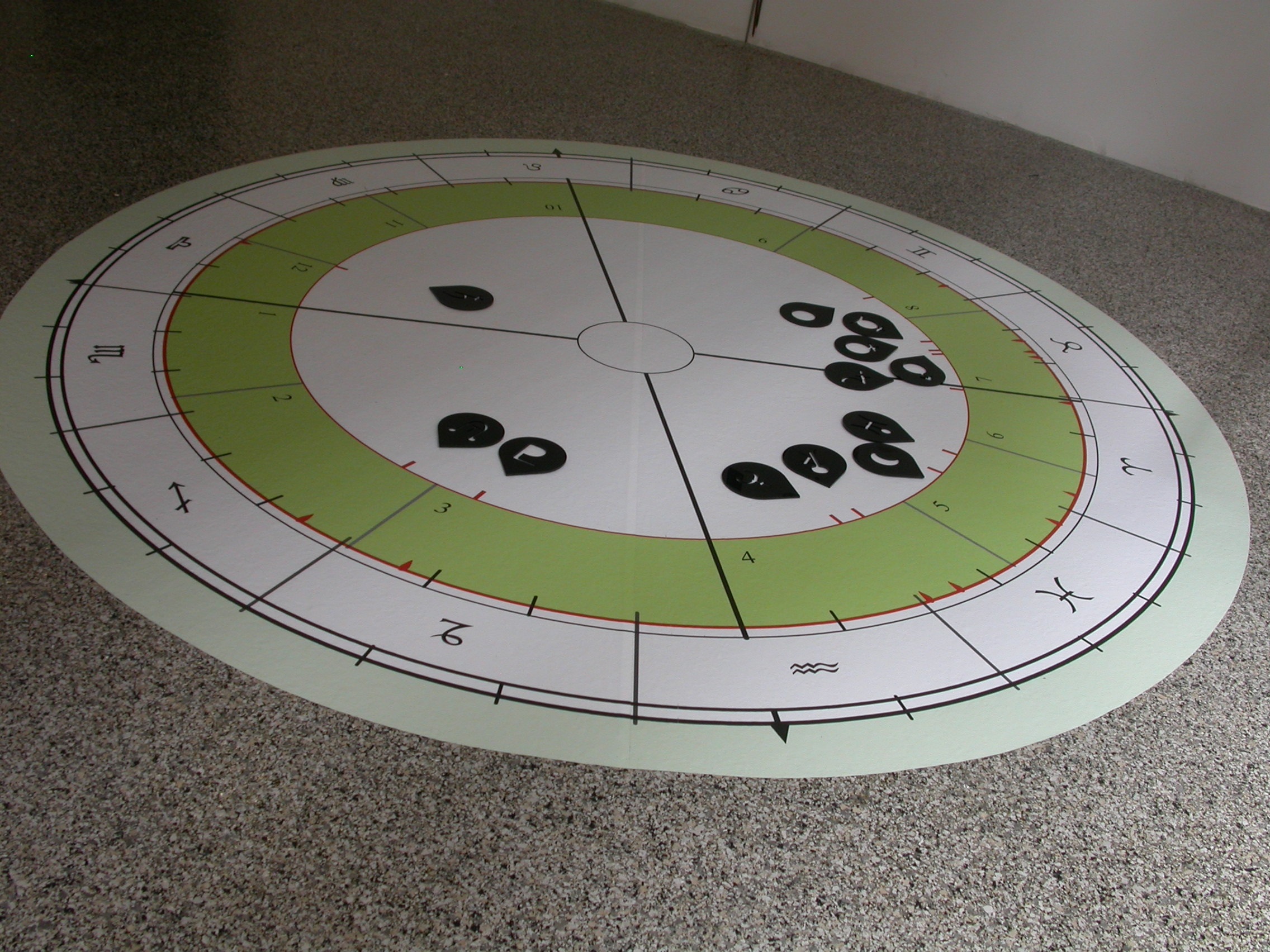
Monia Flynn, Astrological Chart for 26th May, 2011, vinyl graphic, 2.5m (accompanied by live event on 24th June)

The Author of Unusual Papers

Am I the author of this text, and if not, who is? I have examined the text for evidence of my usual themes, subjects, preoccupations, sentence length, adjective use etc. I have found many key words that correspond to articles I have written in the past.  Desire, the self, blank, return of the repressed, art, Glasgow, time, lovers and many more. It seems that I may be the author of this text.

While it is perhaps a more unusual text written by me, I think that I have written it. No, more than that, I feel sure that I have written it. Then, there is the fact that it is a self-reflexive text, a text about identity, that it is a text searching for an author, and that makes me even more convinced of my own authorship. The author is in question, a kind of detective story unleashed, and forensic linguistics is the detective’s tool digging up clues, the lists of similar nouns, like echoes, a stylistic marker of my work, the self-referential, the endless mirrors, mise en abime. Forensic linguistics allows me to dig into what I think is my own writing in order to see more clearly: was it really me who wrote this? Why was it written? What are the clues and what do they point to?

Stylometry makes me cry. What if I am not the author? My sentence lengths are variable, the algorithm learns my style. There is a characterization of which papers are most and least typical for a given author; when I am most myself in my writing and when I am least. And which if either is better? Or when I am most consistently myself at any rate. The text is reduced to a bag of words. I will make it as consistent with myself as possible, in the future. Death, desire, sex, food, text. Why can I write nothing new, nothing inconsistent, nothing that a piece of software would pass over, not merely as an unusual paper for me, but instead a text that is so different that it would simply fail to recognise it as emanating from me. It must be by someone else. But why do I desire this at all? Better surely to accept the prison of my own limitations, of my personality, my style, whatever that is. It’s predicting my words…

WORD                PROB
AUTHOR            0.1965
MIRRORS          0.234
RECOGNISE     0.13
PRISON              0.02

PROB            AUTHOR
0.45               SUSAN THOMSON
0.23               DIANA CARAMASCHI
0.1                  COLLEEN LAMBE
0.3                  MONICA FLYNN

Is this an overlapping text, one in which the authors bleed into one another, or co-author? The first trope consists entirely of French words. There was an apparent peaking of French words in the mid-1990’s. The more red a word, the more likely it is to have been generated by me, the more blue by someone else, the nameless author.
The resulting author model was shown to extract significant hidden information about the author, from the set of abstracts, including all the unusual papers for specific authors. And so we may conclude with a question, is it always the same old story or is there the possibility of an author writing a text that cannot be detected as her own.

Susan Thomson, The Author of Unusual Papers; The Lost Word, installation text, books, copies of manuscripts

Post Script

The text is now a post-script I suppose. It has become audio, in a play version of itself, and is now on the blogosphere, post-play.

It has mutated and spawned versions of itself, mimicry in the text in the windows, things I never wrote but it looks like I wrote them.[1]

The text is now in multiple places; the springboard-text for the show, in the handout, on the wall, through the earphones, on the blog; it seems to be reproducing itself at an alarming rate. The text is in transit. Who knows where it will go next? And still the author has not been found, ascertained.

There is a Sherlock Holmes story, ‘The Adventure of the Reigate Squires’, where the case involves handwriting analysis. A torn piece of paper is found in the murdered man’s hand. Finally, Sherlock deduces that it was father and son who had alternately written each word of the note. Copies of Arthur Conan Doyle’s letters to Roger Casement appear in the show, as well as a copy of Casement’s Black Diaries.[2]

The Black (overtly homosexual) Diaries and White (day to day censored) Diaries is the Reigate story’s historical opposite in that it was believed the diaries were by two separate authors but handwriting analysis subsequently proved both to be authored by him. Conan Doyle and Casement step up to the task, spilling ink for one another, and they sit now in a museum, the ink dried up and their tears lying in the manuscript room.

Our childhood portraits hang in the gallery, painted or drawn from childhood photos after the fact. [3] We all become Dorians living on in youth in the gallery as our adult selves wander the streets. The artists pull facts, words, signs, insights from the text and knowledge they have about my life into their own work. They psychoanalyse and try and reveal through metaphor what lies between the lines. They convert the words into visuals, apply semiological analysis. [4]

Then they add their own personalities, their own thoughts, lives, analyses. They explore archetypes, they animate a month of unusual papers, an unusual paper for every day.[5]

The text on the wall is pinned beside the audio version; with the audio came voice, the freedom to walk around the gallery; with the text, the pleasure of reading. Many seemed to return to their childhoods and opted for both at once. Like learning a new language, in a language booth.

I know who the author is, yes; but the author, invisible, unnameable, has just left the building, escaping, minutes before the show opens, the scene of the crime.

NOTES

[1]Author Claire Behan and anonymous.
[2]Author Susan Thomson.
[3]Author Monica Flynn.
[4]Author Colleen Lambe.
[5]Author Diana Caramaschi.

More about Susan’s work is here.

ART WRITING IN DUBLIN: PUBLICATIONS/ EXHIBITIONS/ PROJECTS

In Uncategorized on June 4, 2011 at 12:19 am

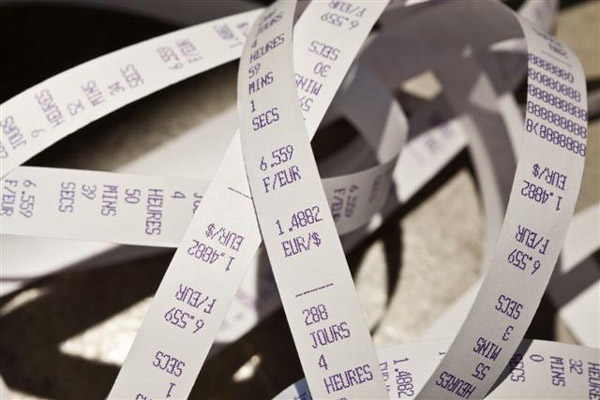
Sarah Browne, Second Burial at Le Blanc, 2011, ticker-tape countdown clock with live currency feed

Last week’s trip to Dublin for ART CRITICISM NOW was a chance to find out about a whole host of art writing projects in the city and beyond, running the spectrum from critical writing projects to art-language initiatives of diverse kinds. This post offers a run through of those projects, continuing an exploration of where one becomes the other, or how a practice might involve/ combine/move between these different possibilities of practice.

At the criticism end of the spectrum is +BILLION- , which began as a one person blog by James Merrigan, currently has a call for writers, and published its own summary of the Art Criticism Now event within a few hours of it finishing. Like the other writing on the site it’s a cogent, focused, informed critique, intelligently aware, as the archive on its site is named, that JUDGMENT CALLS.

In the panel discussion at Art Criticism Now one of +BILLIONS- main concerns was how the size and nature of the Dublin art scene makes criticism difficult. I tried to relate this to the concern in my talk with how writing creates and comes out of artistic communities, as well as my recent experience of a range of art writing related artists and projects in Yorkshire (for example: Open Dialogues, The Wild Pansy Press, Information as Material, Not Yet There, Critical Writing Collective, Millpond…)

William Kentridge Office Love, tapestry, 2001

On the same panel, Cristín Leach of the Sunday Times recalled being told at an opening:  “I don’t know how you dare to show your face in here.”  She recalled how, as a starting out journalist, a newspaper editor had told her not to write catalogue essays if she wanted to write for the newspaper, and how it still felt important to hold to that distinction. It was a position useful to consider alongside what can seem the art world’s default position of an embedded writing practice that sees no problems moving wherever opportunities (and payment) allow.

BILLION was responding to Jason Oakley of  VAN (The Visual Artists’ News Sheet), who had outlined a soon to be launched review supplement to the publication which explicitly briefed writers to evaluate  shows under discussion. It’s interesting that within such contexts straight, traditional reviewing becomes the only appropriate form of writing. Whilst I value such an approach as one among a number of possibilities, I am not sure it has the value as either discourse, PR and/or intellectual capital that it is often ascribed, or that expanded writing practices don’t offer more possibilities for an organisation like Visual Artists’ Ireland to fulfill its broader remit of support and advocacy on behalf of professional visual artists.

As in the UK, my sense was that the potentials of an exploratory criticism is more evident in grass roots initiatives, like BILLION and paper visual art journal. These tend to be unfunded DIY initiatives, which might  give them a limited life cycle, but opens up distinct possibilities as long as the writing and editing of such publications can be juggled with all the other jobs and activities their organisers and contributors are likely to be engaged in.

Edited by Niamh Dunphy, Paper Visual Art Journal’s tagline reveals its difference in emphasis from +BILLION-, self-describing itself as “an online publication for contemporary art. Paper recognises the vacuum of critique and dialogue that exists for the emerging artist or artist group, between graduate and established art practice. The emphasis, at outset, is to address this.”

Critical articles are published alongside listings,  artist profiles (perhaps best described as showcases), and Insight, a new series of texts on artist run spaces.  The project is seems one where different functions of criticism, information,  and gallery are all “embedded together” (it made me think again of John Kelsey’s writing/ art/ gallerist role combinations) and it will be interesting to see how this mixture unfolds. At ART CRITICISM NOW, Dunphy spoke of a hands on editorial approach, wanting to ensure writers said what they wanted to say rather than what they thought they should say.

https://verysmallkitchen.com/wp-content/uploads/2011/06/allotrope-pagefrontw.jpg?w=213

Allotrope, Issue 1, 2011

Encountering all these projects, made me wonder what the equivalents were in London – a scene that, chatting in the bar afterwards, we decided was best described as “nebulous”. Most of the London projects I could think about as having an equivalent energy and dynamism to +BILLION- or paper visual art journal were artist led magazines like Art Licks, spaces for artists writing about their own work,  print spaces for practice itself rather than locations for critique and review, experimental or otherwise.

The day was also a chance to pick up a copy of the broadsheet format Enclave Review, produced in Cork, edited by Fergal Gaynor and Ed Krčma and whose current issue very much places local exhibitions in an international (and often big-name) context (Issue 3 has pieces on Beuys/ Broodthaers/ Zaha Hadid/ Nancy Spero).  Like other publications here, ER seems very much to be finding a space for in depth essays on contemporary art and thinking through how that is reflected in decisions about print and online distribution (in their case, a freely distributed broadside is followed up by online PDF’s once the free print copies are no longer available).

Moving along the problematic but useful creative critical spectrum  I find Allotrope with its themed inaugural issue on Lies. Allotrope is produced through the University of Ulster, edited by Emma Dwan O’Reilly and Keith Winter, and, at least in my and several other cases, was distributed in the lift on the way up to Art Criticism Now. It takes the format of a single folded sheet which contains image-text contributions from 21 writers and artists including Amanda Coogan, Daniel Jewesbury and Douglas Park.

There is no web site for Allotrope, but a second edition on lists  (each issue is produced in a limited, numbered edition) will be published alongside University of Ulster Festival of Art & Design, Belfast, Ireland, 4 – 19th June 2011. As the images above show, it’s a lively magazine, whose single sheet format, unfolded and turned around again and again to be read, deliberately somewhat unwieldy and initially disorientating, reflects the tangled deception of its theme as it impacts on authorial voice and language.  To find out more email allotropepress@gmail.com

The two days were also a chance to catch up on the projects of Jennie Guy, with whom I collaborated on one of Reading Ensemble projects in January, and the events curator, Fiona Fullam, also responsible for the Art/Writing/Talks series in Dublin, Carrick-on-Shannon, and Bristol last fall, and which will shortly be appearing as a print publication.

Jennie Guy, Reading Ensemble II, 2011. Video Still, courtesy Russell Hart

In the galleries of Dublin there were several relationships of writing and exhibition to explore.  At Project Arts Centre, Sarah Browne’s Second Burial at Le Blanc, includes a pile of free newspapers, entitled “On Hoarding, Accumulating and Gifting: A visual essay in preparation for a film by Sarah Browne.”

Each page of the newspaper contains a photo in a sandwich of English and French language text that describes the situation in Le Blanc, a French town that has revitalised its economy by being a place where it is still possible to exchange french francs. Browne’s newspaper moves out from Le Blanc through a wider frame of quotations, notes and images on economics, globalization and the (gift) economy.

If the text is a preparation for the film, it is also catalogue, explication, handout and document. Without it there is something more surreal about the 16mm film projection of the shopkeepers procession, carefully carrying the ticker tape machine (which is also in the gallery, positioned where I might have expected the projector to be) through the town.

The show is most satisfying, however, once newspaper and film can infect each other with their different modes, combining into a parable as much, of course, about Ireland as France, the present future as the past present.

Two final projects exploring the relationshiop of writing and exhibition: tHREE THOUSAND AND NINE, is a book of short fiction alongside an exhibition by Brian Duggan, which itself has as a starting point E.M.Forster’s novella The Machine Stop.  The book feature stories by Daniel Boland, Pauline O’Hare and Niamh MacAlister, an image sequence by Duggan, and an afterword by Francis McKee, whose suggestive beginnings I could imagine being productively adapted for a future ART CRITICISM NOW:

Any unreliable history needs to duck and dive between parallel dimensions, combining improbabilities in a story that connives with its unscrupulous author. A decent account of science fiction in Ireland needs such deviance. Throwing academic propriety to the wind, imagine for a moment that the beginnings of this story could be seen as a film script. (75)

,

Finally, looking at The Author of Unusual Papers exhibition in the LAB, I noticed the text which Susan Thomson had placed on the handout for the show, and on a wall as one entered the exhibition, where it could also be listened to on several sets of headphones.

I was intrigued by the text and its multiple functions, as both a piece of critical writing, a fiction, a curatorial statement, and a script for this exhibition developed by Susan with Claire Behan, Diana Caramaschi, Monica Flynn (who maintains the contemporary art-writing blog Nelly’s Room) and Colleen Lambe. The complete text, with a short essay by Susan on and around its workings, is forthcoming on VerySmallKitchen.

NEW CHAPBOOK FROM RED CEILINGS PRESS: BLACK GARDENS

In Uncategorized on May 30, 2011 at 9:24 pm

My book BLACK GARDENS has just been published by Mark Cobley’s RED CEILINGS PRESS. It is available for online consumption and PDF download here. The full Red Ceilings Press catalogue of e-books is here.

BLACK GARDENS began with THE SHADOW OF A TRAIN exhibition/ project at the Totalkunst Gallery in Edinburgh, in June 2010, particularly a day I spent writing in the gallery as Mirja Koponen and Sara Sinclair worked on an installation.

My search for the black gardens was proving unsuccessful...

...failing to locate the public sculpture for which the black gardens were famous...

I decided not to project my writing, so whilst the artists work was public throughout the day, it was the act/image of myself writing that was public rather than the specifics of what I wrote.

I returned to this writing in April 2011. It was edited and new material was introduced. The aim is still a sense of “liveness” traceable to that original event, but this is constructed artificially through a layering of different moments.

... what I discovered was the dust jackets of books practicing yoga...

BLACK GARDENS also unfolded out of The Moth is Moth This Money Night Moth, my 2010 chapbook from The Knives Forks and Spoons Press, which evidenced a concern for page/ space and for the theatrical operation/ permutation/ extension of a deliberately limited vocabulary.

BLACK GARDENS sought to open those concerns to the daily, the diaristic, rhythms of talking and thought, detail and humor. I was interested in how such garrulousness might play with a minimalist focus on the material of  letter, syllable, word and page.

I wanted a minimal that wasn’t solely about order and contemplation, but which also saw the white of the page and its spare utterances as  a site struggling for any articulation, an inelegant falling apart/ out of form and content…

In the refinement of these concerns, BLACK GARDENS also emerged via the page as simultaneously written and spoken.

... and the black gardens to be found within a self conscious melancholy...

READINGS

A constellation of texts read during the writing of this text, and/or whose reading was prompted by its completion: Rachel Lois Clapham, WORK, HARD, TRY: A (W)reading (Kaleid Editions, 2010). Online pdf here; James Davies, Plants (Reality Street Editions, 2011). See Colin Herd’s review here; Emmett Williams, A Valentine for Noël (Edition Hansjörg Mayer, Stuttgart 1973 – remaindered copies of this and other EW texts have been [May 2011] for sale in the basement of Koenig Books on Charing Cross Road).

Jonathan Williams, Jubilant Thicket: New & Selected Poems (Copper Canyon, 2005)is a vital source for where concrete meets garrulous. See also Craig Dworkin’s Eclipse project, particularly for its PDF’s of books by Aram Saroyan and Robert Grenier.

EVENT: ART CRITICISM NOW at The LAB, Dublin 26th May

In Uncategorized on May 24, 2011 at 9:50 am
DSC_1888

Ciara Scanlan, The Product Service Company, The LAB, 2011


I’ve been working on a talk for the LAB Dublin’s Art Criticism Now event this Thursday. Its been a chance to think through the Lab’s own programme of commissioned writing; the broader debates and publications in the field, and the issues that have arisen in my own practice. 

I’ve also been trying to think through the implications of the various writing collectives that have informed my work of the last few years, such as Open Dialogues and Critical Writing Collective, who have recently embarked on their own research project in the field, and more broadly how to think through art criticism as part of artist-led culture rather than as the preserve of Frieze, Art Monthly, and certain supposedly hegemonic provincialities of the art market.  

A consideration of critical writing projects that orientate around a thematic or organisational identity – such as Emma Cocker’s Not Yet There or Lisa Robertson’s Office for Soft Architecture – have also been part of my project. I’ve also found the following statement by Nathalie Stephens as generative to the conditions and paradoxes of criticism as I am trying to unfold them:

my own need to very aggressively resist, or think through, what an essay is or might be and to find my own way to a text that isn’t one, that isn’t one that’s compliant with a particular form, right? That doesn’t interest me. I understand these forms viscerally. They’ve been inculcated right? But I don’t want that. So in a sense, the thing that’s internalized, the sense of having to be kicked out again, even though we can sort of agree that there’s no outside, but somehow there’s that tearing or rending that has to happen – or breach out of which might emerge this thing. That is this particular text.

SOURCE: Kate Eichorn and Heather Milne eds. Prismatic Publics: Innovative Canadian Women’s Poetry and Poetics (Coach House Books, 2009), 64-5.

 under construction 1

DSC_1584

Ciara Scanlan, The Product Service Company, The LAB, 2011


I’ll post more info here after the event, and there will also be a book from the Lab including critical writings around their exhibition programme of the last few years.

For the moment, I offer below a brief constellation of recently read texts which have opened up possibilities and situations, wondering, as James Elkins does in the O’Brien/ Khonsary anthology, at what point we stop talking about “art criticism” and start talking about something else altogether.

https://i0.wp.com/www.sophiemellor.net/wp-content/uploads/2011/05/urban_wanderer_sophie_mellor_2010.jpg

https://i0.wp.com/www.sophiemellor.net/wp-content/uploads/2011/05/manual_close_and_remote_barrow.jpg

from Manual of Marginal Places (2011). Images Sophie Mellor and Simon Poulter


 SOURCES: A CONSTELLATION

 Emma Cocker and Sophie Mellor, Manual of Marginal Places (Close and Remote, 2011).

Tom Holert, Distributed Agency, Design’s Potentiality  (Civic City Cahier 3, Bedford Press, 2011).

John Kelsey, Rich Texts: Selected Writings for Art (Sternberg Press, 2010).

Chris Kraus, Where Art Belongs (Semoiotexte, 2011)

Emily Jacir and Susan Buck-Morss, 100 notes/100 Thoughts, no.4 (Documenta/ Hantje Cantz).

Melanie O’Brien & Jeff Khonsary,  Judgment and Contemporary Art Criticism (Fillip, 2010).

Jane Rendell, Site-Writing: The Architecture of Art Criticism  (I.B.Tauris, 2010).

Nathaniël (Nathalie Stephens), Absence Where As (Claude Cahun and the Unopened Book)  (Nightboat Books, 2009).

Here is the LAB’s description of the event: 

The LAB Gallery will host an event to explore, tease out and expose the current thinking around art criticism. Looking specifically at the contexts, language and forms of writing about art, reviews, as well as criticism itself, it seeks to clarify and elucidate how and whether criticism translates art works and what is lost or gained in this process. It would consider what elements critique makes visible, as well as asking how it might achieve this. What are the subtleties between review, descriptive text and criticism and how do the presentation and context (wall panels, book, newspaper, pamphlet, catalogue, online essay, etc.) of this kind of writing affect its nature and purpose.

London based writer David Berridge will give the keynote address for this seminar, which also explores what constitutes criticism, looking at alternative elements such as performance, interview, and exhibition. This is followed by an interview between critic and curator Caoimhin Mac Giolla Leith and performance artist Amanda Coogan, considering the merits of having work critiqued as well as the dangers of being reductive. Following this is a panel discussion chaired by Fiona Fullam, with panellists Niamh Dunphy of Paper Visual Art Journal, Cristín Leach of The Sunday Times, James Merrigan of +BILLION- and Jason Oakley from Visual Artists Ireland and VAN. This panel discussion aims to extend the thoughts, ideas and concepts put forward by the other speakers and look specifically at the current state of art criticism in Ireland today.

This event hopes to respond to the current debate around art criticism, its nature and purpose, as well as the function of the critic, which has been considered and probed so extensively of late in journals and online. While the critique of criticism has itself a long history, still there are questions and issues which recur and which merit further discussion and investigation. Art Criticism Now aims to contribute to that continuing conversation.

To book contact Sheena Barrett at sheena.barrett@dublincity.ie
.

NEW ESSAY: RICHARD WILLIAM WHEATER’S NEON LIGHTS

In Uncategorized on April 20, 2011 at 6:26 am

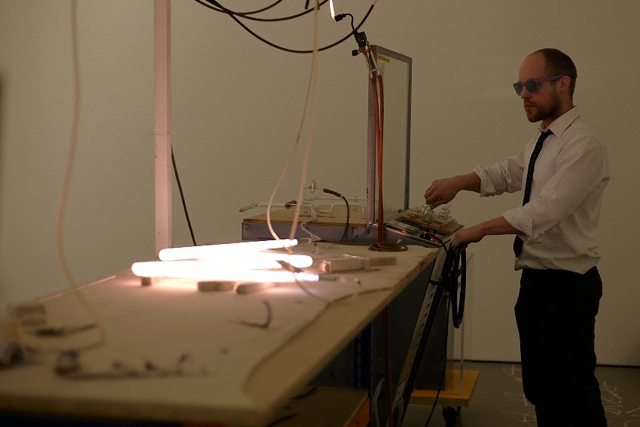
Richard William Wheater, Neon Lights, gallery shot. All Photos: David Lindsay.

In December last year I went to Site Gallery in Sheffield to write about Richard William Wheater’s NEON LIGHTS, as one of the writing commissions alongside the gallery’s SITE PLATFORM program.

The essay is now published on the SITE website, and can be downloaded as a PDF here. In the context of the work on VerySmallKitchen, it highlights a nexus of issues around neon text art, a critique of its dependence on commercial sign makers, and the alternatives available through engaging more fully with the medium.

The commission was also a chance to unfold some connections of art writing and reportage. This emerged as a response to how Richard’s project unfolded live in the gallery space, and how the best response seemed to be to spend time in the gallery, notebook in hand (like Tom Wolfe alongside Leonard Bernstein’s grand piano in Radical Chic, although minus the suit!).

Richard William Wheater, Them and Us

Recent critical texts such as Chris Kraus’ splendid Where Art Belongs were also crucial in discovering the methodology of this text. My initial response to NEON LIGHTS had been a series of short fictional texts, only one of which is present in the version here. It was the reportage approach which I felt had balance of writer and artist appropriate to the project.

More about Richard’s work can be found here, and information on his Neon Workshops project  is here.

The essay begins:

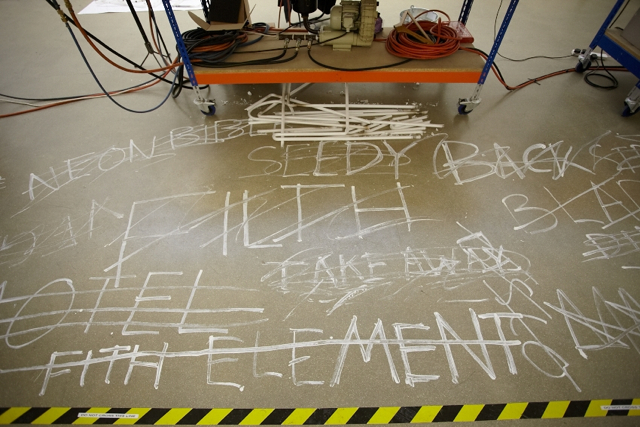
Visitors to Richard William Wheater’s Neon Lights installation were asked for a word to be made into neon by the mobile neon making factory that occupied the SITE gallery for two weeks in December 2010. The words were written on the floor, then crossed out as they were turned into illuminated glass: SEX, MASSAGE, LAS VEGAS, BLADERUNNER, DISCO, and KEBAB. The neon imagination, it seems, has very particular ingredients, although not necessarily accurate. People think of Piccadilly Circus, Richard told me, although there is not any neon at Piccadilly Circus nowadays.

Richard’s own work has sought to think about neon as material rather than as sign. Trained as a glass maker, he founded Neon Workshops in 2008 to provide an artist friendly service for artists, and also to change a situation where most neon work in galleries is text commissioned from commercial sign makers. At the workshop, however, Richard works with skilled neon makers such as Julia Bickerstaff, who make the lettering. The proposal for Neon Lights would be Richard in the gallery for two weeks, doing everything himself. A neon installation by an artist poised between skilled professional and beginner.

The project took its title from Kraftwerk’s 1978 song, which whilst aware of the massage-scapes of neon’s Soho also expresses the character of the material itself. You don’t extrapolate at length in neon, so the (English) lyrics are repeated four times: neon lights/ shimmering neon lights/ and at the fall of night/ the city’s made of light. In the original video, which you can see on youtube, the members of Kraftwerk float in a black void, whilst the city’s neon signs float over and through them,  sometimes appearing directly out of their foreheads.

Wheater’s proposal also made me write down the words from Bruce Nauman’s neon sculpture Human/Need/ Desire (1983). Nauman’s neon lexicon, in addition to the title words, evokes Hope/ Dream/ Hunger amidst a necessary tangle of electric cables. Talking with Richard would gather a small cannon of neon work: Fiona Banner’s Every Word Unmade (Neon Alphabet) (2007), one example where an artist has made their own neon lettering, and the neon hands of Alec Finlay’s Rock, Paper, Scissors at the Northern Art Prize. Richard told me admiringly of Richard Box’s Field installation (2004), where 1301 florescent tubes were controversially powered by the electrical fields of overhead power lines.

I noted some other words on the floor that were still to be neon-ed:

ELECTROPOP
TIMES SQUARE
SEEDY BACK STREET
BURLESQUE
STRIP JOINT
FUTURE

*

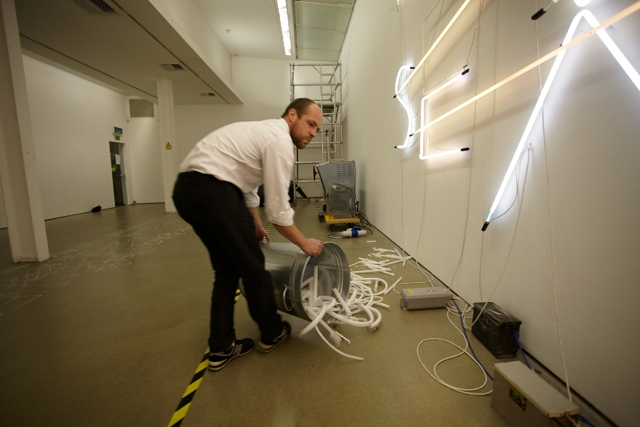
Neon Lights was an installation waiting not to happen. Propane and Oxygen cylinders, naked flames, large high voltage transformers, sharp glass and mercury, make a strong list of Health and Safety issues. Mobile Neon Factory might fit a genre of temporary art architectures, but summer pavilions rarely have firm lines of black and yellow warning tape beyond which only the artist can cross. Neon Lights stretched from one end of Site gallery to the other, and, as Richard’s difficult, frustrating process of learning to make letters unfolded, there was soon lots of broken glass around too.

I watched Richard at work to get a sense of how this unfamiliar process worked. At one end of this temporary production line, neon strips are heated by a hand torch or rolling burner, then bent into the desired shapes. At the other, air is removed from the phosphor coated white tubes, making vacuums that can be filled with gas.

Argon, Richard observes, makes blue light, and is the most commonly used gas. The red of neon is too vibrant. Finished lights are laid out on the aging bed and connected to traditional coil wound transformers for ‘ageing’. Lights might fail, due to impurities or tiny cracks in the glass. When first connected the lights are dim but they soon settle as the gas reacts and warms with electricity for the first time. In theory, they could maintain this light level for a hundred years.

In Sheffield, such production is an act with resonances to the city’s industrial manufacturing past (Richard tells me about a visit from an engineering student, keen to see a now rare example of such manufacturing processes). If the words visitors provide imply certain neon associations, the in-gallery response of many visitors forgets the words altogether, absorbed more by a school chemistry class fascination with the bunsen burner’s spurting flame.

*

Selected from an open call, the Site Platform project lets artists use the gallery for up to two weeks to develop new work. Open to the public, it is both studio and exhibition, and the artist is always engaged in a kind of durational performance. Richard chats with visitors, carrying out the neon making process in front of his gallery audience, when there is one. The participatory elements are curtailed by neon’s intensive production process, not to mention flame torch and protective safety goggles.

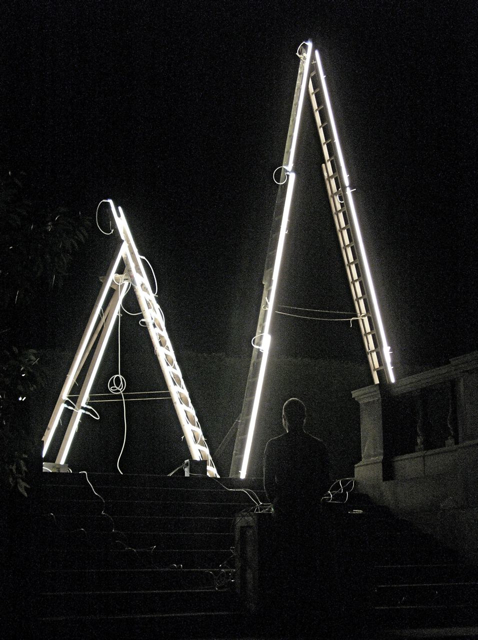
Several of Richard’s previous explorations of neon as a material have involved performance. Neon requires it, deploying and manipulating its demand to be seen, either with or without human accompaniment. Disappearing Paths involved ladders’ of white neon and the accompanying soundtrack of Arvo Pärt’s Cantus In Memoriam Benjamin Britten (1977). Richard found the music “melancholy and beautiful,” in resonant juxtaposition with neon’s electrical and mechanical qualities.

Richard William Wheater, Disappearing Paths

As the music progresses it descends in scale, and the neon lights of each ladder gradually turn off. Disappearing Paths was performed twice, once at Wakefield Cathedral and again in the outdoor environment of the Yorkshire Sculpture Park, which Richard admits he found more exciting. “The cathedral seemed obvious” he observed. “I prefer sitting on the fence.”

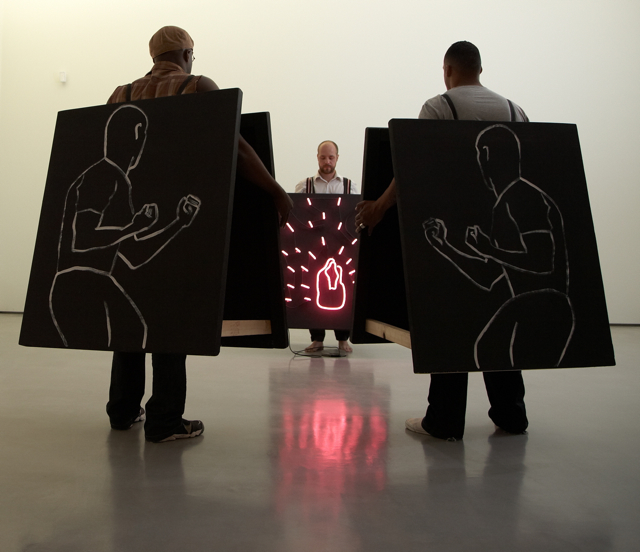
Another piece, Sirens (2010) was a response to Barbara Hepworth’s 1934 sculpture Mother & Child and the context of the newly completed but then still empty Hepworth Wakefield Gallery. Richard had met two men at a cage fighting competition in Cleethorpes, who were members of a mixed martial arts club in Wakefield. They took part in the performance by wearing A boards featuring images of martial arts fighters. They walked around the space, forming tableau around Wheater, who was wearing a neon version of Hepworth’s sculpture and navigated the space by plugging himself into available power sockets. The tableau formed a shifting human-neon response to Hepworth’s stone forms, as well as the stark minimalism of the David Chipperfield designed building. “It’s unknown… senses are heightened. It’s live” says Wheater of this kind of performance.

Richard William Wheater, Sirens, 2010

As neon has to be plugged in (unless it is Box’s Field), the performance ties us to a place and time. As a neon sign blares its message simply into the darkness, this sort of performance orientates around a single gesture and idea unfolding in time, an experiential equivalent to neon’s own directness. Within this time, we move beyond the “neon as sign.” Neon begins to illuminate a different kind of private, shadow space, that in the meanings it produces might not have anything to do with actual light or some metaphorical “illumination.” Neon’s paradoxes begin to be made (in-)visible.

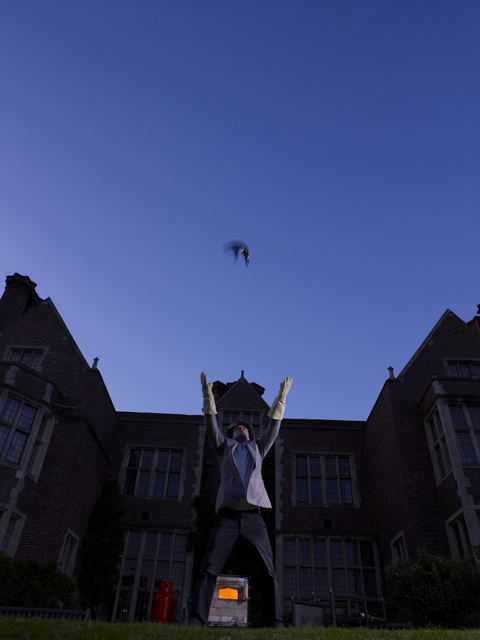
It doesn’t involve neon, but this is also the space of Richard’s Them & Us. In various locations around the UK, glass birds were made in a mobile kiln, then “set free.” A glass seagull for South Shields, a common house sparrow at Ferrybridge Power Station in West Yorkshire, crows in the New Forest and a swallow in Leicester. “It was filled with the breath of my lungs, and still it would not fly!” was Richard’s byline for the project. If the clarity of the gestures survives such dramaturgy, the glass birds, obviously, do not.

Continue reading here.