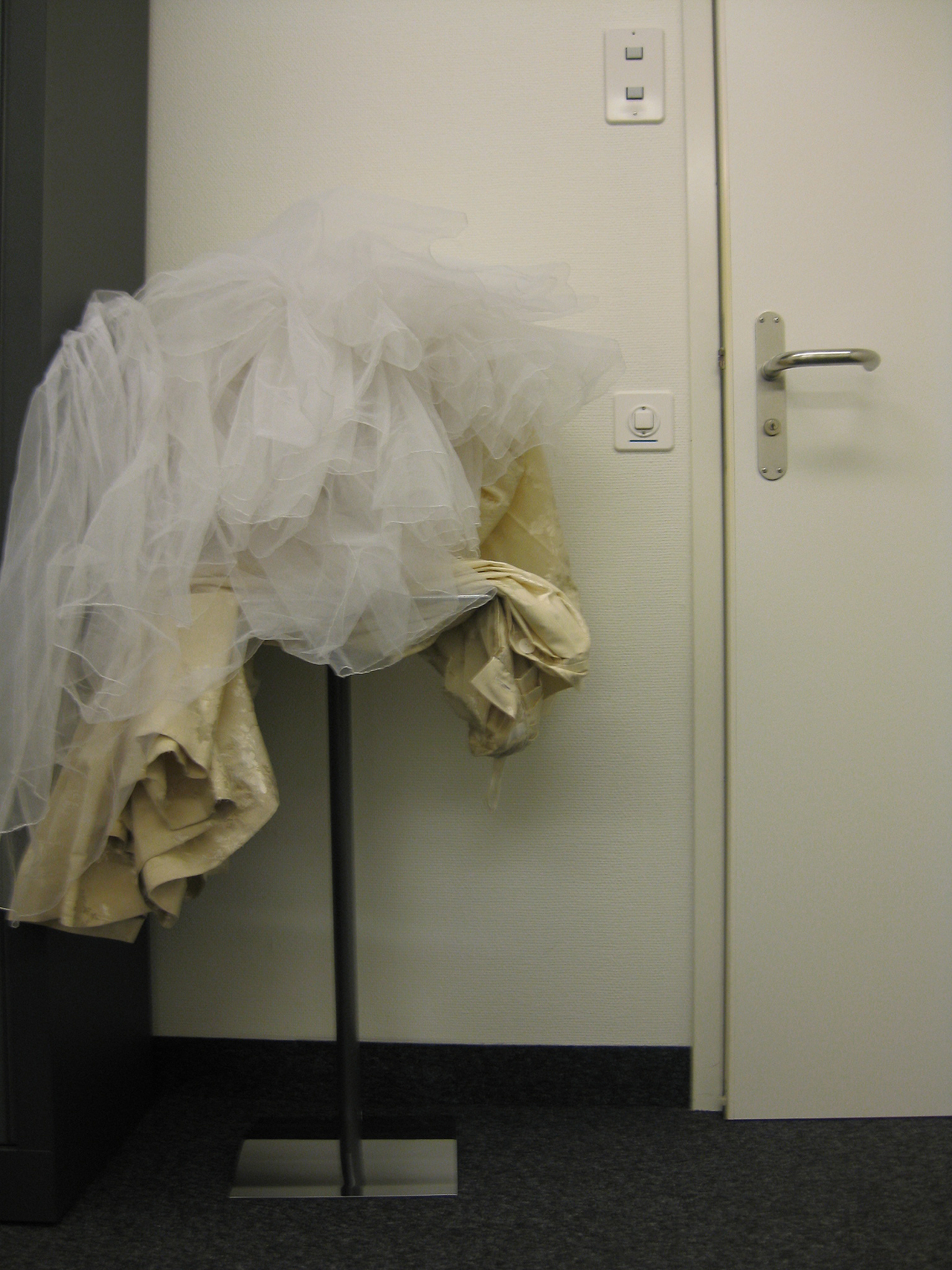
verysmallkitchen

Posts Tagged ‘art writing’

CALL FOR PARTICIPANTS: VerySmallKitchen SUMMER SCHOOL, EDINBURGH, 7-10 AUGUST 2011

In Uncategorized on April 19, 2011 at 2:40 pm

The VerySmallKitchen Summer School will take place at the Totalkunst Gallery, Edinburgh, between August 7-10th 2011. Participants are sought for a small group of practitioners who will work together for three days in the Totalkunst Gallery space, as well as devise and participate in evening events.

The summer school is part of a two week text festival curated by VerySmallKitchen and Mirja Koponen/ Totalkunst Gallery. Participants will also be invited to contribute to a final weekend of exhibitions, performances and conversations on 19-20 August.

VerySmallKitchen will present a number of sessions that unfold from its recent work, including sessions on minimalist poetry, documentary poetics, poets theatre, and boundaries of experimental poetics and art practice. We seek proposals for further sessions/ workshops/ group projects that could take place in the Totalkunst Gallery space.

The final form of the Summer School will unfold from the work proposed and the interests of the group. We welcome proposals that unfold connections of language, writing and art practice, and hope to explore a range of contemporary and historical practices for consideration alongside those of the participants themselves.

Participants should be able to attend all four days of the Summer School, beginning with an opening event on the evening of the 7th. There is no charge for participation. Participants are responsible for arranging their own accommodation. Please note that the event takes place during the Edinburgh Festival, so this should be booked as soon as possible.

Whilst we wish the project to be as open access as possible, the size of the Totalkunst Gallery means places are strictly limited.

TO APPLY: Please send an email outlining the reasons for your interest in the summer school, and include a proposal (250-500 words) for a session you would like to run, to David Berridge verysmallkitchen@gmail.com.  Proposals will be accepted and responded to ongoingly from today until spaces are full.

*

Mirja Koponen, Dispersals, Totalkunst Gallery, 2010

The I AM NOT A POET festival as a whole is still taking shape but here is a rough outline of the structure:

From 7th-21st August Totalkunst Galley and VerySmallKitchen present I AM NOT A POET, a two week project exploring relationships of language, writing and art practice, through a mix of open call, curated and invited work.

I AM NOT A POET has three parts. From 7th to 10th the VerySmallKitchen Summer School makes the gallery space into work space/ exhibition for  exploring a wide range of language based art practice. Between 11th and 18th, the Totalkunst Gallery space has been offered to a range of individuals and groups for 1-3 day “micro-exhibitions.” Artists have been asked to consider how the Totalkunst Gallery can be a generative space in which to produce and show work, emphasizing both display and discussion.

On 19-20 August I AM NOT A POET will conclude with a two day exhibition-event that unfolds from the two weeks, including work by participants on the summer school and contributions from invited participants from Edinburgh’s poetry and art scenes.

I AM NOT A POET is collaboration between David Berridge (VerySmallKitchen) and Mirja Koponen (Totalkunst Gallery).

DEMOTIC ARCHIVES OF ART WRITING (7): JEROME ROTHENBERG on ROBERT MOTHERWELL’S THE DADA PAINTER AND POETS

In Uncategorized on March 15, 2011 at 11:19 pm

A previous Demotic Archive text-gathering- on artists (mis)understandings of Lenin – included material from Robert Motherwell’s 1951 anthology The Dada Painter’s and Poets. I wanted to unfold further the influence of this book, forming a sense of how it was read and utilised by new generations of poets and artists upon publication.

What follows is a gathering of poetic and discursive materials as “a starter” on this topic selected and written by Jerome Rothenberg, who observes in an email 12/03/11:

… yes, there is in fact a great deal that I could say, with Motherwell’s book as a point of departure.  When David Antin and I first sat down with it, shortly after it appeared, what it opened up was both surprising and needed as a way into a kind of poetry and art that we and others were soon exploring or maybe re-exploring.  Before that Dada was something that would turn up in what were already historical accounts of experimental modernism but it was really Dada Painters & Poets that began to flesh it out for us.

The materials below begin with three poems from Rothenberg’s THAT DADA STRAIN collection, with its varying, exploratory proximities  to the ideas, personalities, languages, and histories of Dada. Two discursive pieces then provide (1) a poetic- historical overview and  (2) a trajectory from Dada through Kurt Schwitters, Eugene Gomringer and Seneca singer and ritualist Richard Johnny John…

I also read these materials in relation to two further quotations. The first is Anne Waldman’s comment on the “various trajectories of collaboration” the Motherwell anthology demonstrates.  The other is Brion Gysin’s recollection to Nicholas Zurbrugg:

Everytime we met [in the late 50s in Paris], Tzara would whine, “Would you be kind enough to tell me just why your young friends insist on going back over the ground we covered in 1920?” What could I say, except, “Perhaps they feel you did not cover it thoroughly enough.” Tzara snorted: “We did it all! Nothing has advanced since Dada – how could it!”

*

THAT DADA STRAIN

the zig zag mothers of the gods
of science       the lunatic fixed stars
& pharmacies
fathers who left the tents of anarchism
unguarded
the arctic bones
strung out on saint germain
like tom toms
living light bulbs
aphrodisia
“art is junk” the urinal
says “dig a hole
“& swim in it”
a message from the grim computer
“ye are hamburgers”


A GLASS TUBE ECSTASY, FOR HUGO BALL
Cabaret Voltaire, Zurich, 1916

A glass tube
for my leg    says Hugo Ball
my hat a cylinder
in blue & white
the night    the german ostriches    the sink
he pisses in
all these become his world
his dada song, begun there
holds the image
until it comes at us:
the image from its cross
looks down:
a ribbon
a revolver
mud
these contribute
to his death
also to what his death contributes
later, too hysterical
too sick with god
& time:
a carousel
a roasted poet
fish
the queen says to his mind
& enters
where the street of mirrors starts
she sees his face
reflected
in hunger of the world
as pain, the consciousness
of death    not why we die
bit why we dream about it
& why our dreams can’t save
the dying remnant
Hugo
as I write this poem
the voice cries
from a further room
the dancer / singer calls me
from a further room
I step into an obelisk
below the waist
my mouth opens to sing
but freezes
shut
in grief for you
ombula
tak-e
bitdli
solunkola
the collapse of language
tabla tokta tokta takabala
taka tak
a glass tube ecstasy
escapes from time
babula m’balam
the image & the word
over your bed
hang    crucified
again the cabaret explodes
again again
fatigue
one
foot
in glass
a glass nerve
&
a priestly gas pump
pulls
her hair out


THE HOLY WORDS OF TRISTAN TZARA

sad in his world
or in yours
he walks for years beside
the economic lilies
explores the mysteries of bread
a wax archangel
stands on his tongue
his hands     cold     dry
deprived of water
in the room under the room
where Lenin sat
aromas of Bukovina gather
Moinesti with its corn mush
brinza cheese
petroleum
redheaded Leah
like a hungry wolf
the word he dreams is
dada
dada ice
dada piano
dada flower
dada tears
dada pendulum
dada vanilla
dada don quixote
dada humid
dada archipelago
dada pharmacy
dada sexenial
dada dichotomous
dada dichroic
dada dicrotic
dada didactic
dada didelphian
dada diluvial
dada dingdong
the fur of dada stretched out in the sun
dada on a hill old fox old dada
sammy rosenstock alive old exile
got Zurich on my mind
glass toys betwixt the stars with chains
electric flags & posters
“logic is a complication!
“logic is always wrong!
cries dada
holy cow
o cube
o hobby horse
the freedom first encountered in
first trip to Zurich
ghosts drunk on energy
they pulled the bells of war down
martyred the cabaret
until it exploded
like yiddish dada in the street
the overture to cheese
o Sammy brother
the sad one of your tribe
you said: disgust
you sat next to the photo of
redheaded Leah
under the axe & clock
your monocle hung from your vest
red life grew distant
in the room where Lenin sat
the walls sang politics to us
his nurse’s name was “dada”
so was yours
& sputtered poetry
redbellies laughing thru empty skulls
“my name is Sammy Rosenstock
“Samiro
“is later Tristan Tzara
“I am so sad with life
“I love it
“I am of course Rumanian
“I allow myself to contradict
“I put an owl in a hexagon
“I climb on the stage
“I’m prim
“I’m formal
“I applaud the revolution
“the hands of bandits
“blind worms & dada nightmares
“invade your bowels
” messiahs are passee
“the word we dream is
“dada
“dada sweepeth out
“dada teareth linens
“rips clouds & prayers to shreds
“thou rides on hiccups
“dada has a balcony
“we squat there     pregnant birds
“we shit on thine umbrella
“dada
“dada is against the future
“dada lives
“in fire          wisdom      fear
“– is fear of dada
“like a star? —
“no           like a fish      a plant      the moon
“a metal word
“distorted      boiling
“illumines the urethra
” sixty fingers on each arm
“I am a monster too
“I play with cushions
singing
singing
like hymns of queens
the eye of Lenin
now so wide
pushes the curtains
the chess game opens like a poem
metaphysics of perdition
rules them
tired of the stars
his horse eats colored snakes
o angel horse
on thee rides Hugo Ball
himself an angel horse
here Huelsenbeck & Jung walk
here Arp
here Janco
here kings of Zanzibar
here april nuns
here Tristan Tzara
ghost of Abulafla no ghost
he makes his buttocks jump
like belly of oriental queen
madonna face of Emmy Hennings
a silent fiddle
cuts the room in two
Hugo like a mannikin
at piano
stammers      yodels      farts in rhyme
in lusts of sabbath
— hiccups —
— bowwows —
dusts off the mask of dada
cardboard horsehair leather wire cloth
wears dada collars      dada boots
cothurnus of a bishop
lesbian sardines
ecstatic mice
vanilla derbies
from comers of Cabaret Voltaire
how many kings crow?
how many krazy kittens
cry for you?
how many centuries between
Zurich & Moinesti?
how many grandfathers?
how many clicks before the poem ends?
how much incesticide?
how many accordions to serenade
redheaded Leah?
belated
Lenin dies
brave gymnasts march again
thru workers’ suburbs
Stalin’s moustache adrift
— o feckless future —
writes Mandelstam:
“huge laughing
“cockroaches on his lip
“the glimmer of his boot-rims
“scum & chicken necks
“half human
“the executions slide across his tongue
“like berries
o revolutions of the fathers
you tease us back to death
pink sands of California
line my coast
saloons & oracles
stemming the tide
can’t end it
you are dead
& dada life is growing
from your monocle
ignored      exalted
you lead me to my future
making poems together
flames & tongues      we write
like idiots
ballets of sperm
a brain song for the new machine
squadrons of princes pissing in the street
— intensity      disgust —
an empty church from which
you drew the drapes back
the face of Jesus on each drape
“on each Jesus was my heart”
you wrote
messiah of stale loaves
of frogs in shoes
god dada
messiahs are passee
there is no greater saviour
than this      no eye
so credible
your fart that night was luminous
it stoked the cannons
thruout Europe
in the bus to Amsterdam
in Missouri in Brazil in the Antilles
in a bathrobe
under your bed the shadows massed
like sleeping robbers
the moon became our moon
again o moon
over Moinesti
o moon of tiny exiles
moustaches of antelopes we eat
& cry out “fire”
“water”
“avalanche”
a swamp of stars waits
toads squashed flat against
red bellies
at center of a dream
— magnetic eyes —
whose center is a center
& in the center
is another center
& in each center is a center
& a center on each center
centered
centering
composed by centers
like earth
the brain
the passage to other worlds
passage to something sad
lost dada
an old horse rotting in the garden
maneless      waiting
for the full moon
someone leaps into the saddle
rushes after you
exuding light


PROLOGUE TO DADA


“You are mistaken if you take Dada for a modern school, or as a reaction against the schools of today. … Dada is not at all modern.  It is more in the nature of an almost Buddhist religion of indifference. … The true Dadas are against Dada.” (Tristan Tzara)

Which was Tzara’s way of proclaiming Dada’s postmodernity — not as chronology but as an irritation (a disgust) with solutions altogether (“no more solutions! no more words!”) & with prescriptions (old or new) for making art.  It is important to remember: that at the heart of Dada was a pullback from the absolute: from closed solutions based on single means: not a question of technique, then, but of a way of being, a state-of-mind (of “spirit”), “a stance” (: Charles Olson, decades later) “toward reality.”  For which the only technique was the suppression of technique, the only sense of form was to deny form as a value.  And for all of that, Dada drew from means that were common to its time & to its predecesors in Futurism & Expressionism: a series of projects it would work on until its own (predicted) self-destruction as a movement.  Collage.  Performance.  New Typographies.  Chance operations.  And a high devouring humor.

At the same time Dada had its myth(s) of origin.  Its time was one of war, its place the neutral heart of Europe.  In Zurich, then, a group of artists/poets, brought together by a flight from war & time, set up a venue of their own (the Cabaret Voltaire) & took a name at total variance with the names that came before (expressionism, futurism, constructivism, orphism, etc.).  Their strategy was what a later poet (E. Sanders) would call “a total assault on the culture” — or in the words of one of their own (R. Huelsenbeck) “the liberation of the creative forces from the tutelage of the advocates of power.”  From Zurich the movement dispersed to Germany & France & elsewhere: a first international & generational outcry, by means of art & at the same time making Art (with capitals) its central target.  The “official” German version lurched toward a leftist politics, while the French, holding the center of European modernism, turned Dada into Surrealism (1924) & brought the movement to an end.  With that turning came a realignment with Art or an attempt to conquer Art’s domain: a sense that Dada-qua-Surrealism — like Dada-qua-Bolshevism in Berlin — was itself a solution rather than a challenge to all possible solutions, Dada included.  But the Surrealist accomodation — if it was that — was mild compared to other attempts to rein in the revolutionary nature of the new poetry & art, in favor of a middle-ground & fashionable modernism.  Through all of which, Dada remained a lurking presence, erupting from then to now in a string of neo-Dadaisms, the careers of which will be charted in the volume still to follow.

As with other “movements” before & after, Dada was largely the work of poets or of those who saw in poetry a liberating gesture setting it apart from that of Art.  Of the poets in the Zurich group, Hugo Ball was the founder of the Cabaret Voltaire & of the first Dada magazine, with which it shared its name; he claimed — in a Dada act that turned into a kind of mystic seizure (see below) — to have invented a new “poetry without words,” but fled Zurich shortly thereafter to live out his life in the Swiss mountains, as a kind of Catholic Dada saint.  Tristan Tzara (b. Sammi Rosenstock in Rumania) was — at nineteen — the movement’s principal publicist & its link to the Dada poets of Paris (Breton, Soupault, Peret, Picabia, et al.), some of whom would be, in turn, the founding fathers of Surrealism.  In a similar vein, Richard Huelsenbeck brought Dada to Berlin & a new life at the edge of postwar German politics.  Less overtly political, the work of a number of other German & Dutch Dadas (Kurt Schwitters, who changed his movement’s name to Merz; Hans Arp; Max Ernst; Theo van Doesburg, working through the Dutch De Stijl) crossed notably into poetry, with Schwitters & Arp approaching major status as new language artists.  Finally, New York Dada (so-called) virtually preceded that of Zurich & focused, oddly, on such European expatriates — circa World War One & early 1920s — as Duchamp, Francis Picabia, and Else von Freytag-Loringhoven.  Like Futurism & Surrealism, the movement also had worldwide implications.

EXCERPT FROM “THE SIBILA INTERVIEW”

(with Charles Bernstein, Regis Bonvicino, Marjorie Perloff, Cecilia Vicuña)

Marjorie Perloff: How has translation of German Dada and Concrete poetry – Schwitters, Ball, Jandl, etc.— influenced your own poetry? Does it seem more congenial to you than French Dada?

Among the Dadas, Schwitters was clearly the one with whom I had the most extended encounter through translation, while the Concrete poet on whom I worked extensively wasn’t Jandl so much as Gomringer.  With Ball the only kind of translation I attempted was a performance of his soundwork, Karawane, which I slipped into my own performance of That Dada Strain.  The translations also included a smaller group from French-language poets such as Tzara and Picabia, but it was That Dada Strain, the whole series of poems, that was as much my response as the translations.

Back in the late 50s or early 60s, when Motherwell’s big Dada book opened me up to Dada, I thought that what was needed was a gathering of actual poems.  Motherwell had presented very few of those, and so I announced that I was preparing an anthology to be called That Dada Strain and to be published by my press, Hawk’s Well.  I translated a handful from Tzara, Arp, Schwitters, Huelsenbeck, and Picabia, but the press didn’t last and I got otherwise diverted.  I didn’t really come back to anything like that until sometime in the 70s, and That Dada Strain, as it emerged then, was a series of poems addressed to the Dada poets – transcreations of a sort, to use Haroldo De Campos’s term.  Translations and appropriations were embedded or collaged in some of the poems, and sound poems and  actual translations were sometimes included in performance versions.

In doing that I don’t think I was so much favoring German Dada as Zürich Dada – not least of all because the antiwar and transnational stance of the Zürich exiles corresponded to my own feelings about Vietnam and the Vietnam aftermath – about the whole twentieth-century experience of war and repression if it came to it.  Even so, Paris is very much there in the two opening poems, as well as Schwitters’ Germany in the poem addressed to him.  It was Schwitters too on whom I focused later – by way of translation – because I saw him as an experimental extremist whose work coincided with much in our own time but had never been translated and carried over into English.  (Except by him, of course, when he was in exile in England.)  That Schwitters was himself a victim of war and fascism also had an appeal to me.

What I did with Schwitters was both to translate him and to follow him into performance.  I also tried to bring him forward as a precursor of concrete poetry, but his concrete poems like his sound poems and his poems in English needed no translation.  Where I got into the translation of concrete poetry was with Gomringer – a whole book of poems translated into English as a kind of primer, I thought, not only of Gomringer’s poetry but of the fundamentals of translation, operating in an area of minimal poetry that seemed to eschew translation.  Even more of a transcreation for me was a series of ritual songs that I translated from the Seneca Indian “society of the mystic animals.”  I had collected these in a collaboration with the Seneca singer and ritualist, Richard Johnny John, and I wanted a way to show the sophistication of the apparently minimal use of words and vocables (“meaningless” sounds) in Seneca chanting.   Instead of setting up a song poem like this


A POEM FOR THE MYSTIC ANIMALS


The animals are coming
He-eh-eh-heh

I set it up like this:


HEHEHHEH

HEHEHHEH

The animals are coming     HEHUHHEH

HEHEHHEH

HEHEHHEH


The results, I thought, followed along the lines of what Ernest Fenollosa, early in the game and speaking of something quite different, had called “a brilliant flash of concrete poetry.”

*

SOURCES: “THAT DADA STRAIN”, “A GLASS TUBE ECSTASY, FOR HUGO BALL,” and “THE HOLY WORDS OF TRISTAN TZARA”  are from  That Dada  Strain (New Directions, New York,  1983).

PROLOGUE TO DADA appears in  Poems for the Millenium: The University of California Book of Modern and Postmodern Press, Vol. 1 (University of California Press, Berkeley, 1995), whilst the concluding Excerpt From the Sibila Interview appears in Poetics and Polemics 1980-2005 (University of Alabama Press, Tuscaloosa, 2008).

The quote from Anne Waldman is from her Vow to Poetry: Essays, Interviews and Manifestos (Coffee House Press, Saint Paul), 2001 319. That by Bryon Gysin is from Nicholas Zurbrugg ed. Art, Performance, Media: 31 Interviews (University of Minnesota Press, Minneapolis), 190.

See Jerome Rothenbergs POEMS AND POETICS blog archive here and the UBU Web ethnopoetics gallery here.

DEMOTIC ARCHIVES OF ART WRITING (6): THE ARTISTS LENIN

In Uncategorized on March 10, 2011 at 12:22 am


The latest installment of the Demotic Archives – in which Vladimir Ilyich Lenin offers a set of resources for art writing – developed alongside I DID NOT KNOW THAT LENIN WAS LENIN, my current commission for the Merzman festival in Manchester.

As part of this project I began to explore how Lenin was/is figured in numerous texts by artists, writers and philosophers (both his contemporaries and our own). The quotations that follow chart a certain “artists’ Lenin” emergent through the work of Viktor Shklovsky (quoting Maxim Gorky), Sergei Eisenstein, “the young Roumanian Marcu”, and Dziga Vertov.

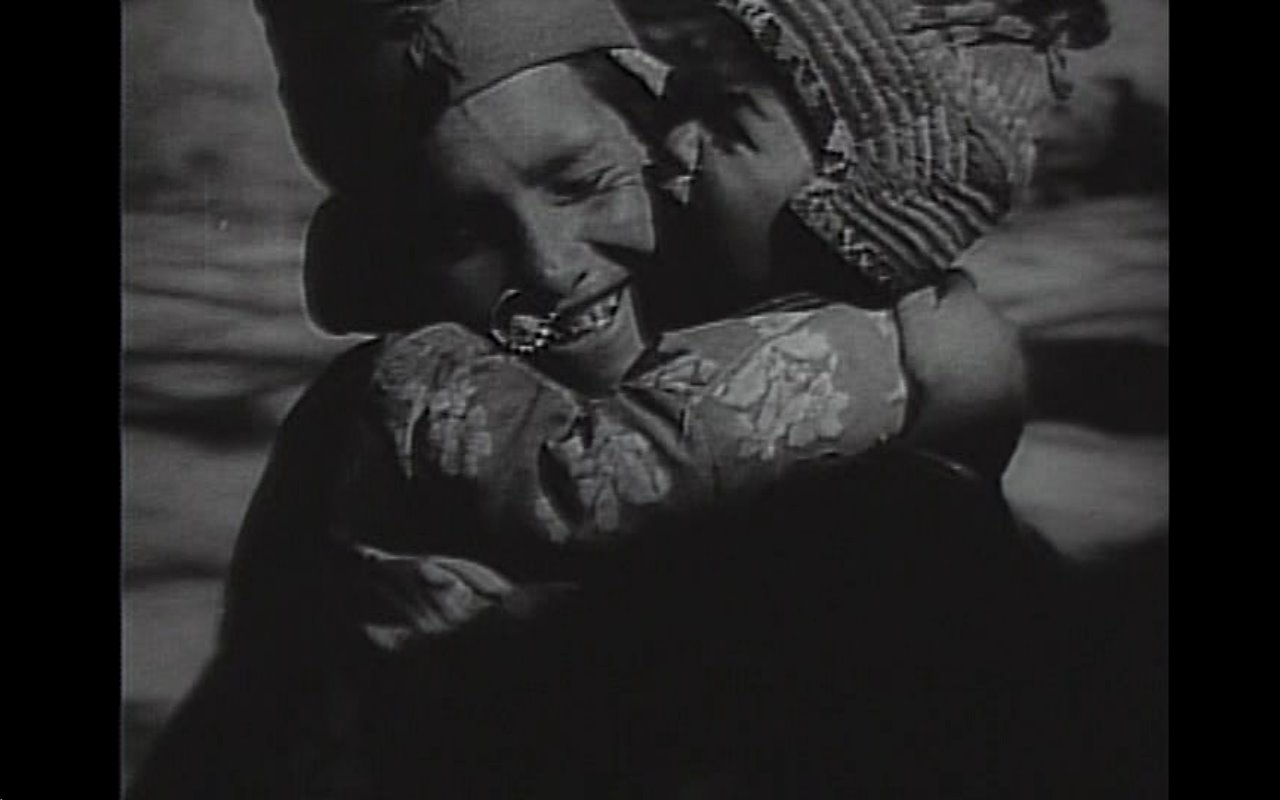
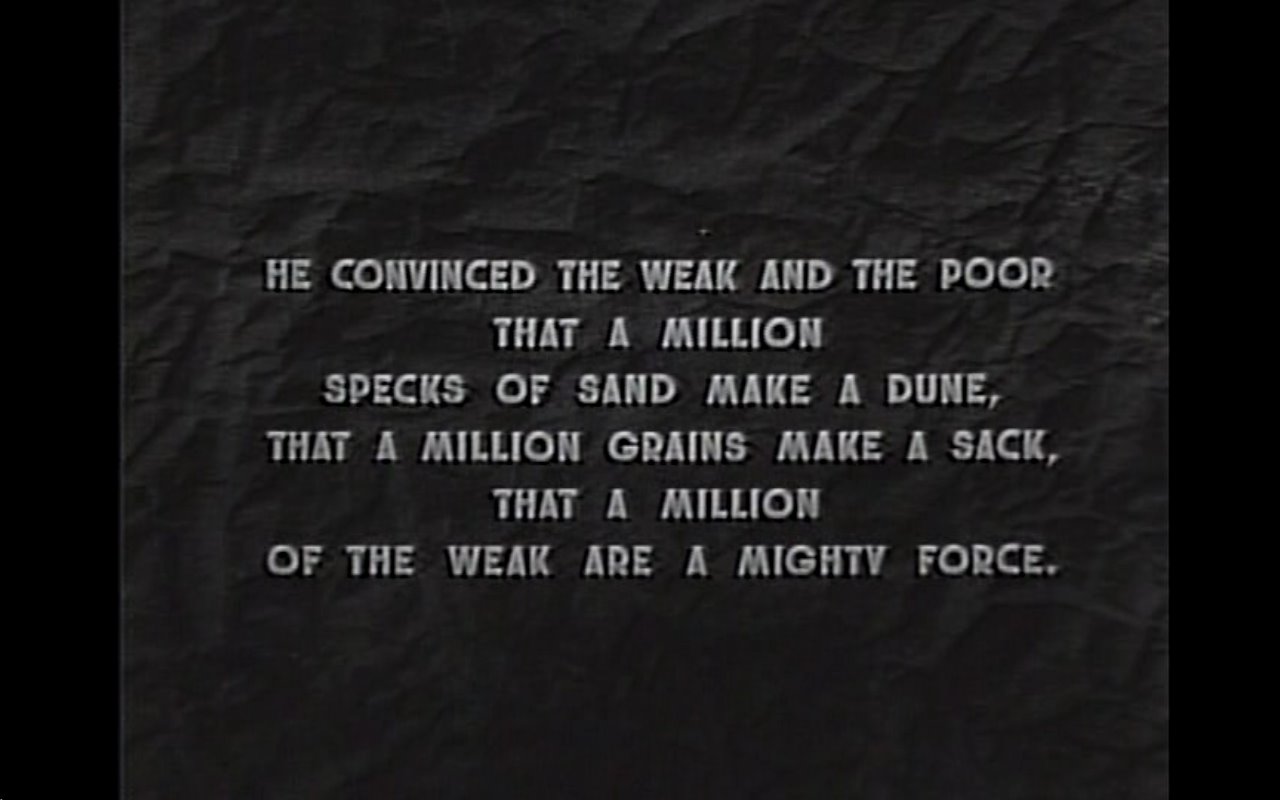
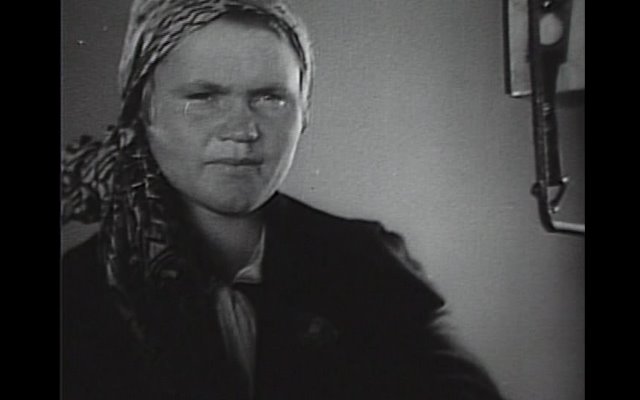
The Lenin that unfolds from these writings is, of course, highly partial and radically different to the Lenin of Lenin’s own writings, or of most historical account. Read in this way, the quotes propose a  figure of Lenin composed of the radical (or not) nature of art practice, and the artists “eccentric” or otherwise stance-in-relation to reality… The images for this post are stills from Vertov’s Three Songs About Lenin (1934).

This gathering also suggests how notions of legacy between artists – and between art, literature and politics – might be operating. The story by Marcu is quoted in and from the introduction to the Robert Motherwell edited The Dada Painters & Poets: An Anthology, a text with a history of influence and appropriation amongst artists and writers in New York and elsewhere, upon its publication in 1951 (a future post of the Demotic Archive will explore this influence further).

This sixth installment of the Demotic Archive concludes with Antonio Negri, whose The Porcelain Workshop: For A New Grammer of Politics, is a key text for the movement of philosophical ideas and methods into writing and art practices. The Negri quote here is from the first chapter of Porcelain. Negri is responding specifically to Lenin, and the “impasse” around conceptions of power in both Lenin, Max Weber and Carl Schmitt…

1. VIKTOR SHKLOVSKY

“It so happened that we had a free evening in London, and a small group of us went to a music hall, a small democratic theater. Vladimir Ilyich laughed easily and infectiously on watching the clowns and vaudeville acts, but he was only mildly interested in the rest. He watched with special interest as workers from British Columbia felled trees. The small stage represented a lumber yard, and in front, two hefty fellows within a minute chopped down a tree of about one meter circumference.

“‘ Well, of course, this is only for the audience. They can’t really work that fast, ‘ said Ilyich. ‘But, it’s obvious that they do work with axes there, too, making worthless chips out of the bulk of the tree. Here you have your cultured English-men!’

“He started talking about the anarchy of production under capitalism and ended by expressing regret that nobody had yet thought of writing a book on the subject. I didn’t quite follow this line of reasoning, but I had no time to question Vladimir Ilyich because he switched to an interesting dicussion on ‘eccentrism’ as a special form of theater art.

“‘ There is a certain satirical and skeptical attitude to the conventional, an urge to turn it inside out, to distort it slightly in order to show the illogic of the usual. Intricate but interesting.’

SOURCE: Viktor Shklovsky, Mayakovsky and his Circle (Pluto Press, London, 1972), 116-17. The story here is Shklovsky’s quotation of a text by Gorky.

2. SERGEI EISENSTEIN

“I have seen the Montagues in a tiny theater in Paris, the very same Montagues whom Vladimir Ilyich Lenin crossed the whole city to see…” (78)

“I notice with astonishment that today’s student, freed from the study of religious instruction reveals the same hostility to the study of dialectics. And I believe this is because, in the process of teaching this almighty shining miaculous method of cognition,  the heavy hands of our sophists, catechists, Plisses and Perekhavalskys are too often laid on it.

Instead of an all-penetrating science, as it was understood and presented by Lenin; a science invoking us to study and reveal its nature and essence everywhere, in everything and over everything (“Begin with the most simple, ordinary, mass-evident, etc., from any premises: the leaves of the tree are green; Ivan is a man; Zhuchka is a dog, etc. Already here, as the genius of Hegel noted, is dialectics…”). Instead of this, the boring catechists, pettifogging pedants, and casuists come to the institutes, and in their hands the living spirit of the sorceress Dialectics disappears. All that remains is an indigestible skeleton of paragraphs, abstract propositions, and the perpetual motion of the vicious circle of once-and-for-all chosen quotations. (204)

SOURCE: Sergei Eisenstein, Immoral Memories: An Autobiography (Peter Owen, London, 1985).

3. YOUNG ROUMANIAN MARCU

When we left the restaurant, it was late in the afternoon. I walked home with Lenin.

“ ‘You see.’ he said, ‘why I take my meals here. You get to know what people are really talking about. Nadezhda Konstantinova is sure that only the Zurich underworld frequents this place, but I think she is mistaken. To be sure, Maria is a prostitute. But she does not like her trade. She has a large family to support – and that is no easy matter. As to Frau Prellog, she is perfectly right. Did you hear what she said! Shoot all the officers!

“ ‘Do you know the real meaning of this war?’

“‘ What is it?’ I asked.

“‘It is obvious,’he replied. ‘One slaveholder, Germany, who owns one hundred slaves, is fighting another slaveholder, England, who owns two hundred slaves, fora fairer distribution of the slaves.’

“‘ How can you expect to foster hatred of this war,’ I asked at this point, ‘ if you are not, in principle, against all wars? I thought that as a Bolshevik you were really a radical thinker and refused to make any compromise with the idea of war. But by recognizing the validity of some wars, you open the doors for every opportunity. Every group can find some justification of the particular war of which it approves. I see that we young people can only count on ourselves…’

“Lenin listened attentively, his head bent toward me. He moved his chair closer to mine… Lenin must have wondered whether he should continue to talk with this boy or not. I, somewhat awkwardly, remained silent.

“‘Your determination to rely upon yourselves,’ Lenin finally replied, ‘is very important. Every man must rely upon himself. Yet he should also listen to what informed people have to say. I don’t know how radical you are or how radical I am. I am certainly not radical enough. Once can never be radical enough; that is, one must always try to be as radical as reality itself…’”

4. DZIGA VERTOV

I’ve managed to make Three Songs About Lenin (at least to some degree) accessible and comprehensible to millions. But not at the price of cinematographic language, and not by abandoning the principles which had been formulated earlier. No one would demand this of us.

The important thing is not to separate form from content. The secret lies in unity of form and content. In refraining from shocking the spectator by introducing objects or devices that are unnatural or extraneous to the work. In 1933, while thinking about Lenin, I decided to draw from the source of the people’s creative folklore about Lenin. I would like to keep on working in this direction.

If he saw darkness, he created light.
From the desert, he made orchards.
From death – life.

or

A million sand grains make a dune.
A million peas make a bushel.
A million weak – a great strength.

Are these images and songs of nameless poets of the people any poorer than the images of the most refined formal works?

The subject in which I am working is the least studied, the most highly experimental subject of cinematography.

The road along which I am going, in an organizational, technical, down-to-earth manner, and in all other senses, demands superhuman efforts. It is a thankless and, believe me, a very difficult road.

But I am hopeful that, in my field, I will be able to defeat formalism, to defeat naturalism, to become a poet not for the few but for the ever increasing millions.

It is far from simple to show the truth.
But truth itself is simple.

SOURCE: “The Writings of Dziga Vertov”, in P.Adams Sitney, Film Culture: An Anthology (Secker and Warburg,1971), 364-5.

*

5. ANTONIO NEGRI

We are faced with a double impasse that seems to impose a necessary choice between two possibilities. The first consists in taking power and becoming another power, that is to say, inescapably remaining a power. The second attempts to totally deny the power exerted over life, and therefore emerges as a negation of life itself. From this point of view, the concept of proletarian power that we find in Lenin is completely symmetrical to that of bourgeois power. The concept of liberation is caught in the vise of power. Might we not imagine, on the contrary, that freedom, singularity and potency (puissance) come about as radical difference from power? (17-18)

SOURCE: Antonio Negri, The Porcelain Workshop: For A New Grammar of Politics (semiotext(e), Los Angeles, 2008).

VSK GALLERY: EVERY DAY IS A GOOD DAY: THE VISUAL ART OF JOHN CAGE

In Uncategorized on March 3, 2011 at 3:03 pm

My essay on EVERY DAY IS A GOOD DAY: THE VISUAL ART OF JOHN CAGE has just been published in The Fanzine here. Entitled NEW POETHIC FOLK CULTURES OF JOHN CAGE GO LARGE it begins as follows:

Still trying to hold in mind the experience of viewing Every Day is a Good Day, the show of John Cage’s visual art, first seen at BALTIC in Newcastle last summer, and now touring the UK. Or, rather, keep some memory of the show in dialogue with the reproductions in the catalogue; hold to its distinctiveness whilst seeing it alongside Cage’s music and writing; unfold its specifics without losing sense of the contemporary. A relationship to Cage in 2011, as always, is a shifting, complex thing.

The show itself has developed its own strategies for negotiating between process and object, the somewhat occasional role of visual art in Cage’s practice and the central focus such a monographic exhibition bestows. As conceived by the artist Jeremy Millar it has adopted Cage’s own structure, developed for Rolywholyover A Circus at MOCA, Los Angeles in 1993, of a “composition for museum” that sought to ensure no two visits encountered the same exhibition….

Continue reading over at The Fanzine here. Before you go, VerySmallKitchen offers a sampler of EVERY DAY IS A GOOD DAY, sequenced less according to methods of chance circus than via the images available from the Hayward Press Office.

EVERY DAY IS A GOOD DAY is at the Hunterian Museum and Art Gallery, Glasgow 19 February-2nd April 2011, and at the De La Warr Pavillion, Bexhill on Sea, 16 April-5 June 2011.

*

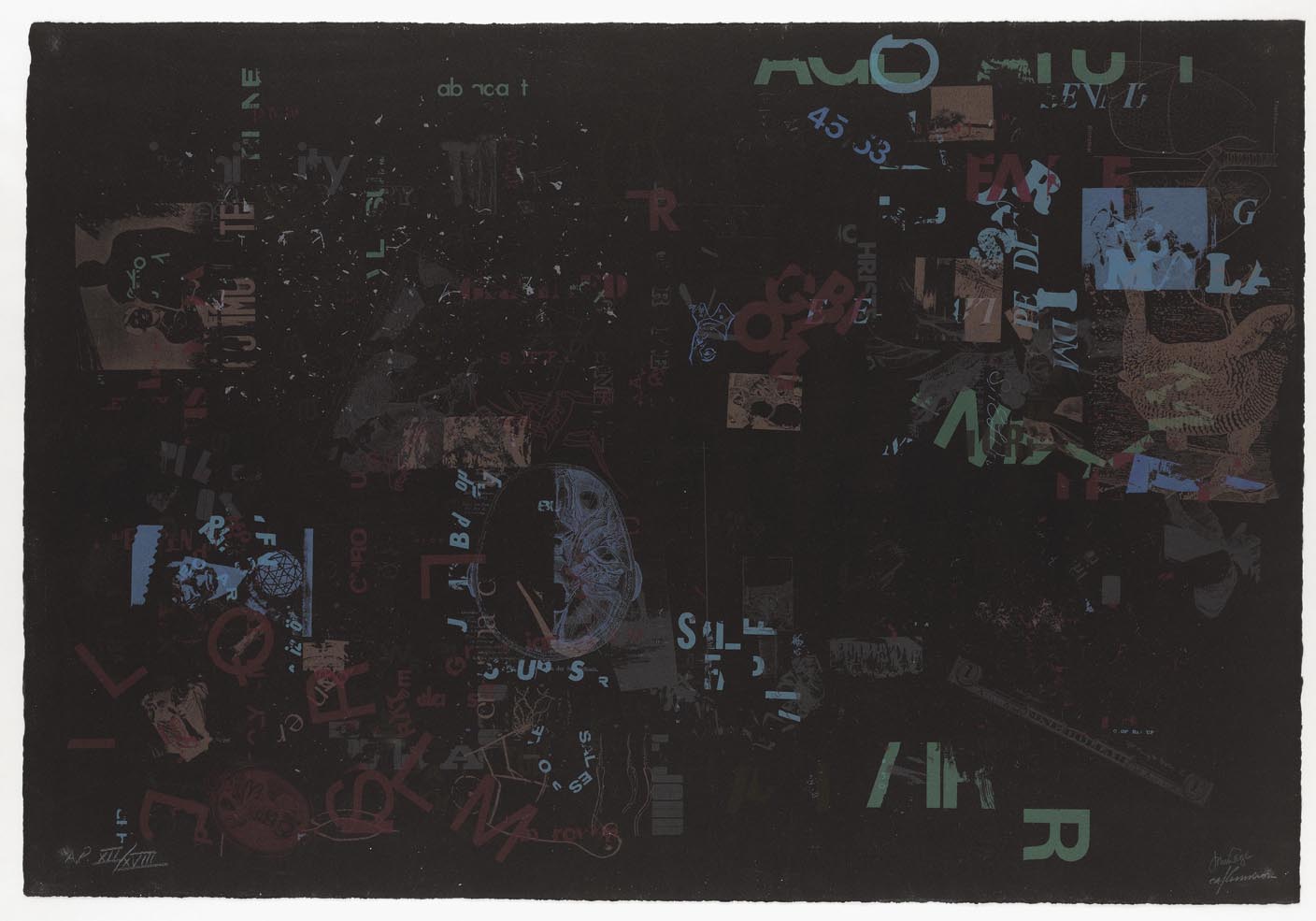
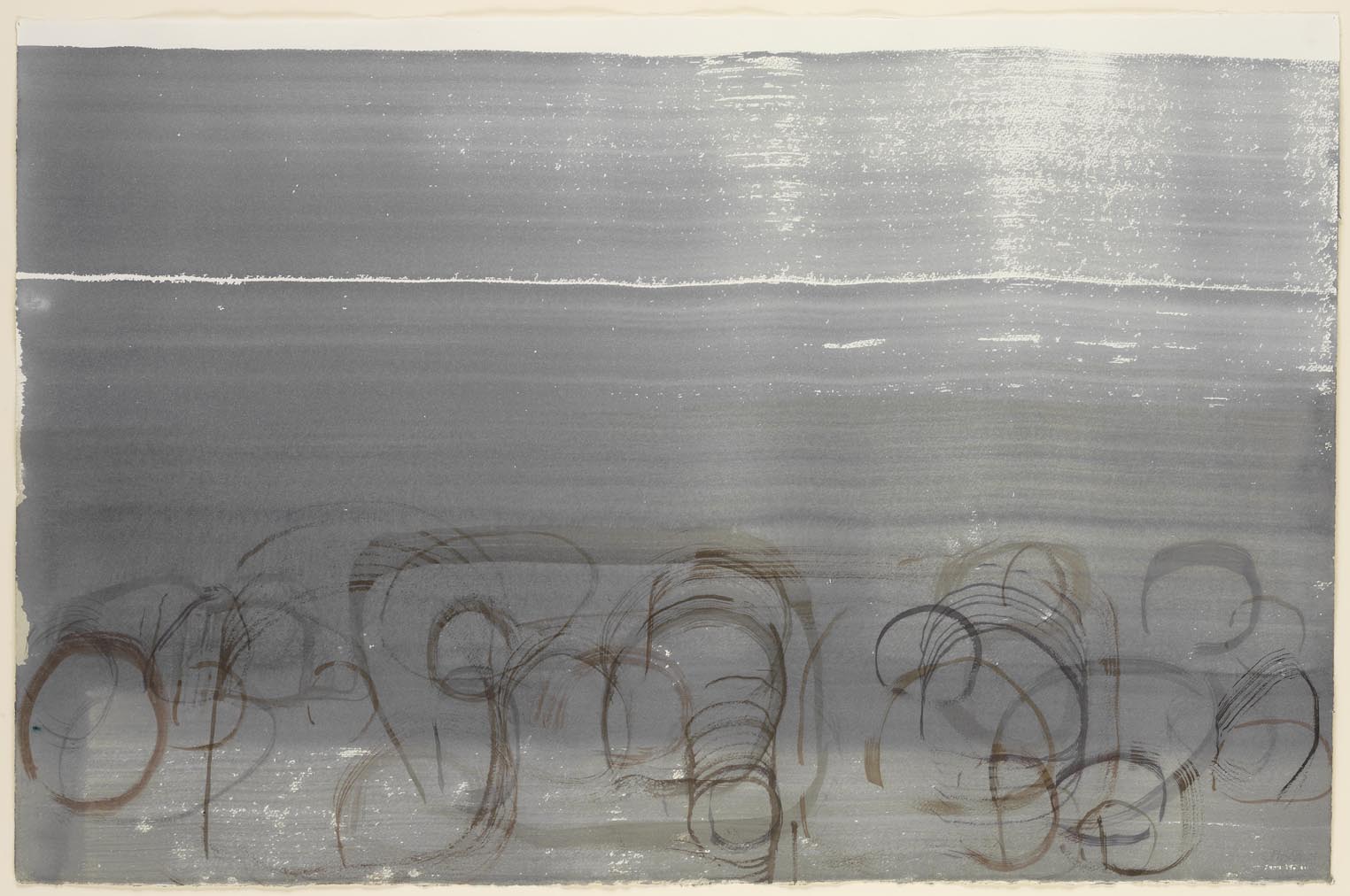
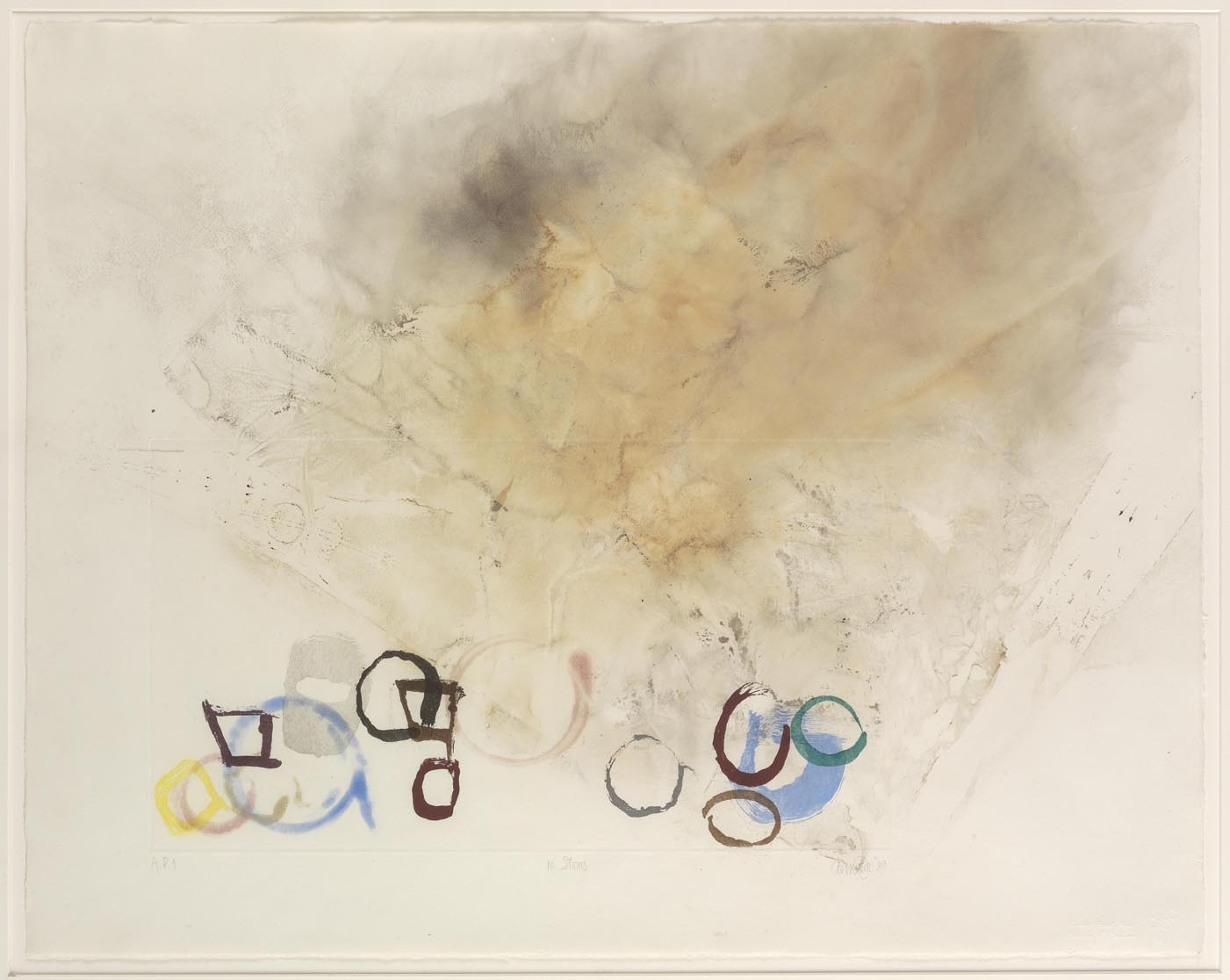
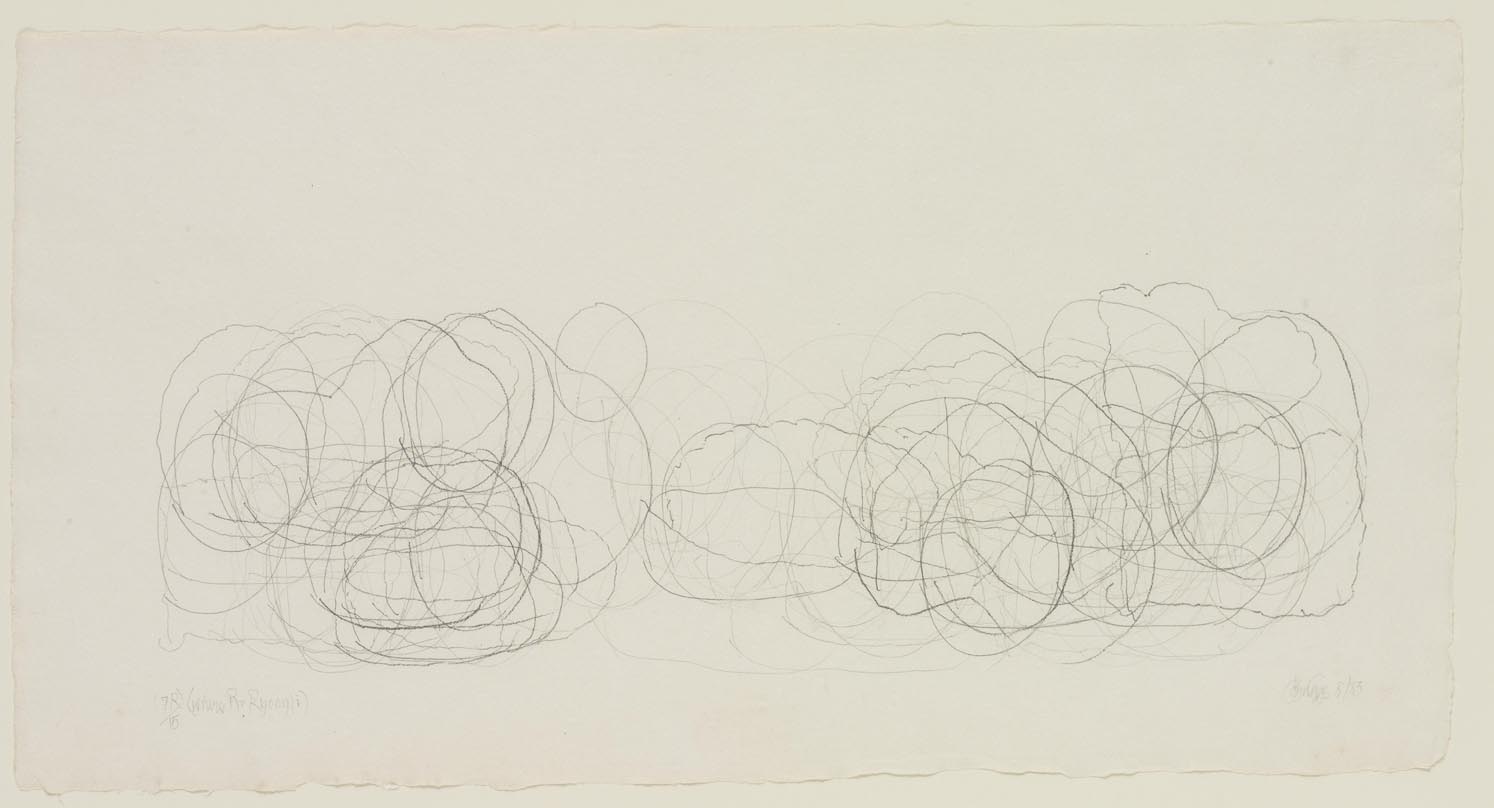
IMAGE CREDITS (FROM TOP): Mushroom Book Plate X (with Lois Long and Alexander H. Smith), 1972  Colour lithograph; Not Wanting to Say Anything About Marcel, 1969. Lithograph on Black Paper; River Rocks and Smoke: 4-11-90 #1, 1990;  Score Without Parts (40 Drawings by Thoreau): Twelve Haiku, 1978. Hard-ground etching, soft-ground etching, photoetching, drypoint, sugar aquatint, and engraving; Dramatic Fire, 1989. Aquatint on smoked paper; Where There is Where There – Urban Landscape, No.27, 1987- 89. Flat bite etching with aquatint. Courtesy Crown Point Press; New River Watercolour Series IV, No.6, 1988. Watercolour on paper; New River Watercolour Series I, No.3, 1988. Watercolour on paper; HV2, No. 17b, 1992. Aquatint (using twenty-four plates). Courtesy Crown Point Press; Global Village 37-48 (Diptych), 1989. Aquatint on brown smoked paper; Dereau, No.11, 1982. Colour photoetching with engraving, drypoint and aquatint; 75 Stones, 1989. Aquatint on smoked paper; 10 Stones, 1989. Colour soap ground aquatint and spit bite aquatint on smoked paper; (7R)/15 (Where R=Ryoanji), August 1983. Pencil on Japanese handmade paper. Courtesy Ray Kass; Where R=Ryoanji: R3, 1983. Drypoint. Courtesy Henning Lohner. All images © The John Cage Trust.


VSK PROJECT: SANDRA HUBER SLEEP/ WRITING/ ROOMS (3)

In Uncategorized on March 1, 2011 at 9:03 pm

[Free Writing from the Sleep Room]

05.07.10

[verbatim] If I could cross time. Beckett writes, “straggling grey moustache and hunted look.” A good way to describe. It is 22:07. Not yet time, the registration does not start for another hour. Black nails. Clock ring. Blue pen. Glowing finger. Red. Lamp x 2, 2 x on. White blanket. White room. Eye in the sky directly in front of me & omniscient. “Watch the television, you’re on vacation.” “But to me this is work.” Structures repeat & give, with only a small space of tenure. I forget words lately. Keep wanting to write, “she winged into the room.” Volcanic ash fastens these electrodes to my head. “She winged into the volcano.” How does one write when one’s being winged into a volcano? Only urgent words. Punctuation gets thrown to the sidelines. A bird in the falafel restaurant, it brushed up against me. One of those small precious things, I felt the flutter of its wings against my ankle & N. said, “that’s for your dreams tonight.”  But Faulkner, I was thinking of Faulker repeating “attenuation” in Absolom, Absolom! again and again & at 1st you think it’s because he’s forgetting that he’s used it, but then, he points to it at one point. He says something like “‘attenuation’, a better word ,” – something like that – it’s a wonderful moment, you see that he chooses it and no other. And that’s the key: that a word itself can become a character. Also a sentence, if repeated enough. This, this, this. Character is repetition of structure. I am wrapped in special kinds of tapes & wires. I am islanded w/i this exoskeleton of measurement. A half an hour has passed. Not quite enough. What is it to wake & write. Perhaps I will try tonight. The room is on the cool side. My apartment lies alone, uninhabited, away from my restless sleeps & somnamulent wakings. What extents do we go to for material. What is this material for? All this stuff. Who. What. Nohow On is Beckett’s book here in front of me under the writing pad. Indeed. “Bonjour,” Nessie says outside to one of the patients. 4 of us here tonight, I only know of 1 other. I heard him through the wall. An American guy. Here for epilepsy I think. All those delicate wires. I found a blonde hair amongst them. Remnant of 1 who has been here before. Blonde hair, feathers, brushing against. One of the small, delicate ones. There are so many textures in this room, a corrugated plastic that looks like a snake shedding. The EMG tight around my ribcage reads

Embla

patient unit

“You can be  my first patient,” she said at the beginning of the night. Pathologized from the getgo, though I am only here to. Writing as pathology. So we have: the bird at the falafel place (brushing), word as character, my right index finger glowing red. Faulkner & ‘attenuate’, McCarthy, this amazing sentence in the opening of The Road – something about a spider. He takes from what he knows & he makes it into these delicately wrought epics. So much attention to each little thing. 10:49 & still on the page. Maybe this is how to write. Extreme situations. Embla Patient Unit. Islanded. Patiented. Pathological. Slightly chilly. My task here is to sleep. No computer. Black lines coming through this white page, penned. Biking through Kreuzberg is where I felt most free. To go straight into sleep from writing, when is the last time I’ve done that. Writing –> then straight into sleep. Glowing red finger. Experience as character. Vice versa. To write in the you & have it be spoken aloud (11 :00) would give the idea of a voice talking to the one who looks upon the writing. Beckett: “what an additional company that would be! A voice in the first person singular. Murmuring now and then, yes I remember” (13). Images are sentences. I look at myself from the inside, not the out. Sleep: is also looking from the inside & yet I must compose from the out. How do I get in? Not unless I am asleep. And yet to record sleep in words from the outside, words, which are always awake, does it even make sense. The images are an algorithm. Imagist. McCarthy’s spider. Faulkner’s ‘attenuation’, Beckett’s play with ‘you’ ‘I’ ‘he’ so that the ‘I’ dissolves. I in the sky. Filmed. There are no windows in this room of walls.

—–

FYI

“… a (you couldn’t call it a period because as he remembered it or as he told grandfather he did, it didn’t have either a definite beginning or a definite ending. Maybe attenuation is better) – an attenuation from a kind of furious inertness and patient immobility…” (Faulkner Ab, Ab !)

“And to the far shore a creature that raised its dripping mouth from the rimstone pool and stared into the light with eyes dead white and sightless as the eggs of spiders” (McCarthy The  Road)

——

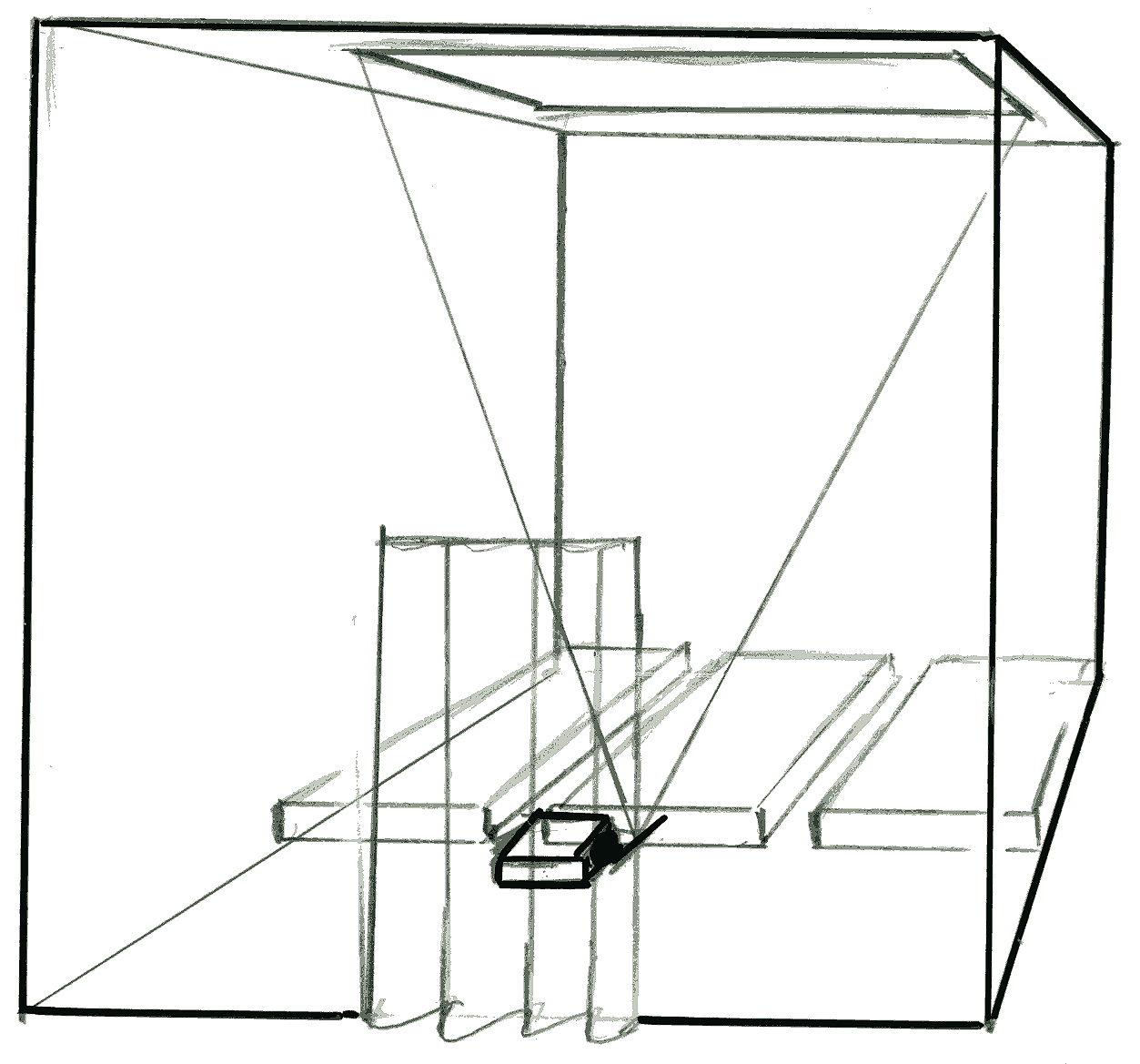
Sketch by Gilles Boss. Note: in the installation, the projector is meant to go behind the mattresses, not in front.


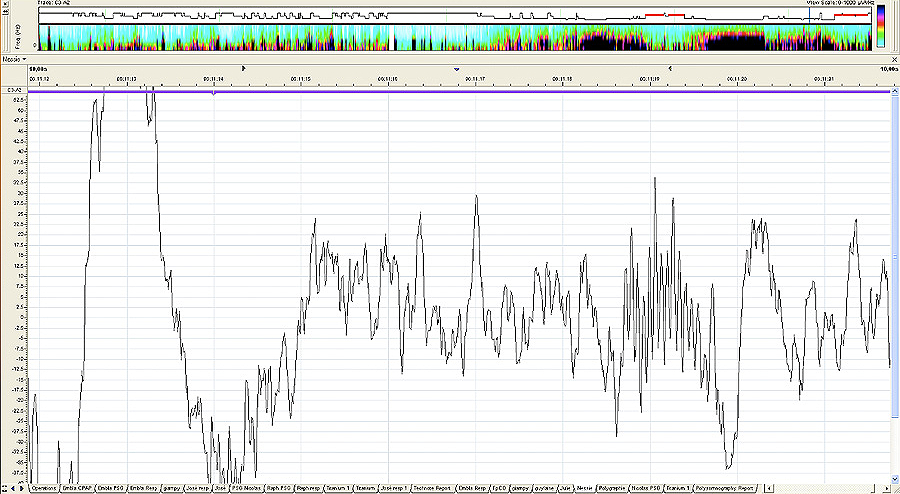
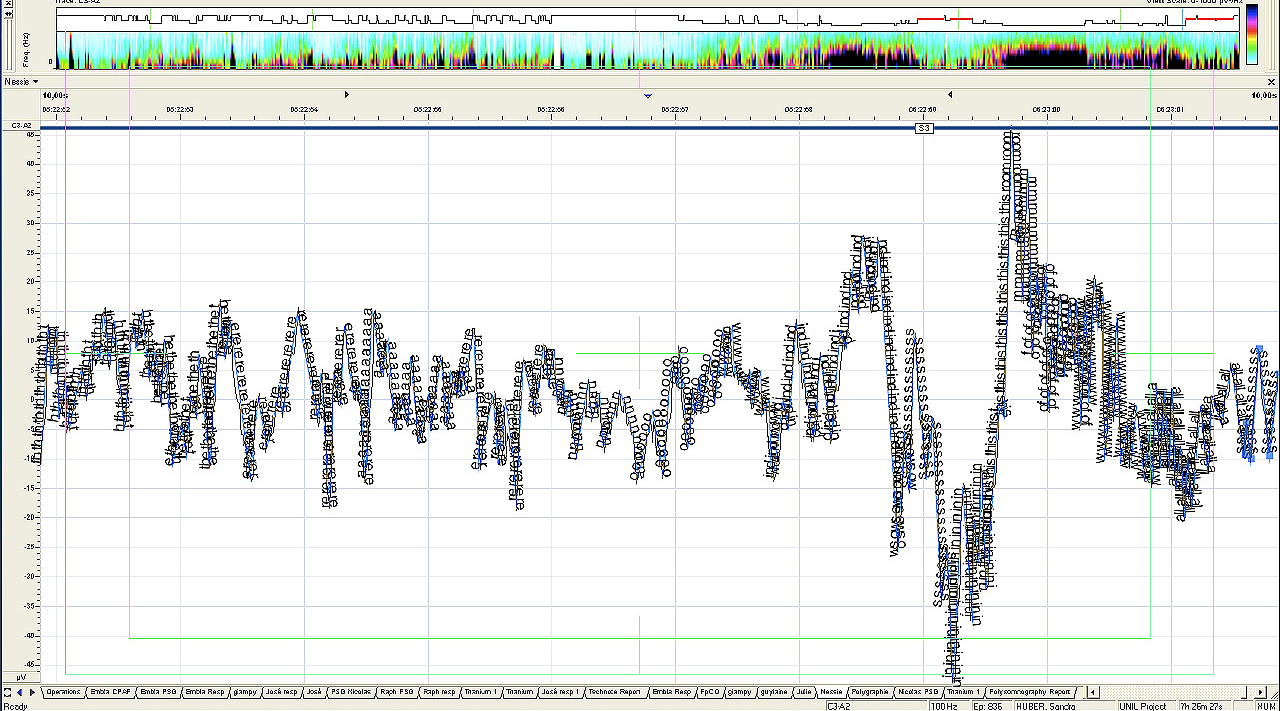
You walk into a simple black room with a curtain entrance and lie down on one of the mattresses provided. You look up. There’s a video projected onto a white ceiling and a small mirror angled down towards you. It looks like jagged brainwaves are passing across a large computer screen and you can see them pass across your body, too, in the reflection.

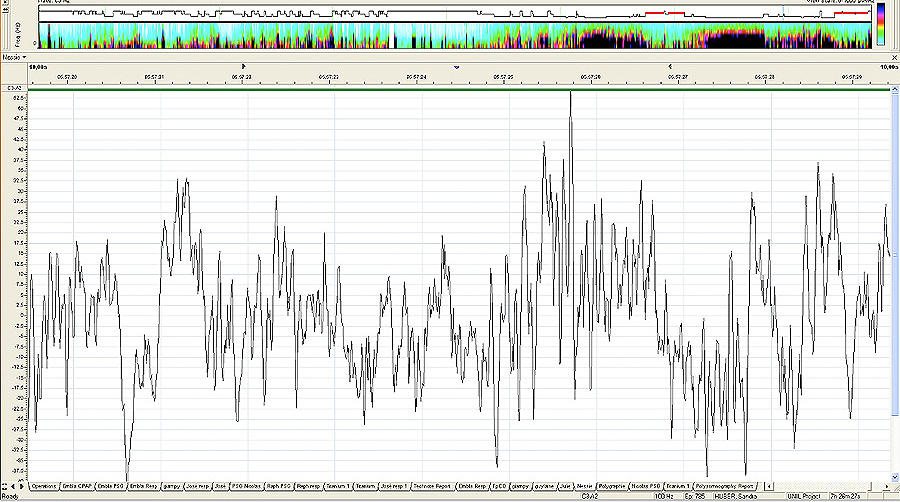
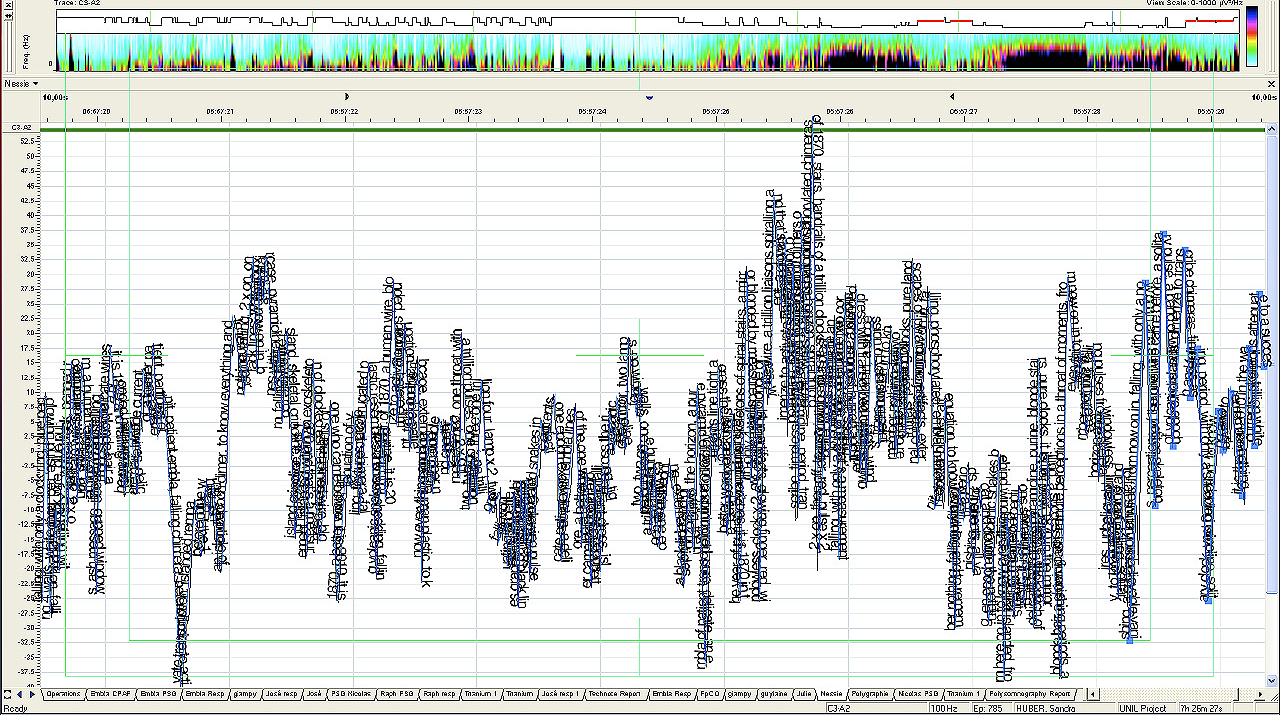
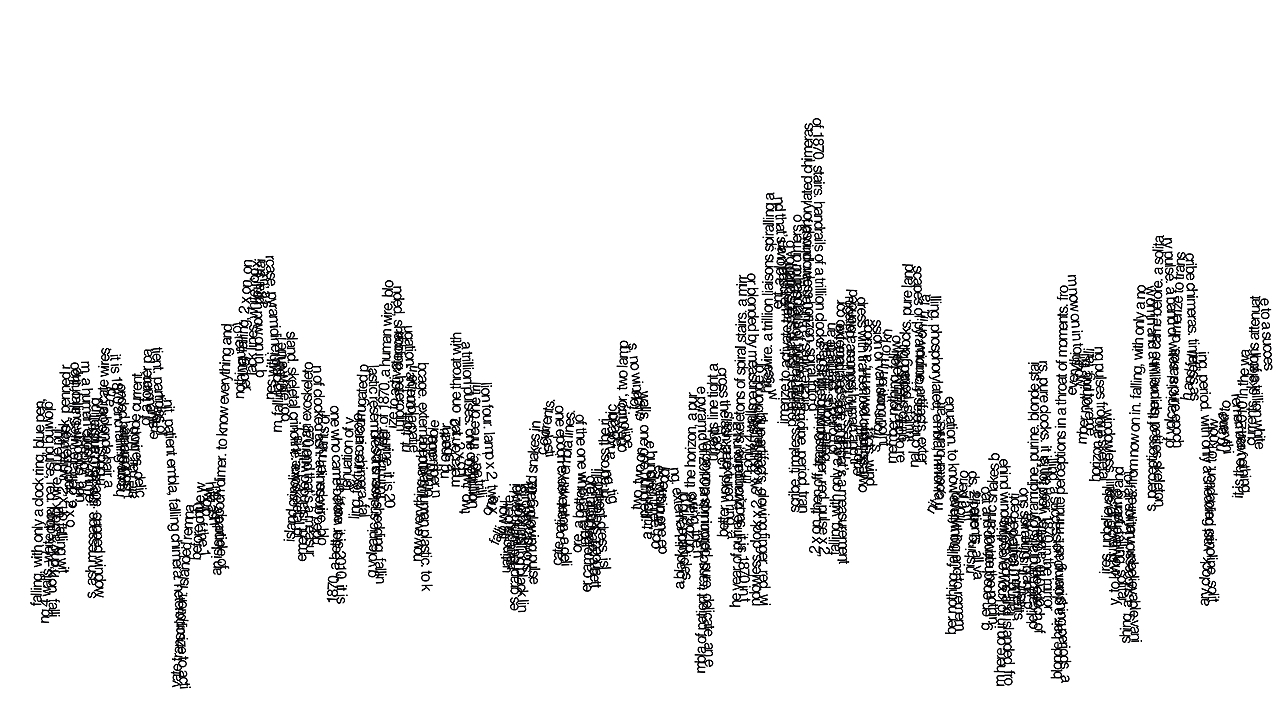
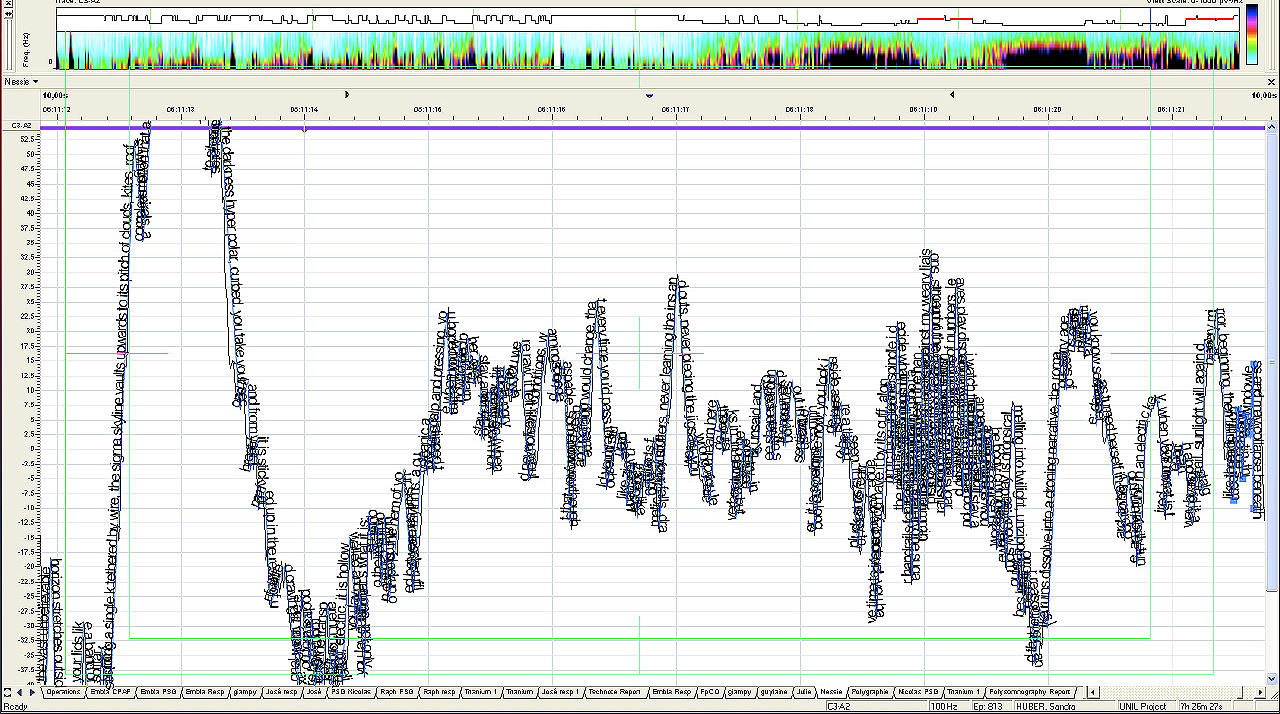
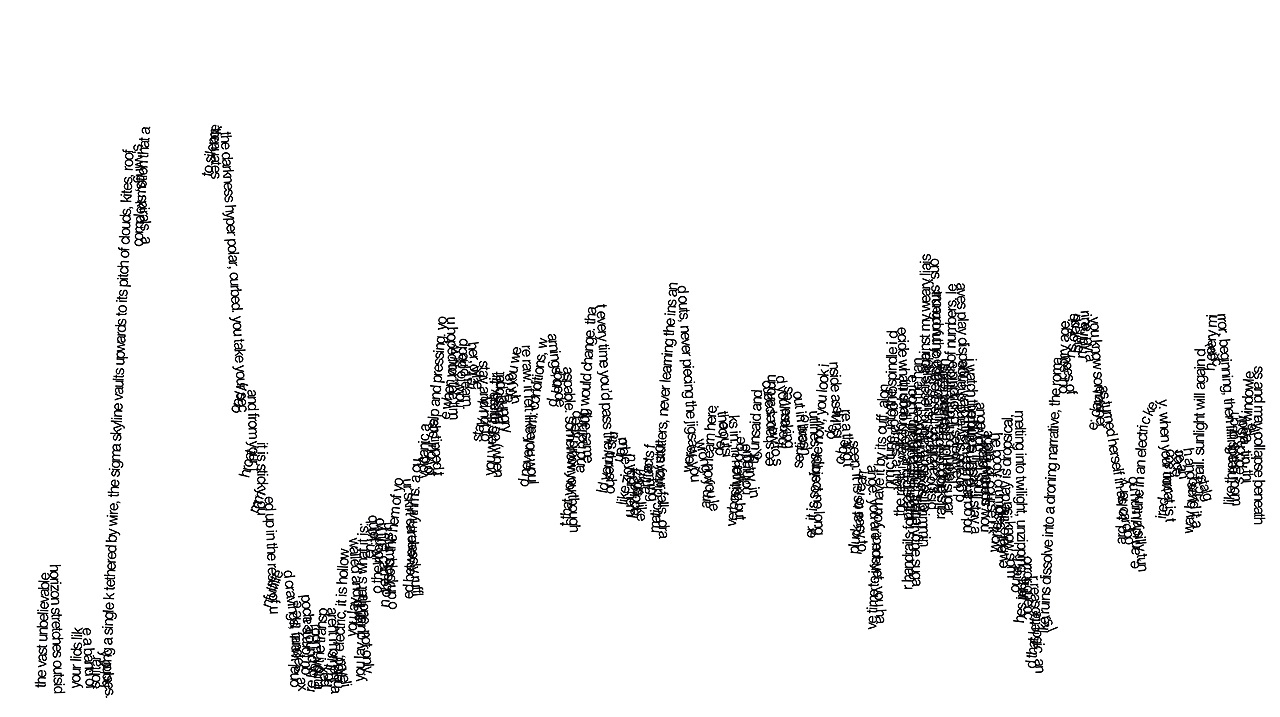
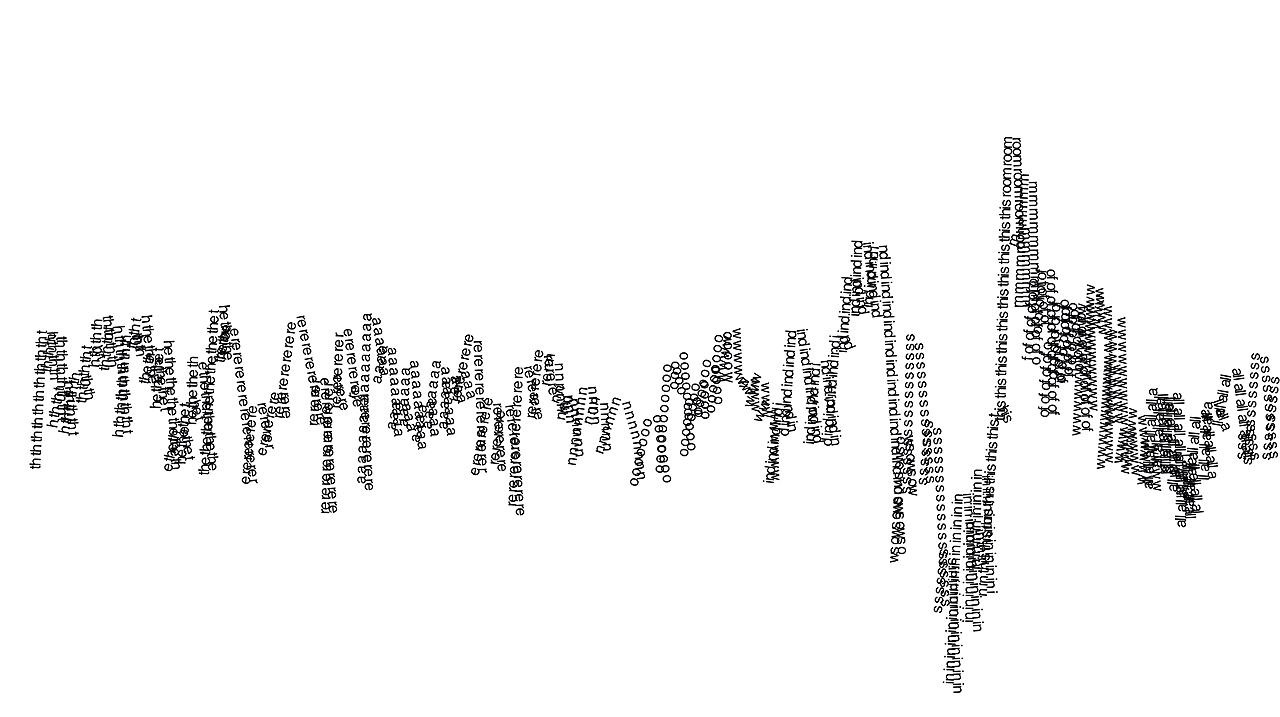
There is a layering of voices surrounding you inside the black room, female, somehow connected to the brainwaves. You realize it is words. In the shape of waves. The voices are repetitive, at times a whisper. Every once in a while a single word or a fragment crests from the waves, and you can read something; sometimes, amongst the voices, you can listen in, understand; the two connect.

The video seems to loop and repeat, and you get the feeling of being trapped in the middle of a very small apperture of space that is somehow unfathomable. The time at the top of the screen shows no more than minutes, very early in the morning, but its seconds seem to stretch out forever.

When you emerge from the black room, you are asked what the words said and what the voices said and you find this difficult to describe.


*

This is the last of three posts that comprise Sandra Huber’s SLEEP/ WRITING/ ROOMS. Part 1 is here and Part 2 here.

VSK PROJECT: SANDRA HUBER SLEEP/ WRITING/ ROOMS (2)

In Uncategorized on February 25, 2011 at 10:44 am

*

*

*

*

[Some Theory behind “Assembling the Morrow”]

poetry has had a difficult relationship with sleep.

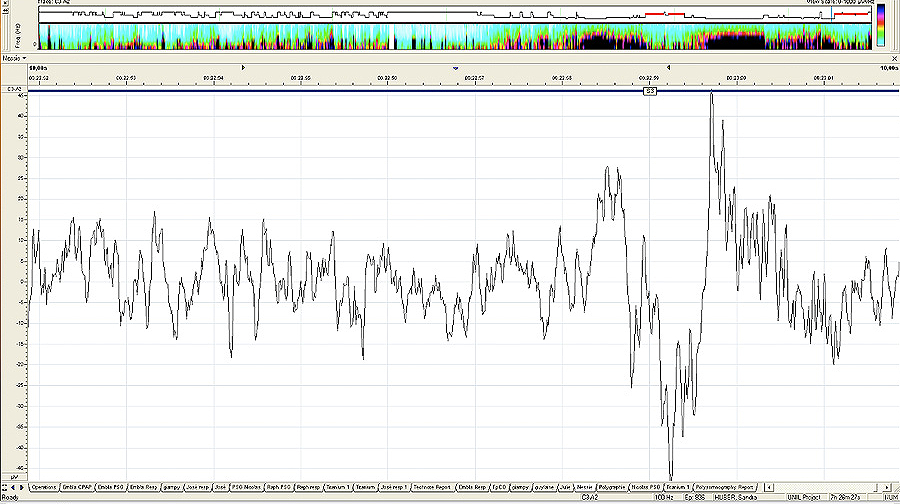
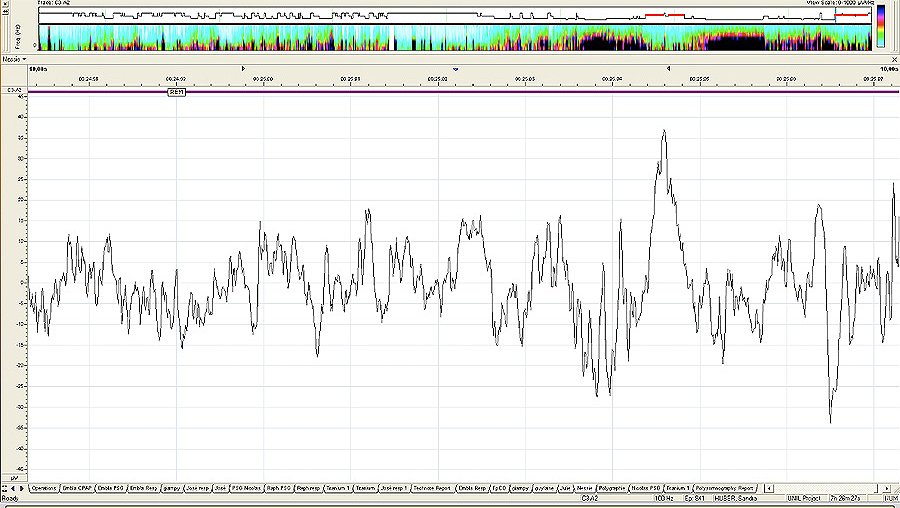
since shakespeare and before, poets of the western tradition have likened the behaviour to a kind of death (“for in that sleep of death what dreams may come”), yet with the invention of the EEG it became clear that sleep, in a manner of speaking, is very much awake. hans berger interfaced the electricity of the brain with waves in the early 20th century, and sleep became a legible phenonemon, groups of neurons firing in a visible choir. assumptions about the natures of sleep as restive and waking as active became instantly problematized – sleep can be as active as the spike of a k-complex rising up from a sea of theta; waking, as quiet as a cup of tea perched on a windowsill beside a blowing curtain. lyn hejinian, in her essay “strangeness,” realizes the difficulties of writing sleep when she speaks of dreaming as a problem of description: one’s written accounts of dreams, she posits, are always unsatisfactory. when i embarked

on a 9 month residency to work with scientists of sleep at the centre for integrative genomics in lausanne, switzerland, i started with these two points: that, 1, sleep is closer to waking than to death (much to the consternation of our romantic metaphors) and, 2, sleep is a problem of description. as i quickly came to see at the laboratory, sleep is also, in the most part, a mystery to the lens of science: though we spend a third of our lives doing it, we still don’t exactly know why. mahowald & schenck: “with the discovery of REM sleep in 1953, it became apparent that sleep is not a unitary phenomenon, but rather consists of completely different states, and each state is an active, rather than quiescent, process”. according to the EEG,

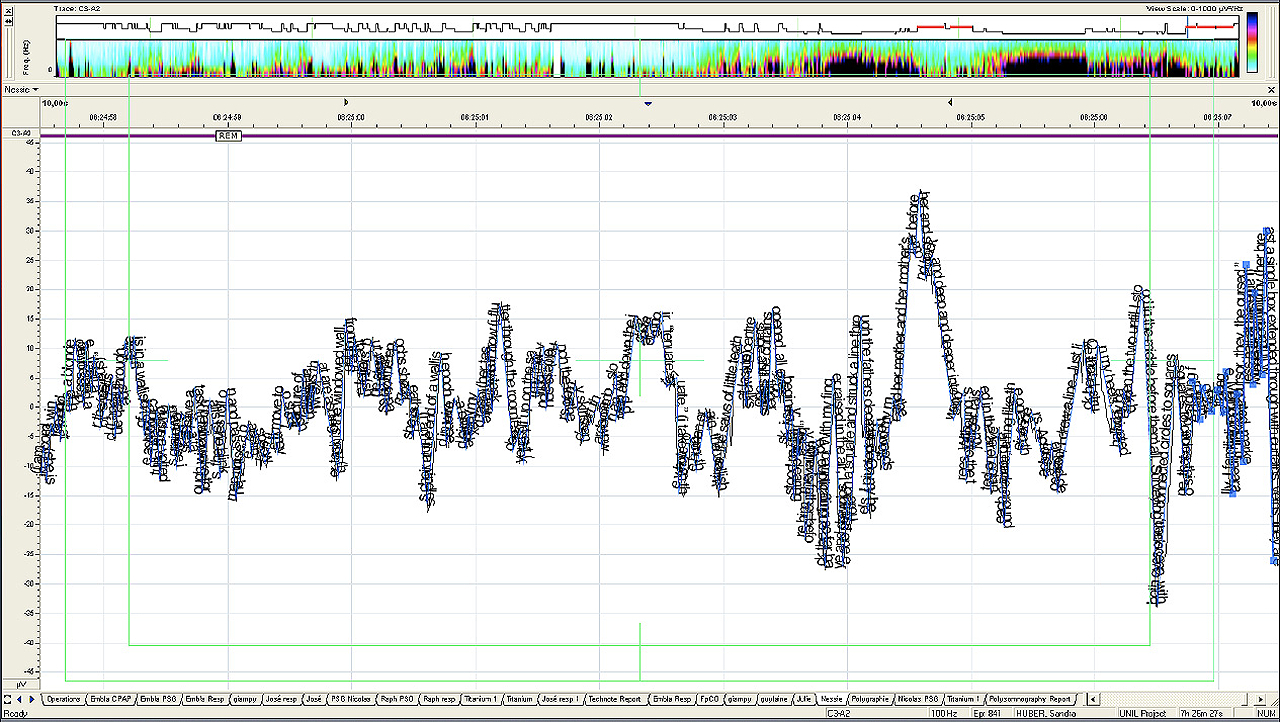
the difference between sleep and waking lies in little more than the flex and rhythm of an electric wave. a line that zigs. one of the main questions behind the experiment/long poem entitled assembling the morrow, therefore, is what happens when the line of berger’s wave (in sleep) turns into a line of poetry, an act of focused consciousness? since words are essentially awake, sleep awakens beneath them. at the same time, poetry itself is forced to change, written not by the principles of ink or lead but electroencephalography. about 9 months ago

when i began, i would write at night, as an experiment, until nights tweaked into the shimmer of days, footprints of light trailing tracks of shadow between. night was writing; day, the clichéd beauty of lausanne against the sterility and mystery of a dish of cells. syringes, papers, computers, coffee, volcanic ash. a wire’s line of waves curved into a line’s wrist of sentences (half past four and asking, what is the difference between a sentence and a line?) (between a line and a wave?) (interfaces, all, stretching like gauze over a thing we cannot define or see). one hand over another, an event horizon shows us what cannot be shown, it is a likeable geometry that covers up a mystery stretching infinitely behind it (but science hates a mystery) (but

poetry feeds from it). according to jonathan c.w. edwards: “in 1972, horace barlow made some suggestions about the number of elements of information required in various parts of the brain for a human percept. the suggestion was that an experience would be composed of about a thousand elements of information, which barlow portrayed as, ‘like words, having the special property that they lead to an economical representation’. thus, although ‘a picture is worth a thousand words’, a thousand words (~5kbytes) would carry information more economically than the necessary array of pixels (?~1mbyte). in barlow’s concept each element of information was associated with the firing of a cell; ‘an active neuron says something of the order of complexity of a word’.” here,

edwards suggests words as a more viable, more economic way of visualizing biophysical space than pixels or lines or any geometric model. words become a powerful semantic interface over something we cannot (as yet) possibly encounter. as william james put it: “the appearance needs the reality in order to exist, but the reality needs the appearance in order to be known.” so much is guessed at by the quality of its surface. to replace brainwaves with words is to inflict upon that wave all the luggage that a sentence can carry: narrative, bias, artifice,

depth. when i say waves, i mean my own and i mean, of course, in sleep. using the self as subject is generally frowned upon in biology: it is taboo to be both researcher and participant, subject and object, author and character, pathologist and pathologized, to be both sides (at once) of the same coin. when i went to the chuv sleep lab, donned that exoskeleton of electrodes, i  became of myself another. there is nothing simultaneously more intimate and more unfamiliar than looking into the eeg of one’s own brain. there is nothing simultaneously more intimate and unfamiliar than sleeping. the singular ‘i’ of the waking day

self fades into the plural ‘i’ of the night’s sleeping selves. it is a science and an art (two sides perhaps of the same coin) to develop a (visual) (visible) method of writing to reflect the brainwaves of a sleeping subject. each alpha theta delta and sigma must be put into a series of words and these words form a poem. a student of william james, gertrude stein developed a language/poetics of consciousness itself, severing words from their proper definitions: “act so that there is no use in a centre. a wide action is not a width. a preparation is given to the ones preparing.” hers is a potential model by which to form a poetics of a brainwave. the tropes of repetition and parataxis reflect the repeating structure of the eeg, of our bodies, too, stuck within their own circadian and ultradian rhythms, recurring,

replaying. as i stated before, my task at the centre for integrative genomics was to turn sleep into a kind of poetry: setting out to do this required embracing illegiblity, keeping it intact; to describe the poem assembling the morrow should remain a problem of description also to the reader: to emerge from a video screening of a poem where words crest in and out of various degrees of illegibility, one is forced to confront the limits of their own knowledge as reflected in the (un)readability of words sculpted to the brainwaves of a sleeping subject. raoul hausmann: “we call this process photomontage because it embodied our refusal to play the role of artist. we regarded ourselves as engineers, and our work as construction: we assembled [in french monteur] our work, like a fitter.” to assemble a morrow is to put together the next coming day using a diverse montage: history, technology, biology, poetry, to create the new, to hold it in that space, unwaking, even as it longs to stutter towards the old. sleep, like grammar, is essentially mysterious: the process lies in unravelling (where every line must have an electricity) (every) (half-

thought a frequency).

*

This is the second of three posts that comprise Sandra Huber’s SLEEP/ WRITING/ ROOMS. Part 1 is here.

VSK PROJECT: SANDRA HUBER SLEEP/ WRITING/ ROOMS (1)

In Uncategorized on February 21, 2011 at 11:50 pm

(1)

(2)

(3)

(4)

(5)

NOTES

This is the first of three posts that will comprise Sandra Huber’s SLEEP/ WRITING/ ROOMS. The following notes are edited from emails between Sandra Huber and David Berridge in February 2011, following an invitation from David to make a project for the VerySmallKitchen blog.

SANDRA: The first thing that comes to mind is a project I did, and am still doing, via Artists-in-Labs, where I was a resident poet for 9 months at the Franken / Tafti sleep laboratories of the CIG in Lausanne, Switzerland. Basically, I took the brainwaves of myself in sleep and started turning them into words, creating a long and extremely visual poem from the raw data of the EEG… Eventually, and when all goes well, it’ll go up as an installation at the lab where I was working in Lausanne, but I’m always open to other ways of presenting this work, either internet or physical venues.

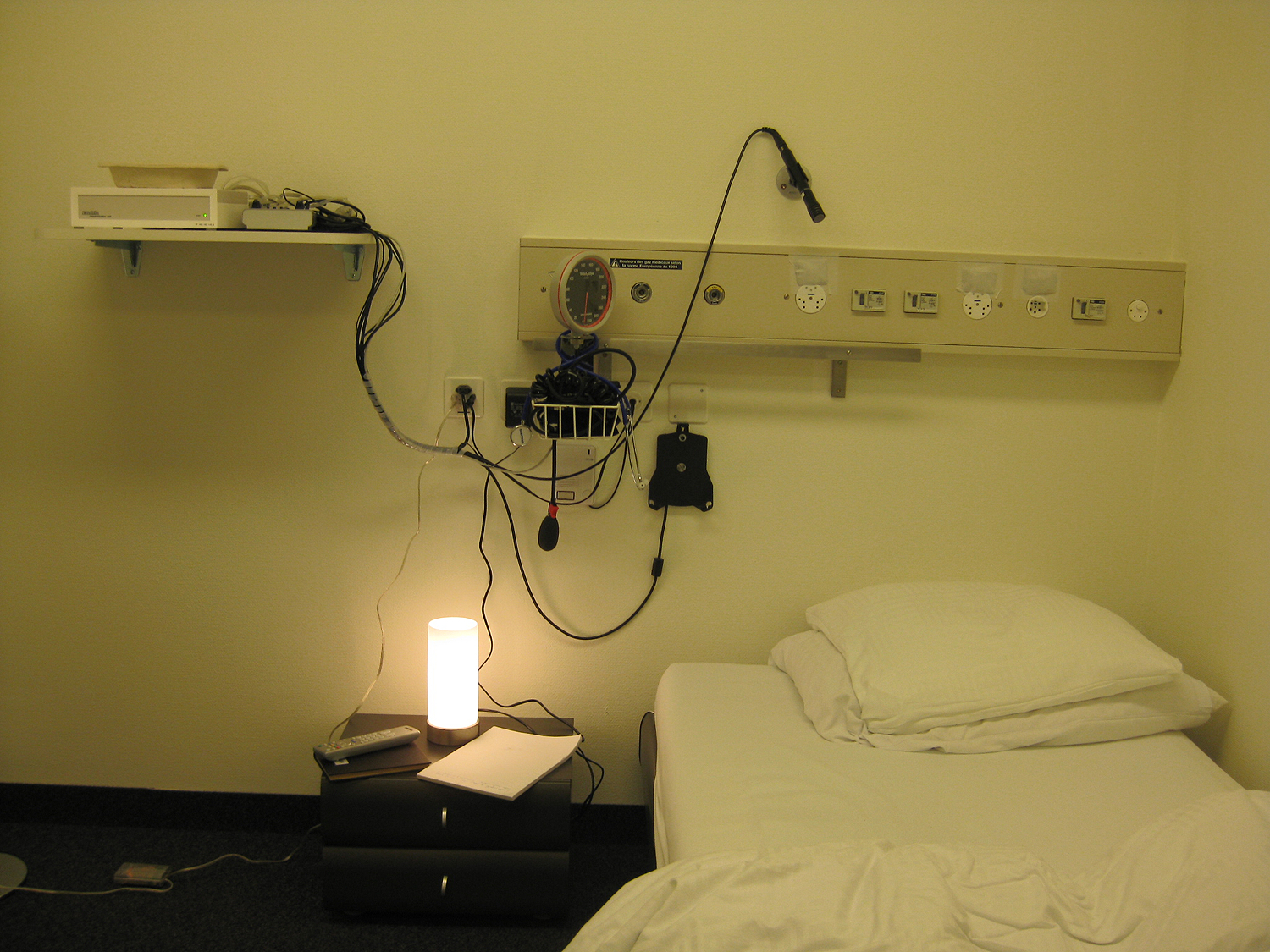
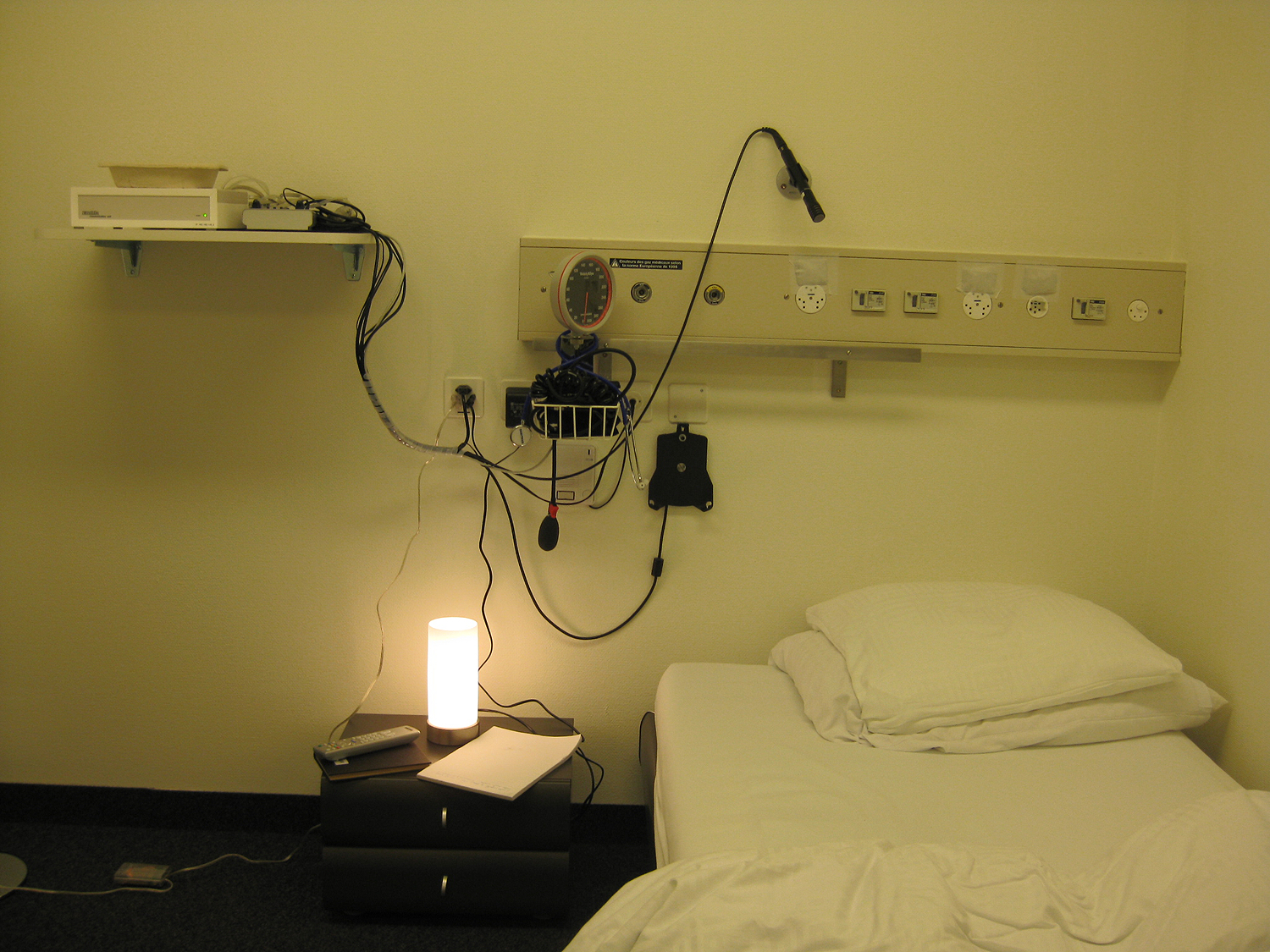
… We could of course start with a sort of e-book/blogroll of the conceptual side of the project, since a lot of the actual poetry is in progress (i.e. not finished…) Here’s an idea: during the residency at the sleep lab, I became very interested in the concept of “the room” — for example, the physical room of the sleep laboratory, at once made to look home-like and yet undeniably sterile, that I had to spend a night in to get my data. There are also the different stages of sleep (S1, S2, S3 & REM) that seemed like disparate rooms themselves, signaled by particular waves (sigma, delta, theta, etc).

We could work on something that gives a sense of rooms and in each “room” could be found something different: a line of poetry on a brainwave, the physical bedroom of the sleeper, a fragment of text on the science / philosophy of sleep. This also makes me think of what you wrote about what happens when the words break out of the rigid structure of the brainwaves — this entering and exiting of rooms that could sometimes spill over their boundaries… Thots?

DAVID:  Would the room be a kind of working proposition for us or would it be apparent in all the posts? I guess we could tie each post to the actual lab room, or – as I read your comments – present a series of “rooms” as distinct spatial-conceptual portions/ propositions:  one post the room of the actual room, one of only the text, one of … and so on. Or mixed up…

Have to think how the blog post format would fit this, and also how on the home page it makes columns of the recent posts. I think images and text combinations work well. The format puts quite a bit of clutter around the posts, so have to explore how something using lots of white space and just text would work, for example.

… how to organise it: posts in a series close together or more  spread out. What do you think? Could be a residency for a week….

oh yes and what you say about the connections between rooms, waves breaking out…. I wonder how we could suggest that… how would you like to start?

SANDRA: Where to start? A good question… Always the most difficult thing…

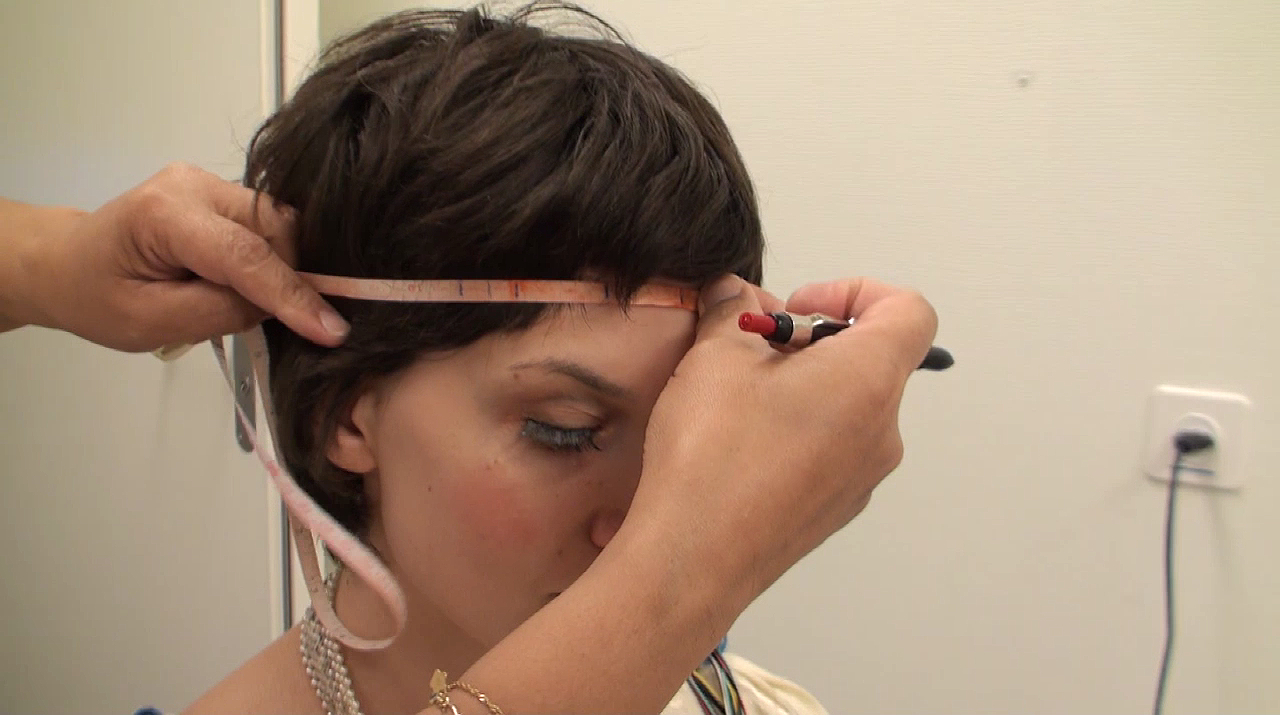
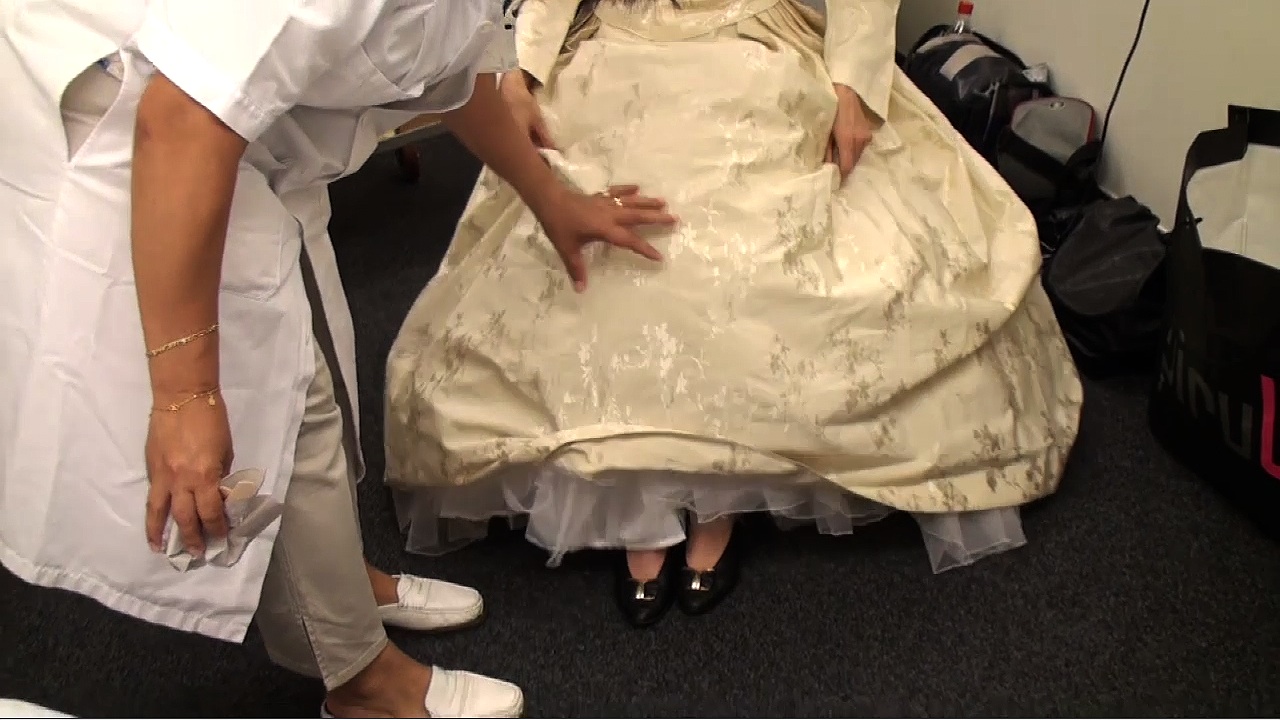
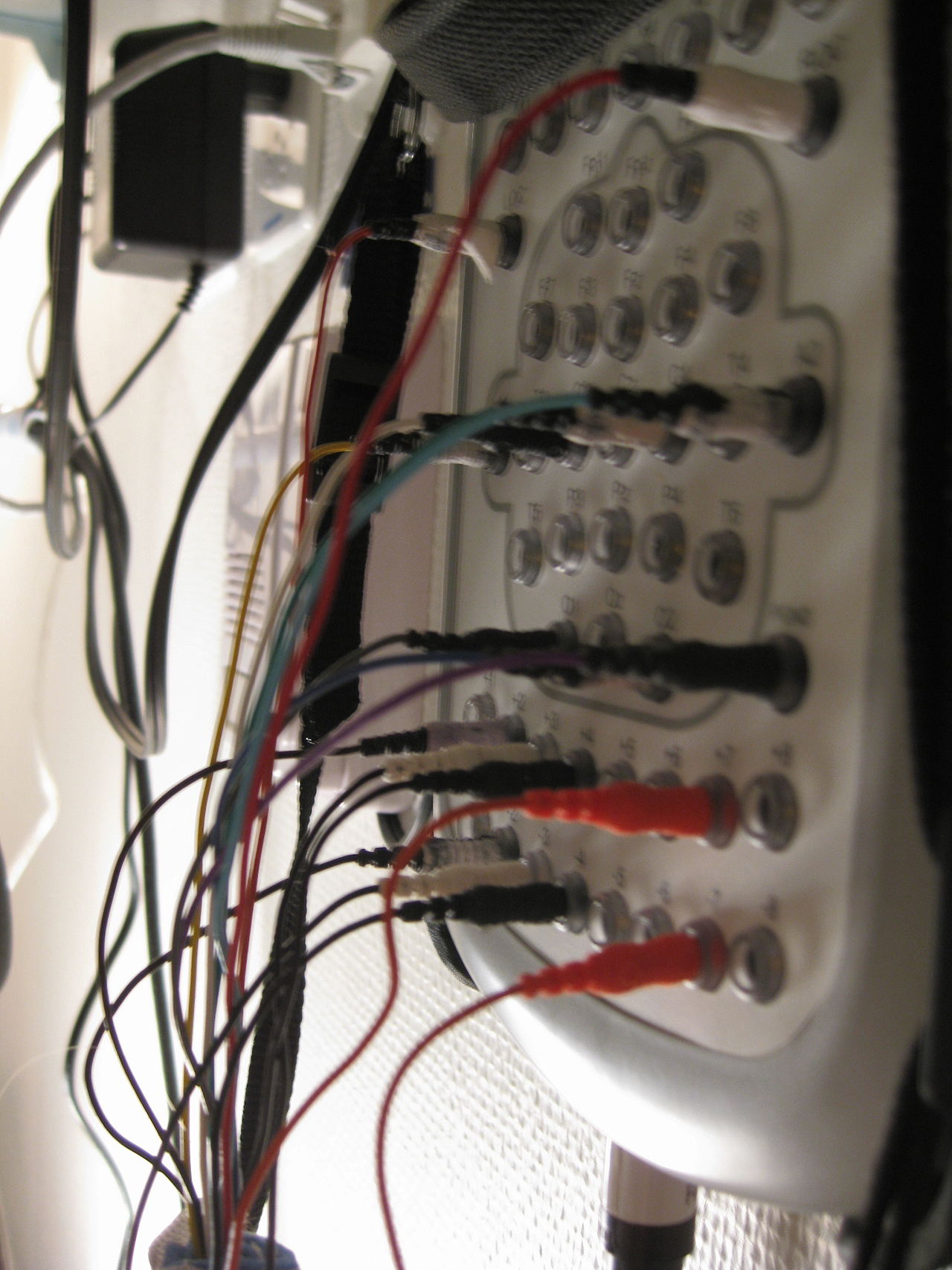
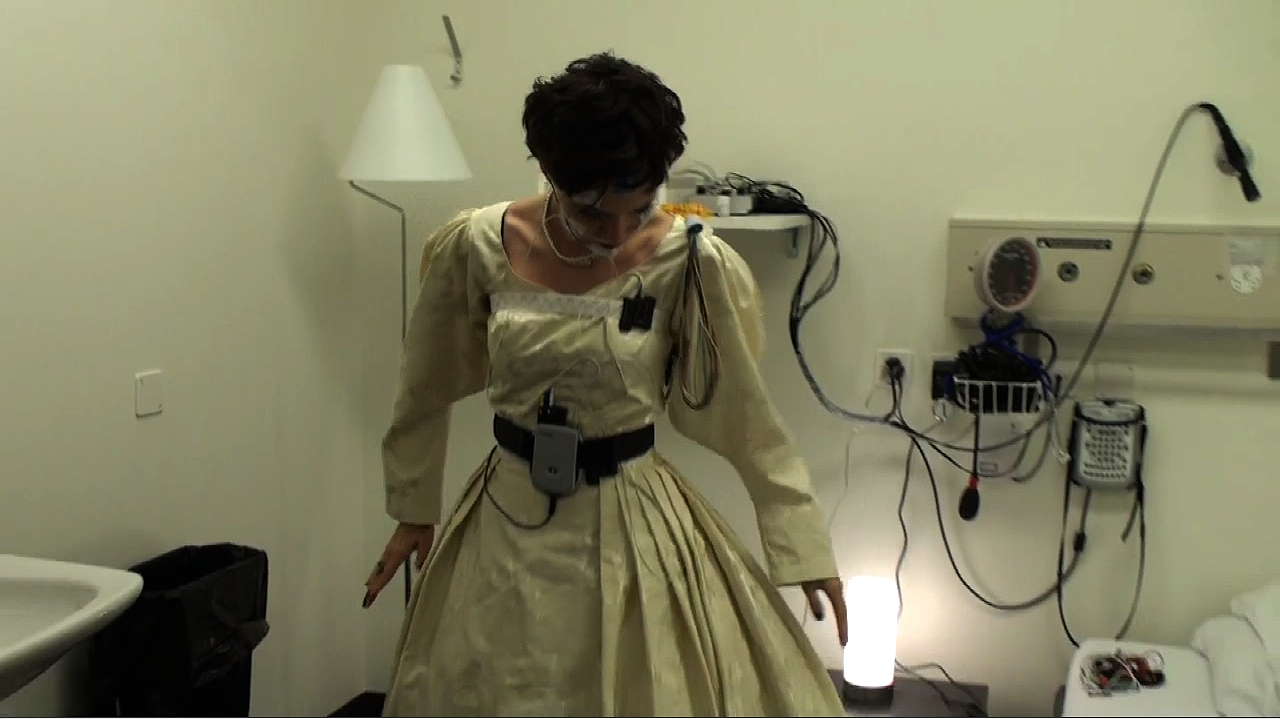
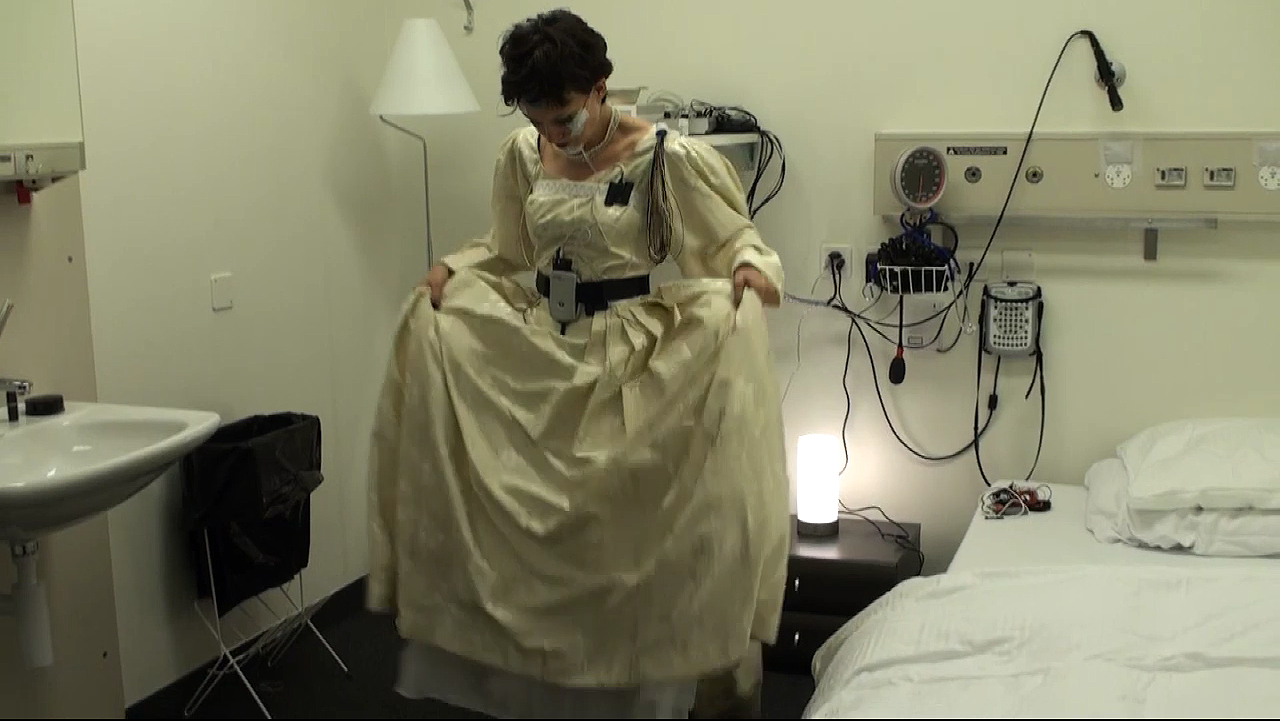
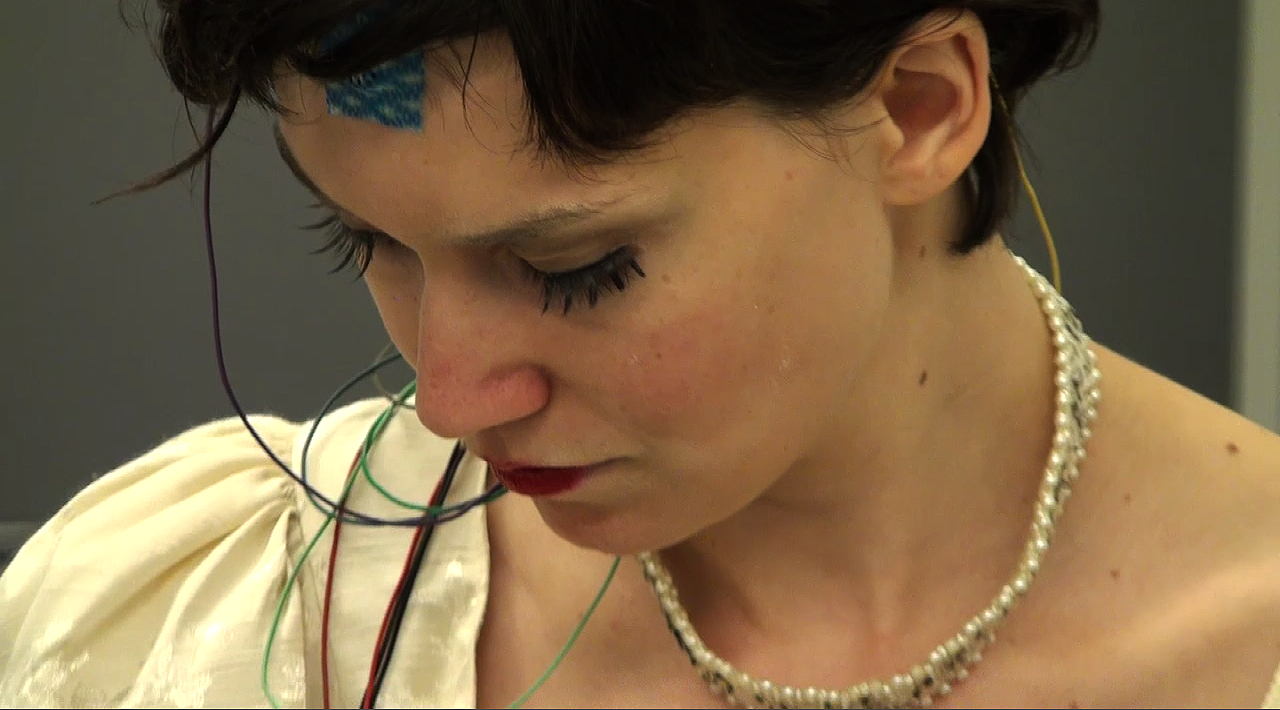
I think, with this idea of “rooms” in mind as a platform, we could literally start with the room itself — the sleep room, a mysterious sort of prelude, and some shots of myself, the sleeper (in a sort of cyborgian costume — I was trying to go for something Ada Lovelace-ish), so at first it’s unclear what exactly is being presented but we do have an idea of an unheimlich sort of space, as well as a character/subject of the writing.

We could then go directly into images of the brainwaves, just the raw waves without writing, and some theory, eventually showing how the brainwaves turn into words, i.e. presenting the poetry, and ending on the sketch of the room of the installation. So in a way, having a movement of the general going to the very specific and zooming back out again (the inside of the sleep room ends in the outside of the installation room: science has completely merged with, or been enveloped by, artifice).

Something like this? As for how it looks on the actual website, or if it’s done in a week’s residency or a more spread out form is entirely up to you..

*

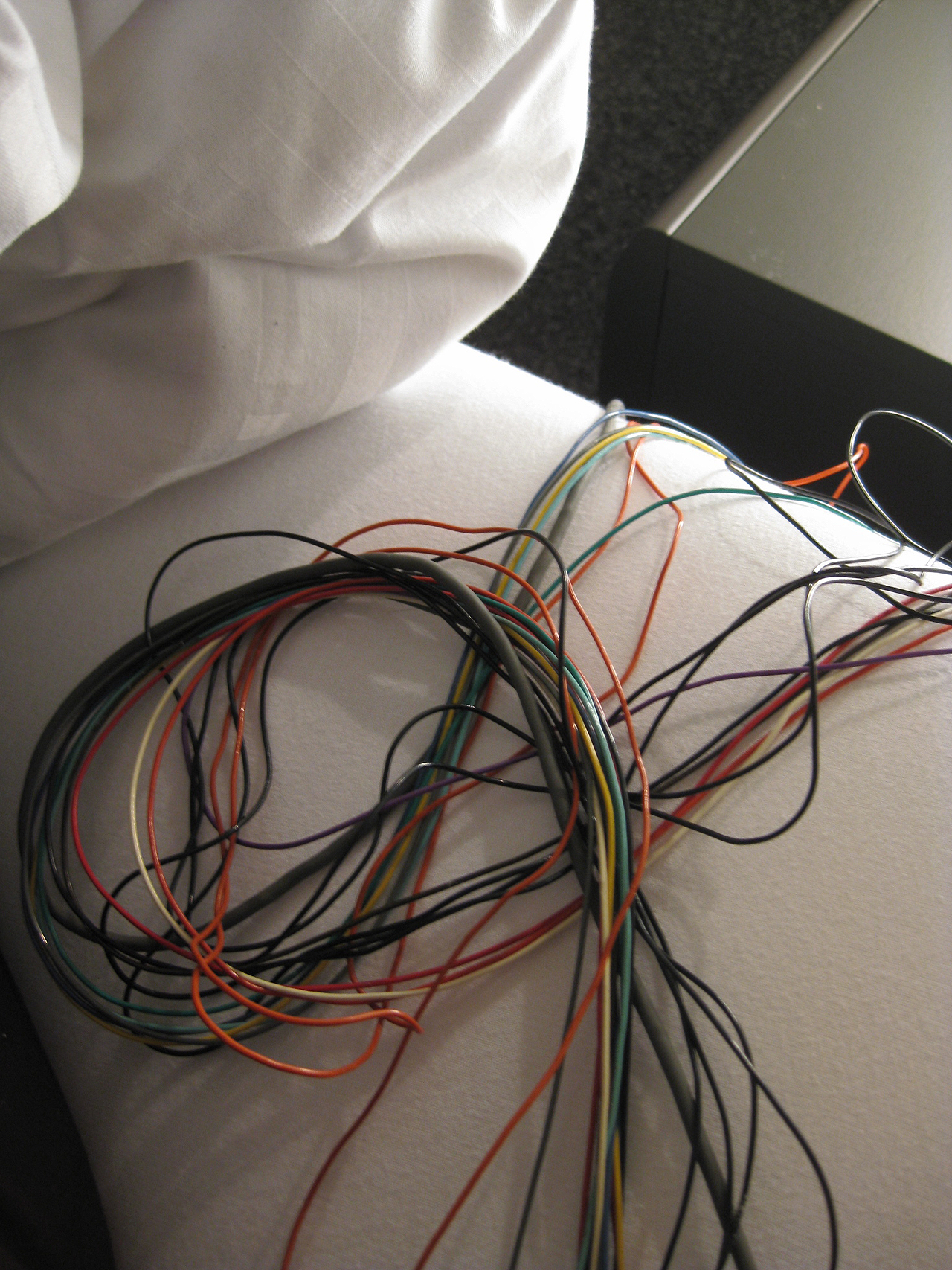
SOURCES: The above video stills and photos were taken on July 5th, 2010 at the Centre Hospitalier Universitaire Vaudois Lausanne sleep laboratory, Switzerland. Of the room: Sandra Huber; of Sandra: Nicole Ottiger (video). The night nurse pictured in the photos is Nessie Tome. The project “Assembling the Morrow” that these images document was made possible through Artists-in-Labs Switzerland and the Paul Franken / Mehdi Tafti sleep laboratories at the Centre for Integrative Genomics in Lausanne.

JOHN BLOOMBERG-RISSMAN: IN THE HOUSE OF THE HANGMAN 362 and A SHORT NOTE

In Uncategorized on February 15, 2011 at 7:05 pm

http://www.johnbr.com/.a/6a00d83451b84369e20111690e57fb970c-pi

A few phrases from MESOSTICTACTICS, a text I wrote for the recent collage-themed issue of The Incongruous Quarterly, were included by John Bloomberg-Rissman as the 362nd installment of the ongoing IN THE HOUSE OF THE HANGMAN project, which appears on his ZEITGEIST SPAM blog.

I was intrigued by the project, noting how, during recent events in Egypt, its appropriated and sequenced “giant mashup” found a discursive place alongside other posts on politics and current affairs. Below is the original post that included the MESOSTICTACTICS texts, and a short essay from John in response to my invitation to outline some of the reasons/ methods behind the project.

NOTE: The image above evidences another series of collaboration, exchange and appropriation between John, Tom Beckett, and Ernesto Priego. Full details here.

*


In the House of the Hangman 362

MBUTTHEREIS NLYAIRTHER ETHEREISN stuffed down the side of a cosmic machine machine in heavens kitchen AB VET CLIMBI NT NLYTHEHIGHHIGHH RI Z NTALBUTMAN YBEF an ugly winged insect, normally seen smoking a cigarette or pipe and sporting a clueless expression the Guberif resembles the “trickle down” and “edge blur” techniques proposed by Ron Padgett in Creative Reading I

head” the

know who

in that line (some civil law chauvinists refer to this as “dog’s law” because you punish the dog after it’s done something bad). CREWMAN regales ignorant former body with report of incident: I was small when I first rocketed to war and was told to keep my speech inside your pocket to be free. Do I regret our united youth? Though aren’t we all, at some age, born to harden in a scabbing flask on power’s boiling stove? In space I have only grown smaller, eyes atrophied to arm’s length radar. My dear aging body, you and I settle in this great glass test tube, centrifuged from one another, bisected by a veil of uniform and white glove. You and I, dear empty friend, we may sunder on the asteroidal floor of God’s Cartesian laboratory! Would my radar darken if I spoke one more through you? These hypotheses no longer have me worn! (he wears away at his agglomerations with an industrial sander) ³&RQVLGHU WKH FDSDFLW\ RI WKH KXPDQ ERG\ IRU SOHDVXUH 6RPHWLPHV LW LV SOHDVDQW WR HDW WR GULQN to see, to touch, to smell, to hear, to make love. Our voluptific capacities (if you will forgive me the coinage) are not exclusively concentrated in these places, but it is undeniable that they are concentrated. Only in certain places are there wells from which we may draw up greater feeling. But not inexhaustibly. And how long is it possible to know pleasure? Rich Romans ate to satiety and then purged their overburdened bellies to ate again. They could not eat forever. A rose is sweet, but the nose becomes habituated. And what of the most intense pleasures, the personalityannihilating ecstasies of sex? Even this will turn into disgust if overprolonged. >«@ Yet consider pain. Give me a cubic centimetre of your flesh and I could give you pain that would swallow you as the ocean swallows a grain of salt. And you would always be ripe for it, from before the time of your birth to the moments after your death. We are always in season for the embrace of pain. To experience pain requires no intelligence, no maturity, no wisdom, no slow workings of the hormones in the moist midnight of our innards. We are infinitely ripe for it. All life is ripe for it. $OZD\V >«@ &RQsider the ways in which we may gain pleDVXUH > «@ &RQVLGHU WKH ZD\V LQ ZKLFK ZH PD\ EH JLYHQ SDLQ 7KH RQH LV WR WKH RWKHU DV WKH PRRQ LV WR WKH VXQ´~%DQN RI 0RQWUHDO¶V UHFRPPHQGDWLRQ IRU SRUWIROLR GLYHUVLILFDWLRQ LQ WKH 1HZ (FRQRP\Alright, an egg has a life of its own, and yet is food in the sense that we are all food; as we consume others, various others snack on us, even as we head toward that final place-setting in the soil (pause to flick an invisible creature from my eyelash). Who isn’t “avaricious”? damage: common sense tells us that additional grey matter is lost; damage: with each passing rainstorm speech or movement problems shatter. Infinite mercury paled smarter, all sunday mourning halfheard honey soothed the moon. Limpid page disengage, each hope a light by the lake. Fluids mingling in flowering currants, lilacs, wild smoke. Energy’s beaming thru the apex of the Bosnian Pyramid of the Sun, radius 4.5m, frequency 28 kHz. Beam is continuous; its strength grows as it moves up and away, contradicting all known physical laws. There’s an underground labyrinth: three chambers and small blue lake, ionization 43x higher than average. Further detection confirms negative radiation through Hartman, Curry and Schneider grids = 0 in the tunnels. 10-ton ceramic sculptures are positioned over the underground water flows transforming negative energy to positive. Thus the underground labyrinth is one of the most secure underground constructions in the world making it ideally fleshly regenerative.

[Note: Sources: Except as noted, Incongruous Quarterly 2; David Berridge, “MESOSTICTACTICS”; Eben Lehman, “Forgotten Characters from Forest History: “The Guberif””, at Peeling Back the Bark, 6 Jan 011; Adam Parrish, “Q&”; James A Reeves, “My Civil Law Books Are Beautiful”, at Big American Night, 15 Jan 011; Chris Felling, “Profound Scenes from Space Thunder Kids”; MM Jones, “Mark Bradford at the ICA”, at Bauzegeist, 6 Feb 011; Colin Fulton, “The Access” (a code-god translation via the medium of cutnpaste); Jean Vengua, “(silk egg) and i cont’d.”, at Jean Vengua, 6 Feb 011; dRobert Swereda, “brain damage, rain damage”; N. Alexander Armstrong, “from Some Seminal Work”; email from Bosnian Pyramid of the Sun Foundation, “Significance of the Bosnian Pyramid Discovery”, rec’d 6 Feb 011, 05:30 AM]

*

A note for David Berridge, in response to his question, “I wondered if it would be possible to include a note/ short essay by you outlining some of the reasons/ methods behind the project, and how both as a whole and as individual pieces it takes shape?”

Ok. First, the project. I’m currently word-painting an altarpiece (non-religion tbd) called Zeitgeist Spam (ZS). The first panel is called No Sounds of My Own Making, and was published in 2008. The second panel is called Flux, Clot & Froth, and was published (2 vols, one text one notes) in 2010. In the House of the Hangman (ITH) is the panel-in progress. There will be at least one more, then I have to paint the backs … What’s ZS all about? What it’s like to be alive today. It’s a “poem including history”, and therefore in Poundian terms an epic. And as a comtemporary epic, it’s a “poem without a hero” (Akhmatova), or rather, a “poem in which the hero is all-or-none of us.” Therefore it’s written by all of us, in a manner of speaking, and assembled by me. It’s a giant mashup.

ITH is the most overtly “engaged” panel. It’s kinda like that last judgment wall in the Sistine Chapel. The title’s from Theodor Adorno, who wrote, “In the house of the hangman one should not speak of the noose, otherwise one might seem to harbor resentment.” The plan is to compose it in 2012 sections (because 2012’s the pseudo-mayan end of everything…), which when complete will be presented as one giant 500 page-or-so paragraph (Since it’s politically engaged, why not be brutal about it?).

Method: for each section of ITH I create a set, which is determined by RSS feeds which I receive via Google Reader daily. That stuff is augmented by whatever comes my way that same day. ITH is very diary-esque. I pick and choose at will from what appears in that set, and arrange as necessary to get the “feel” I want. So the method is semi-formal and semi-freedom.

https://i0.wp.com/meritagepress.com/images/FCFfront.jpg

http://static.lulu.com/product/paperback/flux-clot-and-froth-vol-2/13576404/thumbnail/320

[From her on I’m going to quote some bits from an interview Tom Beckett did with me, which was published in Otoliths a few years back]

Let me quote something Karla Kelsey wrote about me. I think she is dead-on correct. She’s writing about No Sounds Of My Own Making:

This is not a text built on the foundations of either subjectivity OR alterity. This is a text of AND. … Like many texts that hinge on the strength of “and” No Sounds of My Own Making eschews categorization. The work does not belong in a category of “pure” conceptual writing: Bloomberg-Rissman breaks his own rules too often to make a conceptual statement, and the text feels too much to be a member of what Craig Dworkin defines, in his introduction to the ubuweb Anthology of Conceptual Writing, as a pursuit of “meticulous procedure and exhaustively logical process.” However, given that most of the subjective statements in No Sounds are gleaned from other authors via algorithm, the poem cannot read as a purely subjective baring of the soul in the tradition of Wordsworth’s ‘spontaneous overflow’. …

As Karla has intuited, my actual piecework is not algorithm- or constraint- or routine- driven, even if the material and the order, etc. in which I sample it is. To put it succinctly, I will quote Frank O’Hara’s “Personism” manifesto: “you just go on your nerve.” I decide to put this next to that because it feels right. Truthfully, I usually don’t know where I’m going as I piece things together. Except that at some level I’m also expressionist.

…

What I try to get down in pixels or on paper is a version of the tale of the tribe, which = the chatter of a very peculiar bunch of primates, which = a giant wail of suffering, which = a hallelujah chorus. Among other things. 10,000 other things. All remixed as if by a DJ like Spooky or Señor Priego, to keep us all dancing. Because, of course, the dancers inherit the party.

… there’s no real power struggle in my poems, all samples are created and remain equal, no matter how much I mess with them), I do believe that making space for a cacophonic chorus that never quite blends into one voice, each voice at equal volume with all others, each endowed with “equal rights”, is indeed a precondition for letting a just culture flourish, though I’d probably opt for some sort of anarcho-socialism rather than a univocal Maoist version. 

Of course, I know that what I’m creating is something just slightly more than the illusion of such a chorus. There’s a little man behind the Oz-curtain … But what more can I do? The totally aleatory doesn’t work for me. Not all the time, at least. I almost hate to say it, but some days I love Jackson Mac Low’s procedure notes more than his poems. Besides, 4’33” is always-already on the box, isn’t it?

John Bloomberg-Rissman
13 Feb 2011

READING ENSEMBLE/ READING AS PUBLISHING: A SCRIPT FOR A COLLABORATION

In Uncategorized on January 23, 2011 at 12:19 pm


On January 22nd, at the Galway Arts Centre, my collaboration with Jennie Guy was performed as part of DAS SPLINTER, an evening of art and performance, curated by Economic Thought Projects. Jennie asked me to provide some texts for the performance, which was part of her READING ENSEMBLE project.

When we first discussed the project, Jennie gave me the image of a filing cabinet from which she would remove texts, handing them to the audience at the Galway Arts Centre to read. In response to this image I put together the following script. Jennie then worked on the details of the performance itself, such as what instructions (if any) to give the readers.

More info on the performance will be posted here soon. Below is the email in which I outlined my thoughts about the project, and the script itself.

*

Hi Jennie,

I decided to make something out of all the things I had been reading over Christmas and the New Year. I was interested in the filing cabinet as some sort of archive of reading, that each drawer contained a different set/ category of texts. I’ve also been thinking of the Reading as Publishing idea: that this is an archive of reading moments, that this performance/ reading will publish. In the filing cabinet they are sort of inbetween, in limbo, awaiting activation, uncertain…

I’ve been thinking about your role as performer/ enacter/ instigator. How do you see this? I’ve been imagining it almost as conductor – giving out texts and taking them away, listening to people, making taking sheets back, tearing off small bits of text and  giving them back to people, collaging texts, highlighting, taking sheets away from one person and giving them to another, either invitingly or tactlessly or or or – I’ve been thinking about what would be a real/ genuine/ active relationship to this filing cabinet and these texts… what you yourself might say/ read as part of the composition…

All of these texts are translations, that will be further translated by the difficulties of reading them aloud. If there are phrases which are stumbled over that, too, could be a source to work from.

At the moment I imagine three sets of texts. Three folders. One in each of the drawers of the filing cabinet. Each section of the texts printed here – separated by * – is on a separate sheet of paper. The texts are distributed to the audience in order to make the composition. Prior to opening each drawer, there is text that you read as a kind of prelude. Perhaps these texts are on a clipboard that you bring with you when you come onto the stage.

I imagine each folder being the basis of a distinct choral/ musical/ vocal composition, before the next drawer/ file is opened and the new composition begin (whether each section ends with sheets gathered back in, or is allowed to continue but hushed or not, I think depends on the moment). In the moment of performance, you might want to hand out just one or two of the quotations, or all of them, or none!

Text sources and notes are listed at the end of the script.

Jennie Guy, Reading Ensemble, Market Studios Dublin, 2010

THE SCRIPT

Before opening the filing cabinets you read the following text aloud.

JENNIE: This afternoon, I heard a lecture on “The Function of Art and the Artist” by Anais Nin: she is very startling – pixie-like, other-wordly – small, finely built, dark hair, and much make-up which made her look very pale – large, questioning eyes – a marked accent which I could not label – her speech is over-precise – she shines and polishes each syllable with the very tip of her tongue and teeth – one feels that if one were to touch her, she would crumble into silver dust.

FILE 1

Will you please read what’s written above the score?” the lady asked.

“Moderato cantabile.” said the child.

The lady punctured his reply by striking the keyboard with a pencil. The child remained motionless, his head turned towards his score.

“And what does moderato cantabile mean?”

“I don’t know.”

A woman, seated ten feet away, gave a sigh.

“Are you quite sure you don’t know what moderato cantabile means?” the lady repeated.

*

The child did not reply. The lady stifled an exasperated groan, and again struck the keyboard with her pencil. The child remained unblinking. The lady turned.

“Madame Desbaresdes, you have a very stubborn little boy.”

Anne Desbaresdes sighed again.

“You don’t have to tell me,” she said.

The child motionless, his eyes lowered, was the only one to remember that dusk had just broken out. It made him shiver.

“I told you the last time, I told you the time before that, I’ve told you a hundred times. Are you sure you don’t know what it means?”

*

The child decided not to answer. The lady looked again the object before her, her rage mounting.

“Here we go again,” said Anne Desbaresdes under her breath.

“The touble is,” the lady went on, “the trouble is you don’t want to say it.”

Anne Desbaresdes looked again at this child from head to toe, but in a different way from the lady.

*

“You’re going to say it this minute,” the lady shouted.

The child showed no surprise. He still didn’t reply. Then the lady struck the keyboard a third time, so hard that the pencil broke right next to the child’s hand. His hands were round and milky, still scarcely formed. They were clenched and unmoving.

“He’s a difficult child,” Anne Desbaresdes offered timidly.

The child turned his head towards the voice, quickly towards his mother, to make sure of her existence, then resumed his pose as an object, facing the score. His hands remained clenched.

*

Jennie Guy, video still, Livestock Reading, 2010

FILE 2

JENNIE: He chatted with eminent grace between takes, then went over to stretch out again (upon a tarpaulin laid down out of camera range) on the floor of the quarried-out cavern in rock, lit up eerily by the floodlights, to be the transpierced poet—a spear through his breast (actually built around his breast on an iron hoop under his jacket). The hands gripped the spear; the talc-white face from the age of Diderot became anguished. Lunch was preceded by a cocktail, mixed by the famous hands, which he had learned to make from a novel by Peter Cheyney: “white rum, curaçao, and some other things.”

TEXTS IN FILE:

The gaunt, fine hands on the thorax; evacuation of the chest; a great breathing out from himself

*

two beautiful, thin, coupled wrists

*

shrugs  a few moments later

*

He stood—rather tiredly—he was very slight, quite small…

*
… and he went with slow steps to an end table. And he took up a tube of silver cardboard or foil, which made a cylinder mirror upon its outside. And he placed it down carefully in the exact center of an indecipherable photograph which was spread flat on this table, that I would learn was Rubens’s “Crucifixion” taken with a camera that shot in round. Masses of fog blurred out in the photo; elongations without sense. Upon the tube, which corresponded in some unseen fashion with the camera, the maker, the photograph was restored —swirls became men. Nevertheless, the objective photograph remained insane.

*

his voice loses its vibrant timbre—it “bleeds out.” His voice was exceptionally young; here it becomes faded.

*

One feels sure he recognizes the imputations for the art of writing in the decision not to correct;

*

resignedly

FILE 3

JENNIE:  These things happened to me in 1938. I feel the greatest uneasiness in speaking of them. I have already tried to put them into writing many times. If I have written books, it has been in the hope that they would put an end to it all. If I have written novels, they have come into being just as the words began to shrink back from the truth. I am not frightened of the truth. I am not afraid to tell a secret. But until now, words have been frailer and more cunning than I would have liked. I know this guile is a warning: it would be nobler to leave the truth in peace. It would be in the best interests of the truth to keep it hidden. But now I hope to be done with it soon. To be done with it is also noble and important.

TEXTS IN FILE:

the tiny imperceptible interactions between people—the little games of aggression and retreat, the miniscule battles that constitute the present state of the psyche.

*

the interior movements that precede and prepare our words and actions, at the limits of our consciousness.  They happen in an instant, and apprehending them in the rush of human interactions demands painstaking attention.

*

I knew it seemed impossible to me to write in the traditional forms. They seemed to have no access to what we experienced. If we en- closed that in characters, personalities, a plot, we were overlooking everything that our senses were perceiving, which is what interested me. One had to take hold of the instant, by enlarging it, developing it.

*

I felt that a path was opening before me, a path that excited me. As if I’d found my own terrain, upon which I could move forward, where no one had gone prior to me. Where I was in charge.

*

Because it’s difficult. Because I plunge in directly, without giving any reference points. One doesn’t know where one is, or who is who. I speak right away of the essential things, and that’s very difficult. In addition, people have the habit of looking for the framework of the traditional novel—characters, plots—and they don’t find it; they’re lost.

*

No, what is difficult is being on the surface. One gets bored there. There are a lot of great and admirable models who block your way. And once I rise to the surface, to do something on the surface, it’s easy, but it’s very tedious and disappointing.

*

There are always instants. It takes place in the present finally. I’m concerned with these interior movements; I’m not concerned with time.

*

I’m immersed right inside, and I try to execute the interior movements that are produced in that consciousness.

*

Each time it didn’t interest me to continue doing the same thing. So, I would try to extend my domain to areas that were always at the same level of these interior movements, to go into regions where I hadn’t yet gone.

Jennie Guy, Questions and Answers, 2009


SOURCES

“This afternoon I heard a lecture…”: Susan Sontag, Reborn: Journals & Notebooks 1947-1963 (FSG, New York, 2008), 17.

Marguerite Duras, Moderato Cantabile (trs. Richard Seaver, OneWorld Classics, 2008 [1958]), 3-5. The extract here is the opening of the novel.

“He chatted with eminent grace…”: Jean Cocteau: The Art of Fiction No.34. Interviewed by William Fifield. Appeared in Paqris Review Summer-Fall 1964 no.32. Online here. I have extracted interpolations by Fifield, mostly descriptions of Cocteau’s physical deportment.

“These things happened to me…”: Maurice Blanchot., Death Sentance, in  George Quasha ed. The Station Hill Blanchot Reader: Fiction & Literary Essays (Station Hill, 1998, trans. Lydia Davis), 131.

Alain Robbe-Grillet The Art of Fiction No.91 interviewed by Shusha Guppy. Spring 1986 No.99. Online here.

Nathalie Sarraute, The Art of Fiction, No.115. interviewed by Shusha Guppy and Jason Weiss. Spring 1990, No. 114. Online here.  I have extracted texts unfolding Sarraute’s notion of “tropisms”, but excluded reference to the word itself.
JUST PUBLISHED: NEW VSK CHAPBOOK: BULLETINS by Mary Yacoob

In Uncategorized on January 14, 2011 at 2:26 pm

VerySmallKitchen announce the publication of BULLETINS by Mary Yacoob. This latest VSK chapbook is now available, for online consumption and PDF download here.
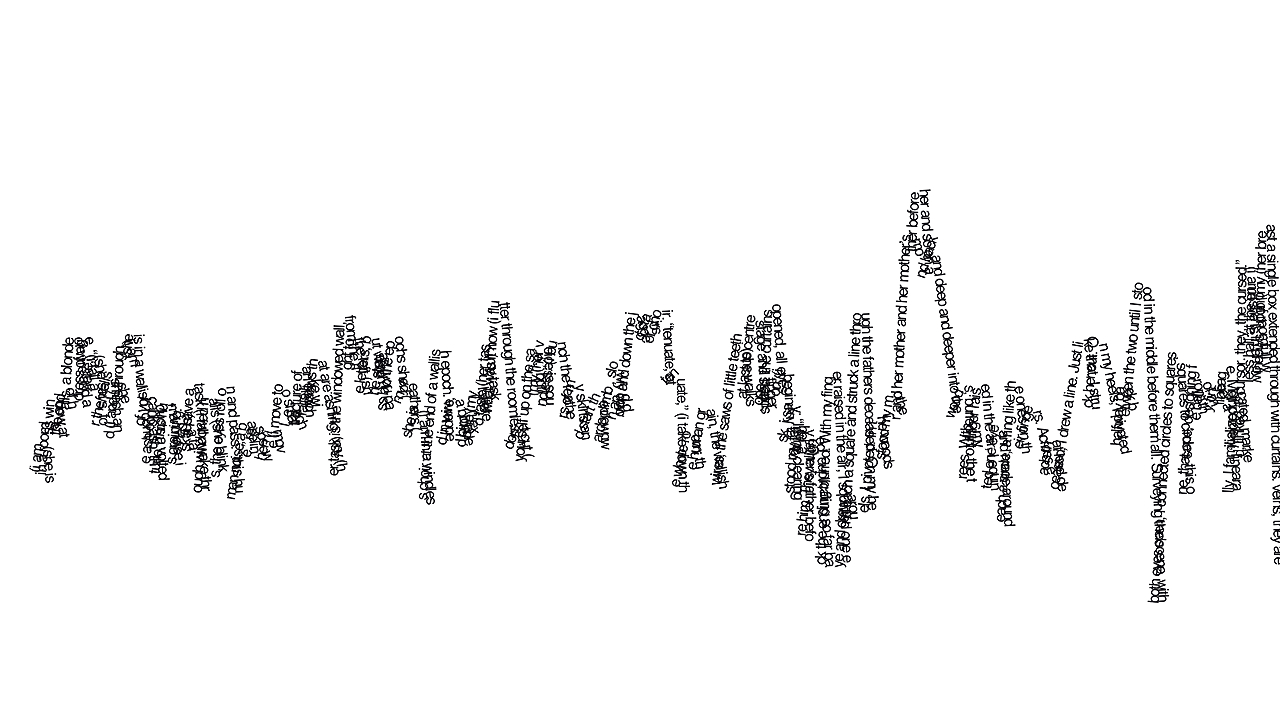
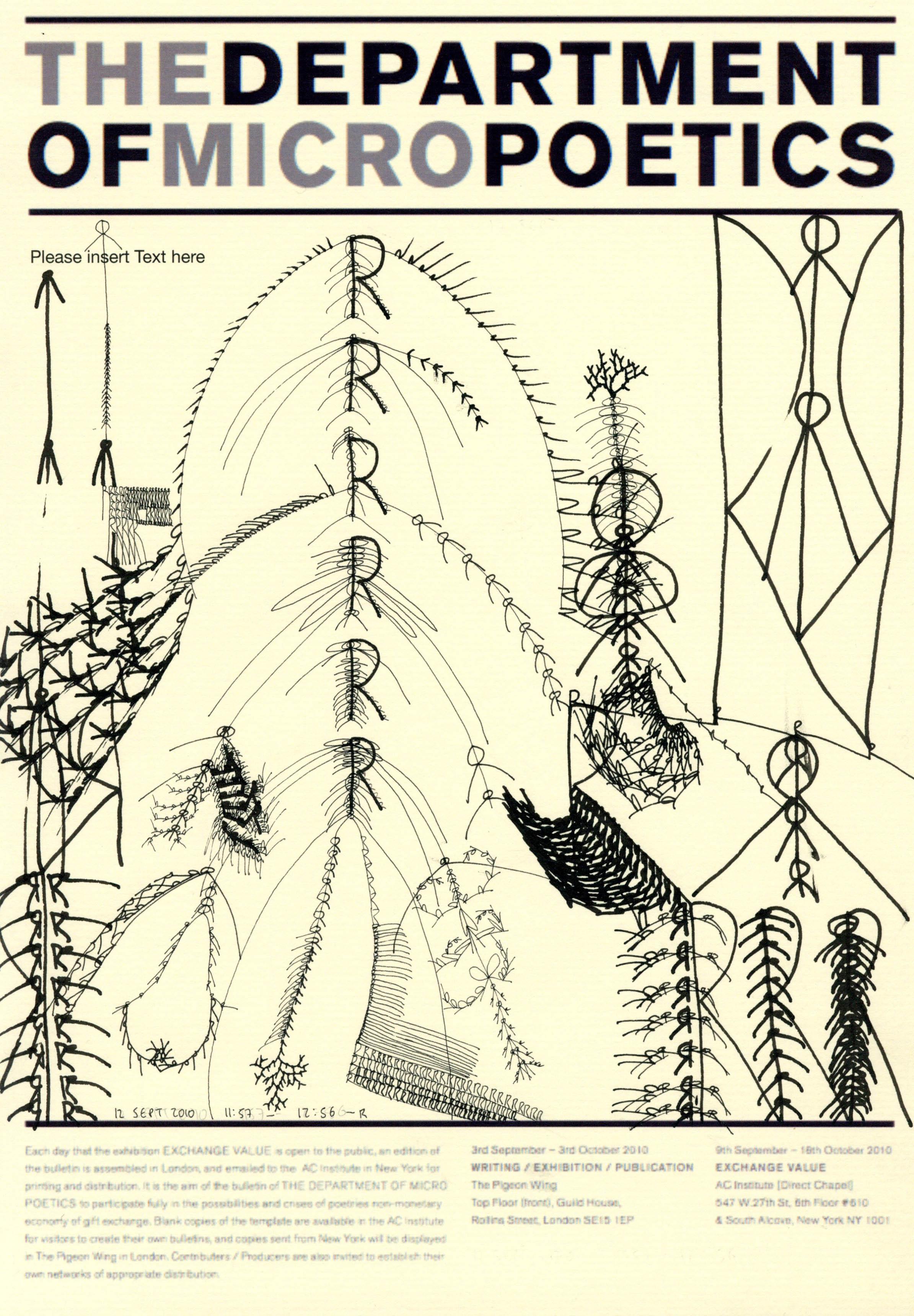
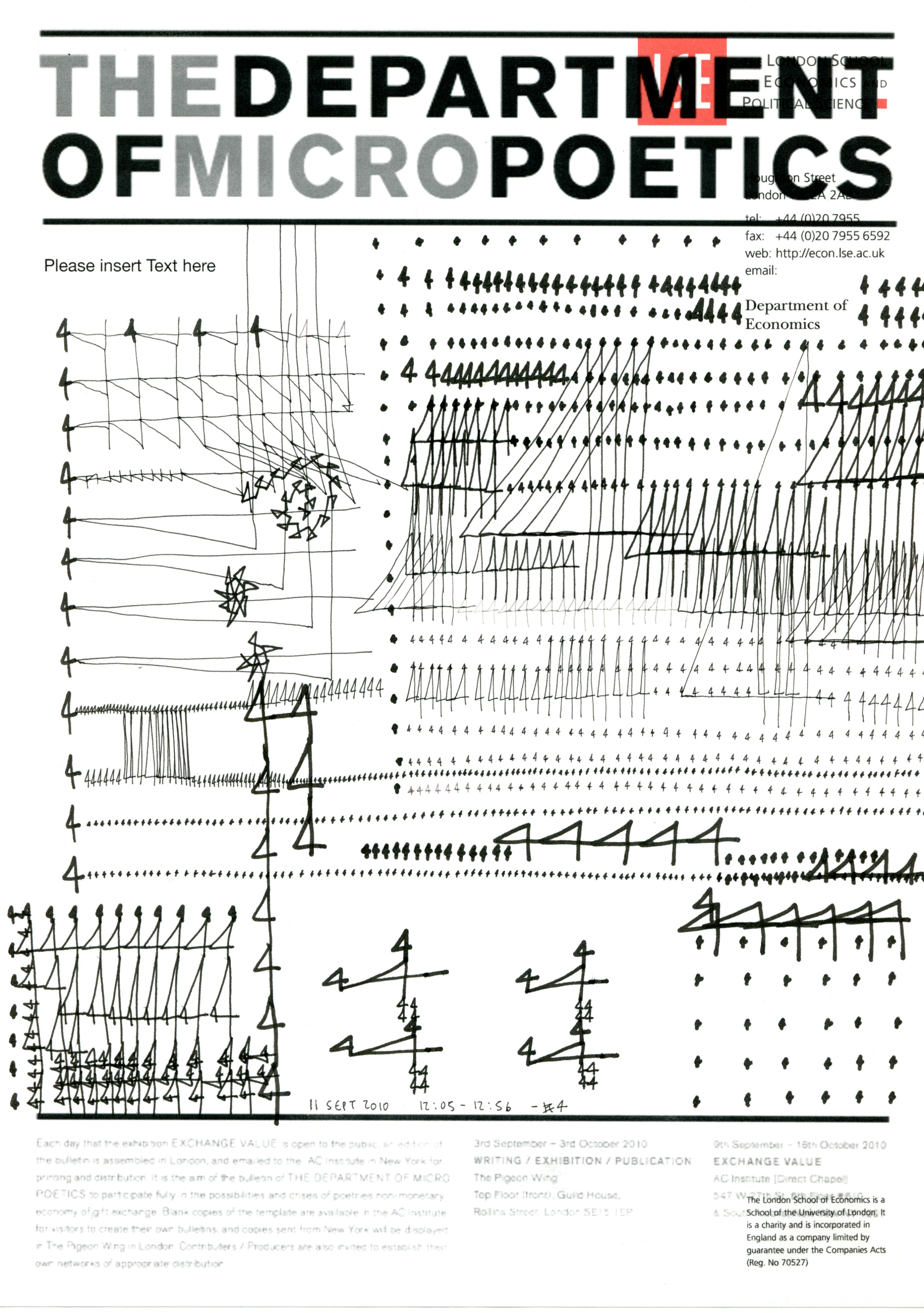
BULLETINS collects 19 individual bulletins that were Mary’s contribution to VerySmallKitchen’s long distance residency at the AC Institute, New York City, in September-October 2010.

Bulletins were sent each week from London to New York, where they were printed out and displayed as part of the DEPARTMENT OF MICRO-POETICS.

The project continued an ongoing strand of Mary’s practice, and several previous collaboration with VerySmallKitchen.  Two other drawings from the project were included as part of The Department of Micro-Poetics exhibition, and a wall drawing was enacted for Writing/ Exhibition/ Publication at The Pigeon Wing.

Mary provided the following statement about this project:

Mary Yacoob’s work centers on drawing and visual languages. Her works are systemic in nature, using rotation, repetition, line and geometry as triggers for ideas. Listening to the radio as she works on her ‘doodle’ drawings, Yacoob draws a letter of the alphabet or number repeatedly until a structure or city emerges. She invents a set of rules to determine the size of the unit drawn and its color (when the verse changes, the size changes, when someone on the radio speaks, the color changes).

These works are related to another project in which she extrapolates a logic from within a photograph of a building and extends it through systemic drawing, creating a proposal for alternative realities. In other works, she appropriates diagrammatic to notate overlooked traces of everyday life, such as bumps in the carpet, or house sounds.


BULLETINS begins with an index, a listing of times and places these drawings took place, a record of trusting the moment, the form, the line, and the emergent structure.

Find out more about Mary’s work here. The template for the bulletins was designed by Marit Muenzberg. For a full list of VerySmallKitchen publications see here.