verysmallkitchen

Posts Tagged ‘art writing’

KAFKA THINKING STATIONS: A CHORA(L) SONG CYCLE

In Uncategorized on April 17, 2010 at 1:50 pm


KAFKA THINKING STATIONS: A CHORA(L) SONG CYCLE, performed at Testing Grounds, Permanent Gallery Brighton, July 18th 2009


KAFKA THINKING STATIONS: A CHORA(L) SONG CYCLE  is a text developed from five short sentences found in the notebooks of Franz Kafka. The piece was first developed and presented as part of TESTING GROUNDS at the Permanent Gallery, Brighton on July 18th 2009. On the 24th April it will be recorded in London as a choral radio play, directed by Joseph Thorpe. 

 The score is preceded by the following text, and for the performance on the 24th this is the only part of the text that performers will see prior to the event:

INSTRUCTIONS FOR PERFORMERS 

 This is a text for a chora(l)* recitation to be performed by any possible number of performers, who may or may not be physically present in the same space. 

The distribution of texts amongst performers should be decided by the performers themselves as a reflection of the desired or actual group process.  All parts of the text may be regarded as vocal music, stage instructions, process notes or documentation and be performed or not as deemed appropriate. 

No instructions are included as to pitch, rhythm, tone, or speed. These are determined by each performer as emergent through sequential acts of word-concentration.

 ______________ 

*CHORA: “a temporary articulation, essentially mobile, constituted of movements and their ephemeral stases.” 
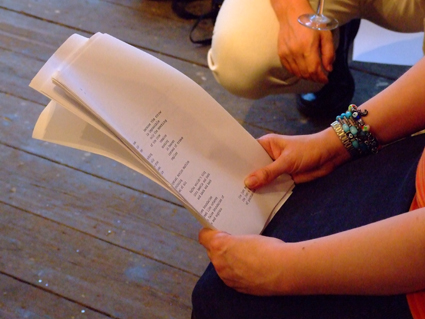
 

At the Permament Gallery KAFKA THINKING STATIONS took the form of a three part vocal performance with myself, Olivia Armstrong and Johanna Linsley. The piece was rehearsed once, and I distributed the following quotation by Jackson MacLow:

Performers must become acutely conscious of both the sounds they themselves are producing and those arising from other performers, the audience, and/or the environment. It is essential to the realization of Asymmetries that all performers choose as many aspects and details as possible of their individual realizations within the context of as clear an awareness of the total aural situation at each moment as performance circumstances allow. In many circumstances  -as when performers are dispersed within the space (e.g. around or in the midst of an audience or when performers and audience are identical), a procedure often followed in performances I’ve directed – each performer’s impression of the total aural situation will necessarily differ from those of the others.  What is asked for is concentrated attention to all sounds perceptible to the individual and an attitude of receptivity and responsiveness such that choices are made spontaneously, often seeming to arise from the whole situation. 

Schematically, this “whole” can be represented by concentric spheres: the inmost is that of the individual performer; next, that of the whole performance group; next, that of the larger social group, including audience as well as performers; next, that of the performance space including room acoustics, electronics etc.; and finally, the larger spaces within which the performance situation is situated: the rest of the building, the surrounding streets, neighbourhood, city (or rural area), etc., all of which may affect significantly the aggregate of sounds heard by each individual at each moment. The spheres are best conceived as transparent and interpenetrating – not static shells but concentric ripples travelling simultaneously out from and  in toward each center.

SOURCE TEXT: Jackson MacLow, THING OF BEAUTY: NEW AND SELECTED WORKS (University of California Press, 2008), 80-81.


We agreed that we would read sequentially through the thirty pages of the script, reading what we wished from each page, in whatever order. We held our separate performances together by agreeing that we would turn the page at the same time.

One discovery of this process was how much more connected we felt when absorbed in our individual acts of reading than when we tried to read looking at each other,  making the script into a too obvious fake conversation.

For the performance on the 24th, ten performers, director, writer, and sound engineer will spend one day together. The script will be read at the beginning of the day, enabling everyone present to identify questions and issues that determine the contents and approach of the ensuing workshop. The afternoon will be given over to a series of performances, each unfolding out into group led discussions and explorations that inform further readings. The resulting sound recording will be broadcast online as part of the PLATFORM RADIO PLAY PROJECT. More details to follow. 

In preparation for this performance, I went through the original script and made a series of annotations and drawings in black marker pen. I was trying to focus on the materiality of the page itself, focussing on my presence as a writer within a collaborative performance project.  When I met with Joe it was fascinated how he translated this markings into his own concerns as director, developing a through-line for the text as a whole.  

Whilst invaluable preparation, both of us will be leaving aside these interpretations in order to experience what emerges from the collective workings on the 24th.
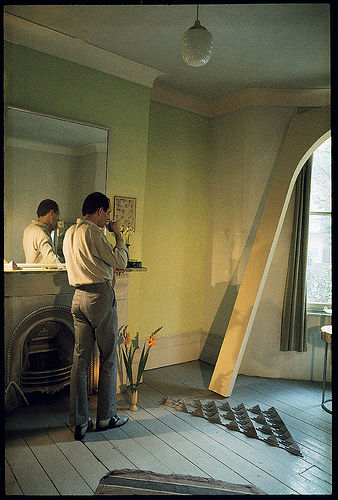
Marc Camille Chaimowicz


A WRITER IN THE REHEARSAL SPACE: I am currently thinking through what it means to be a writer in a rehearsal space, how I can function, not as a provider of meaning and interpretation in regard to the text, but as some sort of facilitator regarding how its language, space and propositions could  organise our time together. 

In an indirect and sometimes contradictory way, I have been thinking about this through the following text by Clémentine Deliss:

…there remains a tension between responding on the basis of background knowledge – a certain precision reconnaissance and intentionality and travelling in the mode of the flâneur with less structure at hand. In my case, I want to know exactly whom it is that I need to talk to if i’m somewhere new. I don’t want to change the language of my practice. I know the intelligentsia is there. I just have to find it. So the last thing I want to do is to float into a location. I have to generate a meeting of intentionality between the other person and myself and for that I do the research before I go out there and I don’t compromise. 

Later in the same book, an overlapping set of issues get formulated by Marc Camille Chaimowicz as follows:

I think the photograph that I happened to find in Nantes of the Café du Rêve was a good example of a simple visual form that said everything I wanted to say. It implied a kind of sociability in a place where you get a wide cross-section of people, all dealing with their own solitude. They go to the Café du Rêve for a number of reasons: to pick someone up, or to get drunk, or to find warmth, or to engage in social intercourse. But because the title is Café du Rêve it also implies something else: that one can transcend and actually go into reverie. That’s a very simple example of what you are hinting at. The everyday in this photograph is not any old café. It has specificity.

SOURCE TEXT:  Jacob Bee et al eds. FIELDWORK (A/S/N MUTUAL PRESS, Edinburgh, 2009).
ART WRITING FIELD NOTES (3): EMMA COCKER

In Uncategorized on April 16, 2010 at 11:14 am

This is the final set of notes from contributers to the ART WRITING FIELD STATION in Leeds on March 27th 2010. It first appeared on Emma Cocker’s Not Yet There blog, which is prefaced by the following methodological statement: 

Operating under the title ‘Not Yet There’, my practice is characterised by a mode of restlessness – or wandering – that functions as both the subject of and motivation for my enquiries. Writing/text-based work (often developed dialogically through conversations with other artists) interrogates the critical and creative potential within experiences or conditions such as failure, doubt, deferral, uncertainty, boredom, hesitation, indecision, immobility & inconsistency, by exploring models of practice – and subjectivity – which resist or refuse the pressure of a single or stable position by remaining willfully unresolved. I am interested in exploring the ‘thinking space’ of practice by shifting attention from the notion of the ‘deliberate’ towards the process of ‘deliberation’; by insisting that purpose or meaning is not synonymous with the notion of achieving a ‘goal’.

Emma’s field notes are below. Notes by Rachel Lois Clapham and Mary Paterson are here and here

A hard copy edition of this text work will shortly be published. The project will be developed for VSK’s exhibition at The Pigeon Wing in September. 

FIELD PROPOSALS

In terms of responding to the David Berridge’s proposition of ‘Field Station’  I have attempted to map a field and propose it as a field station; the text/objects that I presented are both reflective and prospective, (like Breton’s ‘double headed-arrow’) they mark the territory of what has come before but also suggest a possible future use. 

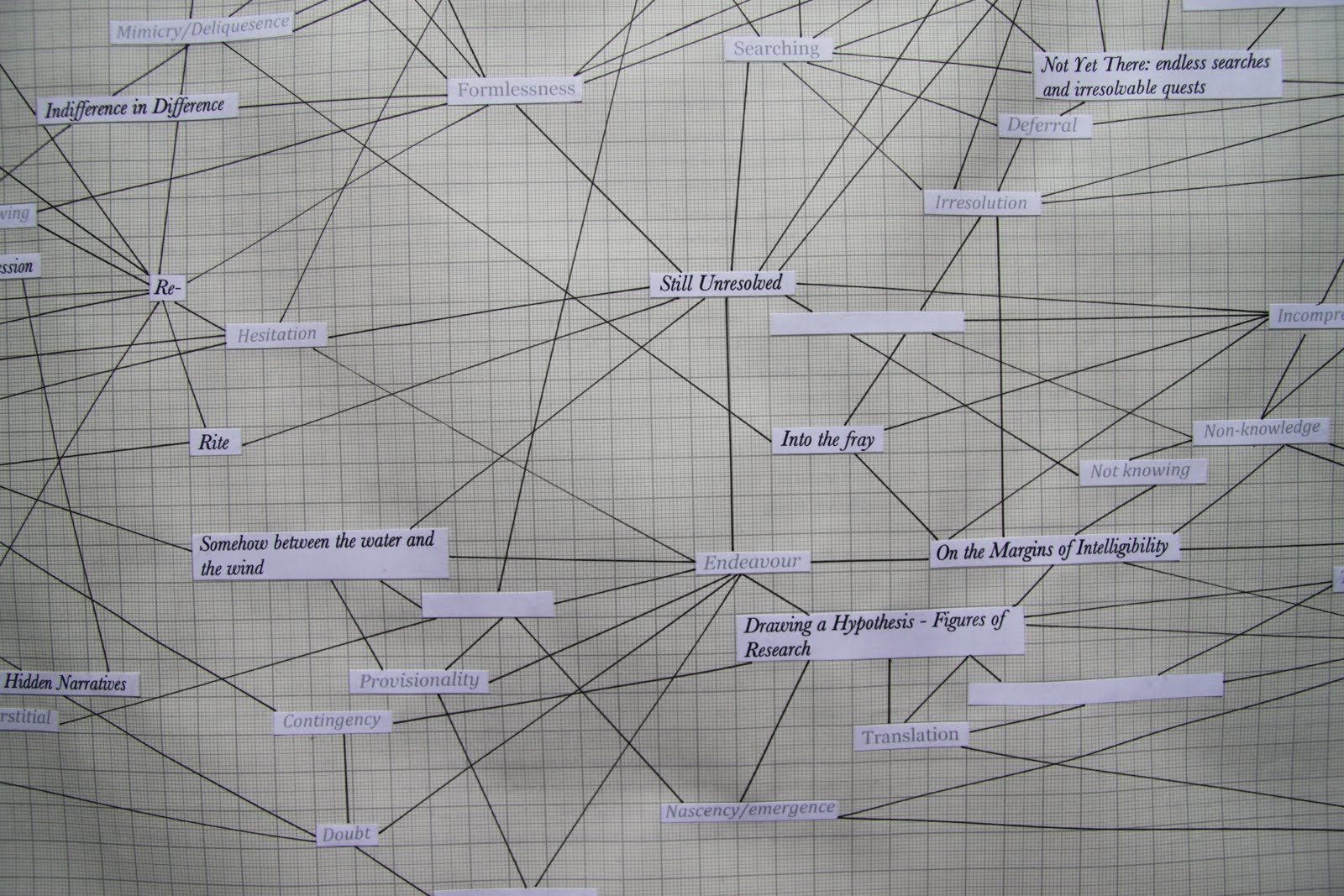
I wanted to propose a series of maps as a response to the idea of fieldfield-maps: My hope is to use these ‘field-maps’ to help me to better understand what might constitute the ‘field’ of my own practice, and the method of my own writing, which I am increasingly coming to see as a restless practice, or a practice that uses the idea of restlessness as itsmethod. Thinking through field-station has forced me to think about ‘the field’ in terms of the architecture of my own art-writing practice, thinking about architecture as:

*  A spatial structure or model (what is its shape)

* Verb: The action or process of building (of assemblage) (how is it produced, what is it methods). Field as an act or of doing something: a sphere of activity, to put into action, a complex of forces that serve as causative agents in human behaviour.

*  Network: the way components fit together (how are connections made and re-made)

The maps correspond to:

* A mapping or rhizomatic field (the network of ideas, practice, bodies – field ascommunity). An attempt to articulate or map or chart or diagram a sense of my writing practice, which operates under the title, Not Yet There. The tension between or field created between different practices (art/encyclopedia; ‘knowing’/knowledge; the gallery/the academy).

Field Station – what constitutes a (art-writing) studio and how can this be made portable or mobile or taken to the ‘field’. Studio as constituted by a set of practices (produced); by the physical surroundings (belongings) and by what it affords (thinking space). NB) In order to build in spaces that are more speculative you have to build in spaces that are more speculative. Mind-mapping habitually presupposes a starting point, a point of original. Here my attempt is to remove the need for a fixed or determined start, or rather to replace the propositional of the conventional starting point with the notion of a potential Macguffin.

Open Field (as open space – thinking space)  – a template, work and tool. An imaginative proposition and an operational model. An attempt to articulate or map or chart or diagram the idea of the ‘field’ as open space, a space of thinking, a germinal terrain. Mapping the process of thinking, without this being about what that thinking is about; a mapping of a process and the producing of a map that corresponds to that process.

* An operational model: using the ‘field’ model as a device through which to explore my field of art-writing practice. A proposition of an essay as map, the essay as a network or proposed community of ideas. The field as essay.  Visual essaying (essay as rhizome). An attempt to use this open field as a device to lay down (or seed or plant) a few specific ideas. A model to be used: what is the field of this event?

Thinking through field:

* Clearing: an expanse of open or cleared ground

* Event: the area in which (field) events are held

* Space of Contestation: a battleground.

* Force/Agency: (physics) the influence of some agent, as electricity or gravitation, considered as existing at all points in space and   defined by the force it would exert on an object placed at any point in space.

 * Horizon: (optics) the entire angular expanse visible through an optical instrument at a given time or (photography) the area of a subject that is taken in by a lens at a particular diaphragm opening.

* Interconnectedness: (psychology) the total complex of interdependent factors within which a psychological event occurs and is perceived as occurring.

* Record: (in a punch card) any number of columns regularly used for recording the same information

* Playing the field – to vary one’s activities, a kind of promiscuous practice, “avoid commitment” – a restlessness

* Flat land – a non-hierarchical playing field

* Skilfulness: To respond to

* Incisive: the site of a surgical operation

* Classification: a data structure

THE ALL EDIE ALL ANDY ALL ME ALL YOU ALICE IN WONDERLAND II

In Uncategorized on April 15, 2010 at 10:59 pm


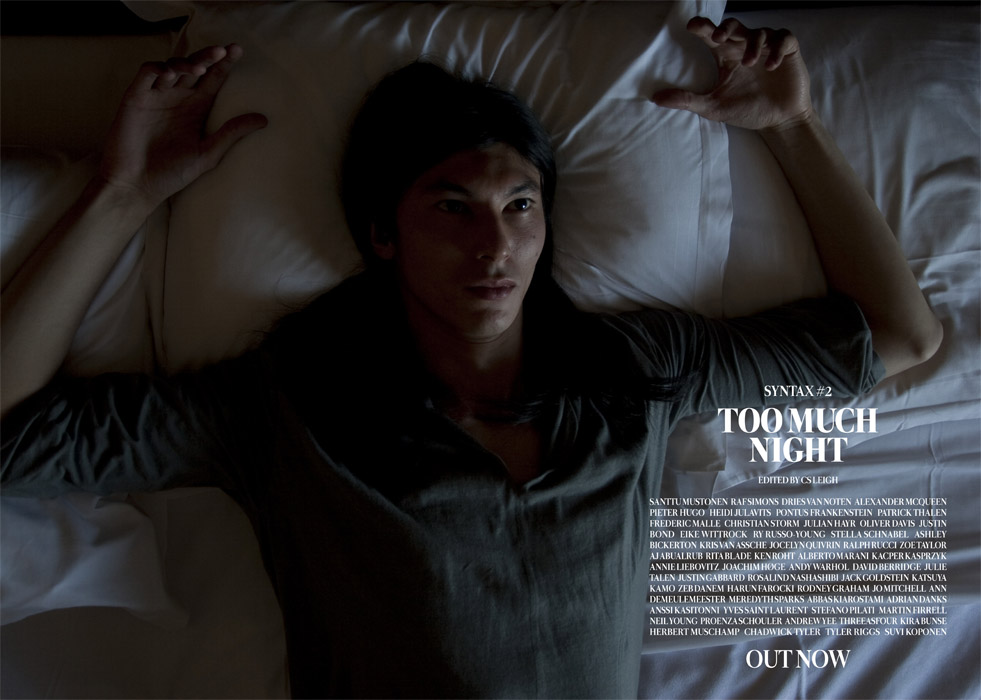
THE ALL EDIE ALL ANDY ALL ME ALL YOU ALICE IN WONDERLAND II  has just published in SYNTAX #2: TOO MUCH NIGHT edited by CS Leigh.  More information on Syntax Editions is available here 

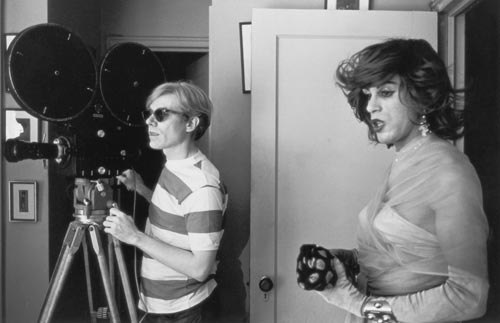
 In its content, language and form, this essay explores my response both to Warhol’s 16mm film work, and the performance style of Mario Montez and Jack Smith. In the context of  VerySmallKitchen I am interested how the methodologies of these performers, the way they position themselves in regards to space, time, and notions of self, can be applied to the acts of expanded writing practice chronicled on this website.  

My interview with CS Leigh, around and out from his contribution to the exhibition WARHOL AND THE SHARED SUBJECT can be seen here. This is how the essay begins:


…This is rumours and whispers, started by Warhol himself, a delirious dream of a phone conversation with B, pieced together from pirated extracts on You TUBE. This is about Warhol’s 16mm films providing a working language for writers and artists in 2009. This is nothing new: once the 16mm films were talked about without being seen and that was their influence.

Well I’ve seen them all, I’ve forgotten much of them, and now I’m watching illegal bits, often filmed straight off the screen, legacy gone viral via atrocious image quality. I tried the DVD collections and 13 Most Beautiful… but now I’m back at my laptop, keyword “MARIO MONTEZ.” All with the same sense of self-collapse, impossible pose, as Henry Geldzahler on the sofa…

Before this, in January, I was in Other Voices, Other Rooms, the Warhol show at the Hayward gallery. Trying on headphones, watching cable TV shows, pleasurably, blankly bored, hopefully in the hyper-productive Warhol way. I pass a video fragment of Edie Sedgwick, where she remarks, slowly and thoughtfully, that Warhol should make a film of Alice in Wonderland, partly because of their shared AW initials.

Sedgwick laughs and says she knows that lots of things have those initials. She also emphasises how, unlike an earlier Disney version, Warhol’s AW would use real people because – I’m paraphrasing – there are so many fantastic people around who could play all the parts.

Other Voices Other Room was maybe a first draft towards AW’s AW. Confused, incoherent, and incomprehensible in its totality, it tried to treat Warhol’s oeuvre as a whole, without value judgements about film or video. It ended up as a microcosm of the issues faced by Warhol obsessives, curators or not, in 2009. In the Hayward I sat and watched whole episodes of cable TV shows, before heading through a room of digitally transferred 16mm work, noticing images but not stopping to experience the duration of what, in the cinema, had absorbed me.

Warhol never made AW, at least not literally, but not to worry. This article will propose a whole series of Alice in Wonderland’s. Because selves are multiple in 2009 in a way Warhol could only say “sure” about. The all Ondine  AW, the All-Edie, or The All-Andy, with Andy played by Marie Menken, two thirds over-exposed white out. You can hear Ronald Tavel shouting the lines. You too. The All-You AW. Sneeze if you forget your lines and I’ll whisper them to you, or look in the fridge. TASK: Map the structure of Alice in Wonderland onto Chelsea Girls, assuming the 1-1 scale of AW’s (both of thems) own maps…

ART WRITING FIELD NOTES (2): RACHEL LOIS CLAPHAM

In Uncategorized on April 13, 2010 at 11:37 am

This is the second in  a series of notes surrounding the ART WRITING FIELD STATION in Leeds on Mar 27 2010. As I wrote in an introduction for the previous posting by Mary Paterson – which can be read here –  I am fascinated by the form of the “note” that emerges in these writings: 

The notes are not what precedes the event, nor are they what comes during or afterwards, be that a written document, a sound recording, an oral tale or private memory. Rather, the notes are writings that, taking place at a fixed moment in the process they are part of, evidence all others. 

More about Rachel Lois’ work can be seen here.

Her VSK Project THE FINGER can be seen here

An instructional score for the NOTES for the ART WRITING FIELD STATION is here.

NOTES ON NOTES (FOR ART WRITING FIELD STATION) 

Here are some typed, online notes that mark my thinking for NOTES at ART WRITING FEILD STATION LEEDS, or NOTES ON NOTES.

Initially, in preparing for NOTES, I started reading David Berridge’s via Clayton Eshleman’s gloss on ‘Plan for Curriculum of the Soul’ a double page text work by Charles Olson, printed in 1968 (1). This lead me somewhat indirectly – by way of another commission I was writing at the same time (2) to Olson’s longer, more oratorical, ‘Projective Verse’ from 1950. (3).

Over the course of the previous weeks I have also been talking about other (related) work with a small group of collaborators David Berridge, Emma Cocker, Mary Paterson and Alex Eisenberg (4). Many of whom will be presenting at ART WRITING FIELD STATION and in proximity to NOTES on the day I perform it.

In the process of coming to NOTES – sporadic (often cursory) reading, collating various bits of online quotes, scraps of articles and materials – I have made copious notes in my usual system (5). Meanwhile, it has become difficult to delineate which things stem from these starting points; which ideas I encountered in the original texts, and which on various commissions, trips, artworks and conversations with friends. So by way of setting out an ecology for NOTES in the context of ART WRITING FIELD STATION, or delineating a certain ‘field’ for this particular work, I have concerned myself here with what is in these notes on NOTES (5b).

I have devised a very loose index.

* Things more clearly related to the idea of FIELD – geographic (and soil based), conceptual and/or systemic (technologic))

** Things that may be me citing something in a text by Olson, or perhaps picked up in conversation with Berridge, Cocker, Eisenberg or Paterson. (6)

*** Things that are my idea but can be tangentially related to the conversations or texts stated above.(7)
////

Grid Lexicon

I really liked geography classes at school. Visits to rundown inner city council estates in Warrington to look at bad examples of social housing (ill advised field trips), never once looking at a map of the world (or of any country) and using wooden set squares to collect data – for example, the number of daisy’s, types of grasses, certain insects – in a meter sq of field. It was usually a scraggy school field or fell bit of land that may or may not have magic mushrooms growing in it. We would later return and analyse these field findings back in the classroom. This is the only thing I remember from High School. That and arm wrestling boys (and often winning) which does not have anything to do with the idea of a field, grid or NOTES. Until now. * I remember thinking the method of the set sq seemed a brilliantly simple and cool (impartial) way to find, gather and sort things out. As a constraint the grid made sense, it imposed order. I remember thinking at the time that this all seemed very neutral and fair. Whatever grew or fell by chance into the set square as it was lay down was given attention, pored over.


In a way that says it all, or at least enough….

But I also want to transpose some other fragments/scribblings as they appear in my notes on NOTES:

Grid form as a field of composition * / **, as something worked by infamous mid Twentieth Century American minimalists, which leads me to Micheal Fried and his equally infamous essay on theatricality and ‘literal art’ (7b) – art which radically (and for Fried pejoratively) effected a drama(tization) of its object-hood and so implicated the viewer bodily in its completion. The notes go from the body, on to site specificity, through theatricality and neatly into performance. (This journey from grid to critical writing to performance does not look so neat in my handwritten notes.)

Mathematics *. X and Y axis *. Grid as productive constraint, grid as writing technology *, working with a different syntax *.

Grid as an unnatural way of working (my notebooks speak for the fact I don’t work like this), a constraint for the notes to push through.

The syllable rules and holds together lines **
Breaking writing down into component parts.
A serial(ization) of writing. *

Expanding the constraints of the page * where all marks, left hand/right hand, beginning and endings, are distributed with equal weight. They can only be pointed to or reinforced as different by the addition of more(equal) marks on the page; such as under linings, CAPS, exclamation marks. (Thinking of Olsons ‘Plan for Curriculum of the Soul’)

Form is never more than an extension of content * / **
(A wonderfully rich, aphoristic note/NOTE) (8)

/////

Field *

A writer in the open * / ***

Writing as +1 to the field * – as +1 to writing *, +1 to the event *

FIELD COMPOSITION/COMPOSITION OF FIELD in which movement from one perception to another….. **Writing that sticks close to its generative moment of perception/cognition. **

Page * as generative space, not receptacle for finished ideas.

Materials that are handled in a series of objects in a field in such a way that a sense of tensions are made to hold, and to hold exactly inside the content and context of the poem which has formed itself, through the poet, and then into being **/ *

///

Then there are some bits that relate more explicitly to the body in relation to FIELD, which features quite highly Olson’s thinking on the ROOM * / ** / *** of writing in both Plan for Curriculum of the Soul and Projective Verse. Also a strong fascination for me, if the notes in my folders can be judged qualitatively/quantifiably:

Percussive writing **

A physical composition **

Writing openly, presently, simultaneously

Moving index(ically)

A writing that maps lines walked * / **

One of the pressures of writing is bodily.

The FINGER and hands and pointing – diagramming physically

The breath of the author punctuating NOTES ** / ***

Breath is the speech force of language, writing is an object that the body has an impact upon. **

Amidst this I think about notes in the pejorative (8b) :

How writing notes always makes you look away from an event, the event- toward your notes/notebook (unless you write notes without looking at your page?)

Notes as unfaithful, unserious, un thought-ful.

Notes as a crutch to performance, to memory, to a practice.

Notes as unfinished, unimportant, unprepared, uncritical, un-publishable, work in progress, as private.

Notes as a learning device for a novice or anorak (Train Spotter) as opposed to notes of a scientist (an expert) – still unpublishable in a scientific / expert context?

Notes made from a performance that make a work mobile and divorce it from its site.

NOTES as pick-up sticks ** / *** ‘grabs’ from a practice – shallow grabs from something else, something deeper, something more sustained. NOTES as tips of icebergs (rather than the icebergs themselves?). (9)

Aspects of NOTES that I am currently experimenting with.

Scale- How important is it for the individual diagrams/gestures to be seen as such (by others should they wish in the moment of writing/performing?). What is the difference in scale between 3 x 3 yellow lined post its, 5 x 7 white fiches and 12 x 12 large pieces of white card? Could the elements be big things- like tablets or objects?

One element is fixed never moves – it is returned to (and marked over continually like a lexicon of the grid activity, a margin, a note of the NOTES). This could be groundwork *

Timings- I am drawn to regular moments over the course of NOTES by an external device. These moments are prompts. The prompts may or may not be marked as such in NOTES.

The hand of the author, pointing and the FINGER how it can diagram physically within the composition.

In what different ways one element that is continually returned to as blank.

How hesitancy or doubt might show itself in NOTES

How NOTES are unfathomable, and no-one can read them whole. They are fictional, unfaithful (to themselves and to the event). How they might be moved away from the event?

How the space outside the grid is important (Nb. 7b)

Underlining as pointing (Nb. FINGER)

Sound of NOTES being made (Nb. Percussive writing **)

How certain gestures will pre-scribe or anticipate the event/the conversation – and others will come during, or after. Others will not be related to the event. How to NOTE these differences.

///

Notes on NOTES (on NOTES)

(1) Taken from here.  

(2) (W)reading Performance Writing. A Live art Development Agency study guide. Downloadable at www.thisisliveart from April 2010. A brief introduction here.

(3) Available in full online  here.     

(4) ROOT with Mary Paterson and Re- with Emma Cocker as part of the RITE publication launch 2010 (RITE contributors are David Berridge, Alex Eisenberg, Mary Paterson, Emma Cocker, amongst others, but not Charles Olson), Writers House on the invitation of David Berridge and Pippa Koszerek (Hard copy notes only about this project at present. Dates May 29-31st ), Question Time with David Berridge, Alex Eisenberg, Mary Paterson as Open Dialogues. Nb. Pippa Koszerek is another collaborator of mine, our having worked on FREE PRESS together (with David Berridge, Karen Di Franco, Matthew MacKisack, Sophie Mellor and Ashkan Sepahvand).

(5) A modular system it could itself be a rumination on notes (although not necessarily the work NOTES I speak of here). It is a system regularly subject to change by the author, and under constant scrutiny as to regulate cost versus my needs in terms of flexibility, provisional dimensions, page capacity, efficiency of storage and ultimate archival (endpoint) quality. A5 black plain page moleskin notebooks are the most expensive experimented with so far at 13GBP for one hardback notebook. Lovely though these are they seem to be the notebook of choice amongst many of my peers. It can get confusing at meetings and seminars. An extra identical moleskin for the table, Sir? ** Cost also prohibitive for someone with potential compulsive note writing disorder. Also not flexible enough (removing pages seems wrong). Standard A4 paper in plastic wallets with homemade ‘titles’ is very flexible- notes changing sets (and so projects) on a regular basis – and is the cheapest by far (circa 1GBP per wallet note-set) but this is not very aesthetically satisfactory. Too redolent of pillaged communal stationary cupboards and WORK (not the good kind). Absolutely no precious archival qualities. The large white plain (I might go back to gridded soon)Fiches index cards I am currently using – 3.99GBP for 100 – seem to combine the optimum blend at present. Cheap, totally singular, as in modular, and pleasant to have/hold. Plenty apt for little diagrams. I wrote in them from a recent talk entitled ‘What is conversation for’ – an evening of conversation with the art writer Yve Lomax (in conversation with herself). Looking back on my Ficheborne note-cards, have a nice speculative (light) circular feel that would not have felt appropriate in any of the other note technologies discussed here.

(5b) I’ve done this in an altogether non Harvard style, in fact in a way much more akin to an exercise in which I randomly look out of my window with a pair of cheap binoculours and try really hard to ‘accurately’ chart the stars *.

(6) Do we use last names in notes?

(7) This charting* itself of course being endemic to noting, or having a certain note like quality to it, in terms of indexing, condensing or documenting. It’s a self conscious exercise transposing these much more scrappy notes into this clean blogpost. The reasons for it are multi-fold. For the before of NOTES = a making sense in advance, an anticipatory staking out the territory*, a speculative mapping* of the area for this work to come. For the after of NOTES = for the fact that you put work out there and it rarely ever comes back ** Notes then, by way of something to come back to. Being something like the splash-back (however unfaithful, unreadable or unlikely it might be) from the act of just throwing something out there *** or pissing in the wind ** that can be the experience of making work. (Although having nothing left is better than something sometimes, especially something like inane notes.). Coming back to the BEFORE for a minute, it feels like there is something at stake in making public the BEFORE (BEFORE NOTES) given the constellation* of ideas/texts here, also because this BEFORE is the crux of my note-taking, where I think my notes might matter most. (It makes me wonder in what way the notes I make are not usually public or published?) I also just made a note on my current Fiche(the one that I always have on the go entitled GENERAL – ie not project/commission specific- that this is the most speculative text I have written for this blog in some time.

(7b) Michael Fried, Art and Objecthood, Artforum 5(10) (1967): 12-23

(8) By now I have reconciled the salient difference between notes and NOTES. There is a difference. But it is constantly on the move.

(8b) I find there’s a lot in the pejorative.

(9) A question of quantity/quality. Is this weight issue, this mobility – if this is what the issue is, which is not to simplify it at all, if it is even an issue in the proper sense – endemic to all words/writing?

ART WRITING FIELD NOTES (1): MARY PATERSON

In Uncategorized on April 8, 2010 at 9:30 am

This is the first  in a series of “notes”  related to the ART WRITING FIELD STATION in Leeds on March 27th 2010. The notes are not what precedes the event, nor are they what comes during or afterwards, be that a written document, a sound recording, an oral tale or private memory.

Rather, the notes are writings that, taking place at a fixed moment in the process they are part of, evidence all others. This first set of notes, by Mary Paterson , is published under a title, below, that willfully demonstrates this transgressive chronology of notes.

More information about Mary’s work can be seen here

NOTES TOWARDS A NAVIGATION THROUGH UNBOUND: FROM U FOR UNBOUND TO A FOR AUTHORITY

In 2009 I began a residency at the Live Art Development Agency.


res•i•den•cy [rez-i-duh n-see] –noun,plural-cies.

1. residence (def. 3).

2. the position or tenure of a medical resident.

3. (formerly) the official residence of a representative of the British governor general at a native Indian court.

4. (formerly) an administrative division of the Dutch East Indies.

[[“residency.” Dictionary.com Unabridged. Random House, Inc. 31 Mar. 2010. .]

I have been looking at Unbound, which is the Agency’s online publication and distribution arm. Unbound is an online shop for books, documentation and the paraphernalia surrounding live art. It is also a commissioning platform for new works, and as such it stocks art historical text books like (for example) Body Art by Amelia Jones, as well as limited edition, commissioned artworks made to mark the Live Art Development Agency’s 10th birthday, which are exclusive to Unbound.

res•i•den•cy [‘re-z&-d&n-sE] –noun, plural -cies

1. an often official place of residence

2. the condition of being a resident of a particular place

[“residency.” Merriam-Webster’s Dictionary of Law. Merriam-Webster, Inc. 31 Mar. 2010. .]

At the Art Writing Field Station event in Leeds last week, I presented some notes towards the text I’m writing for the residency. I described Unbound as my field of study. “Imagine that we are looking.” I wrote, “Imagine that this is what we find – a series of resources labelled Unbound; a metaphorical sheaf of published and commissioned paraphernalia connected to the suggestion of live art. Imagine that this website Unbound is the field of study.”

But a field of study is normally a finite entity, and Unbound is not finite in two important ways. Firstly, it is effectual: unlike an archive, it does not simply claim to record a set of influences, but also to define those influences and shape the discipline. Secondly, it points to resources, but does not map their contents. You have to click on the elegant photographs, enter your credit card details, and wait for a parcel before you can access the knowledge described on Unbound.

res•i•den•cy [rez-əd-ən-sē] –n, pl -cies

: a period of advanced medical training and education that normally follows graduation from medical school and licensing to practice medicine and that consists of supervised practice of a specialty in a hospital and in its outpatient department and instruction from specialists on the hospital staff

[“residency.” Merriam-Webster’s Medical Dictionary. Merriam-Webster, Inc. 31 Mar. 2010. .]

But it is this oblique relationship to knowledge that interests me about Unbound.

residency: The position or term of a medical resident; The position of a musical artist who commonly performs at a particular venue; The condition of being a resident of a particular place; The home or residence of a person, especially in the colonies

http://en.wiktionary.org/wiki/residency accessed 31st March 2010

Unbound does not represent knowledge, but it does give information about it. And information is, of course, another kind of intellectual resource; arguably, one that is more relevant to contemporary living than the weighty facts of knowledge.

I remember sitting round the kitchen table when I was 11 or 12, helping my brother learn the capital cities of the world so that he could pass an exam. He was sliding round the kitchen in his socks and he learnt the capital cities by rote, to the rhythm of his body making laps of the table.

No-one needs this kind of knowledge anymore. It’s all available on the internet, and so accessing the internet is more important than being able to remember words or phrases. This amounts to a change in status that I think of as a change of location. The names of the capital cities of the world are no longer resident in the bodies of schoolchildren. Instead, they live in a shared, virtual system that everyone can access, but which no-one needs to possess. It is a change in status from knowledge to information.

residency: The location that a student is deemed to live for the purpose of funding.

www.learnnowbc.ca/course_finder/glossary.aspx accessed 31st March 2010

What does it mean to have access to “a shared, virtual system”? Is it the same thing as “virtual memory”? Or “cultural knowledge”? Or “common sense”?

residency: Please refer to the Residency Classification Guidelines.

www.umich.edu/~regoff/tuition/explanation.html accessed 31st March 2010

In Leeds, I asked Simon Zimmerman to read out the text I had written, which was about memory and meaning. I asked him to insert some of his memories into my text. He talked about childhood games with his sister, and about travelling on buses with his aunt. When he spoke his memories he lifted his head from the script, and the left corner of his mouth rose in a shy smile. Everyone in the room was captivated.

residency: they tax anyone who lives there, regardless of citizenship;

www.answers.com/topic/multiple-citizenship accessed 31st March 2010

It reminded me of the time when something traumatic happened to a friend of mine. The event was so traumatic, that to describe it was to hold an audience’s attention. After I had described the event to people, they would retell the story elsewhere. Soon, people who did not know my friend would tell the story of the traumatic event. Sometimes I would find myself in a crowd of people where I was known as the person who had a friend who had been affected by this traumatic event. One or two people admitted that they were jealous of me for being so close to such a shocking incident. Nevertheless, they restyled my feelings into their own language. The event had become “common knowledge”, or “cultural memory”, or perhaps “virtual sense.”

Main Entry: domicile/ Part of Speech: noun/ Definition: human habitat/ Synonyms: abode, accommodation, apartment, castle, co-op, commorancy, condo, condominium, crash pad, dump, dwelling, habitation, home, house, joint, legal residence, mansion, pad, rack, residence, residency, roof over head, roost, settlement

http://thesaurus.com/browse/residency, accessed 31st March 2010

After Simon had finished speaking at Art Writing Field Station, we had a short discussion. Emma Cocker (who made a presentation later that morning in relation to rhizomatic diagrams on graph paper that refer, obliquely, to the knowledge and information of her studio and her practice) said that she had been thinking about ‘residency.’ She said (rhetorically): ‘What does it mean to take residency inside someone else’s text?’ Simon said that he was interested in parasitic writing – writing that lives off another source.

Main Entry: dwelling/ Part of Speech: noun/ Definition: home/ Synonyms: abode, castle, commorancy, den, digs, domicile, dump, establishment, habitat, habitation, haunt, hole in the wall, house, lodging, pad, quarters, residence, residency

http://thesaurus.com/browse/residency, accessed 31st March 2010

Aren’t we all parasites? Quotations, definitions, references, libraries, archives, styles, fashions, networks, nods, winks … the building blocks of culture are other people’s ideas. Or, as it says on the gates of the British Library, ‘An original idea. That can’t be too hard. The library must be full of them’ (Stephen Fry). Or to put it another way, we’re all ‘standing on the shoulders of giants’ (Isaac Newton). Or, to put it another way, the moment when you know you are an adult, when you know that you are symbolically present and able to participate in your culture, is when you realise that everyone else is making it up as well (Mary Paterson). Authority is the relative value that we ascribe to cultural artefacts, which turns them into shared experience, implicit or otherwise.

par•a•site [par-uh-sahyt]–noun

1. an organism that lives on or in an organism of another species, known as the host, from the body of which it obtains nutriment.

2. a person who receives support, advantage, or the like, from another or others without giving any useful or proper return, as one who lives on the hospitality of others.

3. (in ancient Greece) a person who received free meals in return for amusing or impudent conversation, flattering remarks, etc.

Perhaps the difference between being a parasite and being a resident is ‘any useful or proper return.’ While a residency is defined by its location, a parasite is defined by its (lack of) production. My work in relation to Unbound is parasitical. It uses the resources to gain nutriment, without offering any of its own. But it is also about location – the location of knowledge, the location of information, and the location of meaning.

The Parasite is the name of several fictional characters that appears in Superman comic book stories published by DC Comics. …

http://en.wikipedia.org/wiki/Parasite_(comics) accessed 31st March 2010

ART WRITING FIELD STATION: NOTES ON WRITING LIVE

In Uncategorized on April 3, 2010 at 7:51 pm


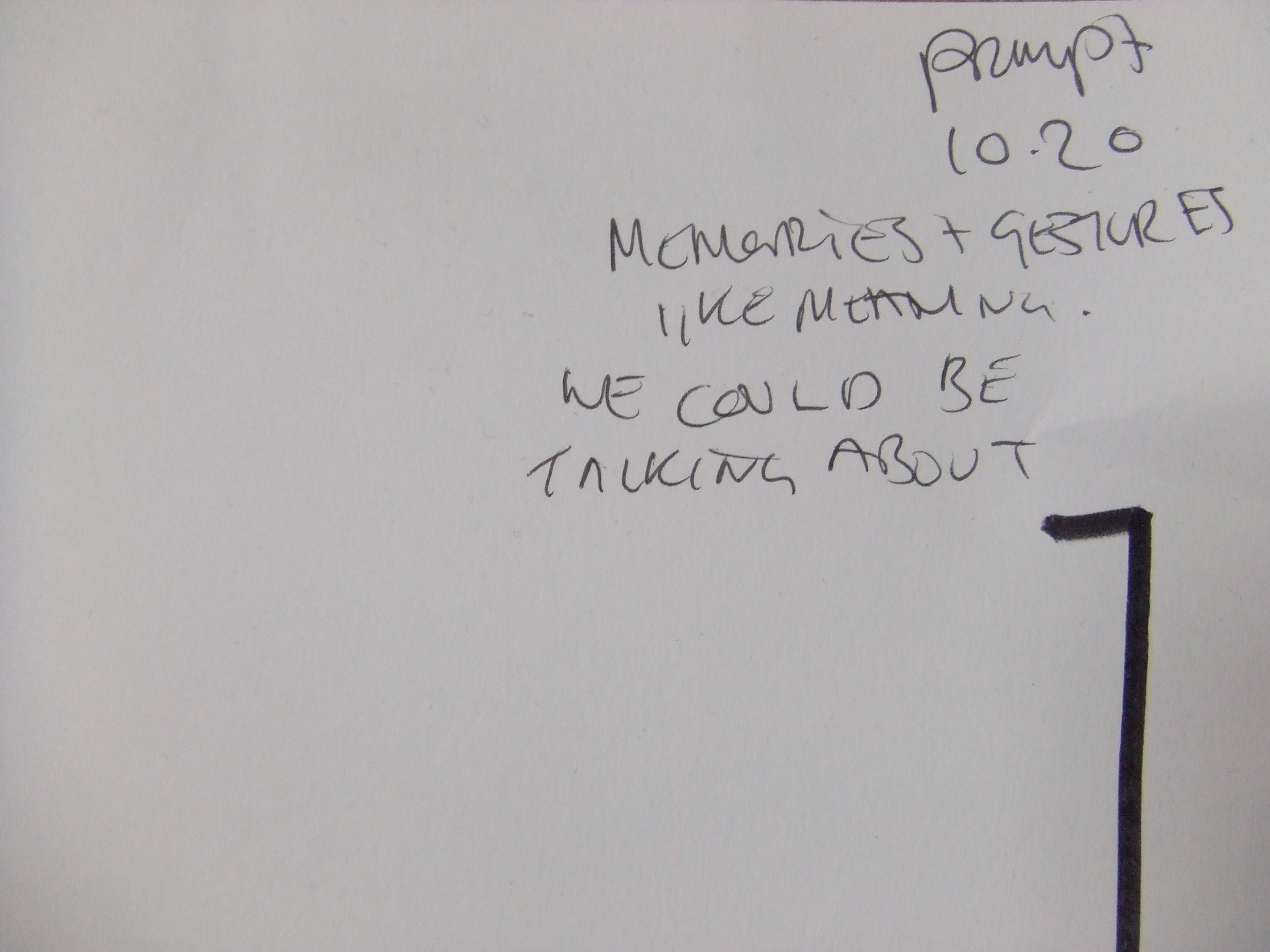
The above text is Rachel Lois Clapham’s score for her project of writing live throughout  ART WRITING FIELD STATION in Leeds on March 27 2010 (see a set of preparatory notes by RL on this project here  and a report after the event here).

Marianne Holm Hansen, Pneumatic Poem (thoughts on Art Writing Field Station), 2010


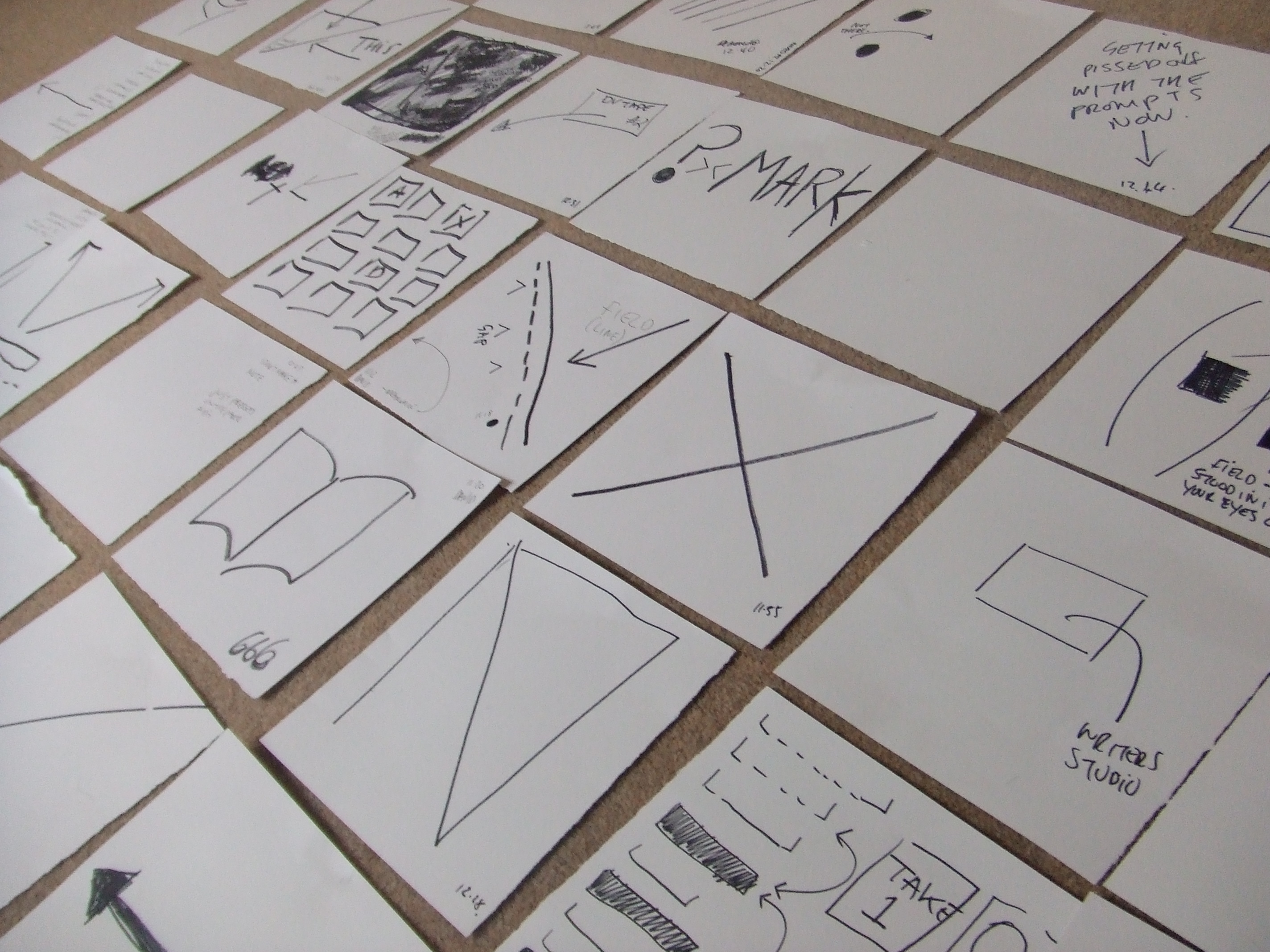
A DESCRIPTION: During presentations by myself, Mary Paterson (performed and interpreted by Simon Zimmerman) and Emma Cocker, Rachel Lois wrote in black marker pen on square pieces of paper, constructing a 3 x 3 grid of these squares. Sometimes new blank squares were placed on top of old, or squares were removed, placed on the floor, and replaced.  

As the last presentation ended, RL removed her last piece of paper from the wall, as if our discussion had returned us to a white wall from which we began, and announced she had finished.

A CONTEXT: This was the second attempt to write live during an ART WRITING FIELD STATION, following on from Marianne Holm Hansen’s work in London. Like Marianne’s project – more information about which is here – the actual act of writing live is a performance both visible and invisible.

Absorbed in discussions, I looked up every so often to see what was happening (as well as the activity on the wall, the grid was filmed and projected). Whilst all of Marianne’s writing figured on a single sheet of piece of paper that was on the wall throughout, RL’s adding and removal of sheets made the whole more illusive. I only ever got a snapshot at different times of what was an ongoing flow, and the processes of editing and decision making remained inaccessible to my piecemeal attention.

Also unlike Marianne’s, RL’s work was principally non-verbal – her grid of squares contained a series of graphic, gestural markings, and if there was an alphabet or lexicon it was one of signs, boxes, brackets, and lines, with arrows indicating movement into and out of both drawn spaces and those of paper, wall and room.

Talks and discussions at the table – one end of which openned onto to RL’s workspace – were being translated into markings, both representing it and working it into something else, accepting its informational quality and its opacity.  When I looked across, the process seemed to be a thoughtful, meditative one, rather than a Jackson Pollock like storm of marker pen scratchings. A lot of time, too, of looking and considering, of (re-)moving the paper, and these as much part of the writing as the writing. 

A PROBLEM OF DEFINITION: As with Marianne’s work, the question of what to call this activity was  problematic. Because of RL’s previous work, I tended to settle on the phrase “writing live.” Because of the gestural quality, I was less prone to use the  phrase “minute taking” – “emotional minute taking” in Marianne’s phrase. 

The frame of camera and careful choreography suggested it was a “performance” but this was definition was slightly challenged by the private nature of the work. Maybe it was better to think of this – to pick up on some topics in Emma Cocker’s presentation – as a “writer’s studio” negotiating a new position of exposure.

Both images: Art Writing Field Station, Patrick Lane Studio's, Leeds, 27 March 2010. Photo: Emma Cocker


CONCERNING AFTER (TEXT &) IMAGE:  My own understanding of what it meant to have someone writing live throughout the ART WRITING FIELD STATION events was originally that  it would offer a summation of each field station as a whole.

Whilst discussions would focus on a series of individual presentations, the live writing would capture a version of what emerged from all those discussions. A field recording. How did this relate to what has actually happened? 

Once again, as soon as the discussions in Leeds finished, RL’s texts demonstrated a tension between their own materiality – a new found set of resonances and associations within the system of these texts as an art work in their own right  – and any relation to the event within which it  had been (was still) occurring.

RL offered spoken commentary on a number of images, connecting back to specific talks and moments, and revealing the close connection of gesture to idea. I wondered how such processes were one way, the resultant markings unlikely to lead back to the original ideas without a guide. 

I also want to think of these live writings as generative, as scripts and scores for future events.  RL’s drawings seemed to function as a series of maps of rooms, conceptual and actual, proposals for actual and ideational movements within those spaces. Sometimes the spaces themselves were defined: four solid black marker pen walls surrounding. Sometime the movement itself had a quality of absorption which meant there was no immediate awareness of frame or container. This could be the starting point for an exhibition or for a kind of art writing field station architecture

A BROADER RESONANCE: The gestural nature of RL’s response suggested several connections. I saw Matt Mullican lecture at the ICA earlier this year. Mullican talked of scrawls and drawings, and how, through meditation techniques, he inhabited and journeyed into his drawings, exploring the landscapes they contained.

Matt Mullican, Galerie Micheline Szwajcer, Antwerpen, 13 Mar -3 May 2008


For Mullican this inhabitation was the only way to understand the true dimensions of what he had drawn – a small dot on the page might  turn out, through imaginative journeying-dreaming, to be a gaping chasm hundreds of miles wide that was the entrance to hell.

Mullican also demonstrated how he had stayed with such images and scrawls over long periods of time, developing them into fleshed out cosmologies, architectural models, and installations. 

WE ARE ALL WRITING LIVE: Of course,it would be wrong to think of RL’s as the only “live writing” going on, in the same way as all texts are “visual” orchestrations, not just those we might choose to label “visual poetry.”

Emma Cocker’s field maps – diagrams on large sheets on graph paper of her writing practice – gave way to a participatory scripting where Simon pointed out particular words, prompting Emma to read particular texts (see Emma’s notes for this project here).

Although Emma read from a set of footnotes devised alongside the diagram, the process revealed how “live footnoting” might work well as a place where different texts were brought alongside the map, with each live reading being a chance to set out a new set of relations of word and map to footnote. 

Mary Paterson’s text – which was read by Simon Zimmerman – explored the workings of memory, particularly as it relates to her work writing about performance (and as writer in residence for the Live Art Development Agency) . Her text left spaces for Simon to introduce his own thought and memories into the text.

This adding of a “live” layer to the text seemed to scramble the text:  upsetting any linear flow and argument. The “live” presence – as  Simon considered what stories to tell when prompted by the script – contrasted with the reflective tone of Mary’s own words, and when Simon went back to the script it was hard to shift back to the argument he had been unfolding before his invited interruption.

This suggested how live writing could involve a number of forms of presence, shifting between and around these different emotional and textual registers in ways both scripted and beyond anticipation.

FIVE WRITE LIVE AT THE PIGEON WING: Finally, I was thinking about all these spaces in regard to The Pigeon Wing space, where VerySmallKitchen will be in residence throughout September. I imagined what it meant for five writers to be writing live, each with their own methods and tools, not in relation to an art work, but as a performance as itself, in relation to the space and each other, as a starting point towards an exhibition.

More on how this particular project unfolds will be on this site in the coming months. For the moment I am imagining how five people could write live here: 

NEW PUBLICATION: TAMARIN NORWOOD’S TEXT AS TOOLKIT: A PRACTICAL HANDBOOK

In Uncategorized on March 30, 2010 at 2:25 pm


Tamarin Norwood, "Genuine Smiles", score photographed at Writing Exhibitions, Stanley Picker Gallery, 30 Nov 2009. Photo:Eliza Tan


Tamarin Norwood’s TEXT AS TOOLKIT: A Practical Handbook is the first in a series of e-chapbooks developed from the Art Writing Field Station. 

It is now available for online consumption and PDF download here

Tamarin’s text was first devised as a presentation for the field station event at Five Years Gallery on 7th February 2009.  As Tamarin observes in her introduction:

TEXT AS TOOLKIT proposes a methodology for reading and hence for writing. The purpose of this methodology is to identify and extract from texts certain metatextual tools that might be used to examine the practices and products of writing. Mining texts for their tools is a consciously interventional strategy that considers texts as provisional and active material participants in a cumulative art writing field. 

The seven specific tools in this handbook are offered as means to grip hold of the abstract and often indistinct relationships that exist between reading, writing, reader, writer and text. It is hoped that by offering diverse and generative grips on these relationships – and moreover by offering a methodology to develop other such grips – robust and raucous explorations of the field might be facilitated.

The hope, finally, is that this handbook might function as a tool that renders itself increasingly obsolete. 

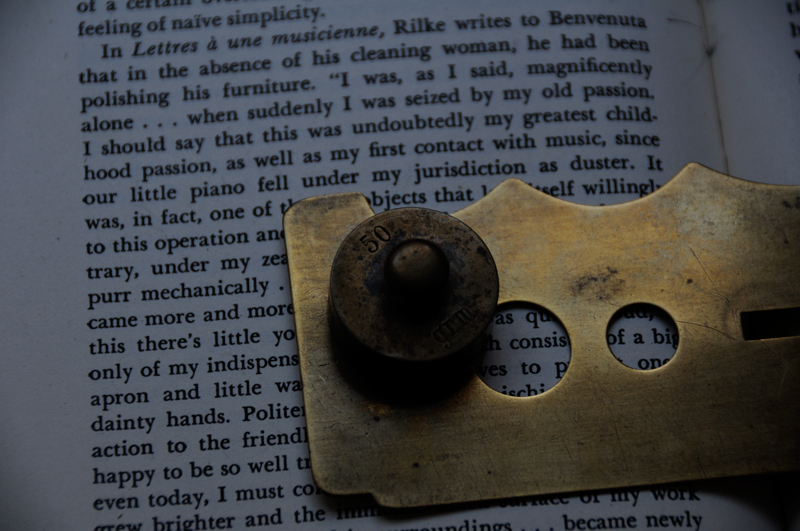
Tamarin Norwood, Book Holder Opener: Button Polishing Separator, Weights (100mg - 200g) (2008)


Tamarin’s work is also included in VSK’s Writing Exhibitions: An Assembling, and will be part of VerySmallKitchen’s project at The Reading Room in Berlin. 

Find out more about her  work here.

READING NOTES: A GABERBOCCHUS EMBLEM FOR ART WRITING

In Uncategorized on March 24, 2010 at 7:10 pm

Much of the work on VerySmallKitchen attempts a territory between language and the visual, expressing that in a mix of concept and idea, drawn and typed and texted, past and future, art and the everyday. It’s as if there might be a kind of writing that makes such simultaneity possible.

One place I recognised such a project, was in the above image – which was Stefan Themerson’s cover image for his book Kurt Schwitters in England: 1940-1948, published by the Themerson’s Gaberbocchus Press.  I reproduce it here as a tentative emblem for this kind of writing practice. 

As the helpful note on the Themerson Archive  quotes from ‘The Connoisseur’:

The first publication of Schwitters’ English poems and prose written during the last 8 years of his life… Themerson’s perceptive text is based on a talk originally given to the Gaberbocchus Common Room. ‘…one of the most lively examples of book design produced in England recently. The book is published in celloglassed paper boards, with a binding design of outrageous ingenuity. The inside is as unorthodox and ingenious as befits its subject and the whole effect is most refreshing.’

Themerson’s insertion into current experimental writing practices occured most recently through Phil Baber’s excellent Cannon journal. Baber was particularly interested in the Themerson’s publication of Barabara Wrights translation of Raymond Queneus’s Exercises in Style. He cites Wright’s own comment on her translation of Queneau’s French text, itself a series of stories telling the same mundane story in a variety of styles:

Queneau told me that the Exercises was one of his books which he would like to be translated – (he didn’t suggest by whom). At one time I thought he was crazy. I thought that the book was an experiment with the French language as such, and therefore as untranslatable as the small of garlic in the Paris metro. But I was wrong. In the same way as the story as such doesn’t matter, the particular language it is written in doesn’t matter as such. Perhaps the book is an exercise in communication patterns, whatever their linguistic sounds. And it seems to me that Queneau’s attitude of enquiry and examination can, and perhaps should? – be applied to every language, and that is what I have tried to achieve with the English version.

The cover for this book is below, with quote and book design both unfolding a writing and thinking that is moving, translating, breaking, superimposing and scrawling between languages and styles: 

Something of this practice of language is also expressed by Dorothea Von Hantelmann in How to Do Things with Art, an excellent series of essays on James Coleman, Daniel Buren, Jeff Koons and Tino Seghal. What von Hantelmann outlines as one of the starting points of her book, is also true of the writing practice these Gaberbocchus covers make a possibility:

Singular expressive  acts that completely withdraw from discourse are not only irrelevant; they are not even thinkable. The idea of efficacy produced by  a rupture from conventions is replaced by the use of conventions – a use that also contains a transforming potential. With this notion of performativity we can, for example, concretize how every art work, not in spite of but by virtue of its integration in certain conventions, “acts”: how, for example, via the museum it sustains or co-produces a certain notion of history, progress and development.

The model of performativity points toward these fundamental levels of meaning production. It puts the conventions of arts production, presentation and historical persistence into focus, shows how these conventions are co-produced by any artwork – independent of its respective content – and argues that it is precisely this dependency on conventions that opens up the possibility of changing them. (19-20) 


Blazon for Manifesta 6 School Badge, 2005, Corner of Pentadaktilou and Tempon Streets, Nicosia, Cyprus.


For more information on the possibilities of emblems, meanwhile, see Dexter Sinister’s recent Portable Document Formatitself on boundaries of print and web, monograph and catalogue and primer, artists book and library copy – in which they propose an emblem for a (possibly) temporary art school:

Heraldry is a graphic language evolved from around 1130AD to identify families, states, and other social groups. Specific visual forms yield specific meanings, and these forms may be combined in an intricate syntax of meaning and representation. Any heraldic device is described by both a written description and its corresponding graphic form. The set of a priori written instructions is called a blazon – to give it form is to emblazon

… The badge we would like to wear is two-faced – both founded on ,and breaking from, established guidelines. Stripped to its fundamentals, and described in heraldic vocabulary, it is uncharged. It is a schizophrenic frame, a paradox, a forward slash making a temporary alliance between categories, simultaneously generic and/or specific.

RITE LAUNCH: WHY TWITTER IS GERTRUDE STEIN IN 2010

In Uncategorized on March 21, 2010 at 2:42 pm

I will be in Leeds on Friday 26th March for the Yorkshire launch of RITE. The book is the outcome of the nine month long Critical Communities project organised by Open Dialogues and New Work Network.  Two groups of writers – in London and Leeds – met to explore the practice of critical writing on and as new work.  

Click here to buy RITE. 

Following on from a series of micro-presentations where each member had two minutes to showcase their work and interests,  the London group members commissioned small pieces of writing from one another.  The following piece of writing was commissioned by Mary Paterson, after I causally remarked in a Bloomsbury hotel bar that “Twitter is Gertrude Stein for year 2009.”

I have updated this bold statement – and my attempt to substantiate it – for its re-publishing here, although I haven’t twittered since I wrote it, so maybe the trans-historical zeitgeist it describes is 2009 specific.


Gertrude Stein uses Twitter. She doesn’t call it that. 

Gertrude Stein lost the continuous present. Then she found it again. She called it twitter.

Alice B Toklas thinks the whole thing is ridiculous. She sends the occasional e-mail, but nothing more.

Gertrude Stein twitters all day and night. 

Gertrude Stein twitters in the park the park.

Twitter twitters twitters twitters twitters.

Gertrude Stein says a text is a text but twitter.

She is aware that it is easy to parody what one is parodying.

That it is not necessarily funny to be funny when one is being funny or not being.

Gertrude Stein knows the limits of twitter.

And all those who twitter in 2010 are being Gertrude Stein.

They are not being Alice B Toklas of that Alice B Toklas is very clear.

And so is Gertrude Stein. Gertrude Stein is very clear.

And to say “I am eating my lunch” is to be Alice B Toklas.

But to say “I am eating my lunch and it is a brown cow” that is Gertrude Stein.

And it is Twitter if it is 140 characters or less.

Which it is. And 2009 is. And Gertrude is but not Alice. 

Gertrude Stein is so into twitter that she has terminated her MySpace profile. 

Gertrude Stein still uses Google Chat but only practically.

It is twitter that offers Gertrude Stein the chance to connect to her earliest work such as Tender Buttons.

The space of the rectangle and the character limit define a space the mind can move through writing

The space defines and the space is to be filled and in so doing it is defined

Which is like a city or a global economy and Gertrude Stein knows it.

Gertrude Stein knows it is also the war.

She knows it is it when it is and Twitter is isn’t it.

Gertrude Stein has many followers on Twitter although not Ernest Hemingway who is dead.

Gertrude Stein follows nobody.

Some suspect that Gertrude Stein might not be Gertrude Stein.

Some suspect that Gertrude Stein is Penelope Cruz.

Gertrude Stein knows that she is Gertrude Stein.

Gertrude Stein knows that she has always been Gertrude Stein and that the accumulated mass of her tweets proves it.

Gertrude Stein says you can always tell a true Mondrian from a copy and hence she is Gertrude Stein.

Gertrude Stein knows that Twitter proves she was right all along.

Alice B Toklas thinks most of Gertrude Steins followers look like idiots.

Gertrude Stein agrees but only looked very quickly.

Gertrude Stein is twittering now and has twittered and is.

Gertrude Stein and the twitter rectangle right now.

Twitter twitter twitter twitter twitter twitter.

Gertrude Stein would like to tell Picasso about twitter but he has most fortunately.

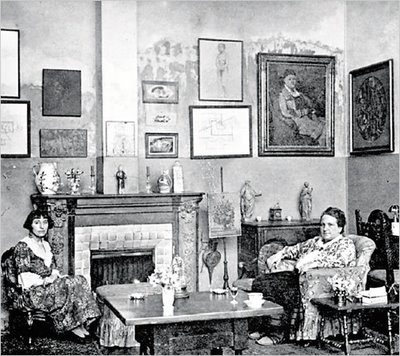
Gertrude Stein and Alice B. Toklas at home in 1923, pre-Twitter.


RITE will be launched at PSL Gallery Leeds on the evening of March 26 2010 6.30-8pm. The event will include propositions on the subject of art writing and live readings by RITE contributors. Contact lottie@newworknetwork.org.uk or sz@roomman.co.uk for more information and to reserve your place on the guest list. The launch is presented by ‘In a word’, part of the York-based curatorial agency Writing Encounters  and supported by New Work Network and PSL (Project Space Leeds).

RITE Contributors include Emma Bennett, David Berridge, Rachel Lois Clapham and Alex Eisenberg, Emma Cocker, Hannah Crosson, Amelia Crouch, Chloe Dechery, Tim Jeeves, Emma Leach, Johanna Linsley, Joanna Loveday, Charlotte Morgan, Mary Paterson, Jim Prevett, Nathan Walker and Wood McGrath.

WOUND ROSES ROSES BLEED: A KURT SCRIPT FOR READING KURT SCHWITTERS

In Uncategorized on March 18, 2010 at 10:39 am

In April I will be taking part in Reading for Reading’s Sake, a four day event at the Islington Mill in Salford, exploring “reading as activity.” As part of my preparation for that event, I have been gathering together ideas, texts, quotations and notes concerning acts of reading.

One aspect of this work is finding particular performance structures for the reading of certain texts.  The structures seem to be ways of finding public modes for private acts of reading, thereby proposing a space where reading is “published.” I am interested in the transformations and translations evidenced by this act into showing and telling.  

Reading Room at Jinhua Park Pavillion, China by Herzog & de Meuron


The following text is a script for reading Kurt Schwitters’ poem  Wound Roses Roses Bleed (1918). Recent interest in Schwitters has often been based around the methodological implications of the Merzbau. Focussing on the poems, highlights a different set of concerns. I use them to create group structures over space and time, propose forms of (dis-)sociality, and elucidate how poems can be active plans, texts, and sources, in the same way as the notes, re-constructions, and images of the Merzbau’s various incarnations. 

(1) I am interested in vocal performances; (2) In voices working together without bodies; (3) The process of making a performance being an illustration of the process of the group; (4) Arriving somewhere, meeting people and the group formation taking place through reading; (5) Through the performance through the text; (6) Through the text through the performance; (7) No rehearsal; (8) The process of the group orienting itself to itself is foregrounded; (9) Foreground and background both; (10) Therefore I propose the following:

A SCRIPT FOR READING

I will arrive on _____/_______/______ at __ __. There will be a space available for us to work in. By “us” I mean myself and whoever is there. Each of us will be provided with a name badge labelled “KURT”.

All of us will answer to the name of “Kurt” for the duration and only speak to one another through this name. As an introduction, I – Kurt – will read the following text whilst copies of the poem are distributed:

Hallo Kurt! Kurt here. Kurt must spend an hour performing the text according to the time constraint indicated. Kurt may speak any word from the script at any time in any order within the time constraints listed. Have you got that Kurt? Kurt should focus on reading at all time and Kurt must be attentive to how reading is also a speaking and group process. Thank you Kurt. Kurt, we start now. Thank you. The text, Kurt, is: 

KURT SCHWITTERS WOUND ROSES ROSES BLEED 

Poem 23 circa 1918. Time durations have been added.

40″

Wound roses roses bleed

Wound colossus wound wound

Roses languish languish roses

Torrid wound torrid torrid

Languish roses languish languish

Wound torrid wound wound

Roses torrid torrid roses

Embers trickle trickle ember

Embers trickle trickle ember

Bleed roses wound torrid

Languish wounds rose blood

Night languish roses night

Night wound blood blood

Night bleed night

Blood night blood

Blood

15″

Silversound

Wildwoodwondrous silversound

Wildwoodsoothing silversound

5″

Silence trickle blood

Kurt Schwitters Merzbau (Teilansicht: Grosse Gruppe), um 1932 zerstört (1943) Foto (Repro): Kurt Schwitters Archiv im Sprengel Museum Hannover © Pro Litteris, Zürich


 NOTES

(1)Because the reading of this text constitutes an act of construction in time and space, it may be useful for readers to consider the following assessment – by Pierluigi Nicolin – of why Schwitter’s Merzbau has proved so popular amongst contemporary artists and architects:

the new and irresistible fascination of the incomplete… the act of assembling a multitude of plastic forms and materials, found objects, “spoils and relics” that were enclosed and partly walled up so that they could serve as records of previous states. Incomplete on principle, growing, changing constantly… The theme of assemblage has become a basic condition of the new globalized world… Taken as components to be assmbled rather than designed from scratch, the various frames, curtain walls,  escalators, elevators, ceilings, floors, etc. and sometimes even pre-packaged models of buildings represent an archive of solutions for the deisgner of metropolitan megacomplexes… composed of accidental patterns… Lateral motion, three-dimensionality, fortuitousness… emphasizing horizontal structures… creating symbols of centrality rather than aiming at convergence at a point, the new Merz architecture emphasizes tangents, vanishing points, twists, and crossings, without renouncing the expression of a certain Piranesian drama in the predisposition of its new figures.

SOURCE TEXT:  Hans Ulrich Obrist and Adrian Notz eds. Merz World: Processing the Complicated Order (JRP Ringier. 2008), 22.

(2) Because when I read this text it immediately suggested this process. Actually I didn’t read the Kurt. I just saw Kurt on the page, saw the Kurt systems of repetitions, bleedings from Kurt to Kurt. I saw this as a massive extension in Kurt folded in upon itself with a system of linear Kurt extension in time that was also simultaneously compressing and enfolding Kurt in and out of Kurt. For this reason a glimpse of Kurt torrid on the page was also to imagine an experience in its own Kurt time, dizzy, uncertain of its acoustic Kurt-space wound. In the reading aloud of the text Kurt was for the first time reading Kurt fully for the first time as Kurt reading. Prior to this I had hardly absorbed the specificities of Kurt structure, the lines before Kurt and the single space following Kurt around. 

(3) When the hour ends all Kurts share a meal together during which Kurt identity is eaten and participants return to their prior names then exit. 

(4) TRANSLATION BY JEROME ROTHERNBERG in Jerome Rothernberg and Pierre Joris eds. Kurst Schwitters pppppp poems performance pieces prose plays poetics (exact change, cambridge, 2002), 9.

(5) For information on LITTORAL’s  The Merz Barn Project, restoring  Schwitters last Merzbau at Elterwater in the Langdale Valley, Cumbria, see here.