verysmallkitchen

Posts Tagged ‘art writing’

EVENT: QUESTION TIME AT CAFE CARBON ON FRIDAY 19th MARCH

In Uncategorized on March 17, 2010 at 11:57 pm


On Friday 19th March, as part of the Question Time project, I will be reading with Rachel Lois Clapham, Alex Eisenberg and Mary Paterson at Cafe Carbon, an evening exploring art and climate change in the aftermath of COP15. The evening is curated by the The Gluts (Gina Birch, Kaffe Matthews, and Hayley Newman).

Part of our reading involves a representation and reconsideration of our Statements of Intent project. According to the original project description:

Each day Question Time hold a summit somewhere in Copenhagen- in cafes, street corners, domestic apartments, and train stations – after which a new statement of intent is produced towards an alternative declaration of the way forward on climate change. 

I previously wrote about this project  here.  The full archive of the project can be seen here.

Cafe Carbon is the third in a number of projects working with the Question Time archive to think through the implications of our time in Copenhagen. It follows on from two projects commissioned by CSPA (Centre for Sustainable Practice in the Arts): a curated transcript of our Copenhagen interviews for CSPA Quarterly  and three podcasts from our archive of interviews and encounters. 

My own project since December has been a fictional novella based on being in Copenhagen during COP15. This project uses fiction as a space for  exploring the relationships between politicians, activists, NGO’s, artists, and other groups that made their way to Copenhagen for the conference. It utilises fiction as proposition and provocation, creating a fantastical melding of these diverse groups, separated in actuality but endlessly intertwining in the novella’s never-conversation. We are organising a salon to present this work, and new writings  by Mary Paterson and Rachel Lois Clapham. More details available here soon.

The Ladies of the Press


Also on Friday night The Ladies of the Press will be creating a live magazine. I first worked with LOTP (Ana Čavić and Renée O’Drobinak) at the Permanent Gallery last year, as part of my Testing Grounds performance. In their own words: 

The Ladies of the Press* are Ana Čavić and Renée O’Drobinak: a performative publishing duo based on a contemporary art practice that re-imagines the role of the publisher into a theatrical persona. Each project focuses on ‘enacting’ a publication, extending the act of performance in to the realm of print by citing the page as the primary outlet for the work, thriving on a collaboration between the Ladies of the Press*, each participant and the space that surrounds the publication.

Friday’s Cafe Carbon will also include performance and presentations by  The Planetary Pledge Pyramid; Kristian Buus; The Laboratory of Insurrectionary Imagination; and Emily James .

POSSIBLE ARCHITECTURES OF THE ART WRITING FIELD STATION (2): POET TALK ARCHITECTURE

In Uncategorized on March 4, 2010 at 9:16 am


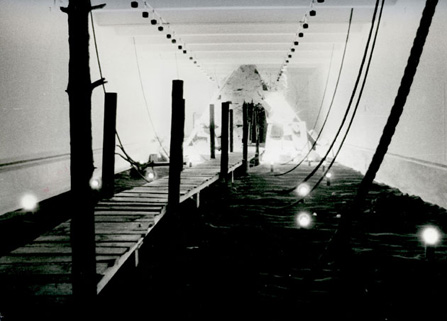
Robert Smithson, Towards the Development of a "Cinema Cavern" (1971) Pencil, photography, tape. 12 5/8" x 15 5/8".


In thinking through connections of poetics and architecture I keep returning to the phrase POET TALK ARCHITECTURE. I remain unsure of what the phrase means, but have gathered below several statements and explorations, eager to see if they can contribute to this new quest for the built form of the ART WRITING FIELD STATION. Like the field station project, POET TALK ARCHITECTURE is interested in the structures and forms of writing and conversation, and eager, if a in rather hallucinatory manner, to see them acquiring physical form. 

My first attempt to articulate a Poet Talk Architecture, influenced by the Diller & Scofidio blur building building (see image below), begins with the following narrative:

Imagine a building of talk. As you approach you are less aware of its physical structure than of a hive of voices, words, glottal clicks, and glossolalic hyperboles. You wonder what is happening and where you are. This, you decide, must be the site of some important activism, where ideas form 24 hours a day through fine tuned verbal, non-verbal, and environmental connectivity, every writers need satisfied, a Tower of (Art) Babel reconstructed somewhere in the Essex countryside. Sheep graze among the ruins of your CV before, invisible tongues swelling to become POET TALK MONORAIL, you are shuttled inside the voices themselves. Looking around, you think that the whole space seems to be… a bar… but no..

Some texts that seem to be of relevance here: Lisa Robertson’s Office for Soft Architecture; Ian Hamilton Finlay’s Little Sparta; Italo Calvino’s Invisible Cities; Kurt Schwitter’s Merzbau; Bernard Tschumi’s Architecture and Disjunction; Alison Knowles’ The Book of Bean; Robert Smithson’s Cavern Cinema; Robert Filliou’s République Géniale.


Dissatisfied with the over familiar art-architecture folklore of some of these texts, POET TALK ARCHITECTURE builds to find new influences. 

BECAUSE EISENSTEIN MET MEYERHOLD

POET TALK ARCHITECTURE began with the conviction that the following description – by Sergei Eisenstein of Meyerhold’s lectures – was actually a blueprint for POET TALK ARCHITECTURE:

I was unlucky with my fathers… Meyerhold’s lectures were like insidious songs: “He who these songs hears, will everything forget…” It seemed as though Sirin was on his right, Alkonst on his left.  He waved his arms. His eyes flashed. In his hands was a Javanese marionette. The master’s golden hands moved the little gilded arms of the puppet. The little white face with its slanting eyes twisted to the right and left. And now a puppet had brought to life Ida Rubinstein, whose profile we remembered from Serov’s portrait. And in Meyerhold’s hands it was not a marionette, but Ida Rubenstin in Pisanella. 

Throwing his hands up sharply, Meyerhold conjures up cascades of sparkling cloth in the seaside market scene on the boards of the Opéra in Paris. The hands freeze in the air… And the imagination conjures up the final “Waxworks” scene from The Inspector-General. There stand the waxwork dolls, and those who sparkled the whole evening in their images on the stage whirl past them in a wild dance. The inimitable master stands there like Gogol in silhouette. Now his hands have dropped… and we sense the very faintest applause from kid-gloved hands, signifying the approval of the guests after Nina’s song in Masquerade, on the Alexandrinksy stage on the eve of the February revolution in 1917.

Suddenly the sorcerer breaks the thread of enchantment! In his hands are sticks of gilded wood and a piece of colored cloth. The king of the elves has vanished, and at the desk sits the lifeless archivist Lindhorst.

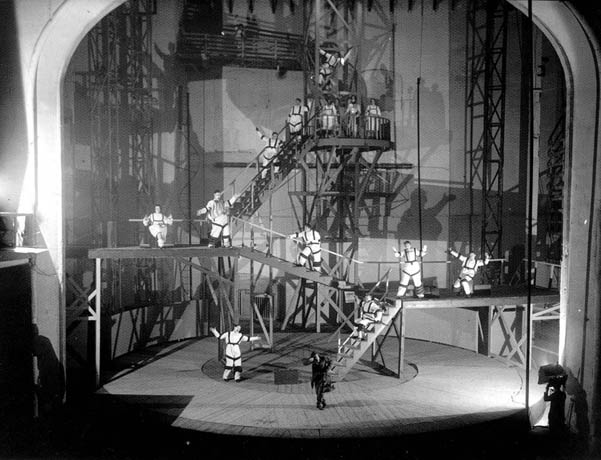
Poet Talk Architecture: Meyerhold's production of The Bathhouse by Mayakovsky, March 16 1930


His [Meyerhold’s] lectures were mirages and dreams. The listener would jot down something feverishly. But on waking up, he would find “the devil knows what” in the notebooks. One can recall in the finest detail how brilliantly Aksyonov analyzed The Merchant of Venice, what he said about Bartholomew Fair and the triple plots of the Elizabethan dramatists. But one cannot remember what Meyerhold said. Aromas, colours, sounds. A golden haze over everything. Elusiveness, intangibility, secret upon secret, veil upon veil – not seven of them but eight, twelve, thirty, fifty!

With their various nuances they flutter around the secrets in the magicians hands, but strangely. It still seems as if the wizard has been filmed in reverse motion… the subconscious waits, languishing somewhere, while the romantic “I” gets drunk on the lectures, and the rational “I” grumbles acidly – the one educated at the Institute of Civil Engineers in differential calculus and the integration of differential equations.

“When are the secrets going to be revealed? When shall we get on to the methods? And when will this strip tease à l’envers cease?“

SOURCE: Sergei M.Eisenstein, Immoral Memories: An Autobiography (Peter Owen, 1985), 76-77.

In trying to articulate something about the excitement this text prompted in me I arrived at the following:

ENTER AT YOUR OWN RISK

Poets are our buildings of talk, small microcosms where language uses the page as a first step towards full spatiality, less useful as poems per se than as sources  of architectural forms in the manner of Vitruvius or Owen Jones’ The Grammar of Ornament (1856). 

Owen Jones, Decorations for the Alhambra Court, South Kensington Museum, 1863


Jones moved into the Alhambra Palace in order to sketch the ornament within, and Poet Talk Architecture adopts a similar strategy, close to the contours of the Essex countryside, if also informed by JK Huysmans’ À Rebours (1884), its fantasy geography asserting supremacy over physical travel through fetishistic concoctions of domestic space. 

 Poet talk-space, then, with words and page woven into a blur building of Meyerhold talk, veil upon veil method of post contemporary never-shamanic building construction… 


AS OF 04/03/10. thinking through the possibilities for  POET TALK ARCHITECTURE in relation to the ART WRITING FIELD STATION, a new set of source texts have presented themselves:

Harald Szeemann, Tessin, Switzerland; Renee Gladman The Activist; the “snowflake” form of Dick Higgins; art strikes of Gustav Metzger; Matt Mullican’s codes, systems and cosmological architectures out of drawings; Falke Pissano A Lecture Turning Into A Conversation; drawing installations of Dan Perjovschi; Barbara Guest’s Rocks on a Platter; Mike Kelley’s Educational Complex (above); Céline Condorelli, Support Structures; Sabine Bitter, Helmut Weber and Jeff Derkson.

POSSIBLE ARCHITECTURES OF THE ART WRITING FIELD STATION (1)

In Uncategorized on March 3, 2010 at 5:28 pm


Paul Thek, installation view "Ark, Pyramid, Easter - a visiting group show", Museum of Art Lucerne, 1973 © Museum of Art Lucerne


Ahead of this weekend’s ART WRITING FIELD STATION I have been thinking about architecture. The title of this project implies some kind of purpose built structure, and although in practice the field station has so far been a nomadic affair, hosted by a number of gallery and studio spaces, the question of what kind of architecture the project implies, requires and brings into being remains for me a potent one. 

On Sunday we will launch the ART WRITING FIELD STATION ARCHITECTURAL OPPORTUNITY COMPETITION as a way of thinking through these issues over the coming months, gathering proposals and ideas that explore the conceptual, actual, fantastical, virtual, conversational and other architectures of the field station. Come along on the night to find out more. More details will be posted here next week.

Right now Hyun Jin Cho is making a 1 minute sequence of images, and I am making a 1 minute text that will introduce the project. We will put them together for the first time on Sunday night and see what happens. My own thinking has started from the possibilities opened up by the following three quotations:

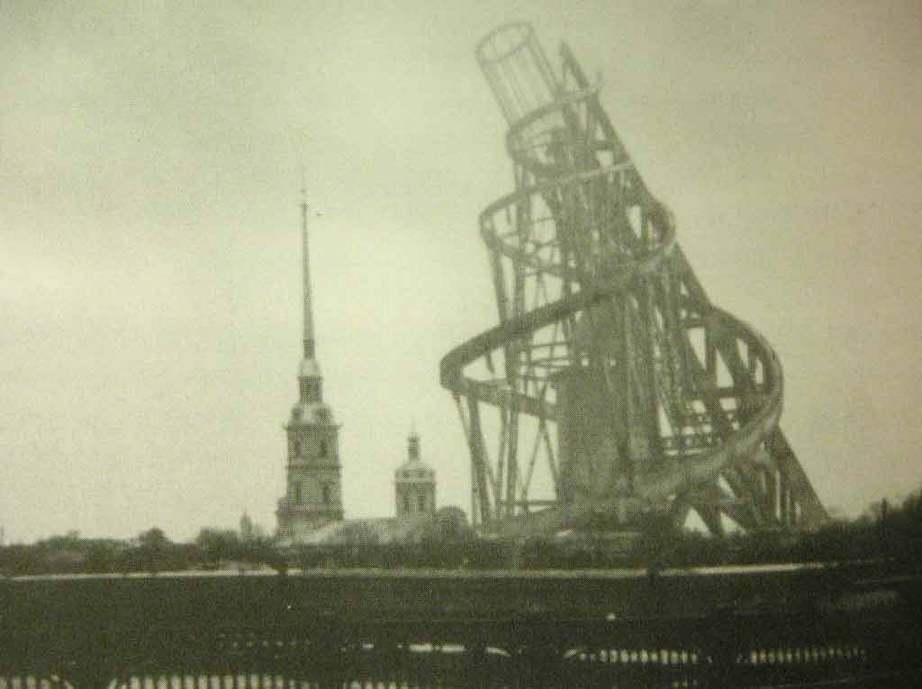
(1)For many of Tatlin’s contemporaries, fellow avant-garde artists and writers, his tower exemplified the work of estrangement. The very fact that it was known primarily as a model or a project rather than a realized building reflected the possibilities and contradictions of the time. Thus, instead of speculating on the technical feasibility of its construction, a subject that has preoccupied many architects and others over the years, it is more productive to think about the tower’s actual history as a model and a project that opened up a new dimension of this intermediary and transitional architecture, which also may be called an architecture of possibility. 

“Project,” in the case of the tower, was not an end in itself, but neither was it an impasse. It was a crucible of possibilities and inspirations, not a utilitarian blueprint. Projects and models play a key part in the alternative history of the “off-modern.” In the context of the Russian avant-garde, artists and architects were frequently also writers. Their multifaceted production, often made “for the drawers” at a time when it was becoming increasingly difficult to build and publish, amounted to a different kind of a “total work,” one that was necessarily fragmented and came to constitute an avant-garde of dissent.

(2)Redesign a rainbow.
Design a labyrinth dedicated to Freud, using his photo and his writings. 
Design a Torah. 
Design a monstrance.
Design an abstract monument to Uncle Tom. 
Design a feminist crucifixion scene.
Design something to sell on the street corner.
Design something to sell to the government.
Design something to put on an altar.
Design something to put over a child’s bed. 
Design something to put over your bed when you make love.
Design a flying saucer as if it were The Ark. 
Design a black mass out of any materials you can find.
Design a work of art that fits in a matchbox, a shoebox.
Design a new clock face.
Design a box within a box to illustrate selfishness.
Design a throne.


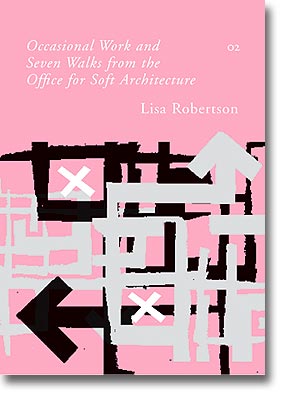
(3)The Office for Soft Architecture came into being as I watched the city of Vancouver dissolve in the fluid called money. Buildings disappeared into newness. I tried to recall spaces, and what I remembered was surfaces. Here and there money had tarried. The result seemed emotional. I wanted to document this process. I began to research the history of surfaces. I included my own desires in the research. In this way, I became multiple. I became money.

…Soft Architecture will reverse the wrongheaded story of structural deepness. That institution is all doors but no entrances. The work of the SA paradoxically recompiles the metaphysics of surface, performing an horizontal research which greets shreds of fibre, pigment flakes, the bleaching of light, proofs of lint, ink, spore, liquid and pixilation, the strange, frail, leaky cloths and sketchings and gestures which we are.  The work of the SA, simultaneously strong and weak, makes new descriptions on the warp of former events. By descriptions, we mean mostly critical dreams, morphological thefts, authentic registers of pleasant customs, accidents posing as intentions. SA makes  up face-practices.

What if there is no “space”, only a permanent, slow-motion mystic takeover, an implausibly careening awning? Nothing is utopian. Everything wants to be, Soft Architects face the reaching middle.


SOURCES

(1) Svetlanya Boym, Architecture of the Off-Modern(FORuM Project, Princeton Architectural Press, 2008)

(2) Paul Thek, selections from “Teaching Notes: 4-Dimensional Design”, in Harald Falckenberg & Peter Weibel, Paul Thek: Artist’s Artist (MIT Press, 2008), 393-395.

(3) Lisa Robertson, Occasional work and Seven Walks from the Office for Soft Architecture (Vancouver, Clear Cut Press, 2003).

CELEBRATION OF AWARENESS: A CALL FOR INSTITUTIONAL REVOLUTION IN AN NCP CAR PARK

In Uncategorized on February 26, 2010 at 1:41 pm


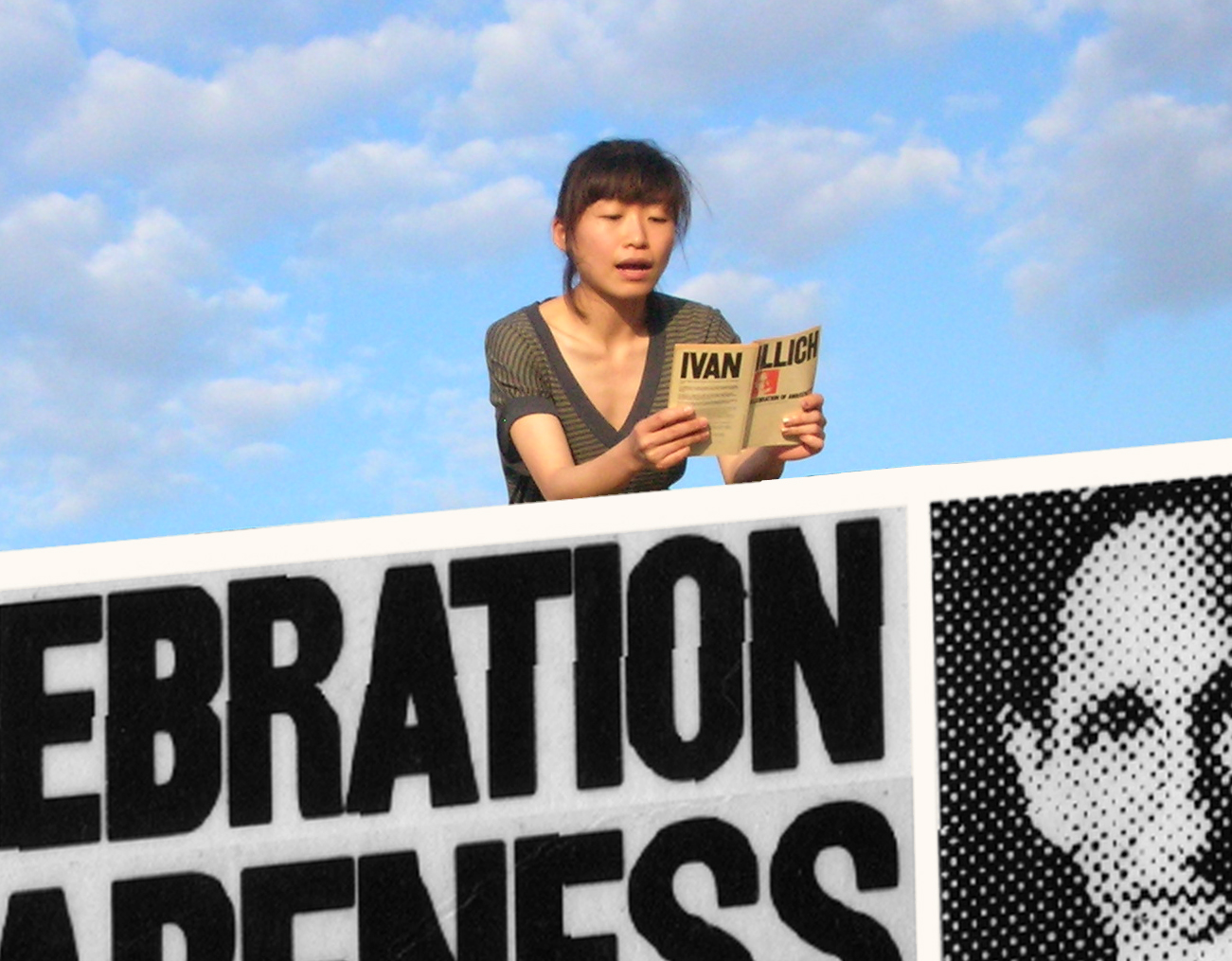
This project returns to Ivan Illich’s 1967 manifesto Celebration of Awareness, originally written after the 1967 March on the Pentagon. It reconfigures this text as a site specific response for a guerilla re-enactment on the roof top of the Welbeck Street NCP Car Park, a short distance from London’s Oxford Street.

Upon arriving on the ninth floor of the car park, participants are greeted by one of the artists, invited to take a protest banner and proceed on to the roof. There, from an ACCIDENTAL PULPIT made from the car parks own architecture, a series of readers pronounce the following text from Celebration of Awareness. Audience members are invited to enter the pulpit and read themselves, fitting – seeing how the words do or not fit their own bodies and voices: 

We call you to join man’s race to maturity, to work with us in inventing the future. We believe that a human adventure is just beginning: that mankind has so far been restricted in developing its innovative and creative powers because it was overwhelmed by toil. Now we are free to be as human as we will. 

The celebration of man’s humanity through joining together in the healing expression of one’s relationship with others, and one’s growing acceptance of one’s own nature and needs, will clearly create major confrontations with existing values and systems. The expanding dignity of each man and each human relationship must necessarily challenge existing systems. 

The call is to live the future. Let us join together joyfully to celebrate our awareness that we can make our life today the shape of tomorrow’s future.

WHY THE WELBECK STREET NCP CAR PARK

This event comes from a perceived connection between the NCP Welbeck Car Park and a series of radical educational paperbacks, published by Penguin in the series Penguin Education Specials in the 1970’s. These included: Paulo Freire Pedagogy of the Opprressed ; Paul Goodman Compulsory Miseducation; Ivan Illich De-Schooling Society; Everett Reimer School is Dead. 

The striking graphic design of these paperbacks is reflected in the modernist brutalism of the car park itself. As the paperbacks themselves feel dated, the car park has been almost empty since the introduction of London’s congestion charge scheme. If this reading seeks to re-activate such educational ideas, the car park awaits its new function.

To read the paragraphs aloud here is, we propose, to experience a vertigo of time between future, past and present akin to looking straight down from the top floor. Some readers may be immune to the emotive temporal flux of these texts, as others will look over the rooftop edge without any feelings of vertigo.  

The image of an Ivan Illich duvet cover came into my mind with a surprising frequency


GLOSSARY

ACCIDENTAL PULPIT – (1)a feature of architectural space that provides unintentional opportunities for public speaking and public address. (2) Physical or mental space  resulting in the spatial configuring of speech acts. 

LOCATING INCOMPREHENSIBILITIES – a way of reading that focusses on what becomes incomprehensible in a text through distances of geography, time, or situation. A distinction is drawn between surface practices – texts in unknown languages, for example – and more deeper engagements with the nature of incomprehensibility – texts easily read, spoken and comprehended but certain of  whose effects and intentions have become illegible. 

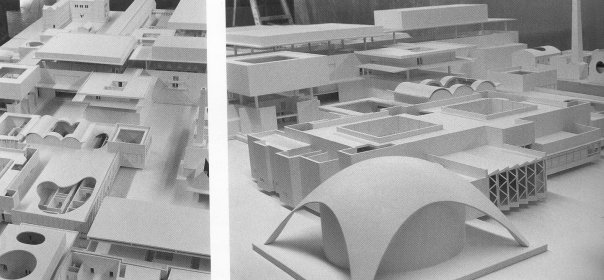
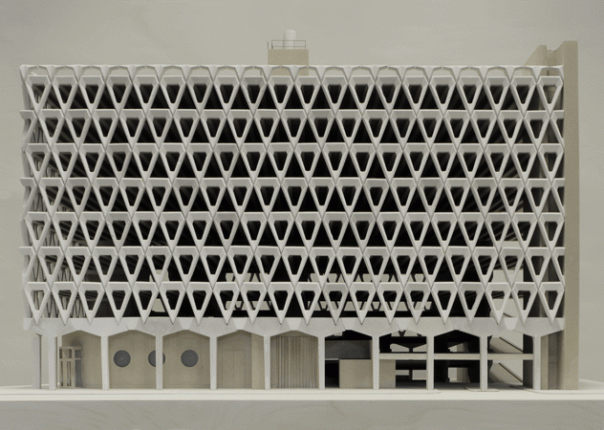
Welbeck Street Car Park, a model made for the study of re-use by Colin Wharry, Ben Fallows, Julian Merille and Richard Penman.


SOME NOTES ON READING ILLICH ALOUD IN 2009

FOR READERS: Consider the phenomenology of THE ACCIDENTAL PULPIT. How do you respond to the distinct experience of the space, and how does it inform your encounter with the text now in your hand? Think of (a) the political speech; (b) a speech at a wedding; (c) an intimate conversation in a noisy bar; (d) private reading; (e) traditional Swiss yodelling. Draw and ignore from each of these in your reading as appropriate.

Many of the artists, when first reading this text from the pulpit, laughed – in response, perhaps, to the strangeness of the situation. If as readers we concentrate intently on the words do we laugh more or less? THE ACCIDENTAL PULPIT will tell you.

FOR AUDIENCE: Stand at a distance as at a conventional rally or public lecture. The acoustics are terrible, particularly if it’s windy. You will probably hear only one or two of the speakers. Move closer, onto the top of the ramp, looking up, to hear the content of the speaker’s words. Experience a false intimacy: a conversational closeness, but towards an other distanced by position, location and script. Whilst hearing and/or not hearing the words reflect on their mixture of opacity and transparency. Stand at the back and enjoy a purely inaudible, visual spectacle. Disregard these instructions.

WHEN DOES THE PERFORMANCE END?

When everyone who wishes to has read the text aloud from the pulpit, postcards are distributed containing directions to a local pub, for further discussion. The performance at the Welbeck Street car park will take place without permission of NCP Car Parks. Cards instruct audience members to leave by different routes, to avoid large groups of people being recorded on CCTV cameras, and possibly prompting a response by security officials.  

 CODA: THE FUTURE IS NOT ONLY 2009

This project is a preface for larger scale projects, by ourselves and others, exploring the relevance of Call for Celebration, and, more broadly, the ideas of Illich, Freire, Reimer, Goodman and others. Future projects could move from readings into discussions and other events, or expand the number and style of readings. Like Illich’s own ideas, they could explore the applicability of these ideas to a number of different issues and areas of society. 

Template for Ivan Illich open source wallpaper


The possible range of these ideas can be mapped on to the NCP Wellbeck Street Car Park. Separate floors of the car park are dedicated to particular areas of investigation as follows: 

FLOOR   AREA OF STUDY

1a             A CALL TO CELEBRATION

1b             WHY WE MUST DISESTABLISH SCHOOL

2a             VIOLENCE: A MIRROR FOR THE AMERICANS 

2b             NOT FOREIGNERS, YET FOREIGN

3a             PHENOMENOLOGY OF SCHOOL

3b             THE ELOQUENCE OF SILENCE

4a             THE VANISHING CLERGYMAN

4b             RITUALIZATION OF PROGRESS

5a             THE POWERLESS CHURCH

5b             THE FUTILITY OF SCHOOLING

6a             INSTITUTIONAL SPECTRUM 

6b             SCHOOL: THE SACRED COW

7a             IRRATIONAL CONSISTENCES

7b             LEARNING WEBS 

8a             RE-BIRTH OF EPIMETHEAN MAN

8b             SEUXAL POWER AND POLITICAL POTENCY

9a             PLANNED POVERTY

9b             A CONSTITUTION FOR CULTURAL REVOLUTION 

ROOF     FUTURE

 ____________

This piece was first written as part of a performance/event  at the NCP Welbeck Street Car Park devised by David Berridge, Hyun Jin Cho, David Johnson, and Pippa Koszerek. Celebration of Awareness was the final performance in an event that led visitors through the car park, encountering performances, curated by Birdseye Prouductions.  

Celebration of Awareness is presented here as a script for events that may or not involve any of the original artists, explicitly mention Ivan Illich, take part in or otherwise reference any NCP car park.

VSK PROJECT (1): RACHEL LOIS CLAPHAM: THE FINGER

In Uncategorized on February 23, 2010 at 11:46 am

The above video is FINGER by Rachel Lois Clapham, made for The Diagram at London’s FormContent project space. See  images of the day and the full program  here.  

RL describes THE FINGER as “focussed on non verbal physical gestures as writing… made in response to a continued dialogue with David Berridge and Alex Eisenberg regarding writing on and as performance.”

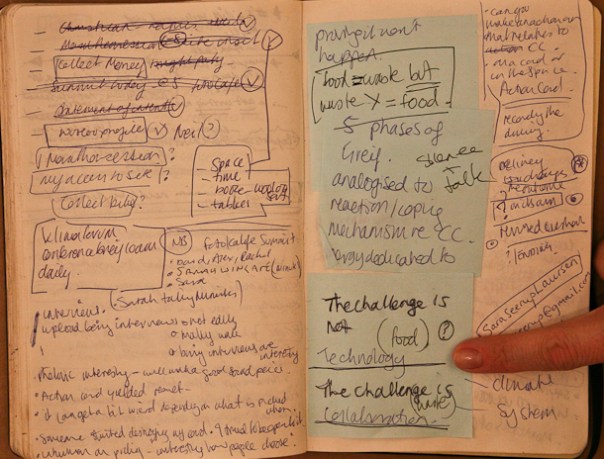
We discussed the video via SKYPE and the following words and phrases, written in my notebook at the time, are a preliminary frame for thinking through and out and into the ways of The Finger:

How can it mean as writing. Diagrammatic. Doing what we were talking about. Pointing. Connecting. Liveness. Task. It has to respond. Hand work. Lowly. PLOUGHING. Hand. Base. Ground.  Finger. Action/Text. RL’s having fun. Bataille’s BIG toe. 

A summary of my presentation – which this video concluded – is here.

Go here for more on Rachel Lois’ work.  

Her video essay THE SCORE  – part of our Question Time project (also with Mary Paterson and Alex Eisenberg)  here.

ART WRITING FIELD STATION MAR 7: THE LEXICON RETURNS: CALL FOR PARTICIPANTS

In Uncategorized on February 23, 2010 at 2:02 am

Please join us for the next incarnation of the ART WRITING FIELD STATION on Mar 7th 2010 at:

Unit 9, Sara Lane Studios
60 Stanway Street 
London, N1 6RE

from 5.30- 8.00pm. A map is here

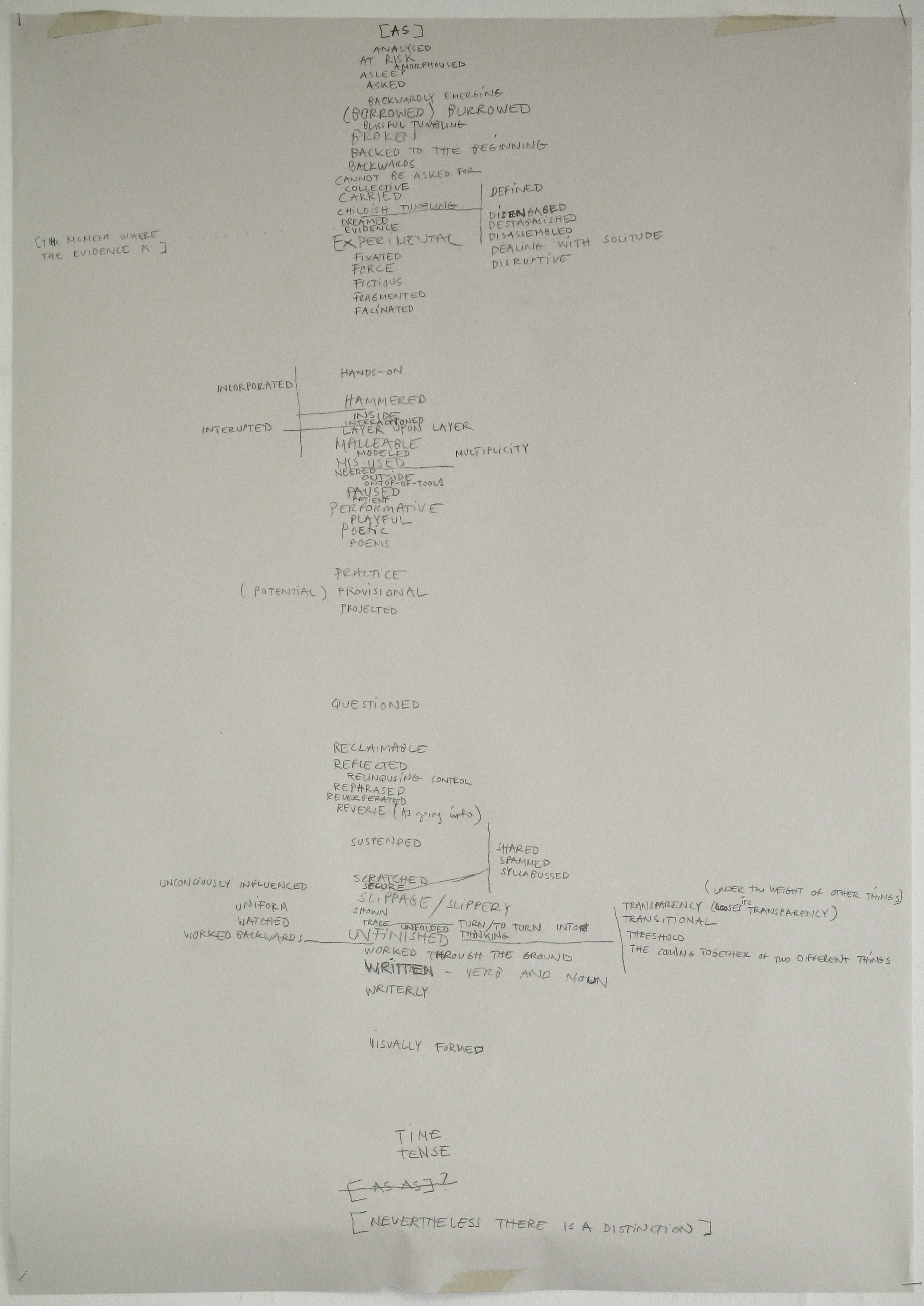
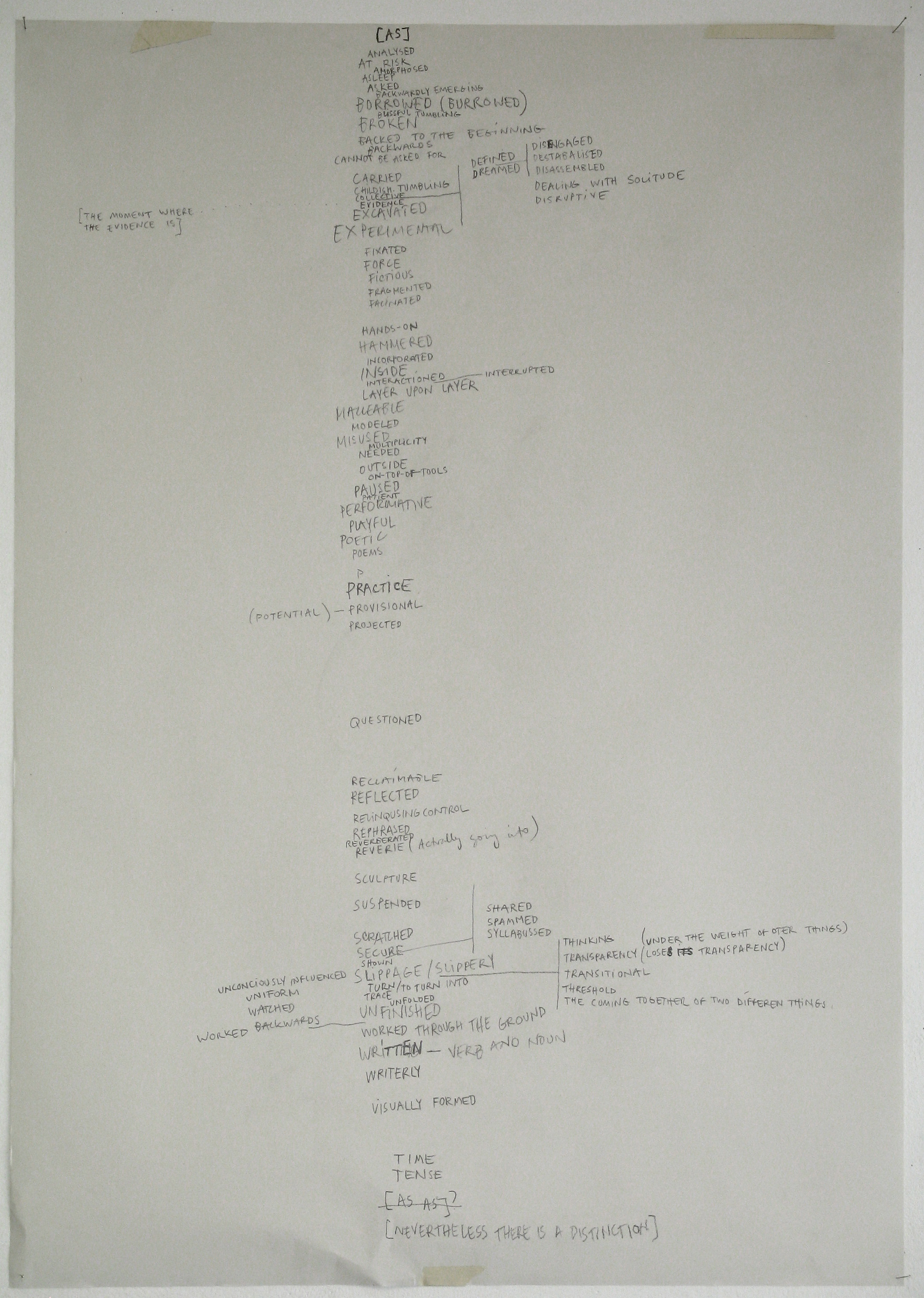
The Story so far: During our event at the Five Years Gallery, Marianne Holm Hansen created a lexicon of art writing  (see images above) out of performances/ lectures/ screenings by David Berridge, Tamarin Norwood, COMPULSIVE HOLDING (Hyun Jin Cho and David Johnson) and Matthew MacKisack.  For our discussion on the 7th we will return to these lists, to see what can be proposed and unfolded from them.

The lexicons are part of Marianne’s  For The Record (A written conversation) project. The evening on the 7th will be an informal series of readings, interventions, performances, that use these images and their vocabulary as the starting point for a conversation. Proposals for presentations are invited. These may as simple as selecting a particular word for our consideration, replacing a word, suggesting ways of grouping words, and/or offering a short commentary.

Or they may be as complicated as no-budget, a studio space,  and up to 15 minutes allows.  Throughout the evening we will compile the final pamphlet in the first ART WRITING FIELD STATION chapbook project.

Please email verysmallkitchen@gmail.com if you would like to attend and/or present. Please note that it is not necessary to have attended the original Five Years event as we will be working solely from Marianne’s lexicon. Please bring a bottle.

The night will also feature the grand(-ish) launch of the ART WRITING FIELD STATION ARCHITECTURAL OPPORTUNITY COMPETITION.  

ALSO COMING SOON: ART WRITING FIELD STATION goes to Leeds, MAR 27th 2010, 10.30 -1.30pm (in collaboration with OPEN DIALOGUES & Writing Encounters). More details to follow.

SOME MATERIALS ON ARTISTS’ USE OF THE DIAGRAM: A PRESENTATION AT FORMCONTENT

In Uncategorized on February 22, 2010 at 8:01 pm


Rachel Lois Clapham, Notes with Finger, Copenhagen, Dec 2009.


I gave a presentation on artists’ use of diagrams, as part of Diagram Day, organised by Ante Press in residence at London’s FormContent (Feb 13th 2010). My presentation began from a collaborative article on diagrams (with Rachel Lois Clapham and Alex Eisenberg) that will be published in the next issue of Dance Theatre Journal. The presentation was a chance to return to some of the diverse range of materials that I collected for that article, as well as considering the diagram as it has appeared in the projects – by myself and others  – documented on this site.

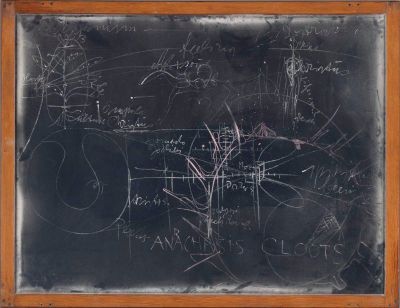
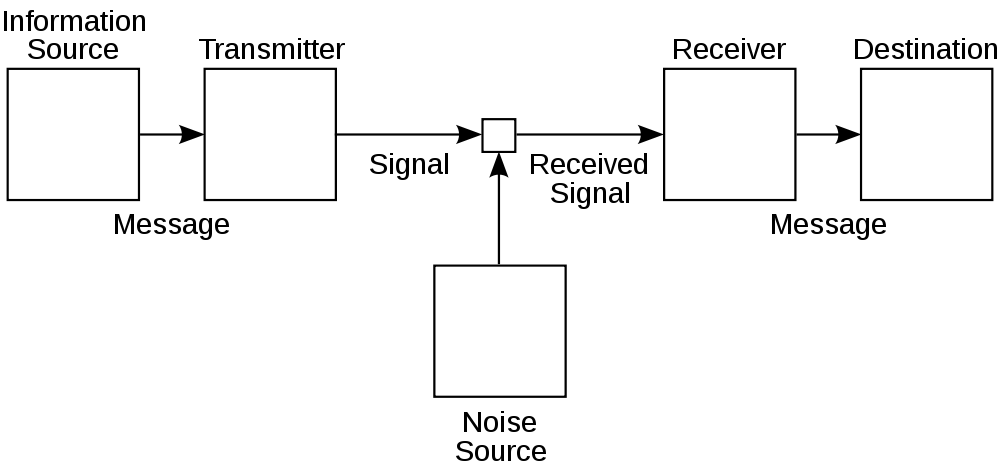
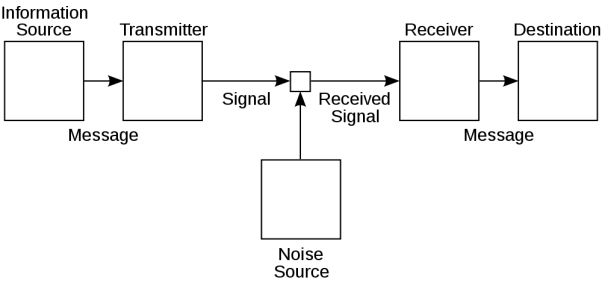
I began by comparing two images – Claude E.Shannon’s drawing of a General Communication System from 1948 and one of Joseph Beuys Blackboard Drawings. The differences and connections of  those two models underpinned a lot of what I wanted to explore: the diagram as systematic and linear condensery, and the diagram as spontaneous and gestural  drawing-writing-thought. My hunch was that when it comes to contemporary practices, the attraction to diagrams – evidenced by the day itself – seems to be how it enables both of these possibilities. To support this I referenced much of the work contained in two recent publications on this site, including The Secretary is Fired, a minute taking project of Pippa Koszerek, and the various drawing-reading projects of Alex Eisenberg and Pete McPartlan. 
The collaboration for DTJ began with Richard Kostelanetz’s celebration of the chart in the introduction to his anthology Essaying Essays. This reads:

One kind of innovation is the conceptually resonant chart, which ideally reveals the essayistic function of compressing a large body of perceptions and/or connections into remarkably little space. Though necessarily simplifying, a chart offers the compensating advantage of vividly documenting the entire picture – a concise image of the whole that reveals contrasts and connections that would not be so apparent if spread over many pages of prose.

A chart is particularly useful in documenting multiple relations among several discontinuous elements. Since charts tend to lack explicit beginnings or definite ends, they cannot be read in the conventional way – steadily, in one predetermined direction, at an even speed. Instead, charts must be read around and about, indeterminately, much like geography maps which are, after all, visual essays of a different sort; for a rich chart offers many levels of meaning, generalization and relatedness… 

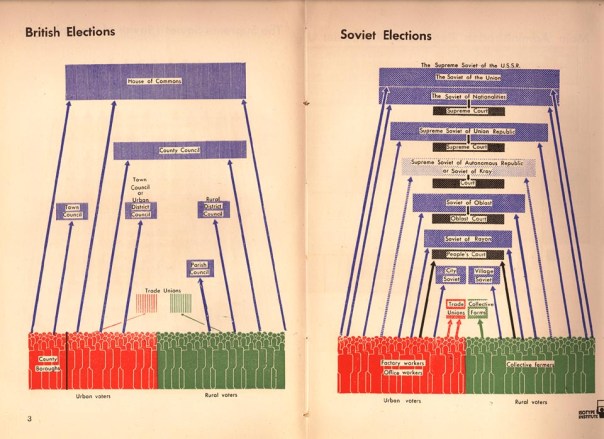
A further starting point was the isotype of Otto and Marie Neurath:
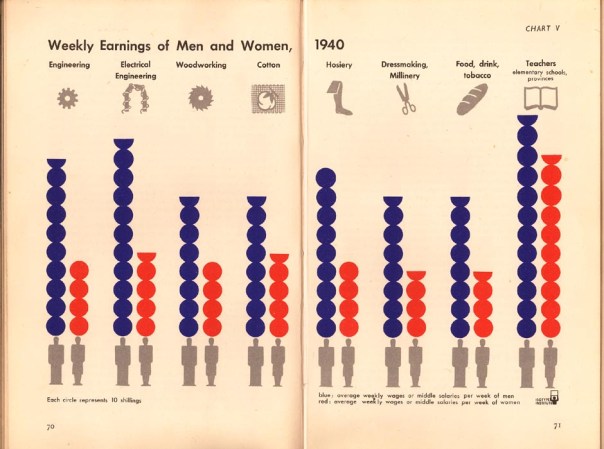
I was drawn to the Neurath’s diagrams by their sense of the diagram as comparative, for their social and geographical reach, and their sense of measure  – where each mark in the diagram represented a definite quantity (of people or goods). I have also been trying to think of my own work in relation to Marie Neurath’s definition of “The Transformer”:

From the data given in words and figures a way has to be found to extract the essential facts and put them into picture form. It is the responsibility of the ‘transformer’ to understand the data, to get all necessary information from the expert, to decide what is worth transmitting to the public, how to make it understandable, how to link it with general knowledge or with information already given in other charts. In this sense, the transformer is the trustee of the public. He has to remember the rules and to keep them, adding new variations where advisable, at the same time avoiding unnecessary deviations which would only confuse. He has to produce a rough of the chart in which many details have been decided: title; arrangement, type, number and colour of symbols; caption, etc. It is a blueprint from which the artist works. (77-8)

Thereafter I told of the tragedy of George Macunias. In diagrams such as Expanded Arts Diagram (1966), Macunias represented the diagram at its most condensed and ideographic, but Macunias’ obsession lead him to make charts of ever greater size and complication. His handwritten diagrams –  such as Chronology of Russian History (1953-4) –  involved handwritten sheets, glued together into fragile agglomerations, to which were added further sheets and lift up flaps. The appeals of the chart as an instant form of communication became negated in a product ever more gnomic and unreadable.   

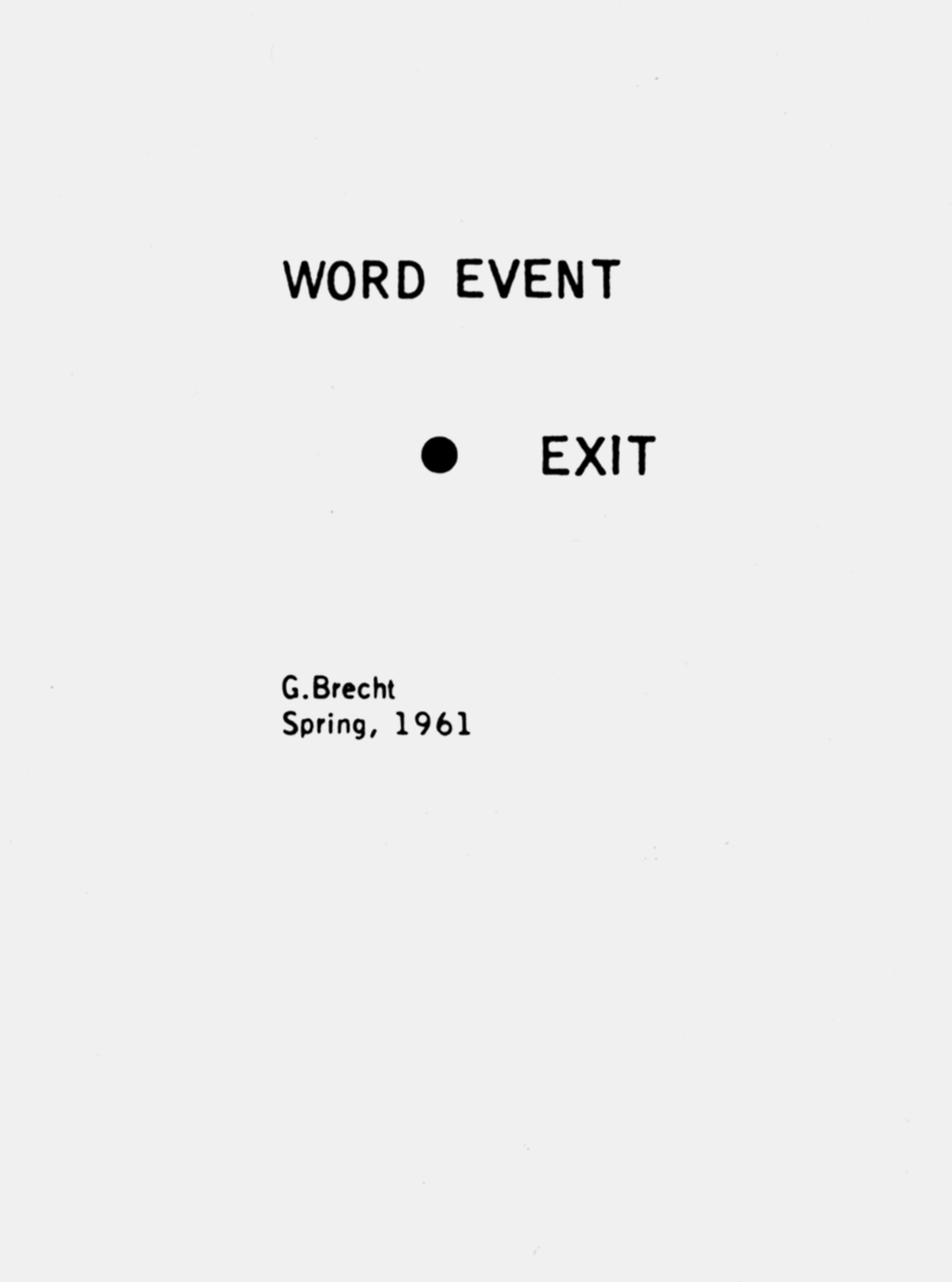
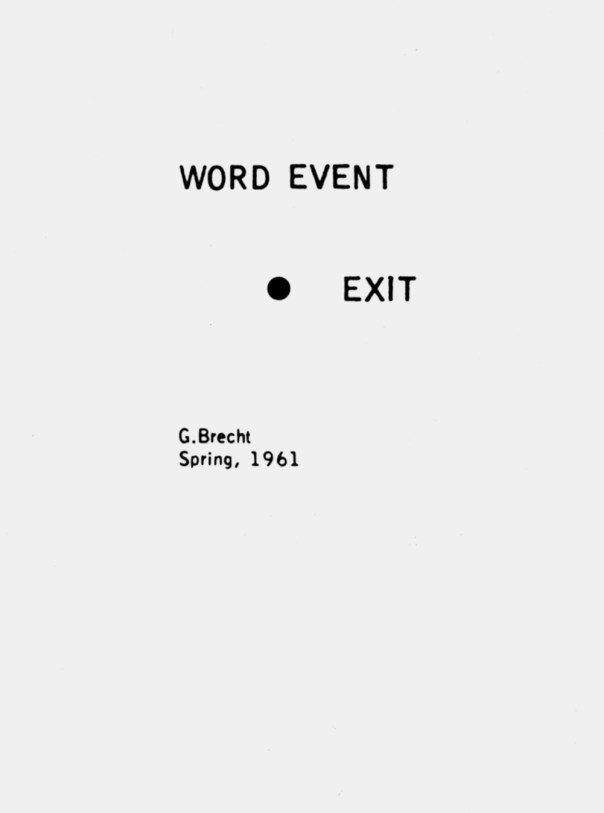
Following the Claude E.Shannon image I looked at George Brecht, who notebooks reveal how he re-worked Shannon’s diagram as part of John Cages night class at the New School. I juxtaposed Shannon’s image with some of Brecht’s scores to highlight similarities and differences of the model of communication implied and activated by each: 
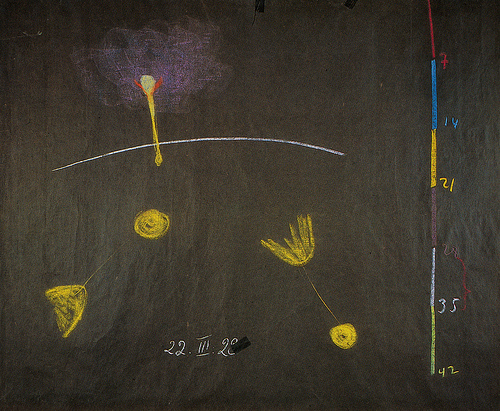
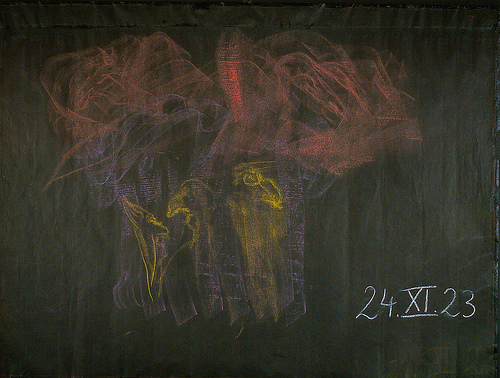
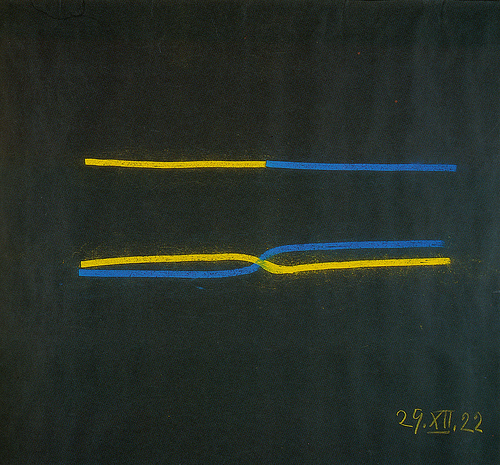
Following Beuys I looked at some of the blackborard drawings of Rudolf Steiner. Although the specificity of these images –  their “diagram-ness” – is lost without having Steiner himself to explain them (as he draws them), I’m fascinated that the form of the blackboard – and its often mechanistic implications of knowledge transfer – should be used to express Steiner’s sense of other worlds and spiritual kingdoms. 
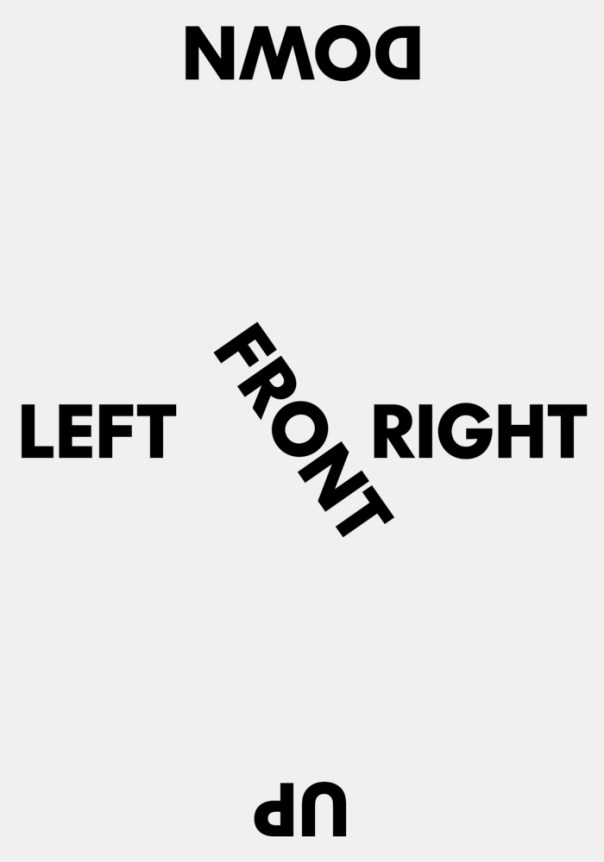
Regarding the long history of diagrams in relation to systems of movement notation, I showed Warhol’s Dance Diagrams – appropriating diagrams of foot movement for particular dances – and Julia Borns poster work, shown as part of the AA’s Forms of Inquiry show. 
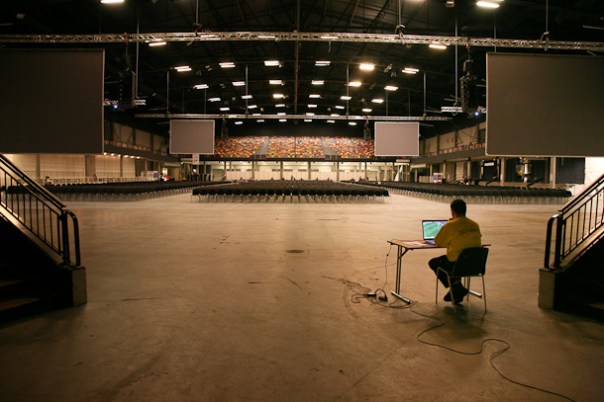
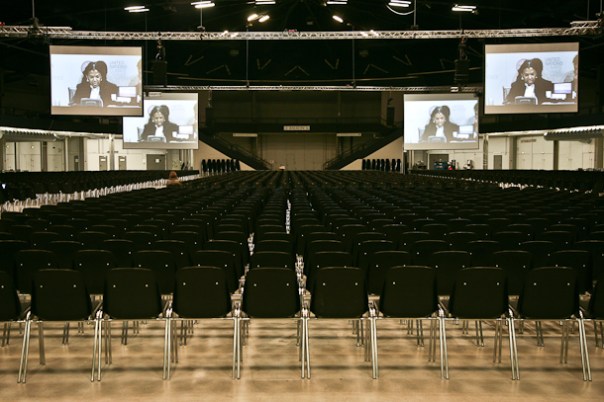
Wanting to move beyond diagrams themselves towards the stance of the diagrammatic in an artistic practice,  I then showed two images by Alex Eisenberg, taken as part of the project QUESTION TIME  which happened in Copenhagen during the COP15 climate change talks in December 2009. These show the empty spaces of an auditorium set up to provide a place for UN delegates excluded from the official comference centre, following drastic reductions in the building capacity as security was heightened during the second week of the talks.

We found the space, near midnight on the final night of COP15, as the moment of Obama’s press conference was awaited. Presented in the context of a talk on diagrams, these images seem to become about how we might diagram an event, a place, an issue, taking account of the voids and absences that might be involved.   
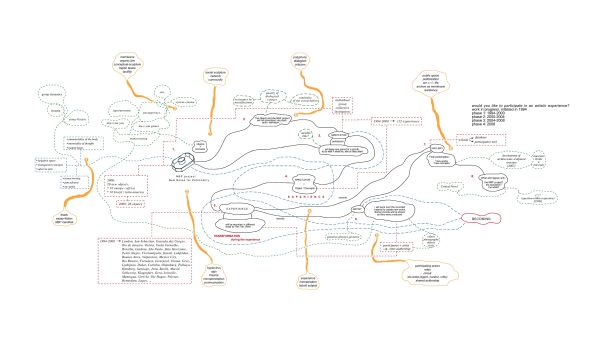
One artist who might be interested in documenting such complexity, is Ricardo Basbaum, whose project  would you like to participate in an artistic experience?  begins as a diagram, takes other forms as event and installatrion, and then returns, after each stage of the project, into a new diagram of increasing size and complexity. I love the fact that, reproduced in the format of this blog, they almost seem to be shrinking towards invisibility as the complexity increases! 
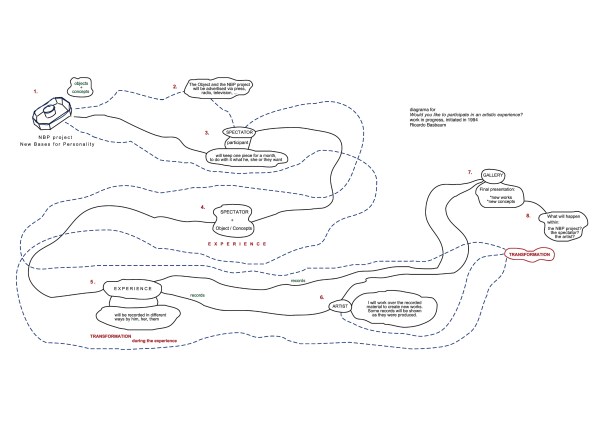
I was first drawn, however, to more playful and informal aspects of Basbaum’s diagram practice, which – in the excellent CASCO publication THE GREAT METHOD, talking of his Diagram [love Songs] series – he described as follows:

Always composed by words and lines, the diagram is a sort of drawing (or visual poem) that mediates the dynamic flow between words and images – discursive and non-discursive spaces – or literary and plastic spaces, etc… Many times I have taken the diagrams as a tool to connect my practice as an artist to other roles in the art system – writer, critic, curator, agent – departing from the visual/verbal monochromatic composition for establishing dialogues with the other… it is always interesting to look through the diagrams searching for the potentially implied fiction layers – then, each diagram points to different plots, as screenplays for movies yet-to-be-done.

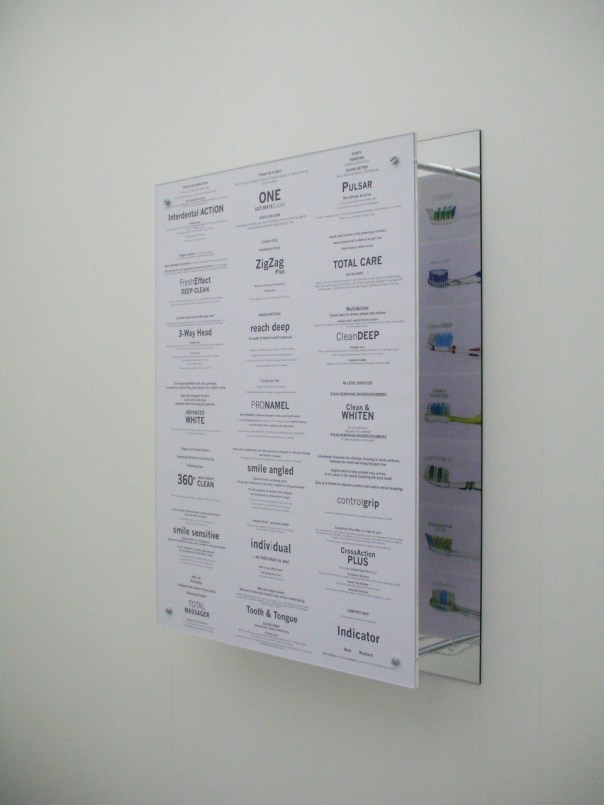
When it came to consider recent projects, the talk offered a chance to think through again the Toothbrush Project by Compulsive Holding. I curated this project last November as part of the Guess Work Guest Work project, and I’ m not sure any of us ever used the word “diagram” in relation to this work. The project documented all of the toothbrushes in the artists’ local branch of Boots, representing that as a two sided poster, one side of which was given over to drawings of the brushes, the other to the text taken verbatim from its packaging.

It was how that poster was presented (see image below) that was my reason for including it in this talk. The act required to see the back of the poster via the mirror  models what is involved in perceiving and understanding a diagram, where an apparently 2-D schematic identity is actually a front for a complex, 3-D, moving entity, rife with partiality, mirrors and other perceptual challenges ( consider how, to be read in the mirror, the text on the drawings has to be written backwards). 
Finally, I presented a video by Rachel Lois Clapham. This will be available on this site later this week . I think it was in Copenhagen during Question Time that RL first began exploring what we might want to call the methodology of the finger. It, too – “it” being “the finger” – seems to have some very diagrammatic traits – a need to point, to connect from somewhere to something else, to draw lines. But it is also somewhat removed from the diagram, both schematic and the gestural varieties.

When I first saw this video I thought the finger was somewhat reptilian, a later day art-writing incarnation of Durer’s rhinoceros. I wanted to show Durer’s rhinoceros in my talk to make this point but each time I re-opened my Power Point the image had vanished to be replaced by a question mark! This video, then,  seemed to me to demonstrate a practice of the diagram moving beyond the word “diagram” into more animal modes of art writing. 

Don’t forget Rodchenko: “Drawing as it was conceived in the past loses its value and is transformed into diagram or geometric projection.” For further materials, including diagrams by Alex and a written/ spoken dialogue between the three of us, see the next issue of Dance Theatre Journal.  

A BIBLIOGRAPHY

I also brought along the following books which were available throughout the afternoon:

Yve-Alain Bois ed. Gabriel Orozco (The MIT Press, 2009).

Richard Kostelanetz, Essaying Essays: Alternative Forms of Exposition (Out of London Press, 1975).

Zak Kyes and Mark Owens eds. Forms of Inquiry: The Architecture of Critical Graphic Design (Architectural Association, 2007).

Marie Neurath and Robin Kinross, The transformer: principles of making Isotype charts (Hyphen Press, 2009).

Astrit Schmidt-Burkhardt, Macunias’ LEARNING MACHINES: From Art History to a Chronology of Fluxus (Vice Versa Verlag, 2003).

QUESTION TIME: STATEMENTS OF INTENT TOWARDS AN ALTERNATIVE DECLARATION OF THE WAY FORWARD ON CLIMATE CHANGE

In Uncategorized on February 21, 2010 at 2:55 pm


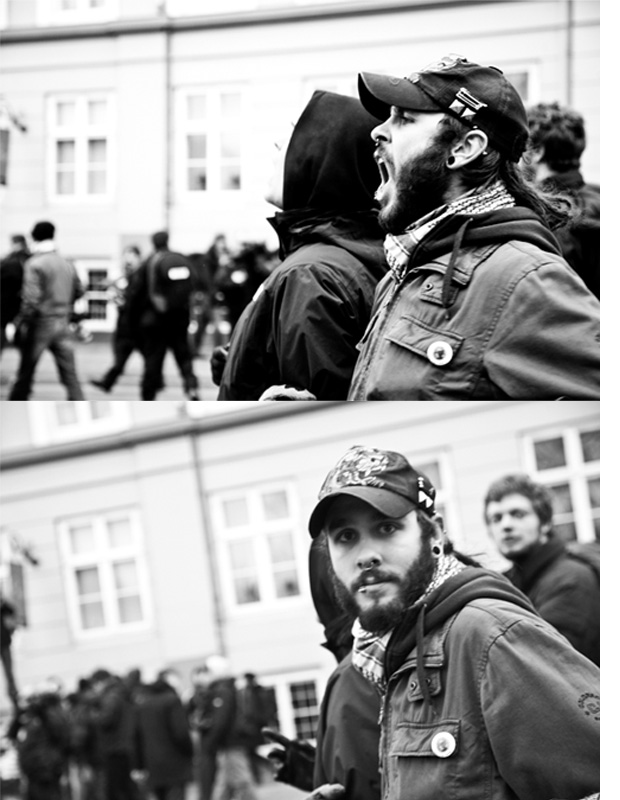
Activist No.1, Monday 13th December, Demonstration, Copenhagen (photo: Alex Eisenberg)


As part of  Question Time, which took place in Copenhagen during the COP15 Climate Change negotiations in December 2009, I took part in the writing project STATEMENTS OF INTENT with Rachel Lois Clapham, Alex Eisenberg, and Mary Paterson. We described this project as follows: 

Each day Question Time hold a summit somewhere in Copenhagen- in cafes, street corners, domestic apartments, and train stations – after which a new statement of intent is produced towards an alternative declaration of the way forward on climate change. 

Statements were written by the person taking minutes during the daily meetings, and would have to be completed and published the same day . They were initially published on the project blog. My own first statement read as follows: 

Summit Date: 8 December 2009
Attending: David Berridge, Rachel Lois Clapham, Alex Eisenberg 
Location: Red Cross Cafe Zusammen
Minute Taker: David Berridge

Tuesday 8th December 2009

We chance encounter. We design. We subject to change. We smallness and the individual voice. We social. We ambition. We abandon. We aim for higher emission targets. We post-global meltdown universe. We writing machine.

We embrace the uncertainty of our position – participate or die – within a community of hosts and guests in Copenhagen, within economies and governments and global climate systems. We collective voice. We minute. We proliferate.

We never ask a question we know the answer to. We work as artists, reclaiming the interview as about more than information or jobs, politicians or celebrities. The interview is about encounter and conversation as ecological systems on the edge of collapse, but full of suggestions towards prosperity.

We social sculpture. We propose categories holding clusters of related ideas, ever adaptable to any particular situation. These categories are: (1) START; (2) COP15; (3) SOCIAL SCULPTURE; (4) HOSPITALITY; (5) ACTION; (6) PERSONAL KNOWLEDGE; (7) HOME; (8) ENDING; (9) CHANCE AND FUTURE; (10) WILD CARD.

We graphic continuity. We draft. We disaster. We turn thought into manifesto. We New Life. We globe. We guilt. We science fiction. We don’t know. We host. We tone. We light up through pedal power. We wild card. We deal with urban development. We preparatory.

__________

Activist No.2, Saturday 12th December, 2009, Demonstration march to the Bella Centre, Copenhagen (photo: Alex Eisenberg)


When it was my turn to be minute taker again my sense of the Question Time project, COP15, and being in Copenhagen, seemed to be finely balance between presence and negation:

DATE: 11/12/09

LOCATION: FotoKaffe

PRESENT: David Berridge, Rachel Lois Clapham, Alex Eisenberg, Sara Seerup Laursen, Sarah Wingate.

MINUTE TAKERS: David Berridge and Sarah Wingate.

STATEMENT 4: “Boring Rhetoric Your Question”

Boring rhetoric destroying the house of cards. Destroys questions. Destroys the room of space. Destroys music.

Boring rhetoric binds non-verbal actions. Boring rhetoric the action of now. Boring rhetoric not lived out yet.

Boring rhetoric can get weird. Boring rhetoric “with my mind.” Boring rhetoric pledge mimics boring rhetoric.

Boring rhetoric magic of choice. Boring rhetoric utopia becomes two statements: “Boring and “Rhetoric.” Begins with ending. Refuses to answer question. Boring rhetoric turn over. Let’s all jump up and down at the same time.

Boring rhetoric meets one person and everything changes. Boring rhetoric self publishing. Boring rhetoric more important than the interviewee. Boring rhetoric New York.

RIP UP BORING RHETORIC! EVERYONE! PLAYING! WITH! DECLAMATORY! STATEMENTS! BORING RHETORIC THROUGH ABSENT MINDEDNESS DESTROYED!

WE SAY: THE BORING RHETORIC EMERGENCY COULD BE A BORING RHETORIC CRISIS! RHET YOUR CONFIDENT BOR AND TOR AND IC AND ING!I CAN’T MAKE OUT IF YOU’RE HAVING A TERRIBLE TIME. IS EVERYTHING OKAY?

WE SAY: BORING RHETORIC THE MOST CRYSTALLISED! TAKE A PHOTOGRAPH! DESTROY! BORING RHETORIC WHAT PEOPLE TAKE IT AS! WE SAY:


BORING RHETORIC WHAT IS YOUR QUESTION?


The statements were later re-formatted as a set of downloadable press releases. A sample of the project is below. You can read the full set of Statements of Intent here

Statement o.o

Statement 2.3

Statement 2.4

ART WRITING FIELD STATION at FIVE YEARS GALLERY

In Uncategorized on February 20, 2010 at 4:54 pm

The first ART WRITING FIELD STATION took place at Five Years Gallery on 7 Feb 2010 2-4pm. It featured presentations from David Berridge, COMPULSIVE HOLDING (Hyun Jin Cho and David Johnson), Tamarin Norwood and Matthew MacKissack. Marianne Holm Hansen responded to the presentations and discussion, creating a lexicon of Art Writing as part of her FOR THE RECORD (A Written Conversation) project.   

The following is the proposal that I sent Edward Dorrian, in response to his Open Call for contributions to the FIELD RECORDINGS season:

A PROPOSAL

Histories of experimental poetics and writing are often related to practices and metaphors of “the field” – from Charles Olson’s “open field” poetics to engagements with anthropological field trips and field notes as models for situational and performative writing.  The aim of this discussion for FIELD RECORDINGS is to try and explore how such ideas can inform current writing practices by offering an event that models the idea of ” a writer in the field” and also offers a “field recording” of such practices in poetic operation. 

 ART WRITING FIELD STATION began as a fictionalising of my work as a writer interested in connections between writing and contemporary arts practice. I gathered together a variety of texts from different virtual and physical locations (galleries, bookstores, events, websites) that together constitute part of the ever shifting “field” of my writing practice. I find conceiving of this practice as “field” helps foreground such texts not as finished, consumable products but as active EVIDENCE and MATERIAL, something malleable to be worked with, examined, taken apart, noted, and annotated, and also part of a broader cultural (eco-) system.   

I invited COMPULSIVE HOLDING, Matthew MacKisack and Tamarin Norwood to present their own response to this theme of “field.” The precise structure and nature of this event has unfolded from discussions between us. Each of us will present for 20 minutes. Marianne Holm Hansen will compile from all of our talks a lexicon of words and phrases.  This “field” of words and emotions will be seen as the field that has emerged from the bringing together of our individual practices within this event at the FIVE YEARS gallery. The final part of our event will be an open discussion of this emergent field.     

 ART WRITING FIELD STATION will also test the validity,  ourselves, of discussing and presenting work within a concept of the “field” and a “field recording.”

Each of the presentations will be published by VSK in March as a 20 page e-book. The second ART WRITING FIELD STATION will take place in Leeds on March 27th, with presentations from David Berridge, Rachel Lois Clapham, Emma Cocker, and Mary Paterson. Please email verysmallkitchen@gmail.com if you would like to attend.

As part of our preparations for the FIVE YEARS event Hyun Jin Cho sent us the following drawing of the space: