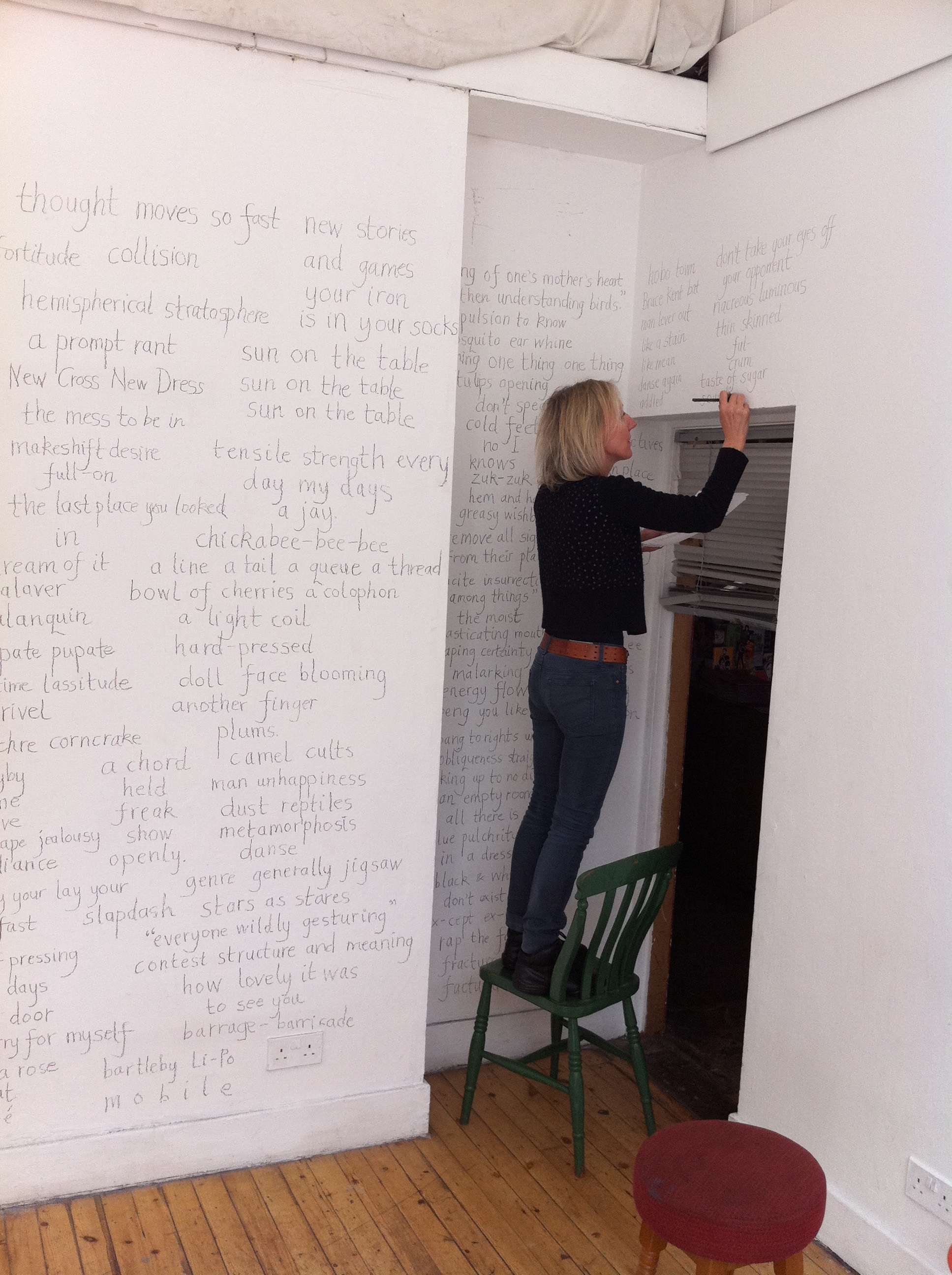
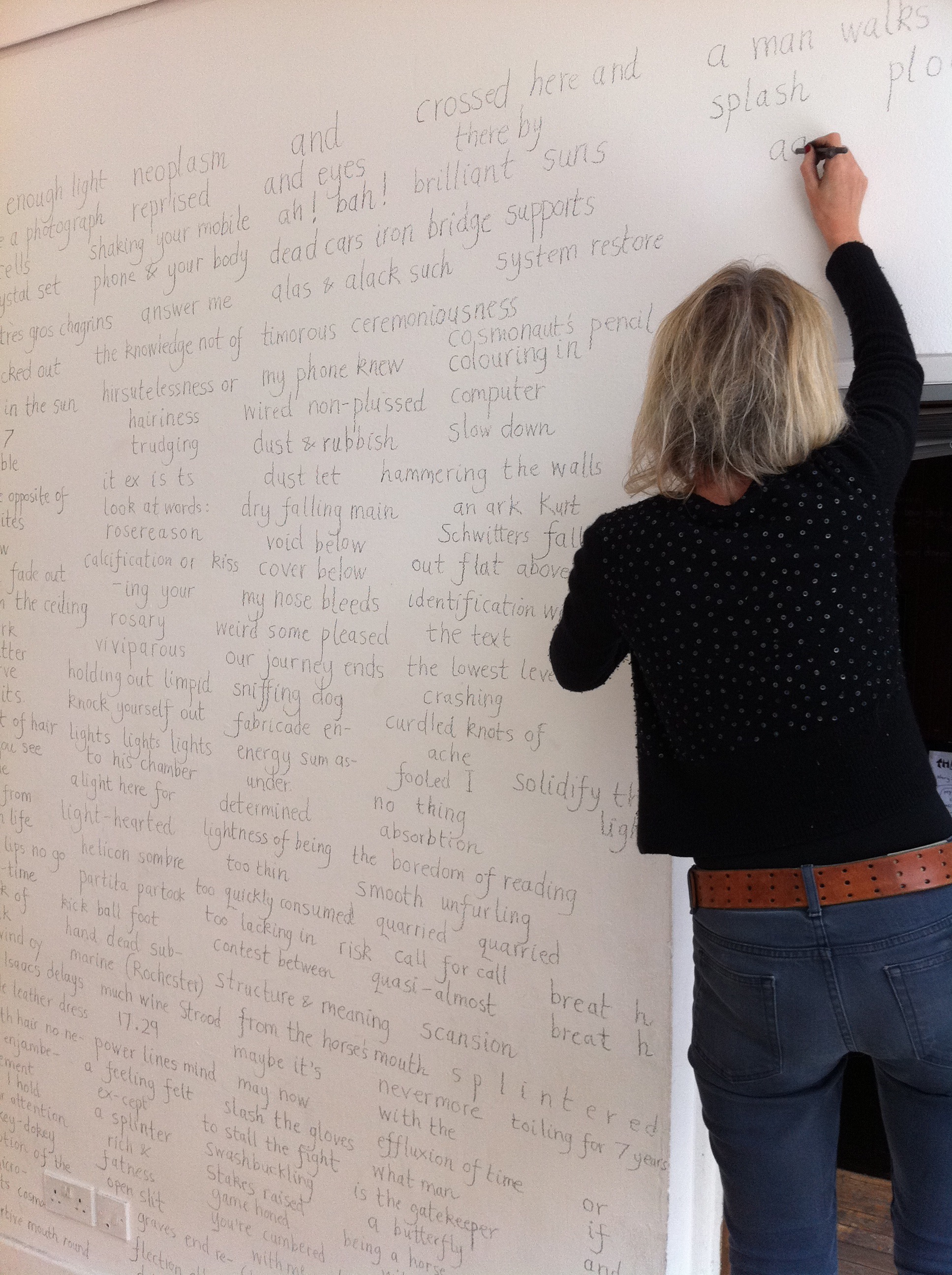
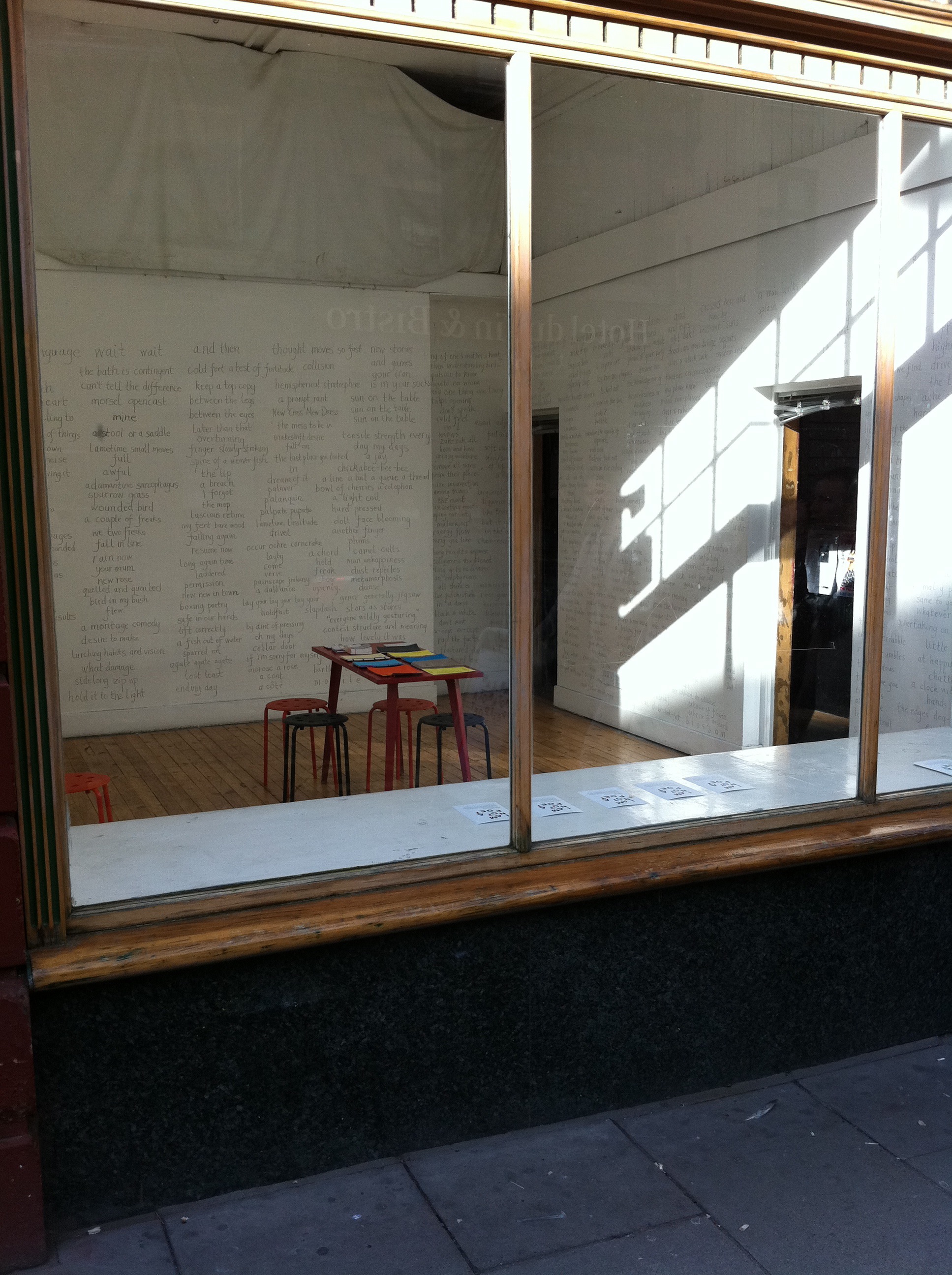
verysmallkitchen

Posts Tagged ‘art writing’

I AM NOT A POET: EMMA COCKER’S CLOSE READING (C.O.P.V, 1950)

In Uncategorized on August 9, 2011 at 8:37 pm


As part of I AM NOT A POET, VerySmallKitchen will feature online a number of films from its screening programme. The full festival of films is here.  This first online screening presents work by Emma Cocker. Emma writes:

Close Reading (C.O.P.V, 1950) is part of an ongoing series which investigates the practice of close reading or of an ‘explication de texte’. Here, close reading is not understood as the critical attention paid to the meaning of words themselves as signs, but is instead interested in those meanings produced by looking at words ‘close up’, through a process of visual magnification or close visual attention. Drawing on the Latin origins of the word explicare (as in explication de texte) which means to unfold, to fold out or set forth, within Cocker’s close reading words appear shifting and unstable, restless and unwilling to be stilled. The work looks towards the threshold where writing or text collapses into its component parts (ink and page); the point where the sense or legibility of a word is rendered illegible or nonsensical the closer it is attended to, as writing slips towards image.


I saw an early part of the work presented as part of Emma’s Close Reading/ Open Reading, a contribution to Writing (the) Space, at The Wild Pansy Press Project Space, Leeds on May 19th.

On that occasion Emma observed how a  “starting point or point of provocation” had been the following sentence from Olson’s 1950 poetics Projective Verse: “If I hammer, if I recall in, and keep calling in, the breath, the breathing as distinguished from the hearing, it is for cause, it is to insist upon a part that breath plays in verse.” She continued:

Close Reading / Open Reading investigates the capacity of methods of close attention for producing uncertainty, indeterminacy and formlessness rather than fixing or clarifying any single, stable meaning, where paradoxically perhaps, the more something becomes scrutinized the less it becomes known. Within my practice, processes of extraction, fragmentation, listing, footnoting and cross-referencing become used for generating ‘openings’ rather than conclusions, for appearing purposeful whilst remaining without clear or discernible intent…


… I envisage future experiments emerging from this presentations exploring the relationship between the practices of flitting and lingering (over a text)…

More of Emma’s work is here. Notes on Emma’s FIELD PROPOSALS for the  ART WRITING FIELD STATION are here.

I AM NOT A POET AUGUST 8TH: CREAMY LANGUAGE BY SEEKERS OF LICE

In Uncategorized on August 8, 2011 at 10:14 pm

VSK PROJECT: TAMARIN NORWOOD’S THE LOCATIONS OF SIX DOMESTIC FIGURES

In Uncategorized on August 5, 2011 at 9:16 pm

Figure 1. Cup

Figure 2. Felt-tips

Figure 3. Hole punch

Figure 4. Miscellaneous

Figure 5. Pot plants

Figure 6. Tubes


Figures 1–6 are excerpted from What The Matter Is (2009) by Tamarin Norwood, first broadcast March 2009 on Resonance 104.4FM.


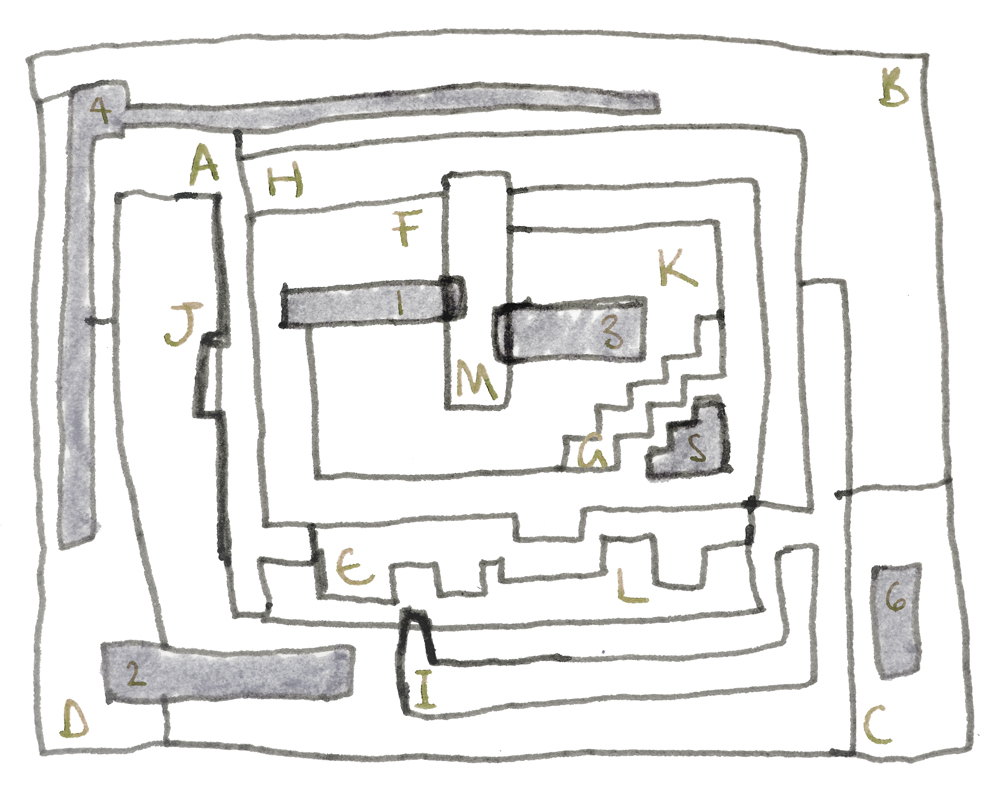
Figure A.

A utensil, once it has been damaged, becomes its own image (and sometimes an esthetic object: ‘those outmoded, fragmented, unusable, almost incomprehensible, perverse objects’ that Andre Breton loved). In this case, the utensil, no longer disappearing in its use, appears. This appearance of the object is that of resemblance and reflection: one might say it is its double. The category of art is linked to this possibility objects have of ‘appearing,’ that is, of abandoning themselves to pure and simple resemblance behind which there is nothing – except being. Only what has surrendered itself to the image appears, and everything that appears is, in this sense, imaginary.

Maurice Blanchot, “Two Versions of the Imaginary,” in The Gaze of Orpheus, ed. P. Adams Sitney, trans. Lydia Davis. New York: Station Hill Press, 1981 (original French 1943), pp.79-89: p.84


Figure B.

My life day to day was lived through ordinary actions and powerful emotions. But the more ordinary a day I lived, the more I lifted a child, conscious of nothing but the sweetness of a child’s skin, or the light behind an apple tree, or rain on slates, the more language and poetry came to my assistance. The words that had felt stilted, dutiful and decorative while I was a young and anxious poet, now sang and flew. Finally, I had joined together my life as a woman and a poet. And on the best days I lived as a poet. The language at the end of my day, when the children were asleep and the curtains drawn, was the language all through my day. It had waited for me. What that meant was crucial. For the first time as a poet I could believe in my life as the source of the language I used, and not the other way round. At last, I had the means to challenge what I believed had distorted the idea of the poet. The belief that poetry had the power to dignify and select a life, instead of the reverse. That a life, in other words, became important only because it was the subject matter for a poem.

Eavan Boland, A Journey with Two Maps: Becoming a Woman Poet. New York: WW Norton & Co, 2011


Figure C.

As they circulate through our lives, we look through objects (to see what they disclose about history, society, nature, or culture – above all, what they disclose about us), but we only catch a glimpse of the things. We look through objects because they are codes by which our interpretative attention makes them meaningful, because there is a discourse of objectivity that allows us to use them as facts. A thing, in contrast, can hardly function as a window. We begin to confront the thingness of objects when they stop working for us: when the drill breaks, when the car stalls, when the windows get filthy, when their flow within the circuits of production and distribution, consumption and exhibition, has been arrested, however momentarily. The story of objects asserting themselves as things, then, is the story of a changed relation to the human subject and thus the story of how the thing really names less an object than a particular subject-object relation.

Bill Brown, “Thing Theory,” Critical Inquiry, Vol. 28, No.1, special issue: Things. Autumn 2001, pp.1-22: p.4


Figure D.

What Twain helps us to recognize is how the accumulation of objects (and not the desire for the object) might be considered the (futile) effort to materialize that abstraction – to fill up that abstraction, as it were, with particular contents. ‘The House Beautiful’ chapter of Life on the Mississippi registers that effort with a five-page catalogue of objects: ‘ingrain carpet; mahogany centre-table; lamp on it, with green-paper shade. […] Other bric-a-brac […] quartz, with gold ward adhering; old Guinea-gold locket, with circlet of ancestral hair in it; Indian arrow-heads, of flint.’ Despite the hyperspecificity of the catalogue, these are simply the generic contents of the generic ‘residence of the principal citizen, all the way from the suburbs of New Orleans to the edge of St. Louis.’ However passionate the particularity, it has no particularizing point.

Bill Brown, “The Tyranny of Things,” Critical Inquiry, Vol. 28, No. 2. Winter 2002, pp.442-469


Figure E.

It is rare that a being who is not totally engrossed in his action is not mannered. Every personage who seems to tell you: ‘Look how well I cry, how well I become angry, how well I implore,’ is false and mannered. […] If you lose your feeling for the difference between the man who presents himself in society and the man engaged in action, between the man who is alone and the man who is looked at, throw your brushes into the fire. […] Whether you compose or act, think no more of the beholder than if he did not exist. Imagine, at the edge of the stage, a high wall that separates you from the orchestra. Act as if the curtain never rose.

Denis Diderot cited in Michael Fried, Absorption and Theatricality. Chicago IL: University of Chicago Press, 1988, pp.82-132


Figure F.

I’m put off by museums in general; they reek of a holy death which offends my sense of reality. […] Moreover […] most advanced art of the last half-dozen years is, in my view, inappropriate for Museum display. […] Museums do more than isolate such work from life, they subtly sanctify it and thus kill it.

Allan Kaprow 1967, cited in Allan Kaprow: Art as Life, eds Eva Meyer-Hermann et al. London: Thames & Hudson, 2008, p.70


Figure G.

[…] here is the ball park I perceive: an artist can

work within recognizable art modes and present the work in recognizable art contexts (e.g., paintings in galleries; poetry in poetry books; music in concert halls, etc.)

work in unrecognizable, i.e., nonart, modes but present the work in recognizable art contexts (e.g., pizza parlour in a gallery; a telephone book sold as poetry, etc.)

work in recognizable art modes but present the work in nonart contexts (eg., a “Rembrandt as an ironing board”; a fugue in an air-conditioning duct; a sonnet as a want ad, etc.)

work in nonart modes but present the work as art in nonart contexts (e.g., perception tests in a psychology lab; anti-erosion terracing in the hills; typewriter repairing; garbage collecting, etc. (with the proviso that the art world knows about it))

work in nonart modes and nonart contexts but cease to call the work art, retaining instead the private consciousness that sometimes it may be art, too (e.g., systems analysis; social work in a ghetto’ hitchhiking; thinking, etc.)

Allan Kaprow, “Nontheatrical Performance” (1976), in Essays on the Blurring of Art and Life. Berkeley CA: University of California Press, 2003, pp.175-176


Figure H.

Masahiro Mori, “The Uncanny Valley,” trans.  K. F. MacDorman & T. Minato (original Japanese “Bukimi No Tani.”) Energy, Vol. 7, No. 4. 1970, pp.33-35


Figure I.

Oscar Wilde’s unsettling epigram that being natural is a post isn’t too far away. Consciousness makes artifacts of us all. And so does the gallery, the transforming powers of which increase as modernism declines. The spectators in the late-modernist gallery are somehow artificial, aware of being aware – consciousness quoting itself. Though time in the white cube is always changing, the space gives the illusion that time is standing still, as if on a pedestal.

Brian O’Doherty, Studio and Cube: On the Relationship between where Art is Made and where Art is Displayed. New York: Columbia University Press, 2007, p.5


Figure J.

The idea of working in a ‘studio’ makes me uncomfortable, always has, as has thinking of myself as an ‘artist.’ Both terms presume that my motive is ‘to make art’ […] I don’t like to know where I’m going to end up before I begin. […] I tried having a studio only once, in 1985, when a sculptor friend and I rented an additional apartment in the Hell’s Kitchen building where we lived. For me, the experiment lasted just two weeks. I didn’t understand maintaining a separate room to which I was to ‘go and make my art.’ I hadn’t gone to art school and never got into the studio habit. Having a studio made my mind feel boxed-in.

David Robbins in The Studio Reader: On the Space of Artists, eds. Mary Jane Jacob and Michelle Grabner. Chicago and London: University of Chicago Press, 2010, p.261


Figure K.

Lucas Samaras,‘Room #1’ (1964)


Figure L.

This is what I have been thinking: for the most commonplace event to become an adventure, you must – and this is all that is necessary – start recounting it. This is what fools people: a man is always a teller of tales, he lives surrounded by his stories and the stories of others, he sees everything that happens to him through them; and he tries to live his life as though he were recounting it.

Jean-Paul Sartre, Nausea, trans. Robert Baldick. Harmondsworth: Penguin, 1965 (original French 1938), p.61


Figure M.

He began, very cautiously, to open his eyes, to see whether a gramophone was really there. But real things – real things were too exciting. He must be cautious. He would not go mad. First he looked at the fashion papers on the lower shelf, then gradually at the gramophone with the green trumpet. Nothing could be more exact. And so, gathering courage, he looked at the sideboard; the plate of bananas; the engraving of Queen Victoria and the Prince Consort, at the mantelpiece, with the jar of roses. None of these things moved. All were still; all were real.

Virginia Woolf, Mrs Dalloway. Oxford: Oxford University Press, 1998 (first published 1925)


*

More about about Tamarin’s work can be found here. Her VSK Chapook TEXT AS TOOLKIT: A Practical Handbook is here. Her exhibition THESE ARE NOT POEMS will be at the Totalkunst Gallery, Edinburgh August 17-19 2011 as part of I AM NOT A POET.

I AM HIDING IN A ROSE: SWEENEY REED & CONCRETE POETRY by LINDA SHORT

In Uncategorized on July 30, 2011 at 9:43 am

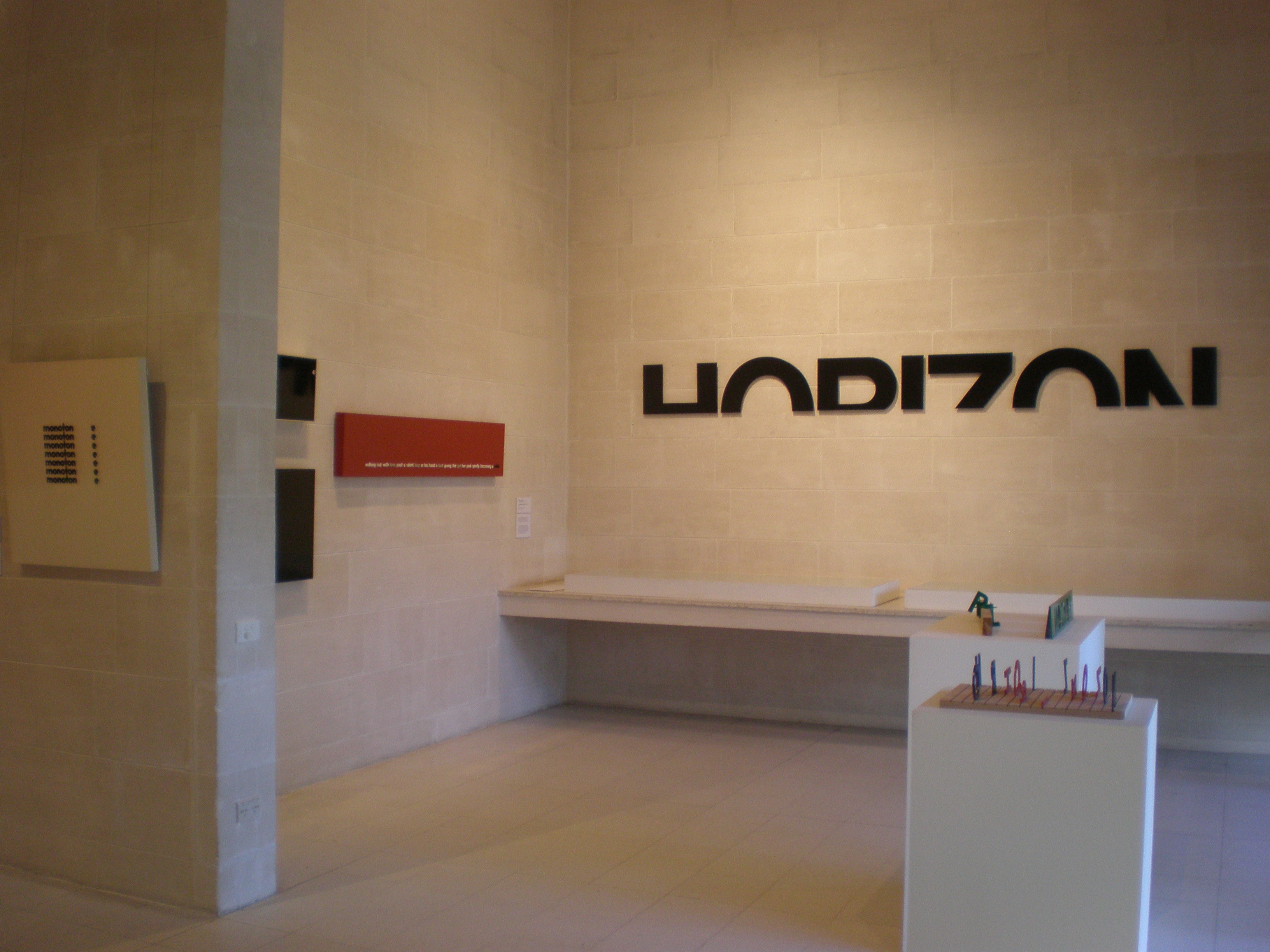
Born to Concrete Installation Heide II Heide Museum of Modern Art, Melbourne

Born to Concrete: The Heide Collection showcases the museum’s significant holdings of Concrete Poetry acquired over a period of thirty years, through the generosity of individual gifts and two important donations from the estates of editor and author Barrett Reid and concrete poet Sweeney Reed.

Sweeney Reed (1945–1979) is well-known as the son of celebrated modernist artists Joy Hester and Albert Tucker who was adopted as a child by art patrons and Heide founders, John and Sunday Reed. Born to Concrete explores the important contribution Reed himself made to the development of Australian art, as a practitioner, supporter and promoter of Concrete Poetry in the 1960s and 70s. The exhibition presents his work alongside that of his Australian contemporaries, while also considering the influence of international peers.

Alex Selenitsch monoton eeeeeee 1969 acrylic letters on enamel on composition board 71 x 69 x 4 cm Heide Museum of Modern Art, Melbourne Gift of Alex Selenitsch 2011 © the artist

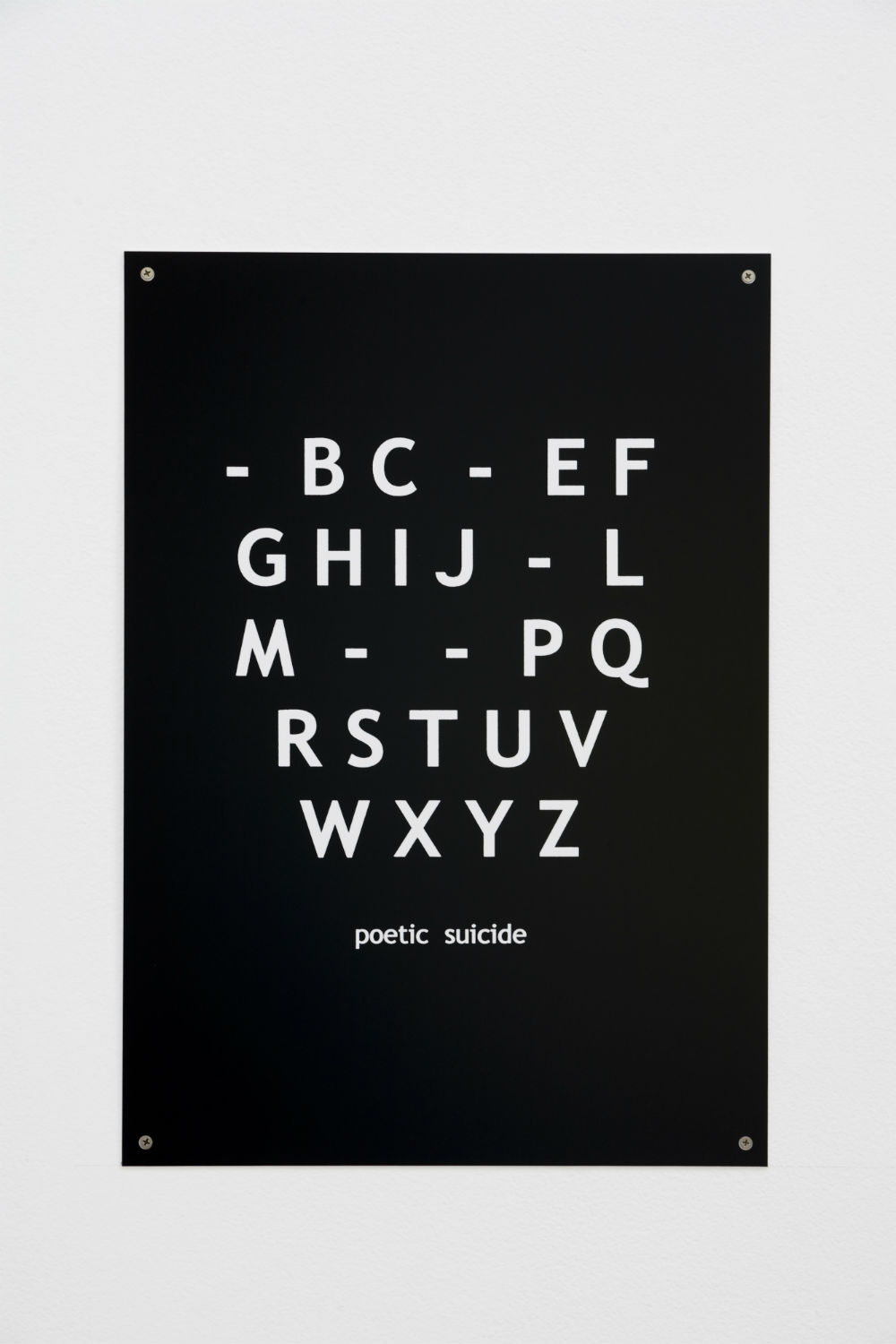
Aleks Danko Poetic Suicide engraving on gravoply 59 x 42 cm Courtesy of the artist and Sutton Gallery, Melbourne © the artist

Reed’s interest in art and poetry, preoccupations from  an early age, came together  in his practice as a concrete poet. A year spent in London from 1964–65 exposed him to the Concrete Poetry movement flourishing in Britain. He worked briefly at the Institute of Contemporary Arts, where he saw the influential ‘Between Poetry and Painting’ exhibition,[1] and established contact with a number of poets, notably Bob Cobbing, Bill Butler and Ian Hamilton Finlay. These experiences were significant for Reed’s future practice once back in Australia, and were imparted to other concrete poets whose engagement with international developments had been limited to imported books and journals. [2]

On his return to Melbourne, Reed fulfilled his aspiration to establish a gallery to promote the work of younger artists and poets. From 1966–69 he was the director of Strines Gallery in Carlton and from 1972–75 he operated the Sweeney Reed Gallery in Fitzroy. As well as holding exhibitions, Reed organised poetry readings and published prints, catalogues and books under his own publishing imprints. [3] In 1969, Reed invited Alex Selenitsch to present the first individual exhibition of Concrete Poetry in Australia at Strines, and a number of the works originally shown feature in Born to Concrete.

Following the closure of his galleries, in 1977 Reed enrolled at Melbourne’s Victorian College of the Arts to study printmaking, enabling him to realise many of his own poems in a concrete, material form. It was a prolific period for Reed during which he mastered complex experimental techniques and processes which he applied to prints and three-dimensional constructions. Many of these feature in Born to Concrete, a highlight being the artist’s most ambitious work, Impounded Illusion (Horizon) (1977), where large steel letters are set directly upon the wall. Represented by only the top half of each letter, the word ‘horizon’ appears to emerge from the cut of an horizon line.

In a 1977 press interview Reed revealed that the poem was inspired by the view from his Aspendale studio. His aim was to ‘capture the horizon … I wanted to remind people it’s here … We take this sort of thing too much for granted, you know.’ [4]

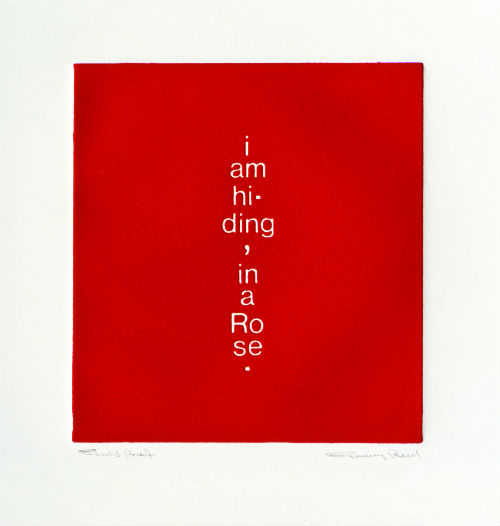
Sweeney Reed Rose I 1977 embossed etching 16.5 x 16.3 cm Heide Museum of Modern Art, Melbourne Gift of Pamela, Mishka and Danila McIntosh 1990 © Pamela McIntosh

The lyrical and expressive tendencies in Reed’s poetry  are also apparent in Rose I (1977), which is widely regarded as the artist’s signature work. Like many of Reed’s poems, it had been in gestation since early childhood, the subject of continued notation and distillation  in personal journals and sketchbooks. The arrangement of the words ‘I am hiding in a Rose’ visually reinforces the idea of concealment and enclosure expressed in the poem; the letters cascade down the page as if they  are folding in on themselves.

This poem also features at the centre of Reed’s Rosepoema (1975), embedded in a portrait of the modernist writer, Gertrude Stein. Stein’s often- quoted line, ‘a rose is a rose is a rose is a rose …’ [5] would have resonated with Reed, who placed great significance on the symbolism of the rose in his own work: ‘The Rose is as much a homageto E.E. Cummings as a personal statement. For me (and perhaps Gertrude Stein) the Rose is the centre of the universe—that is, taking the view that life is part of an on- going process of which birth and death are only part of the cycle, not the beginning and the end.’ [6]

For Reed, the rose represented many personal and philosophical associations: from the rose garden at Heide to his interest in the Buddhist belief of reincarnation. The motif is also explored inthe work of Ian Hamilton Finlay, who is regarded as Britain’s foremost concrete poet. Born to Concrete presents a key selection of Finlay’s early concrete poems, including a new acquisition for the Heide Collection: A Rock Rose (1971). In this and many of his works, Finlay makes links between flowers and the sea and in particular the rose as a common name for boats. Reed had a profound admiration for Finlay and sought to publish his work in Australia, a collaboration that is explored for the first time in the exhibition.

Alan Riddell Eclipse I 1969 screenprint 15/20 73.7 x 99 cm Heide Museum of Modern Art, Melbourne Gift of Ann Lewis 1989 © The Estate of Alan Riddell

NOTES

[1] The exhibition, curated by concrete poet (and Benedictine monk) Dom Sylvester Houédard, had a seminal influence on contemporary art in Australia and internationally.

[2] As a result of his travels, Sunday Reed’s Eastend Booksellers in Melbourne stocked recent publications of  international Concrete Poetry which were available to local artists and poets.

[3] Reed’s four publishing imprints were: Strines Publications; Still Earth Publications; Sweeney Reed Publications; and Overland Press  (the later by arrangement with Overland magazine).

[4] Sweeney Reed quoted in Barry MacFadyen, ‘A Place in the Sun’,  The Sun, 24 May 1977.

[5] The meaning most often attributed to Stein’s line is the notion that when   all is said and done, a thing is what it is.

[6] Sweeney Reed in ‘A-RANGE of Moments: notes on the years 1960–66’, in Missing Forms: Concrete, Visual and Experimental Poems, Collective Effort,  Melbourne, 1981, not paginated.

Curated by Katarina Paseta and Linda Short,  BORN TO CONCRETE: THE HEIDE COLLECTION is at the Heide Museum of Modern Art, Melborne 16 April-25 September 2011.  A commentary on the show by Michael Farrell appears in Jacket2 here.

READING NOTES: THE SOCIAL LIFE OF THE BOOK (1): OSCAR TUAZON MAKING BOOKS

In Uncategorized on July 29, 2011 at 3:23 pm

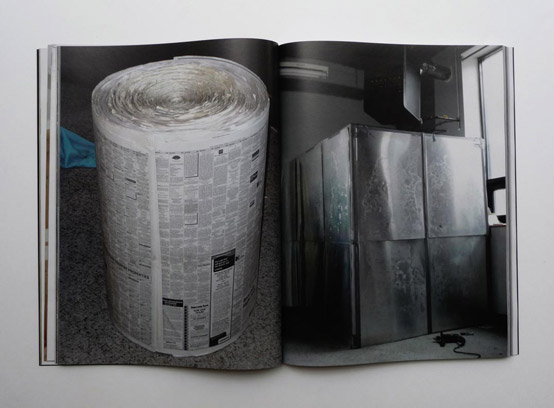
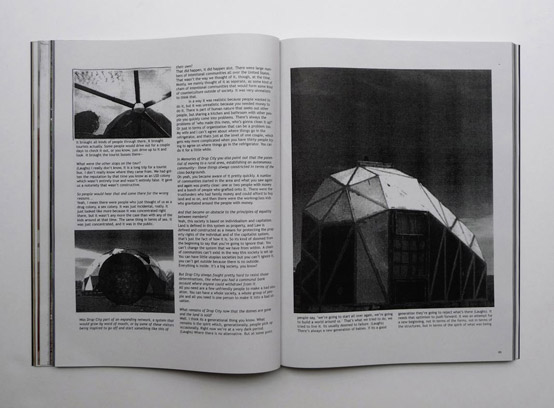
Page spread from Oscar Tuazon, I CAN'T SEE (Paraguay Press, 2010).


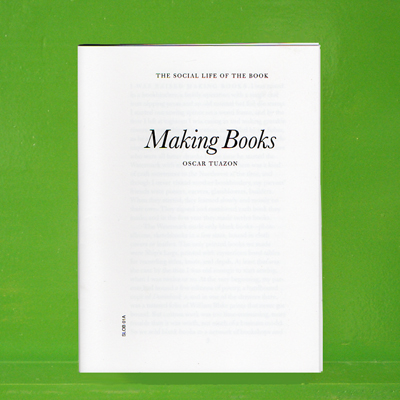
With a “publication structure” credited to Will Holder, The Social Life of the Book describes itself as “a monthly, subscription based series of original texts by writers, artists, publishers, designers, booksellers, etc., reflecting on reading, designing, publishing, and distributing books, today.” It is edited by castillo/corrales in Paris, and published through its Paraguay Press, Imprint.

The series begins with “Making Books”, an essay by Oscar Tuazon, a founding member of the gallery. Tuazon begins and ends his short text with accounts of book making: his parents bookbindery, principally producing blank books such as photo albums and sketchbooks; his own use of traditional bookmaking skills  to produce his two artist books, Dwelling Portably, and Leave Me Be.

Tuazon elegantly describes these experiences, but it is the model of the book and distribution that he unfolds from them that is where the pamphlet becomes provocative. His particular views emerge when discussing the blank books of his parents and how they were often used for private journal keeping. Noting “a completely onanistic model of production and distribution: write a book yourself, for yourself”, Tuazon goes on to sympathetically notice:

A book for an audience of one. A blank book is an anti-book. And it is this aspect that I actually find most interesting, the idea of producing a book not as a form of distribution or communication, but as an object. (6)

Tuazon goes on to explore various ways in which the book is a failure in 2011, unable to justify if you are looking for discussion or communication. Tuazon balances this against his involvement in publication projects like The Social Life of the Book  and Section 7 bookshop in Paris. Such spaces, he declares, function like commercial galleries, purveyors of rarified objects in that:

I don’t have many illusions about the bookshop as a place for discussion or debate, as a public space. It is a curated space… for a tiny, sophisticated public with extra money to spend on rare beautifully-crafted objects. (7)

I agree about the first this sentence, but I think there are other ways of responding than this quote’s conclusion…

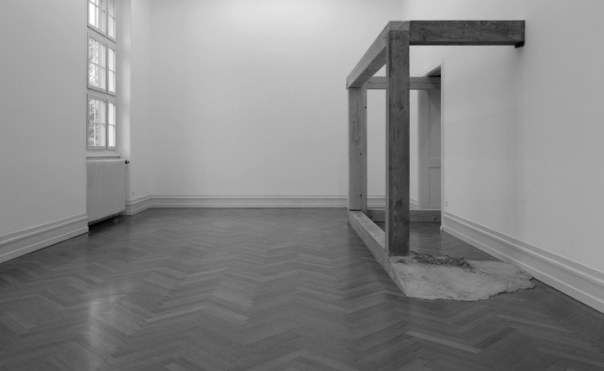
Oscar Tuazon, 2010. Photo by Dominique Uldry.

Tuazon’s notions of the book are usefully read as contemporary responses to two legacies of post-1960s art practices. One is the alignment of writing and sculpture, as practiced, for example, by Lawrence Weiner and Robert Smithson. Curiously, if that was about democratising the art work, through low price books and art work in magazines, Tuazon seems to share an urgency focussed upon printed matter, whilst moving – in economic and distribution terms – in the opposite direction.

This is partly due to his rejection of both writing and reading: “The craft of writing does not interest me.” (9) Tuazon says, also telling us he has recently finished writing a novel. Here, too, Tuazon enters into an historical debate where the artist relates to writing and the book by denying or destroying its function as distributed/ readable object (think, most famously, of Marcel Broodthaers and John Latham).

Oscar Tuazon, Dwelling Portably

Again key differences unfold in his/our contemporary moment. The repudiation of book as reading-writing object remains as some kind of rite of passage, but the object is not destroyed or literally digested, except in terms of distribution and through a heightened focus on the books sculptural properties. Some of Tuazon’s own comments are useful here (note how repudiating writing requires a carefully, crafted, refined prose style):

I consider the process of making a book – even writing it – like making a sculpture: I consider how it can or can’t be used, how it relates to an idea of function, what it looks like and how it feels, most of all how it gets built. And above all, making a book (like making a sculpture) is always a way of answering the question of why to make a book. Reanimating the corpse. (9)

Talking of poetry books his parents sometimes made for private clients:

This was a kind of ideal book, a book out of circulation, a useless object like a painting is useless. Painting started to get really interesting at about the time photography came along: when it was finally stripped of the last shreds of function, of any possibility of serving a public purpose, of communicating anything. Then it finally had to stand on its own, autonomous and abject, just a thing. Those volumes of poetry, unread and beautiful, narcissistic and perverse, onanistic, queer- that’s what a book wants to be. Autonomous and indifferent, an abstract book. (10)

There is an element of A Modest Proposal, or, more accurately, a desire to inhabit the perversity and paradox of this position. Of his own novel writing, for example, Tuazon comments how “The book itself needed to be invisible.” Likewise, when conceiving of a book version of Dwelling Portably, a survivalist newsletter published out of the Oregon woods by Burt and Holly Davis, and asked by its authors to make a book as lightweight and portable as possible, Tuazon instead re-publishes them as a “thick tome of a book, a bible, bound in black goatskin. It becomes funereal, finite, a kind of austere memorial to a hardcore lifestyle, somehow impenetrable… taken out of circulation.” (13)

Tuazon proposes such contradictions are how a contemporary practice of the book is achieved. Tuazon’s views on death-book and anti-book give a contemporary relevance to forms of book production that would lack that status otherwise, countering a history of artists publications unfolding out of the mimeo revolution, and inserting such styles into the discourses and markets of Tuazon’s art work and that of the castillo/ corrales gallery.

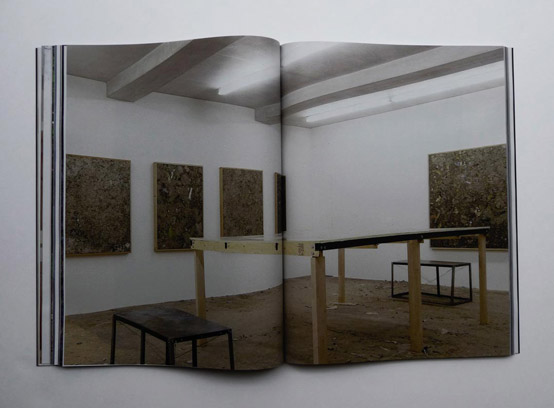
Page spreads from Oscar Tuazon, I CAN'T SEE (Paraguay Press, 2010)

This highlights  a number of tensions applying both to MAKING BOOKS and the whole field of art(ist)-led printed matter:

(1)Such an argument seeks to remove both reading and writing from the discourse of book making, and perhaps the book becomes a way of talking about graphic design and sculpture rather than writing.

(2)This position risks celebrating its failure to see publication as in anyway related to creating a public (for an alternative view see Mathew Stadtler’s talk here, from which this formulation is derived).

(3)The interest in a carefully curated space becomes a notion that the only option for printed matter is books costing upwards of 25 euros (or 5 euros for a 14 page essay, as here), and creating a culture where it feels wrong to questions such decisions about exclusive cost and distribution….

(4)I (want to) feel such texts always want a utopia by the back door, merely by the virtue of engaging in such activity. If that hope/ delusion is not present, the artist shifts from being an agent of gentrification to producing a gentrified version of the artist…

Leave Me Be No.3, 2009 Particle board Unique Artist´s book, No. 3 of 10 54 x 80 x 18 cm

If Making Books effectively raises these issues, it  leaves me uncertain about its precise position. There is also Making Books as I experience and encounter it, through a recent visit to Section 7 books in Paris, emerging with saddle stitched chapbook, ideal for transmission through gift and exchange, read in five minutes, acquiring form in conversation and in texts like this…

Section 7 was a welcoming place. We were given coffee and had a good conversation with the director about books and projects. They had some books I had been looking for for a long time, which I brought not as beautiful, luxury objects but because their contents fitted into work I am making/ thinking/ experiencing, its histories and consequences…

I’m thinking through how such desires relate to the arguments of Tuazon’s provocative text, how both positions entwine in contradiction and reciprocity through particular notions of materials and communication…

*

The next installment of The Social Life of the Book will be The Wet and The Dry by Moyra Davey. The colophon notes: “The series will be hand-bound annually, into a 192-page volume, whose edition is determined by demand. This currently stands at 15.” More information and orders here.

The book I found at Section 7 was the issue of the Swedish journal OEI (no 51 2010,) dedicated to Mary Ellen Solt, edited by Antonio Sergio Bessa. The book brings back into circulation Holt’s poetry and essays in a move that both gives provisional form to her own life work and opens up new materials/ ways of thinking about concrete poetry, particularly its lineage out of William Carlos Williams project of The American Idiom.

I AM NOT A POET: A FESTIVAL AT THE TOTALKUNST GALLERY, EDINBURGH 7-21st AUGUST 2011

In Uncategorized on July 28, 2011 at 1:33 pm


VerySmallKitchen and theTotalkunst Gallery, Edinburgh, present I AM NOT A POET, a 2 week festival exploring connections of language, writing and art practice. Beginning with conversations and lectures as part of AN EDINBURGH ZINE & SMALL PRESS FAIR on 7th August, I AM NOT A POET presents a series of three and one day exhibitions, alongside conversations, lectures, performances, publications, and screenings…

Artists include: Pete Cant, Magdalen Chua, Patrick Coyle, Alex Eisenberg, Jennie Guy, Colin Herd, Shandra Lamaute, Michelle Letowska, Marit Muenzberg, nick e-melville, Tamarin Norwood, Mary Paterson, Gerry Smith, seekers of lice. Curated by David Berridge (VerySmallKitchen) and Mirja Koponen (Totalkunst Gallery)

TotalKunst Gallery
3 Bristo Place
Edinburgh
EH1 1EY

*

Shandra Lamaute, Ideas of Beauty: Conversations, installation view

There are still some events to be confirmed, and the structure is open to events and projects that unfold as the two weeks develop so check back or follow the VerySmallKitchen twitter feed for updates. The programme of film screenings is here.

Queries, questions or consternations? Email verysmallkitchen@gmail.com. Not in Edinburgh? The festival will also have digital presence on this blog. The programme below is followed by some notes by the artists about individual projects. Thanks to Marit Muenzberg for the logo above…


PROGRAMME

August 7th

16.00 A conversation with Shandra Lamaute

17.00 I AM NOT A POET/ I’M A MINOR POET OF THE TWENTY-FIRST CENTURY, performance-lecture by seekers of lice.

August 8th

10- 22.00 – CREAMY LANGUAGE, seekers of lice. One day installation.

August 9th

10-18.00-  VerySmallKitchen THE SUMMER SCHOOL OF SILENCE.  Contributions from David Berridge, Magdelen Chua, Mirja Koponen, Mary Paterson, Michelle Letowska, and Kim Walker.

August 10th


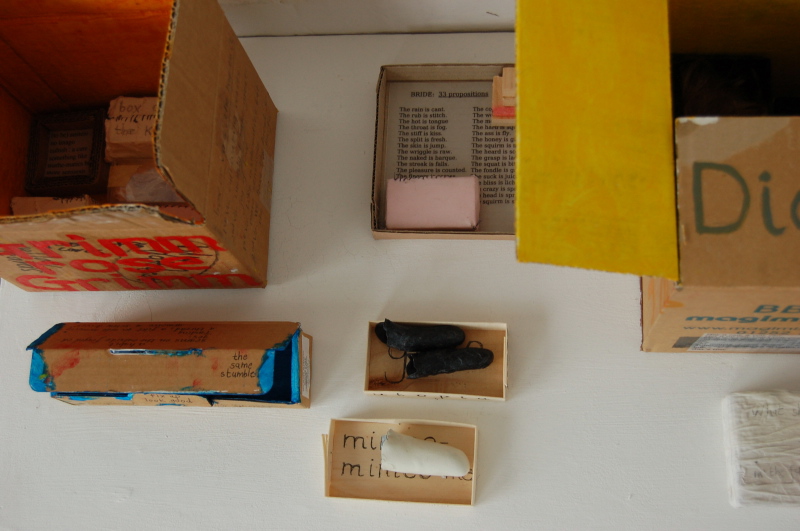
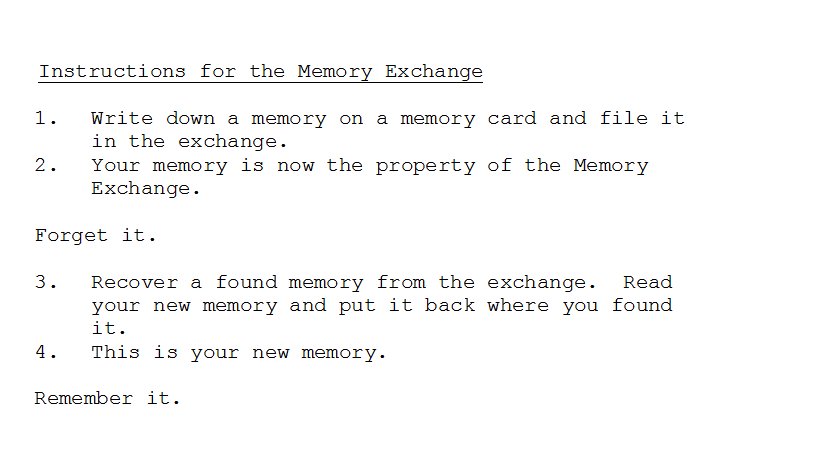
10-22.00- MEMORY EXCHANGE, Mary Paterson. One day performance installation. Come and exchange a memory.

10-22.00- Alex Eisenberg and Peter Cant, INSTRUCTIONS/ CONSTRUCTIONS 1 day installation-performance.

August 11-13th

10-22.00- Gerry Smith and Shandra Lamaute, three day joint exhibition.

August 12th  

14.00- 15.30pm. Conversation with Gerry Smith followed by Haikuisation workshop. Please bring a book of short stories (or borrow one from the Forest Cafe…).

August 14-16th

NOW THAT’S WHAT I CALL, Colin Herd. Three day exhibition.

Colin has curated a reading series at 5pm on each day of his exhibition :

14th 5pm- iain morrison
15th 5pm- posie rider
16th 5pm- surprise reading tbc

August 15th

15.30-16.00 Artist talk: Brody Condon on Level Five

August 17-19th

10-22.00- THESE ARE NOT POEMS by Tamarin Norwood, three day exhibition.

August 18th

18.00-22.00 Selected Crônicas by Jennie Guy (screening on a loop in the gallery).

August 19th

11-12.30 Writing, Exhibition, Curation. A conversation with Magdalen Chua (Project41) and Tamarin Norwood.

1.00-3.00pm Screening and discussion of Selected Crônicas by Jennie Guy and performance by Tamarin Norwood.

August 20th

10.00-22.00- editorial. nick e-melville, installation and performance.

August 21st

11-16.00 Concluding Lazy Publication Indoor Picnic. Readings, publications, performances, food and drink.


seekers of lice, installation view from WRITING/ EXHIBITION/ PUBLICATION at The Pigeon Wing, 2010

SOME NOTES BY THE ARTISTS


seekers of lice: Creamy Language

Creamy Language proceeds through association of sound, meaning, thought, and pattern of letters and words, following its own logic – or lack of it – in fits and starts – a specific energy keeping together a field.

Includes:  I am not a poet/ I’m a minor poet of the twentieth century. A talk- 59 index cards in no particular order.

I used to call myself an artist/ then someone said to me

“You’re not artist. At best you’re a minor poet and that’s much worse.”


seekers of lice, installation view from WRITING/ EXHIBITION/ PUBLICATION at The Pigeon Wing, 2010

Mary Paterson: Memory Exchange

Peter Cant & Alex Eisenberg, INSTRUCTIONS/ CONSTRUCTIONS


In September 2007 i went to New York.

Pete stayed in london.

In August 2011 pete will go to Edinburgh

I will stay in london.

This is a remote project.
A project where thinking of the other is enough.

It consists of ‘instructions’
That will always make ‘constructions’

Pete and Alex will not speak during the course of the project.

Colin Herd: Now That’s What I Call

Now That’s What I Call is a participatory sound-work and performance involving a c.d. sequence of 40 semi-improvised talk poems interrogating and riffing over the double c.d. pop music anthology Now That’s What I Call Music 26. The piece conflates the terms through which we think about poetry and pop music. The focus is on thinking about the mechanics of pop records and poems through techniques such as the hook, the bridge etc. Emphasis is on reading,  attention, consumption and digestion. The poems themselves are intended to mimic effects of pop music: throwaway, boring, repetitive, indulgent, cynical, clinical, intense, sexy etc.  Multiple walkmans will be available for gallery visitors to listen to the c.d.s. Through the exhibition, the complete text of lyrics from the c.d. will be transcribed as a kind of backing track of loops on scrolls around the gallery walls.

Gerry Smith from THE UNIVERSAL HISTORY III

Gerry Smith and Shandra Lamaute


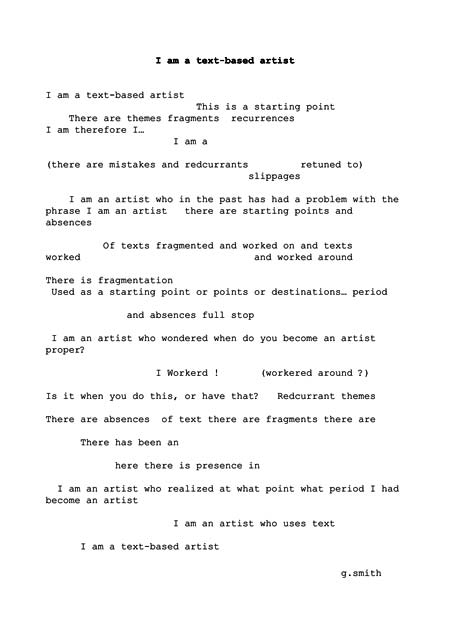
Gerry Smith writes: I am a text-based artist who has recently been working with reductive forms. The following works are exhibited:

Whilst Walking Past A Tall Building is a process piece in five articles and eight letters. I began the process by submitting a question to The Guardian’s Notes & Queries, and the piece consists of the answers that were published. Only structural edits were made, with no alteration to the contents. Hayley Jones, Graham Simpson, and Emily Streete provided the readings.

Breathe consists of three punctuation poems constructed from breves. The texts used are taken from Allan Kaprow’s Performing Life.

12 Haikuisations. These reductive works demonstrate the simple writing strategy of haikuisation. These texts are based upon works by the following authors:Nicolas Evans, Johann Wolfgang Von Goethe, Samantha Harvey. William Heiensen, M.R.James, A. L. Kennedy, Heinrich Von Kliest,Robert Maugham, William McIlvanney, Georges Simenon (twice) and Emma Smith.


Gerry Smith, i am a text-based artist (2010)


Shandra Lamaute writes: The sound pieces shown – Al-Qalam (The Pen) and Ideas of Beauty: Conversations – are two explorations of the communicative properties of how an object or a reflection of self has the ability to influence the ideologies associated with the societal norms of identity. Al-Qalam is derived from the experience of insertion whereby the user (myself) is assuming a role by engaging in an action—writing in Arabic with a traditional reed pen used for the art of Islamic Calligraphy—that is not culturally attributed to my identity or me. Ideas of Beauty: Conversations is an account of women’s ideas of beauty in relation to their identity and societal pressures.


Brody Condon

Artist Brody Condon introduces Level Five: a live performance event focused on critically exploring group therapy seminars from the 1970. This project is a commission for Abandon Normal Devices; a festival of experimental art and cinema, taking place across the Northwest of England in October

Artists, performers and members of the public are invited to participate in this physically and psychologically intense day-long performance that will loosely follow the structure of early Large Group Awareness Trainings, using live role playing techniques.  Level 5 is an investigation into the ideological legacy of this historical type of gathering and its influence on contemporary culture.

During his talk Brody will discuss key aspects of participation in Level 5 as well as his wider artistic practice. Space is limited, but Brody will be available to answer questions afterwards in Forest Cafe. For more info please contact Vanessa@andfestival.org.uk


Tamarin Norwood:  THESE ARE NOT POEMS

I am not a poet: these are not poems. They are things lined up on shelves. Domestic interiors reading left to right, sometimes with a rhyme at the end. This is a room and not a book of poems.

Tamarin Norwood is an artist and writer. In her work she identifies and extends exchanges between practice and everyday life; studio and gallery; word and thing.

Jennie Guy, Selected Crônicas, film still, 2011.


Jennie Guy:  Selected Crônicas


With as little vocal or physical direction as possible Jennie Guy uses video and sound recordings of a cast of willing readers set in a remote location to reenact the crônicas of Brazilian writer Clarice Lispector, originally published in the Jornal do Brasil between 1967 and 1973.


nick e-melville from FOUR SELF-PORTAITS


nick e-melville: editorial


Read all about it!  Recent news stories have shown how news can be manipulated from out of nowhere and reach everywhere.  Furthermore, in the media world August is usually known as silly season (because parliament is on holiday…).  On August 19th, three tabloids and three broadsheets of the day will be taped to the walls of the Total Kunst gallery.  Join poet nick-e melville as he attempts to make non-news from these newspapers.  Grab some tippex, or white paint, and start editing the news to create your own exposé.  Erase words and letters to create your own news, or even just a sequence of nonsensical words that don’t actually mean anything at all.

DEMOTIC ARCHIVES OF ART WRITING: JAMES BALDWIN’S STRANGER IN THE VILLAGE

In Uncategorized on July 24, 2011 at 11:06 pm

VerySmallKitchen writes: Reading the Glenn Ligon texts included in last week’s VSK HANDBOOK OF PERVERTED CIRUCMSTANCES, sent me back, as it should do, to James Baldwin’s “Stranger in The Village” essay, from his 1955 collection Notes of A Native Son. If Ligon’s painting was about both revealing and concealing, faith in and suspicion of the written word, its other gesture was less ambiguous: a prompt to return to Baldwin’s writing itself.

It seemed right, after this, to include Baldwin’s text as the latest installment of the DEMOTIC ARCHIVES OF ART WRITING. I was, however, aware how this text differed from the archives previous gestures of re-publication. Most texts – such as those by Richard Foreman, Thomas A Clark ,and Richard Kostelanetz – have been examples and propositions about certain histories of thought and practice, reclamations of texts and ideas around a broadly considered field of art writing.

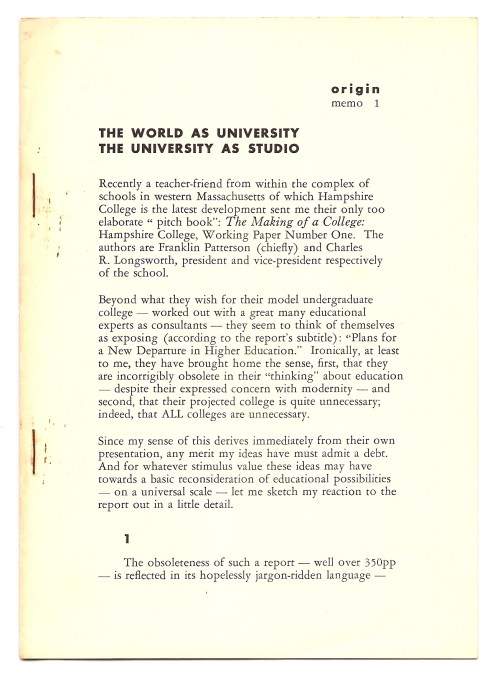
Other’s – such as Kenneth Tynan’s notes on the Berliner Ensemble – have fulfilled this role from a more outsider position. And come back to that Richard Kostelanetz post. It was as much about the role of the anthologist as it was about the text that was appended at post’s end, possibilities of the unavailable book. A pedagogy, then, in the manner of the Cid Corman THE WORLD AS UNIVERSITY/ UNIVERSITY AS STUDIO text that formed another installment of art writing archival demotic-ness.
Baldwin’s text functions, it seems, rather differently. I come to it at this moment having been much preoccupied how texts – by themselves and others – are  “recomposed and rechannelled” (20) by Dexter Sinister in, most recently, the pages of  Bulletins of The Serving Library #1. I wondered how the act of re-printing Baldwin relates to how Anthony Elms sums up Sinister’s practice in the Summer 2011 issue of Afterall:

The material of Dexter Sinister – not the format or the design, but the language used in the formats ,and think of the differing formats as one material: communication. Dexter Sinister transform what can be plainly transformed, industrially produced and/or distributed. Whatever offers an opporunity for formalised release, proving that a material in use equals a form in flux. This opportunity is manifested in multiplication: distribution and publishing an economy of making public, making multiple the locations of encounter and interpretation through changes in tone, style, format and context.

SOURCE: Anthony Elms, “A Flibbertigibbet, a Will-o’-the-wisp, a Clown (Or 10 Reasons Why Graphic Design Is Not The Issue), Afterall 27, Summer 2011, 45.
I wonder if the DEMOTIC ARCHIVE might be discovering itself to be the bad tempered version of this, indignant that the specificities of writers and writing, of literary practices and histories, are being negated through a discourse focused on multiplication, form in flux and communication. Re-printing Baldwin feels more about the continued potency of its content, of the particular history and struggle of this writer, than any shift of format.

I think I might be overstating this to try and introduce some new tonalities into the conversation. Literary history as thickening, then, recalling Ligon’s own workings of Baldwin in his coal dust paintings (illustrating the texts below) but also what  Joan Retallack talks about through her adoption of “poethics” rather than “poetics”:

A poetics can only take you so far without an h. If you’re to embrace complex life on earth, if you can no longer pretend that all things are fundamentally simple or elegant, a poetics thickened by an h launches an exploration of art’s significance as, not just about, a form of living in the real world. That as is not a simile; it’s an ethos. Hence the h. What I’m working on is quite explicitly a poethics of a complex realism.

This quote is from an inteview in Retallack’s The Poethical Wager essay collection, although it is copied here from Adam Pendleton’s grey-blue grain, an artist books that appropriates several quotations from the interview as structural foundation for its own page-based gatherings and unfoldings.

Pendleton_03

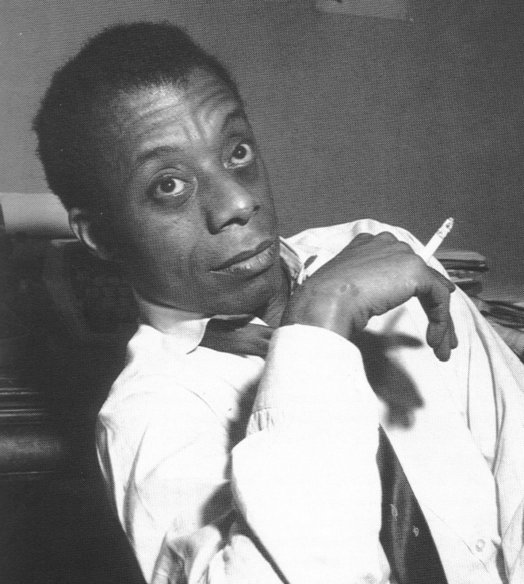
JAMES BALDWIN “STRANGER IN THE VILLAGE”

From all available evidence no black man had ever set foot in this tiny Swiss village before I came. I was told before arriving that I would probably be a “sight” for the village; I took this to mean that people of my complexion were rarely seen in Switzerland, and also that city people are always something of a “sight” outside of the city. It did not occur to me-possibly because I am an American-that there could be people anywhere who had never seen a Negro.

It is a fact that cannot be explained on the basis of the inaccessibility of the village. The village is very high, but it is only four hours from Milan and three hours from Lausanne. It is true that it is virtually unknown. Few people making plans for a holiday would elect to come here. On the other hand, the villagers are able, presumably, to come and go as they please – which they do: to another town at the foot of the mountain, with a population of approximately five thousand, the nearest place to see a movie or go to the bank. In the village there is no movie house, no bank, no library, no theater; very few radios, one jeep, one station wagon; and at the moment, one typewriter, mine, an invention which the woman next door to me here had never seen. There are about six hundred people living here, all Catholic- I conclude this from the fact that the Catholic church is open all year round, whereas the Protestant chapel, set off on a hill a little removed from the village, is open only in the summertime when the tourists arrive. There are four or five hotels, all closed now, and four or five bistros, of which, however, only two do any business during the winter. These two do not do a great deal, for life in the village seems to end around nine or ten o’clock. There are a few stores, butcher, baker, epicerie, a hardware store, and a money-changer-who cannot change travelers’ checks, but must send them down to the bank, an operation which takes two or three days. There is something called the Ballet Haus, closed in the winter and used for God knows what, certainly not ballet, during the summer. There seems to be only one schoolhouse in the village, and this for the quite young children; I suppose this to mean that their older brothers and sisters at some point descend from these mountains in order to complete their education-possibly, again, to the town just below. The landscape is absolutely forbidding, mountains towering on all four sides, ice and snow as far as the eye can reach. In this white wilderness, men and women and children move all day, carrying washing, wood, buckets of milk or water, sometimes skiing on Sunday afternoons. All week long boys and young men are to be seen shoveling snow off the rooftops, or dragging wood down from the forest in sleds.

The village’s only real attraction, which explains the tourist season, is the hot spring water. A disquietingly high proportion of these tourists are cripples, or semi- cripples, who come year after year-from other parts of Switzerland, usually-to take the waters. This lends the village, at the height of the season, a rather terrifying air of sanctity, as though it were a lesser Lourdes. There is often something beautiful, there is always something awful, in the spectacle of a person who has lost one of his faculties, a faculty he never questioned until it was gone, and who struggles to recover it. Yet people remain people, on crutches or indeed on deathbeds; and wherever I passed, the first summer I was here, among the native villagers or among the lame, a wind passed with me-of astonishment, curiosity, amusement and outrage. That first summer I stayed two weeks and never intended to return. But I did return in the winter, to work; the village offers, obviously, no distractions whatever and has the further advantage of being extremely cheap. Now it is winter again, a year later, and I am here again. Everyone in the village knows my name, though they scarcely ever use it, knows that I come from America though, this, apparently, they will never really believe: black men come from Africa-and everyone knows that I am the friend of the son of a woman who was born here, and that I am staying in their chalet. But I remain as much a stranger today as I was the first day I arrived, and the children shout Neger! Neger! as I walk along the streets.

It must be admitted that in the beginning I was far too shocked to have any real reaction. In so far as I reacted at all, I reacted by trying to be pleasant-it being a great part of the American Negro’s education (long before he goes to school) that he must make people like him. This smile-and-the world-smiles-with-you routine worked about as well in this situation as it had in the situation for which it was designed, which is to of phenomenon which allowed them to see my teeth-they did not, really, see my smile and I began to think that, should I take to snarling, no one would notice any difference. All of the physical characteristics of the Negro which had caused me, in America, a very different and almost forgotten pain were nothing less than miraculous-or infernal-in the eyes of the village people. Some thought my hair was the color of tar, that it had the texture of wire, or the texture of cotton. It was jocularly suggested that I might let it all grow long and make myself a winter coat. If I sat in the sun for more than five minutes some daring creature was certain to come along and gingerly put his fingers on my hair, as though he were afraid of an electric shock, or put his hand on my hand, astonished that the color did not rub off. In all of this, in which it must be conceded there was the charm of genuine wonder and in which there were certainly no element of intentional unkindness, there was yet no suggestion that I was human: I was simply a living wonder.

I knew that they did not mean to be unkind, and I know it now; it is necessary, nevertheless, for me to repeat this to myself each time that I walk out of the chalet. The children who shout Neger! have no way of knowing the echoes this sound raises in me. They are brimming with good humor and the more daring swell with pride when I stop to speak with them. Just the same, there are days when I cannot pause and smile, when I have no heart to play with them; when, indeed, I mutter sourly to myself, exactly as I muttered on the streets of a city these children have never seen, when I was no bigger than these children are now: Your mother was a nigger. Joyce is right about history being a nightmare-but it may be the nightmare from which no one can awaken. People are trapped in history and history is trapped in them.

There is a custom in the village- I am told it is repeated in many villages- of buying African natives for the purpose of converting them to Christianity. There stands in the church all year round a small box with a slot for money, decorated with a black figurine, and into this box the villagers drop their francs. During the carnival which precedes Lent, two village children have their faces blackened-out of which bloodless darkness their blue eyes shine like ice-and fantastic horsehair wigs are placed on their blond heads; thus disguised, they solicit among the villagers for money for the missionaries in Africa. Between the box in the church and blackened children, the IJ village “bought” last year six or eight African natives. This was reported to me with pride by the wife of one of the bistro owners and I was careful to express astonishment and pleasure at the solicitude shown by the village for the souls of black folks. The bistro owner’s wife beamed with a pleasure far more genuine than my own and seemed to feel that I might now breathe more easily concerning the souls of at least six of my kinsmen.

I tried not to think of these so lately baptized kinsmen, of the price paid for them, or the peculiar price they themselves would pay, and said nothing about my father, who having taken his own conversion too literally never, at bottom, forgave the white world (which he described as heathen) for having saddled him with a Christ in whom, to judge at least from their treatment of him, they themselves no longer believed. I thought of white men arriving for the first time in an African village, strangers there, as I am a stranger here, and tried to imagine the astounded populace touching their hair and marveling at the color of their skin. But there is a great difference between being the first white man to be seen by Africans and being the first black man to be seen by whites. The white man takes the astonishment as tribute, for he arrives to conquer and to convert the natives, whose inferiority in relation to himself is not even to be questioned; whereas I, without a thought of conquest, find myself among a people whose culture controls me, has even, in a sense, created me, people who have cost me more in anguish and rage than they will ever know, who yet do not even know of my existence. The astonishment, with which I might have greeted them, should they have stumbled into my African village a few hundred years ago, might have rejoiced their hearts. But the astonishment with which they greet me today can only poison mine.

And this is so despite everything I may do to feel differently, despite my friendly conversations with the bistro owner’s wife, despite their three-year-old son who has at last become my friend, despite the saluts and bonsoirs which I exchange with people as I walk, despite the fact that I know that no individual can be taken to task for what history is doing, or has done. I say that the culture of these people controls me-but they can scarcely be held responsible for European culture. America comes out of Europe, but these people have never seen America, nor have most of them seen more of Europe than the hamlet at the foot of their mountain. Yet they move with an authority which I shall never have; and they regard me, quite rightly, not only as a stranger in the village but as a suspect latecomer, bearing no credentials, to everything they have-however unconsciously-inherited.

For this village, even were it incomparably more remote and incredibly more primitive, is the West, the West onto which I have been so strangely grafted. These people cannot be, from the point of view of power, strangers anywhere in the world; they have made the modem world, in effect, even if they do not know it. The most illiterate among them is related, in away that I am not, to Dante, Shakespeare, Michelangelo, Aeschylus, Da Vinci, Rembrandt, and Racine; the cathedral at Chartres says something to them which it cannot say to me, as indeed would New York’s Empire State Building, should anyone here ever see it. Out of their hymns and dances come Beethoven and Bach. Go back a few centuries and they are in their full glory-but I am in Africa, watching the conquerors arrive.

The rage of the disesteemed is personally fruitless, but it is also absolutely inevitable: the rage, so generally discounted, so little understood even among the people whose daily bread it is, is one of the things that makes history. Rage can only with difficulty, and never entirely, be brought under the domination of the intelligence and is therefore not susceptible to any arguments whatever. This is a fact which ordinary representatives of the Herrenvolk, having never felt this rage and being unable to imagine, quite fail to understand. Also, rage cannot be hidden, it can only be dissembled. This dissembling deludes the thoughtless, and strengthens rage and adds, to rage, contempt. There are, no doubt, as many ways of coping with the resulting complex of tensions as there are black men in the world, but no black man can hope ever to be entirely liberated from this internal warfare-rage, dissembling, and contempt having inevitably accompanied his first realization of the power of white men. What is crucial here is that since white men represent in the black man’s world so heavy a weight, white men have for black men a reality which is far from being reciprocal; and hence all black men have toward all white men an attitude which is designed, really, either to rob the white man of the jewel of his naiveté, or else to make it cost him dear.

The black man insists, by whatever means he finds at his disposal, that the white man cease to regard him as an exotic rarity and recognize him as a human being. This is a very charged and difficult moment, for there is a great deal of will power involved in the white man’s naiveté. Most people are not naturally reflective any more than they are naturally malicious, and the white man prefers to keep the black man at a certain human remove because it is easier for him thus to preserve his simplicity and avoid being called to account for crimes committed by his forefathers, or his neighbors. He is inescapably aware, nevertheless, that he is in a better position in the world than black men are, nor can he quite put to death the suspicion that he is hated by black men therefore. He does not wish to be hated, neither does he wish to change places, and at this point in his uneasiness he can scarcely avoid having recourse to those legends which white men have created about black men, the most usual effect of which is that the white man finds himself enmeshed, so to speak, in his own language which describes hell, as well as the attributes which lead one to hell, as being as black as night.

Every legend, moreover, contains its residuum of truth, and the root function of language is to control the universe by describing it. It is of quite considerable significance that black men remain, in the imagination, and in overwhelming numbers in fact, beyond the disciplines of salvation; and this despite the fact that the West has been “buying” African natives for centuries. There is, I should hazard, an instantaneous necessity to be divorced from this so visibly unsaved stranger, in whose heart, moreover , one cannot guess what dreams of vengeance are being nourished; and, at the same time, there are few things on earth more attractive than the idea of the unspeakable liberty which is allowed the unredeemed. When, beneath the black mask, a human being begins to make himself felt one cannot escape a certain awful wonder as to what kind of human being it is. What one’s imagination makes of other people is dictated, of course, by the Master race laws of one’s own personality and it’s one of the ironies of black-white relations that, by means of what the white man imagines the black man to be, the black man is enabled to know who the white man is.

I have said, for example, that I am as much a stranger in this village today as I was the first summer I arrived, but this is not quite true. The villagers wonder less about the texture of my hair than they did then, and wonder rather more about me. And the fact that their wonder now exists on another level is reflected in their attitudes and in their eyes. There are the children who make those delightful, hilarious, sometimes astonishingly grave overtures of friendship in the unpredictable fashion of children; other children, having been taught that the devil is a black man, scream in genuine anguish as I approach. Some of the older women never pass without a friendly greeting, never pass, indeed, if it seems that they will be able to engage me in conversation; other women look down or look away or rather contemptuously smirk. Some of the men drink with me and suggest that I learn how to ski-partly, I gather, because they cannot imagine what I would look like on skis-and want to know if I am married, and ask questions about my metier. But some of the men have accused le sale negre-behind my back-of stealing wood and there is already in the eyes of some of them that peculiar, intent, paranoiac malevolence which one sometimes surprises in the eyes of American white men when, out walking with their Sunday girl, they see a Negro male approach.

There is a dreadful abyss between the streets of this village and the streets of the city in which I was born, between the children who shout Neger! today and those who shouted Nigger! yesterday-the abyss is experience, the American experience. The syllable hurled behind me today expresses, above all, wonder: I am a stranger here. But, I am not a stranger in America and the same syllable riding on the American air expresses the war my presence has occasioned in the American soul.

For this village brings home to me this fact: that there was a day, and not really a very distant day, when Americans were scarcely Americans at all but discontented Europeans, facing a great unconquered continent and strolling, say, into a marketplace and seeing black men for the first time. The shock this spectacle afforded is suggested, surely, by the promptness with which they decided that these black men were not really men but cattle. It is true that the necessity on the part of the settlers of the New World of reconciling their moral assumptions with the fact -and the necessity-of slavery enhanced immensely the charm of this idea, and it is also true that this idea expresses, with a truly American bluntness, the attitude which to varying extents all masters have had toward all slaves.

But between all former slaves and slave-owners and the drama which begins for Americans over three hundred years ago at Jamestown, there are at least two differences to be observed. The American Negro slave could not suppose, for one thing, as slaves in past epochs had supposed and often done, that he would ever be able to wrest the power from his master’s hands. This was a supposition which the modern era, which was to bring about such vast changes in the aims and dimensions of power, put to death; it only begins in unprecedented fashion, and with dreadful implications, to be resurrected, today. But even had this supposition persisted with undiminished force, the American Negro slave could not have used it to lend his condition dignity, for the reason that this J supposition rests on another: that the slave in exile yet remains related to his past, has some means-if only in memory-of revering and sustaining the forms of his former life, is able, in short, to maintain his identity.

This was not the case with the American Negro slave. He is unique among the black men of the world in that his past was taken from him, almost literally, at one blow. One wonders what on earth the first slave found to say to the first dark child he bore. I am told that there are Haitians able to trace their ancestry back to African kings, but any American Negro wishing to go back so far will find his journey through time abruptly arrested by the signature on the bill of sale which served as the entrance paper for his ancestor. At the time-to say nothing of the circumstances-of the enslavement of the captive black man who was to become the American Negro, there was not the remotest possibility that he would ever take power from his master’s hands. There was no reason to suppose that his situation would ever change, nor was there, shortly, anything to indicate that his situation had ever been different. It was his necessity, in the words of E. Franklin Frazier, to find a “motive for living under American culture or die.” The identity of the American Negro comes out of this extreme situation, and the evolution of this identity was a source of the most intolerable anxiety in the minds and the lives of his masters.

For the history of the American Negro is unique also in this: that the question of his humanity, and of his rights therefore as a human being, became a burning one for several generations of Americans, so burning a question that it ultimately became one of those used to divide the nation. It is out of this argument that the venom of the epithet: Nigger! is derived. It is an argument which Europe has never had, and hence Europe: quite sincerely fails to understand how or why the argument arose in the first place, why its effects are frequently disastrous and always so unpredictable, why it refuses until today to be entirely settled. Europe’s black possessions remained-and do remain-in Europe’s colonies, at which remove they represented no threat whatever to European identity. If they posed any problem at all for the European conscience, it was a problem which remained comfortingly abstract: in effect, the black man, as a man, did not exist for Europe. But in America, even as a slave, he was an inescapable part of the general social fabric and no American could escape having an attitude toward him. Americans attempt until today to make an abstraction of the Negro, but the very nature of these abstractions reveals the tremendous effects the presence of the Negro has had on the American character.

When one considers the history of the Negro in America it is of the greatest importance to recognize that the moral beliefs of a person, or a people, are never really as tenuous as life-which is not moral-very often causes them to appear; these create for them a frame of reference and a necessary hope, the hope being that when life has done its worst they will be enabled to rise above themselves and to triumph over life. Life would scarcely be bearable if this hope did not exist. Again, even when the worst has been said, to betray a belief is not by any means to have put oneself beyond its power; the betrayal of a belief is not the same thing as ceasing to believe. If this were not so there would be no moral standards in the world at all. Yet one must also recognize that morality is based on ideas and that all ideas are dangerous-dangerous because ideas can only lead to action and where the action leads no man can say. And dangerous in this respect: that confronted with the impossibility of remaining faithful to one’s beliefs, and the equal impossibility of becoming free of them, one can be driven to the most inhuman excesses. The ideas on which American beliefs are based are not, though Americans often seem to think so, ideas which originated in America. They came out of Europe. And the establishment of democracy on the American continent was scarcely as radical a break with the past as was the necessity, which Americans faced, of broadening this concept to include black men.

This was, literally, a hard necessity. It was impossible, for one thing, for Americans to abandon their beliefs, not only because these beliefs alone seemed able to justify the sacrifices they had endured and the blood that they had spilled, but also because these beliefs afforded them their only bulwark against a moral chaos as absolute as the physical chaos of the continent it was their destiny to conquer. But in the situation in which Americans found themselves, these beliefs threatened an idea which, whether or not one likes to think so, is the very warp and woof of the heritage of the West, the idea of white supremacy.

Americans have made themselves notorious by the shrillness and the brutality with which they have insisted on this idea, but they did not invent it; and it has escaped the, world’s notice that those very excesses of which Americans have been guilty imply a’ certain, unprecedented uneasiness over the idea’ s life and power, if not, indeed, the idea’ s validity .The idea of white supremacy rests simply on the fact that white men are the creators of civilization (the present civilization, which is the only one that matters; all previous civilizations are simply contributions” to our own) and are therefore civilization’s guardians and defenders. Thus it was impossible for Americans to accept the black man as one of themselves, for to do so was to jeopardize their status as white men. But not so to accept him was to deny his human reality, his human weight and complexity, and the strain of denying the overwhelmingly undeniable forced Americans into rationalizations so fantastic that they approached the pathological.

At the root of the American Negro problem is the necessity of the American white man to find a way of living with the Negro in order to be able to live with himself.And the history of this problem can be reduced to the means used by Americans-lynch law: and law, segregation and legal acceptance, terrorization and concession-either to come; to terms with this necessity , or to find a way around it, or (most usually) to find away of doing both these things at once. The resulting spectacle, at once foolish and dreadful, led someone to make the quite accurate observation that “the Negro-in-America is a form of insanity which overtakes white men.”

In this long battle, a battle by no means finished, the unforeseeable effects of which will be felt by many future generations, the white man’s motive was the protection of his identity; the black man was motivated by the need to establish an identity .And despite the terrorization which the Negro in America endured and endures sporadically until today, despite the cruel and totally inescapable ambivalence of his status in his country , the battle for his identity has long ago been won. He is not a visitor to the West, but a citizen there, an American; as American as the Americans who despise him, the Americans who fear him, the Americans who love him-the Americans who became less than themselves, or rose to be greater than themselves by virtue of the fact that the challenge he represented was inescapable. He is perhaps the only black man in the world whose relationship to white men is more terrible, more subtle, and more meaningful than the relationship of bitter possessed to uncertain possessors. His survival depended, and his development depends, on his ability to turn his peculiar status in the Western world to his own advantage and, it may be, to the very great advantage of that world. It remains for him to fashion out of his experience that which will give him sustenance, and a voice. The cathedral at Chartres, I have said, says something to the people of this village which it cannot say to me; but it is important to understand that, this cathedral says something to me which it cannot say to them. Perhaps they are struck by the power of the spires, the glory of the windows; but they have known God, after all, longer than I have known him, and in a different way, and I am terrified by the slippery bottomless well to be found in the crypt, down which heretics were hurled to death, and by the obscene, inescapable gargoyles jutting out of the stone and seeming to say that God and the devil can never be divorced. I doubt that the villagers think of the devil when they face a cathedral because they have never been identified with the devil. But I must accept the status which myth, if nothing else, gives me in the West before I can hope to change the myth.

Yet, if the American Negro has arrived at his identity by virtue of the absoluteness of his estrangement from his past, American white men still nourish the illusion that there is some means of recovering the European innocence, of returning to a state in which black men do not exist. This is one of the greatest errors Americans can make. The identity they fought so hard to protect has, by virtue of that battle, undergone a change: Americans are as unlike any other white people in the world as it is possible to be. I do not think, for example, that it is too much to suggest that the American vision of the world-which allows so little reality, generally speaking, for any of the darker forces in human life, which tends until today to paint moral issues in glaring black and white-owes a great deal to the battle waged by Americans to maintain between themselves and black men a human separation which could not be bridged. It is only now beginning to be borne in on us-very faintly, it must be admitted, very slowly, and very much against our will–that this vision of the world is dangerously inaccurate, and perfectly useless. For it protects our moral high-mindedness at the terrible expense of weakening our grasp of reality. People who shut their eyes to reality simply invite their own destruction, and anyone who insists on remaining in a state of innocence long after that innocence is dead turns himself into a monster.

The time has come to realize that the interracial drama acted out on the American continent has not only created a new black man, it has created a new white man, too. No road whatever will lead Americans back to the simplicity of this European village where white men still have the luxury of looking on me as a stranger. I am not, really, a stranger any longer for any American alive. One of the things that distinguishes Americans from other people is that no other people has ever been so deeply involved in the lives of black men, and vice versa. This fact faced, with all its implications, it can be seen that the history of the American Negro problem is not merely shameful, it is also something of an achievement. For even when the worst has been said, it must also be added that the perpetual challenge posed by this problem was always, somehow, perpetually met. It is precisely this black-white experience which may prove of indispensable value to us in the world we face today. This world is white no longer, and it will never be white again.

*

The images accompanying Baldwin’s essay are from Glenn Ligon’s OFF BOOK exhibition at Regen Projects II, Los Angeles, Dec 12 2009-  Jan 23 2010. Full images and installation views can be seen here.

VSK CHAPBOOK: FIONA TEMPLETON’S FOURTH THING

In Uncategorized on July 14, 2011 at 12:01 am


The latest VerySmallKitchen chapbook is Fiona Templeton’s Fourth thing, which is available for online consumption and PDF download here.
The chapbook is one installment of Fiona’s project 6 Things, part of the exhibition Archipelago at the Cafe Gallery in Southwark Park (11 Jun-17 July 2011). The score for this project is as follows:


Each week of the 6-week exhibition Archipelago I will creative an invisible thing to install on a shelf. The thing will be made of words, which I will improvise and record on site. Each week I will make a book of this text and put it on the shelf to make the thing visible. By the end of the exhibition there will be six shelves, each with a thing.


At the show’s opening weekend, VerySmallKitchen picked up a copy of First thing, which occupied what at that time was a single small shelf on the gallery wall. I was interested if the project’s site specificity could unfold differently in the online context of VSK…

Fiona proposed that one week of the project also take the form of an online PDF chapbook, a further extension of the project’s shifting writer-engagement with visible and invisible, text and object, distribution and substitution.

More about Fiona’s work here.  The text begins:
 

A divided day

money flying


trusted

used

strangers’ eyes


flakes off


Continue reading here.


DEMOTIC ARCHIVES OF ART WRITING: SPECIAL ISSUE ON THE OCCASION OF THE RICHARD KOSTELANETZ BOOKSTORE

In Uncategorized on July 11, 2011 at 11:36 am


This issue of the Demotic Archive of Art Writing is a celebratory act of critical reflection and literary piracy alongside The Richard Kostelanetz Bookshop at the Kunstverein, Amsterdam, which offers both exhibition, bookshop, and retrospective of Kostelanetz work as writer, publisher, and editor/ASSEMBLER.

This multiple format of exhibition and bookshop both positions Kostelanetz within contemporary interests in writing as art practice/ reading room as a gallery format, as well as recognising the uncertain economics and distribution of a practice negotiating between  experimental poetics, fiction, essays, music and performance.

Highlighting some of the tensions and possibilities of this, the Press Release for The Richard Kostelanetz Bookshop (a text by Kostelanetz) features RK’s Encyclopedia Britannica entry along with his own comment upon the entry. See that as a PDF here.
 

1.

As a response to the RK bookshop, this blog post is  notes thinking through a series of anthologies edited by Kostelanetz between 1973-1980. Thinking about such books not just for the work that they contain, but because they offer new ways of thinking through the limits, forms, and self-definitions of an “experimental” writing practice, and how we might approach the legacy and historical moment of former generations of such work.

The text below is the introduction to Essaying Essays: Alternative Forms Of Exposition (1975), which served as a basis for an online reading group  curated by VerySmallKitchen in 2009. Given the non-availability of the book itself (except as highly price second hand copies),  the introduction functioned to open a space of possibility, a framework for thinking about our own contemporary essaying and editorial practices. Kostelanetz’s ASSEMBLING publication also offered a model for how the results of our discussions might be collated and distributed further.

This space of possibility is confirmed, if you can get hold of a copy, by a look through the anthology, where a range of image text, scores, notations, critical writings and diagrams, are linked through the theme of essaying. Such immediately apparent formal eclecticism was the case of all of the anthologies – including Breakthrough Fictioneers: An Anthology (1973), Scenarios: Scripts to Perform (1980), and Text -Sound Texts (1980).

As with Essaying Essays, the introductions to such texts seek specificity in the diversity. What keeps something as an essay? How does something remain fiction? What are the boundaries of script and non-script? What is Text-Sound as opposed to,say, Sound-Text? When is it useful to contain experiment in such defined containers?


In the introduction to Breakthrough Fictioneers, for example, Kostelanetz puts it as follows:

“As freedoms are asserted, so much restrictions be acknowledged. All of the following selections emulate at least one of the components of classic fiction – expository language, characters (which need not be human), evocative artifice, narrative, etc., as even the totally visual contributions reflect typically fictional concerns; and most of them express significances that would surely be familiar to open-minded connoisseurs of imaginative literature. The most obvious formal limitation stems from the practical publishing convention of printed rectangular pages of uniform size, bound in a fixed sequence and limited in color to blacks, whites and occasional greys – limitations which regrettably forced the exclusion of several “fictions” I should otherwise have wanted to include.” (xix)
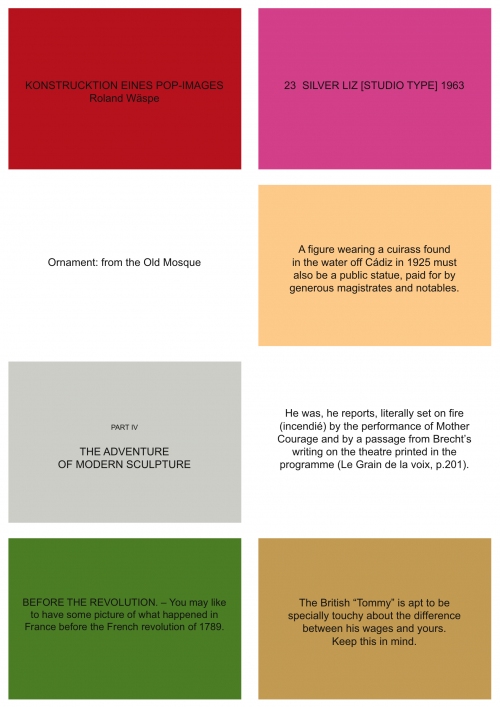
Here, then, is a methodology, let us call it EDITORIAL PROCESS AS SITE-SPECIFIC, with “site” a concept functioning across genres and publishing conventions, but also operative in the stuff of the writing itself, BOTH form and content:

“These innovative works suggest that “fiction” can be most generally defined as a frame filled with a circumscribed world of cohesively self-relating activity. This fictional material may be primarily human, naturalistic, or stylistic, which is to say that fiction may predominantly deal with people, or things, or merely a certain linguistic style and/or formal device; but within fictional art is usually some kind of movement from one point to another. In these respects of diversity and change within an acknowledged frame does fiction particularly differ from poetry, which emphasizes concise, static, generally formalized statement. Fictions tends toward fullness, while poetry is spare, fictions encompass, while poetry concentrates: fictions go, while poetry stops.” (xv-xvi)
 

2. SIX NOTES FOR FURTHER EXPLORATION


(a)In 2011 the anthologies are valuable for their mix of texts/ artists which have attained canonical status and those who were part of the small press scene at the time but have now disappeared from our representations of these periods of activity.

I appreciate the anthologies for this expansive notion of a literary/ artistic “scene” at a particular time, constructing histories beyond a set of canonical names or categories – “conceptual” or “Fluxus” – instead bringing the complex abundance of an historical period into the present.

(b)Note the publication history of these texts. The Anthologies offer a useful case study of the (lack of) (abundant) possibilities for distribution that have characterised Kostelanetz career. If Text-Sound Texts attained a major publisher (William Morrow & Company), Scenarios was self-published by K’s own Assembling Press, Breakthrough Fictioneers appeared from Dick Higgins Something Else Press, and Essaying Essays from Out of London Press.

(c)The work explored on VerySmallKitchen often posits and requires a distinct space involving art, fiction, poetry/ poetics and criticism, and a related shifting between authorial positions and functions.

Histories and curatorial/ editorial practices often serve to remove writing from these multiple possibilities, reducing, for example, response to narrow definitions of criticism. K’s anthologies recognise the need for strategic and opportunistic containers, but towards the clarification and operation in that broader field.


https://i0.wp.com/www.richardkostelanetz.com/examples/images/moholy.jpg

László Moholy-Nagy’s visual representation of Finnegan’s Wake, from “Vision in Motion” (1947) (reprinted in Essaying Essays)


(d)I view Kostelanetz’s monikers in a similar way, less as terms fixing work – “ conceptual art” – than as attempts to introduce a lexicon that both gives form to a particular body of practices, convinces publishers to invest in a project, and also (hopefully/ potentially) is a working term/ artists coinage/ critical formulation to be utilized as generative or abandoned. One of the questions in our reading group was how notions of “essaying essays” could be a useful working trope for practices more involved in performance than page or screen based writings…

Take, for example, “Text-Sound Art”: which, in this formulation, works out this similarity and distinctiveness:

“The art is text-sound, as distinct from text-print and text-seen, which is to say that texts must be sounded and thus heard to be “read,” in contrast to those that must be printed and thus be seen. The art is text-sound, rather than sound-text, to acknowledge the initial presence of a text, which is subject to aural enhancements more typical of music. To be precise, it is by non-melodic auditory structures that language or verbal sounds are poetically charged with meanings or resonances they would not otherwise have. The most appropriate generic term for the initial materials would be “vocables,” which my dictionary defines as “a word regarded as a unit of sounds or letters rather than as a unit of meaning.” As text-sound is an intermedium located between language arts and musical arts, its creators include artists who initially established themselves as “writers,” poets,” “composers,” and “painters”; in their text-sound works, they are, of course, functioning as text-sound artists. Many do word-image  art (or “visual poetry”) as well, out of a commitment to exploring possibilities in literary intermedia.

The term “text-sound” characterizes language whose principal means of coherence is sound, rather than syntax  or semantics – where the sounds made by comprehensible words create their own coherence apart from denotative meanings…” (14)


(e)This eclecticism of distribution is a point of connection between RK’s work and contemporary practices. Compare with, say, Dexter Sinister, who, in the recent Bulletins of The Serving Library #1 describe how their A NOTE ON THE TYPE essay/ project/ font has been “recomposed and rechanneled through” various publication and exhibition contexts.

(f)In an essay on Bernadette Corporation, Chris Kraus talks about both their writing of poetry and the “gestural poetry” of BC’s work as a whole. Their recent project The Complete Poem seems to work through acts of dislocation within and between the different communities, many of whom are contained within K’s anthologies.

For example, a text deeply dependent on histories of experimental poetry is exhibited in a gallery context to an audience and in a format that in some way removes it from that history. This suggests a reading of all four Kostelanetz anthologies that considers their considerable accumulated mass as serial acts of undoing…


3.


If K’s anthologies resonate for their multiple locations of practice and distribution, in other ways I wonder if they are somewhat alien to contemporary practice. I wonder, for example, if the expansiveness of its materials would seem a necessity of any anthologist working today, and if artists and poets across different areas of art writing would appreciate and find generative an 800 page anthology cross-cutting between poetry, fiction, essay, and script…

I suspect not. I spent some time on Saturday looking through the material at x marks the bökship in Bethnal Green, and if a model of/ hope for social formation emerges from such work as a whole it is definitely one of small distinct groups and cliques, low scale social formations, often deliberately finding spaces and communities away from the need for overtly relational/ participatory practices. Connections between art/ performance/ poetry seem only to take place in particular, defined situations.  This, too, into the matter of writing, creates a particular form and style of sentence, paragraph, text-space…

.. the text below is reprinted from The Brooklyn Rail for July-August 2009, charting other forms for legacy/ affinity/ difference…


*

Thinking about how the anthologies read as a mix of survey and manifesto (it’s the later that emerges more clearly the older the anthologies get). Thinking through what contemporary equivalents do exist, I link here to the PDF of the introduction for Kenneth Goldsmith and Craig Dworkin’s Against Expression anthology (thinking, too, of the Jerome Rothenberg and Pierre Joris Poems for the Millenium anthologies). If differing in focus, these books (all over 500 pages) nonetheless share with Kostelanetz’s anthologies  a commitment to  SERIOUS BOOK MASS AS WRITER TACTIC.


4.


So onto the (essaying) essay itself.  The act of piracy here reflects the presence of Essaying Essays in the VerySmallKitchen (see The Piracy Project of AND Publications for another thinking through of this). I have repeatedly talked about this book, showed it, lent it to be photocopied, worked with it. Its ideas, editorial principles, and contents can be traced quite concretely through projects and collaborations on this site.


The introduction to Essaying Essays is available as a PDF here. If much unfolds from considering these books as gestures, I hope to get to Amsterdam and unfold what follows from the books themselves and the Kunstverein’s act of  putting them back into circulation. The Bookshop is open until 1st October. RK’s own extensive 1999 essay On Anthologies is here.

VSK PROJECT: PAUL ANTONY CARR EXCERPTS: TADEUSZ & GREGORY

In Uncategorized on July 7, 2011 at 9:14 am


“Tadeusz stands behind the diagram. He is brandishing a pair of safety scissors borrowed from an office down the hall. Disassembling or destroying the pattern ought to liberate Gregory. But using this barely effectual cutting implement to mechanically sever from each other the linear connections that infest the sheet of paper will be a clumsy affair, and it occurs to Tadeusz that obliterating the diagram could irreversibly damage Gregory’s eyes. Thus Tadeusz stalls momentarily, and then he steps out of the room. He returns swiftly with a proper set of scissors. He holds them open over the top edge of the eerily suspended chart. He pauses again, and looks at his colleague’s lifeless face. No, even with these sharper scissors, the process of cutting up the diagram will be too excruciatingly slow and deliberate for Tadeusz to follow through with. He feels squeamish and afraid. If Tadeusz is going to blind Gregory in the rescue attempt, Tadeusz will need to do so in a hasty and forceful manner from which there can be no turning back. He suddenly raises his right knee until it almost touches his chest, and then aims his foot at the seat of Gregory’s chair.”

2011. Ink on paper. 8.25 x 8.5 in.

*

Paul Antony Carr writes: I am very much interested in certain relationships between image and text. This interest is not only concerned with final forms, or products, but also with the processes “drawing” and “writing” through which the results are arrived at. I see parallels between grammatical structure and delineated form, especially within the sort of mental and physical groping exercised when working toward their refinement. The pictorial and verbal connections I attempt to handle in my practice are often nebulous at best, yet apparent enough for me to negotiate conceptually. However, once momentum has died down and all that remains is the final draft – the residue of process – it is the specifics of fiction, with its requisite plot and character(s), which tie together disparate visual and textual elements. Formally disconnected images band into a unified series through a titling system which reads like excerpts from an overarching narrative. At the same time, uncertain illustrational relationships between text and a visually cohesive set of images can be reinforced through the repetitive application of narrative continuity.

Tadeusz & Gregory are most certainly fictional, and possess potential for fluid identity. The idea of Tadeusz & Gregory is an intentionally vague set of relationships which can be played with in a variety of ways. Regardless of what is written about them, Tadeusz & Gregory may or may not be alike Mason and Dixon, Mason & Dixon, Harrison and Wood (but neither Harrison nor Wood), Reeves & Mortimer, Mark and Jeremy, or any of countless other (and not necessarily British) duos. However, Tadeusz & Gregory are definitely self-serious intellectuals whose research, of no fixed academic discipline, is likely insignificant to both their peers and the population at large. Yet the pair carry on while maintaining an impeccable work ethic. In turn, they celebrate their achievements and bemoan their failures.

Tadeusz & Gregory’s pairing as a duo carries with it the expectation of an act or routine. The nature of this enacted relationship is informed by what is committed in writing about the two colleagues, but is also influenced by expectations carried over from popular culture. The implied missing, or extra, identifying narrative information that is inherently present in excerption as a format lends itself to the malleability of the two characters’ association. This facilitates the conceit of the Excerpts series: that the titles are written as though excerpted from a greater completed story. However, there is largely no premeditated continuity in Excerpts. Thus flexibility in both the identity and interactive tendencies of the characters is useful for allowing the introduction or de-emphasis of landmarks and trajectories within the expanding fiction. And because the drawing and writing are so structurally and procedurally interwoven, enabling verbal improvisation encourages similar leeway in the realm of the pictorial.


VerySmallKitchen writes: Paul Antony Carr’s Excerpts is an ongoing project which VerySmallKitchen first encountered on his website, where it is regularly updated, usually on Fridays.  The EXCERPTS project as a whole can be read in various ways, and Carr’s own website organises the archive either chronologically or into four sections: Tadeusz & Gregory, The boy changes his name again, The Winding Cave, and Untitled.

It is this first strand that forms the basis of Paul’s VSK Project, which presents a new text-image combination above, and a glimpse into the archive, below. How projects shift between contexts is an ongoing interest of VerySmallKitchen, and perhaps the archive here acquires a new narrative quality in condensing together sequential blog posts and removing them from their original temporality. I wondered, too, whether to keep those page and material dimensions for each image, those references beyond the screen to a (prior) paper life and scale.

Paul will also be in residence at  VerySmallKitchen over the next three months, and a new section of the EXCERPTS project will appear here between now and October.

(1)

https://i0.wp.com/paulantonycarr.com/wp-content/uploads/2011/07/tg032web.jpg


“Tadeusz kicks the seat of the chair. The chair rolls away from him on its casters, carrying with it Gregory and the diagram (despite the latter having no physical connection to anything at all). It doesn’t take long for the chair to slow down, but momentum keeps Gregory’s inflexible body moving and he begins to fall sideways from the seat to the floor. Of course, the chart precisely matches Gregory’s movement and descends perpendicularly towards the linoleum with a force that, Tadeusz hopes, will shatter the cursed sheet of paper to smithereens.”

2011. Ink on paper. 8.25 x 5 in.

(2)

https://i0.wp.com/paulantonycarr.com/wp-content/uploads/2011/06/tg031web.jpg


“Tadeusz cautiously rolls the chair, with Gregory on it, a few feet back from the drafting table. Sure enough, the diagram follows Gregory to maintain the distance between itself and the seated scientist, while defying the laws of gravity at the same time. Fearful of looking directly at its pattern lest he fall victim to whatever has afflicted Gregory, Tadeusz walks around to the back side of the hovering diagram and examines its surface. The paper is thin and fragile, but also rigid. It is as solid as a brick wall to the touch. Tadeusz smiles to himself. The diagram will also be as brittle as a sheet of ice. Tadeusz knows what to do.”

2011. Ink on paper. 8.25 x 5 in.

3.

https://i0.wp.com/paulantonycarr.com/wp-content/uploads/2011/06/tg30web1.jpg


“Tadeusz, while deep in thought, unbuttons his cuffs and begins to roll up his sleeves. A series of interrelated solutions has presented itself to him. Tadeusz could physically remove the diagram from the vision of his unmoving colleague, and this might be accomplished by simply rolling up the chart, folding it closed, or picking it up off the drafting table and placing it elsewhere away from Gregory’s relentlessly focused eyes. But Tadeusz is reluctant to attempt any of these methods, for he knows the inadequacies of his own athleticism – if the deadlock between the diagram and Gregory’s retinae cannot be so easily broken, any attempt to move the chart would require shifting Gregory’s body at the same time along a parallel vector. Such would be an unwieldy undertaking, both heavy and unbalanced. Indeed, if the assumption holds true that the distance between, and relative positions of, Gregory and the surface of the diagram are fixed, it would require far less effort to instead directly move Gregory and allow the sheet of paper to follow suit (especially considering that Gregory is seated on a chair with casters). Although, this alone would not be a successful way to rescue Gregory from the clutches of the chart’s petrifying visage.”

2011. Ink on paper. 10.75 x 7.5 in.

4.

https://i0.wp.com/paulantonycarr.com/wp-content/uploads/2011/06/tg029web.jpg


“It is just a few minutes past 7.00am when Tadeusz unlocks the office door and steps in. He flicks the lights on, rests his briefcase against a bookshelf, strolls past Gregory, and sits down on the worn Le Corbusier-inspired sofa. Tadeusz examines his colleague. Unsurprisingly by now, Gregory sits motionless at the drafting table with eyes fixed on the complex geometric chart laid out before him. Gregory does not move, blink, breath, eat, drink, defecate, or urinate – though he sometimes sweats, his hair and beard do not grow. Gregory should be dead, but three weeks have passed since Tadeusz discovered him frozen in the office, and still Gregory shows no signs of decomposition. So, despite all commonsensical objections, Tadeusz surmises that Gregory must yet be alive. Tadeusz would almost allow himself to be overjoyed by this conclusion if he could but determine a method to successfully reclaim his friend from the visually-induced stasis.”

2011. Ink on paper. 10.75 x 7.5 in.

5.

https://i0.wp.com/paulantonycarr.com/wp-content/uploads/2011/05/tg028web.jpg


“Gregory rolls the chart flat onto the angled drafting table. The plot laid out on the surface of the paper is a complex pattern that occupies the entirety of the sizeable sheet. He begins to study it intently. But fear sets in before long. Although his intellect tells him the graphic pattern physically ends at the perimeter of the chart, with his vision focused at its centre, the repetitious uniformity of the diagram begins to encroach upon his peripheral vision. What normally serves as a visual buffer at the edge of his sight is effectively abolished, and he finds his eyes locked into place in relation to the ubiquitous diagrammatic matrix presented before him. Furthermore, panic ensues when he realizes his predicament extends beyond the ocular, and that he is rendered incapable of wresting his body from it’s current position less than two feet away from the chart. ‘I can’t move,’ is what he’d like to say, but not even his lips are able to escape the solid grip of delineation.”

2011. Ink on paper. 8.25 x 5.25 in.

6.

https://i0.wp.com/paulantonycarr.com/wp-content/uploads/2011/05/tg027web.jpg


“Their next project – it’s more like a frivolous challenge really, but somebody is actually funding the research – is to devise a system by which a pontoon plane can stay airborne without recourse to aerodynamics. The requested solution is to have the plane counterintuitively stay ‘afloat’ in midair upon downward falling rain.”

2011. Ink on paper. 8 x 5 in.

7.

https://i0.wp.com/paulantonycarr.com/wp-content/uploads/2011/05/tg011web.jpg


“Tadeusz stops writing mid-word, not to sharpen his pencil – though it could do with sharpening – but rather because he just now realises he might finally understand the eagle-thing analogy Gregory incoherently expounded the other evening.”

2011. Watercolour on paper. 9.5 x 7 in.