verysmallkitchen

Archive for the ‘Uncategorized’ Category

A COMPENDIUM OF STRATEGIES: RODNEY GRAHAM AND READING AS PUBLISHING

In Uncategorized on April 6, 2010 at 4:52 pm


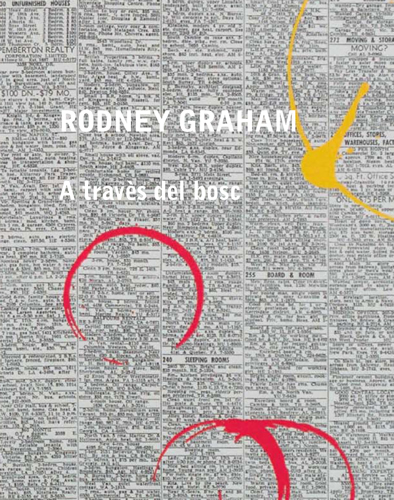
Rodney Graham, catalogue for Through the Forest, MACBA, 2010


What follows is a compendium of “reading as publishing” strategies derived from the work of Rodney Graham, based on my reading of two texts in the catalogue for  Graham’s recent Through the Forest MACBA show: Grant Arnold’s “It Always Makes Me Nervous When Nature Has No Purpose: An Annotated Chronology of the Life and Work of Rodney Graham” and Christa-Maria Lerm Hayes “Rodney Graham: Literature and What an Artist Does with It.”

Lerm Hayes essay is structured around the following taxonomy, which serves as a useful taxonomy of Graham’s “reading as publishing” concerns: The Study; Writing (or Not); The Book; The Typewriter, Paper; The Bookshop; Slipcases, Architectures for Reading. “Reading as Publishing” is a term I have been exploring for my presentation and workshop as part of Reading for Reading’s Sake at Islington Mills, Salford, 9-11 April 2010. As Hayes proposes:

[Graham] approaches literature… not as an opposed pole, but with ambivalence, similar to how he engages with cinema: quoting, appropriating literature’s methods, motifs, and forms, critiquing, at times lampooning, as well as revering and even reviving its traditions. What emerges is a way of working with literature that (re)presents it in innovative ways to new (and old) audiences… It provides a current and coherent (albeit idiosyncratic) way of harking back to the times of the universal artist/ scholar, while in all its idiosyncrasies and ambivalence showing how even today a critically reflected unity of all the arts may be possible. 

Rodney Graham problematizes what it is to produce and receive literature today, to read, to interpret it visually and textually, to write, design, print and sell books, to exhibit them as well as the outcomes of his complex, visual investigation into literature. (65-6)  

Rodney Graham, Reading Machine for Lenz, 1993


A COMPENDIUM OF READING STRATEGIES

Lenz (1983) is an appropriation of a short unfinished work of fiction by Georg Buchner. As Lenz journeys through a mountain landscape to find a pastor, experiencing psychological breakdown, Graham takes the first 1,434 words of C.R. Mueller’s translation, typesets them so they fall on five justified pages, and creates a narrative loop so the reader, like Lenz, continually retraces their steps. The resultant work is produced in two forms: a 16 page prospectus (in edition of 210) and cloth bound book of 336 pages (in slipcase).

Also working with the loop is Dr.No (1991), a bookmark with text by Graham ( derived in part from Alain Robbe-Grillet) that can be inserted between pages 56 and 57 of the original first edition to extend and loop a scene in which a poisonous centipede transverses Bond’s naked body.

As Hayes summarises this method:

In using selection and the loop as strategies, Graham also conveniently caters to the art context’s comparatively shorter attention span or expected reception time. Like Joyce, Graham strategically rearranges literary history, showing the disturbing, evocative, fresh and colourful nature of earlier writing, “recycling” sources, placing himself within both a nineteenth-century and a Viconian context, that of a cyclical world order, for which the book, an object that one can turn around on its spine, is certainly a good image. (70)

Graham considers inserting his own text into existing books. Finds Lacan unsuitable, but turns to Freud. Freud Citation is a photograph of the cover of The Species Cyclamen L by Friedrich Hildebrand with a text referring to the books role in Freud’s anaysis of his “Dream of the Botanical Monograph.” Freud glimpsed the book in a Viennese bookshop and then dreamed about it.  

This project develops into Installation for Münster, a 1987 installation for Skulptur Projekte Münster in which 24 dummy books – their cover a replica of Hildebrand’s texts, their pages blank, if you could open them to see – are installed in windows of Münster’s bookshops. As Max Wechsler observes the book:

has become an object,  a symbol of its content rather than an actual container for them, and the starting point for an autonomous chain of associations… this is an art that wants to retreat under the hood of the everyday, to withdraw, if not into invisibility, at least into a discreet reserve. (100)


The System of Landor’s Cottage: A Pendant to Poe’s Last Story (1984) is a book based on and encompassing Edgar Allan Poe’s Landor’s Cottage: A Pendant to “The Domain of Arnheim.” Poe describes a small cottage set in an idyllic valley. Graham makes  the story into a novel by adding an extensive description of an annex to the cottage. The project becomes an architectural model, drawings, a dummy book, and a 312 page novel (in edition of 250).  A leather bound deluxe edition of 4 is also produced. 

Rodney Graham, Standard Edition, 1988


Graham also produces book sculptures. Die Traumdeutung, (1986) inserts books into replicas of minimalist sculptures by Donald Judd. Sculptures are also produced including works by Raymond Roussell(Nouvelles impressions d’Afrique), as well as La Séminaire (Lacan), Cours de Linquistique générale (Ferdinand de Saussure) and Jokes/Case Studies and Standard Editions (Freud). 

Casino Royale (Sculpture de Voyage) (1990), another project derived from Ian Fleming’s James Bond novels, is installed in a hotel room so you could lie in bed and read above you a section where Bond, tied to a chair  from which the seat caning has been removed, is thrashed on buttocks and genitals. As Hayes observes of Graham’s focus on slip-cases and “mini-architectures” for books, they make reading impossible but, through echoing the books subject matter, provide “associative and interpretive companionship.” (80-82)
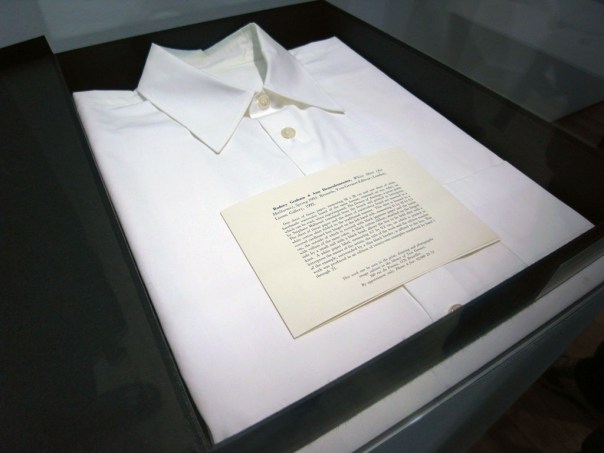
Rodney Graham, White Shirt (for Mallarmé), Spring 1993


In White Shirt (for Mallarmé), Spring 1993. A black cardboard box contains a white men’s dress shirt folded as if on display in a clothing shop. Inside the shirt is a sheet of white paper with with the text of Stéphane Mallarmés poem “The Demon of Analogy.” Through the fabric of the shirt can be seen a sheet of tissue paper with the poem title, the phrase “La Pénultième est morte” and Mallarme’s signaure. The shirt fits Graham. It is intended to be exhibited simultaneously in gallery and shop front.

Irradiation (1993) is a boxed set of 8x 10 inch glass negatives of the first forty-four pages of section four of Bibliographie analytique des principaux phénomènes subjectifs de la vision by Joseph Plateau, which describes optical effects caused by the observation of stars at night. 

Graham’s confinement of the book to the luxury edition enables a foregrounding of the book as both impossible and ideal. Illustrating the former, a project on Czerny’s piano exercises links them to Galileo’s fomulation of the law of free fall, to produce a text variously exhibited as a 1,443 page wall text, and 24 volumes (one hour of music).

Projects (1988) begins from a glimpse – like that which leads Freud to his dream of the botanical monograph – that mistakes a cardboard box for a book “such as I myself should someday like to write” Graham observes:

This later idea set off a new speculation – a daydream in which I found myself mentally assembling a whole series or recent thoughts about books into a more or less coherent form, into a prescription for my ideal, future book. I should most certainly (I recall telling myself) have the work’s title and my name composed in the romantic-style topography I love (in black, red, green and gold ink – I had recently seen an example of this, the engraved title page of an old architectural pattern book, at the home of my brussels friend) the paper of the book should be soft and supple ( I like a book that yields to the hands and drapes when opened) its pages of a creamy white etc. etc. 

In Five Interior Design Proposals for the Grimm Brothers’ Studies in Berlin (1992), CAD drawings of the brothers matching studies were manipulated and moved around creating a series of varying doubles, then rendered as nineteenth century interior design illustrations. 

Rodney Graham, Rheinmetall / Victoria 8, 2003


In the film Rheinmetall/ Victoria 8, the typewriter becomes covered in filmic snow/ flour, which Hayes interprets as an end to optimistic views of technological progress. It offers an image of “reading as publishing” that both reveals and conceals. In Hayes useful phrase Graham practices “a conceptualism that overdoes it” (78)

Graham’s more recent work has moved away from a focus on the book and reading, although Allegory of Folly: Study for an Equestrian Monument in the Form of a Wind Vane (2005), a pair of black and white light boxes, features Graham as Erasmus, reading a phone book whilst seated backwards on a model horse used to train jockeys.
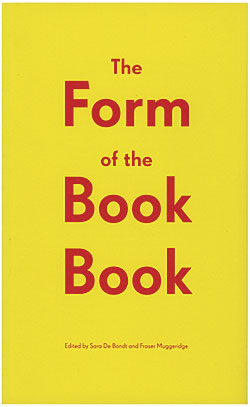
READING NOTES: CARDBOARD LANGUAGE POETICS AND THE BOOK OF THE BOOK BOOK

In Uncategorized on April 4, 2010 at 9:29 am

Sara De Bondt and Fraser Muggeridge eds. The Form of the Book Book (Occasional Papers, London, 2009).

Two essays in particular have been preoccupying me here. The first is Catherine de Smet’s “Le Corbusier as Book Designer: Semi Modernity à la française” which explores Le Corbusier’s own assertion – in an autobiography written in the third person – that ‘A large part of LC’s creative work took place in his books.’ 

De Smet explores some of unexpected characteristics of LC’s book life: his rejection of the modernism of Swiss book design for French traditionalism and the resultant choice of handwritten and collaged texts over a clean, grid based modernist design. She concludes by wondering whether we should understand Le Corbusier’s book life as curiously anti-modern – particularly in relation to the architecture such books explored – or whether such combinations of book styles is best seen as some kind of proto- post- modernism.

This dilemma raises questions about how any practice, conceptually and practically, becomes mediated through the form of the book, and whether a book about that practice supports, extends, or counters the work it contains (also the conversation taking place in and around it).  This, in turn, asks how an idea of the book as the place where ideas are presented influences the ideas themselves, even if those are not – as in LC’s architecture – writerly or book based projects.

How pervasive is the metaphor of the book in a particular artists/ architects/ writers conception of their work and how it is distributed?   How is this image/ metaphor/ ideal book  modeled/ negotiated with/ rebuffed/ relished?

When texts become distributed through the internet, or through exhibition, or dissolve completely into events and curatorial processes, then what happens to this book archetype, what replaces it as an ideal container for thought in words? Le Corbusier conducts architectural practice in books, so, too, I’m thinking about a book practice conducted by writers-artists in speech, exhibition, and curatorial idea-storms. 

The second essay I’ve been returning to is James Goggins “The Matta-Clark Complex: Materials, Interpretation and the Designer.” Goggins offers a brief survey of monographs of Matta-Clark, and how designers have felt a need to approximate in their book designs the artists own strategies of slicing and cut through, removing a chunk of the book’s spine or making cut-out squares in its cover through which the Matta Clark eye peers. 

Goggins’ appreciates how such designs seek an engagement with the practice of the artist, but wonders where the boundary is between intelligent response and an object that becomes a parody. Similarly, when does the designer start competing with the artist, rather than seeking the best way to present their work? He concludes: 

When content and materials are interpreted and combined in a balanced way, the result can be greater than the sum of its parts. A transformation of the given matter through a kind of elegant alchemy, rather than cut-and-paste pastiche. (31) 

AN ELABORATION: I’ve had the idea of  adopting The Matta-Clark Complex, but embracing rather than rejecting the more excessive, parodic elements of its design conversation. It suggests that artists relate to each others work on a very physical and cumbersome architectural level, ever prone – particularly when the artists are historical-dead-canonized like Matta Clark – to parody-inflation-imbalance. 

I propose: writing that emerges out of The Matta Clark Complex will find itself abandoning the essay and the book as containers for its thought, finding those objects too cut through and sliced to be useful, but finding a landscape rich with the possibilities of  a new Cardboard Language.

This Cardboard Language would engage with the book in the terms suggested by another contributor to this volume – Bob Stein of The Institute for the Future of the Book, interviewed by Sarah Gottlieb – who talks about the “social aspects” of the book form. Everyone recognizes cardboard. As Stein says:

…a book is a place where readers and authors can congregate. Reading and writing have always been social experiences, but when frozen into print these relations tend to be omitted. A significant book gets people talking in society, but this is not seen or incorporated in the paper-based object. What we’ve been working on is expanding the boundaries of the page , to consider its social aspects, which are so fundamental to it. We are re-defining content to include the conversation that it engenders. (64)

NOTE: Several aspects of Cardboard Language may require elaboration at the future moment when Cardboard Language has come to be.

ART WRITING FIELD STATION: NOTES ON WRITING LIVE

In Uncategorized on April 3, 2010 at 7:51 pm


The above text is Rachel Lois Clapham’s score for her project of writing live throughout  ART WRITING FIELD STATION in Leeds on March 27 2010 (see a set of preparatory notes by RL on this project here  and a report after the event here).

Marianne Holm Hansen, Pneumatic Poem (thoughts on Art Writing Field Station), 2010


A DESCRIPTION: During presentations by myself, Mary Paterson (performed and interpreted by Simon Zimmerman) and Emma Cocker, Rachel Lois wrote in black marker pen on square pieces of paper, constructing a 3 x 3 grid of these squares. Sometimes new blank squares were placed on top of old, or squares were removed, placed on the floor, and replaced.  

As the last presentation ended, RL removed her last piece of paper from the wall, as if our discussion had returned us to a white wall from which we began, and announced she had finished.

A CONTEXT: This was the second attempt to write live during an ART WRITING FIELD STATION, following on from Marianne Holm Hansen’s work in London. Like Marianne’s project – more information about which is here – the actual act of writing live is a performance both visible and invisible.

Absorbed in discussions, I looked up every so often to see what was happening (as well as the activity on the wall, the grid was filmed and projected). Whilst all of Marianne’s writing figured on a single sheet of piece of paper that was on the wall throughout, RL’s adding and removal of sheets made the whole more illusive. I only ever got a snapshot at different times of what was an ongoing flow, and the processes of editing and decision making remained inaccessible to my piecemeal attention.

Also unlike Marianne’s, RL’s work was principally non-verbal – her grid of squares contained a series of graphic, gestural markings, and if there was an alphabet or lexicon it was one of signs, boxes, brackets, and lines, with arrows indicating movement into and out of both drawn spaces and those of paper, wall and room.

Talks and discussions at the table – one end of which openned onto to RL’s workspace – were being translated into markings, both representing it and working it into something else, accepting its informational quality and its opacity.  When I looked across, the process seemed to be a thoughtful, meditative one, rather than a Jackson Pollock like storm of marker pen scratchings. A lot of time, too, of looking and considering, of (re-)moving the paper, and these as much part of the writing as the writing. 

A PROBLEM OF DEFINITION: As with Marianne’s work, the question of what to call this activity was  problematic. Because of RL’s previous work, I tended to settle on the phrase “writing live.” Because of the gestural quality, I was less prone to use the  phrase “minute taking” – “emotional minute taking” in Marianne’s phrase. 

The frame of camera and careful choreography suggested it was a “performance” but this was definition was slightly challenged by the private nature of the work. Maybe it was better to think of this – to pick up on some topics in Emma Cocker’s presentation – as a “writer’s studio” negotiating a new position of exposure.

Both images: Art Writing Field Station, Patrick Lane Studio's, Leeds, 27 March 2010. Photo: Emma Cocker


CONCERNING AFTER (TEXT &) IMAGE:  My own understanding of what it meant to have someone writing live throughout the ART WRITING FIELD STATION events was originally that  it would offer a summation of each field station as a whole.

Whilst discussions would focus on a series of individual presentations, the live writing would capture a version of what emerged from all those discussions. A field recording. How did this relate to what has actually happened? 

Once again, as soon as the discussions in Leeds finished, RL’s texts demonstrated a tension between their own materiality – a new found set of resonances and associations within the system of these texts as an art work in their own right  – and any relation to the event within which it  had been (was still) occurring.

RL offered spoken commentary on a number of images, connecting back to specific talks and moments, and revealing the close connection of gesture to idea. I wondered how such processes were one way, the resultant markings unlikely to lead back to the original ideas without a guide. 

I also want to think of these live writings as generative, as scripts and scores for future events.  RL’s drawings seemed to function as a series of maps of rooms, conceptual and actual, proposals for actual and ideational movements within those spaces. Sometimes the spaces themselves were defined: four solid black marker pen walls surrounding. Sometime the movement itself had a quality of absorption which meant there was no immediate awareness of frame or container. This could be the starting point for an exhibition or for a kind of art writing field station architecture

A BROADER RESONANCE: The gestural nature of RL’s response suggested several connections. I saw Matt Mullican lecture at the ICA earlier this year. Mullican talked of scrawls and drawings, and how, through meditation techniques, he inhabited and journeyed into his drawings, exploring the landscapes they contained.

Matt Mullican, Galerie Micheline Szwajcer, Antwerpen, 13 Mar -3 May 2008


For Mullican this inhabitation was the only way to understand the true dimensions of what he had drawn – a small dot on the page might  turn out, through imaginative journeying-dreaming, to be a gaping chasm hundreds of miles wide that was the entrance to hell.

Mullican also demonstrated how he had stayed with such images and scrawls over long periods of time, developing them into fleshed out cosmologies, architectural models, and installations. 

WE ARE ALL WRITING LIVE: Of course,it would be wrong to think of RL’s as the only “live writing” going on, in the same way as all texts are “visual” orchestrations, not just those we might choose to label “visual poetry.”

Emma Cocker’s field maps – diagrams on large sheets on graph paper of her writing practice – gave way to a participatory scripting where Simon pointed out particular words, prompting Emma to read particular texts (see Emma’s notes for this project here).

Although Emma read from a set of footnotes devised alongside the diagram, the process revealed how “live footnoting” might work well as a place where different texts were brought alongside the map, with each live reading being a chance to set out a new set of relations of word and map to footnote. 

Mary Paterson’s text – which was read by Simon Zimmerman – explored the workings of memory, particularly as it relates to her work writing about performance (and as writer in residence for the Live Art Development Agency) . Her text left spaces for Simon to introduce his own thought and memories into the text.

This adding of a “live” layer to the text seemed to scramble the text:  upsetting any linear flow and argument. The “live” presence – as  Simon considered what stories to tell when prompted by the script – contrasted with the reflective tone of Mary’s own words, and when Simon went back to the script it was hard to shift back to the argument he had been unfolding before his invited interruption.

This suggested how live writing could involve a number of forms of presence, shifting between and around these different emotional and textual registers in ways both scripted and beyond anticipation.

FIVE WRITE LIVE AT THE PIGEON WING: Finally, I was thinking about all these spaces in regard to The Pigeon Wing space, where VerySmallKitchen will be in residence throughout September. I imagined what it meant for five writers to be writing live, each with their own methods and tools, not in relation to an art work, but as a performance as itself, in relation to the space and each other, as a starting point towards an exhibition.

More on how this particular project unfolds will be on this site in the coming months. For the moment I am imagining how five people could write live here: 

NEW PUBLICATION: TAMARIN NORWOOD’S TEXT AS TOOLKIT: A PRACTICAL HANDBOOK

In Uncategorized on March 30, 2010 at 2:25 pm


Tamarin Norwood, "Genuine Smiles", score photographed at Writing Exhibitions, Stanley Picker Gallery, 30 Nov 2009. Photo:Eliza Tan


Tamarin Norwood’s TEXT AS TOOLKIT: A Practical Handbook is the first in a series of e-chapbooks developed from the Art Writing Field Station. 

It is now available for online consumption and PDF download here

Tamarin’s text was first devised as a presentation for the field station event at Five Years Gallery on 7th February 2009.  As Tamarin observes in her introduction:

TEXT AS TOOLKIT proposes a methodology for reading and hence for writing. The purpose of this methodology is to identify and extract from texts certain metatextual tools that might be used to examine the practices and products of writing. Mining texts for their tools is a consciously interventional strategy that considers texts as provisional and active material participants in a cumulative art writing field. 

The seven specific tools in this handbook are offered as means to grip hold of the abstract and often indistinct relationships that exist between reading, writing, reader, writer and text. It is hoped that by offering diverse and generative grips on these relationships – and moreover by offering a methodology to develop other such grips – robust and raucous explorations of the field might be facilitated.

The hope, finally, is that this handbook might function as a tool that renders itself increasingly obsolete. 

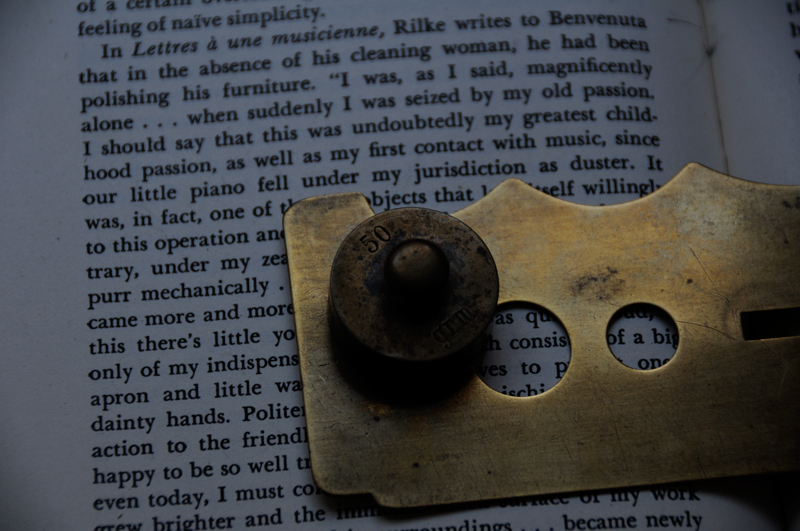
Tamarin Norwood, Book Holder Opener: Button Polishing Separator, Weights (100mg - 200g) (2008)


Tamarin’s work is also included in VSK’s Writing Exhibitions: An Assembling, and will be part of VerySmallKitchen’s project at The Reading Room in Berlin. 

Find out more about her  work here.

VSK PROJECT (4): PAIN RATING by HYUN JIN CHO

In Uncategorized on March 28, 2010 at 9:18 am

_____

PAIN RATING  by Hyun Jin Cho is the fourth in a series of five projects, notebooks and essays on this site, exploring relationships between language and image. This curatorial statement is itself re-written  after each project post, charting changing conceptions of the work underway.  

More information about Jin’s work can be seen here.  She is currently artist in resident at Gyeonggi Creation Center, Gyeonggi-do, Korea.

ANNOUNCEMENT: ART WRITING FIELD STATION LEEDS ON SATURDAY MAR 27th

In Uncategorized on March 25, 2010 at 11:02 am

ART WRITING FIELD STATION will be take place at East Street Arts Patrick Studios, St.Mary’s Lane, Leeds, LS9 7EH, on Saturday March 27th 2010, 10am – 1pm as part of the RITE publication launch. A map is here.

ART WRITING FIELD STATION is an ongoing event and publications series at which practitioners present material and evidence of the “field” of art writing. The aim is both to make a field recording of the field of art writing as constituted by a set of practices, and to offer an example of that field in poetic operation. 

 As well as individual presentations, each ART WRITING FIELD STATION produces a lexicon or live writing archive of its group discussions, which serves as a script and provocation for future events.

 ART WRITING FIELD STATION at Patrick Studio’s will feature presentations of new work by David Berridge, Rachel Lois Clapham, Emma Cocker, Mary Paterson, and Nathan Walker.  

 Please join us for the presentations and discussion, but note space is limited. To reserve a place email David at verysmallkitchen@gmail.com

The first set of FIELD STATION chapbooks (including texts by Tamarin Norwood, Matthew MacKissack, and Hyun Jin Cho) will be published on Mar 30th).

This web site includes a range of images, texts and materials unfolding the concept of the field station and its possible architectures. See here.    

 ART WRITING FIELD STATION LEEDS is supported by Writing Encounters, East Street Arts, PSL (Project Space Leeds) and New Work Network.

READING NOTES: A GABERBOCCHUS EMBLEM FOR ART WRITING

In Uncategorized on March 24, 2010 at 7:10 pm

Much of the work on VerySmallKitchen attempts a territory between language and the visual, expressing that in a mix of concept and idea, drawn and typed and texted, past and future, art and the everyday. It’s as if there might be a kind of writing that makes such simultaneity possible.

One place I recognised such a project, was in the above image – which was Stefan Themerson’s cover image for his book Kurt Schwitters in England: 1940-1948, published by the Themerson’s Gaberbocchus Press.  I reproduce it here as a tentative emblem for this kind of writing practice. 

As the helpful note on the Themerson Archive  quotes from ‘The Connoisseur’:

The first publication of Schwitters’ English poems and prose written during the last 8 years of his life… Themerson’s perceptive text is based on a talk originally given to the Gaberbocchus Common Room. ‘…one of the most lively examples of book design produced in England recently. The book is published in celloglassed paper boards, with a binding design of outrageous ingenuity. The inside is as unorthodox and ingenious as befits its subject and the whole effect is most refreshing.’

Themerson’s insertion into current experimental writing practices occured most recently through Phil Baber’s excellent Cannon journal. Baber was particularly interested in the Themerson’s publication of Barabara Wrights translation of Raymond Queneus’s Exercises in Style. He cites Wright’s own comment on her translation of Queneau’s French text, itself a series of stories telling the same mundane story in a variety of styles:

Queneau told me that the Exercises was one of his books which he would like to be translated – (he didn’t suggest by whom). At one time I thought he was crazy. I thought that the book was an experiment with the French language as such, and therefore as untranslatable as the small of garlic in the Paris metro. But I was wrong. In the same way as the story as such doesn’t matter, the particular language it is written in doesn’t matter as such. Perhaps the book is an exercise in communication patterns, whatever their linguistic sounds. And it seems to me that Queneau’s attitude of enquiry and examination can, and perhaps should? – be applied to every language, and that is what I have tried to achieve with the English version.

The cover for this book is below, with quote and book design both unfolding a writing and thinking that is moving, translating, breaking, superimposing and scrawling between languages and styles: 

Something of this practice of language is also expressed by Dorothea Von Hantelmann in How to Do Things with Art, an excellent series of essays on James Coleman, Daniel Buren, Jeff Koons and Tino Seghal. What von Hantelmann outlines as one of the starting points of her book, is also true of the writing practice these Gaberbocchus covers make a possibility:

Singular expressive  acts that completely withdraw from discourse are not only irrelevant; they are not even thinkable. The idea of efficacy produced by  a rupture from conventions is replaced by the use of conventions – a use that also contains a transforming potential. With this notion of performativity we can, for example, concretize how every art work, not in spite of but by virtue of its integration in certain conventions, “acts”: how, for example, via the museum it sustains or co-produces a certain notion of history, progress and development.

The model of performativity points toward these fundamental levels of meaning production. It puts the conventions of arts production, presentation and historical persistence into focus, shows how these conventions are co-produced by any artwork – independent of its respective content – and argues that it is precisely this dependency on conventions that opens up the possibility of changing them. (19-20) 


Blazon for Manifesta 6 School Badge, 2005, Corner of Pentadaktilou and Tempon Streets, Nicosia, Cyprus.


For more information on the possibilities of emblems, meanwhile, see Dexter Sinister’s recent Portable Document Formatitself on boundaries of print and web, monograph and catalogue and primer, artists book and library copy – in which they propose an emblem for a (possibly) temporary art school:

Heraldry is a graphic language evolved from around 1130AD to identify families, states, and other social groups. Specific visual forms yield specific meanings, and these forms may be combined in an intricate syntax of meaning and representation. Any heraldic device is described by both a written description and its corresponding graphic form. The set of a priori written instructions is called a blazon – to give it form is to emblazon

… The badge we would like to wear is two-faced – both founded on ,and breaking from, established guidelines. Stripped to its fundamentals, and described in heraldic vocabulary, it is uncharged. It is a schizophrenic frame, a paradox, a forward slash making a temporary alliance between categories, simultaneously generic and/or specific.

RITE LAUNCH: WHY TWITTER IS GERTRUDE STEIN IN 2010

In Uncategorized on March 21, 2010 at 2:42 pm

I will be in Leeds on Friday 26th March for the Yorkshire launch of RITE. The book is the outcome of the nine month long Critical Communities project organised by Open Dialogues and New Work Network.  Two groups of writers – in London and Leeds – met to explore the practice of critical writing on and as new work.  

Click here to buy RITE. 

Following on from a series of micro-presentations where each member had two minutes to showcase their work and interests,  the London group members commissioned small pieces of writing from one another.  The following piece of writing was commissioned by Mary Paterson, after I causally remarked in a Bloomsbury hotel bar that “Twitter is Gertrude Stein for year 2009.”

I have updated this bold statement – and my attempt to substantiate it – for its re-publishing here, although I haven’t twittered since I wrote it, so maybe the trans-historical zeitgeist it describes is 2009 specific.


Gertrude Stein uses Twitter. She doesn’t call it that. 

Gertrude Stein lost the continuous present. Then she found it again. She called it twitter.

Alice B Toklas thinks the whole thing is ridiculous. She sends the occasional e-mail, but nothing more.

Gertrude Stein twitters all day and night. 

Gertrude Stein twitters in the park the park.

Twitter twitters twitters twitters twitters.

Gertrude Stein says a text is a text but twitter.

She is aware that it is easy to parody what one is parodying.

That it is not necessarily funny to be funny when one is being funny or not being.

Gertrude Stein knows the limits of twitter.

And all those who twitter in 2010 are being Gertrude Stein.

They are not being Alice B Toklas of that Alice B Toklas is very clear.

And so is Gertrude Stein. Gertrude Stein is very clear.

And to say “I am eating my lunch” is to be Alice B Toklas.

But to say “I am eating my lunch and it is a brown cow” that is Gertrude Stein.

And it is Twitter if it is 140 characters or less.

Which it is. And 2009 is. And Gertrude is but not Alice. 

Gertrude Stein is so into twitter that she has terminated her MySpace profile. 

Gertrude Stein still uses Google Chat but only practically.

It is twitter that offers Gertrude Stein the chance to connect to her earliest work such as Tender Buttons.

The space of the rectangle and the character limit define a space the mind can move through writing

The space defines and the space is to be filled and in so doing it is defined

Which is like a city or a global economy and Gertrude Stein knows it.

Gertrude Stein knows it is also the war.

She knows it is it when it is and Twitter is isn’t it.

Gertrude Stein has many followers on Twitter although not Ernest Hemingway who is dead.

Gertrude Stein follows nobody.

Some suspect that Gertrude Stein might not be Gertrude Stein.

Some suspect that Gertrude Stein is Penelope Cruz.

Gertrude Stein knows that she is Gertrude Stein.

Gertrude Stein knows that she has always been Gertrude Stein and that the accumulated mass of her tweets proves it.

Gertrude Stein says you can always tell a true Mondrian from a copy and hence she is Gertrude Stein.

Gertrude Stein knows that Twitter proves she was right all along.

Alice B Toklas thinks most of Gertrude Steins followers look like idiots.

Gertrude Stein agrees but only looked very quickly.

Gertrude Stein is twittering now and has twittered and is.

Gertrude Stein and the twitter rectangle right now.

Twitter twitter twitter twitter twitter twitter.

Gertrude Stein would like to tell Picasso about twitter but he has most fortunately.

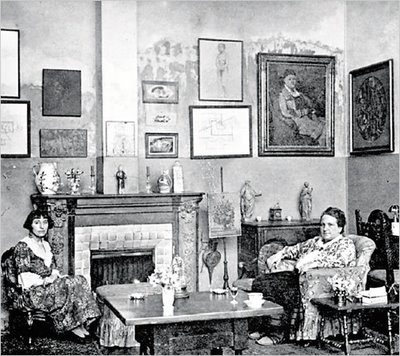
Gertrude Stein and Alice B. Toklas at home in 1923, pre-Twitter.


RITE will be launched at PSL Gallery Leeds on the evening of March 26 2010 6.30-8pm. The event will include propositions on the subject of art writing and live readings by RITE contributors. Contact lottie@newworknetwork.org.uk or sz@roomman.co.uk for more information and to reserve your place on the guest list. The launch is presented by ‘In a word’, part of the York-based curatorial agency Writing Encounters  and supported by New Work Network and PSL (Project Space Leeds).

RITE Contributors include Emma Bennett, David Berridge, Rachel Lois Clapham and Alex Eisenberg, Emma Cocker, Hannah Crosson, Amelia Crouch, Chloe Dechery, Tim Jeeves, Emma Leach, Johanna Linsley, Joanna Loveday, Charlotte Morgan, Mary Paterson, Jim Prevett, Nathan Walker and Wood McGrath.

VERY SMALL KITCHEN at THE READING ROOM in BERLIN

In Uncategorized on March 20, 2010 at 9:53 am


The e-flux Reading Room, New York


Two projects by VerySmallKitchen have been selected to be part of THE READING ROOM in Berlin, curated by Dominique Hurth and Ciarán Walsh. Both Writing Exhibitions and Essaying Essays will feature in what Hurth and Walsh term “a curated archive of artist’s printed projects.”  

My proposal for THE READING ROOM explored how the form of both publications occupied an overlapping space between print and online, magazine, exhibition and essay. The format for each publication – each contributer has 3 pages of A4 – was rooted in a hard copy concept of publication, but for convenience and economy the publication has been distributed almost entirely as an online PDF. THE READING ROOM is thus a chance to re-imagine both the individual contributions and the whole publication as a printed object.

Because of the relaxed yet specialised reading experience THE READING ROOM hopes to cultivate (see below) I have been thinking of both publications as unbound folios, that enable both authors and readers to approach the materiality of each contribution. The writers and artists involved have all been asked to re-imagine their contributions for this possible new format.

The curators describe their project as follows: 

The Reading Room is a project based in Berlin with the aim to maintain, archive and represent products of contemporary art practices evolving within printed and published formats. Through archival methodology, critical reflection and strategic methods of presentation, The Reading Room will focus on these representations of contemporary practice that both utilise and interrogate the published form as their primary medium.

In addition to the traditionally understood artist’s books, monographs or exhibition catalogues, the published format is now widely utilised as a primary site for various art practices. Often secondary when compared to the established presentation space of the gallery, the act of publishing has diversified and widened into self-contained body of artistic method and research. The Reading Room will focus on the publication as medium and context for artistic practice, in which the artists choose deliberately and critically the publication as support, while using its materiality, edges and frame as tools for both visual and semantic expressions. 

An event by Amalgum at the ICA Reading Room, London


The Reading Room will only consider books, printed material, publications or magazines that are actively interrogating or reconsidering the textuality, materiality and context of their chosen medium: works by artists who use the concept of publication or book as a primary and independent mean of artistic production without serving purely the representation of earlier artworks or illustrating physical artworks. 

The Reading Room is based on former institutional “Reading Rooms” (such as the one of the British Museum in London), and functions as such: it will be open for public viewing, with those wanting to use it being required to make an appointment and also register beforehand their particular interested in the publications or project. The Reading Room takes its initial presentation location from the idea of the “Salon”, gathering its printed matters under the roof of an inspiring hostess or host. The visitors and readers of the Reading Room will ring the bell of a private apartment, climb up the stairs to it, and then be able to sit in a study room. Refreshments will be served. 

The organisers of The Reading Room will maintain a curated monthly selection of approximately 25 publications that can be seen at one time. Those will be chosen based on changing criteria, such as topics, size, colour, content, and links to each other. A monthly index will be published online. By special agreement, the remaining publications of the archive can of course be read and viewed, next to the monthly selection.

WOUND ROSES ROSES BLEED: A KURT SCRIPT FOR READING KURT SCHWITTERS

In Uncategorized on March 18, 2010 at 10:39 am

In April I will be taking part in Reading for Reading’s Sake, a four day event at the Islington Mill in Salford, exploring “reading as activity.” As part of my preparation for that event, I have been gathering together ideas, texts, quotations and notes concerning acts of reading.

One aspect of this work is finding particular performance structures for the reading of certain texts.  The structures seem to be ways of finding public modes for private acts of reading, thereby proposing a space where reading is “published.” I am interested in the transformations and translations evidenced by this act into showing and telling.  

Reading Room at Jinhua Park Pavillion, China by Herzog & de Meuron


The following text is a script for reading Kurt Schwitters’ poem  Wound Roses Roses Bleed (1918). Recent interest in Schwitters has often been based around the methodological implications of the Merzbau. Focussing on the poems, highlights a different set of concerns. I use them to create group structures over space and time, propose forms of (dis-)sociality, and elucidate how poems can be active plans, texts, and sources, in the same way as the notes, re-constructions, and images of the Merzbau’s various incarnations. 

(1) I am interested in vocal performances; (2) In voices working together without bodies; (3) The process of making a performance being an illustration of the process of the group; (4) Arriving somewhere, meeting people and the group formation taking place through reading; (5) Through the performance through the text; (6) Through the text through the performance; (7) No rehearsal; (8) The process of the group orienting itself to itself is foregrounded; (9) Foreground and background both; (10) Therefore I propose the following:

A SCRIPT FOR READING

I will arrive on _____/_______/______ at __ __. There will be a space available for us to work in. By “us” I mean myself and whoever is there. Each of us will be provided with a name badge labelled “KURT”.

All of us will answer to the name of “Kurt” for the duration and only speak to one another through this name. As an introduction, I – Kurt – will read the following text whilst copies of the poem are distributed:

Hallo Kurt! Kurt here. Kurt must spend an hour performing the text according to the time constraint indicated. Kurt may speak any word from the script at any time in any order within the time constraints listed. Have you got that Kurt? Kurt should focus on reading at all time and Kurt must be attentive to how reading is also a speaking and group process. Thank you Kurt. Kurt, we start now. Thank you. The text, Kurt, is: 

KURT SCHWITTERS WOUND ROSES ROSES BLEED 

Poem 23 circa 1918. Time durations have been added.

40″

Wound roses roses bleed

Wound colossus wound wound

Roses languish languish roses

Torrid wound torrid torrid

Languish roses languish languish

Wound torrid wound wound

Roses torrid torrid roses

Embers trickle trickle ember

Embers trickle trickle ember

Bleed roses wound torrid

Languish wounds rose blood

Night languish roses night

Night wound blood blood

Night bleed night

Blood night blood

Blood

15″

Silversound

Wildwoodwondrous silversound

Wildwoodsoothing silversound

5″

Silence trickle blood

Kurt Schwitters Merzbau (Teilansicht: Grosse Gruppe), um 1932 zerstört (1943) Foto (Repro): Kurt Schwitters Archiv im Sprengel Museum Hannover © Pro Litteris, Zürich


 NOTES

(1)Because the reading of this text constitutes an act of construction in time and space, it may be useful for readers to consider the following assessment – by Pierluigi Nicolin – of why Schwitter’s Merzbau has proved so popular amongst contemporary artists and architects:

the new and irresistible fascination of the incomplete… the act of assembling a multitude of plastic forms and materials, found objects, “spoils and relics” that were enclosed and partly walled up so that they could serve as records of previous states. Incomplete on principle, growing, changing constantly… The theme of assemblage has become a basic condition of the new globalized world… Taken as components to be assmbled rather than designed from scratch, the various frames, curtain walls,  escalators, elevators, ceilings, floors, etc. and sometimes even pre-packaged models of buildings represent an archive of solutions for the deisgner of metropolitan megacomplexes… composed of accidental patterns… Lateral motion, three-dimensionality, fortuitousness… emphasizing horizontal structures… creating symbols of centrality rather than aiming at convergence at a point, the new Merz architecture emphasizes tangents, vanishing points, twists, and crossings, without renouncing the expression of a certain Piranesian drama in the predisposition of its new figures.

SOURCE TEXT:  Hans Ulrich Obrist and Adrian Notz eds. Merz World: Processing the Complicated Order (JRP Ringier. 2008), 22.

(2) Because when I read this text it immediately suggested this process. Actually I didn’t read the Kurt. I just saw Kurt on the page, saw the Kurt systems of repetitions, bleedings from Kurt to Kurt. I saw this as a massive extension in Kurt folded in upon itself with a system of linear Kurt extension in time that was also simultaneously compressing and enfolding Kurt in and out of Kurt. For this reason a glimpse of Kurt torrid on the page was also to imagine an experience in its own Kurt time, dizzy, uncertain of its acoustic Kurt-space wound. In the reading aloud of the text Kurt was for the first time reading Kurt fully for the first time as Kurt reading. Prior to this I had hardly absorbed the specificities of Kurt structure, the lines before Kurt and the single space following Kurt around. 

(3) When the hour ends all Kurts share a meal together during which Kurt identity is eaten and participants return to their prior names then exit. 

(4) TRANSLATION BY JEROME ROTHERNBERG in Jerome Rothernberg and Pierre Joris eds. Kurst Schwitters pppppp poems performance pieces prose plays poetics (exact change, cambridge, 2002), 9.

(5) For information on LITTORAL’s  The Merz Barn Project, restoring  Schwitters last Merzbau at Elterwater in the Langdale Valley, Cumbria, see here.