verysmallkitchen

Posts Tagged ‘VSK project’

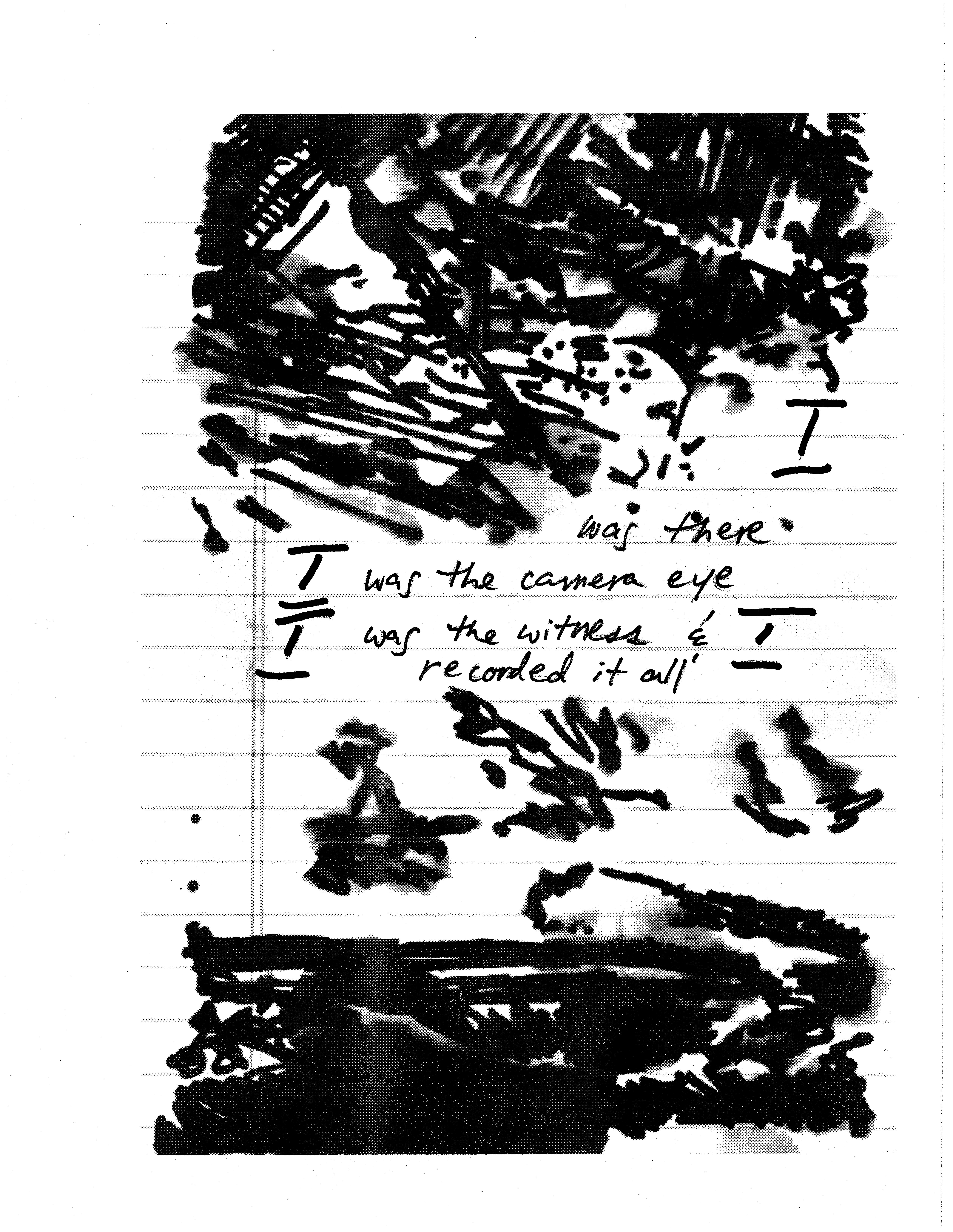
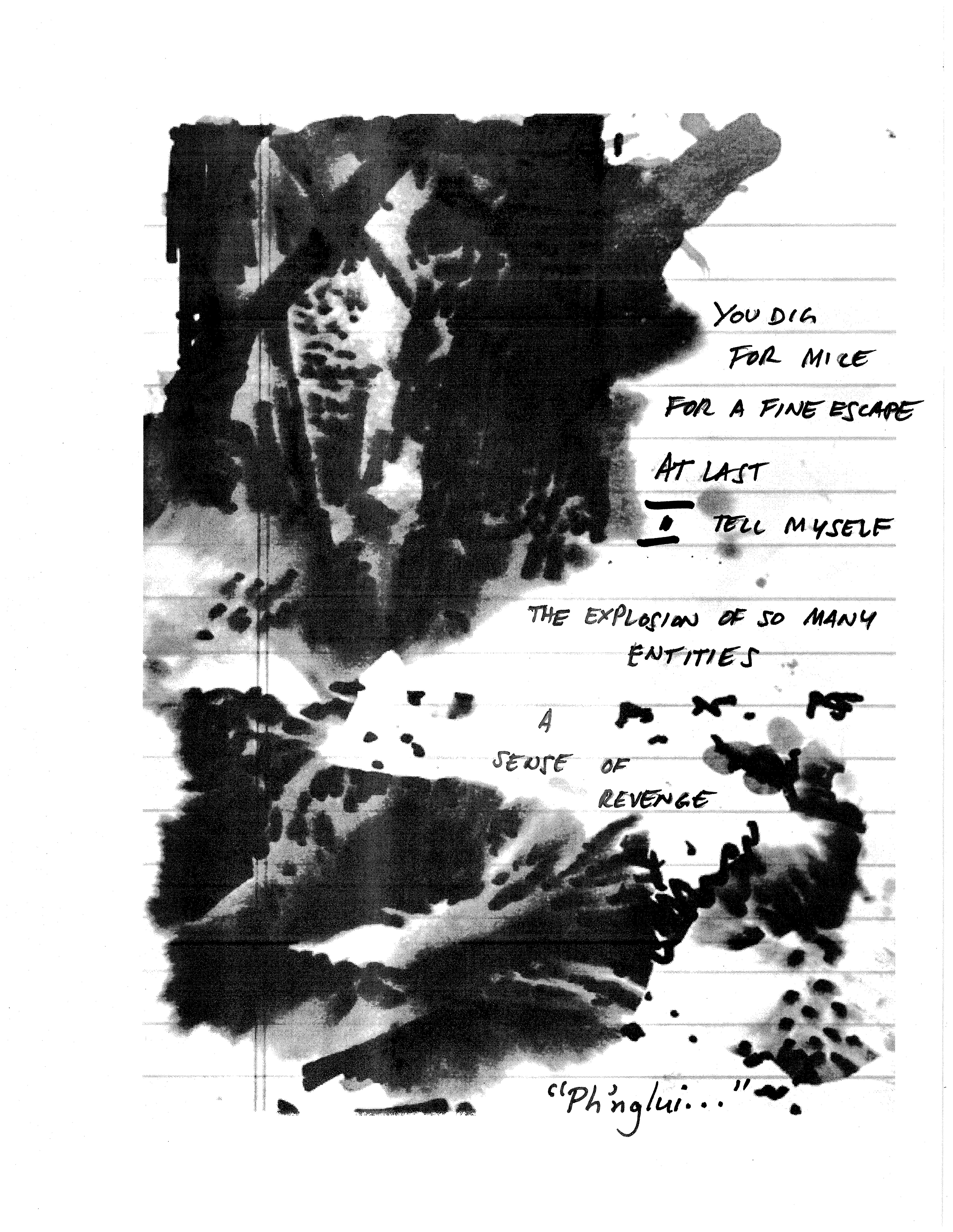
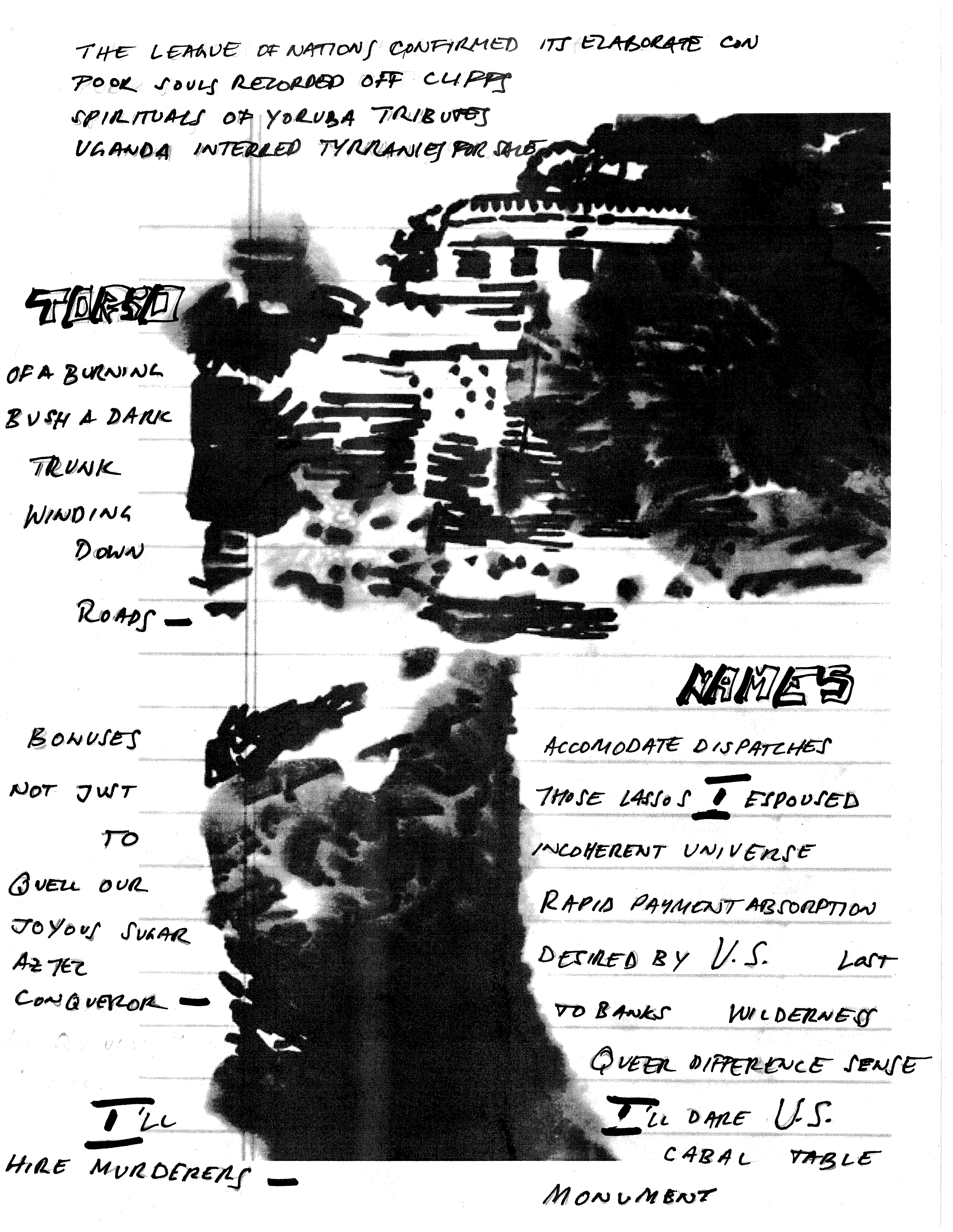
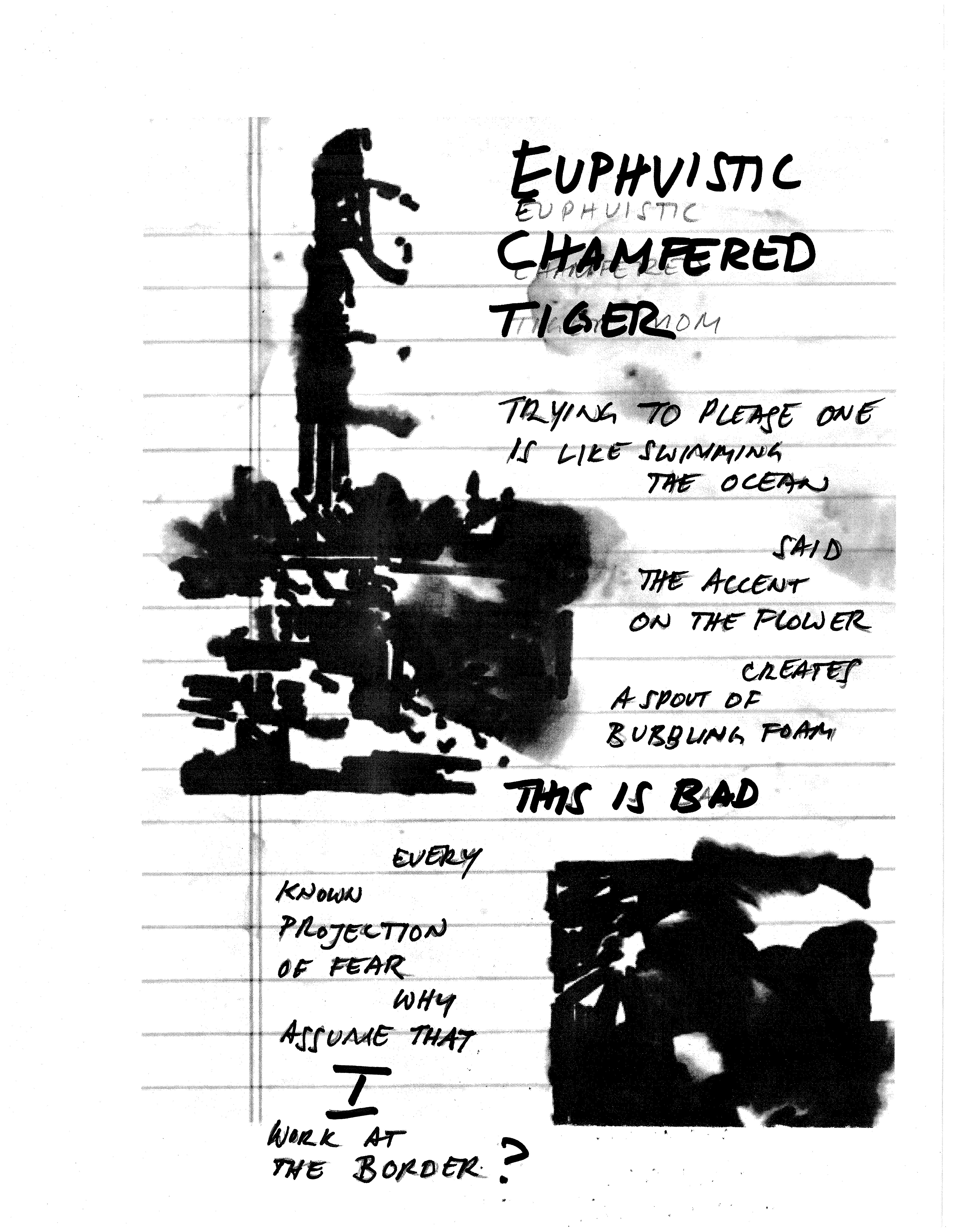
VSK CHAPBOOK PAOLO JAVIER AND MATT JONES: FROM THE OCCULT DIARY OF HOSNI MUBARAK

In Uncategorized on December 18, 2011 at 11:41 pm


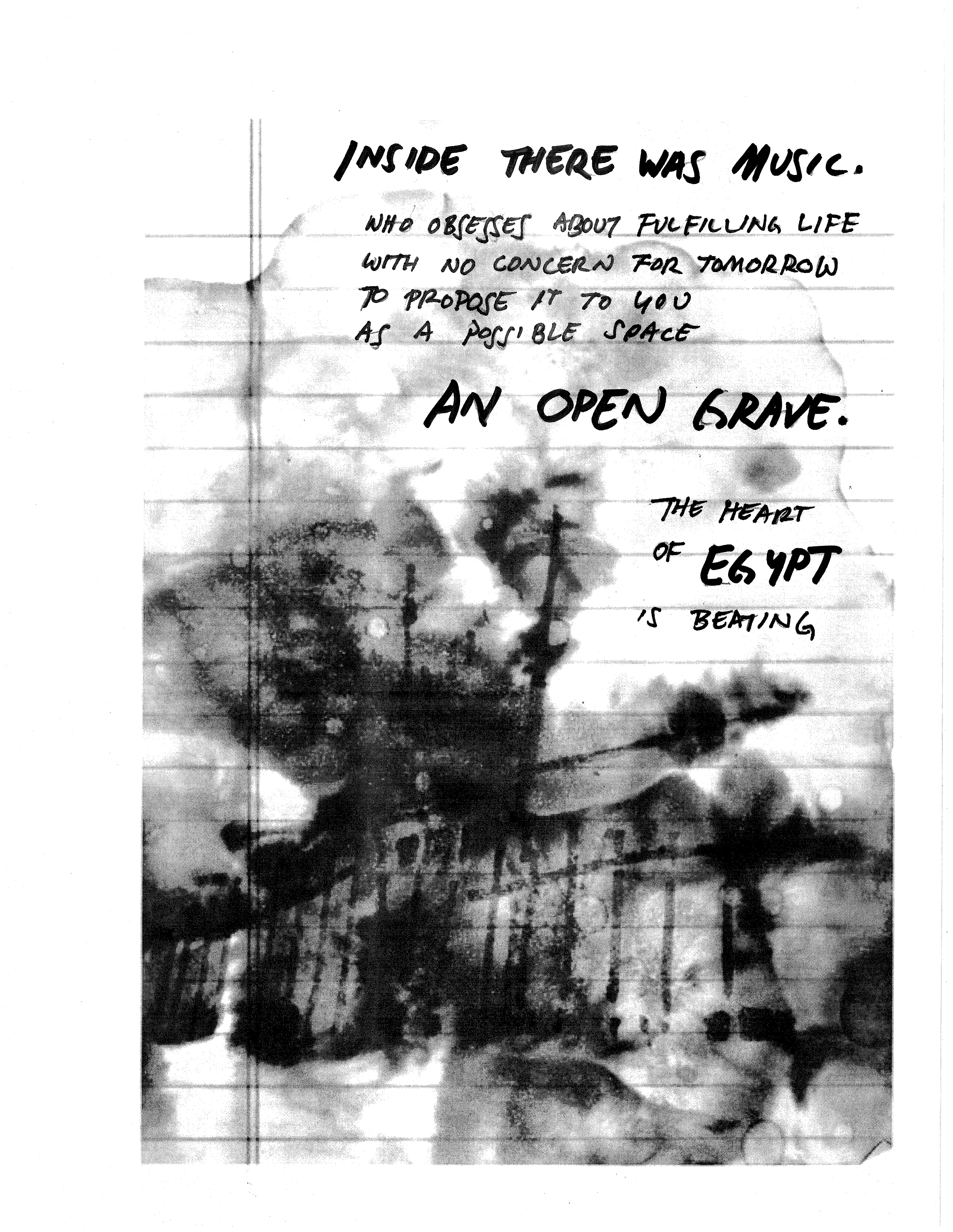
The latest VSK Chapbook is  FROM THE OCCULT DIARY OF HOSNI MUBARAK by Paolo Javier and Matt Jones.  It is available for PDF download here.


*


The authors provide the following information about themselves:

Paolo Javier is the current Queens Borough Poet Laureate. The recipient of grants from the Queens Council on the Arts and New York State Council on the Arts, he is the author of four chapbooks and three full-length poetry collections, including The Feeling Is Actual (Marsh Hawk Press, October 2011).

Matt Jones was born and raised in a suburb of Rochester, New York. He received his BFA in art from the Cooper Union for the Advancement of Science and Art in 2002.

He has had a half dozen solo shows and participated in numerous group shows over the last eight years. He lives and works in Williamsburg, Brooklyn. He’s also read every book on UFOs, the paranormal, ancient astronaut theory, the Knights Templar, and quantum mechanics he can get ahold of.

Ghostbusters is his favorite movie.


*


Paolo was previously artist in residence for VerySmallKitchen’s DEPARTMENT OF MICROPOETICS at the AC Institute in New York. Details of that project is here.

One starting point for collaboration here was Matt Jones Occult Drawings in 2nd Avenue.


*


Read FROM THE OCCULT DIARY OF HOSNI MUBARAK here.


VSK PROJECT NEIL CHAPMAN: MEMO SEVEN

In Uncategorized on December 13, 2011 at 12:11 am


Read MEMO SEVEN as a VSK Chapbook here.  More on Neil’s work is here.


VSK RESIDENCY OHAD BEN SHIMON (2): 2 DECEMBER 2011

In Uncategorized on December 6, 2011 at 4:36 pm

“…it is clear that we must trust in what is difficult; everything alive trusts in it, everything in nature grows and defends itself any way it can and is spontaneously itself, tries to be itself at all costs and against all opposition. We know little, but that we must trust in what is difficult is a certainty that will never abandon us; it is good to be solitary, for solitude is difficult; that something is difficult must be one more reason for us to do it.”

(Rainer Maria Rilke, Letters to a Young poet, The Seventh Letter, May 14th , 1904, Rome)


“Ask yourself in the most silent hour of your night: must I write? Dig into yourself for a deep answer. And if this answer rings out in assent, if you meet this solemn question with a  strong, simple ‘I must’, then build your life in accordance with this necessity; your whole life, even into its humblest and most indifferent hour, must become a sign and witness to this impulse.”

(Rainer Maria Rilke, Letters to a Young poet, The First Letter, Feb 17th , 1903, Paris)


2.12.11


It is night-time.
It is winter.
It is cold.

It is difficult.
It is hard.
It is driving you crazy.

Nevertheless.

It is good.
It is for the good.
It is difficult for the good.
It is a difficult time for the good.

Nevertheless.

You will be fine.
You will.

As long as you keep your eyes open no harm will be done to you.

Be aware.
Be brave.
Be funny.
Be consistent.
Be around friends.
Be in big cities.
Be in the country side.

Be sexy.
Be aroused.
Be attracted and attractive.
Be horny.
Be flirty.
Be clever.
Be yourself and not yourself.
Be the different characters of yourself.

Be a literary hero.
Be a movie star.
Be famous.
Be famous.

Be emotional.
Be lost.
Be free.

Be reading books.
Be walking in the forest.
Be riding the bike.
Be and be not-be.

Be someone who cares.
Be honest.
Be a man.

Be a woman.
Be a child.
Be in equanimity.

This poem demands a final ‘Be’ standing alone at the end but I wont do that.

Be-cause,
this poem wants to
be
a
tree.


_


What has not been said?

There must be something that has not been said.

Postmortem.

How can we connect that to Postmodernism?


_


She is on her fours,

I am above her.

She is below me.

She is blowing me.


I am being blown.

I am being blown from below.

I am being blown from below by a beautiful blonde.

I am being blown from below by a beautiful blonde with big breasts.

b(e)-b(e)-b(e)-b(e)-b(e)-b(e)-b(e)-b(e)

Her breasts are dangling in front of me.

I look at them.

They are big.

They belong to a beautiful blonde with big breasts.

I take them in my mouth.

I suck on them.

She sucks on me.

We both suck each other.

We suck and suck and suck.

Then we fuck and go to sleep.


The following is a reconstruction of an email exchange between VerySmallKitchen and Ohad Ben Shimon in response to the above post, which took place Dec 3-4 2011.


OHAD: i have been wanting to write something erotic after reading bataille’ story of the eye for the first time. im aware that it doesnt quite pass by my usual subject matters or ‘style’.

what made the last section definite for me is that it is not at all about desire or the sexual act but only about the one long sentence where i felt like coming up with a lot of words starting with the letter ‘b’ – being blown by a beautiful blonde with big breasts and that that would echo somehow the verb/wish – ‘be’ from the first section, so to have some kind of ‘coded’ message. and in relation to poetry and photography…that they should also just be in the sense that a poem wants to be and a photograph/image wants to be..

i guess im ‘building on’/trusting the contingency of language..in form and in essence in the sense that contingency is something applicable to propositions and i see art as a proposition. maybe that is the necessary link we need in order to come back to our original question – what is the relation between art practice and writing..


VerySmallKitchen: One characteristic of texts that position themselves between art practice and writing seems to be an immersion in the possibilities of a form or genre which is simultaneously a utilisation of its possibilities/effects and a commentary upon those –


Ohad: i do consider all of this discourse as one which is on a meta level yes definitely. i think the kind of poetry i am most interested in is ars poetics and i guess that im interested in connecting poetry as the highest form of literature to a possible highest form of visual art, perhaps that would be painting or some other form of image-language (beeld-taal in dutch)? so im dealing here with comparing these two systems, the system of language to the system of art via a meta connection, yes.


VerySmallKitchen: But these multiple levels of (self-) awareness are not necessarily shared or even identified by a reader.  Perhaps that explains texts that require performance or discussion to be “completed” in some way, either as “afters” or by inviting notions of script and conversation into their own page forms –


Ohad: (thinking out loud) is an incomplete text one that does not have con-text? do we need a text to have a ‘con’ in order to justify it or can it just be without having an antagonist to ‘fight’ against? a preposition (con) to complete the proposition? does a text need a context in order to be self-aware? does its self-awareness require a context in order to be comprehended? does a text need to be comprehended?

maybe this is a quality that we can borrow from visual art which does not necessarily require to be comprehended in order to be enjoyed..maybe such is the form of the ‘artistic’ text? maybe con-text as such is something we can start to imagine doing without. i mean this in the sense that everything is context. everything is going against the text. that is why it wants to be, to be on its own, to exist on its own terms (like the reference by rilke) to exist.

the text is the protagonist and the con-text is the antagonist. maybe that is the duel of literature..that is the pity i find in story of the eye by bataille.. it is followed by an unnecessary ( in my opinion) contemplation by roland barthes and susan sontag who will creep their way into whatever interesting text is out there..

… i think a good way to deal with this is indeed through performance, especially as regarding to voice, and the sound the text and reader make whilst reading it – indeed a more physical form. perhaps that is the reason for all the explicit physicality, stereo-typical sexual representation, i.e the politics of representation at the end. the politics of representation here is in fact a politics of repression in which the voice is being repressed by an all encompassing Über-con-text.

… some final thoughts about things standing on their own..perhaps we are attempting here a challenge to what is believed to be unachievable in contemporary art..an object standing on it own..a self contained object..


VerySmallKitchen: But despite all these processes/ideas the post still concludes with a stereotypical heterosexual male sexual fantasy/ porn image-


Ohad: what is a classic porn image/ male fantasy? im sure there are million different kinds of fantasies. why are we forced to think that there is one iconic, original, solid male fantasy. the nature of fantasy itself is in the multitude not the singular..dreams and fantasies are lucid. maybe we are dealing with challenging the classic definition of a male fantasy?

maybe the ‘pornographic’ section at the end is dealing with the deconstruction of the original/monolithic text/male fantasy as such? maybe that is where porn and poetry meet..? i guess you are right in pointing out that we do have some gender issue on our hands. how to deal with that? maybe in the next post?


VerySmallKitchen: Thinking about blog traffic I was considering the relations of our ideas on language and art practice to “beautiful blonde big breasts sucks” as google search terms… should this be part of our concern?


Ohad: the google search terms is part of our inquiry i believe. google is the all encompassing context which the texts we are dealing with today take their oxygen/raison de etre from.


Post 1 is here. More about Ohad’s work is here.


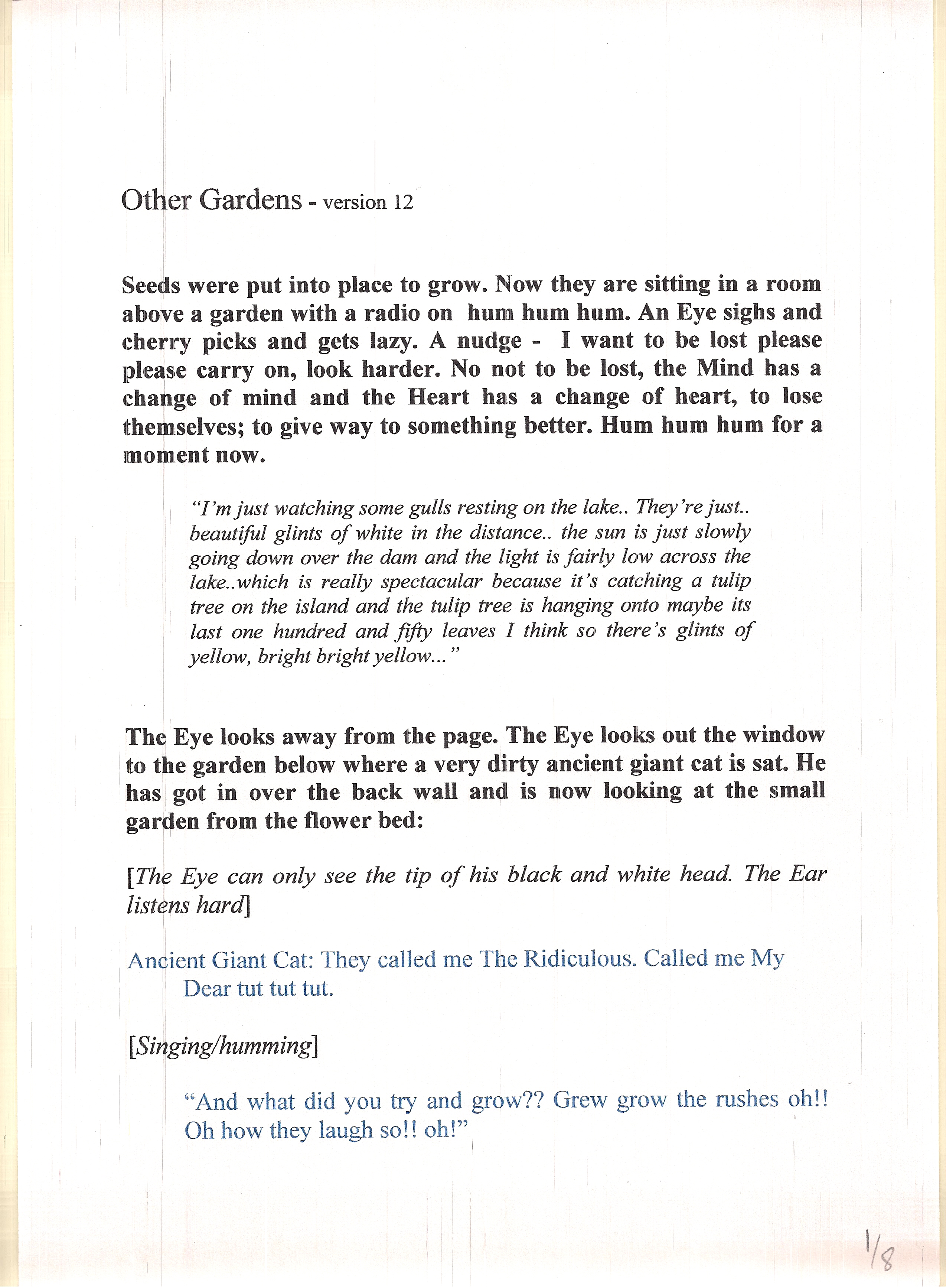
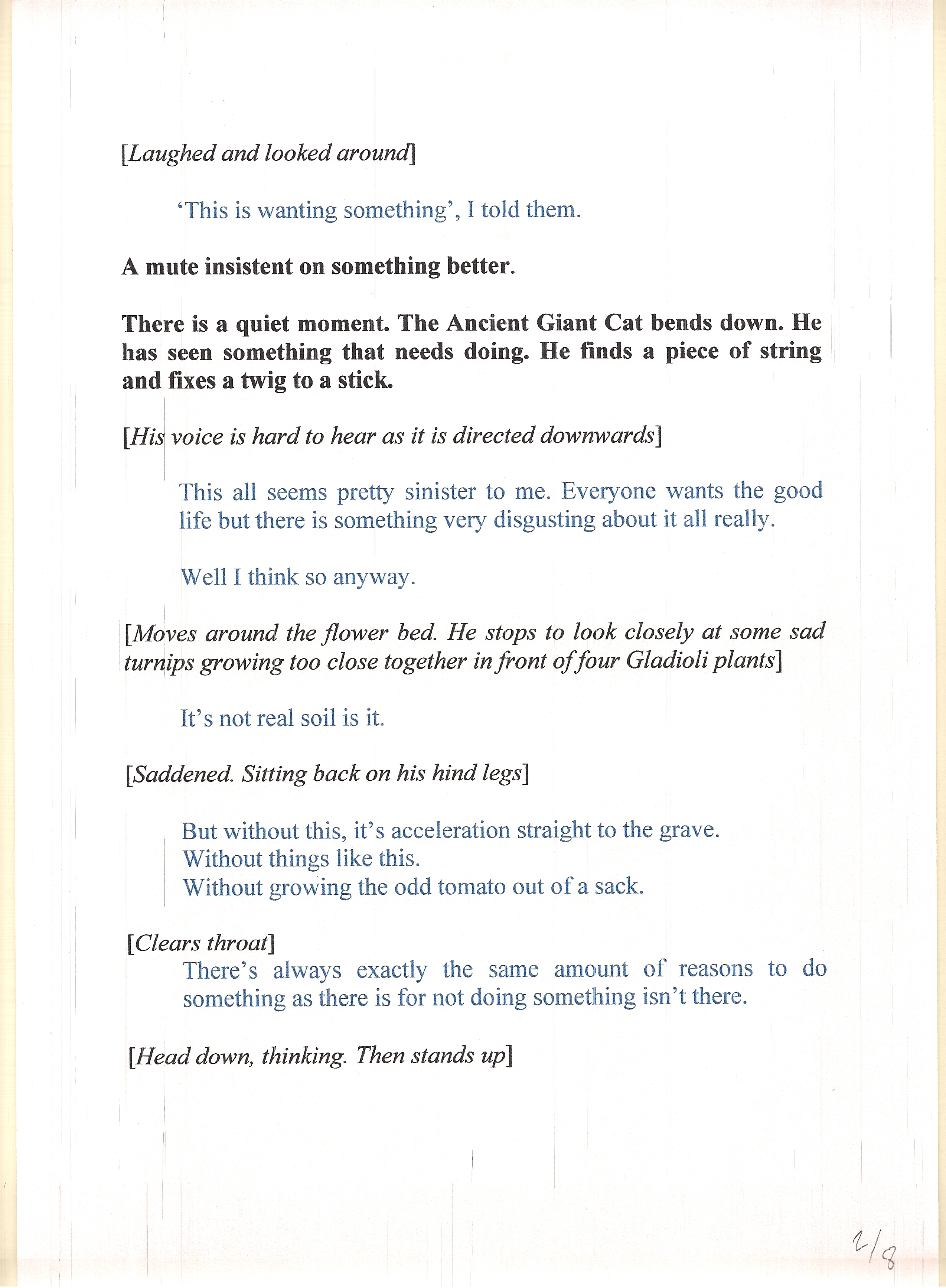
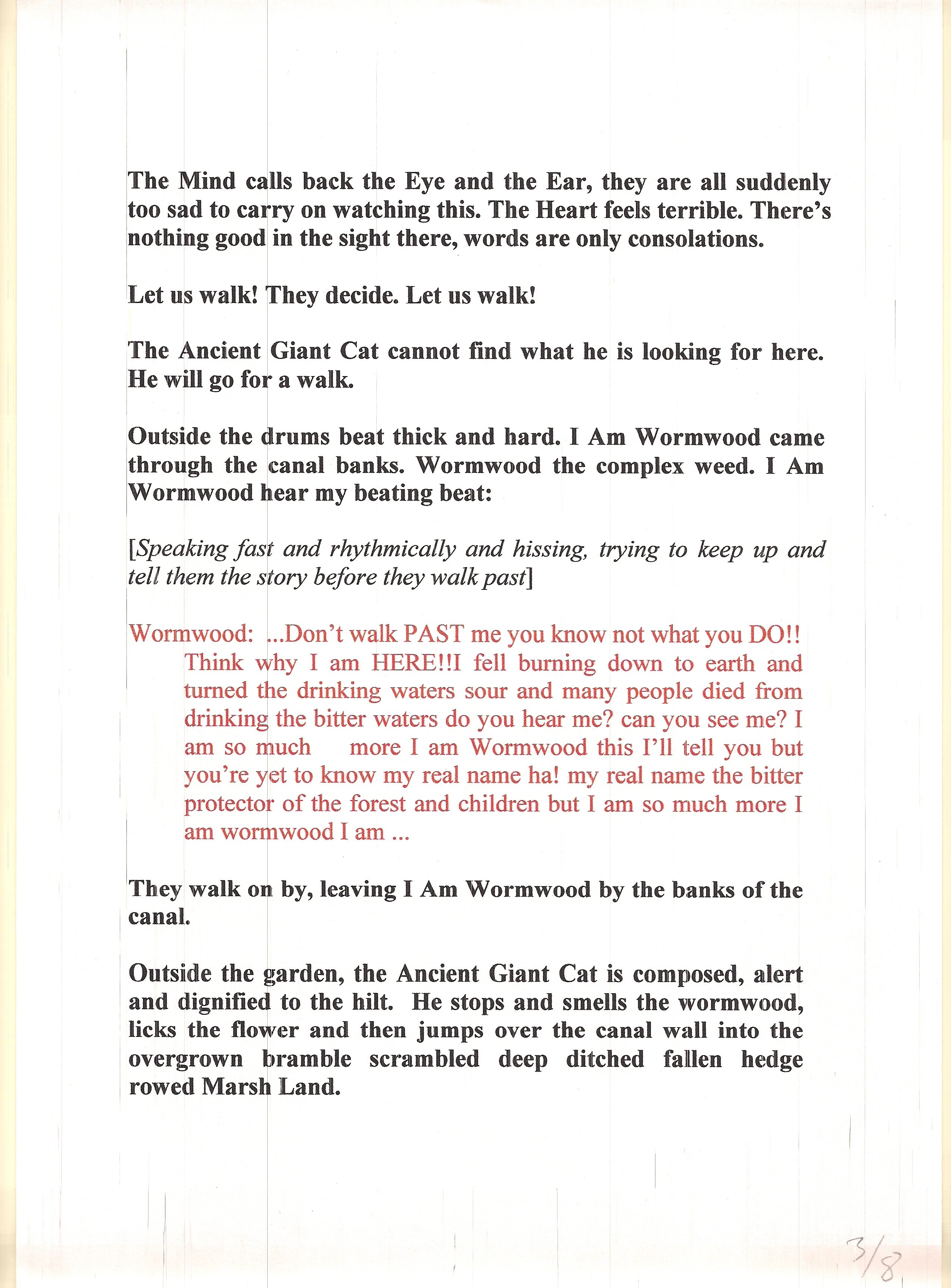
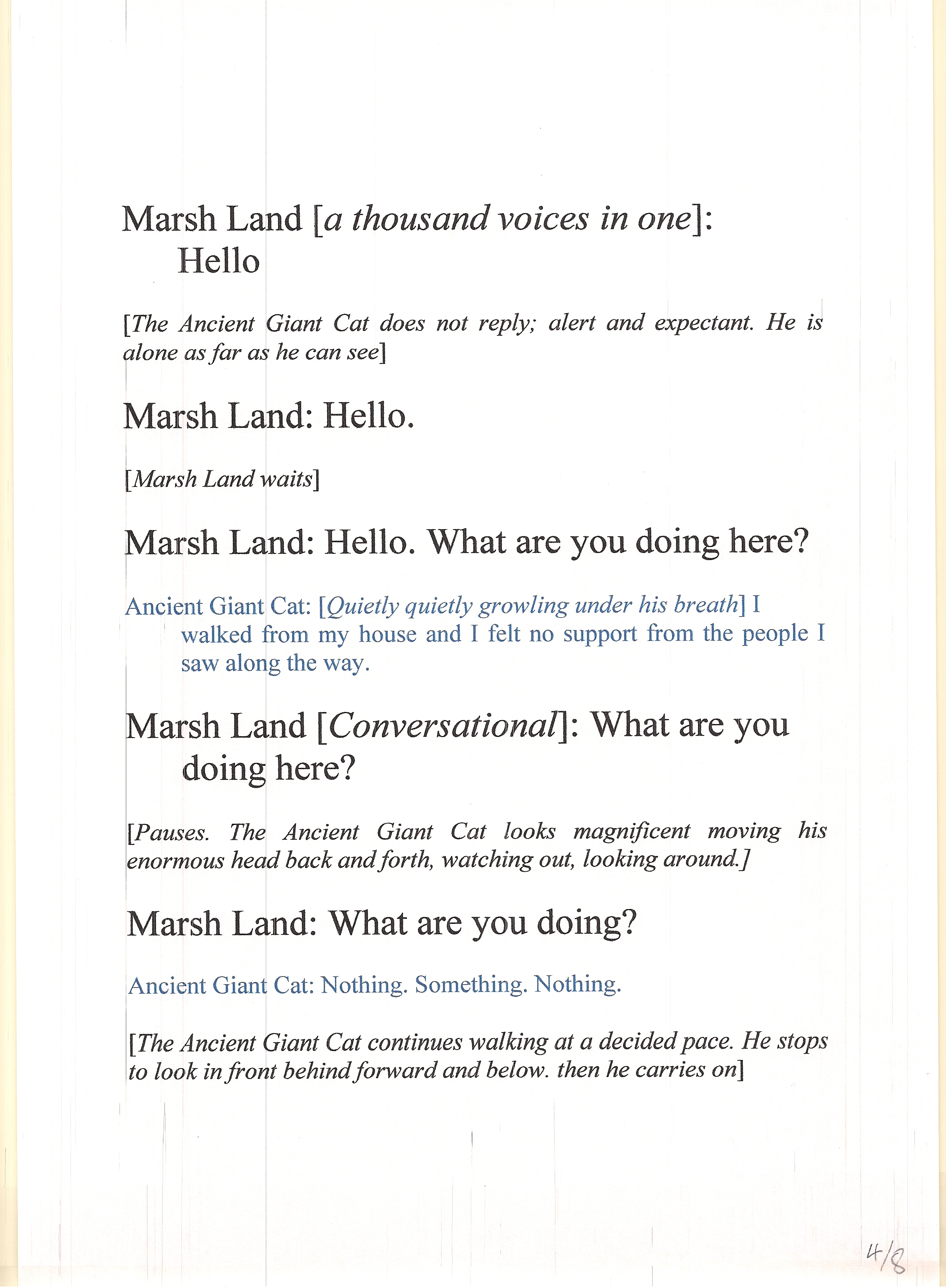
VSK PROJECT: ALISON BALLANCE OTHER GARDENS – VERSION 12

In Uncategorized on December 1, 2011 at 9:29 pm


Other Gardens – version 12 is available as a VSK chapbook here.  More on Alison’s work is here.


VSK RESIDENCY OHAD BEN SHIMON (1): 14 NOVEMBER 2011

In Uncategorized on November 17, 2011 at 6:44 pm


-You shall not look through my eyes either, nor take things from me,
You shall listen to all sides and filter them from your self.

-I have heard what the talkers were talking, the talk of the
beginning and the end,
But I do not talk of the beginning or the end.

-These are really the thoughts of all men in all ages and lands, they
are not original with me,
If they are not yours as much as mine they are nothing, or next to nothing,
If they are not the riddle and the untying of the riddle they are nothing,
If they are not just as close as they are distant they are nothing.

(Walt Whitman, from Song of Myself, 1855)


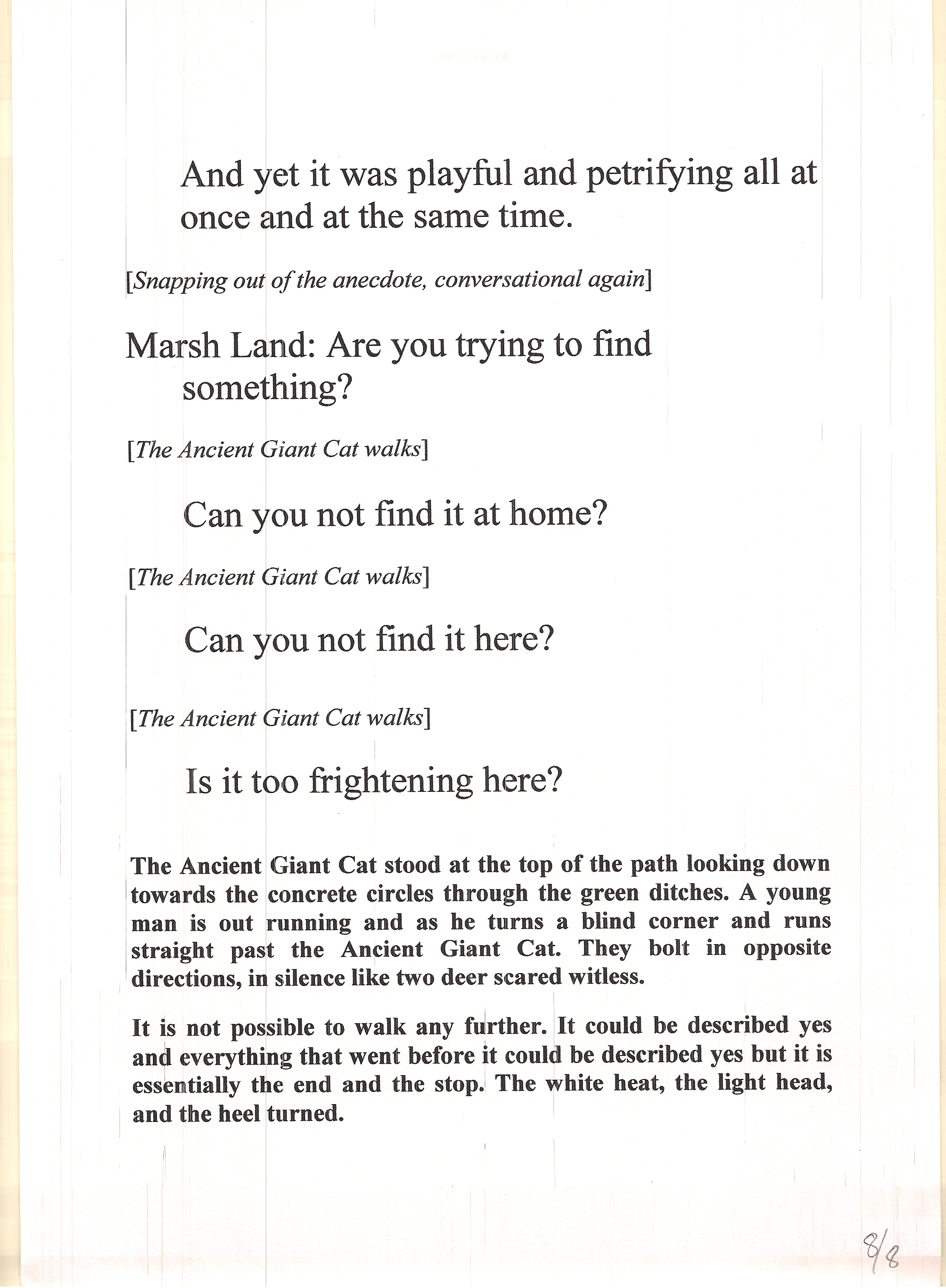
I am at a park.
I am at the queen’s park.
I am at the park of the queen,
but I don’t see the queen.
I am told she is in the palace.
I see the palace.
I see the palace garden.
I see the guards of the palace.
I see the gardeners of the palace
garden.


I see the birds in the park.
I see the flowers in the park.
I see the winter trees in the
park.
I even see the mist in the
queen’s park.


But I don’t see the queen.


The Queen’s Painter Prize is about obscurity.
It is about the obscurity of the queen and the obscurity of the painting, {and the relation (indexical)
between the queen and the painter}.


Am I the obscured writer?
Am I a Camera Obscura?
Am I in the obscured kamer?
Is the kamer obscured from the rest of the world?
Is it a hidden room?
It is.
And from the darkness of the room comes light.
And the light is right.
And ‘the right’ writes.
And ‘the wrong’ remains obscure.
The obscured writer is ‘the wrong’ writer.
And ‘the wrong’ writer is always right. Always.
The obscured writer writes
with an obscured pen.
The pen is obscure.
The whole trick of writing is how to obscure the pen.
The whole ____ of _____ is how to obscure the ___.


See?


VerySmallKitchen writes:  The following notes are edited from emails between Ohad and VerySmallKitchen in November 2011.


OHAD: I have been playing with a few ideas in my head about my possible contribution to VerySmallKitchen..they center around my desire to figure out/’re’-search (even though I am a bit skeptical of the term ‘research’) the space between writing and contemporary art practice (including mainly performance and photography).

(Thinking out loud)

As a starting point I would situate the discourse involving writing and art practice, on the issue of Categorization at large..I mean to say..I think both writing and art practice as fields of interest, have a kind of dialectical character which begs the question of the attraction between them. Writing as a category may refer to 2 main ‘things’ – Writing as a noun, the ‘thing’ that is written, and Writing as a verb, which designates the ‘activity’ of writing…and of course the ongoing debate regarding genres, cross-genres, etc.

Contemporary art practices are also obsessed with categorization, with art historical references, art movements, mapping-outs, delineating, etc…and also in the more traditional artistic practices the obsession with object oriented art production…hence the connection I would speculate between thing (writing) – object (art practice).

A question to myself – Is writing really a medium or is it an inscription onto a medium?


I’m not exactly sure I understand what it means to be an artist in residency on a website…but I could tackle that question in my writing in a kind of self reflexive manner..For each post I would write a diary entry from a very specific and limited time/space…it would then be a kind of performance which I’m writing from… image and text as two separate and yet parallel language systems…

another more interesting option I’m thinking of now is to limit the space even more.. down to the level of an object… investigating how my presence on the object influences my writing..suggesting a diffusion of the subject-object dichotomy..how my physical contact with the object influences my writing… You could see it as a taxonomy of a sort.


I see these texts as drafts in the sense that they are instantaneous, like a sketch, of the moment. Usually drafts would mean something on the way to somewhere else, but for me this kind of drafting is more of the present, its not leading anywhere, only to its own reason to be.


More about Ohad’s work is here.

VSK PROJECT NICO VASSILAKIS: STARING APPENDIX PART ONE

In Uncategorized on November 2, 2011 at 9:33 am


How looking at atomics informs the celestial is how parts of letters construct a word. The keyboard as periodic table, as stillness and value assigned to each button. Accelerated molecules go streaming out the mouth. Elements are floating everywhere. A sub-atomic splice of Q caught in an asterisk. The mega volume of billboard words being staved with a diligent stare. To confound the dictionary by purposefully eroding cohesion between the letters that form a word. Like a word, like biscotti snapped in two, in four parts, into crumbs. Then there are aspects of an erupted B dangling off a row of commas.

Morton Feldman said of Philip Guston’s abstract expressions that he was taking snapshots of Time Undisturbed. What is staring but that, Time Undisturbed, until the fidgeting subsides, until the pace is realized, until thought is cleared out enough to allow the material to enter. A repurposing of the given till new possibilities emerge.

What can you say about seeing? It’s wonderful, well, that’s not nearly enough. Try as you might, and thousands have, to describe the joyous nature of seeing. Some of it romantic, some of it informative, but all of it detached. It’s removed, if you will, from the very moment of sight. An image getting, not so much lost in the translation parts of the vision system, but diluted through distance. That distance or measurement where content is vulnerable to corruption. It’s a passage from the thing through the eye into the brain. Seems like a fantastically long journey where anything can happen. And it does. And no one ever seems to really be there. No one ever gets it right, so we continue to look, to stare.

SEGUE LISTE


a)there is nothing to cut loose from

b)the goal is ecstasy

c)now is supreme, break the stiff neck of habit

d)the constant baptism of newly created things

e)the white fertilizing ray

f)motion leaks everywhere

g)the god is inside the statue

h)the rest is ease, pause, grace

i)between above and below can be no mirrored reflection

j)i am talking from a new double axis

k)the mystery remains – an open reality and each reality is endlessly
            multifaceted and polyhedral

l)i am to build a house of ice/because it is more liquid

m)I was visited nearly every day by the Superior of the birds named
Loplop, my private phantom, attached to my person. He presented me with
a heart in a cage, the sea in a cage, two petals, three leaves, a flower
and a young girl. Also, the man of the black eggs and the man with the
red cape. On a beautiful autumn afternoon he told me that one day he had
invited a Lacedemonian to come and listen to a man who imitated the
nightingale quite perfectly. The Lacedemonian replied: “I have often
heard the nightingale herself.”  One evening he told me some jokes which
didn’t make me laugh: “Joke: it would be better not to reward a
beautiful deed at all than to reward it badly. A soldier had lost both
arms in a battle. His colonel offered him a five dollar bill. The
soldier responded: “No doubt you think, sir, that I have lost only a
pair of gloves.”

n)Book I.


definitions.

1.    A point is that which has no part.

2.    A line is breadthless length.

3.    The extremities of a line are points.

4.    A straight line is a line which lies evenly with the points on itself.

5.    A surface is that which has length and breadth only.

6.    The extremities of a surface are lines.


13.  A boundary is that which is an extremity of anything.

14.  A figure is that which is contained by any boundary or boundaries.


a)gertrude
b)kerouac
c)dh lawerence
d)lorca
e)kandinsky
f)fenollosa
g)pound
h)zukofsky
i)klee
j)olson
k)malevich
l)schwitters
m)ernst
n)Euclid

These pieces were created using the TypeDrawing app for iPod.


*


VerySmallKitchen writes: Nico Vassilakis’ staring@poetics began as a presentation at the Avant Writing Symposium 2010 in Colmbus, Ohio, comprising a written text and a series of images (the later created whilst in attendance at the conference).

Images and essay intertwine in the book published by XeXoXial EdiTions in 2011, in which Nico observes:


“The initial act of reading is staring. When you add saccades you initiate movement. Text itself is an amalgam of units of meaning. Words, right. As you stare at text you notice the visual aspects of letters. As you stare further meaning loses its hierarchy and words discorporate and the alphabet itself begins to surface. Shapes, space relations, visual associations emerge as you delve further. Alphabetic bits or parts or snippets of letters can create an added visual vocabulary amidst the very text you’re reading.”


which I relate to Susan Sontag’s observation in “The Aesthetics of Silence” (from Styles of Radical Will, 1969):


“Consider the difference between “looking” and “staring.” A look is (at least, in part) voluntary; it is also mobile, rising and falling in intensity as its foci of interest are taken up and then exhausted. A stare has, essentially, the character of a compulsion; it is steady, unmodulated, “fixed.”

Traditional art invites a look. Art that’s silent engenders a stare. In silent art, there is (at least in principle) no release from attention, because there has never, in principle, been any soliciting of it. A stare is perhaps as far from history, as close to eternity, as contemporary art can get.”


*


Nico’s “silent art” is vispo and his text unfolds staring as the strategy for both its practice and its discussion:


“How to speak about vispo? For one, the relatable denominator is how we see. How language affects us visually, how staring at language is essential to reaping functionality out of vispo. In this case, we’d consider a stare to be an elongated gaze, and staring the hyper-focused verb from which we gain further insight.”

Also, this text/talk tells: “When staring bores an opening it defines the border where breathable atmosphere and relentless space meet.” “Staring at textpo creates the potential for vispo.” On several occasions such considerations become list and litany, document and invocation:


Staring at simple shapes
Staring at alphabetic division
Staring at new logic
Staring at elegant contraption
Staring at destruction
Staring at evasive composition
Staring at annihilation of word
Staring at newer logic
Staring at the seed of looking


For more information on STARING POETICS see here.

VSK PROJECT MATTHEW MACKISACK: (A COMEDY OF) DANGER

In Uncategorized on October 15, 2011 at 1:30 pm


Matthew MacKisack, Initial & Reprise installation view, 2010


Matthew MacKisack writes: The Radio of the Future – the central tree of our consciousness – will inaugurate new ways to cope with our endless undertakings and will unite all mankind. … The main Radio station, that stronghold of steel, where clouds of wires cluster like strands of hair, will surely be protected by a sign with a skull and crossbones and the familiar word “Danger”, since the least disruption of Radio operations would produce a mental blackout over the entire country, and temporary loss of consciousness. [1]

The first play written for British radio was Richard Hughes’ Danger (1924), a one-act melodrama set in an unlit and flooding coal mine. As the author later remarked,

Our audience were used to using their eyes; this was a blind man’s world we were introducing them to. In time they would accept its conventions but how would they react on this first occasion? Better make it easy for them, just this once. Something which happens in the dark, for instance, so the characters themselves keep complaining they can’t see. Perhaps we could get the listener to turn out his lights and listen in the dark. [2]

‘Listen in the dark’ is exactly what the Radio Times advised its readers to do. In an attempt to foreground the ethics of making it ‘easy for them’, of the naturalistic illusion, and in the spirit of a Khlebnikovian ‘flight from the I’, Richard Hughes’ original script has been revised and edited according to contemporaneous Russian formalist theories – themselves a response to Futurist aesthetics – of ostranenie, or defamiliarization.


[1]  Velimir Khlebnikov, The Radio of the Future, 1921
[2] Richard Hughes, The Birth of Radio Drama, B.B.C. Home Service, 1956


(A COMEDY OF) DANGER


Cast:

A, B,C


Scene:

A gallery in a Welsh coal mine.


A. [sharply] What’s happened?

B. The lights have gone out!

C. Where are you?

A. Here.

B. Steps stumbling.

C. Where? I can’t find you.

A. Here. I’m holding my hand out.

B. I can’t find it.

C. Here!


[pause]


A. [startled] What’s that?

B. It’s all right: it’s me.

C. You frightened me, touching me suddenly like that in the dark. I’d no idea you were so close.

A. Catch hold of my hand. Whatever happens, we mustn’t lose each other.

B. That’s better. – But the lights! Why have they gone out?

C. I don’t know. I suppose something has gone wrong with the dynamo. They’ll turn them on again in a minute.

A. I hate the dark!

B. It’ll be alright in a minute or two.

C. It’s so dark down here.

A. No wonder! There must be nearly a thousand feet between us and the daylight.

B. I didn’t know there could be such utter darkness as this, ever. It’s so dark, it’s as if there never was such a thing as light anywhere. It’s like being blind!

C. They’ll turn the lights up again soon.

A. I wish we’d never come down this mine! I knew something would go wrong.

B. Where are the others?

C. They’re just on ahead, not far.

A. Suppose we get lost!

B. We can’t get lost.

C. I wish you hadn’t wanted to drop the others! I’m afraid of the dark.

A. It’ll soon be over.

B. And I wish we hadn’t left behind those lamps they gave us! [Pause] Listen!

C. Steps heard.

A. There’s someone coming!

B. [Distant, muttering] Of all the incompetent idiots, turning the lights off just when a party of visitors were seeing the place! Call this a coal-mine!

C. Hello?

A. Hello? Who’s there? Of all the stupid –

B. What’s happened? Is it all right?

C. Is it all right, indeed! Leaving us suddenly in the dark like this!

A. But has there been an accident?

B. God knows! I’d expect anything of a country like this! They’ve got a climate like the flood and a language like the Tower of Babel, and then they go and lureus into the bowels of the earth and turn the lights off! Wretched, incompetent –

C. Well, I suppose the only thing to do is to sit and wait for the lights to go up again.

A. There’s no danger, is there?

B. No, there’s no danger.

C. I’m beginning to think it’s quite fun.

A. Well, if you can find any fun in breaking your shins in the dark –

B. Why, don’t you call it fun, being in a pit disaster?

C. But this isn’t a disaster, it’s only the lights –

A. Of course! You don’t think it would be fun if it were a real disaster, do you? But the lights going out might have meant a disaster – and imagine telling everyone afterward! Let’s –

B. Yes?

C. Let’s pretend it’s serious.

A. What do you mean?

B. Let’s pretend it’s a real disaster, and we’re cooped up here for ever and will never be able to get out.

C. Don’t joke about it.

A. Why not? There’s no real danger, is there?

B. Well of all the morbid –

C. Let’s pretend the roof has fallen in, and they can’t get to us.

A. [Uncomfortably] Very well … [In mock solemnity] Here we are, my dear, buried alive! Alas, they’ll never find us! [Reverting] Well?

B. I’m so frightened!

C. What of?

A. About the roof falling in.

B. But it hasn’t; it’s only pretense.

C. Yes, but when I pretend, it seems so real.

A. Then don’t pretend!

B. But I want to pretend! I want to be frightened!

C. [In mock solemnity again] We shall suffocate, or starve, or both, my dear, in each other’s arms.

A. Even death shall not part us.

B. Don’t! It’s too awful.

C. There’ll be articles in the newspapers.

A. [Delighted] I wish I could read them!

B. You can’t have your funeral and watch it.

C. A distant explosion, with a long echo, swelling in volume.

A. Good God!

B. Let go! You’re throttling me! Let go of me!

C. Another explosion, nearer, followed by the hiss of water.

A. The dust! It’s choking me! I can’t breathe!

B. Stop screaming! How do you expect to be able to breathe if you’re screaming all your breath out?

C. Pull yourself together! We’re alright; we’re not hurt.

A. We’re not hurt. But listen!

B. Water heard louder.

C. Water!

A. [Sotto voce] Be quiet. Don’t let her hear!

B. What’s that roaring?

C. It’s only the echo.

A. Can’t we find the others?

B. I don’t think we could; it wouldn’t be much use to us if we did.

C. [quietly and sharply]. Oh, good God! Good God!

A. They’re no better off than we are.

B. Listen! That must be them!

C. Voices heard singing.


A, B and C:


Hlaha! Uthlofan, lauflings!
Hlaha! Ufhlofan, lauflings!
Who lawghen with lafe, who hlaehen lewchly,
Hlaha! Uflofan hlouly!
Hlaha! Hloufish lauflings lafe uf beloght lauchlorum!


A. That must be the others. They can’t be very far off. Let’s call to them.

B. Sound carries a long way in a tunnel.  But listen.

C. The roar gets louder.

A. The echo’s getting louder! It isn’t an echo! It’s water! The mine’s flooding! We’re going to drown!

B. The voices are again heard singing, closer this time.


C, A and B:


Hlaha! Loufenish lauflings lafe, hlohan utlaufly!
Lawfen, lawfen,
Hloh, hlouh, hlou! Luifekin, luifekin,
Hlofeningum, hlofeningum.
Hlaha! Uthlofan, lauflings!
Hlaha! Ufhlofan, lauflings! *


C. I wish I had their faith. It’d make dying easy.

A. I don’t want to die yet! I won’t, I won’t!

B. It has got to come some time; isn’t it better for it to happen now, in your lover’s arms? Death might have parted you – but instead he’s joining you closer together.

C. I want to live!

A. Do you think I don’t? Do you think they don’t? They’re singing hymns!

B. Look, instead of talking like this, let’s do something; let’s make some sort of an attempt at escape!

C. What do you propose?

A. Look for some way out. We can’t stay here and drown, like rats in a cage.

B. But if you start to walk, you’ll start to run; and if you start to run, you’ll panic, and go mad in the dark. I’d rather die with my wits about me!

C. I’d rather not die at all!

A. Keeping still is the only thing for us, if we don’t want to lose our heads. Remember how far into the side of the hill we are. What earthly hope do you thinkthere is of finding our way out?

B. Here it comes! Listen!

C. Rush of water quite close now.

A. Yes, it will be on us in another five minutes.

B. Pray Heaven it finishes us off quickly.

C. Think of dying somewhere out in the open, in the sunlight! Me able to see you, and you able to see me! What bliss it would be!

A. It’s strange how little we wonder what will happen to us. In five minutes we’ll know ourselves, all three of us. I’ve always wanted to travel. Now I’m going to.

B. My poor dear!

C. I’m beginning to feel excited about it, like a child going to the seaside for the first time. Aren’t you?

A. I never looked at it like that.

B. The water’s coming! It’s over my feet!

C. Courage, courage.

A. I don’t want to die – I hate it! I want to live!

B. Don’t make it harder.

C. Only for an hour more! There was something I wanted to say to you, and I can’t remember it … I must remember… it’ll be too late soon.

A. Do you think you’re the only one dying before his time? I tell you, every man dies before his time, even if he lives to be as old as Methuselah!

B. It’s up to my knees!

C. [Very quietly] Don’t clutch at me like that, it won’t do any good.

A. But the water – the current’s washing me away –

B. I’ve got you! And I’ve got my other arm round the wooden thing!

C. Hold tight then!

A. If only I could see you!

B. Just think of the things I had meant to do!

C. Shut up about the things you had meant to do! Will you realize we’re all in the same boat, and it’s as hard on me as you – or worse, a thousand times worse!

A. You hoary old sinner, why can’t you prepare to get out of the world?

B. Let’s pray.

C. Pray if you like – I can’t.

A. [Hoarsely] Help! Help!

B. Hold your self in.

C. It’s so close.

A. Help me!

B. It’s no good; no one can possibly hear us. The only thing is to keep calm. It won’t be long now.

C. Tapping heard.

A. What’s that? Listen!

B. Help!

C. Shut up. We need to listen.

A. Tap, tap.

B. It’s up to my waist now.

C. My God! It’s someone tapping. [Shouts] We’re here! Further along!

A. [Calmly] Is it? They’ll find our bodies, that’s all.

B. They’ll find us if they’re quick enough! [Shouts] Further along – that’s right!

C. They can’t possibly be quick enough.

A. Help! Dig quicker! We’re drowning!

B. Stop it; they won’t be in time.

C. [Quietly] I won’t leave you.

A. How do you know they’ll let you stay with him? What do you know about death? I tell you death isn’t heaven and it isn’t hell. Death’s dying. Death’s being nothing.

B. Knocking grows louder.

C. It’s up to my chin! Help me!

A. Let me lift you.

B. [In a childlike voice] Say it isn’t true, what he’s been saying.

C. Hurry up – smash your way in! We’re drowning!

A. They must be nearly through! God, this suspense! How much longer?

B. Look! There’s a light! A hole in the roof! Quick, quick!

C. Sound of strong blows, then sound of coal falling; sound of cheering.

A. They’re though!

B. Quick, below there! Catch on to the rope!

C. I’m an old man!

A. There’s a girl here!

B. I’ve got the rope.

C. She’s fainted.

A. Pass her up – she’ll be alright.

B. Pass the bight of the rope round her shoulders!

C. All right up there? Have you got her?

A. Got her. Now the next.

B. Up you go – the water’s still rising!

C. No, after you; you’re more value in the world than I am.

A. Nonsense, you first! Quick, or there won’t be time!

B. You’ve got her to think of – now, haul away up there!

C. No, no! Lower me!

A. We’ll have you up first; there’s no time to waste. Right?

B. I’m all right. Lower away again. Down there, catch hold! Have you got it? [Pause] Hey! [Pause]  Have you got it? [Pause] He’s gone!


* Velimir Khlebnikov, Incantation by Laughter, trans. Paul Schmidt (1910 / 1985)


Script based on Richard Hughes’ A Comedy of Danger, written and first broadcast 1924, published as Danger in ‘Plays’, London: Chatto and Windus, 1966; revised by Matthew MacKisack for performance in October 2011 at Soundfjord, Unit 3B – Studio 28, 28 Lawrence Road, London, N15 4ER .  Performed by Carla Espinoza,  Lauren McCullum and Leo Ashizawa as the Opening Event of Cast & Figment: Radio as Metaphor & As Such.


*


More about Matthew’s work is here.
VSK PROJECT STEFAN RIEBEL: SOMETHINGS 07

In Uncategorized on October 3, 2011 at 2:15 am


07 / for verysmallkitchen


– one
– pleasingly
– didn’ts
– strings
– mindless
– webps
– two weeks
– <br>
– übrý
– Geschenke
– dave david davidson
– flanger
– techno
– murmur
– htsm
– hbc
– plainblack
– b sp
– hangovercity
– little myth
– a million shouldhaves a day
– plenty of time
– whitechapel
– five-o’clock-freak-out
– rainy
– TESCO (extra)
– an X from me
– that was nice
– (out)
– holding pencil, ready to for writing
– EAST
– 62127
– SLOW
– wwwwww wwwwwww
– cramped
– nervous
– feverly
– pass this on (knife)
– another
– sans serifs
– travelling list
– hyphen
– <br>
– piep.
– mit Quittung
– as soon as you go
– sit set sad
– offline
– mercystreet
– nackt
– unbound
– google lists
– backup service
– plan to follow
– things to forget
– September 14th 2011
– very small kitchen
– bigger bedroom
– systematic changes
– low
– highlighter
– zwergnase
– kidsnoharm
– endless endeavor
– lightbox
– extension
– lies
– for varying degrees
– download enhance
– getting close
– l@#1!
– beware
– nothing in particular
– rename
– renew
– ask me
– frowny
– ninetofive
– löä
– good luck
– list of lists
– milkymist
– quick coffee
– keyless
– aus
– tommorrow already
– lästig
– because i know
– maybe
– finishing
– lagos
– Mary.
– pheasant
– choosing
– paypal
– delayer
– so sorry
– dibelief
– conjunct
– Farbton / Sättigung
– raisin
– schreihals
– meadows
– Life’s Good ; )
– needokeep
– koppla
– anstrengend
– roman
– kloot
– only only
– 1:1
– hurt
– ggbfls
– bloß weg
– mops
– berlin
– even
– 5 am
– forcefully lowercased


VerySmallKitchen writes: Stefan Riebel visited X Marks The Bökship on September 5th, 2011, the first day of my four month writer-in-residency. He was visiting London to perform with Filipa Guimarães at the Wimbledon Collage of Art. A week later Stefan emailed the text above,  the seventh installment of his ongoing project somethings.

somethings is a series of language works Stefan sub-titles a gathering of “specific intentions, descriptions, poems and illusions.”  In a broader methodological statement this description turns prefaces a litany:

*


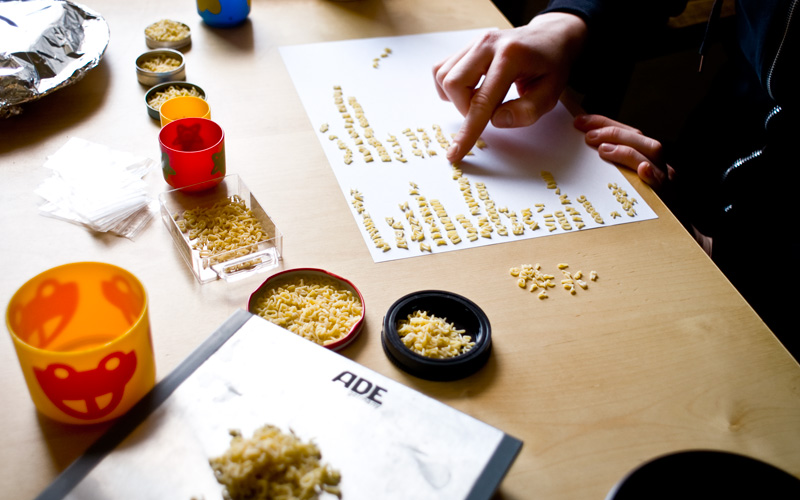
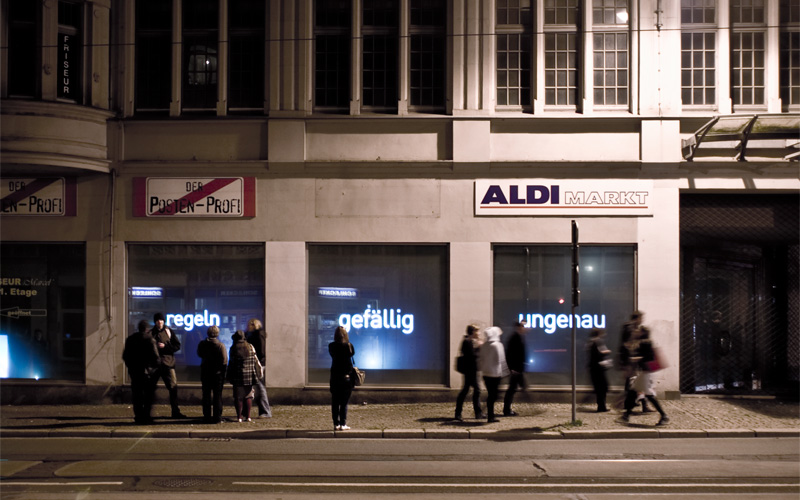
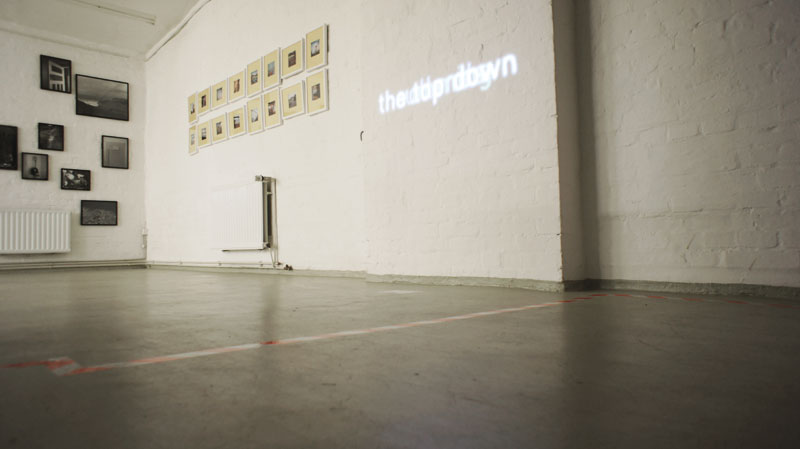
07/ for VerySmallKitchen was sent to me as a list in an .rtf file, as above but in Helvetica Neue. It appears on Stefan’s web site as a word grid that re-orders itself every 30 seconds . This mutability is evident in other works in the somethings series which, as well as their appearance on his web page, are realised by being projected and editioned as letter-seed kits/packets.

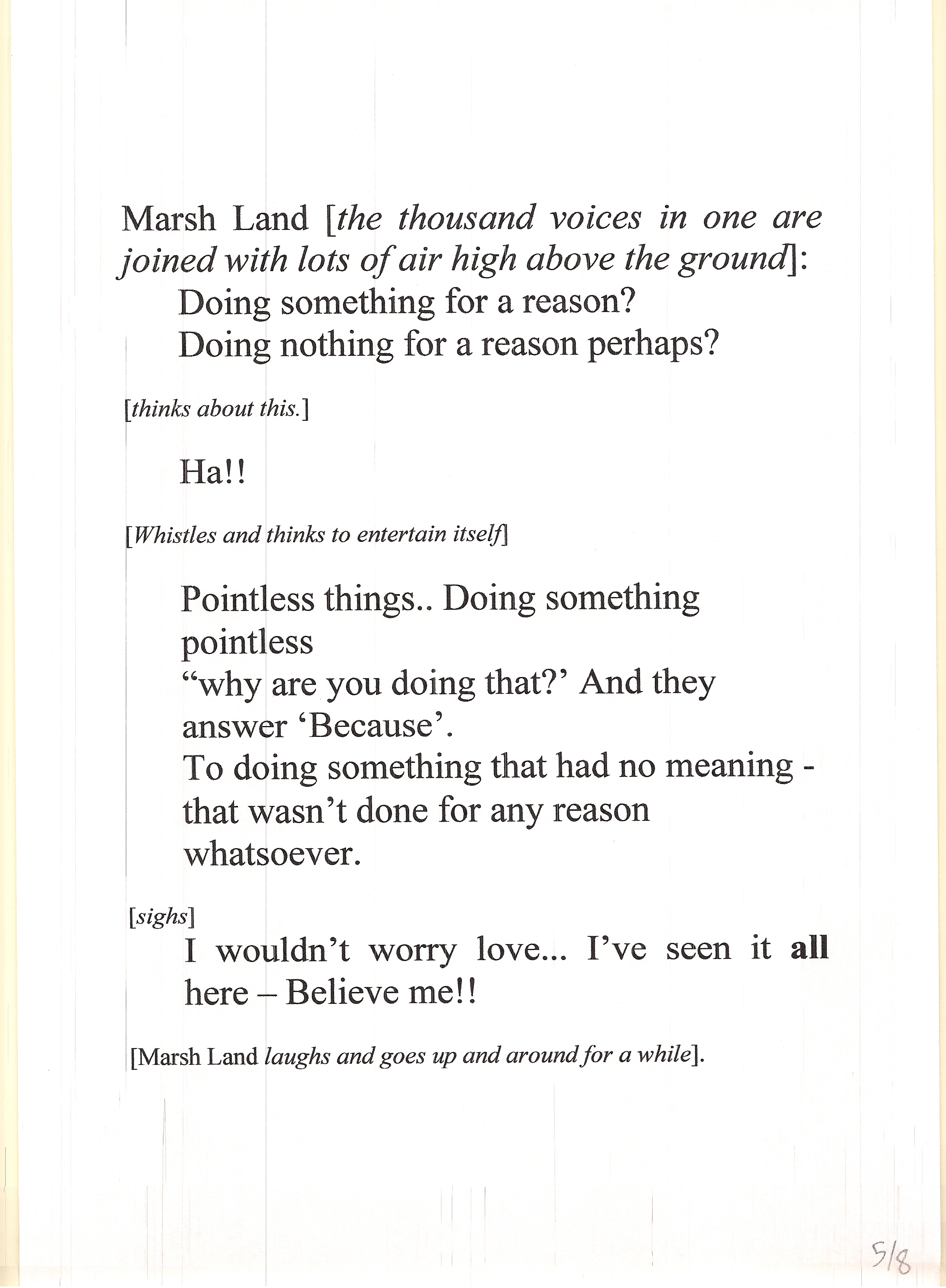
In an email, Stefan described the images in this VSK Project as “documentation of former realisations.” He noted “i do not have one illustrating the word set for verysmallkitchen, maybe you have an image for it ?”  I decided 02/10/11 to realise the following text:


… I recognise words/ entries as notations of things we talked about,  looked at, and moved amongst. Other words, which might also be transcriptions, remain mysterious. Perhaps the notation is in a language I/ both of us don’t know, which includes any English/ German.  Compared to transcription, notation accepts it has already forgotten. This gift holds in its distance-making.

Even as we talk together context is multiple (places/ languages/ moods/ times). This is only (politely) evident in the text, which could never be true to a single encounter, so is always layering infidelities upon infidelities. To try and trace its logic through a trail of referents is to admit the reader’s ridiculousness.

Error and Misspelling are not useful categories for reading. Punctuation or acronym are as immediate and vernacular here as speech and vice versa. Journal as data entry. Statements of emotion and mood might be html. Semi-colon and bracket make a smiley face.  The robot’s I remember is as funny as Joe Brainard’s.

This text holds close – through words and title – to (our) encounter.  It seems wrong to emphaise impersonality. Language’s non-personicity here (to invert a phrase Alain Robbe-Grillet uses of Roland Barthes’ texts in WHY I LOVE BARTHES)  is not smoothed by an evident constraint or system, nor known by its (appropriated) source. I should focus instead on the personicity your text offers evidence of.

To accommodate these tensions go empty the words into your city. This happens when words are projected in gallery or on a shop front or turned into seed-letter packets. When there are “only” the words – as in 07/ for VerySmallKitchen – it is the reader’s intelligence that becomes city via a meaning not threatened by sudden re-arrangements, ever attentive to the specifics of any multiple scaled event.

One example. Disblief ( I think) is dibelief.. .to (nearly) die keep the I but lose the plurality. Then blink. No internet. A conversation is an equality of berlin and raisin. Realise. If this is a new grammar then of course a proper name brings its own full stop as (almost) part of itself.


*


More info about Stefan’s work here. Co-founder of the institut für alles mögliche (institiute for all kinds of things) Stefan is now collaborating on the  Abteilung Für Alles Andere (department for everything else) which will run from September 2011- September 2012 as “a temporary office / laboratory / initiative for art and everything else.”

Films from Stefan’s UNTITLED project were included in I AM NOT A POET at the Totalkunst Gallery, Edinburgh  in August 2011 and are online here. View the complete series here.
VSK RESIDENCY PAUL ANTONY CARR: NATHANIEL’S PERPETUAL MOTION (3)

In Uncategorized on October 2, 2011 at 12:25 pm


“An individual need only possess a single sponge during the span of his or her lifetime. The sponges neither wear out nor diminish in absorbency. Most of the original models are still in circulation. Nathaniel inherited his from his father, who had previously acquired the sponge from Nathaniel’s grandfather. [ . . . ] The sponge compacts all that it absorbs into its core. Such is its efficiency that the area occupied by the compacted matter gains no measurable increase in volume during the course of a generation. Nathaniel envisions a future in which a sponge passed down a bloodline eventually accumulates, after many centuries, so much human detritus that it collapses into a shit singularity, and ultimately devours whole solar systems.”

2011. Ink on paper. 7 x 7.25 in.


*


“The extreme absorbency of these sponges guarantees that they are perpetually sterile. For this reason, it is common practice to both wipe up household messes and clean one’s genital and anal territories using the same sponge.”

2011. Ink on paper. 7.5 x 7 in.


*


“Nathaniel recalls his grandfather’s tales of toilet paper use; of how at times one could wipe and wipe and wipe after defecating with no indication of a progression toward cleanliness. Of course nowadays toilet paper has been replaced by superabsorbent synthetic sponges, which leave no trace of solid matter, nor liquid, nor even bacteria, upon their surfaces after wiping.”

2011. Ink on paper. 7 x 7 in.


*


This is the third post of Paul Antony Carr’s 3-month residency in the VerySmallKitchen. It follows Paul’s VSK Project here, which presented an aspect of his EXCERPTS project.

Nathaniel’s Perpetual Motion is a new strand of this project, and a series of image-text pairs have appeared on VerySmallKitchen since August. See part one here  and part two here.
VSK PROJECT: MAURICE CARLIN: NOTES ON THE SELF PUBLISHER

In Uncategorized on September 8, 2011 at 3:18 pm


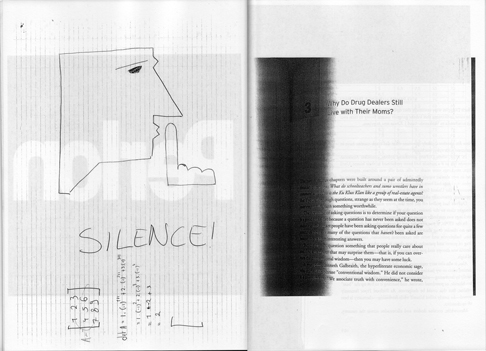
VerySmallKitchen writes: I first encountered The Self Publisher as part of  Preambles and Perambulations, an exhibition at The Charles Dickens museum in London, curated by Island Projects. Printed as folded and stapled A3 sheets, each issue comprised documents gathered from various copy shops throughout Manchester, later assembled and sequenced by Maurice Carlin.

As Maurice told the Shrieking Violets fanzine:


…I mistakenly took some stuff that had been left behind in a copy shop and I had it around for a while — I do tend to collect stuff. Sometimes you have something and you don’t know why you’re interested in it then later you realise why. Then later I thought ‘maybe all I need to do is present it differently.’.

…I’m interested in the photocopier as a format as it’s democratic — it reduces everything to a black and white image and flattens it all out. Even glossy magazine articles are reduced to a bit of text.

…It is accidental publishing. It would be quite different if I collected all the material I found on the street like scraps of paper — it is found in a place of publication and reproduction. Even if it is being reproduced for one person it is still being reproduced and published.

…I’m interested in how meaning is formed. The material I collect is both mundane and vital. A lot of it is things that are really important to people, for example propaganda — people copying 100 posters saying ‘Say no to the English Defence League’— or forms motivating people to do something.

…It’s a document of a moment just gone. I take all these different narratives and put them back to back.


See the full Shrieking Violets interview on The Self Publisher here.
 

The notes below are from an email exchange between VerySmallKitchen and Maurice in preparation for an installation of The Self Publisher at The Pigeon Wing in Sep/ Oct 2010 as part of WRITING/ EXHIBITION/ PUBLICATION.

From the beginning I had been fascinated by how the final magazines related to gathered materials. As well as making the publications available, I wondered if there was some way of showing the materials from which they were composed…


MAURICE: I do keep the copies that I find at the machines. I hadn’t thought of it before but yes, I think you’re right, there could be something interesting to explore between the ‘pile’ of documents (and it is a pile!) and the journals.


… It reminds me [the installations of Joseph Grigely] of a publication I attempted to make through collecting paper and other residue left behind from gig nights at Islington Mill. On the first occasion, I left paper and pens, pencils (in what I thought was quite a casual manner) around on the bar and on a few tables before people turned up for the event. In the main, I had zero responses. My guess was that the gig punters felt like they were being ‘set up’ for something.

On the other occasion, I didn’t do anything beforehand but simply collected what I found afterwards. There were some great things in there including a series of interesting/banal conversation notes written on the back of a few flyers amongst what I assumed to be 2 flat mates about an electricity meter reading earlier that day. Although, it was a small gig with only 30 – 40 people sat around at tables, the bands were incredibly loud and I assume the conversation notes were written though one of these loud sets where it would have been impossible to talk! So, I was able to make a publication for that one.
Grigelys piecing together of the notes to create narrative is interesting. I guess I do this also in the sense that I have the opportunity to choose the order in which each 2 months worth of collections will sit in the journal. My editing process stops there but I am interested in what happens when these multiple ‘discourses’ are brought together back to back. (Propaganda, personal appeals, official documents, academic texts, musical scores, letters, memo’s etc etc)


…The collections for July/Aug [2010] so far include a Primark pay advice slip, a Bar Mitzvah seating plan, ‘Sharon, the latest and greatest employee of the month’, pages from a Polish/English reading manual which contains questions like ‘ Q. Can we cut bread with the thick edge of a knife? A. No, we can’t’, ‘ Q. Why do factories put food in tins? A. Factories put food in tins to conserve it’, ‘Q. Can we balance a dinner plate on its edge? A. Yes, perhaps we can balance… but it’d be rather difficult and would depend on the type of plate’


Something I looked at was the concept of “agonistic democracy” as written about by Chantal Mouffe and Ernesto Laclau, the idea that democracy in the social sphere should ideally be based around dissensus rather than consensus, that we are a community of differences rather than bonds and by opting for one meaning or discourse, we potentially exclude a whole lot of others.


“Any discourse is constituted as an attempt to dominate the field of discursivity, to arrest the flow of differences, to construct a centre.” (Laclau & Mouffe, 1985, p112).

“The practice of articulation (…) consists in the construction of nodal points which partially fix meaning; and the partial character of this fixation proceeds from the openness of the social, a result, in its turn, of the constant overflowing of ever discourse by the infinitude of the field of discursivity.” (Laclau & Mouffe, 1985, p113).


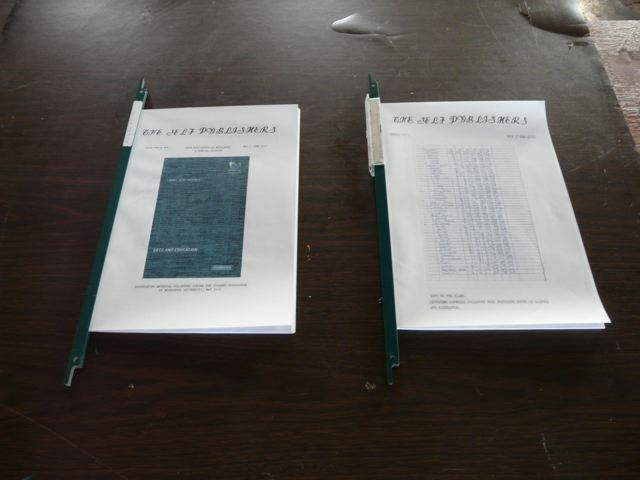
…So, I’ve been having a play around with how the journals and the piles of collected material could be displayed in the Pigeon Wing exhibition. A few photos are attached…


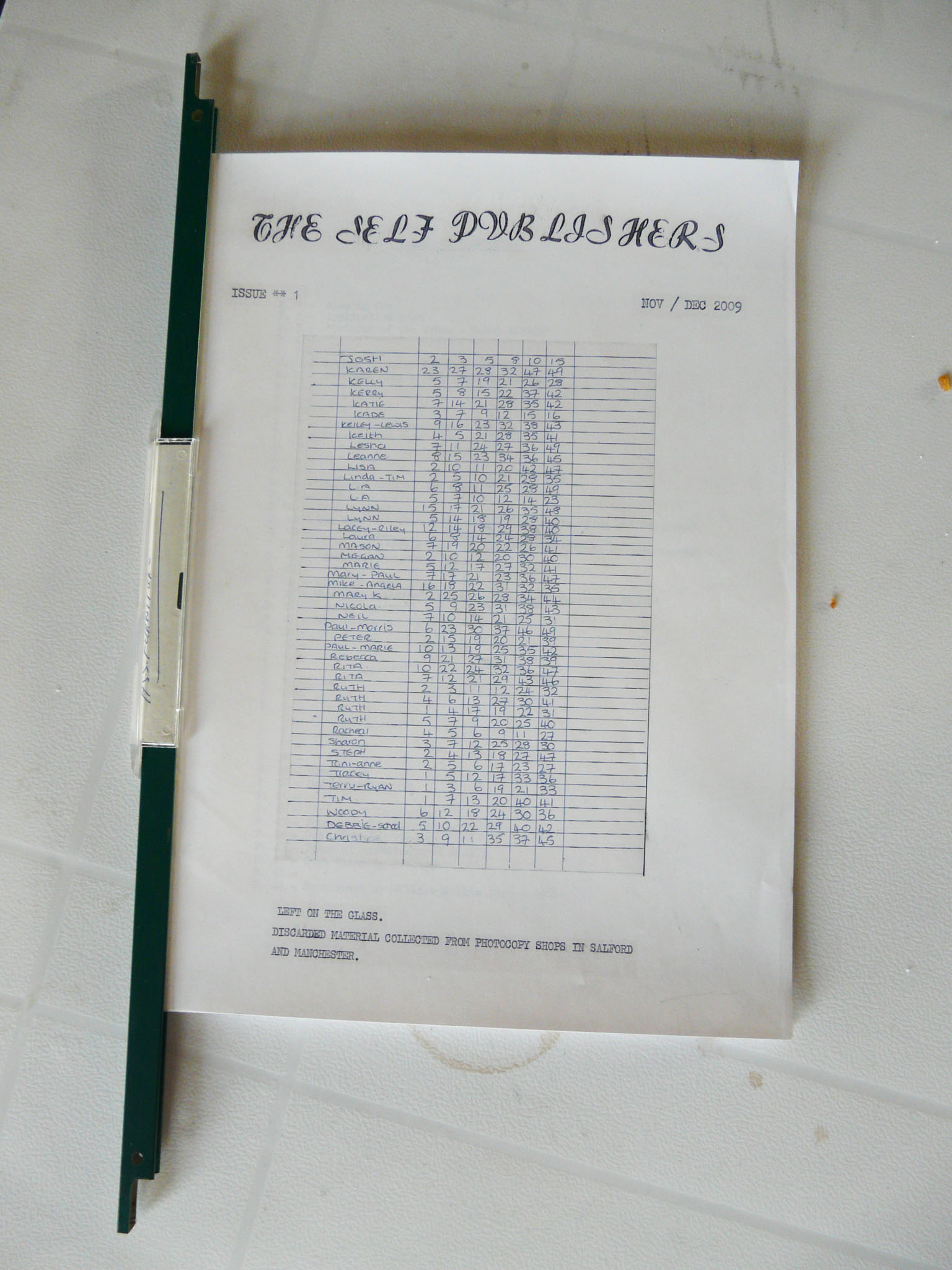
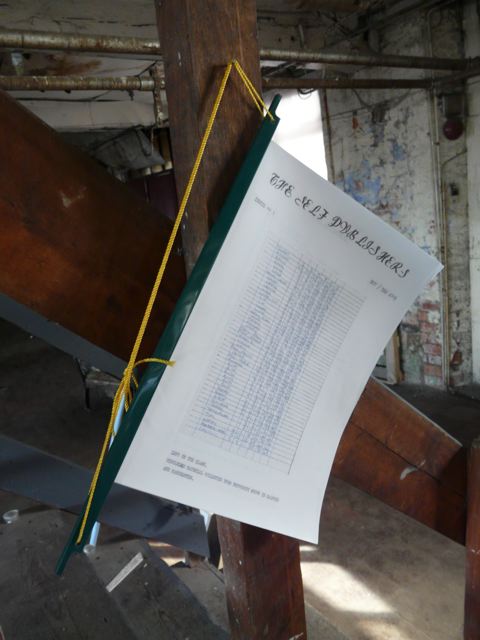
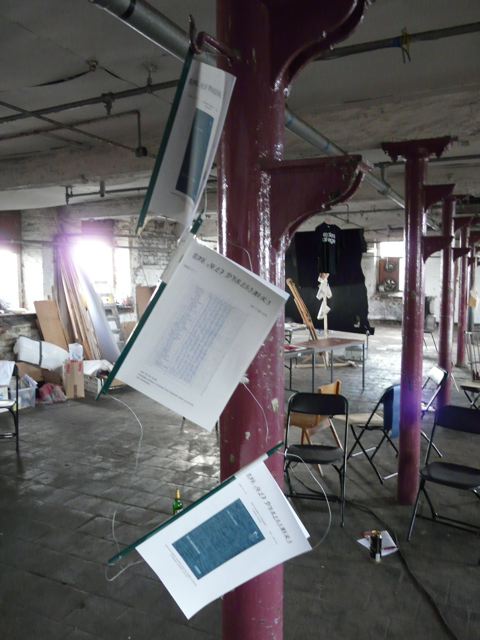
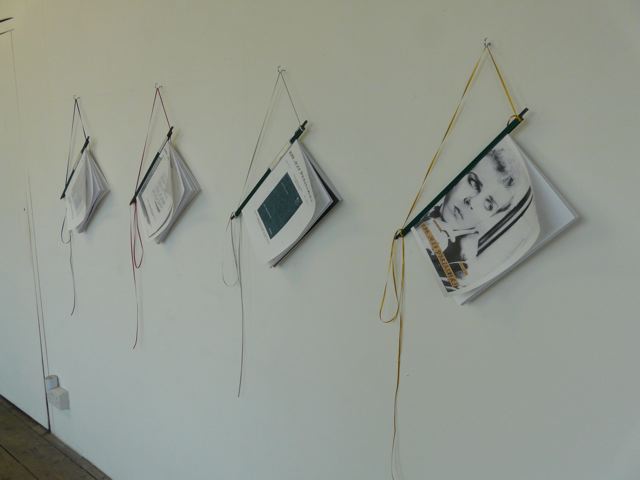
I’ve been using parts from a collection of old 1980’s green Crystal ‘suspension files’ that I found recently in a skip. The green binder parts are a perfect fit for the journals. In the photograph here, I’ve left the tab on which says something like ‘Ass. Furniture’. These remind me of the victorian wooden binders to which newspapers in cafes and libraries would be attached to, I don’t have the name for them? I could attach some string or ribbon through the holes and these could simply be hung around the space. I guess there are links to be made with found materials and I also like the associations with ordering and redundant systems for ‘managing’ documents.

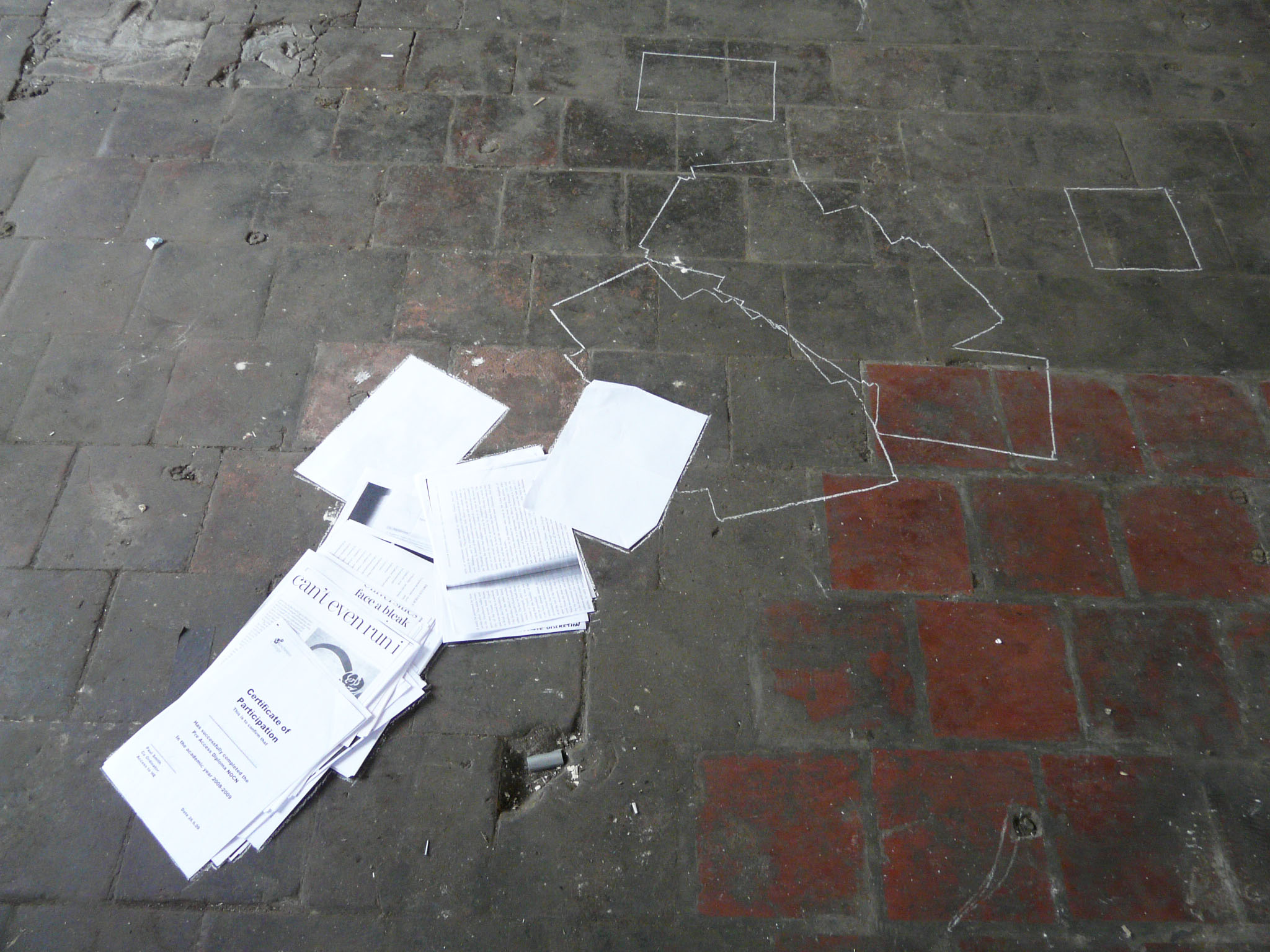
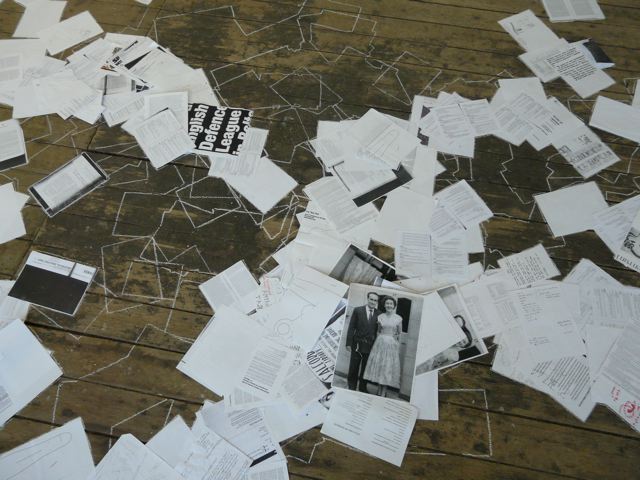
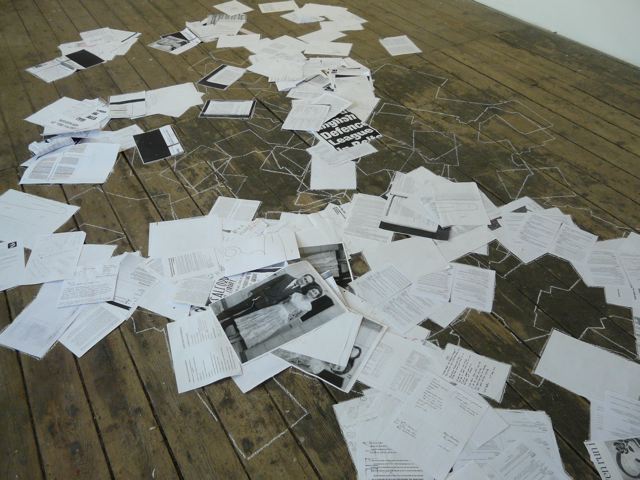
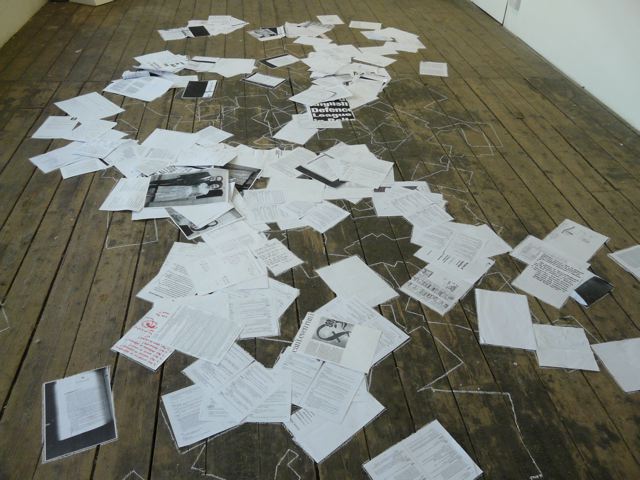
The 2 other pictures here are where I’ve been scattering the piles of collected papers around the floor. In some cases chalking out their outline, collecting them and dispersing them again, repeating this process to build up a series of outlines on the floor.


I’ve attached some images below showing some further ideas that I’ve been experimenting with for showing the work. I’ve put some text under each image to explain further.


Hanging the journals using builders ‘string line’ attached to the holes in the suspension files. The string line is coloured yellow for ease of visibility and I guess there are obvious associations with order, measure, standards, containment etc


As above


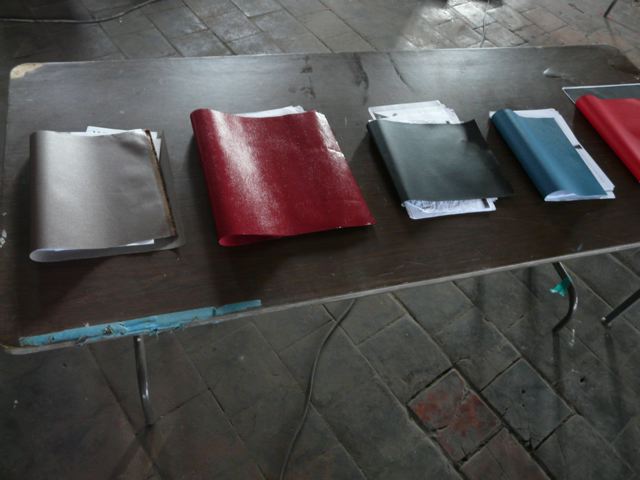
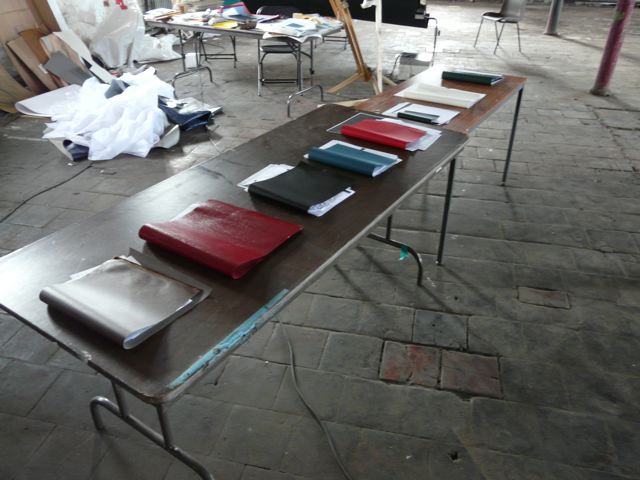
Using rejected pieces of buckram bookcloth (found and purchased in a bookbinding suppliers factory), I’ve wrapped the piles of collected material loosely and arranged on tables. I imagine that this is a presentation which would allow visitors to the exhibition to leaf through the material and it not being important if documents were put back in a different order, fell onto the ground etc.

There is a connection here with the photocopies, both being rejected materials not fit for purpose, although it may not be immediately obvious with either. There may also be a common theme in both the bookcloth wrapping and the use of the suspension files (and perhaps in the journals themselves) as being at the same time both an acceptance and a rejection of order.

Acceptance in the sense of going part way towards realising a system of classification which would attribute ‘meaning’.  Rejection in the halting of the binding/finishing/editing process part way leaving everything unresolved and open ended.


As above, laid out on 2 tables


The journals linked to each other using wire and hung from a central point. As a display or composition it has a cascading, tumbling effect which I like but perhaps is overly cumbersome to read..


….


DAVID: Are you still thinking of the chalk markings/ scatterings as a possibility for The Pigeon Wing?… I had been thinking of a central space in the centre of the room for your installation. Think of it as a rectangle in the middle of the space about a metre and a half wide and two metres long (roughly).

I like the images of the long tables a lot, but am slightly worried that there are several table projects already (projects that don’t adapt to another form)  and that anymore would make the space difficult to navigate. We also have an archive/ reading space at one end so I’d like to have some different form of engagement in how other projects are presented…


MAURICE:  I’ve had a look at the picture of the space again. There is a nice rectangular black patch to the centre of the floor which would probably make good ground for chalk lines. It looks as though there may have been a table or perhaps a piece of machinery sitting there before in a previous life of the building? with the footworn parts around the edges…


THE INSTALLATION


(1)


(2)


*


If each issue of The Self Publisher is a mapping of Manchester, as a concept it can be applied more widely.

One of the issues displayed at The Pigeon Wing had been made during the occupation in protest at the closure of Middlesex University philosophy department. After The Pigeon Wing, in December 2010, Maurice Carlin made an issue as part of Midnight Coffee Preview in Antwerp. As Maurice told the Shrieking Violets:


…I had no idea if it would translate into a different place. In Antwerp I had to make more of a choice when deciding which material to put in. There was more material in English than I had expected and I chose more in English than was perhaps representative.

…I was really surprised the things I found related so directly to the place. Lots of the material related to Antwerp, for example one person wrote an abstract about Antwerp as a port town.

…Someone suggested I should go ask copy shops for the material. I went in to shops and asked if they had any old paper they were going to dump. There’s less suspicion of that kind of thing there and they handed a pile over. I asked copy shops when I got back to Manchester and they said they couldn’t possibly give it out for confidentiality reasons.

…There is more openness and transparency in Antwerp.


As I compile these notes – in the process of writing an essay on Maurice’s work – he is artist in residence at Banner Repeater, the gallery and artists bookstore/ archive on platform 1 of Hackney Downs railway station.

When I first visit, copy shop findings are arranged on the wall. For the show’s opening the new issue is published. The design puts “PUBLISHER” on the front cover, and “THE SELF” on the back, which is a starting point for thinking how artist/ asssembler/ editor  both appears and disappears throughout the various stages of entwining between container and contents…


For more info and to purchase/ subscribe to The Self Publisher email Maurice at deaddigital@islingtonmill.com