verysmallkitchen

Posts Tagged ‘art writing’

VSK EVERGREENEVERGREEN CHAPBOOK: LEAVES by SJ FOWLER

In Uncategorized on April 21, 2012 at 10:41 am

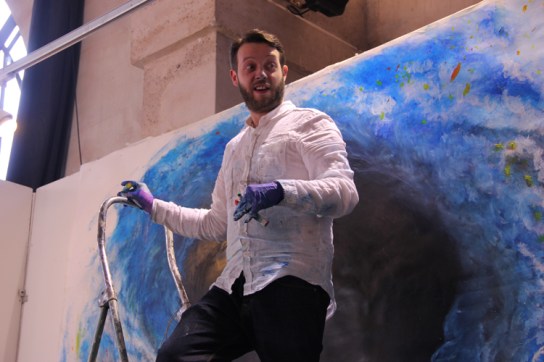
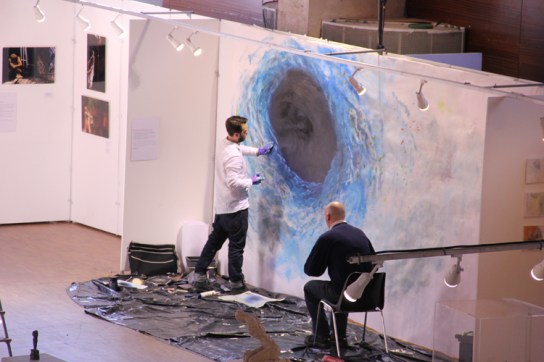
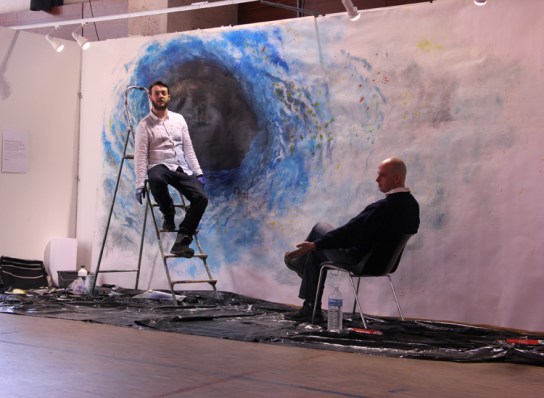
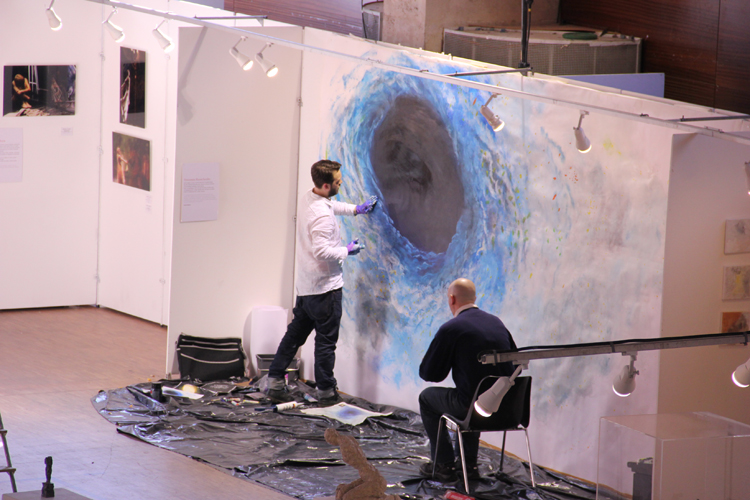
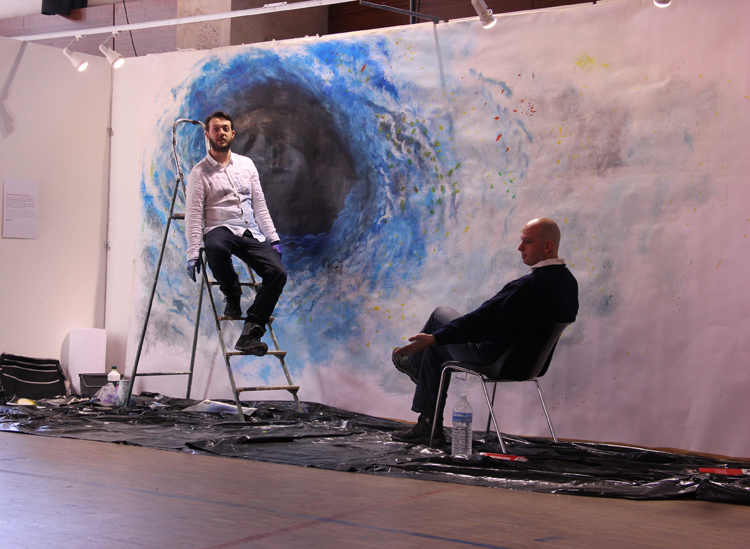
SJ Fowler, Work in progress: The Revenge of Miguel Cotto for the London Sinfonietta Blue Touch Paper scheme (2012)


The latest VSK Chapbook is LEAVES by SJ Fowler. It is available for online consumption and PDF download here. It begins:


were it not for the spines
would it rather not be fish backwards
is it remarkable how
much pain
the bodies can endures?
the spiny po
               cket puffer grenade
the oligarch, raping his maid
spread, like the kit
they call a test
that happens afterwards a fall


tap a hole right into the humunc
with
a tap, or knife, or screw
whether it would then pour
or been boiled, to sugary, don’t know
but the men thereon
were making most of water
& stuck when a hole in them
like a tree syrup did leak out
& they died


to comparison a human hand
laid out all flat
would rather gone at the start
of Alien
on the eve of the release of Prometheus
                               {bam bam bam bam-bam}
I am Theon Greyjoy
regretti
            ng
an easy way to loose a leaf
to drag bird shaped rocks
from coal, as a cloud
& assuming, nothing
will now abstain from filth
& mischief
a lost dog still must ‘strain its greens’
as fingers that remain attached
were not meant to remain
clean


//


LEAVES was written for and first performed at Evergreen, X Marks the Bökship, London on March 30th 2012, part of an evening of readings, performances and soup around the theme of leaves, curated by VerySmallKitchen for the London visit of Márton Koppány.


//


moving in, as a profession
like marching
& now not to bring sheets
but plenty for the stuffing
the greened
unbroken
& brown flitter, the dropped
water
a mattress made of what isdead
& wonder, as are you a eunuch, of sorts
when they took your cushion
did they remove the pillow cases too?


if one only
leaves were dry
girls
we would do
better?
to gyms, to learn how to fall?
rather to promote & produce
veins
thick & furious as intestinal
parasites
to be a leafed, with rib
                                   bons
run like android wires
from our temple to our dick


//


Continue reading here. More about SJ Fowler’s work is here.

Other work from EVERGREEN by Claire Potter is here and seekers of lice here.


EVERGREENEVERGREEN: LEAF/ LEAVES by SEEKERS OF LICE

In Uncategorized on April 19, 2012 at 12:30 pm

Photo: March Gutt


Take a leaf out of  my book – believe me – I lief would – leaves of grass – leaf thin gold leaf –  leaf mulch  – leafing through something thumbing pages flicked through dog-eared –  turning over a new leaf  – the Manyoshu or Collection of 10,000 Leaves is the first major anthology of Japanese poetry, compiled sometime about 760 AD and containing over 4500 poems – “…your thoughts disheveled like your morning hair” – leaf green is chlorophyll – Indian Yellow was made from the urine of cattle fed on mango leaves, a cruel process finally banned in 1908 – I went into the garden to cut a cabbage leaf – Margaret, are you grieving / Over Goldengrove unleaving? / Leaves, like the things of man, you / With your fresh thoughts care for, can you? – next to humans, leafcutter ants form the largest and most complex animal societies on Earth – they feed on a fungus created from a mixture of the ants’ fluid and freshly cut leaves which exists only in Leafcutters’ nests – each year winged females and males leave their nests en masse and engage in a nuptial flight known as the revoada – each female mates repeatedly to collect the 300 million sperm she needs to set up a colony – to start her own fungus garden, the queen stores bits of the parental fungus garden mycelium in her infrabuccal pocket –  most species of cacti have lost true leaves, retaining only spines, which are highly modified leaves – Clarice Lispector complained that some of the translators of her novels from the original Portuguese removed the prickles from the cactus by translating away her awkwardness –  write carelessly so that nothing that is not green will survive – you who were the smooth bark, roundness and leaf of my words – Daphne escaping from Apollo’s unwanted advances metamorphosing into a tree, fingers turning to leaves – the tears of the Heliades, sisters of Phaethon who drove the Sun God’s chariot too close to the sun, their tears becoming amber as they became poplar trees – in old books when coloured plates were tippped in, a leaf of tissue lay between the text and the plate for protection, so that each illustration was seen first through a veil – leaves can show many different degrees of hairiness for which botany has a very precise vocabulary – leaves can for example be hirsute, bearded, bristly, pubescent, floccose, glabrescent – glabrescent leaves lose hairs with age – leaves as camouflage covering ghillie suits – on location a ghillie suit is customized with twigs and leaves commom to that habitat – these local additions must be changed every few hours as the leaves and green grasses wilt – leaves are carried by the soldiers as Great Birnam Wood comes to Dunsinane and Macbeth is vanquished – the trees are coming into leaf like something almost being said – leaf and stick insects camouflage themselves by their uncanny mimesis of particular leaves – Antonio Pigafetta sailing with Ferdinand Magellan’s circum-navigational expedition writes: “In this island are also found certain trees, the leaves of which, when they fall, are animated, and walk. They are like the leaves of the mulberry tree, but not so long; they have the leaf stalk short and pointed, and near the leaf stalk they have on each side two feet. If they are touched they escape, but if crushed they do not give out blood. I kept one for nine days in a box. When I opened it the leaf went round the box. I believe they live upon air” – leaf-like camouflage is used by many different species including frogs and fish – leaf red is erythrophyll – certain bats are leaf-nosed, having a leaflike appendage on the snout – botanically a leaflet is a division of a compound leaf –  commonly it is a small-sized leaf of paper containing printed matter often for free  distribution – airborne leaflet propaganda is a form of psychological warfare in which leaflets or flyers are scattered from the air – there are six different functions of airborne leaflet propaganda which have been used over the past century – in  Isaac Babel’s1920 Diary detailing his time as a war correspondent with the Red Cavalry he describes the great power of Soviet Union leaflets brought to them by defectors from the Polish army – later he finds a Polish leaflet –  “Touching, sad, without the steel of Bolshevik slogans, no promises and words like order, ideals and living in freedom. Victory will be ours!” – but it wasn’t – Duchamp’s wedding present to his sister Suzanne was the instruction for a readymade – she was to hang a geometry book by strings on the balcony of their apartment “so that the wind could go through the book, choose its own problems, turn and tear out the pages” –  wind in the leaves The Unhappy Readymade – disparaging the seriousness of a book full of principles – in its exposure to the weather “the treatise seriously got the facts of life” – a leaf scar is the cicatrix left on the bark by separation of the leaf stalk of a fallen leaf – Duchamp’s concept of the infrathin refers to the invisible yet nevertheless defining qualities of objects or materials which are part of a temporally defined process – Duchamp believed that the infrathin can only be described by examples, such as the difference between a clean shirt and the same shirt worn once – the lingering warmth of a seat when someone has just vacated it – a leaf‘s thickness of difference – the victor wears a crown of laurel leaves – The Laurel, meed of mighty Conquerors / And Poets sage… The Willow worn of forlorn Paramours –  poisonous leavesleaves of three, let them be  –  deadly nightshade or belladonna is one of the most toxic plants in the Western hemisphere –ingestion of a single leaf can be fatal to an adult  –  salad leaves  – skeleton leafleaf print – leaf line leaves on the line, a common cause of train delays –  in the UK a number of rail companies change their timings and publish special “leaf fall timetables” – the French word for leaf is feuille –  millefeuille is a classic French pastry cake popularized by Carême –  it consists of three pieces of puff pastry sandwiched with cream – classic puff pastry correctly made has 729 layers of butter between 730 leaves of pastry so millefeuille has 2190 leaves  –  feuilleton from feuillet / sheet of paper / little leaf is the part of a European newspaper containing reviews and articles of general entertainment –  on the Beaufort wind scale leaves rustle in a light breeze – in a gentle breeze leaves and small twigs are in constant motion – in a moderate breeze dust and leaves are raised up – I found it out, what love is all about / And every day at three, when school lets out / I see my baby, I get weak in the knees / Ain’t nothin’ shakin’ but the leaves on the trees


__


LEAF/ LEAVES was written for and first performed at Evergreen, X Marks the Bökship, London on March 30th 2012, part of an evening of readings, performances and soup around the theme of leaves, curated by VerySmallKitchen for the London visit of Márton Koppány. Other work from the night by Claire Potter is here.


More about seekers of lice is here. See also LILMP and CREAMY LANGUAGE.


EVERGREENEVERGREEN: TEA LEAVES by CLAIRE POTTER

In Uncategorized on April 16, 2012 at 9:59 am


         It’s true. Bulah and Bill Brown did little more than move from the flats of the their backs to the chairs at the arse-end of the room for years. They’d been packing to go back to Jamaica when she fell down the stairs carrying a box. She had to go in for a double knee operation which took her off her feet and then he wasn’t far behind her with his leg ulcers. After that it was bed to chair, chair to bed, bed to chair, chair to bed. That’s what happens to most of them when they come home; physios attend to people who aren’t about to kick the bucket, it’s just how it is. People end up trapped and they have to carry it. So in place of walking, when they can’t just leave the room, can’t walk away from a situation, they do other things; new skills, routines, new structures – trying to make sense of being stuck.

‘Come!
Yu nah ‘ear meh, mi seh, ‘Come!’’

         I was warned from the outset she was a bit of a nightmare, Bulah, something to be reckoned with as one manager put it. After the operation some years before I’d met her, she started to develop what the plan called as a keen sensibility for order: a neurosis. In practice this meant the placement of things and sequence of events were keys to her mood. If you happened to follow the protocol, you were treated warmly, you’d come fi see Nana, but out of line at all and you were nothing but a damn maid.

         ‘Ok, so once you’ve logged in with the phone let her finish with her papers or whatever she’s doing, then it’s phone-on-bed, table-down-the-bottom and then get the Stand Aid. Don’t bring the Stand Aid in first, she’ll think you’re rushing and she doesn’t like people rushing. And word to the wise, put the harness on from the back – you’ll only catch her with the Velcro.’

‘Ooooweh!
Looord av manna!
Yeh try tek mi eye owt!
Bill! She try fi tek mi eye out!
Damn foolishness! Owt! Yu nah know wha-fi do – Owt!’

         Each slip added new scare stories to her legacy and she knew it. I could see it in her sly side glances. Crafty like a lawyer, she could make use of anything to prove her point, any point, so it was with awe and watchful caution that I began taking tea with Bulah. Bill however, I took to Bill like my granddad, he did the same quick winks. It wasn’t a useful association as it happens.

         For a while I was telling myself it was the fourteenth the last time she looked into my leaves. I liked the sort of anxiety it gave me – the date being the same number as their house – but in fact we had tea on other days after that, I just can’t remember them. Tea on the fourteenth has eclipsed all other teas. It was the reading on that day that brought us the weasel blocking the seal – someone untrustworthy in the home, two figures carrying baskets, and the worst and most sickening of all the symbols in the tea leaves, the sign that eventually sent me under, a rock and a motor in conjunction with a wavy line.

         ‘Just forget about the remote control – don’t keep picking at it. He could have waited, the daughter was coming back at eleven, you know he could have waited. Just try to remember that. No one saw this coming, it’s nobody’s fault.’

         What the seer reads is in accordance with the muscular action of the arm as controlled by the brain of whomever consults the leaves. I looked that up the day I heard the news. It means that the symbols Bulah read in the tea leaves were of me, like a trace of myself in the cup. But not like a footprint, it wasn’t an impression of me, an outline, and not containing either, not like flaked dead skin, but somehow behind things. At base, that’s what I couldn’t shake, this behindness, the code of it, what happened when the symbols were combined and how I fitted into that. A symbol of a tree means a tree, it means one tree, but two symbols of trees, three symbols of trees – well that’s something else isn’t it, that’s a place. Somehow an unlocatable woods is created through combination of two symbols of a tree. That’s what did me in the end. This thinking. I just couldn’t distance myself from the structures, from all the associations; things just kept on unpacking.

         The rock, motor and wavy lines being in conjunction warned of some forthcoming alarm in connection with a motor expedition, but the episode would be in the distance, would be remote.

         ‘Twigs and stems! Woman yu likea chil – look-fi pichas in thee fyah!’

         Bill wasn’t keen on it, there was no good in it. He told me to go on about my business, come change his catheter bag, go make him a chocolate. Bulah encouraged my interest she always called it a natural curiosity, but it’s what she said to me that day that’s inscribed the date on me like this, that gave it all more weight. She said it was my doing, the message, and she made it sound so plausible; the mind moves the arm that writes the leaf.

         ‘Right, so you’ve got her in bed and she’s comfortable, now it’s table-up-the-side, teeth-top-right, put the glucose tablets on the near right and the phone to the front in case of emergencies. She does wear a Life Line button round her neck – which she’s got a better chance of reaching if anything does happen – but she just feels better with the phone there.’

         Before Bill died, Bulah read my leaves. She didn’t do it once he’d gone. He had pressed for the backrest to go all the way up, going for the telly button I had wrongly placed just out of reach, and he had fallen, out of the bed, down the gap between the unit and the chest of draws. His asthma attack brought on his heart attack and so he died: trying and reaching. I see him doubled, with legs in the air, stuffed down fleshy into the corner, Bulah crying out and pulling at the cord, grasping at the receiver as he had done for the remote.


__


TEA LEAVES was written for and first performed at Evergreen, X Marks the Bökship, London on March 30th 2012, part of an evening of readings, performances and soup around the theme of leaves, curated by VerySmallKitchen for the London visit of Márton Koppány.


More about Claire Potter’s work is here.


VSK PROJECT CIA RINNE: FRIENDS AND ENEMIES

In Uncategorized on April 14, 2012 at 10:33 am


friends and enemies


(stockhausen’s childhood)
the french were our enemies
and the english were our enemies
and the italians were our friends
and the spanish were the friends
and the japanese were the friends
and the russians were the friends
(but that changed a year later;
then the russians were enemies as well)
and the finnish were friends, etc.
I did not know what to do with this.


(childhood friends)
the russians were our enemies
and the americans were our friends
and the french were our friends
and the italians were our friends
and the british were our friends
and the communists were our enemies
and the capitalists were our friends
and we did not know what to do about it.


(adult enemies)
the americans are no longer our friends
and the russians are no longer our enemies
but the muslims are our enemies
and the immigrants are our enemies
and the terrorists are our enemies
and the gypsies are our enemies
and we do not know where it all will lead.


composition militaire

komm, position!

         ||


composition traumatique

ballon
pfff
et: rien.


composition post-traumatique

1) ballon
2) ex(ballon)nation
         |
     exbl()tion

ça suffit.


it is only getting better/
it is only getting worse/
it is only getting better/
it is only getting worse/
it is only getting
i                          bet


human involution
(évolution
eh, vos solutions?)
human beings are not the same
human beings are not insane
human beings are not to blame

continue.


//


In an email to VerySmallKitchen 08/01/12, Cia Rinne writes:


I think that working with visual poetry and conceptual pieces is often like an escape, a sphere where you can neglect rules, concentrate on such – seen in a wider perspective – ridiculous things as language, meaning, and sound, so maybe they are not explicit. I feel that if I want to say something important I should rather do it in a text; although there are many pieces reflecting my other practice, working with the Roma for instance, I would not want conceptual writing to become a mere means for an agenda. It can feel like mere luxury to be working with such pieces when you have knowledge of what is happening in the world however, so I guess a balance is good and necessary both ways.


For more about Cia Rinne see the online work archives zaroum at Afsnit P. An interview with SJ Fowler as part of the Maintenant project is here.

See also sounds for soloists and Ubuweb’s edition of zaroum and notes for soloists here. The two books were released as a single volume in France last year by Le clou dans le fer.


VSK PROJECT ARIEL GOLDBERG: LETTERS TO ROBERT GOBER AND EHREN TOOL

In Uncategorized on March 28, 2012 at 12:26 am

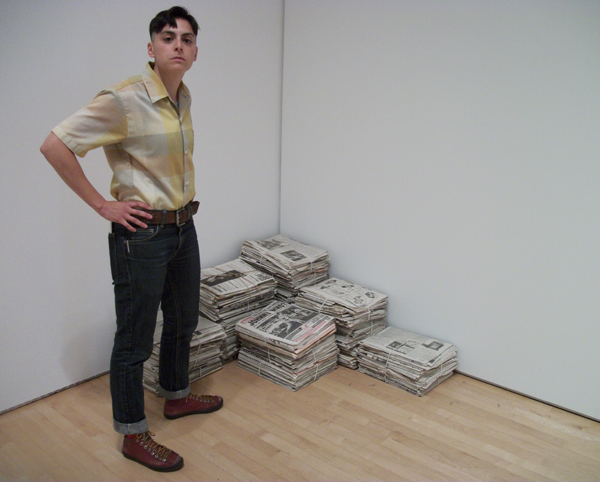
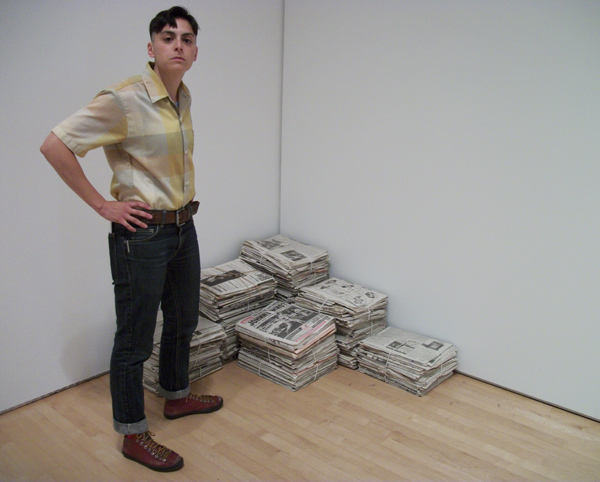
Ariel Goldberg and "Newspaper" (1992) by Robert Gober


July 7, 2011


Dear Robert Gober:

There is a psychic connection between your sculpture of your fake newspapers and the relatively recent flurry of people taking pictures in museums. To visit a museum is something to report on, or to make available to see, for that unknown audience of memory. The impulse seems linked to imitating a newspaper spread. When I see someone posing next to a piece of art, or, their bodies just in front of it, not inside the photo, I see that picture getting discarded. I don’t know how it is that when people are taking so many pictures I still feel that pictures don’t exist.

I thought about staging performers to be photographing in the galleries leading up to your piece. But I cringe at even directing someone to take a picture. I think I need to be directing people in not taking a picture. But are these opposites? The planted photographers would look attached to me, they would probably have been my friends, and I realized I wouldn’t want to be attached to fake photographers. Like, if I was dating and everyone was a photographer, the fake photographer would not be my type. I would rather imagine staring at people photographing. Cameras, at least deactivated on the bodies of people in the museum, happen frequently enough that I wouldn’t have to stage it. And anyway, I still have my whole life to watch people take pictures.

I don’t blame people for photographing; I don’t know if they can help it. Vilém Flusser writes in his book Towards a Philosophy of Photography:


Cameras demand that their owners (the ones who are hooked on them) keep on taking snaps, that they produce more and more redundant images. This photo-mania involving the eternal recurrence of the same (or of something very similar) leads eventually to the point where people taking snaps feel they have gone blind…They are not ‘in charge of’ taking photographs, they are consumed by the greed of their camera, they have become an extension to the button of their camera…A permanent flow of unconsciously created images is the result.


Officially allowing photography was a watershed decision before the 2007 Frieda Kahlo show at the San Francisco Museum of Modern Art, where your “Newspapers” are in the permanent collection. At the information desk I learn that this coincided with the increasing technology of cell phone cameras. Guards couldn’t tell the difference between when people were taking notes on their phone and taking a picture. Meanwhile, visitors were actually complaining they couldn’t take pictures in the museum, maybe because it was like a violation to their personal experience, like a threat to their memory. The leading defense was, if the museum could sell reproductions of a piece, why couldn’t visitors pose next to it, for their noncommercial uses? Not allowing photography got linked with the sinister motive to capitalize off a restricted picture only being accessible through a postcard, a book, or a t-shirt. What became clear in this struggle for the right to photograph in a museum is how it is the taking of a photo that offers the intended memory. This is a transfer or a gestural reinforcement from something you could hold. It’s like multiple lenders. The photo is an event.

When I went to a talk the other night, the announcements began with saying you cannot take people’s pictures without the express permission of the person being photographed. I wonder how often people might ask a painting, a sculpture, a photograph permission, and how this might seem crazy. Then the next night, I was sitting in the audience at a cabaret style performance and all I could see was the screen of the person in front of me taking photos of the burlesque act. This could have been the friend of the performer, they could have had permission, but I suspected it was the free reign technique.

I have stood guard at “Newspapers,” communicating with the sculpture so to speak, which deters, but also attracts visitors because they think I am a docent. Someone even asked me if I was the artist. They were joking. I ended up talking about how “Newspapers” is really a performance of negligence. And I’m not trying to say people don’t look at art, because that wouldn’t be fair, they are in the museum because in some form, they care about art. People come here to look at art, right?

I’m just curious about what discourages “Newspapers” from being looked at. I’ve been watching how most people don’t read the surface of these stacks, and how what you would read feels a little bit like a puzzle to solve. Stopping to solve a puzzle doesn’t go with conveyer belt flow of moving through galleries, even if it is easy, like a travel size puzzle sold in a toy store, one that loses its pieces in between car seats. Also, “Newspapers” is one of the only pieces on the ground in this permanent collection exhibition, and it’s bunched like waste, good-looking garbage, but still associated with what is ready to be brought to the people who sell trash.

Reading the wall text, I see it’s on archival paper, that they are constructed to be like newspapers, but ones that don’t yellow. When my eyes jump over the twine, I see the headlines are twisted, combined, and selected. “Protestor thrusts a fetus at Clinton,” “Student killed after objecting to racial slur,” “Bush is sent forth as Champion of family Values,” “Judge Dismisses Case Against Men Holding Hands,” “Vatican condones discrimination against homosexuals.” What that means is the Vatican intended to scrutinize laws intended to protect gays and to oppose them if they promote public acceptance of gay behavior. When I search the New York Times archive I find they have changed homosexual to gay in the headline, but not in the text’s body.

It’s not a subtle world you’ve created at all, once you bend over. Weddings look absurd, all the pots, and rings, and dresses: the gift is presented as a road sign, like an attraction up against this hit parade of who gets a shit taken on them.

I also have stood at other sides of this gallery to watch people interact with “Newspapers.” It’s very uncomfortable to stand still in a gallery longer than a few minutes without a uniform saying my job is to stand here, which is perhaps emblematic of how uncomfortable it is to be an artist, with the rare occasion of time, to do their work. It’s weird to come do my work inside a museum; I am even more aware of the ambient social doubt that a non-canonized, person making art is necessary. So the discomfort is really suspicion. Anyway, if I circled the gallery, and the new people coming in did not know that I was on a loop, that would be maybe less uncomfortable. The incognito artist is, in other words, just a performance artist.

What also feels uncomfortable is listening to people turning on their cameras, the path of beeps to turn a flash off make cameras like portable video games. It’s strange, the limitations on behavior. How just saying no flash, or not on this floor but on those floors, is a reminder of this limp control. Photography has become akin with a sort of lawlessness– it’s like the power you might feel when jaywalking. I wonder if there is, a connection with outdated laws, or the reality of living gay versus the laws about being gay, and how someone photographing, might be exerting this strong desire, one they cannot help, and don’t think is wrong. This isn’t a comparison, but a sort of collision between your piece and the photographic acts.

Anyway, I am writing to let you know that no one really photographs your “Newspapers.” I’ve been visiting your piece for about a month now, once a week, sometimes more, depending how lost I am about what to say, and I’ve seen no one photograph it. It’s in the corner of a room, the middle of the second floor, so those factors might lend to a moment of fatigue. The location of your piece is similar to hitting the gooey bottom of a body of water.

Also, “Newspapers” is right next to René Magritte’s painting of a comb, Ibuprofen, a bed, a feather, and clouds as wallpaper, to indicate a dream. “Personal Values” is the title, which goes nicely with the singeing “family values” codeword in one of your Newspapers’ headlines. In fact, that’s the only curatorial logic I can detect here. To say “Newspaper” is next to a surrealist painting is a way of saying that your piece is often treated in the periphery. Because surrealism, you know, is famous, recognizable, comforting, explanations of the movement make it to high school curriculums.

I don’t think this twisted reality of you being the model for a Saks Fifth Avenue wedding dress is a 1992 version of dream state surrealism. It’s just a prize coined by a hidden layer, for curators, friends, historians, people who bought the audio tour, for artists. It’s an act of withheld information, something akin to a hunt. In all the writing about your work, the “Newspaper” pieces are mentioned the least, maintaining that same periphery the general population of SFMOMA exerts on to it. “Newspapers” is therefore a very successful insistence on what it means to be overlooked. However public a newspaper might be, on a stand, or a screen, reading the news is an intensely personal process. You might as well be getting yourself in the news if you are making fake newspapers, right? Your face is the imaged bride, on the page with the news, as a testament to this. It’s like a where’s Gober when you didn’t know you were being given a where’s Gober.

Only recently I began to understand the desire to be taking pictures in a museum. I had given an assignment of going to this museum and writing about a piece of art, interpreting it. Somehow the assignment that I modified from another teacher had this requirement to take a photo of the thing students would write about, and I didn’t take that requirement out. It was an oversight, or an experiment. I’m not sure which. Anyway, I was helping two students with editing drafts of their essays, and one of them began to reminisce about the first time he saw a Salvador Dali painting at this museum. How that was a really special experience for him because he grew up on the reproductions. His classmate asked, did you take a picture of it? I seized on this question with inexhaustible fascination. My brain was on fire.

Why take a picture of a painting? His explanation took some detours. He had to go to Las Vegas for his sister’s wedding. There was a Manet or Van Gough show there, I don’t remember which. He expressed his need to see this show, and this strong desire was also an announcement to his family of being an artist. This show felt like the opportunity to meet a celebrity, one that you could stare at and they wouldn’t flinch or blink. Objects can be celebrities. The weekend was too busy with ceremony for him to go. He felt deeply deprived and disappointed.

His answer to my persistent question, can it still be a sacred experience without taking a picture, was, I take pictures of everything, everything interesting. To prove this, he scrolled through the photos in his phone. He showed me a photo that I had even showed him, taken from the computer screen I had wheeled into class one day. Actually that photo was of the Vija Celmins drawing right near your “Newspapers” piece that looks like a photo but when you get up close you see it’s a very meticulous graphite drawing. He keeps this picture to make conversation, to ask his friends to guess if it’s a photo or a drawing, and everyone says photo, and then he says no! It’s a drawing!

Why am I so confused about people taking photos–why do I care, right, how does it hurt me? What is difficult for me is to reconfigure my relationship to the camera. I don’t see a camera as something that can help me see someone else’s art better, or for extended or injected time. Or maybe this is my issue with this never-ending conflict, or subsidiary framework, where photography often becomes this bland tool for painting unless it imitates the bigness of painting. It’s some history hang over. I mean, I have no problem documenting art with photography–art that needs documentation that is. And ultimately everything needs a reproduction. So the question might be about when we start employing ourselves to be the reproducers.

My relationship to a camera is not about saving the first time I see something. It is more about the continual times I see something, or the impossibility for there be a precious moment, just a painfully ordinary one. Or entering a place of delay and darkness. To me photography is just an accumulation; it’s versions of people accumulating. Or photography has almost completely shifted for me from mechanical tools to word tools, and that I continue to argue with that idea also.

Anyway, we are at a battleground of what gets called mundane or not. I cannot avoid it here, love and death. I am standing in front of your work, Robert Gober, and people are watching me. They are listening. The museum has hired me to give a talk here. It’s part of a live influx of writers to coincide with the Gertrude Stein Family collection show upstairs. The Stein show costs more money at the door, so the permanent collection feels like a discount. Upstairs, the paintings are shipped from Europe, displayed behind glass, a type of glass you can see your own reflection in if you try to see the texture of the paint. They have extra guards in that show, and photography is absolutely not allowed. But that doesn’t mean people haven’t been taking pictures.

I went to see the Gertrude Stein PBS style biography show across the street, at the Jewish Museum. It leaves out readings of her work, practically denigrating her more experimental works as unreadable because it decidedly focuses on the visual Gertrude, the surface. I found the Félix González-Torrez photo of Alice B. Toklas and Gertrude Stein’s grave under the subject heading of “legacy” in the show. I heard the curator talk about this photo, saying it’s cross gendered queer bonding, creating ties to the past, creating hope for the future, whatever that means. Talk about utopia can be such a bummer sometimes.

I’ve been thinking a lot about subtlety these days. About how in June all the alternative spaces’ art shows have queer in the title and clap their hands, literally, holding applause signs, promoting the work of who is going to say this is queer. And it seems to be the only place for art made by queers this month, the megaphone.

Anyway, the photo of what is maybe Stein and Toklas’ grave or maybe is just a camera pointing at flowers, is “Untitled.” González-Torrez subtitles the “grave” giving an estimate of its location in place, name. There is a concept neatly delivered, or the piece readily contextualized. So it isn’t untitled, that’s sort of a joke. Meanwhile, your “Newspapers,” aren’t really newspapers, so there’s the joke. The hope, maybe I should say. You title them “Newspaper,” single, but I’ve actually been re-titling your piece in the plural, just to make my sentences sound better.

On the wall intersecting “Untitled” is a Tammy Rae Carland photo of Félix González-Torrez’s grave. It’s basically a replica, with different color flowers. I don’t know if he was even buried in Oakland. Referent on referent–like phyllo uncooked. I had to iterate my attachment to these pictures by standing longer than I did in front of anything else; they sort of cradled me. Maybe it was the corner.

I had seen the Stein Toklas grave photo before, but only as a slide in a lecture, on an old type of projector, one that shuts you up in a room in the dark and hums. Then I had seen it in books. Instead of taking a photograph of this picture, to commemorate my first time seeing it, I composed a text message, saying right now I stand in front of the González-Torrez grave picture that I know is one of your favorite pictures. I sent the message to the person who showed me the grave photo for the first time, when I was listening to her slide lecture.

I think about newspapers as inescapable reproductions, emanating a disavowal of the real thing. What could we demand, with the situation of someone looking at a photo under the condition it is not a flat thing? “Newspapers” might as well be a grave. It makes me think about the right to determine graves, where they are, if the experience of mourning is so displaced over time. And how much grief is stored up in photos, waiting for us, like an invitation. What is a grave in a time when deaths are unacknowledged? Can newspapers be a grave? Can a reproduced portrait of David Wojnarowicz be another grave, and for who, for the artist who died of AIDS or all the not so famous people? Fake Newspapers are a kind of exhumed gravestone, one that sunk underground because it’s made of the vulnerable. The “Newspapers” are a lot less pretty than framed flowers; unless you have a newspaper fetish, which I kind of do, because it’s my only sense of home.


__


Dear  Ehren Tool:

“Each Image must be in a chain of images, for if it were not in a tradition, it would not be decipherable. Of course, this doesn’t necessarily always work.” (Vilém Flusser, Into the Universe of Technical Images)


To decipher an overlap in positions can’t be comfortable.
Peace is for pussies: this is a quote.
You cannot tell if this is professional because of the bathing suit lines.
Pride risks an invasion of style: looking at patriotism can make you feel less patriotic.
Artillery drops like deer pellets in rotation.

The excuse of an accident.
There is the professional here too, in a spectrum of salutes.
Implants from the care package or the screen.
The portrait studio of badges and pins.
You can fill in the blank of who they are when they do smile.

The official portrait’s meaning is in how it repeats.
We start to recognize them.
They may be dead.
Every picture is of someone that may be dead.
Most people bring their own camera.

This could be considered a placeholder camera.
They are hugging with heads down.
They don’t discuss a plan but recover from one.
That flag is upside down and bedazzled with skulls instead of stars.
Agitation lines indicate what’s shaken is being thrown.

The head does not look attached to the body.
People are scrambling.
Caretakers to the wounded are captured from a movie.
The way a dummy can scare you.
A label too small to read.

This keeps on happening.
This is hungry for a victory.
A commemorative keychain or poster or a t-shirt reapplied here.
Iconic shock leaks permission.
They are aligned full frontal, legs spread slightly wider than hips.

A flag hangs sideways in the backdrop to fulfill the military fetish.
Reverse the pledge of allegiance.
Uniform covers body except for unzipped fly.
The president gives a press conference.
The cue is replaced with a halt.


__


Dear  Ehren Tool:

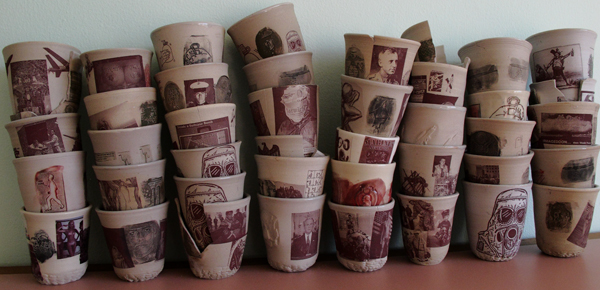
I’ve captioned your cups, but I will never feel ready to write about your cups. They disarm readiness, or characterize readiness as an apparition. The cue is replaced with a halt. What results is tumbling into many descriptive lists where I’ve become this person trying to organize or talk to the pictures on the cups.


All the damaged cups Ehren Tool gave Ariel Goldberg in 2010


I’ve studied the cups as if round history books. I’ve stored them in different ways in closets, tables, and basements. I’ve thought about when their backside faces the wall, hiding images on them. How even the most minor choice to see one image and not another is enacting the perpetual selection, and abbreviation of a glut to reckon with. The week I decided to photograph the cups, I was stacking them, to make variations of high short rows or long low rows. I was figuring out my favorites and making those images visible for the surface of a photo. At night I’d fall asleep facing the cups. I was living with them at all times in that room, as a peripheral headspace. I’ve taken over 300 pictures of the cups in all sorts of positions.

What I’ve arrived at is how a photograph of the cups doesn’t let you hold a cup, or drink from it. The cups you gave me live in a state of fragility, containing hairline cracks that are small enough to miss. The cups were never precious; you even threw one to the ground in your studio when we met to make this clear. It wasn’t quite like the burning of a letter. When the cup is broken, images on them still work. Not only do the pictures still remain readable, they feel even more relevant with fractures or missing parts. Of course they could get more damaged, more unsee-able but they are suspended. Perverse, banal, or recognizable images are only in the context of something broken.

Images feel at home on broken surfaces. Pictures do or don’t remain. By holding pictures on a cup, a hand is holding multiple unoriginal pictures at the same time. The photos are being rounded and hidden. In order to hold the cup, your hand must cover a picture or pieces of pictures. This contact of a palm or the fingers over a picture compares to holding the edges of a print, to see a framed photo, or glance at a screen. The hand to the photo on a cup is both a silencer and amplifier to a picture. We are actively and inactively remembering and forgetting images all the time. We are carrying images all the time. Photos are watching us take them in.


__


More about Ariel Goldberg’s work is here and Ehren Tool’s here.  A dialogue between Ariel Goldberg and Ohad Ben Shimon is on VerySmallKitchen here.


NEW VSK CHAPBOOK: EDITORIAL by NICK-E MELVILLE

In Uncategorized on March 25, 2012 at 12:08 pm


The latest VSK chapbook is nick-e melville’s EDITORIAL, which is available for online consumption and PDF dowload here. EDITORIAL begins:


ti
ded
ded

fiend kills girlfriend’s mum
over wedding snu

lax

it’s good to pay
for careless drivers

                             over
              steam
first de playwright JB Priestley.
              poet Samuel
Taylor Coleridge

80 Lap
Mixed Lots

RIP

sentencing backlash
as riot moth
is set free

oil stopped

David Mellor famously
warned that the British
press was now “inking
in the loon”.

South Africa
selected art up to 2012
the Big word
Andy Devl

like a nit
George’s plan isn’t quite
stacking up


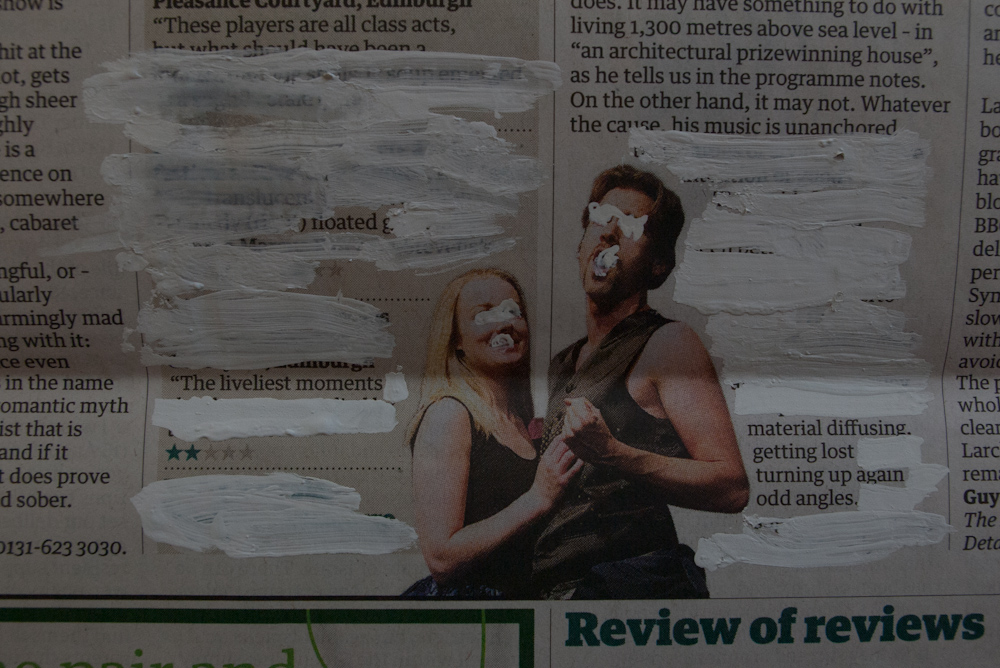
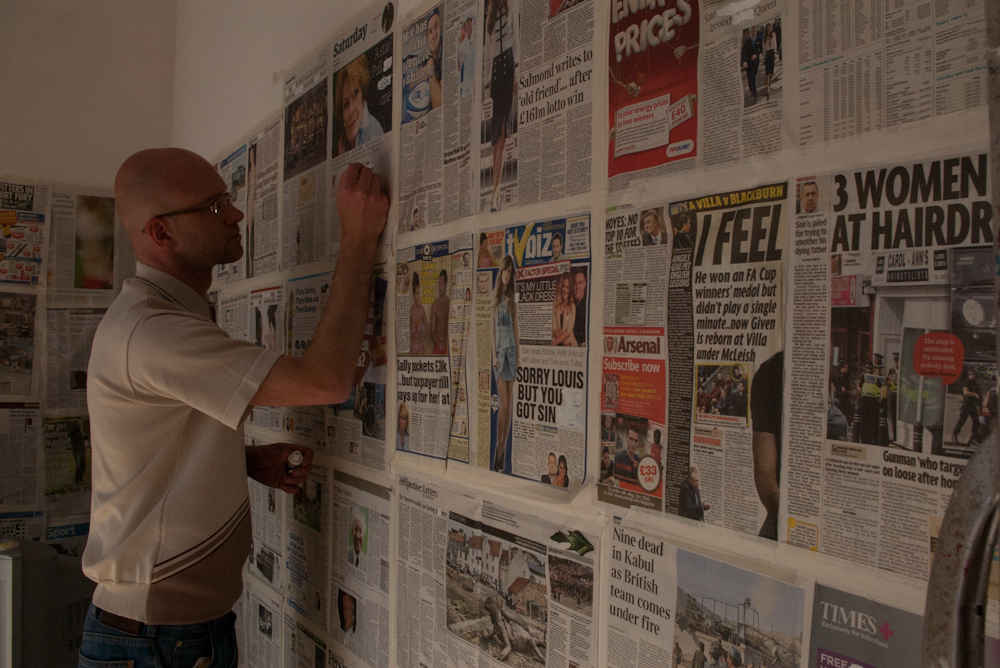
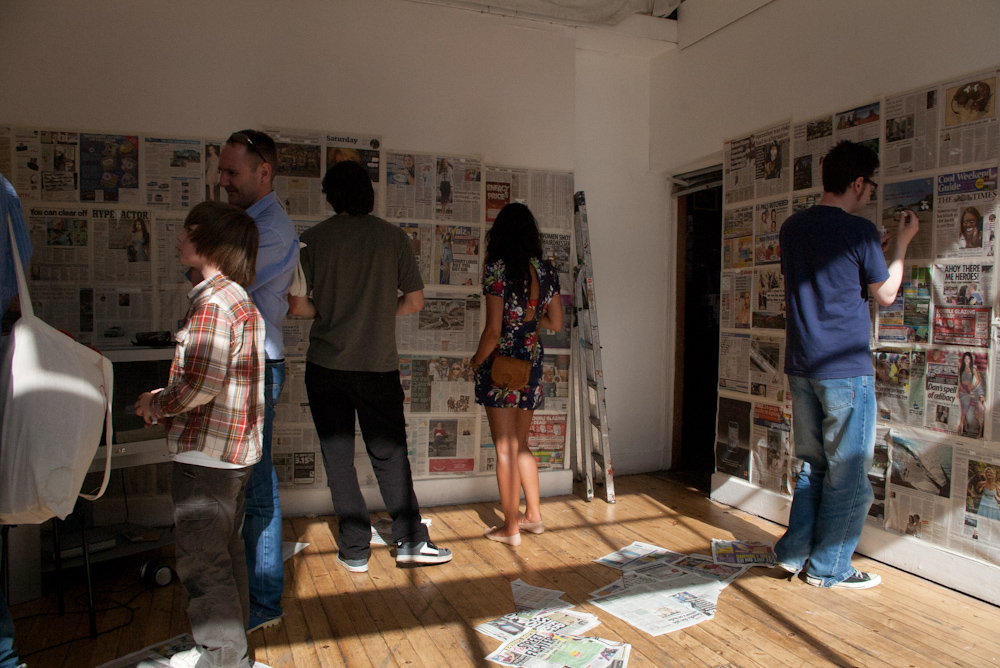
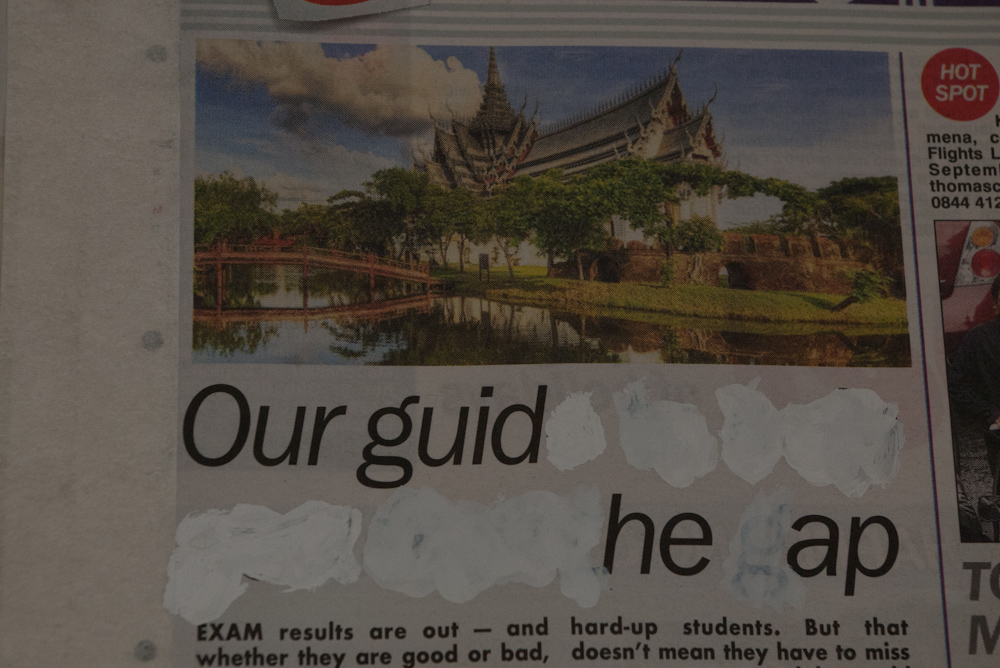
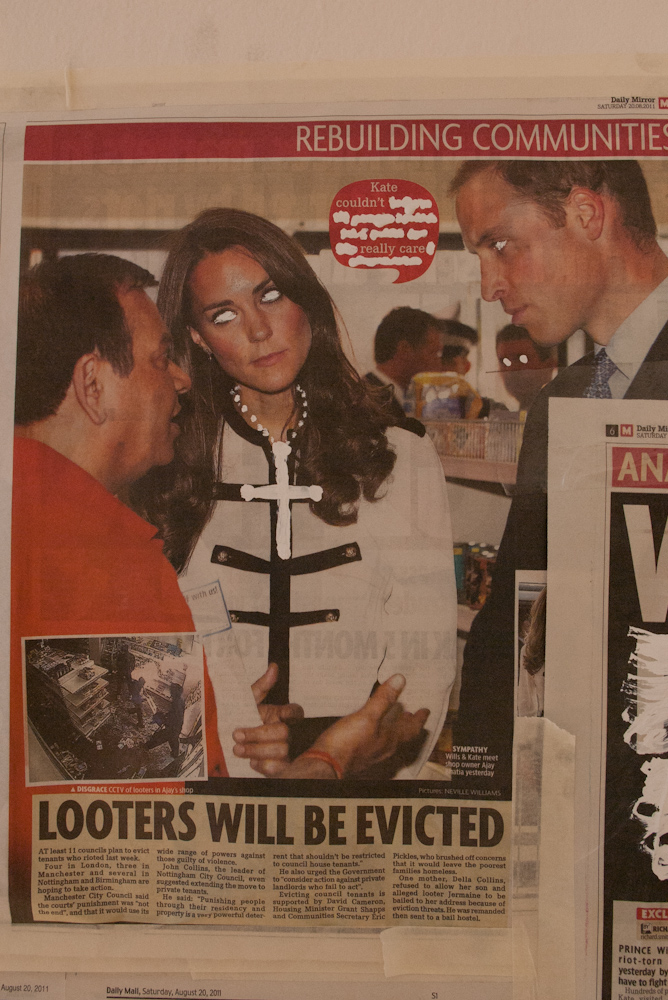
EDITORIAL began as an installation of the day’s newspapers at the Totalkunst Gallery, Edinburgh 20/21 August 2011, the concluding installation of I AM NOT A POET.


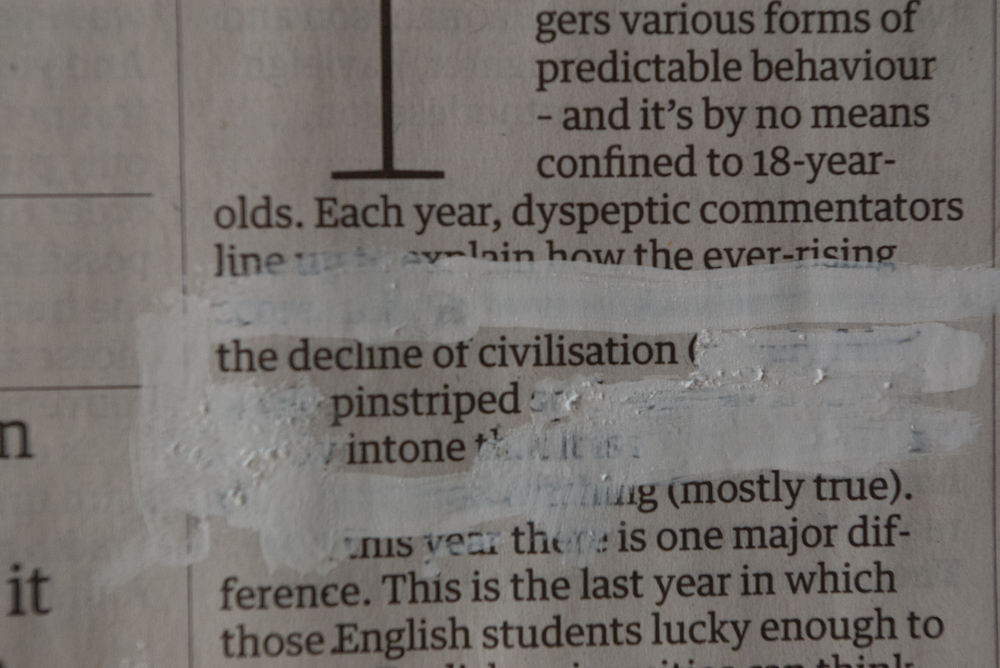
Tippex and marker pens were available, and a score invited “tippex the papers and correct the news.” As the notes to this chapbook explain:


words made from tippex deletions.

words in brackets are words added in tippex by participants
words in bold are words added by participants with black marker, one provided or their own.
words in red are words added by participant(s) in red marker.
words in square brackets describe images made by tippex.

each variation comes from a separate notational revolution round the gallery.


EDITORIAL will be launched as part of Evergreen at X Mark’s the Bökship on 30th March  2012.


A u u with no and thos’

our guid heap

venture
seeing
eering
Go:

outrage as Tussaud’s
defends its right
to say Heil Hitler

Last minute sale
Bank Bargains!

Honeymoon horror
Killer was White

a moral bound
the pup that won
Cilla’s ear


nick-e melville’s work is also part of VerySmallKitchen’s I AM NOT A POET ASSEMBLING.

Other tippex works by nick-e were part of THETEXTISTHETEXT (co-curated with Gerry Smith), an online version of which is on VerySmallKitchen here.

See a recent interview and reading at The Other Room here.


the man who spent
£15,000 to shed pounds

park boss heck
over light sides

fat spread as city’s tin walls join the strike
tens of 1000s of port
celebrated
man who relishes a fight
everything it touches
turns to ash

the new capital
one world
mastercard will
pay you back hands

charge the bank


Continue reading here.


VSK RESIDENCY: OHAD BEN SHIMON AND ARIEL GOLDBERG: A CORRESPONDENCE

In Uncategorized on March 20, 2012 at 11:17 pm

Ariel Goldberg, Part of the epistolary novel, and performance "The Photographer," March, 2012


The following is an edited version of a correspondence which took place by email between 24 February and 15 March 2012, between Ohad Ben Shimon and Ariel Goldberg.

Ohad emailed Ariel as a follow up to their inclusion in Ugly Duckling Presse’s Emergency Index publication, proposing a dialogue, one of whose public forms would be as a blog post on VerySmallKitchen.

Transcript edited by VerySmallKitchen 18/03/12. The full unedited exchange can be seen here.


OHAD: I was quite happy to view and read your thoughts regarding the intersection of photography with performance and text. It’s nice for me to take photography as a starting point as I was also educated in art school in photography and kind of drifted away from it. I’m more into connecting writing/performance to painting nowadays. But eventually i guess all roads cross.

ARIEL: I started in photography school also, turned to writing as the more practical and versatile tool, but always still deep in photography. Actually I argue my writing is photography. Photography is in such rapid change, I think language is at this moment of really entering the game. Like caption revenge or something.


Photo: Ohad Ben Shimon


OHAD: Your writing might very well be (is) photography, I get that. Presence/absence etc. What is the object of writing/photography? I also used to identify myself as a photographer without a camera for people who didn’t get the picture. It should go on from there to new and yet unknown territories.

ARIEL: Just subbed for a class of 18 year old photo students and I felt like why make supremacy out of photography. It seems like these photographers, and they were very young ones, who knows what they will become, had no hunger for reading/writing as maybe a better lens when the world is over-saturated image wise.


Ariel Goldberg, slide lecture, AND NOW festival, 2011, based on photgraphs of parents Ellie and Ira Goldberg.


Past explaining things, settling into writing as a primary medium may be where I have always been heading. Perhaps there is some idea of not wanting to give up one for the other. Preferably the unknown, as you say.

I have a prompt for this emergency index release party to make a piece “from” something else in the anthology. I’m curious about the medium, if there can be one, of “performance lecture.” Is this a thing? I feel like it is a buzz word right now in the arts crossing over to writing. I’m interested in how a faux-expert operates. As a real expert, tonally.


OHAD: Can we free photography from its contemporary heavy chains of disgust? Can we acquire the sense of innocence that once inhabited this medium? Without getting all sentimental about it or perhaps to exaggerate this sentimentality to an absurd point…

The lecture-performance format deals with a certain academic authority to my understanding. This authority is perhaps the same sovereign authority that the photographic medium has dealt with throughout history.

Predominantly I think a lecture-performance is a way to designate an exchange between an artist and an audience which is neither an academic (lecture) exchange nor a performance in the normal sense of the term. So it’s an interesting case of a double negation. Like the double negation of writing slipping into art. It’s neither writing, nor art. Neither-nor.


Ariel Goldberg, Directed self-portrait, as a bridesmaid, in New Jersey, 2011


Who is telling what to who? Who is listening? Who’s in the picture? Who’s not? Who’s smart? Who’s stupid? Who’s infantile? I sound like Heide Klum in Project Runway. What if we could break all the cameras in the world in one given moment and then glue them all back together to form one uber-camera? What would we see?

I’ve had another talk with a friend last week, also contemplating what you say regarding the realisation that writing is/should be your primary medium. But what the hell is a writer? Is it someone who publishes books? Goes to readings? Is reviewed about? I really don’t know.

For me writing lately comes down to silence. There is a silence when I write. I transform that silence into a certain visible trace in the form of words. Maybe it’s similar to the way a camera brings a certain darkness into light?


ARIEL: I am thinking today about caption errors. About how this seems to be the most dramatic twist, some affirmation of the way blind faith in the surface of an image distorts our experiences (of what?).

I read the news constantly, more so now maybe because I started getting a New York Times weekend edition. So the papers just pile up and it feels like I am a worker, like Bartleby the Scrivener, getting through the stories.

Do you read the news? Are broken cameras caption errors? There are so many cameras going into the garbage heap everyday, it is the most rapidly evolving and consumer cycling technology it seems, if cell phones are included in the pile of cameras. I like to stare at those bins at thrift stores of film cameras. But I don’t want to accumulate them.

If we took this, cameras broken then gluing it back together, and thought about what we would see- light leaks? Literal. We would see the people in the military taking the horrific pictures of the dead bodies their commands are responsible for. This sort of footage of carnage is under constant raps, but so much of it is flowing through the memory cards of the U.S. military.

I’ll tell you what a writer is, in the sense of how it feels in my daily life: I wake up in the morning and I must write. The thing I am making, are pieces of paper with writing on them. Other stuff grows from that point but I guess it’s a crude estimation of my production that I say I am more of a writer.

I must write or I go crazy. It is really actually a compulsion. I must write down the things that seem crucial to observe, minutia in photography, inside my many little systems for collecting then finessing this observation into a piece of writing to redistribute back to the world.


Ariel Goldberg, SFMOMA 2011: "On July 7, I led a group of people up to Robert Gober’s Newspaper piece, discussing, theorizing, and reciting the photographic acts that happen throughout the museum. Evan Kennedy helped by narrating the script up to the piece..."


But it is a struggle. And there is a lot of silence in it. Yes, I agree silence is crucial, something to seek, to cultivate. I guess mostly, a writer is a reader. I guess I identify with the procedures for arriving at subjects or projects like that of a writer, but also that of a photographer, a photographer who doesn’t use film but uses language, because it is much freer. In the economic sense, I think it is important to differentiate between photography and writing.

You write “the lecture-performance format deals with a certain academic authority to my understanding. this authority is perhaps the same sovereign authority that the photographic medium has dealt with throughout history. who is telling what to who?”

For a while I was obsessed with writing the imagined voice of the subject of photographs, as these sort of dredged captions. Then I was also writing the voice of the photographer- who sounded kind of like an asshole. I think with citizen journalism, anyone who is there with any type of camera and catches a crucial picture to document something considered news or history, the sovereign power of photography is changing.

Perhaps more people doing “performance lectures” is just a result of the spread of academia into the arts, which it seems everyone bemoans at every opportunity they get. Bash the M.F.A. or the B.F.A.


OHAD: What motivates me? Kinship. Maybe that’s why I contacted you. I sensed a certain kinship. which is strange. I mean we are total strangers.

I saw Rabih Mroué in Utrecht. I liked his approach. I also sat behind him just before and after his performance in the audience. I thought of talking to him and congratulating him for an interesting performance. But then I thought to myself. Wait. You are Israeli. He is Lebanese. I felt like anything I would say would be disrespectful. Maybe something I did or said would be interpreted by him as offensive. I felt guilt. I rather remain silent and appreciate him from a distance. And so I did.

There is a bit of an element of fooling around in a child-like way in your (and mine) writing/performances. Maybe that foolishness is our way to maintain the innocence we once experienced as related to photography? Maybe photography is a funny medium. A fun-ny medium.


ARIEL: I’ve spent some more time with your performances, or the documentation of them, The Mirror Stage in particular, and then when two people come together, giving a reading, and the interview with Chris Clarke.


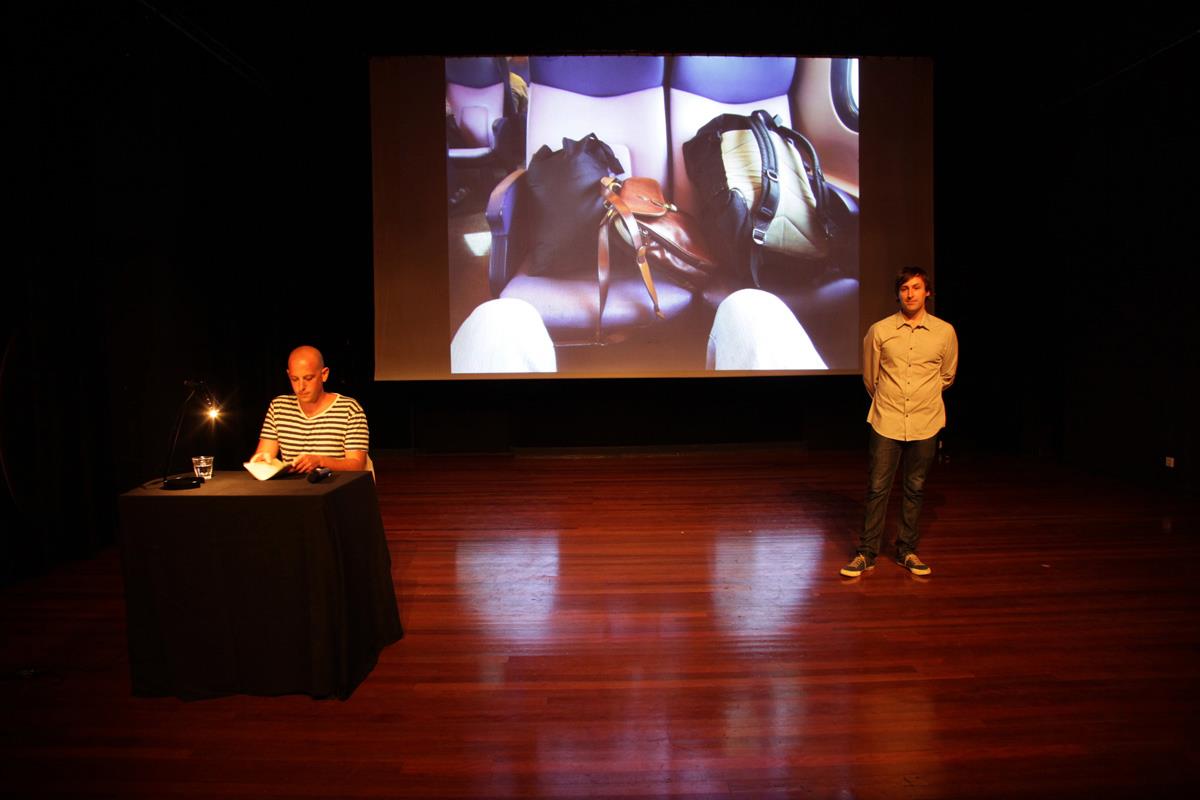
Ohad Ben Shimon, The Mirror Stage at The Second Act, Amsterdam, 2011


I have this urge to ask a long string of questions and observations which you can choose to answer or not.

I was curious about the image in your the documentation of the mirror stage- how it only shows one image, and the whole performance cycles through many many images. Did you choose that still for the picture on the screen?


Is there hierarchy or can there be of “good pictures” when you are showing them as a mass? Are favorites possible? Is a “good” picture becoming obsolete when there are just necessary or de-facto pictures?

Do you bring a little kit for your performances or are they built from whatever equipment that is there? That lamp, and the desk. I have this urge to use no technology- have no tek needs that is, for upcoming
performances. Or if there is a photo or a text people need to see they hold it.

I was interested in Chris Clarke’s question about integrating “your pictures” after doing performance talks/ readings without images and how you said you experienced a “distrust with photography”.


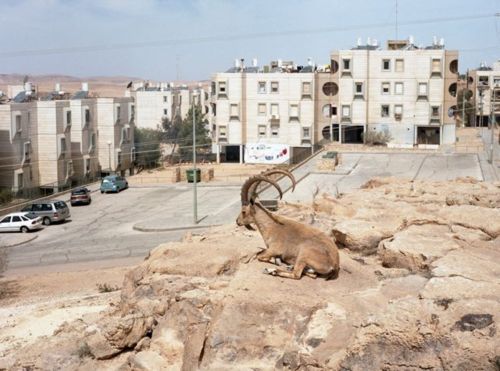
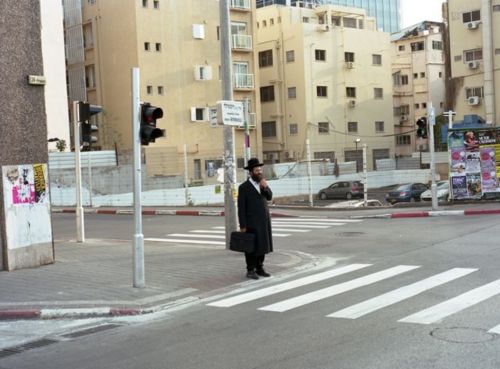
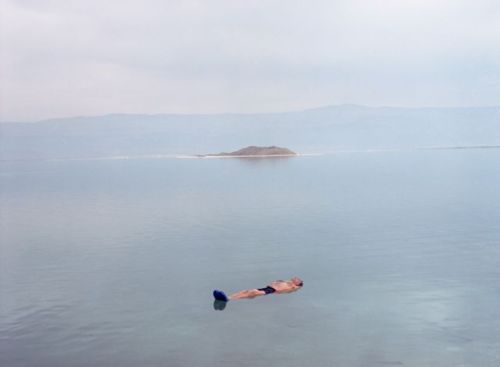
Photos by Ohad Ben Shimon. From Top: Mitzpe Ramon; Tel Aviv 2009; Dad at the Dead Sea; The Love Parade Berlin.


…and The Mirror Stage is reflective we are striving for a unity a feeling with the audience taking these fragments- there is something about vulnerability. What do you think about vulnerability? Is diary a misnomer? I have been thinking about handing people work, literally,
the page that i first write about something on (and I edit a ton when it transfers into type on the computer). The holding of a piece of writing as performance.

Do you know Stephen Ratcliffe, the American poet’s work? I think it would interest you. How it all begins with a date, as numbers, he writes from the same place, mostly, everyday, a sort of same sounding poem.

Can we make an analogy of anything to photography? Is it that far and wide? Do you prefer to sit than stand while reading to an audience? How much of that do you premeditate?

Do you edit the diary? Really? How many languages do you speak? Forgive me, I am very verbose by nature. I cannot seem to edit this down. I want it to be real/rawe.

Perhaps the reason I am so interested in correspondence, and interviews or other topics for criticism is that I must have something to bounce the photography focus off from or else I’ll get bored with it. I might. I might stop the obsession but it is alive and well now. I am not done. I am not discovering but collecting. Maybe afraid of losing to cope with real losing. Talk about psychology! For motivating procedures for making.

I like getting glimpses of the big time difference between us. How your bed time, or meal time, with when I am reading. Correspondence, even over the internet, guarantees some delay, like the delay I think I am most attached to in photography.


OHAD: I also like the delay very much. The more ‘serious’ photos I take I store the film for about half a year until I’m in Tel Aviv again and I develop them in my favorite lab. It’s the only lab I develop film.

So the status of my analogue photography is always tied to this lab, in which the owner died from cancer about 2-3 years ago and since then his son has taken over. They have nice punk concerts there on Friday afternoons. I once took my father and brother and we had a nice time. We drank arak. Do you know arak? It’s this kind of anis.

Thanks a lot for your reflections about my works. It felt like I had a solo show, you know this specific attention to specific works and details. You don’t imagine that you can actually have a solo show online, depending on the attention of the viewer.

In The Mirror Stage performance there was no real hierarchy… and I was never a kind of fanatic digital photography producer of images. I guess I’m kind of choosing to exaggerate the medium to see where it will break. Breaking the medium by overusing it.


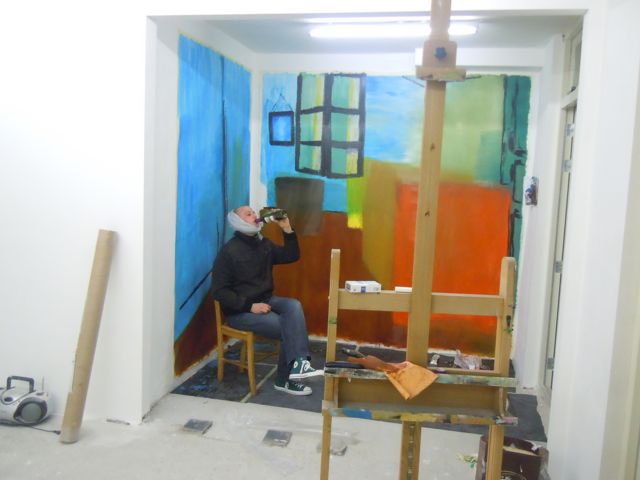
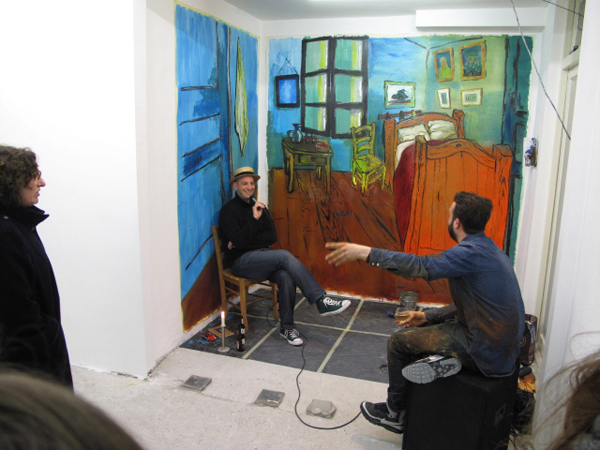
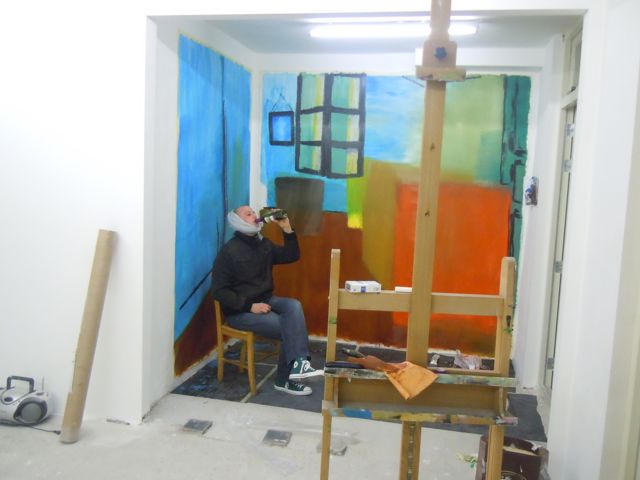
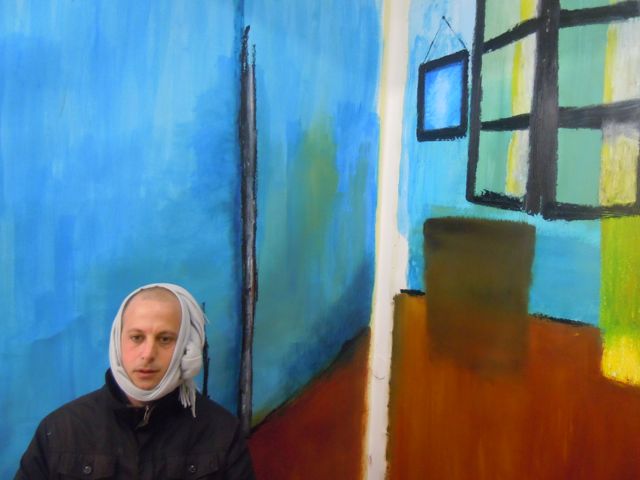
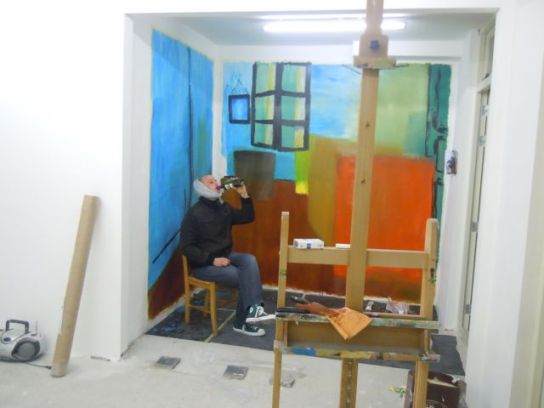
Ohad Ben Shimon & Veniamin Kazachenko, Self Portrait As Van Gogh Sitting On The Chair In His Famous Painting - The Bedroom, 2012.


The camera I used for that performance actually did break. I was with a new friend I just met in Amsterdam. She went on the roof of her apartment. Then she asked for the camera to take a picture of us hanging around the balcony. Then it dropped and never opened again.

Did I mourn it? I still have another one with me. I never buy cameras. I somehow manage to receive them from someone who doesn’t need them. So it’s like a ready made. I treat the cameras I use as ready made.

Today is the International Women’s Day and I was wondering how being a woman is related to your text/performances.. I’m sure it’s quite significant.

It’s nice to discover that our approaches are the same in a kind androgynous way. I mean to say all this technology and monotony and the rest are kind of a-sexual. Until now I only met a few guys who were doing this kind of pseudo news reporter lecture-performance things.

I feel now like I felt with Rabih in a way that because I’m not a woman I might say something wrong in a non p.c manner. Is that a pressure to perform? Ok enough about this guilt-trip thing. So how does being a woman relate to your technique of performance?

No, I don’t have a kit. I try to have only the pieces of paper. I find the rest on site or someone arranges it. I actually want to stop using photographs also. In 2010 I made a performance without images (my pen died). I think conceptually that was stronger.

I like how you take out pieces of my performances. Like you are actually photographing it/me/my voice/the text. I understand you do that often, create a kind of mash from your own writing with the writing of behaving of others. a kind of self dissolving in others, others self-dissolving in you. Authorship issues, etc. But also a kind of fusion. Not necessarily with people but also with inanimate things. Do you want to become a camera? Are you a camera? Wasn’t Warhol busy with this as well?

I don’t usually edit the diary. I manage to fool some people that I speak about 7 languages but in fact I only speak about 2 and a half. Hebrew, English and ok level of Dutch.


ARIEL: I find the morning writing time to be crucial and something to protect. That numbness, a perfect fit for untimed stares out the window, is in some way a judgement or clutter free state, one where obligations or logistics can get suspended, if the time is of course predetermined as protected.


Ariel Goldberg, Potential Implications of Photography on the Surface of Clothing, 2011


I find the establishment of quiet in the morning, allows me to remember my dreams, and even if the smallest conversation happens, like oh no the alarm didn’t go off, there will be a ticket on the car because it is parked in a metered spot, I then cannot focus all morning.

Sometimes even the first ten steps from the bed is a period of time the dream goes away. I find if I don’t have a chunk of time to write with coffee in the morning, about nothing, it is always just the journal then, that my mood is very strange and fractured for the rest of the day.

Sometimes when I am holding the camera I get so satisfied by that feeling of the echo of a camera, the insides of the machine clicking and turning reverberating into my palm, that I then take more, a little string of pictures.

One night recently I set up my slide projector in the studio and shot film pictures of the slides because I wanted to finish the roll of film but also didn’t have time to scan them- it turned out the digital ones I took that night were much better, of course, because it was dark and the border and empty space needed to be excised.

I forgot really that the shadow coming in from the window and then edge of my projection screen would just be black in the exposure. I forgot when i was setting up the shot that what I saw through the viewfinder was not what I would see as the picture. That my eye wasn’t the camera.

It’s so great you ask about the being a woman thing. I actually don’t identify as a woman. I identify as a feminist who is queer. I identify as a little butch dyke. Your questions about it, and the awareness of your questions coming from a male perspective I find really provoking and touching.


OHAD: Travel. Motion. An important component of writing somehow. At least for me. The displacement of the physical body always begs the wandering of the creative ‘spirit’/drive. Maybe it’s no coincidence that the word ‘drive’ is used both in a libidinal sense and in creative forces.

We drive somewhere. We go. We cross. We map and are mapped. We at times conquer something or somewhere or sometime. Some times it has bad consequences (in the form of a national drive) but most often in a personal sense it has good consequences.


More about Ariel’s work here and Ohad’s here.  Ohad’s VerySmallKitchen residency posts can be seen here.


CORRIDOR8 PREVIEW: RE-READING BREAKTHROUGH FICTIONEERS

In Uncategorized on March 8, 2012 at 12:01 am


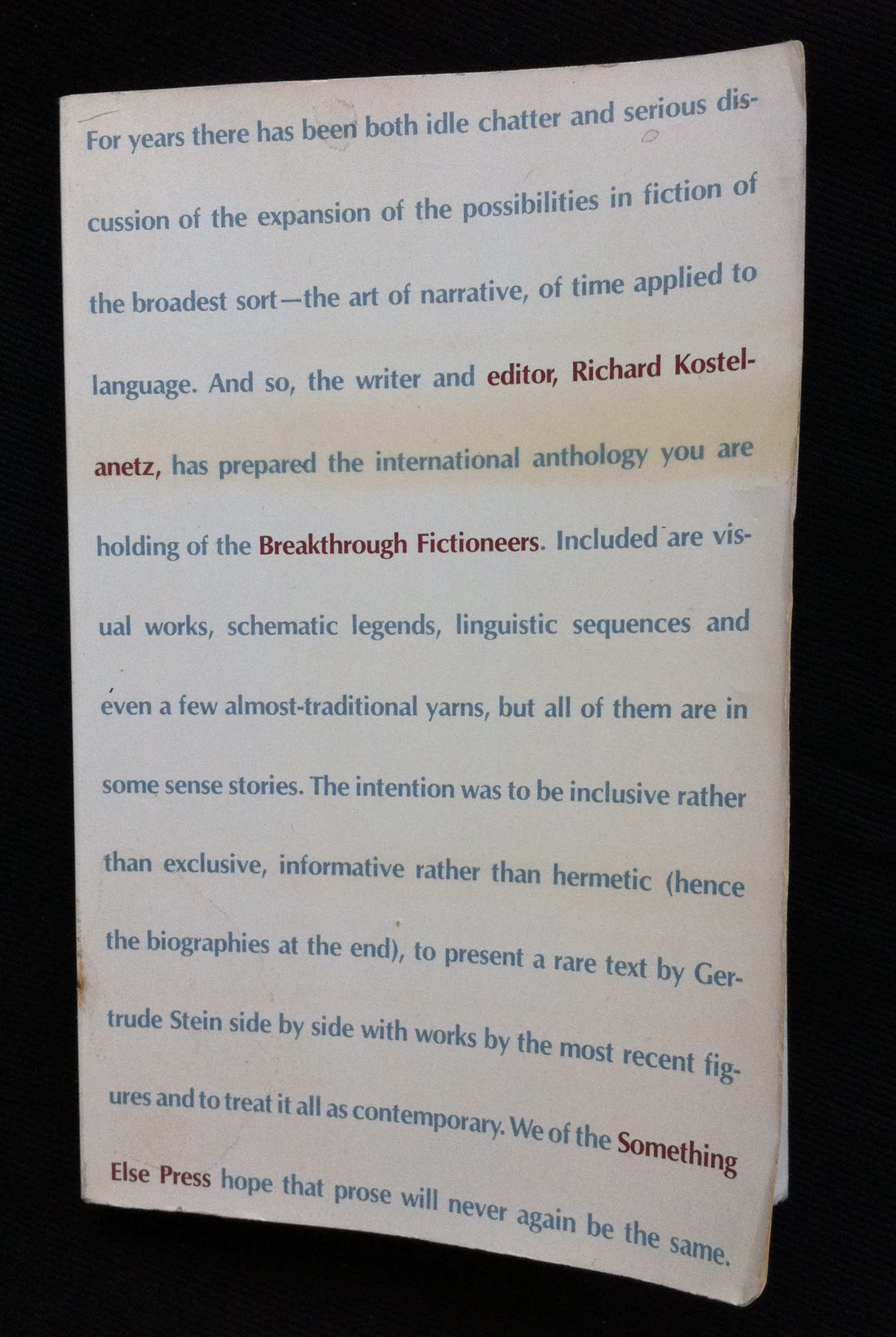
The new issue of Corridor8 includes a supplement of new work expanding out from the 1973 anthology Breakthrough Fictioneers, edited by Richard Kostelanetz and published by Something Else press. As a preview of this new issue (designed by the Sheffield based collective dust), VerySmallKitchen offers a gathering of materials:


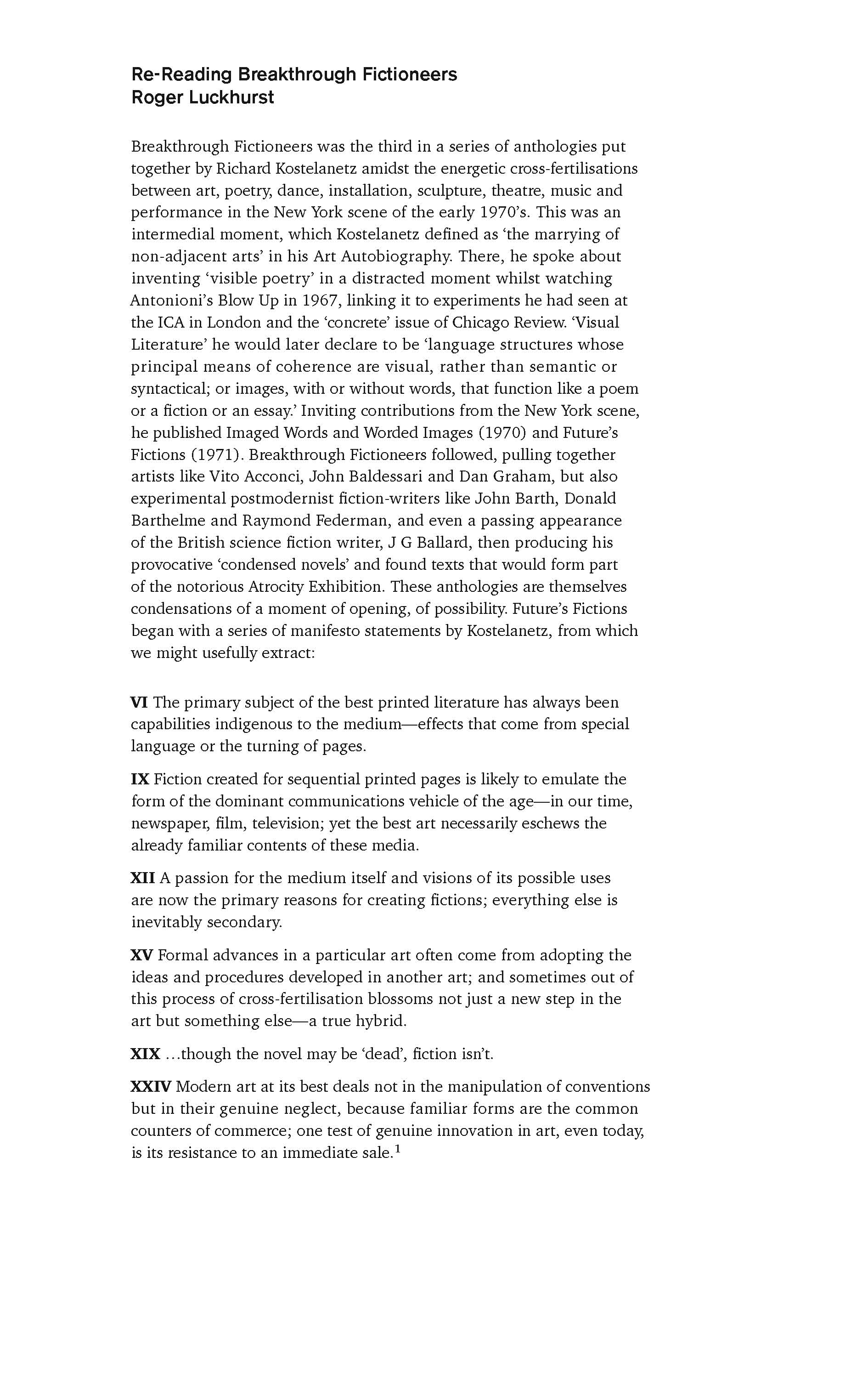
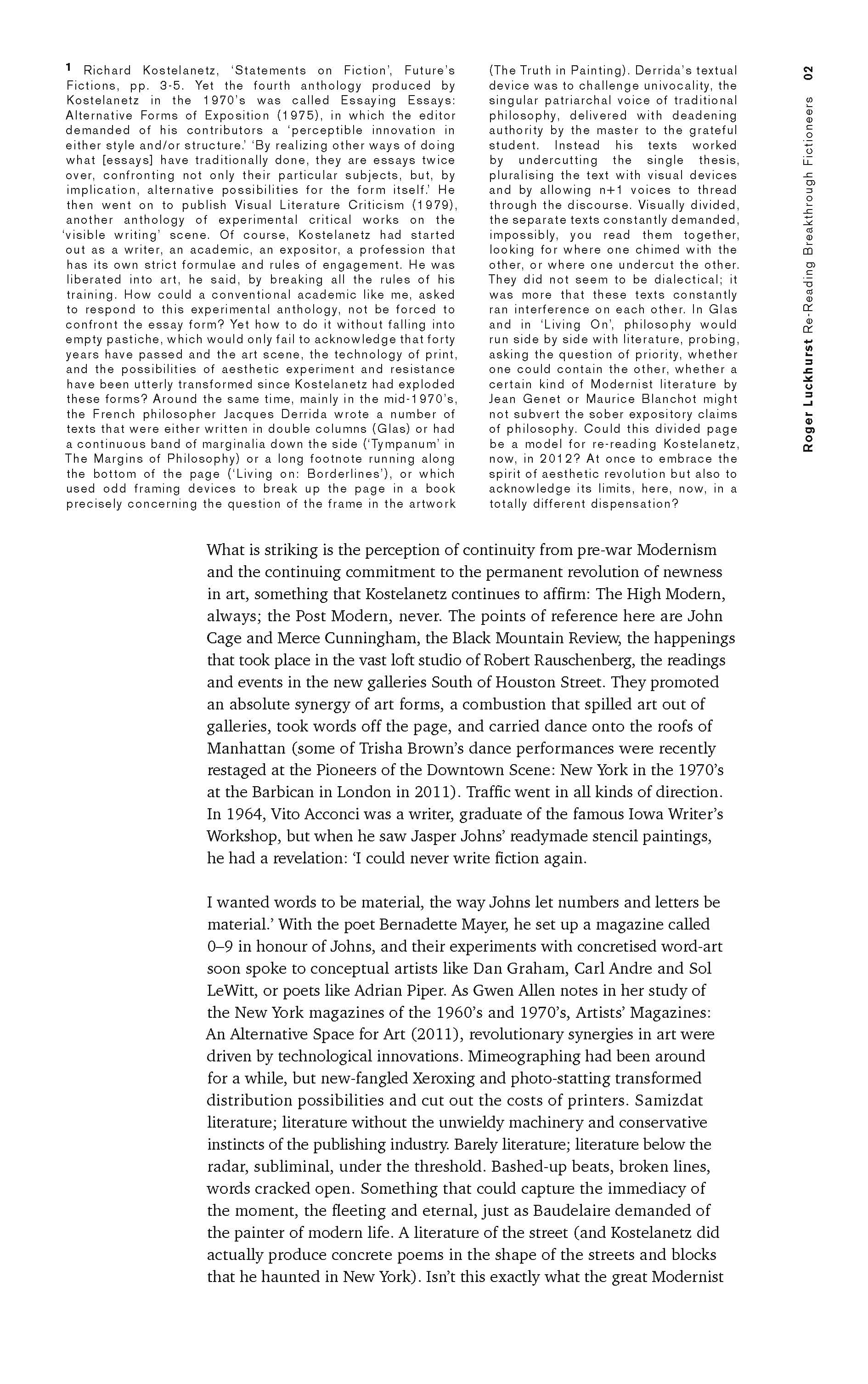
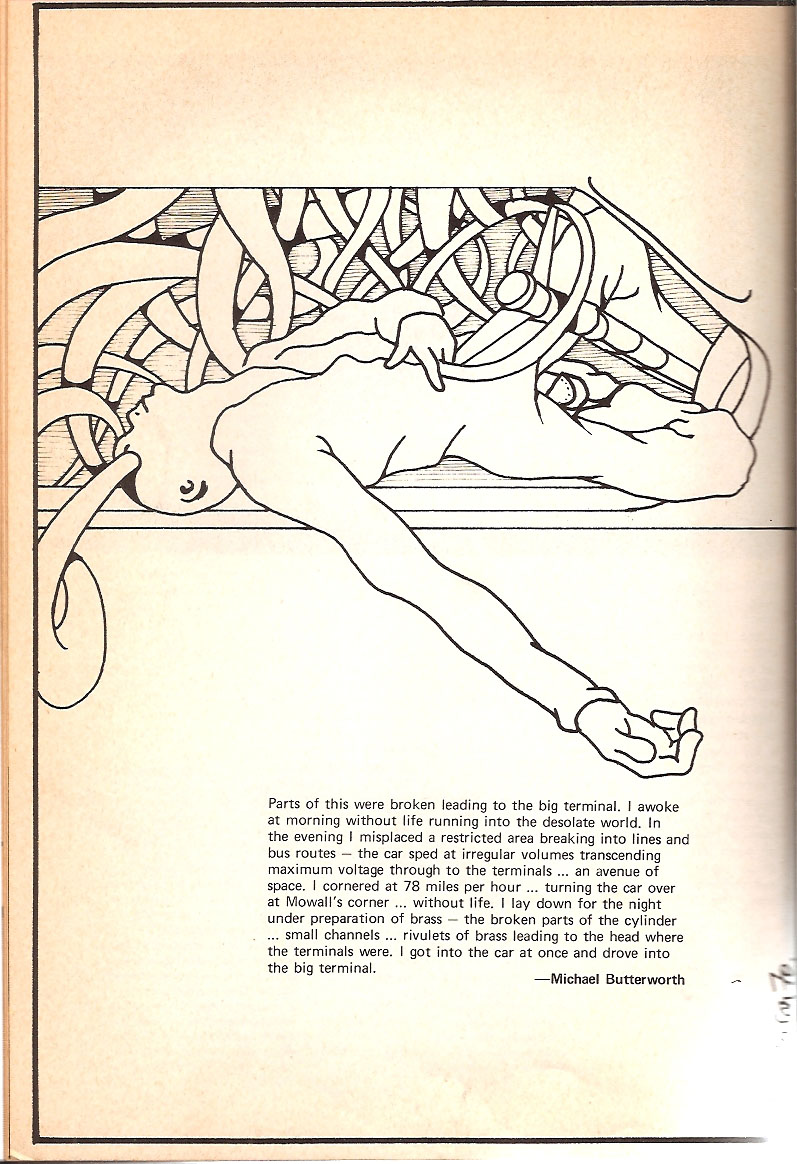
(1) Roger Luckhurst’s introductory essay “Re-Reading Breakthrough Fictioneers”; (2) extracts of the Richard Kostelanetz introduction to Breakthrough Fictioneers, proposing anthology as polemic; (3) a scan from Corridor8 writer Michael Butterworth of his contribution to New Worlds #199 March 1970 (illustration by Allan Stephanson), which was later published in BF, minus illustration.

Finally, (4) A sample of note cards, collected in RK’s On Innovative Performance, to be read by Rachel Lois Clapham as part of a presentation at the Portable Reading Room (see below) which, says RLC, “explores Kostelanetz as chief chronicler, enthusiast and performance Neanderthal.”

The Corridor8 project appears alongside Michael Butterworth’s interview with Richard Kostelanetz for soanyway.org, which has itself been expanded into a special issue of Derek Horton and Lisa Stansbie’s online magazine.

All of these projects and Richard Kostelanetz’s work more broadly is part of a round table event co-organised by VerySmallKitchen at the Portable Reading Room in Leeds City Art Gallery, March 10th, 2012, 1.00-3.00pm, with David Berridge (VerySmallKitchen), Michael Butterworth (Corridor8), Rachel Lois Clapham (Open Dialogues) and Derek Horton (soanyway.org).


(A) Re-Reading Breakthrough Fictioneers


This text can also be read as a PDF here.


(b) Breakthrough Fictioneers


RICHARD KOSTELANETZ: The polemical aim of this anthology is nothing less than a drastic enlargement of our sense of fictional possibility; for the individual selections were made with one elementary criterion in mind – their distance, as hypothetical positions, beyond what we have often read before. No particular deductions about fiction’s future exclusively shaped my choices – not even  this needlessly conservative conclusion I drew four years ago: “ What will, I think, primarily distinguish fiction of the future from the other arts will be an emphasis upon words as such, selected and arranged out of evident taste for language, a measure of human significance, a sense of potential linguistic articulations, and an awareness of the viable traditions of literature.” As the ensuing variety of stylistic alternatives would suggest, however, there exists not one but several possible futures for fiction and language is not necessarily prerequisite. (xiv-xv)


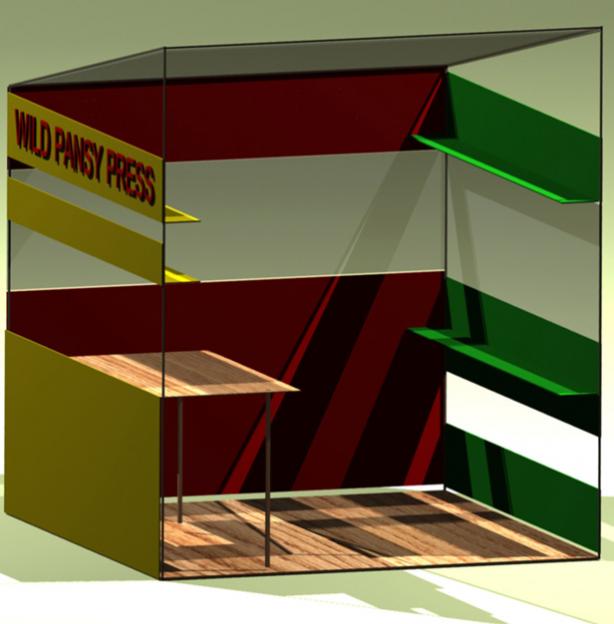
The Wild Pansy Press Portable Reading Room


These innovative works [by Barth, Nabokov, Borges, Barthelme and Crumb, amongst others] suggest  that “fiction” can be most generally defined as a frame filled with a circumscribed world of cohesively self-relating activity. This fictional material may be primarily human, naturalistic, or stylistic, which is to say that fiction may predominantly deal with people, or things, or merely a certain linguistic style and/or formal device; but within fictional art is usually some kind of movement from one point to another. In these respects of diversity and change within an acknowledged frame does fiction particularly differ from poetry, which emphasizes concise, static, generally formalized statement. Fictions tend towards fullness, while poetry is spare, fictions encompass , whilst poetry concentrates; fictions go, while poetry stops.

Fictions thus favour sequential forms (and yet remain distinct from film), as the difference between the material on one page and its successors (and predecessors) often generates the work’s internal event. For instance, a single page of Raymond Federman’s richly inventive  Double or Nothing (1971) might succeed, in isolation, as a graphic picture or “word-image,” where visualizations of various kinds complement the marvelous language; but Federman’s frames in sequence, abetted by sustained preoccupations, begin to weave a fictional action not evident in one alone. More specifically, just as one page can facilely follow from another, so can it drastically contradict its predecessors – an esthetic interface also possible in the similarly edited arts of film and video-tape, but not in live performance, whether on stage or television, or in a lecture. That is, the act of turning pages, which is condusive to sequence, can introduce non-sequential material that is nonetheless artistically related, and in this respect can the interfacial forms of certain fictions resemble this entire anthology. On the other hand, even within a single page can sometimes be compressed a world of artistic activity that is ultimately more fictional than poetic, as well as yet more reduced than Beckett’s Nouvelles textes pour rien (1958), to mention one prior milestone of literary minimalism.

What is new in contemporary art often deals inventively with the essentials of the medium; in fiction’s case, the possibilities of language and narrative form, as well as the potentialities of both a rectangular printed page and the rhythmic process of turning pages; and “freedom” in any art means the uncompromised opportunity to use or fill these basic materials without restraint – without deference, to be more specific, to either literary conventions or worldly realities. Therefore, just as some new fictions depend upon unfamiliar linguistic signs, others eschew language completely in the telling of stories (thereby echoing Tristan Tzara’s declaration for a Dada literature: “ No More Words”). Once the old-fashioned, extraneous, needlessly restrictive criteria for  “fiction” are phased out, it becomes readily clear that many alternatives are possible, which is to say that the fictional medium’s components can still be artistically deployed in innumerable unprecedented ways. The “novel” may be dead, along with other historically mortal forms; but fictionalizing, as a creative impulse, is not.  (xv-xvi)


As freedoms are asserted, so must restrictions be acknowledged. All of the following sections emulate at least one of the components of classic fiction – expository language, characters (which need not be human), evocative artifice, narrative, etc., as even the totally visual contributions reflect typically fictional concerns; and most of them express significances that would surely be familiar to open-minded connoisseurs of imaginative literature. The most obvious formal limitation stems from the practical publishing convention of printed rectangular pages of uniform size, bound in a fixed sequence and limited in color to blacks, whites and occasional greys – limitations which regretfully forced the exclusions of several “fictions” I should otherwise have wanted to include.” (xix)

New York, New York

May 14, 1972


from “Introduction” by Richard Kostelanetz, Breakthrough Fictioneers: An Anthology (Something Else Press, Barton, 1973).


(c)TERMINAL by Michael Butterworth


(d) Three Notecards by Richard Kostelanetz


Extracted from Rachel Lois Clapham “Writing AVANT GARDE PERFORMANCE”, forthcoming at Soanyway. SOURCE: RIchard Kostelanetz On Innovative Performance(s): Three Decades of Recollections on Alternative Theater (McFarland & Company, 1994).


A.


Philip Glass and Robert Wilson
Einstein on the beach (Brooklyn Academy of Music). It was an authentic reproduction, and it was spectacular. What struck me most was how classic it had become and how it would always be a classic. Even though Lucinda Child’s choreography replaces Andy de Groat’s, it is not sufficiently distinguished to change anything. (My recollection is that Andy de Groat depended mostly upon spinning, whereas this is mostly circular movement.) One stylistic mark of the work is repetition, down to Linda Child’s monologue, another is the slow pace. Both these qualities now strike me as terribly dated. Samuel M. Johnson, an elderly black man eight years ago, now seems more infirm than before, but his concluding monologue, delivered from a locomotive cab, struck me as especially brilliant. Some of Wilson’s moves seem even more derivative, such as the pseudo-mysterious rectangle that appears from time to time, reminding me of 2001. The so-called knee plays seem ever more inconsequential. Toward the end Philip’s music appears to get bored with its own style, as each of the instrumentalists takes solos that strike me as terribly UnGlassian. I’d like to see it again, nonetheless. (December 1984).


B.


David Jacobs
 Wah Ching Box Works Assyrian Fair, Baby (Allan D’Arcangelo’s studio).  Though Allan Kaprow invited me, with a scrawled ‘Do come!’ on an announcement, I was surprised to find so few people attending. An innocent middle-aged lady from Life’s Modern Living Department was there, along with her photographer boyfriend. She said that David Bourdon had told her to call him if the performance turned out to be good. Like other examples recently, it reminded me of how snotty and unadventurous the established mixed-means practitioners (and their admirers) are about auditing others who work in this medium, others who are not their intimate friends. Jacobs worked with sculptural materials pumped by air-some belch regularly, others bounce in place, some occasionally let off noises. He skilfully introduced his anthropomorphic figures one at a time. With coherence both visual and aural, I liked what I saw, however thinking that these machines would be more effective in an environmental situation, with the sculptures surrounding the spectators, instead of sitting before us. The noises were too loud for my taste. (December 1, 1967)


C.


Vito Acconci 
Claims (private loft, 93 Grand Street). I’d not seen any of Vito’s new performance pieces-at least not since the deep breathing at N.Y.U a year and one-half ago, which I liked more in contextual retrospect than I did then. Always ‘experimenting with himself’ so to speak, he sets up a situation hazardous, initially to himself, whose results compromise the piece. For example, he had the Post Office forward his mail to the Museum of Modern Art, where he had to go and pick it up. Or he does the same exercise (such as jumping on and off a stool) for a fixed period of time every day. Or he burns the hair off his chest. The term ‘body art’ might be appropriate, because what happens to his body is now the content. ‘Conceptual Art’ is really a more accurate epithet. For Claims Vito sat at the bottom of a stairway with a collection of long poles. Blindfolded, he assigned himself the job of protecting his territory – the bottom of the stairway- from intruders. A close-circuit camera was trained on him, and the results were immediately broadcast ‘live’ on a TV monitor upstairs, as well as recorded on videotape. Thus, his voice could be heard not only through the door leading downstairs but also over the electronic playback system. He did this for a full four hours, constantly mumbling to himself that he had to protect his territory; but nothing else ‘happened’ or changed in the course of the performance. The audience never numbered more than a dozen people, most of whom were (like me) his friends. (September 1971)


___


Other attempts to think through the legacy and contemporary presence of RK’s work include The Richard Kostelanetz Bookstore at Kunstverein in Amsterdam.

The Corridor8 Breakthrough Fictioneers supplement will include work by Anna Barham, Pavel Büchler, Ben Jeans Houghton, Richard Kostelanetz, Roger Luckhurst, Carol Mavor, Charlotte Morgan, David Osbaldeston and Imogen Stidworthy.


VSK RESIDENCY OHAD BEN SHIMON (5): 25 FEBRUARY 2012 and PARIS DIARY

In Uncategorized on March 3, 2012 at 1:54 pm


_


“I’ve thought of you so often these past few days, and also occasionally about the time long ago when, as you will remember, you visited me in The Hague and we walked along Trekweg to Rijswijk and drank milk at the mill there. It may be that this influenced me somewhat when I did these drawings, in which I have tried as naively as possible to draw things exactly as I saw them.”


From: Vincent van Gogh
To: Theo van Gogh
Place/Date: The Hague, Saturday, 3 June 1882


25.2.12 (Amsterdam)


I’m sitting on a bench in the Museumplein in Amsterdam.

I’m facing the Van Gogh Museum.

A big banner on one of the facades of the museum says:

‘The Bedroom has returned’.

Under the big bold black letters is a reproduction of the bedroom painting by Vincent Van Gogh.

It is only lately that I feel attracted to Van Gogh and his work.

It is the figure of Van Gogh as the romantic artist that fascinates me the most.

The portrayal of his struggle encapsulated in a world that could not or did not want to understand him is what strikes me.

In the letters to his brother Theo I could detect a certain sensitivity of the everyday and banal elements of reality.

Van Gogh trusted his vision, he immersed himself in it and held onto it as his only ally. By being immersed in this reality he could perhaps transcend his own existence and become one with this reality.

The erasure of all external factors is a charming idea. It gives the feeling that only him alone equipped with his vision of the world was the world.

The bedroom in this context was a place of refuge for Van Gogh in which he could put this vision of the world to rest.

Where did The Bedroom (painting) return from?
Where did it travel to?


The ‘re-turning’ of The Bedroom (painting) also designates a primary return of the painting to its metaphorical bedroom – The Van Gogh Museum.
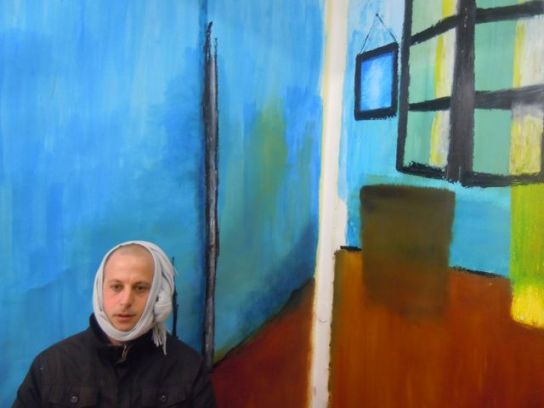


Work In Progress: Self Portrait as Van Gogh Sitting On His Chair In His Famous Painting - The Bedroom, Ohad Ben Shimon & Veniamin Kazachenko, 2012


The painting now, embodied with Van Gogh’s aura can go back to sleep.

It is a curious incident in which a content of a painting dictates its contextual reception.

The Bedroom (painting) rests in its bedroom (museum) and the visitors of the museum acquire the position of witnessing an artifact with a human quality – fatigue.

The painting continues to hibernate in an eternal winter sleep and the museum maintains its status as the all containing reservoir of art.

I see two birds passing.

Then a sound of two planes roaming the skies.

It is the end of the winter.

Nature will soon awake to a glorious yellow-blue spring.


*


16.2.12 (Paris)
 

Photo: Daillier Fabien


_


“Shit!”

“What?”

“I forgot my camera. Do you have the key? Open the door! I need to get my camera”.

“I don’t have the key.”

“Does Lev have the key?”

“No. Nobody has the key.”

“Shit!”

“Come on! We gotta hurry, the train leaves in half an hour”.

It’s 5 thirty in the morning.

We’re in Amsterdam. We are on our way to Paris.


“Bonjour. Can I see your tickets?”

We show our tickets.

“This is not your cabinet”.

Lev has already drunk a beer and is searching for his second one.

“If you guys want to sit near a big table you can sit in the cafeteria cabinet”.

We go sit in the cafeteria cabinet.

Ben goes to look for beer. It’s 6 fifteen in the morning.

“There is no beer here” he says as he comes back from the cafe lady behind the counter. Ben takes out a deck of Russian cards and we play some Russian card game in which there are no winners, only losers.

The train stops at Rotterdam.

We consider stepping out for a smoke but by the time we have made our minds to get up of our seats, the conductor lady says that the train is leaving.

We leave.

We stop in Antwerp.

“Should we try and have a smoke now?”

“Yeah”

We go to get coffee.

In line before us is one of those ladies with small change. She keeps counting her change. It takes her about 10 minutes.

By the time we get our coffees and try to go step outside the conductor informs us that it is too late to get out.

The train leaves. The next stop is Brussels. We will try to have our cigarette smoke there.

We stop in Brussels.

We smoke.
We get on the train.
We move.

We continue moving for a bit, then we fall asleep and wake up in Paris.

Ben and Lev leave the train while I stop by the toilet to take a piss.

I piss and get off the train.

As I walk on the platform towards the escalators I see Ben and Lev from a distance with 2 police guys that are asking them all sorts of questions and showing them some badges.

As I approach them I hear the police guy saying to Lev that he needs to check his bags.

I conclude quickly that its some kind of drug inspection.

I remember hearing something early in the morning that Lev has some white powder present that he got from someone for someone else. Not knowing exactly what Lev is carrying with him I decide to continue walking without making any eye contact with them.

I try to observe what’s going on from the other side of the platform but the parking trains block the sight.

I try to come up with a plan of what to do as I imagine Lev and Ben being arrested for smuggling drugs into Paris from Amsterdam.

I walk out of the station trying not to be noticed and go search for an ATM machine to take out money so that I can pay for a hostel for the night.

As I don’t have a mobile phone nobody can reach me and I can’t be tracked by the police.

I get out some money from a machine and ask a guy for the directions to Centre Pompidou which is near where our exhibition will take place. The guy points me in the direction and says it’s quite far.

I decide to go back to the station one more time before I depart towards Centre Pompidou. I reach the crossroad and try to be out of sight of the police. I see Ben waiting outside the station by himself without any bags. I signal to him to come meet me down the road as I’m afraid the police will connect me with Ben and Lev.

Ben meets me at the end of the road and says “It’s over”.

I ask him if Lev is arrested. He says yes and that they took all their bags.

After we walk for a bit more I suddenly see Lev sitting in a cafeteria with the bags.

It appeared to be that Ben was just fooling around and that eventually nobody got arrested.

He said that indeed the police, whom were customs officials, opened Lev’s bag and found a small bag with white powder in it and asked him what it was. Lev said to them that it’s a small present from a friend and that he is an Artist coming to Paris for an exhibition and that the white powder is just plaster powder for a sculpture he is going to make.


17.2.12


I’m in some kind of youth hostel near Montmartre. I’m already 33 years old and I’m still sitting around 18 year olds fighting for a second round of breakfast consisting of bad coffee, small croissants and artificial orange juice.

Ben is upstairs showering and Lev is downstairs having breakfast. I’m sitting in the entrance of the hostel watching different young people pass by.

2 guys next to me are speaking Spanish. Some Japanese girl is touching her iPhone and some other Spanish guy is writing “Fuck” on a chalkboard wall that is here for the visitors of the hostel to write stuff on. Then he writes “Room 203, I’m waiting”.

I store my big black bag in the luggage storage room. I hope we will be able to come back today to pick it up. I roll myself a cigarette and go outside for a smoke.


18.2.12


I’m outside of an art shop sitting on some metal fence thing smoking and writing.

Ben is inside shopping for paper and oil.

Afterwards we will have something quick to eat and go back to the exhibition space to meet up with the others.

Tuesday night is the opening of our show in Espace des Blancs-Manteaux around the corner of the Centre Pompidou.

My feet are hurting from too much walking.

A guy is standing about 10 meters from me with a grey jacket and watching the traffic go by.

I go check in on Ben inside.

There are many people inside the large art shop.

Ben is checking the acrylic department.

He says “I’m so stupid, why didn’t I take some French speaking person with me?”

I go outside of the art shop and sit on the sidewalk.

A car parks.

A French couple talk some French and walk.

An old lady is walking her cat with a yellow leash.

I’m hungry.
I’m tired.
I’m in Paris.


Dinner was had. Chinese.

Ben is drilling.

Lev is searching for something on the internet.

We are inside the huge exhibition space.

It’s 22:00 o’clock.

Rain is raining outside.

Part of the exhibitors have already put up their stuff on the white panels.

There is nobody besides us here now.

I was told the space used to be a mental institute before and after that a meat market.

“Hey, how did Ceel use to say ‘Record’ in French?” Lev asks and then answers to himself “Ah yes, Register, Register.”

“…but he’s exhibiting in the Biennial,” Ben says.

“Which Biennial?” I ask.

“I don’t know. What’s a biennial?” Ben asks.

Now we move the table closer to the electricity so we can have some music on the laptop.

Lev needs my pen to write down ‘Magneto-scope’. I use my other pen.

It’s Saturday night.

“I’m not going to buy a fucking Magneto-scope (the french term for a VHS Player) for 40 euros”, says Lev.

Ben continues drilling.


19.2.12


It’s a beautiful sunny Sunday morning.

Paris is waking up.

I bought a juice from the supermarket that says it has 12 fruits and 10 vitamins in it.

I’m opening it.

It makes the sound of a juice bottle being opened.

I drink the 12 fruits and 10 vitamins.

I search for my tobacco in my pocket and realize that I must have forgotten it somewhere.

I drink some more of the vitamins.

The Parisians seem to be minding their own business. They walk by me with baguettes and dogs.

A guy on a skateboard rolls down the sunny street.

The shop’s name sign in front of me says “Look”.

The birds are birding.

I like mornings in Paris.

A lady walks by with flowers.

Then some more people walk by.

A young puddle dog sniffs some poop on the sidewalk and then pisses on it.

A guy runs.

A car cars.

I go back to the hostel to see if the others are already awake and showered.


I’m back in the hostel.

I’m waiting for Ben and Lev to come down.

Above the reception desk are 3 clocks.

The left clock says 2 o’clock and “Los Angeles” under it.

The middle clock says 11:00 o’clock and “Paris” under it.

And the right clock says 7 o’clock and “Tokyo” under it.

A CCTV camera connected to a small monitor on a fridge displays various video shots of us in the interiors of the hostel.


20.2.12


I’m tired.

The radio is playing classical music.

I’m going to sleep.


21.2.12


I’m standing on a sunny corner of Paris.

Tonight is the opening of our exhibition “Donner du temps au temps” which translates into “Giving time to time”.

Me and Ben will do a dialogue-painting-performance during the 3 days of the exhibition in which he will work on his painting whilst I talk on a microphone and have a reflective dialogue with him in front of the public.

He started already by painting a big black hole on the 6 x 2.5 m paper.

Lev is working on his installation upstairs.

Yesterday we were interviewed about our work and how it is related to the theme of time and why we chose to work in-situ.

I’m starting to get hungry.

For the last 3 days we had falafel and shawarma.


22.2.12


I’m standing on a sunny corner of Paris outside our exhibition space in the Jewish quarter.

Last night was our opening. Many people came.

Ben was painting whilst I was talking to him with a microphone so that the audience could hear our dialogue.

At first the painting started with a black hole and throughout the time/evening and our talk it included also a black swan.

The idea was that it would combine somehow two distinct points of view simultaneously. The macro level or cosmic elements of the universe and the down to earth, everyday, micro level of the human animal. Ben was the cosmic one, I was the everyday.

Towards the end of the event a guy approached our installation and asked if it is possible to have it in smaller scale. While I was performing with Ben I asked the guy out loud with the microphone how big he wanted it. He made a gesture with his hands of something like 100 x 80 cm. I asked Ben with the microphone if he could do it in that size. He said yes whilst he continued working on the painting.

At some point Ben finished and talked to the guy who identified himself as Monsieur Daniel. When I asked him what does he do for a living he said it’s not important.

He continued to give Ben complements of how much of a genius he is and he expressed many prospects about Ben becoming famous and warned him of being around the wrong people.

The girls that were responsible for the selling of the works in the exhibition took Monsieur Daniel aside and wrote down his phone number.


Photo: Dallier Fabien


_


We’re at Notre Dam.

The tourists flood the square in front of the Notre Dam. A young American girl is wearing a hat next to me with the price sticker still on it saying 17.90 euros. I wonder if she knows it’s still there. She seems to be having a casual talk with a guy who appears to be Thai. She asks him if he went to the top yet. He says no. She asks if it’s because he’s afraid of heights. He says no and gives some explanation.

The American girl has an American accent. The Thai looking guy has an Arab accent for some strange reason.

Various other tourists pose in front of the Notre Dam and take pictures of themselves as tourists standing in front of the Notre Dam.


I’m back in the installation-performance-painting-dialogue.

I’m seated on a chair.

The microphone is next to me.

I’ve eaten a cold lasagne for 5 euros.

The painting has taken a new form. After I came back from the walk Ben was busy making fine details of the painting.

Ben and me started talking while the audience were watching us paint and talk. At some point we reached the conclusion that the painting has reached a certain stage and that now it was becoming static from the significance it had received as a work of art with a certain value. We tried to think what should be the next step. One of the visitors asked if the painting has a title. We replied that it doesn’t have a title.

At some point Ben opened a tube of silicon and started smearing it on the painting together with some black paint. Then he made some more scribbles with some yellow and red crayons. It was becoming less of a painting and more of a child’ drawing. Then Ben took some more oil and acrylic paint and started erasing the black hole. It became one big black mess of nothing.

Ben continued obliterating the painting until it became a big messy cloud of paint. The black swan managed to survive and remained in its place without damage.

I said to Ben and to the audience that I feel much more relieved now. A certain weight was removed from the painting.

I remarked that it’s a bit like in Buddhism. It is a process that changes all the time. Yesterday night it was still a painting with a black hole and black swan. Now it has changed. It has transformed into something else. It doesn’t matter that it can’t be named now. Only that it existed for a certain moment and in a way died at a certain moment.

It became lighter this way.

I asked Ben if he felt relieved also. He said sure. He smeared some more paint around and then we went to get some USB sticks and wine.

A few visitors pass by the different art works in the exhibition that are installed in an art fair fashion.

They walk.
They stop.
They look.
Then they move onto the next booth.
They scratch their heads.

They look at the sign that is suppose to explain what this is about.

Then they look back at the work and move on.


23.2.12


It’s 6:25 in the morning.

We’re in Gare du Nord metro station

The train is leaving.
We are on it.
We drink coffee.
The rain rains outside.


We stop in Brussels.
We smoke a cigarette.

When we come back from the smoke we see that some old guys have taken our seats which we took from them.

Ben and Lev go over the documentation images of the exhibition.

The girl sitting next to me is sleeping.

She has a purple shirt, dark black pants, dark shoes and dark earrings.

She has one leg crossed over the other.

She moves her legs a bit in her sleep. Her black scarf is hanging on the hanger next to her. He face is facing the window. She has a dark coat worn backwards on her keeping her warm.


It’s 8:30 in the morning

I try to have a little nap but can’t manage to fall asleep. The old guys that took our seats that we took from them are talking a mixture of French, Flemish and Dutch.

Mist is covering the fields outside.

The train stops in Antwerp.

The sleeping girl next to me moves a bit. Then she wakes up and checks her iPhone. It says 8:36. Then she goes back to sleep.

The ticket lady walks up and down the cabinet.

Some Belgian people outside are riding their bikes.

The voice of a male conductor comes out of the speakers and apologizes for a delay of 10 minutes in 3 different languages.

The trains stops at Rotterdam.

Ben says “Come on, let’s get off. This is our stop”.

I stop and get off the train


Notes


The following exchange took place by email from 28th February – 1st March 2012.


VERYSMALLKITCHEN: Do you ongoingly keep diaries like this or does it require the focus of a particular event or commission?


OHAD: My diary writings have been an ongoing project/format of mine since a residency I was invited to visit in Hoyerswerda, Germany in 2008. Back then it was meant to document the last days of a group of artist that were inhabiting an old abandoned apartment block that was destined to be demolished when the residency terminated.

Since 2008 I have occasionally written these diaries (to be performed in a kind of Lecture-Performance format) on travel (extra-territorial motion tends to surface these concerns) whilst participating in Exhibitions, Festivals and Conferences across Europe. They are usually part of and apart from the actual experience taking place. I see my position in these encounters as a cross between a pseudo-journalist/art critic and a group psychologist.

This is the first time that a diary like this is not filtered primarily through my voice in a live performance in front of a live audience.
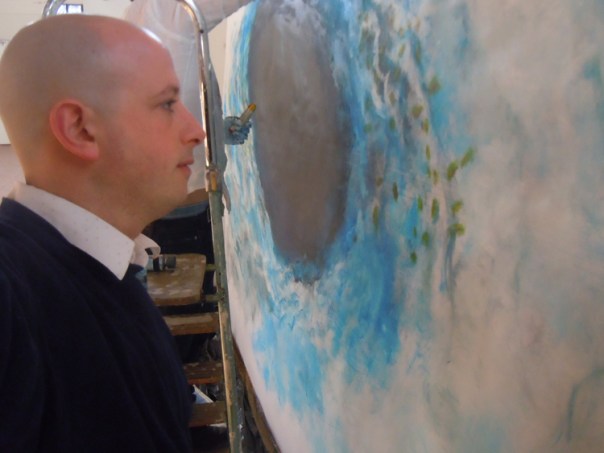


VERYSMALLKITCHEN: What is the absence this writing gives shape to? Looking at the texts you sent me, writing constructs this absence whilst also providing commentary, evidence, naturalistic detail, anecdote…


OHAD: Perhaps the absence you correctly describe is an absence of this diaristic voice…


VERYSMALLKITCHEN: I’m thinking how Maurice Blanchot begins his discussion on Recourse to the “Journal” in “The Essential Solitude”:


It is perhaps striking that from the moment the work becomes the search for art, from the moment it becomes literature, the writer increasingly feels the need to maintain a relation to himself. His feeling is one of extreme repugnance at losing his grasp upon himself in the interests of that neutral force, formless and bereft of any destiny, which is behind everything that gets written. This repugnance, or apprehension, is revealed by the concern, characteristics of so many authors, to compose what they call their “journal.” Such a preoccupation is far removed from the complacent attitudes usually described as Romantic. The journal is not essentially confessional; it is not one’s own story. It is a memorial. What must the writer remember? Himself: who he is when he isn’t writing, when he lives daily life, when he is alive and true, not dying and bereft of truth. But the tool he uses in order to recollect himself is, strangely, the very element of forgetfulness: writing.  That is why, however, the truth of the journal lies not in the interesting, literary remarks to be found there, but in the insignificant details which attach it to daily reality. The journal represents the series of reference points which a writer establishes in order to keep track of himself when he begins to suspect the dangerous metamorphosis to which he is exposed.  (The Space of Literature, 29)


OHAD: In the performance together with Veniamin Kazechenko, we mainly had an internal dialogue between ourselves and to a small extent between us and the audience. Yet it felt predominantly different than the kind of monologue I’m used to.

Still, as you suggest, the performance does fill in an absence of a sort. Yet I’m not sure it is in direct relation to the text. Or maybe, the diary could be thought of as an account between a 1st and 3rd person, in comparison to the performance which was more of an account between a 1st and 2nd person.


VERYSMALLKITCHEN: You also offer a narrative of an artist’s life. I recently read YEAR from Komplot in Brussels, which in its contents and design consciously constructs a narrative of a contemporary artist’s lifestyle and personality as part of its presentation of the work…


OHAD: The narrative of an artist’s life is something that indeed interests me in the last few years. I’m aware of the Bildungsroman and the Künstlerroman genres which are two forms that interest me, yet I’m still puzzled as regards to what kind of coming of age my texts could be referring to or point at.

There is a point in the diary text from Paris where I’m writing about me being 33 years old sitting in a youth hostel of 18 year olds’ fighting for a second round of free coffee. I mean, this kind of coming of age never seems to come. Maybe it is an account of these days in which adulthood is postponed to an indefinite future.


VERYSMALLKITCHEN:  In the first part of this post you work with/ from the narratives-become-myths of Van Gogh –


OHAD: To be honest I’m still trying to discover what part of this myth enchants me the most. It probably has something to do with the discrepancy between the artist’s own subjective perception of reality and the public personification and portrayal of the artist by society/culture.

I’m also interested in a kind of testimonial level or witness experience coming from the artist usually in contradiction to the accounts of the artist by society. What I mean to say is that I trust artists more in their historical accounts. Something in the figure of the artist lends itself to a kind of historical validity or accountability which perhaps the myth of the artist tries to de or re-construct.


VERYSMALLKITCHEN: My initial thought for how to publish this post was the Van Gogh piece, then the diary beginning 21.2.12 and ending with 23.2.12 “It’s 6:25 in the morning”…. maybe starting with 19.2.12 but also maybe good in the blog post itself to keep a focus around the performance? The whole diary could be available as a PDF.


OHAD: I’m quite puzzled as how to deal with it. For me usually the diary texts are in a way a kind of round artistic gesture in the sense that I start writing at a specific time (and place) and I end in a specific time (and place – on location in front of an audience).

In that sense it is a performative kind of writing. It’s hard for me to carve out pieces from it. Yet I’m aware it’s quite long for a blog post. So I leave it up to you to decide how to handle it. Maybe have 2 posts (part a / part b?). And I have this nice piece of text from Gertrude Stein which i read on the train today:


Once upon a time I met myself and ran.
Once upon a time nobody saw how I ran.
Once upon a time something can
Once upon a time nobody sees
But I I do as I please
Run around the world just as I please.
I Willie.


(Gertrude Stein, Willie and his singing, From The world is round.)


OHAD: I love the first sentence! Once upon a time I met myself and ran – beautiful!


*


More about Ohad’s work is here. See also post one, post two, post three and post four.
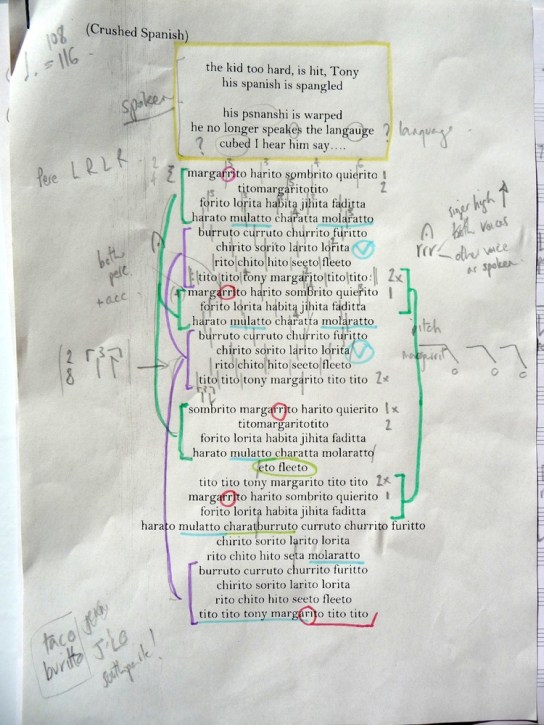


SOB BASIC WIRTTEN WITH A WOODEN LAPTOP: TYPEWRITER AS ART PRACTICE

In Uncategorized on February 25, 2012 at 9:40 am

Steve McCaffery, panel from Carnival (1967-75)


This weekend David Berridge and Rachel Lois Clapham present DocU, a twenty four hour typing performance as part of inXclusion at East Side Arts Patrick Studios in Leeds.

In preparation for and as an accompaniment to this event, the following is a gathering of ideas and sources on the use of the typewriter in both historical and contemporary art and writing practices.


Image: Marianne Holm Hansen

Image: Marianne Holm Hansen


Such notes function as a personal set of annotations to historical gatherings such as Peter Finch’s 1972 anthology Typewriter Poems, in the introduction to which Finch asserts:


in some poetry there is rhythm, and there is rhyme, there is a metrical structure within which the poet expounds his ideas, spends his words. its hard work. in typewriter poetry there is no rhythm and there is no rhyme, but there is a metrical structure. the space bar, the ratcheted roller, the keys themselves. within those limits the poet explodes his ideas, burns his words. its not easy either. some poets are more structurally minded than others – they add and adapt the basic meter. coloured ribbons, masks, different pressures, overlaps. (5)
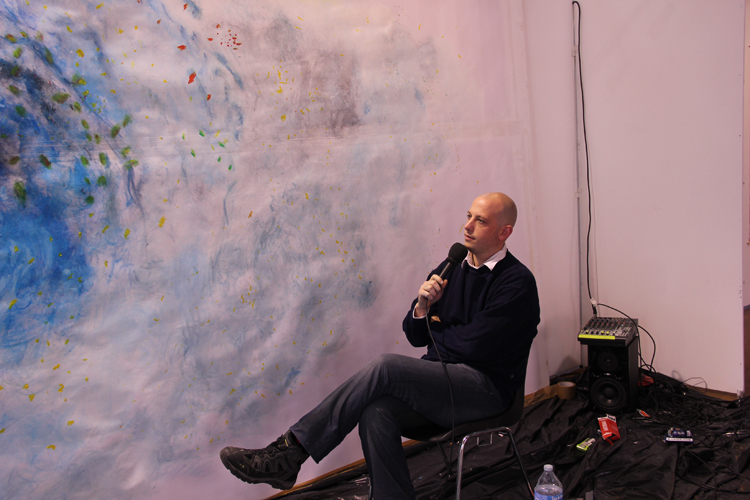
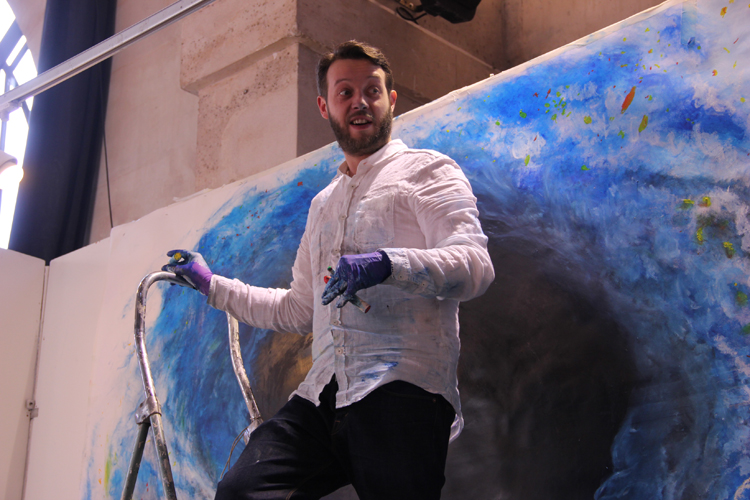


and scholarly studies of the field, inparticular Darrel Wershler- Henry’s The Iron Whim: A Fragmented History of Typewriting (McClelland & Stewart, 2005, Cornell UP, 2007) which begins:


Typewriting is dead, but its ghosts still haunt us. Even in our image-saturated culture, the iconic value of the typewriter looms large. Artfully grainy, sepia-toned, close-up photos of its quaint circular keys grace the covers of tastefully matte-laminated paperbacks, announcing yet another volume extolling the virtues of the writing life. In magazine and billboard ads, magnified blotchy serifed fonts mimic the look of text typed on letters that sit crookedly above or below the line with paradoxical consistency. On radio and TV, the rapid clatter of type bars hitting paper signals the beginning of news broadcasts. We all know what this sound means: important information will soon be conveyed. Typewriters may have been consigned to the dustbin of history, but their ghosts are everywhere.

What’s remarkable is not that typewriting continues to haunt us, but that typewriting itself was always haunted. (2)


Another starting point would be Michael Winslow’s The History of the Typewriter, included in Christian Bok’s VJ reel for Information as Materials Sounds Like This event at the Whitehapel Gallery last weekend, where it was projected on the multiple, mirroring screens of Josiah McElheney’s  The Past Was A Mirage I Had Left Far Behind:


http://www.youtube.com/watch?v=eVzEB_CJLNY


18/02/11 On skype I ask RL what purpose a gathering of resources like this could serve in relation to the actual performance in Leeds.

RL: It gets that narrative out of the way as a form of research – retro aesthetics. On the day we enact it….  A distinct piece of web forethought… being excited about typewriters… afterwards the focus will be on writing, the product, how we were in the event…


MARY YACOOB writes: The book is called: “10 Ways X”, laserjet print A5 artist book, 2012. I typed the letter X on manual typewriter during the What is an Art Book event organised by the Modern Language Experiment at the Mews Project Space in Whitechapel in Autumn 2011.


I was surprised to see that the top half of the X was printed black and the bottom half was printed black, perhaps because the ribbons crossed.

So I scanned and enlarged the letter X and set out finding a method by which to map the location and tone of the reds and blacks, using geographical and spatial metaphors and scientific visual languages to observe, quantify, measure, classify, and notate.

My first drawing was in black and white and was included in the compendium of typewritten drawings and texts by about 50 artists in the What is an Art Book publication by Modern Language Experiment. A couple of weeks later I started a new artist book in response to the call out by Bookartbookshop on the theme of “X = Or What is to be done?”.

This artist book used the black and white drawing I’d already made as a book cover, and I made a further 10 colour drawings of 10 different methods by which to map the red and black colours and tones of the typewritten letter.


DB: Good morning typewriter. I’m trying to think how our relationship can not be primarily nostalgic.


NOTE: This notion of personally addressing your typewriter is adapted from a quotation by Hannah Weiner, that both RL and DB copy out to send to the other, finding it (again) in Thom Donovan’s article in Jacket2 on “intense autobiography.” Weiner observes:


I bought a new typewriter in January 74 and said quite clearly, perhaps aloud, to the words ( I talked to them as if they were separate from me, as indeed the part of my mind they come from is not known to me) I have this new typewriter and can only type lowercase, capitals, or underlines (somehow I forgot, ignored or couldn’t cope with in the speed I was seeing things, a fourth voice, underlined capitals)  so you will have to settle yourselves into three different prints. Thereafter I typed the large printed words I saw in CAPITALS, the words that appeared on the typewriter or the paper I was typing on in underlines (italics) and wrote the part of the journal that was unseen, my own words, in regular upper and lower case.


SOURCE: Hannah Weiner’s Open House, ed. Patrick F. Durgin, Kenning Editions, 2007)


From the beginning of Charles Olson’s Projective Verse the typewriter is integral as instrument and paradigm: a poetry based upon “the kinetics of the thing”; poem as “energy discharge” and “If I hammer, if I recall in, and keep calling in, the breath…” It is two thirds of the way through before the connection is made explicit:


The irony is, from the machine has come one gain not yet sufficiently observed or used, but which leads directly on toward projective verse and its consequences. It is the advantage of the typewriter that, due to its rigidity and its space precisions, it can, for a poet, indicate exactly the breath, the pauses ,the suspensions even of syllables, the juxtapositions even of parts of phrases, which he intends. For the first time the poet has the stave and bar a musician has had. For the first time he can, without the convention of rime and meter, record the listening he has done to his own speech and by that one indicate how he would want any reader, silently or otherwise, to voice his work.

It is time we picked the fruits of the experiments of Cummings, Pound, Williams, each of whom has, after his way, already used the machine as a scoring to his composing, as a script to its vocalization. It is now only a matter of the recognition of the conventions of composition by field for us to bring into being an open verse as formal as the closed, with all its traditional advantages. (245)


Olson goes on to suggest some beginning components of this typewriter-grammar:


If a contemporary poet leaves a space as long as the phrase before it, he means that space to be held, by the breath, an equal length of time. If he suspends a word or syllable at the end of a line (this was most Cummings’ addition) he means that time to pass that it takes the eye – that hair of time suspended – to pick up the next line. If he wishes a pause so light that it hardly separates the words, yet does not want a comma – which is an interruption of the meaning rather than the sounding of the line – follow him when he uses a symbol the typewriter has ready to hand:

What does not change/ is the will to change

Observe him, when he takes advantage of the machine’s multiple margins, to juxtapose:

Sd he:
  to dream takes no effort
     to think is easy
        to act is more difficult
     but for a man to act after he has taken thought, this!
is the most difficult thing of all

Each of these lines is a progressing of both the meaning and the breathing forward, and then a backing up, without a progress of any kind of movement outside the unit of time local to the idea. (246)


As Olson concludes:


But what I want to emphasize here, by the emphasis on the typewriter as the personal and instantaneous recorder of the poet’s work, is the already projective nature of verse as the sons of Pound and Williams are practicing it. Already they are composing as though verse was to have the reading its writing involved, as though not the eye but the ear was to be its measurer, as though the intervals of its composition could be so carefully put down as to be precisely the intervals of its registration. For the ear, which once had the burden of memory to quicken it (rime & regular cadence were its aids and have merely lived on in print after the oral necessities were ended) can now again, that the poet has his means, be the threshold of projective verse. (246)


SOURCE: Donald Allen and Benjamin Friedlander eds. Collected Prose, Charles Olson (University of California Press, 1997).


RL: The sound is key (of the keys).


 I come across typewriters, seemingly ready for use, after climbing the stairs to the Sylvia Beach library at Shakespeare and Company in Paris.


Janice Kerbel, Underwood (2004)


Some choreography: The writer sat at the typewriter. Pages pulled out of the machine, screwed up and thrown into the bin. We should have bins, RL and DB agree on skype, although as resources to be rummaged in for language when needed rather than trash awaiting collection and removal.

Perhaps, suggests RL, our bins  could be at the other end of the table, on opposite sides, because throwing things into/ at the bin is an important part of this particular routine.

I like this idea, imagining how each of us types amongst a diagonal airborn flurry of the other’s rubbish…


off from Weiner and Olson into  histories/ practices of poetry: Jack Kerouac (in Capote’s quote) not writing but typing; the centred on the page poems of Michael McClure, which required a practice of counting spaces and letters (the courier font’s democracy of the equal letter size).

Larry Eigner: “with only my right index finger to type with I never could write very fast – to say what I want to when I think of it, before I forget it or how to say it… I typed fast enough back when to be familiar enough with the keyboard to work in the dark or dusk with one finger…” (149)

Cid Corman describes Eigner’s method as he encountered it as an editor and also suggests how it connects to a particular mode of attention and ways of understand the perception- body- typewriter connection:


Larry generally seems to work off his typewriter on a single sheet of paper, sometimes on both sides, sometimes in margins, crowding more than one poem on a page, or more unusually on larger outsize sheets (devised or somehow come by), if my recall is accurate. (Most of his manuscripts have, often in carbons, come my way through the years and yet.)

The random quality is often due to the brevity of the poet’s attentions, acute and wandering. Finding every distraction a focal point and the alert mind mingling ideas, facts, as wires, hinges, bolts, and sometimes just flashes. Glimpses and glances, queer connections of the most familiar.” (146)


SOURCE: Larry Eigner, areas lights heights: writings 1954-1989 (Roof Books, 1989); Cid Corman, At Their Word: Essays on the Arts of Language Volume II (Black Sparrow Press, 1978).


Then coming through to the concrete – the typewriter as mode of composition, the cosmic typewriter of Dom Sylvester Houédard


…. the visual wonders of Steve McCaffery’s multi-panel Carnival….


… through Nancy Spero’s Artaud Codex, its use of the bulletin typewriter, presenting Artaud’s words whilst mediating and attempting to inhabit his act of writing….  ideas of channeling I talk about with RL on skype as possible score for our DocU…. then ‘typings’ of Christopher Knowles:


Christopher Knowles untitled (Top 14 of 1978) c. mid 1970s typing on paper 11 x 8 1/2


DB: If you are about on the sixth let’s meet in TYPE this boutique in Bethnal Green, where the shop sign is two suspended typewriter’s and the whole brand aesthetic is unfolded from the typewriter…

Have you seen scree? A magazine from Edinburgh, whose form copies the typewritten format of Poor. Old. Tired. Horse. and other sixties mags, although I guess they might have made this on indesign… what does it mean to so fully recreate an aesthetic as a means of presenting new, experimental work? Perhaps it provides a container that offers a certain set of values and assumptions about poetry, its importance and legacy…


Christopher Knowles
: Ohne Titel (42 Relationships) 
c. 1983 


On skype, I ask RL about her own relationship to the typewriter. As she speaks, I attempt to transcribe what she says:


the manualness of it
as a how to its sob  basic is like a-z of writing tutorial level
theres nothing more to it than pressing
]tghe gesture of punching the ket being osmehow gutteral on a writing level
you don’t need any more knowledge forethought afterhought
base level action
the groundedness of it
]thrinking back to cop15 the limitations of it being on ditital
wirtten with a wooden laptop
i really feel like that sppedd miught euseful in this day and age
its a constraint strips away networking the battery life
a typewriter uis somehow much more infinite durable than a computer
a toral object status much more than a website or a computers hard drive
theres an honest to it
a smallness of it a limiting is a productive excericise
a false natural
no more natural on a typewriter than a computer
used to work at that speed with eidting spell chcekc
strip awya focus on marks physical gestures sound

ttyoewrites says hall o i am writng it is happening now
the sound in the wee hours of the morning ressonate arounde the space
like an audio recording of us typing miught be interesting moment.

some kind of stocatto and brail]


Gregory Bateson and Margaret Mead, Iatmul, 1961


RL: Maybe there is no getting away from hunching over a desk ..!


JAMES CLIFFORD: A short essay could be written about typewriters in the field. When Jean Briggs (1970) is ostracized by her Utku Eskimo hosts, she finds solace in her typewriter. Geertz represents the ethical ambiguities of fieldwork through a struggle over a typewriter with a Javanese informant (1968). Colin Turnbull reveals somewhere in The Forest People (1961) that he has the machine with him (forcing us to reimagine his Mbuti villages, adding to the calm suffusion of forest sounds the tap-tap of fieldnotes in the making)… Mead and Bateson in the Iatmul “mosquito room,” facing each other from behind separate typewriters. (63)


Clifford’s examples highlight the situations/ scenes within which the typewriter is present: as physical object, soundscape, symbol, prop, currency.

He goes on to explore the kinds of writing activities and actual text such a machine produces and symbolically represents:


This moment of initial ordering, the making of a neat record (whether in type or script), must be a crucial one in the fieldwork process. “Good data” must be materially produced: they become a distanced, quasi-methodical corpus, something to be accumulated, jealously preserved, duplicated, sent to an academic advisor, cross-referenced, selectively forgotten or manipulated later on. A precious, precarious feeling of control over the social activities of inscription and transcription can result from creating an orderly text. The writing is far from simply a matter of mechanical recording: the “facts” are selected, focused, initially interpreted, cleaned up.

Most writing is sedentary activity. Unlike storytelling, it cannot be done while walking along a path. The turn to the typewriter involves a physical change of state, a break from the multisensory, multifocal perceptions and encounters of participant-observation. Writing of this sort is not “situated” like discourse or an oral story, which includes- or marks in the performance – the time/ space of the present moment and audience. Rather, the present moment is held at bay so as to create a recontextualized, portable account. In crucial respects this sort of writing is more than inscription, more than the recording of a perception or datum of “evidence.” A systematic reordering goes on. Fieldnotes are written in a form that will make sense elsewhere, later on. Some may even, like the notes included in The Religion of Java, pass directly into a published book. Turning to typewriter or notebook, one writes for occasions distant from the field, for oneself years later, for an imagined professional readership, for a teacher, for some complex figure identified with the ultimate destination of the research. Facing the typewriter each night means engaging these “others” or alter egos. No wonder the typewriter or the pen or the notebook can sometimes take on a fetishistic aura.”  (63-4)


SOURCE: James Clifford, “Notes on (Field)notes” in Roger Sanjek ed. Fieldnotes: The Makings of Anthropology (Cornell University Press, 1990).


….


The Bateson and Mead photograph feeds into aspects of our own performance. Two typewriters, two bins, two writers, an act offering a strange mirroring (writers of each other/ writers and event). RL suggests we consider Rodney Graham’s Rhinemetall/ Victoria 8 (2003).


Rodney Graham’s Rhinemetall/ Victoria 8 (2003)


As Julian Heynen observes in his essay on Graham entitled “A Kind of Author”:


Two objects – that is, two machines – confront each other in all their technical detail, and the action appears to play itself out without the intrusion of any human or psychological element. A freestanding 35mm projector projects a film whose sole protagonist is a mechanical typewriter. The various parts of this archaic but elegant machine are presented in a series of slowly changing shots. Its design, like the film’s highly disciplined camera work, is reminiscent of the descriptive matter-of-factness of the nineteen twenties aesthetic of Neue Sachlichkeit (New Objectivity). The metal plate displaying its brand name, Rheinmetall, also alludes to this – and we might mention here in passing that this firm was and is well-known for producing armaments, while the name conjures associations with the much fought-over sunken treasure of Wagner’s opera Das Rheingold (The Rhinegold). In the course of the ten minute film, a fine, snow-like substance falls softly and slowly onto the machine, so that by the end it is almost completely covered. The technical apparatus mutates into a kind of winter landscape. All that can be heard is the mechanical noise of the projector. The typewriter’s streamlined efficiency and its poetic transformation are subverted, if not altogether upstaged, by the sound of the very device that is responsible for bringing them to light, making them visible, and awakening them to life: the projector… Two generators – one of images, the other of text – stand face to face, each the distorted image of the other. (16)

The confrontation of the projector with the typewriter casts onto the wall the emblematic image of the twentieth-century writer, a successor to the quill pen of earlier times, and a mechanical instrument that stands both for literature’s turn to the realities of modern life and for the integration of writing into industrial production. With an equally documentary enthusiasm, the camera records in all its clarity and precision the individual parts of this typewriter, which seem to guarantee the quality of the texts that will be produced by them. Then something else starts falling onto this creative apparatus, at first almost mesmerizingly, but soon completely covering it, indeed burying it so that it becomes unusable. While at the beginning we had the infinite possibilities of text, discourse and criticism, we are left at the end with a beautiful and somewhat mysterious image. A vision of utter stasis is now contrasted with the image machine that continues to operate unceasingly – until the film loop plays the narrative of the two machines’ changing fortunes from the beginning again. (18-19)

 
SOURCE: Julian Heynen, “A Kind of Author”  in Rodney Graham: Through the Forest (Hatje Cantz Verlag, 2010).


RL tweets: Remmington Envoy 111 is slightly more lady-sized. I might use this one and give the Silver Reed 500 to @verysmallkitch @inXclusion


DB: Tamarin Norwood did a performance at the David Roberts Foundation ( Etienne Chambaud VII ‘The Copyist embodied by Tamarin Norwood‘, 2010) where she notated what happened in the gallery. Live writing became surveillance, where someone’s action would be followed a moment later by the sound of her typewriter notating the activity.

I remember Tamarin saying she suspected the gallery receptionist began trying to do things that were not visible – the lack of a following typing sound indicated that the action had been undetected.

Also, M told me she used to put toilet paper in the typewriter and pound away when in a rage. The next day ubuweb was tweeting about this object on ebay which was Moby Dick typed out on toilet paper.


DB: This is the first page of J.G.Ballard’s typed manuscript for CRASH…


RL: pic comes out quite low res, but the handwritten annotations are enough for me to know for sure that no typewriter works at the same pace as a brain, or a thought, or a mind, or a hand.

Maybe using one forces your hand on this level – forces a slowing down, to ponder more, type less?

There is just something so MANUAL about the endeavour that brings it all down to basic elements, or the ground (or slowness, equally speed, is a myth). Typewriters and brains have actually been at the same speed all along.


CARL ANDRE: The grid system for the poems comes from the fact that I was using a mechanical typewriter to write the poems, and as you know a mechanical typewriter has even letter spacing, as opposed to print which has justified lines with unequal letter spacing. A mechanical typewriter is essentially a grid and you cannot evade that. And so it really came from the typewriter that I used the grid rather than from the grid to the typewriter. (212)

I have used the typewriter as a machine or lathe or saw, to apply letters on the page. I really do feel very tactile using a typewriter. I never learnt to use a typewriter automatically. I still only type with one finger but that made each operation of typing a very machine-like act. It was like actually embossing or applying physical impressions on to a page, almost as if I had a chisel and was making a cut or a dye and making a mark on metal. (212)


SOURCE: Carl Andre, Cuts: Texts 1959-2004 (MIT Press, Cambridge, 2005).


Carl Andre, Yuca 68. 1972. Xeroxed typewritten text.


DB: Pavel Büchler speaking at Camden Arts centre tonight (08/02/12) about/around the Hanne Darboven show: typewriters in Eastern Europe in the 1970s were a very common thing, but they made you nervous. There were conspiracy theories/ urban legends (maybe true) that the secret service had vast piles of typewriters.

A relative of Büchler’s was imprisoned “for many years” after taking carbon copy paper from work, he said, because no one could think of a non-accusatory reason why someone would do this.

Büchler talked about how he had first encountered Darboven’s work in Prague in the 1970’s where it was valued for its non-aesthetic qualities amongst a group of artists for whom a sheet of paper was a more available form than gallery walls. It was odd, he said, to find himself so taken in 2012 with the aesthetics of these works, both of individual pages/ acts of writing  and the overall gallery installation.


Hanne Darboven, "Sunrise/ Sunset" 1984


I wonder if, as a way of negotiating the retro- and aesthetic, there is a way of using the typewriter that equates to Darboven’s own descriptions of writing:
 

still each time I have to write, it becomes so calm and so normal. There is no story there, nothing to figure out, not a secret, but still exciting. I feel myself not thinking what other people think, but what I think. I write for myself, there is no other way. This is for me. Going on is the enormous thing I do.  (191)


and when (1968) Darboven starts working directly from the calender she observes:
 

not knowing any more of days, time; just take every day’s mathematical index, a great invention, fiction. No inquiry, no exploration, just to search into something between everything for a time while time is going on… Nothing to write, nothing to read, nothing to say; something to do, contemplation, action. (193)


SOURCE: Lucy Lippard, From the Center: Feminist Essays on Women’s Art ( E.P.Dutton & Co., 1976).


MARIANNE HOLM HANSEN: Now we write in different ways so using the typewriter it becomes something else. We pick it up because a particular reason. My reason is it’s a very physical way of working, of constructing writing or words. I only make words or very short sentences.

It made a lot of sense in response to the lists [in For the Record] to type each word. I’m interested in how things change over time. Putting them in alphabetical order you lost that. Each came from a particular situation, so I thought of returning the words to space, individually spacing them out again, asking the question: could you reimagine the situation from which these words have arisen? I don’t think that worked. It becomes contrived.

Something else came out of one word in a page. It becomes something else. It’s the undo function. There’s no undo. If you do it on the typewriter the trace will always be there of what you did before. If you change your mind you have to start again. On a computer you don’t.  On  a computer thought more about layout and font beforehand.  On a typewriter you have to type it out.

I  played around with spacing, put in hyphens: hopeless i made hope-less.  It gives you time, being limited in what you can write – the font is set. So I play with the spacing of the words, where it sits on the page. It makes you think about the word itself and the meaning and potential meanings of the word….


Read the full VerySmallKitchen post  TYPE TYING TYPINGS TYPIST TYBE: MARIANNE HOLM HANSEN TALKS ARTIST AND TYPEWRITER.


DB: Which brings me, in conclusion, to something else from Pavel Büchler talk, about time and labor. Büchler connected Darboven’s endeavors to a sense of work time and leisure time, a sense of signing on and off at the beginning and end of a work shift.


Sue Tompkins, "Fruit Works"


He contrasted this to Roman Opalka, who he said, in his cynical opinion, had wasted in his life in an obsessive painting of numbers towards infinity. Büchler’s art-labor spectrum was further extended to include On Kawara, understood here as the full time gambler undertaking art projects that require little or no labor (paint the date/ send telegram saying I AM STILL ALIVE).

This reminds me of a recent article in The New Yorker on the popularity in China of work place novels, with titles like Du Lala’s Promotion Diary and Su Changchang’s Struggle to Get a Raise Diary. As we prepare for these 24 hours typing, RL, I’ve been thinking about what makes a project healthily or destuctively obsessive, how to make the distinction…


RL: A writer being in the event/A writer occupation/A writer as channel/conduit/contingency/A writing machine as channel/conduit/contingency/PERFORMANCE(s) and writing as exclusionary or as exclusive. Reaching or coming from the typewriter.


*


DocU- by David Berridge and Rachel Lois Clapham takes place at inXClusion, East Street Arts, Patrick Studios, St. Mary’s Lane, Leeds, LS9 7EH, 25-26 February 2012, 6pm-6pm.