verysmallkitchen

Posts Tagged ‘art writing’

DEPARTMENT OF MICRO-POETICS: KAI FIERLE-HEDRICK AND RACHEL ZOLF EXCHANGE VALUE #2

In Uncategorized on September 29, 2010 at 10:31 am

Kai Fierle-Hedrick

Exchange Value #2; 24 September 2010                                                                                                                                                                                                                                                                                                             

[…] You see me there […]

[…] It’s that abstract […]

+ Rachel Zolf, ‘Poem 35 – Learning machines’                                                                                                                                                                                                                                                                                                  

I say […] and we assess our difference:

stiffen with divisions and the prompt

to concede the stereotype: now we are ticks

and ticks of boxes: now not: we are awkward

humor turned currency: ransom: or code

for the labels we shy: in this classroom

owning each projection troubles it.

It(‘)s ease. It(‘)s lack of exchange.

The Department of Micro-Poetics, AC Institute, New York, 2010. Sara Jordeno with Jill Magi in residence


Rachel Zolf

The projection of the intimate into the historical 
(for Exchange Value)                                                                                                                                                                                                                                                                                                                         

The day lives us and we it remain at home

Pilfered rhetorics track an economy of one thing after another

I send you the burnt rulebook, who baked that challah?

The Time, Manner and Place of Speech Activities and Expression Speech activities

This list of dominant frames refined by a chimpanzee tossing darts

I revisited each story featuring the divined Violence Frame

A Place Altered by Moods, Greek residues of hard and soft

Perhaps all three are chairs, or codes for one


Doesn’t logic depend on tact animated at birth?

When a person stumbles, sings in cracking high tones, makes nervous gestures, etc.,
everyone knew this is a Jew Gay Gene Mull Court-shy Borders Kitch Scribbler

I’m not sure that the text is as rich in thematic content as what Karen generated

There are broader problems of unspeakable bodies and of “interest”

The subject escapes its alienation through a term of 25,000 colors

The table a procedure of knowledge dying to pronounce its name

Jay MillAr is glad someone paid the ransom

Thank you to everybody that submitted ticks and tsetse flies

Can somebody please put the necessary code between my code?

There are no kids in class, they’ve all gone to tolerance camp, apparently


ABOUT THIS PROJECT

The above work by Kai Fierle-Hedrick and Rachel Zolf  was the outcome of their residency in the DEPARTMENT OF MICRO POETICS at the AC Institute, New York City on September 24th 2010.  Kai and Rachel describe the project as follows:

Rachel Zolf and Kai Fierle-Hedrick will collaborate – via an on-site/off-site residency at the AC Institute – to write a sequence of poems responding to the exhibition EXCHANGE VALUE. Fierle-Hedrick will write on-site at the gallery, and at the end of each session will forward an ekphrastic poem to Zolf. 

Responding via The Tolerance Project – a collaborative MFA in Creative Writing rooted in an online archive of “poetic DNA” traces donated by 86 writers, artists and thinkers – Zolf will identify a set of search terms in Fierle-Hedrick’s poem and use these to generate a new response from within The Tolerance Project’s archive. 

Zolf’s poetic permutation will then serve as the starting point for Fierle-Hedrick’s next session in the gallery, and so on. The residency explores a variety of exchanges – ekphrastic, dialogic, technological – in addition to embodying some of the challenges and creative loopholes of distance collaboration.

The residency concludes on October 1st 2010.

WRITING/ EXHIBITION/ PUBLICATION at THE PIGEON WING: CLOSING EVENTS ON OCT 3rd

In Uncategorized on September 28, 2010 at 12:10 am


Press Free Press, A Time for Work


WRITING/ EXHIBITION/ PUBLICATION and THE FESTIVAL OF NEARLY INVISIBLE PUBLISHING concludes on October 3rd with a day of public residencies, performances, installations, and a closing meal.

From 2pm artists working and performing in the space include:

Matt Dalby, who will use voice, recordings and objects to create semi-improvised sound poetry in response to the exhibition and The Pigeon Wing space.

Karen Di Franco, whose CONCRETE RADIO: SCORE FOR ONE & TWO offers “intercedence/interference using short wave recordings with two radios and two transmitters.”

Karen Di Franco, Concrete Radio, 2010


+ from 2-5pm Rachel Lois Clapham in collaboration with Antje Hildebrandt present READERS WANTED:

READERS WANTED to share an intimate (w)reading performance for two. This is a little game, a small exercise in trust and a live cursive encounter. You can decide how long it might take. Two minutes is good though. Bring a + 1 with you if you like.

Please come. I’ll be waiting.

A score for READERS WANTED

Nb. I am waiting for you
You set off on from your home
Nb. I am waiting for you
You arrive
Nb. I am waiting for you
You find me
Nb. I am waiting for you
You take your shoes off and come inside
Nb. I am no longer waiting
We blindfold one another
I whisper to you
We might touch
We (w)read together
Then we look at what we have made
You leave me
You return home
Nb. I am still waiting for you

Rachel Lois Clapham, Readers Wanted, Colliers Wood, 2010


Artists concluding month long projects over the weekend include Pippa Koszerek’s INOPERATIVE MINUTES, whose documentation of the exhibition in shorthand will conclude with the publication of The Pigeon Wing glossary.

Marianne Holm Hansen will spend the weekend unfolding her installation FOR THE RECORD (A WRITTEN CONVERSATION) in response to the month’s events.

Tamarin Norwood, text performed at The Pigeon Wing, Sep 3rd 2010


At 6pm there will be a NEARLY INVISIBLE MEAL, prepared by Magda Fabiancyk, followed by a programme of readings and performances. Julia Calver, Helen Kaplinsky/ Hammam Aldouri, Tamarin Norwood, and Press Free Press will conclude month long writing projects, alongside performances by Matt Dalby and James Davies.

As Tamarin writes of her own project:

This month Tamarin Norwood has been trying not to write things away. It hasn’t worked. Her writing has persistently generated words, not things.

At the close of WRITING/ EXHIBITION/ PUBLICATION Tamarin will discuss the impossibility of a written form that might leave its object unwritten, considering a spectrum of practices from observing, swallowing and drawing to self-apparent, self-effacing and obliterated writing.

FESTIVAL OF NEARLY INVISIBLE PUBLISHING: NEW E-BOOK BY NYEEMA MORGAN

In Uncategorized on September 25, 2010 at 9:34 am

LIKE IT IS: PRELUDE by Nyeema Morgan is the first e-book of the FESTIVAL OF NEARLY INVISIBLE PUBLISHING. A festival in itself, a document, a proposal, of something that has happened, will happen and won’t.

Of necessity the book form offers a coherent sequence, a momentary sense of order, but only to enable the diverse wholes that LIKE IT IS: PRELUDE proposes.

LIKE IT IS: PRELUDE is available for online consumption and PDF download  here .

LIKE IT IS:PRELUDE should also not be seen as the work itself. If there is such a work, it is to be found in the endless rearrangements that adobe and a hard copy might facilitate. A puzzle, then, but one in which the precise nature of the solution is up for grabs. 

A work, too, to encounter in unknown ways – which is difficult for a book with its name and title. 

As Nyeema writes, of previous incarnations of LIKE IT IS:PRELUDE : 

It is a digitally modified xerox of a text excerpt. The work itself, existing and having been manipulated within the computer, has no form. When exhibited, the work exists as ephemera, given form particular to the exhibition context.

In one instance LIKE IT IS: PRELUDE  was printed, framed and sat atop a night table left in the domestic space (similar to how someone might display a personal snapshot).

In another exhibition, it exists as a prelude to the work being shown in the form of the printed invitation, both mailed to the attendees and available in the space upon entrance.

For  THE FESTIVAL OF NEARLY INVISIBLE PUBLISHING this  e-book  is instruction, ingredient, proposition, record, making and deleting sense.  It is the work and not, with its materialities of types and ink and page that are not actually there. A delicate textual operation, but within modes of mass production and mass dissemination. Please disseminate.


WRITING/ EXHIBITION/ PUBLICATION: JULIA CALVER SUNBEAM and FOREST

In Uncategorized on September 23, 2010 at 7:31 pm


(1) 

Indistinct objects.     He remembered the object of a gun and a loose eye. Wet leaves pasted together like sticky inner pockets soaked in blood.      As the sun rose over the trees it deposited little fragmented fossils: white, gritty, and with an abrasive surface, they grated against shale and looked like part of a pelvis or a shoulder. The sun made its excavation and pieced together some bones that might stay together in plan view. They contacted other things – loose change – with the sound of coins sliding over a shale of coins, coins – these ancient things – encased in flannel.      He was lying low in the mud with a feeling of something boozy swilling in him. The sun turned light over the coins and over his bones.      His mind grated and slipped on all the proximal matter. He made careful arrangements of the unobserved leaves with his eyes tightly closed against the red of the new sun. He ordered the nearby pebbles according to the strange subject of their familiarity.      Some small crescents filled with earth pressed somewhere out in the fields of his sensations. His head was lodged somewhere down below his face and his eyelids, so compressed, made no indented line on anything.       

The funny thing was that things became blacker at dawn and his own lucid appellative SUNBEAM slipped away from his consciousness and gave itself over to the wateriness of the real sun.  The name of the ‘real’ sun vanished. There was a treachery of the dark things and  FOREST was stilled – in fact, their dialogue, which had roamed half the night, rounding on the small scratching sounds of nocturnal things,  had lulled itself into silence. So that there was now only the exclamation of this hanging sound.

!


——————————————————————————

(2)


                   What—

                                               is —


                                                                                     an—


                                                                                                               intell—

                                                                                                                            ect—

                                                                                                                                       ual———


                                                freedom?———


                                                                               Is—

                                                                                  that—

                                                                                        an—


                                                                                                                            owl


                                                                                                                            pellet


                                                                                                                                     ?


____________


The above texts were produced as part of  SUNBEAM and FOREST, a month long residency by Julia Calver at WRITING/ EXHIBITION/ PUBLICATION. Julia has described the project as follows:

SUNBEAM and FOREST exist inside an interminable argument which takes place at the level of the forest floor. They argue over who forms the ultimate frame for their ongoing dialogue. This work switches on and off through various iterations as SUNBEAM slips into periods of silence and then ‘reawakens’ in new ideas. Performances throughout the exhibition; texts in the space to take away.

NOTES: (1) was first performed at The Pigeon Wing for the opening of WRITING/ EXHIBITION/ PUBLICATION on September 3rd 2010; (2) was performed alongside an evening of films by Matthew MacKisack at The Pigeon Wing on September 17th 2010. The final part of the project will be performed at the closing event on 3rd October. 

BIO Julia Calver is a member of antepress and recently completed the MFA in Art Writing at Goldsmiths. Recent work includes a performative reading as part of Work in Progress; Art on the Underground and FormContent residencies; and Digestives, an ongoing Resonance FM art writing radio series.

NEW EXHIBITION AND PUBLICATION: A_IMPOSSIBLE READER and SPILL: ON AGENCY

In Uncategorized on September 22, 2010 at 9:19 am

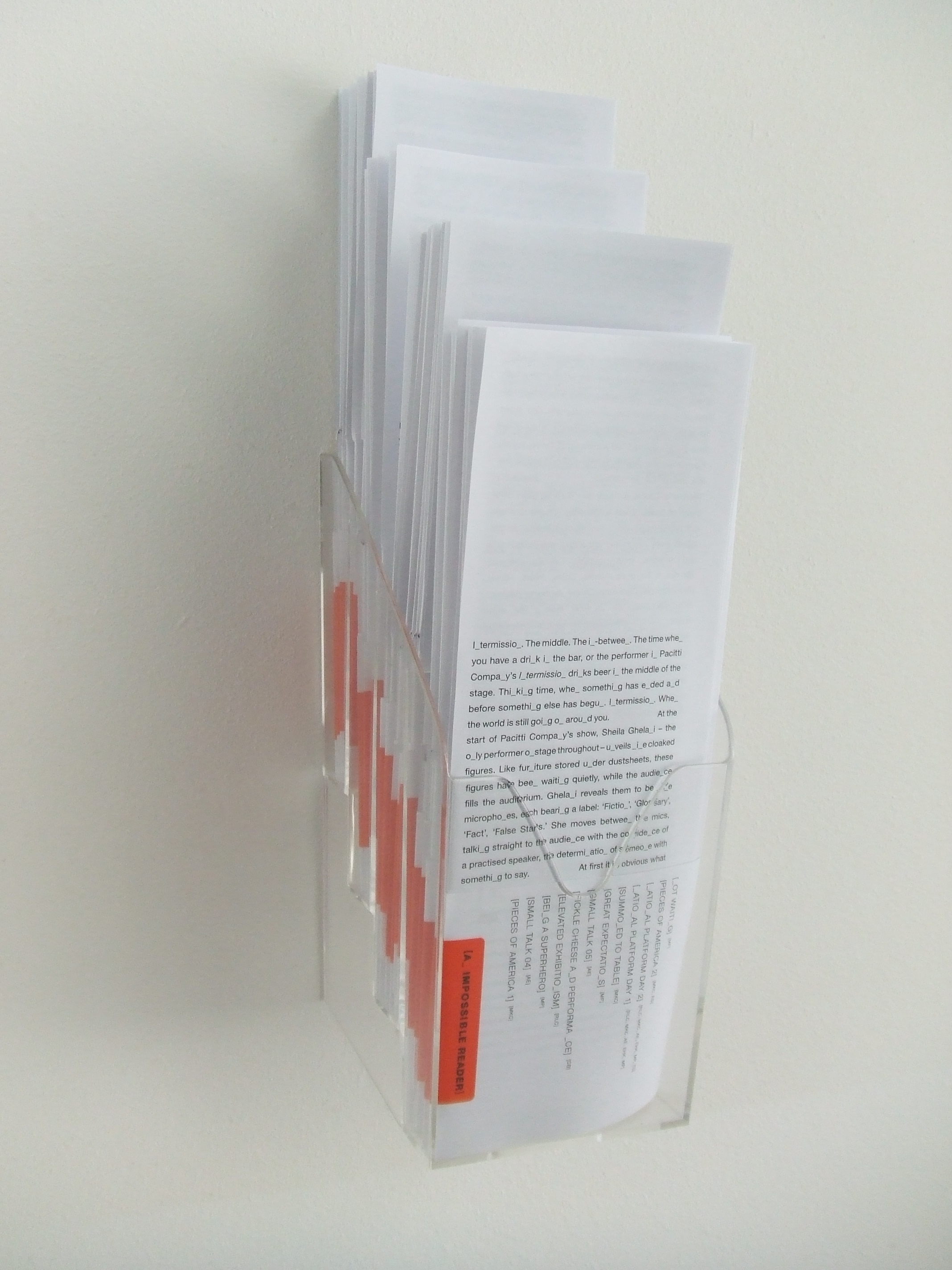
Some work I produced as part of the SPILL: OVERSPILL writing project in 2009, has taken new form as part of  A_ Impossible Reader, a project by Open Dialogues  and Marit Muenzberg, exhibited in After Live, at the Norwich Arts Centre (4 Sep-30 Oct). As Open Dialogues describe the project:

A_ Impossible Reader is incomplete, unbound, personal and portable. It is (not) a record, (not) a document, (not) a marker of absence, (not) a work of art.

A_ Impossible Reader is a specially designed and made series of publications containing texts from SPILL: Overspill, an Open Dialogues project exploring the event of criticism in relation to performance and the SPILL Festival 2009.

Each reader is displayed in the gallery at intervals throughout After Live and contains a randomly curated variety of texts from SPILL: Overspill. If a text exceeds one page, it remains incomplete. A_ Impossible Reader is a partial document of Overspill, or a partial document of SPILL, or a work of art in its own right.

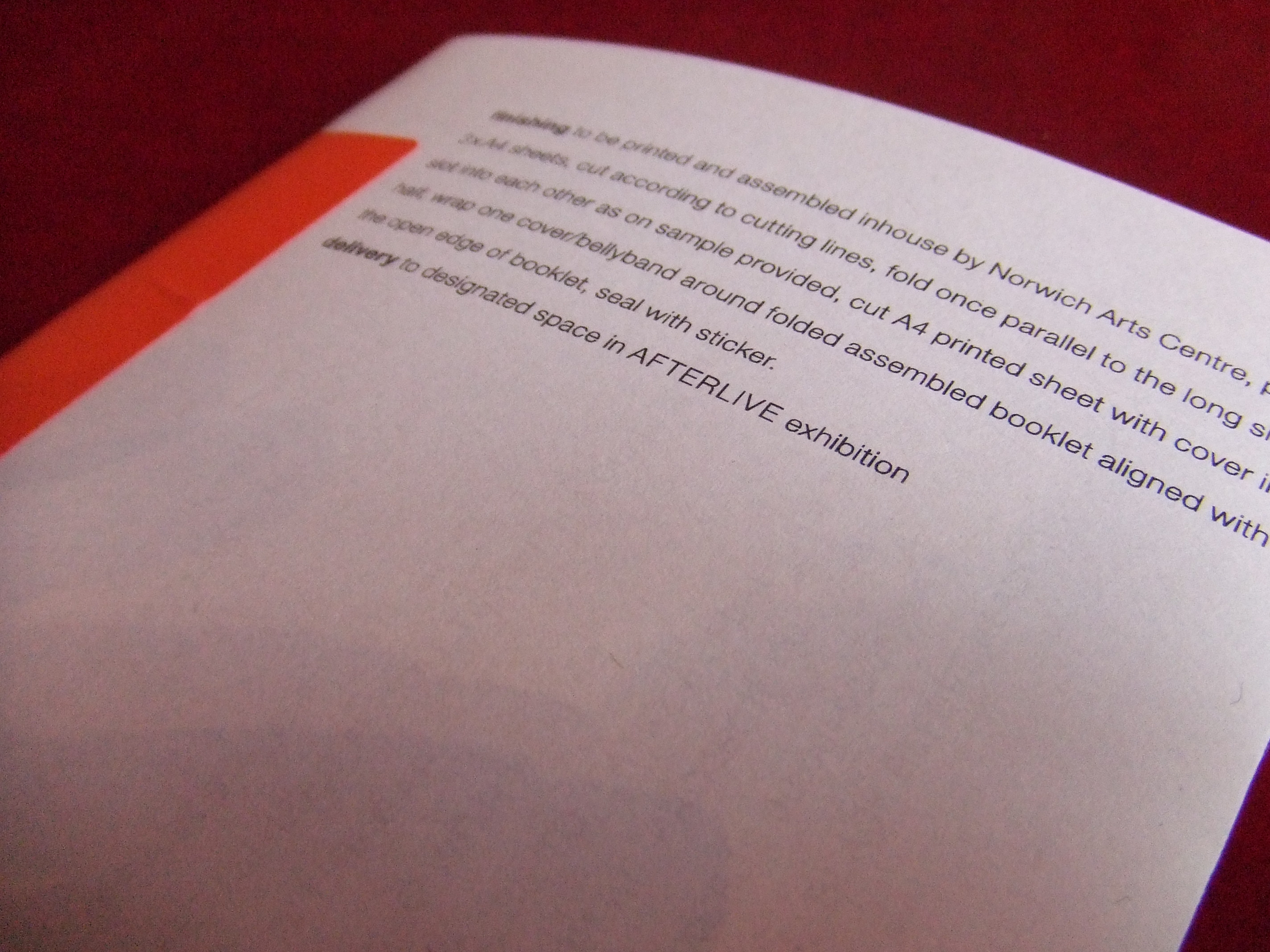
A_Impossible Reader also comes with its own assembly instructions for the curators of the exhibition: 

To be printed and assembled inhouse by Norwich Arts Centre, print 3xA4 sheets, cut according to cutting lines, fold once parallel to the long side, slot into each other as on sample provided, cut A4 printed sheet with cover in half, wrap one cover/bellyband around folded assembled booklet aligned with the open edge of booklet, seal with sticker.

So far, I’ve only seen the various incarnations of A_Impossible Reader as online PDF’s. It’s a startling transformation of the generally straight reviews on the SPILL: OVERSPILL blog, opening them out both into a new found materiality of their textual existence, and into a new autonomy of presence separate – and/ or differently related – to the performances from which they originated. 

A_IMPOSSIBLE READER is also a subtle and agonistic answer to some of the complexities of the SPILL:OVERSPILL project and the problems and possibilities of writing in (contractual) proximity within a performance festival. Curiously, if A_IMPOSSIBLE READER opens into the full possibility of a writing practice in proximity to performance, it also does so through illegibility and anonymity.

To this extent, A_Impossible Reader is usefully viewed alongside SPILL: ON AGENCY, the Pacitti companies publication about the festival, edited by Robert Pacitti and Sheila Ghelani. Here, alongside a spread for each of the performers, there is a gathering of essays by SPILL_OVERSPILL writers. Many of these are engaged with the same questions: what is the residue of a performance (and a performance festival)?  

Should a writer in such a context be engaged with the specifics of a particular artists work, or be using it as material for their own investigations?  How, even (feeling dissatisfied with this last sentence) to articulate the possibilities/ actualities of this relationship?

You can purchase a copy of SPILL: ON AGENCY for £15 +P&P here.  My own essay BACK ATTHE SOUTH POLE AGAIN: CRITICAL FRAMEWORKS OUT OF PERFORMANCE  begins as a postcard and, looking back at it now, it’s a curious document, turning to fiction and an almost cartoon imaginary to try and answer the disappearance of performance and the desire for it  to have unfolded/ remained as memory unfolding into methodology:

I’m thinking about all the shows I saw in SPILL, six months after, on a small biplane about to land on the South Pole. I’m trying to articulate the residue of each performance, what stays in the mind, what emerges through  thinking, writing, and ___________. I’m wondering if these residues, in whatever form they take, can be some sort of framework, through which I can think about the performance itself, my writing about it, performance and writing more broadly, about all that is proposed and enacted here. 

Sound, talk, slogan, inscription, metaphor, critique, script, poetry, assemblage, history, polemic. It’s snowing. Through my goggles and the window of the biplane I can see physical evidence of melting ice caps, polar bears stranded on the remnants of huge ice bergs. I wonder if I’m overly preoccupied with the utility of these performances, or if the simplicity of my Antarctica could cause the plane to crash.

Both and more. An essay like this is a good opportunity to at least pretend towards such a utility and see what happens. A soft bump and we’ve landed. I hope my clothing is warm enough. I assumed a good knowledge of contemporary performance art would in itself be enough for an Antarctic winter.


A CAUTIONARY PREFACE: … It plays with its fiction and its reality both, with a script not adverse to examining its own premises even when it seems to function as a child to adult telling-it-how-it-is. On the night I saw the show, I felt as if the audience responded more to this second function, with parents audibly chuckling at some revelation of adult behaviour because “I also said (or did) that.” Such audience responses confirmed the script as truth-telling, ignoring or absorbing its self-critical aspects.

Leaving the plane I’m greeted by the Camp Entertainments Manager. She immediately warns me against whimsy and over-intellectualism, both fatal in such a landscape. I say I have three methodologies I want to use to explore the Antarctic, each one of which is devised from a performance I saw during the SPILL festival. These are:


(1)Puppet Writing

(2)Incorporating Refusal

(3)Song Notes


The rest of the essay unfolds these three methodologies.

SPILL OVERSPILL writers were David Berridge,Rachel Lois ClaphamMary Kate ConnollyAlex EisenbergEleanor Hadley KershawMary Paterson and Theron Schmidt. 

WRITING/ EXHIBITION/ PUBLICATION: PERFORMANCES, DISCUSSIONS, INSTALLATIONS on SAT 25th SEPTEMBER

In Uncategorized on September 21, 2010 at 8:42 am


seekers of lice, Invent the Present (part II), 2010


On Saturday September 25th 1.30-4.30, WRITING/ EXHIBITION/ PUBLICATION presents an afternoon of performances, discussions and installations. 

1.30pm How To Blush – performance lecture by seekers of lice:

 “The talk as an installation space: How to blush is a collaged text circling around blushing via the life of the bedbug, the colour puce, visceral reactions, earlobes, Sappho…”

2.00-3.30pm LemonMelon Publishing Seminar.

LemonMelon extends the following invitation: Please join!!! LemonMelon would like to discuss the following with you

a book as strategy
a book as a living organism
a book as a platform for research
a book as an exhibition space
a book as a place of collaboration
a book as nearly invisible publishing
a book as structure

Specifically invited contributors are asked to present their publications and to respond to the above.

Contributers include: seekers of lice, Phil Baber/ Cannon, David Berridge/ VerySmallKitchen, James Davies/ If P Then Q, Tamarin Norwoood/ Homologue, Marit Muenzberg/ LemonMelon.

Red Fox Press, C'est Mon Dada and ASSEMBLING archive at WRITING/ EXHIBITION/ PUBLICATION


3.30-4.30pm  Janine Harrington, Performing Book Experiment No.2

“Performing Book Experiment No.2 is a structure for five or more dancers. The work aims to facilitate a playful interaction between the audience-reader and the performers. The structure is only activated when an audience member enters a “channel” of the space, their movement programs the danced material in a certain way. As the activator becomes aware of their role as co-author of the work they are able to play with the structure, changing the direction of movement, its relationship to time and scale.”


ALSO THIS WEEKEND:

The 25th will be the conclusion of Phil Baber’s The Archaeology of an Essay installation, the result of a 3 day residency at WRITING/EXHIBITION/PUBLICATION:

“Through artifacts, images, and texts, I’ll be unpacking, plotting, and presenting the ‘source-code’ of an essay-in-progress.” 

The Festival of Nearly Invisible Publishing also continues to unfold with  Greetings from DEAL – an installation by Colin Priest, Malcolm Hobbs and Joe Reeves – plus the online launch of LIKE IT IS: PRELUDE, an e-book by Nyeema Morgan, and an announcement of five Titles by Raqs Media Collective

WRITING/EXHIBITION/PUBLICATION concludes with a final weekend of performances and events  on October 2-3. See full programme of events here.

DEPARTMENT OF MICRO POETICS: KAI FIERLE-HEDRICK AND RACHEL ZOLF EXCHANGE VALUE #1

In Uncategorized on September 20, 2010 at 7:35 am

Exchange Value #1; 17 September 2010

[the moment where 

                the evidence is]

this catapult stress entry-point as stitch, as flutter
heartbeat and fingerprinting fiasco

as handle
as conductor
as pivot
as machine
as line

as such I brackets the length of corridor, a

written conversation
transcribed —
— for spatialisation

to braid interloper sun into silhouettes, a graphic language or
bid for some share of these

[neon geometries] the joint design loosening
I attends the grace instruction

action/beforemath         facing down         the document aftermath

to trace any intersection of mark, mobility
or passable other

however fragile letting flutter-flutter

to give [record] to take

Kai Fierle-Hedrick, Exchange Value #1


Learning machines
(for Kai, Exchange Value #1)

Aphorisms are done for the

Whole mass of documents that capture and fix them

Extension of and agent external to the body

So the speaker is the engine oil, what needs the additive

GRUUB can accesss the entiree diissk

Guns a-flutter with no evidence of microinvasion

You realize how important “feeling whole” is

With you my self-confidence has sky rocketed

But a time machine wouldn’t look like a booth with spinning wheels

The only way to seal the gap is leather soaked in oil

Mixed in with your soup

Your documentary can document anything 

Such evidence accrued despite the best efforts of lacy aprons 

Build a machine to fill up the pause in conversation

Self here is the implied mental comfort

A low ratio of formative roots and limber joints   

Replete with just-before-recess name-calling 

I vacate the moment when necessary

You see me there

It’s that abstract.


ABOUT THIS PROJECT

The above work by Kai Fierle-Hedrick and Rachel Zolf  was the outcome of their residency in the DEPARTMENT OF MICRO POETICS at the AC Institute, New York City on September 17th 2010.  Kai and Rachel describe the project as follows:

Rachel Zolf and Kai Fierle-Hedrick will collaborate – via an on-site/off-site residency at the AC Institute – to write a sequence of poems responding to the exhibition EXCHANGE VALUE. Fierle-Hedrick will write on-site at the gallery, and at the end of each session will forward an ekphrastic poem to Zolf. 

Responding via The Tolerance Project – a collaborative MFA in Creative Writing rooted in an online archive of “poetic DNA” traces donated by 86 writers, artists and thinkers – Zolf will identify a set of search terms in Fierle-Hedrick’s poem and use these to generate a new response from within The Tolerance Project’s archive. 

Zolf’s poetic permutation will then serve as the starting point for Fierle-Hedrick’s next session in the gallery, and so on. The residency explores a variety of exchanges – ekphrastic, dialogic, technological – in addition to embodying some of the challenges and creative loopholes of distance collaboration.

The residency continues on September 24th 2010.

NierghtravAOnWint’sIf A Teller: A BOOK IN 8 CHAPTERS AND 4 DIMENSIONS

In Uncategorized on September 19, 2010 at 11:32 pm

Last Thursday saw the beginning of NierghtravAOnWint’sIf A Teller: a book in 8 chapters and 4 dimensions, edited by Simon Lewandowski for 24/7 at the Gooden Gallery on London’s Vyner Street (Sep 16-Nov 25 2010).  I am one of 8 artists taking part in this project. Our collective description is as follows:  

Each chapter lasts one week and is visible 24 hours a day from the street.  

Each artist will construct a chapter 

Each chapter will be embedded in the previous one.   

Each will change, incorporate or move aside what is already in the space to develop a series of unfolding chapters. 

The work is rule-based 


THE RULES 


• 8 chapters will follow a preface and in turn be followed by an afterword 

• The order in which artists make a chapter has been randomly determined in advance 

• Each chapter will be a response to the previous one 

• Material can be introduced into the space but not taken out.  Anything can be altered, moved, reconstituted (even destroyed) but must stay there till the end. 

• The rules are a part of the work so subject to the same rules. 

• New rules may be introduced but not removed. 


The Artists (in alphabetical order):  David Berridge, Wayne Clements, Cinzia Cremona, George Eksts, Anna Francis,  Hugh Gilmour, Daniel Lehan, Simon Lewandowski, Richard Price, Barbara Ryan, Ben Woodeson 

The images in this post are from the first weeks installation by Simon Lewandowski. My own week in the space will be October 15-21st. 

We offer the following two passages by way of explanation: 

 “Alternating between second-person narrative chapters of this story are the remaining (even) passages, each of which is a first chapter in ten different novels, of widely varying style, genre, and subject-matter. All are broken off, for various reasons explained in the interspersed passages, most of them at some moment of plot climax. After reading the first chapter, the reader finds the book is misprinted and contains only more copies of that same chapter. When he goes to return it he is given a replacement book, but this turns out to be another novel altogether.

Just as he becomes engrossed in that, it too is broken off: the pages, which were uncut, turn out to have been largely blank. This cycle repeats itself, where the reader reads the first chapter of a book, cannot find the other chapters in his copy of the book, so he goes out to find another copy. But the new copy he gets turns out to be another book altogether. …Themes which are introduced in each of the first chapters will then exist in proceeding narrative chapters, such as after reading the first chapter of a detective novel, then the narrative story takes on a few common detective-style themes. 

There are also phrases and descriptions which will be eerily similar between the narrative and first-chapter chapters. The ending exposes a hidden element to the entire book, where the actual first-chapter titles (which are the titles of the books that the reader is trying to read) make up a single coherent sentence…” 


… the … project was, a scheme for entirely abolishing all words whatsoever; and this was urged as a great advantage in point of health, as well as brevity. For it is plain, that every word we speak is, in some degree, a diminution of our lungs by corrosion, and, consequently, contributes to the shortening of our lives.

An expedient was therefore offered, that since words are only names for things, it would be more convenient for all men to carry about them such things as were necessary to express a particular business they are to discourse on. … many of the most learned and wise adhere to the new scheme of expressing themselves by things; which has only this inconvenience attending it, that if a man’s business be very great, and of various kinds, he must be obliged, in proportion, to carry a greater bundle of things upon his back, unless he can afford one or two strong servants to attend him…

But for short conversations, a man may carry implements in his pockets, and under his arms, enough to supply him; and in his house, he cannot be at a loss. Therefore the room where company meet who practise this art, is full of all things, ready at hand, requisite to furnish matter for this kind of artificial converse.”

SOURCE TEXTS:  (1) Wikipedia entry describing Italo Calvino’s ‘If On A Winter’s Night A Traveller’; (2) Extract from Jonathan Swift’s ‘Gullivers Travels’ 


DEPARTMENT OF MICRO-POETICS: KAI FIERLE-HEDRICK AND RACHEL ZOLF IN RESIDENCE

In Uncategorized on September 14, 2010 at 8:39 am

Kai Fierle-Hedrick and Rachel Zolf will be in residence as part of VerySmallKitchen’s DEPARTMENT OF MICRO-POETICS at the AC Institute in New York City, on Sep 17th, 24th and October 1st.

Kai and Rachel describe their project as follows: 

Rachel Zolf and Kai Fierle-Hedrick will collaborate – via an on-site/off-site residency at the AC Institute – to write a sequence of poems responding to the exhibition EXCHANGE VALUE. Fierle-Hedrick will write on-site at the gallery, and at the end of each session will forward an ekphrastic poem to Zolf. 

Responding via The Tolerance Projecta collaborative MFA in Creative Writing rooted in an online archive of “poetic DNA” traces donated by 86 writers, artists and thinkers – Zolf will identify a set of search terms in Fierle-Hedrick’s poem and use these to generate a new response from within The Tolerance Project’s archive. 

Zolf’s poetic permutation will then serve as the starting point for Fierle-Hedrick’s next session in the gallery, and so on. The residency explores a variety of exchanges – ekphrastic, dialogic, technological – in addition to embodying some of the challenges and creative loopholes of distance collaboration.

Kai has also contributed an installation to the DEPARTMENT OF MICRO-POETICS based on Exercise 1-11, a series of texts that first appeared in Signals magazine here. The texts are prefaced by a quote by Paulo Freire – “ the child has, at the very least, the right to prove the craziness of his or her idea” – and offer documentation, proposition, and provocation of where experimental poetics and radical pedagogy (hopefully) meet.

Find out more about her work here

Rachel Zolf unfolds the process of The Tolerance Project as follows: 

Eighty-six writers, artists and thinkers have donated their poetic traces to The Tolerance Project, a collaborative MFA in Creative Writing. Each piece of poetic DNA in The Tolerance Project Archive has been assigned its own barcode. Each poem written for the MFA will employ traces from the donated traces. The MFA poems are restricted to The Tolerance Project Archive for their content.

MFA poems written for class will be posted on this blog. Poetic DNA barcodes for the traces used in each poem appear at the end of each MFA poem post. Click on the barcodes to reveal the donor identities and poetic DNA traces.

This collaboration includes you. The online public is welcome to use the comments field to give constructive feedback on The Tolerance Project poems. You are also very welcome to browse The Tolerance Project Archive and create your own MFA poems. Post them on the Archive site and if we like them, we may even bring them to class for feedback.

Based on cumulative feedback received within and without the institution, the MFA poems will be scrupulously revised toward the creation of The Writing Thesis.

As of September 13th the classes most recent project is: POEM 34- Homphobic poseur buffoon + narcissistic geometrical zip = nurture whose text is as follows: 

The concept of geometrical tolerancing is complex

Buffoon of the Play house will die a ridiculous Death

She looked across the street and the tears fspell down (all the narcissus planted in rows)

I empathize deeply with the state-sponosored [sic] homophobia of the US government

We don’t follow the support and nurture model of learning – it’s more swill and swear

The feature toleranced is indicated by a leader line media berea arrowhead scenic allegoric Pandora minoan midday convulsion auk earthmover klein paper tug

Like a horrible cocktail party full of insufferable poseurs intent on name-dropping while grilling you on trivial gibberish

A geometrical tolerance is applied to a feature when there is a requirement to control its variation of form or position

Along the way it gradually jettisoned all feeling and emotion, until it arrived at an austere and impersonal form of so-called artistic purity or truth

Gear wheels, zips, bearings, pressure tubing, kitchen utensils and blow mouldings, and clothing fabrics

My grandmother’s hands zipping open pale skin in a metal bowel

To check out the full barcodes and DNA of this poem click the images above or go here. See more about Rachel’s work here, and an interview with Joel Bettridge in JACKET here

Details of Jill Magi’s SMALL TALK SMALL BOOKS residency are here.  Details of projects by Paolo Javier and Vincent Katz to follow. Matt Dalby will perform in the DEPARTMENT OF MICRO POETICS on Thursday 14th October 6-8pm.

READING NOTES: THE TRADUCING RUDDLE OF THE ARTISTS’ NEWSPAPER

In Uncategorized on September 13, 2010 at 8:25 am

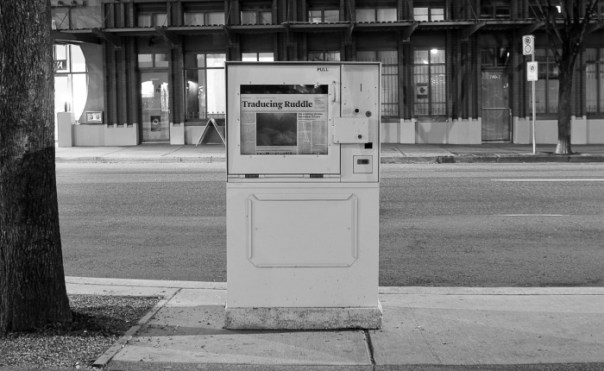
Reading Mark Manders Traducing Ruddle – one of a series of publications and installations by the artist involved with the idea of “fake newspapers” – got VerySmallKitchen thinking more broadly about the genre of the artists newspaper,  how it appropriates the newspaper form – its shape and paper, its implications about distribution. What happens to the form when artists use it? As Kathleen Ritter observes in an article on Ruddle for Fillip 12: 

Exactly how does one read Manders’s fake newspaper? It is not something to be read from beginning to end. It is not to be studied or cited. It is not to be gleaned for pertinent and timely information as one might normally read the daily paper. Rather, this object suggests a kind of meta-reading, that one reads while consciously critical of the act of reading itself. I would argue that Manders’s work is about the very activity of reading and, in this case, how such activities are articulated and performed in public.

For Ritter the history of the newspaper is a history of changes in reading practices: the where and how of reading.  

The performance of reading has changed over time; indeed, reading has a history. In the eighteenth century in particular, the increased consumption of reading materials was considered key to many social and political developments in Europe. Some historians have argued for the existence of a “reading revolution,” pointing out that until the mid-eighteenth century reading was performed “intensively,” in that people would own a small number of books and read them repeatedly, often for a small audience. 

After this point, people began to read “extensively,” going through as many books as possible and increasingly reading alone. During this period, Europe saw a proliferation of libraries, coffee houses, salons, and other spaces designed to accommodate the new practice of reading.

She concludes:

It was during this era that newspapers began to proliferate as well. 


Thinking of Manders’ project – both its printed form and its use to block up empty shop fronts in Window with Fake Newspapers– I think about the artists newspaper as a ghostly parallel of the original newspaper and its bold claims to public space, occupation of the everyday and all pervasive distribution. Hoping to find a new function, a new kind of news and immediacy and public space, that, as Mander’s project observes, comes from an embrace of varieties of irrelevance,redundancy, and invisibility. 

This post is a brief survey of  artists newspapers encountered through my own research. The focus of this article largely ignores artists who actually use “real” newspapers – such as Kenneth Goldsmiths transcriptions of The New York Times in Day; Dieter Roths bulk newspaper bindings in his own Collected Works; or Gustav Metzger’s pile of Evening Standards at his recent Serpentine retrospective. Although these obviously help dilineate a broader field of artist-newspaper fascination. 

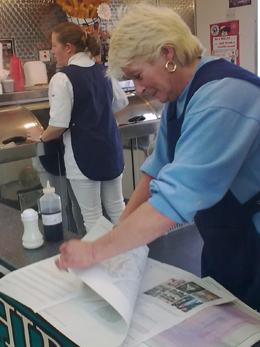
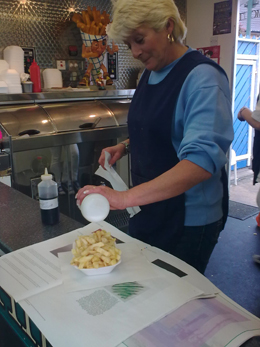
One brief note: a sign at the Serpentine asked visitors to consult an invigilator if they wished to look at the newspapers.  Surely, engagement with newspapers has to embrace the brief life of the form – sitting uncomfortably with artists careers, or even the duration of an exhibition – one reason why I was so delighted that YH485’s *periphery newspaper  – to which I was a contributer – had a second life as chip paper in the fish and chip shops of Great Yarmouth. 
One other project to bring into mind: in the catalogue for Every Day is a Good Day: The Visual Art of John Cage, Cages assistant Laura Kuhn tells the story of how, when Cage was writing his Norton lectures, Merce Cunningham suggested that to make the lectures more contemporary he should take material from each days New York Times. Cage is delighted, but Kuhn arrives one day to find him in tears and pointing at an article about “crack babies.” Kuhn observes how Cage seemed to be totally thrown to discover such a thing existed and she writes:

I began to wonder whether what we might reasonably call the weights of the world ,and I would include crack babies in this category, were unusually heavy on him. That letting them in, so to speak, engaging with them, on any level, paralysed him, making him question the viability of his work as an artist, making him wonder whether his work wasn’t in some very real sense futile. 

It’s a useful story to ponder when considering artists newspapers, and how many of them relate to that tumult of experience that defines the form. 

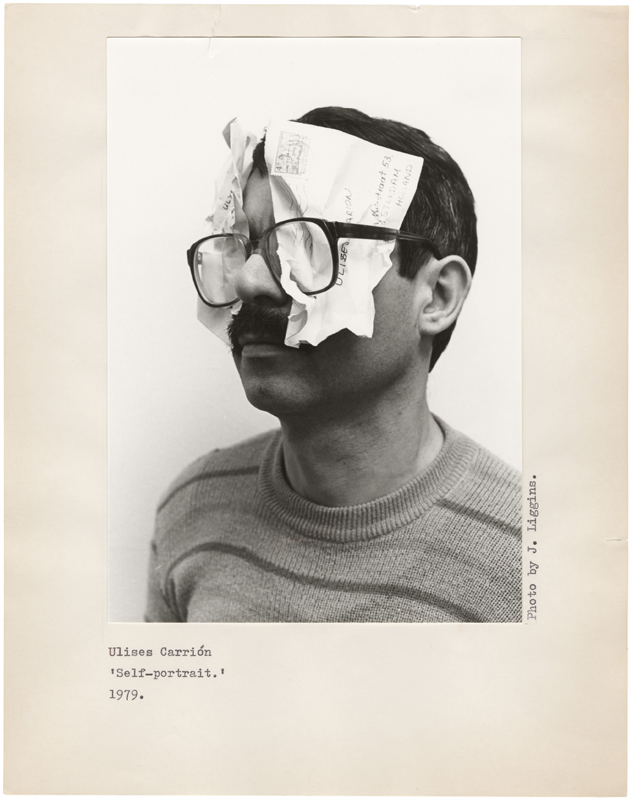
Finally, by means of introduction, its curious to note how Ulises Carrión writes about newspapers in his 1980 essay BOOKWORKS REVISTED (recently reprinted in facsimile as part of James Langon ed. BOOK, Eastside Projects, 2010). For Carrión it is the newspaper form that moves the traditional book both towards Carrión’s notion of a time-space sequence,  the complexity of the everyday environment, and a form informed by histories of visual art, notably cubism (which, as he observes, often incorporated newspapers):

When compared to a book page, the newspaper page offers quite a contrast. More movement, more vivacity, even some messiness. You can start reading on different points of the page. Every column can be written by a different individual. Texts can be printed in a variety of types, with or without illustrations. 

All this means a more sophisticated use of the printed surface, and reflects the great complexity of the external world that the newspaper is intended to reflect as compared to the univocal point of view a book page offers. 

and:

The difference between these two kinds of pages has been compared with that between Cubist and pre-Cubist painting… The newspaper is also apprehended sequentially, therefore it’s a spatial and temporal structure. In contrast to the book, it offers a plurality of points of view that’s expressed in  a varied, vibrating typography. 


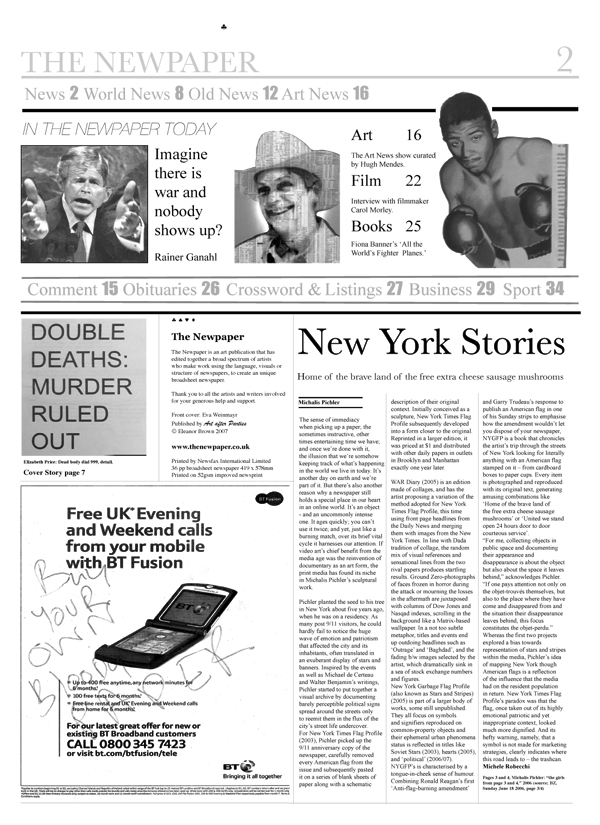
So some projects: Eleanor Vonne Brown’s The Newpaper,  with tongue in cheek , sees the artists appropriation of the form as a shift from “news” to “new.” Or “new” is what passes for “news.”  In an interview for The Self-Publishing issue 10 of the  Korean publication GRAPHIC  Brown describes the theme as “that tradition is only repetition” and observes of the process:

The Newpaper is a newspaper about the work of artists and writers who use the language, visuals or structure of newspapers in their work….. it’s very much sitting for hours in an empty room emailing people from around the world. I spend a lot of time conceptualizing The Newpaper and because the subject matter (work about newspapers) is the same as the project (a newspaper about newspapers) I have met a lot of people through it with who I have a lot of shared interests…. I am planning to start work on a Local Newpaper in the autumn. It will use the themes of a local paper and I hope to create an open access newsroom to produce it from (to get out of the empty room!)

Brown’s remarks highlight the different varieties of the newspaper form (local/ national/ special interest) and also the particular environments of its production (the newsroom) which the artist also appropriates in new (more solitary?) ways. 

Brown has recently collaborated with Michalis Pichler  on the Newspaper Research & Reading Room. The project is described as “gathering conceptual publications and/or artpieces that use form or content of newspapers.”

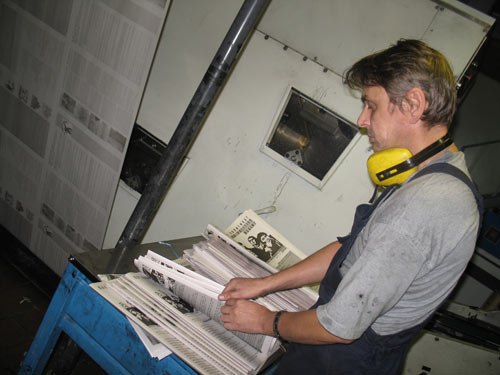
Chto Delat: Newspaper at the printers in Petersburg. Photo: D. Vilensky


The Reading Room includes Chto Delat who, amongst the long list of artists involved, have made one of the most sustained engagements with the newspaper form. All their newspapers can be seen in full here  (throughout Sep-Oct Chto Delat are in residence at the ICA in London). Chto Delat define their newspaper work as follows: 

Each newspaper addresses a theme or problem central to the search for new political subjectivities, and their impact on art, activism, philosophy, and cultural theory. So far, the rubrics and sections of the paper have followed a free format, depending on theme at hand. There are no exhibition reviews. The focus is on the local Russian situation, which the newspaper tries to link to a broader international context. Contributors include artists, art theorists, philosophers, activists, and writers from Russia, Western Europe and the United States.


Dot Dot Dot 19, whilst still in the journal’s usual paperback format, is printed on newsprint paper and re-works a project of the group for Performa 9:

1 NOVEMBER 2009 — Recently described as “wheat paste,” DEXTER SINISTER are set to produce a newspaper twice a week for three weeks this fall under the umbrella of PERFORMA 09, New York’s well-regarded bi-annual festival of performance art. 

Together with a hastily assembled staff of international writers and photographers, the Lower East Side “pamphleteers” will occupy a disused, street-level space in New York’s Port Authority bus terminal on the corner of 8th Avenue and 41st Street, directly opposite the new New York Times building. According to sources close to Sinister, The First/Last Newspaper (TF/LN) will be “as much about the current state of news media as anything else.” 

…In Sinister’s own characteristically melodramatic words: “You don’t want to start quantifying things or you’re dead.” 

Dexter Sinister’s self conscious (mock-) blurb offers a useful summary of how the artists newspaper is often equated to political pamphleteering. It explains why publications such as Variant also adopt a tabloid format, distributed for free in galleries (as, too, it explains why the newspaper should be so popular in an age of Seth Price’s DISPERSION and other projects foregrounding the distribution part of the writing/ publishing process – and the PDF as the artists newspaper 2010 could be the subject of another post). 

NOTE: It’s noticeable, too, that in The Artist Publisher, Coracle Press’ 1986 exhibition/ survey catalogue for the Crafts Council Gallery, the section on “Alternative Newspapers” has a much more counter-culture, alternative lifestyle, radical politics tone than any of the other sections. Titles include the Haight-Ashbury Tribune, Free City, and The International Times.

What is also interesting about Dexter Sinister’s project is that it preserves what they call the “mosaic” quality of the newspaper format whilst several examples here – such as YH485’s *Periphery – adopt the newspapers form but in a very much ordered and tided up way, reconfiguring it as a series of artists pages. But as Dexter sinister observe:

In other words, and this amounts to an aesthetic system, the only meaningful way in which art can speak of man and his world is by organizing forms in a particular way and not by making pronouncements with them. Form must not be a vehicle of thought: it must be a way of thinking. . . . Here I must repeat that the newspaper, from its beginnings, has tended not to the book form, but to the mosaic or participational form. With the speed-up of printing and news-gathering, this mosaic form has been a dominant aspect of human association; for the mosaic form means, not a detached “point of view,” but participation in process. . . . No real news followed for 14 years.

For financial and aesthetic reasons, newspapers seem to be finding much popularity in exhibition contexts.  The New Museum in New York are just about to launch their exhibition The Last Newspaper. If the title suggests a sense of requiem, then its press release reconstitutes the newspaper as the site where Borges’ Library of Babel meets Relational Aesthetics, and the newspaper acquires status as potent cultural figure: 

Conceived in response to pronouncements of the daily newspaper’s demise as a tangible record of events, “The Last Newspaper” investigates what is possibly lost and what might be gained in a world where an avalanche of interpretation compromises the increasingly vulnerable privileging of facts. 

“The Last Newspaper” is a multi-platform, multimedia laboratory inhabiting an art-filled landscape surrounding an architecturally innovative office… These research and reportage-based activities will be surrounded by artworks including photography, collage, sculpture, and installation. These works reflect newspapers’ infinite permutations and possibilities while critiquing their complicity with dominant ideologies. 

The catalogue full the show will the collated weekly newspapers, produced by Latitudes under the title THE LAST POST/ THE LAST GAZETTE/ THE LAST REGISTER…

Reading all this can also give VerySmallKitchen a desire to reclaim something of the printed newspapers anachronistic awkwardness, the unwieldy as opposed to its now usually tabloid-shrunken format, its refusal to be neatly page turned, to stay confined to a single persons space on a train or bus… artists newspapers like the London Metro and Lite that now seem like a gone tabloid blizzard blowing through the London underground…

It also makes me wonder about the newspaper as methodology, as practice, whether there is some other way of unfolding it as spatial practice?

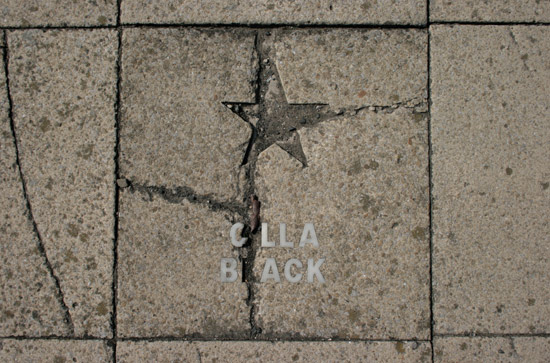
Nelson Guzmán, Cilla Black, Liverpool walk of fame, 2008


Coming closer to home, my own engagement with artists newspapers began with an article I wrote for FUTURE VISIONS OF HISTORY, an artists’ newspaper curated by Daniel Simpkins and Penny Whitehead/ OPEN EYE PROJECTS. 

As the editors observe:

On the Long Night of the Liverpool Biennial a group of artists and art students assisted me in gate-crashing the Capital of Culture party, disseminating alternative view points to the hegemonic art and literature so profuse on the streets of the city throughout Liverpool08. This one-off, free publication explores some of the issues, themes and locations that do not feature in the official 2008 programme. The hidden, the neglected, the absurd, the contentious.

I recently met Penny and Daniel as part of Reading for Reading Sake at Islington Mill in Salford, where they discussed the Politics and Aesthetics Reading Group and its spontaneous field trip to Lincoln to distribute copies of The Coming Insurrection by The Invisible Committee. In this context it’s useful to think of this project as characterised by a certain tactics of the artists’ newspaper- following some of the particularities of the newspaper form into social relations and action that aren’t confined to tabloid or broadside. 
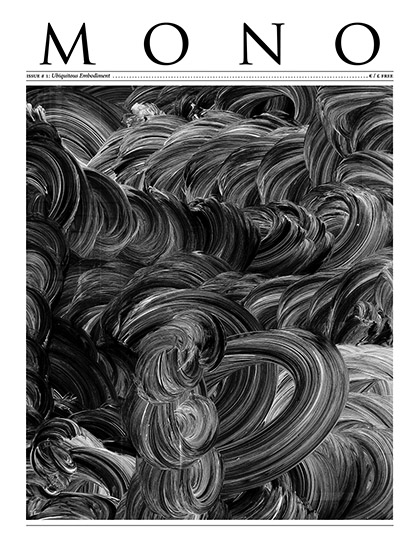
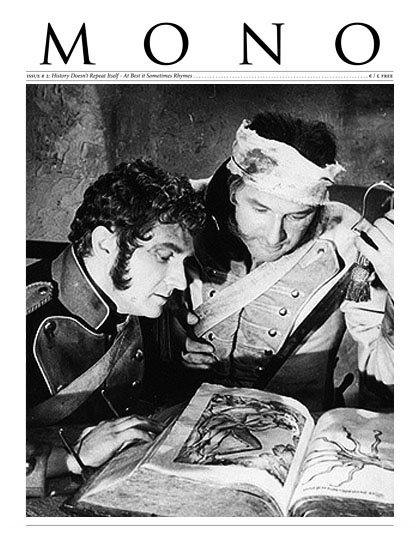
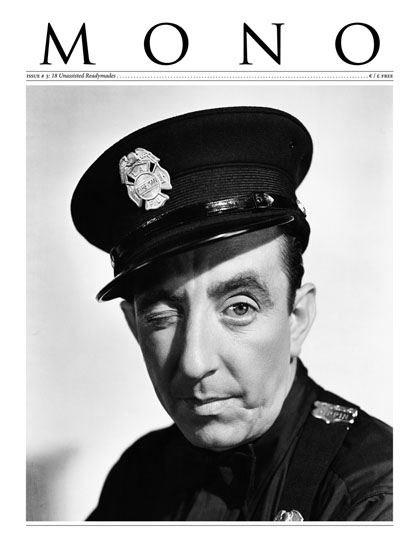
Other discoveries: the excellent Mono whose description reads as follows:

Mono is a free quarterly paper dedicated to publishing image based essays. Each issue is selected by invited artists and curators. Mono aims to provide a unique platform for the exploration of ideas through images.  

Mono adopts the often fraught format of the freely distributed newspaper (often moved out of the way by gallery bookstores…) but it makes this a definite project space,eager to engage with the newspaper as a place of sequencing akin to exhibition making. I haven’t yet spotted a copy of issue three lurking anywhere. 

CODA: A GESTURAL POETICS OF THE NEW(S)PAPER

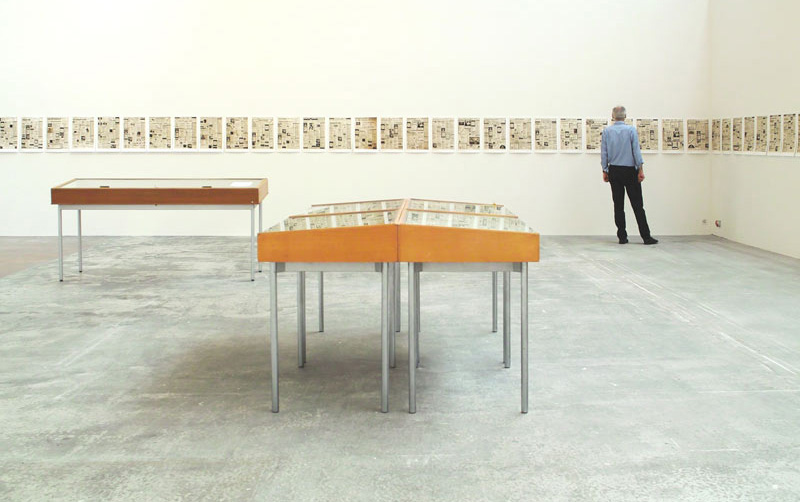
Dieter Roth’s The Sea of Tears was a collection of aphorisms published on the small ad pages of the newspaper Anzeiger Stadt Luern und Umgebung, between 17 March 1971 and 15 September 1972. After 114 ads the newspaper terminated the contract ( having earlier refused to print 3 of the ads). 

Dieter Roth, Das Tränenmeer, installed at Kunsthalle Luzern, 21 Aug 2010- 20 Oct 2010


At the same time as The Sea of Tears was published in 1973, Roth published The Lake of Tears, comprising 1200 original pages of the newspaper.  

Roths own comment on The Sea of Tears project, and its choice of the small ad pages: 

Those pages are so brutal, they’re like a gigantic junkyard. So I thought I’d just stick a little tear in them.
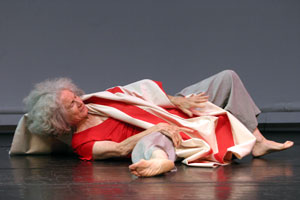
News Animation. Photo © Carol Petersen.

 

Secondly, Simone Forti describes her NEWS ANIMATIONS project as follows:

When I’m in motion I can more easily access the raw store of fragmentary thoughts, feelings, and speculations out of which I build my understanding of the world. A News Animation performance involves improvising with movement and spoken language, taking off form the fluid, flickering, dream like image of the world brought to us by the news media…

My father used to read a couple of news papers each day and I always felt protected by that… When he died in 1985, I began to read the news myself. It wasn’t coming easily to me. I did start to experience a sense of familiarity with

the stories, with the personages, but most of all, as a dancer, I started to have kinesthetic impressions of pressures, currents, accumulations and pending collapses. 

I was noticing terminology like ‘the dollar in free fall’, and Lebanon being called ‘a slippery slope.’ Soon I was dancing the news, talking an dancing, being all the parts of the news; tankers moving up the Persian Gulf, ‘human waves’ of Iranian youths crashing into the Iraqi forces invading from across the Shat al Arab estuary. 

The movement included the kind of gestures one makes when explaining and describing, but here the gestures were taking on the whole body.     

SOURCE TEXTS: Dieter Roth, Inserate/ Advertisements 1971-2 (Edizioni Periferia, Luzern, 2009); Simone Forti, “About the News Animations” in   Simone Forti/ Jeremiah Day (Project Press, Dublin, 2009), 92-93.