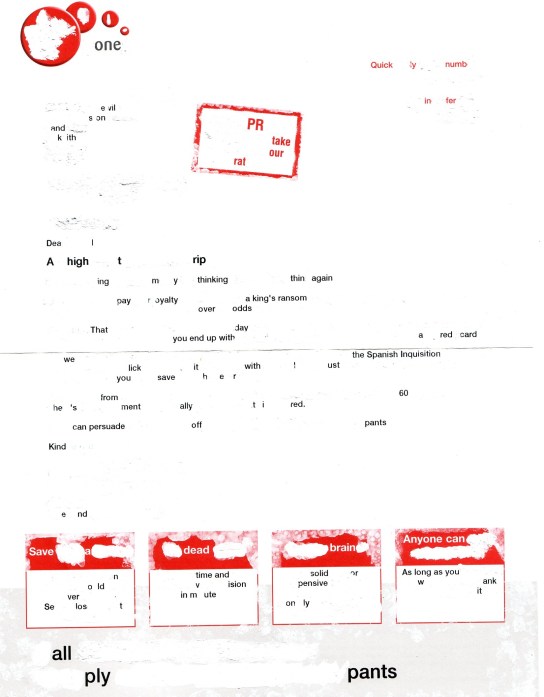
MARIANNE HOLM HANSEN: Kinko’s in New York used to have typewriters in ’94. I remember writing a CV on my neighbour’s typewriter. Even then I was aware of how physical it was. You see what you do.
My little one is small enough to travel with, to take my typewriter like a laptop. Sound becomes an issue. To type on different sites. It’d be quite nice – people talk loudly on mobiles and I make a different sound. Type twitter. This person tweetering throughout a conference. Be cool to take a typewriter instead and circulate what you wrote by hand. It’d be like early photographers lugging all the equipment around and how different that made the process…
Type is a nice word. Typing. A type as in the font a type a characteristic. It’s not writing it’s typing. I think if someone said they were typing I would think of a typewriter.
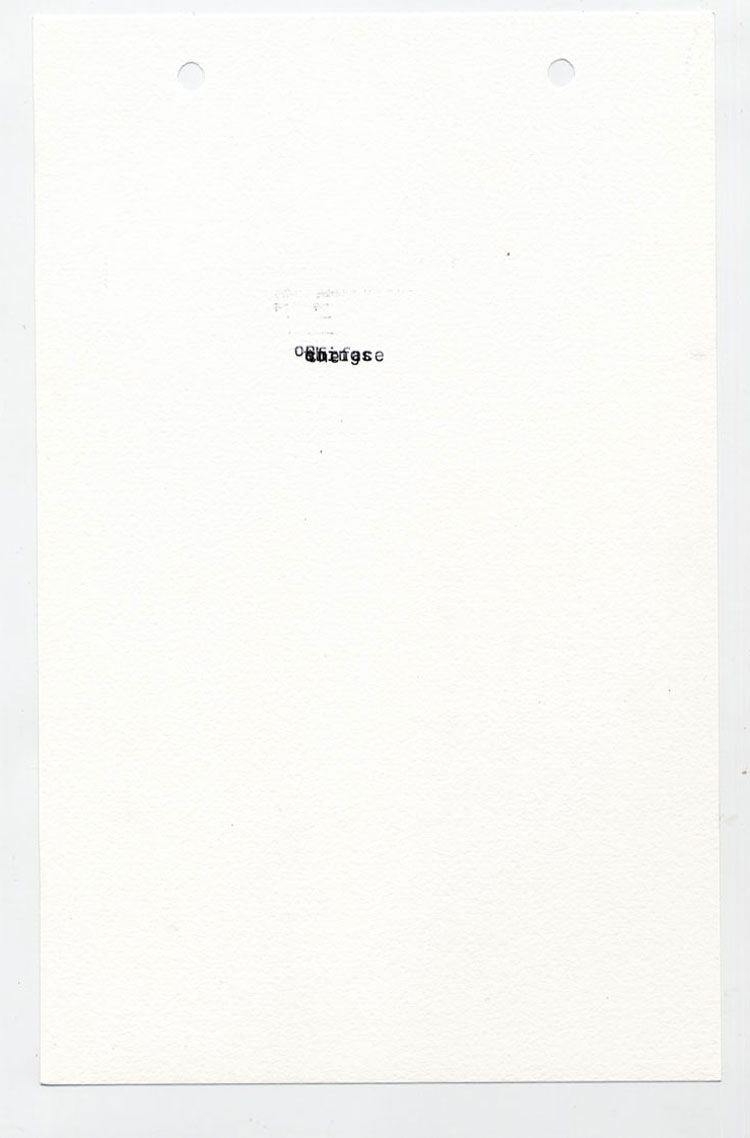
Now we write in different ways so using the typewriter it becomes something else. We pick it up because of a particular reason. My reason is it’s a very physical way of working, of constructing writing or words. I only make words or very short sentences.
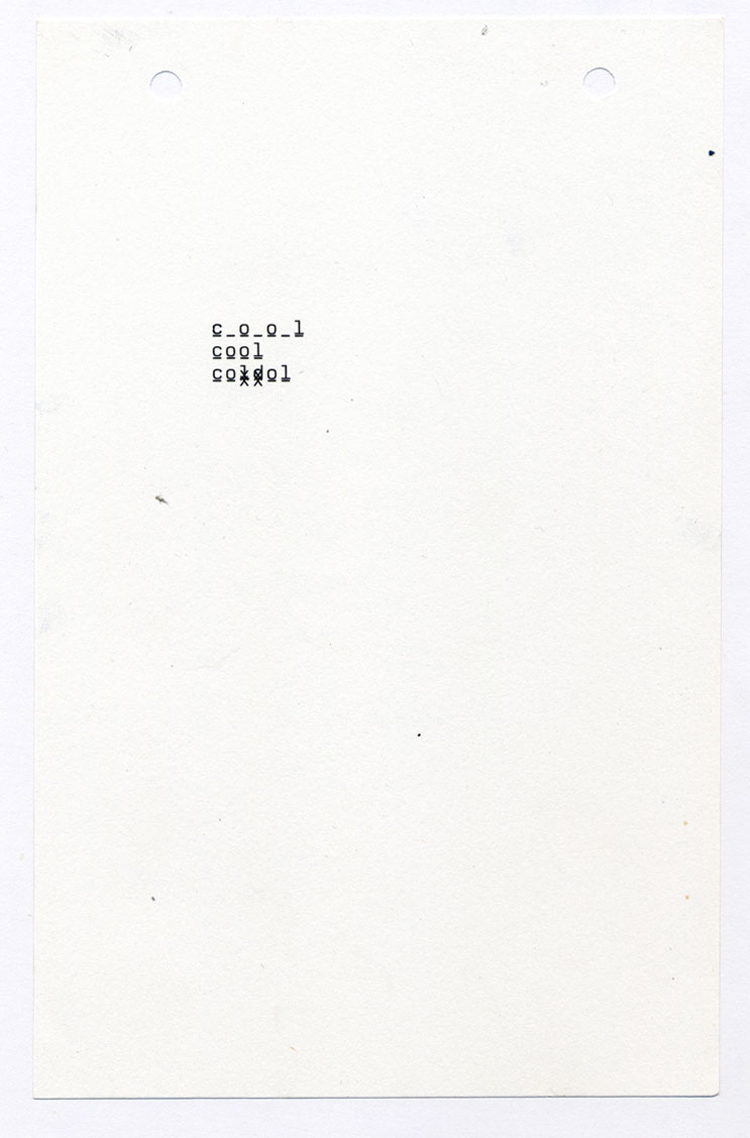
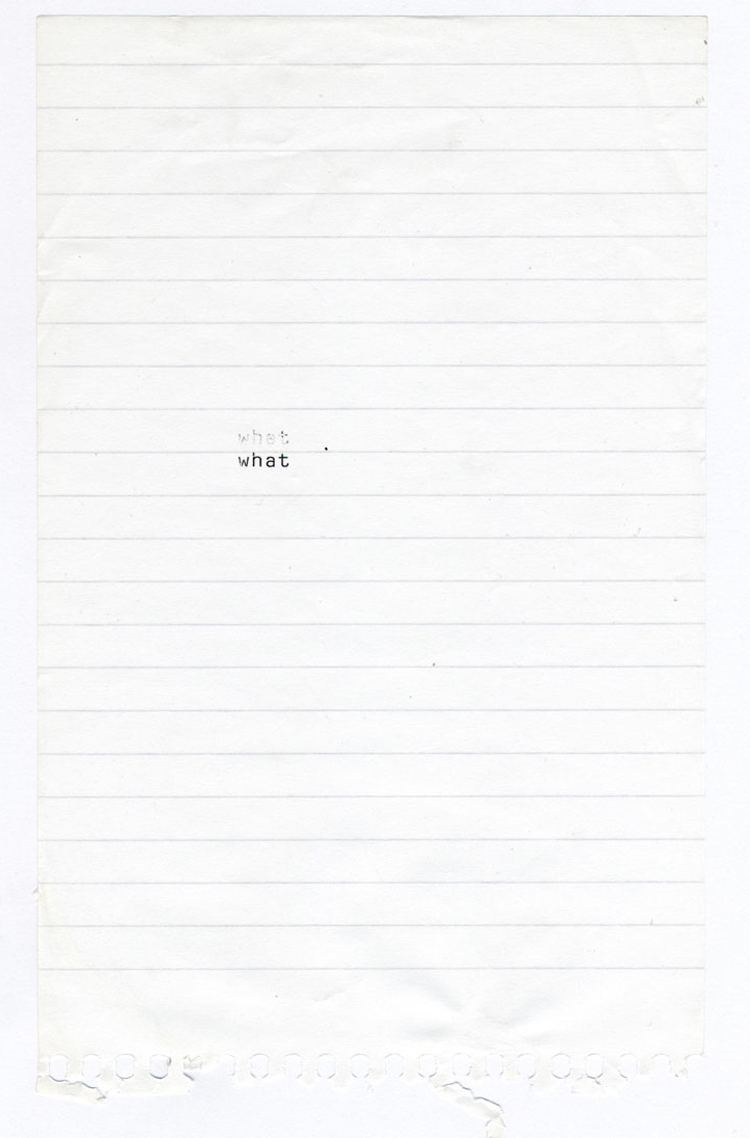
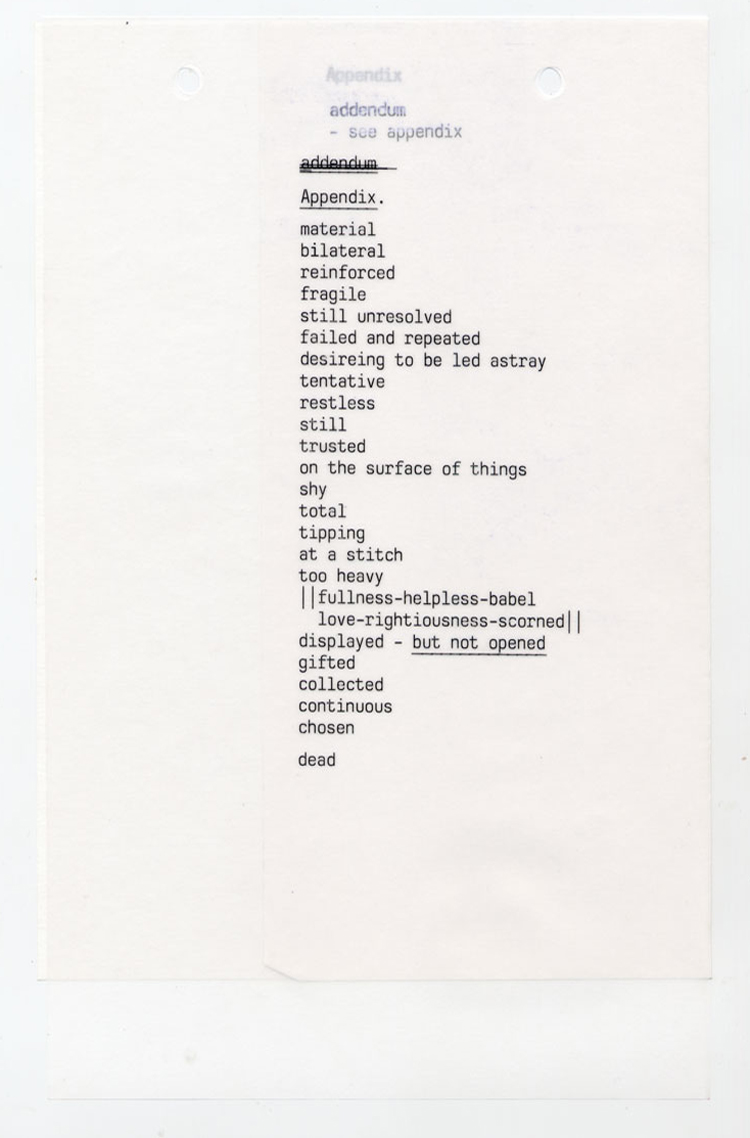
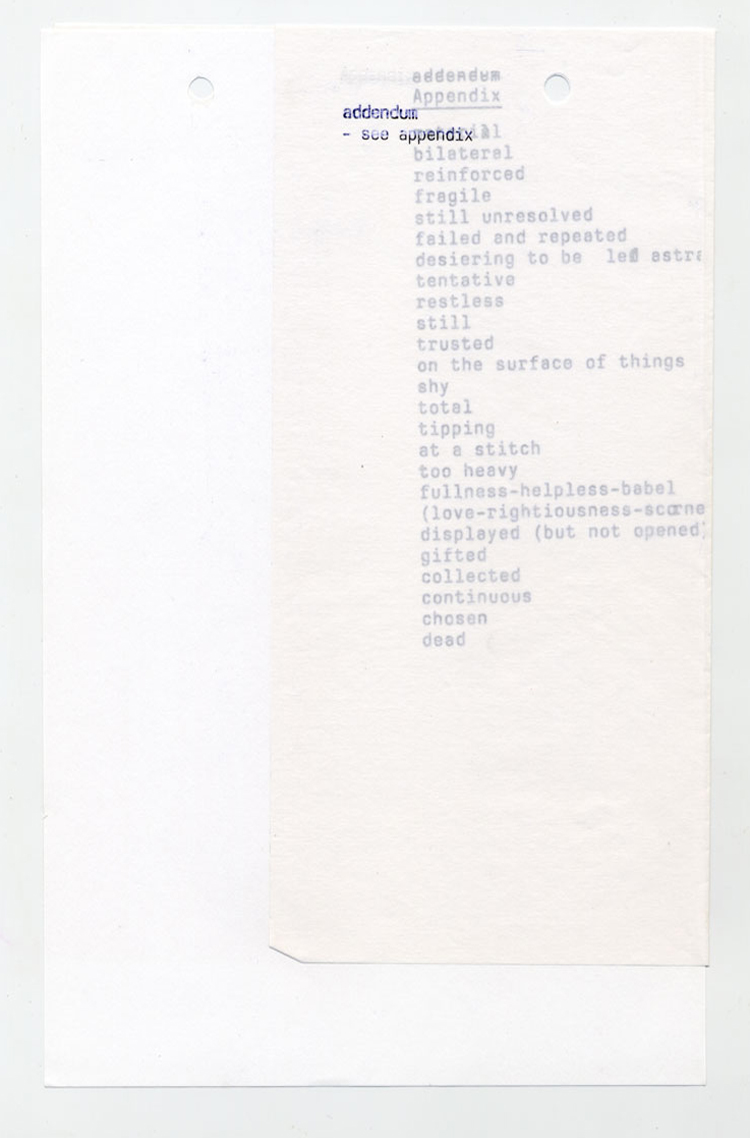
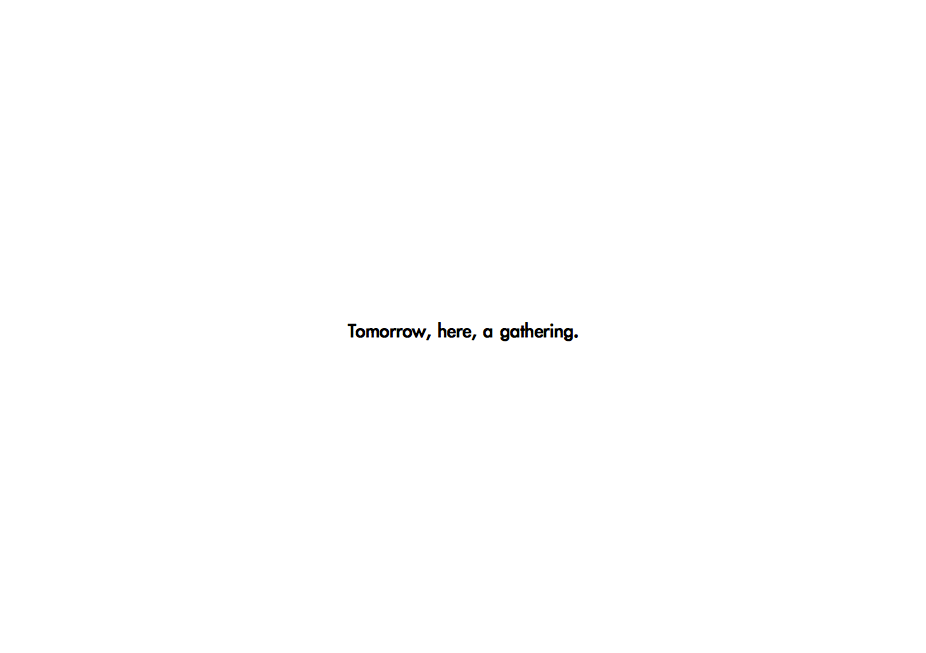
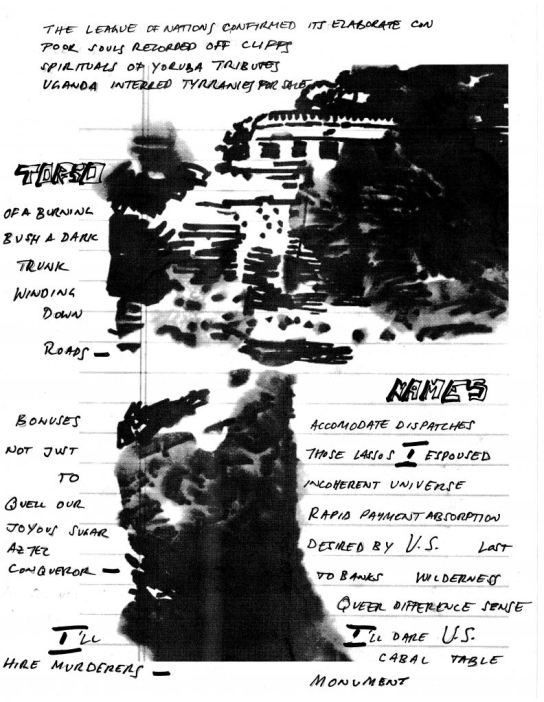
It made a lot of sense in response to the lists [ of Marianne’sFor the Recordproject, the source of the words shown here ] to type each word. I’m interested in how things change over time. Putting them in alphabetical order you lost that.
Each came from a particular situation, so I thought of returning the words to space, individually spacing them out again, asking the question: could you re-imagine the situation from which these words have arisen? I don’t think that worked. It becomes contrived.
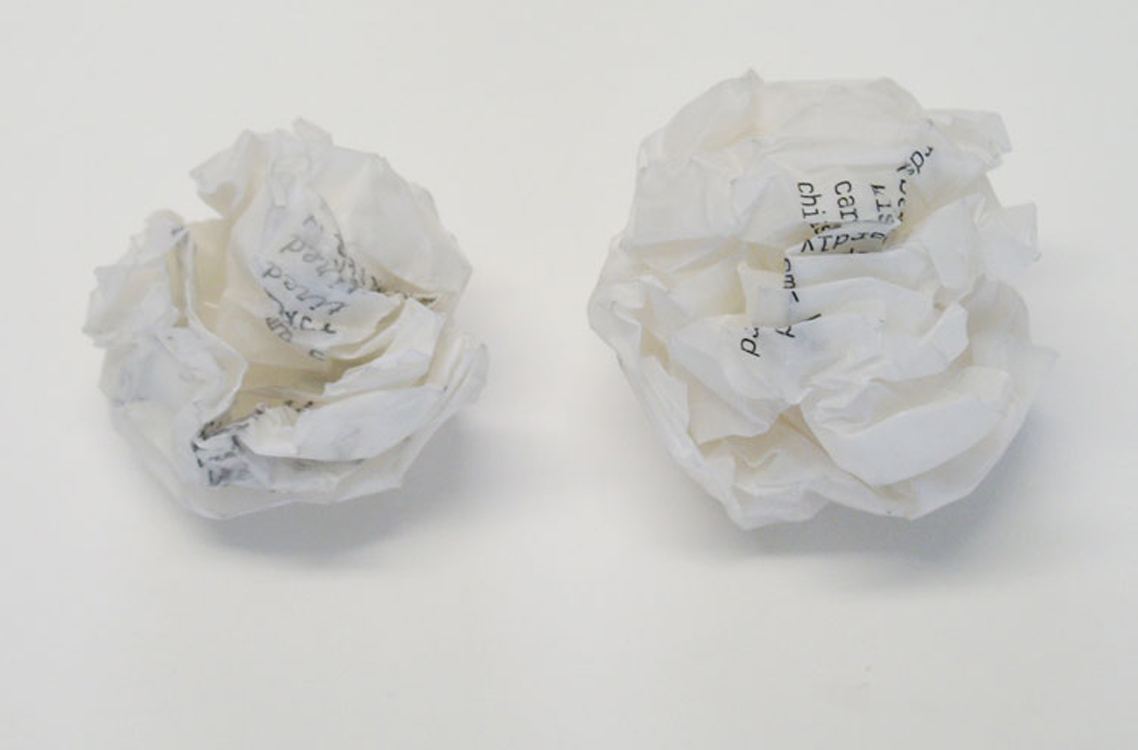
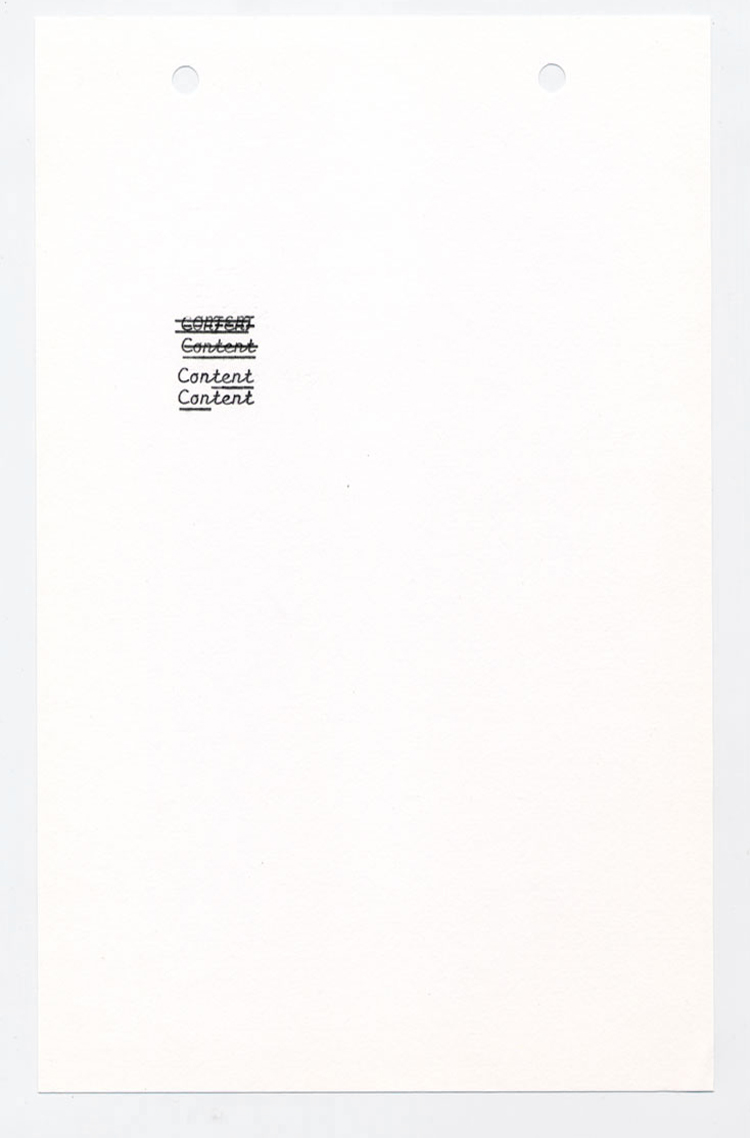
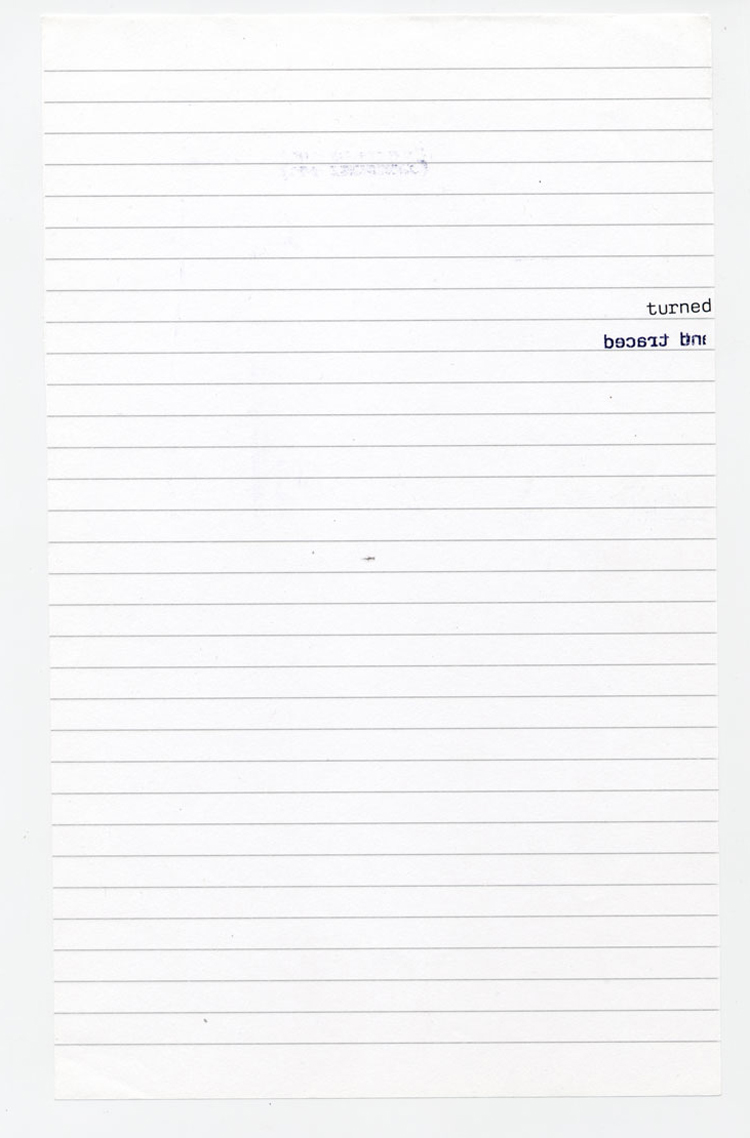
Something else came out of one word on a page. It becomes something else. It’s the undo function. There’s no undo. If you do it on the typewriter the trace will always be there of what you did before. If you change your mind you have to start again. On a computer you don’t. On a computer you think more about layout and font beforehand. On a typewriter you have to type it out.
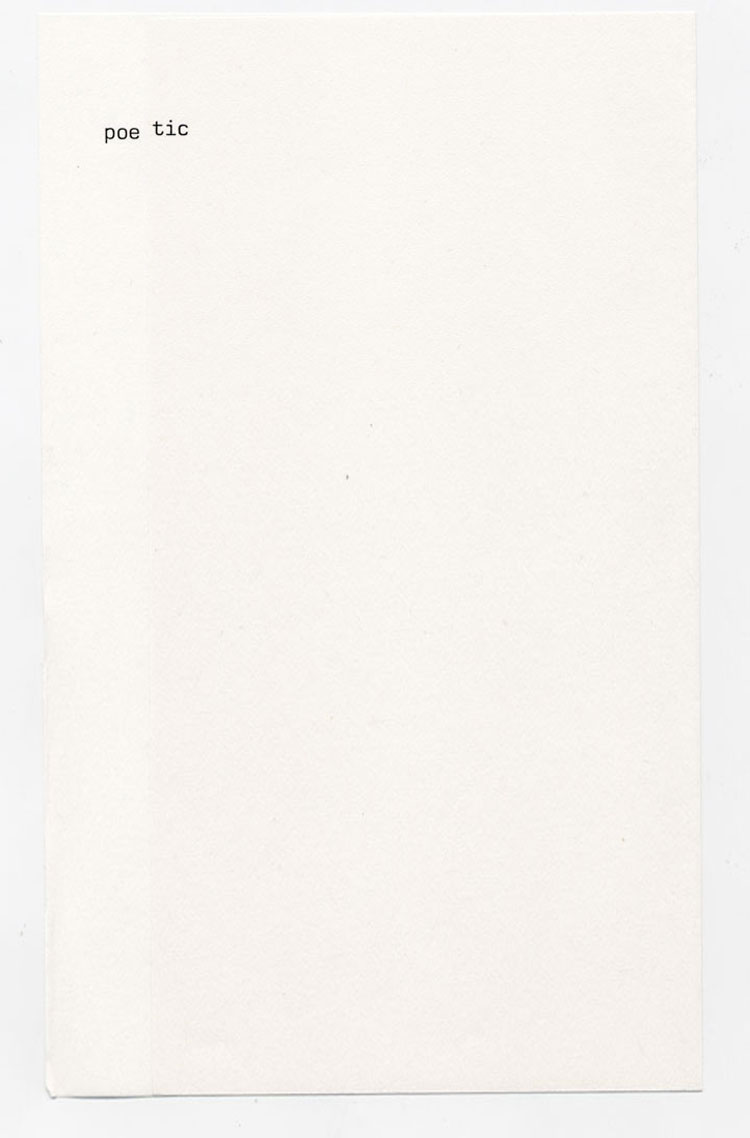
I played around with spacing, put in hyphens: hopeless i made hope-less. It gives you time, being limited in what you can write – the font is set. So I play with the spacing of the words, where it sits on the page. It makes you think about the word itself and the meaning and potential meanings of the word.
There’s a weird economy in it. There’s something about…. I feel like I can allow myself to put one word on the page. On a computer that is wasteful. Why is that? I wonder if working on the typewriter can be considered as closer to drawing than it is to writing.
In drawing if you work things out a mark here a mark there deal with a particular form it kind of materialises very directly as you go ahead. If you erase it leaves a trace. Whatever you do is left on the page even if you try to erase it. Typewriting leaves the mistake.
The mistake is in there in some way which opens up a whole new possibility for thinking about language. If I use it for a written document or use the typewriter font on my computer when making a document, it’s an entirely different thing…. a different conscious process…
It’s embodied…. a material thing to type that the computer doesn’t do in the same way. A physical act. Have you seen Jack Nicholson in The Shining? He types: all work and no play makes Jack a dull boy…
This conversation between VerySmallKitchen and Marianne Holm Hansen took place in Bethnal Green, London on Feb 22nd 2012. More about Marianne’s work is here.
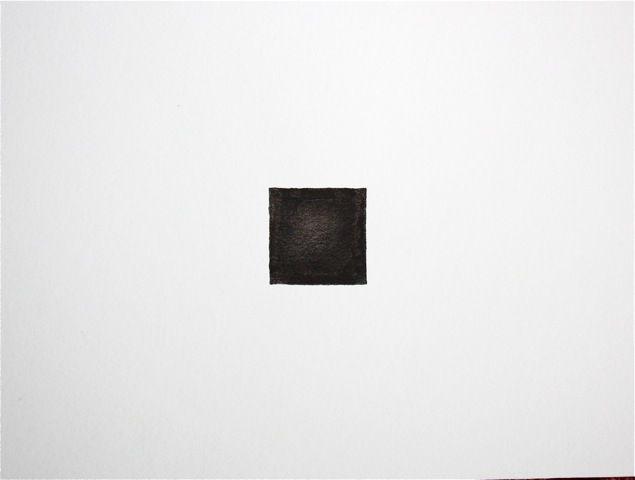
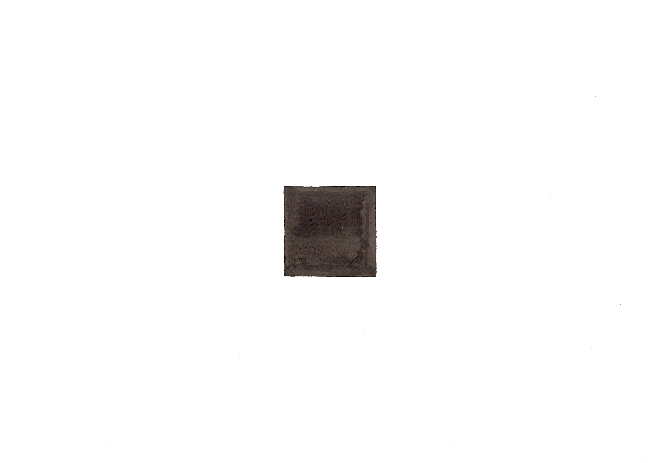
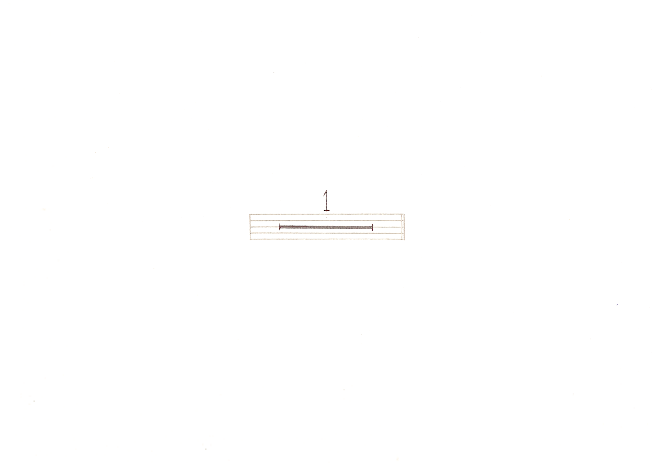
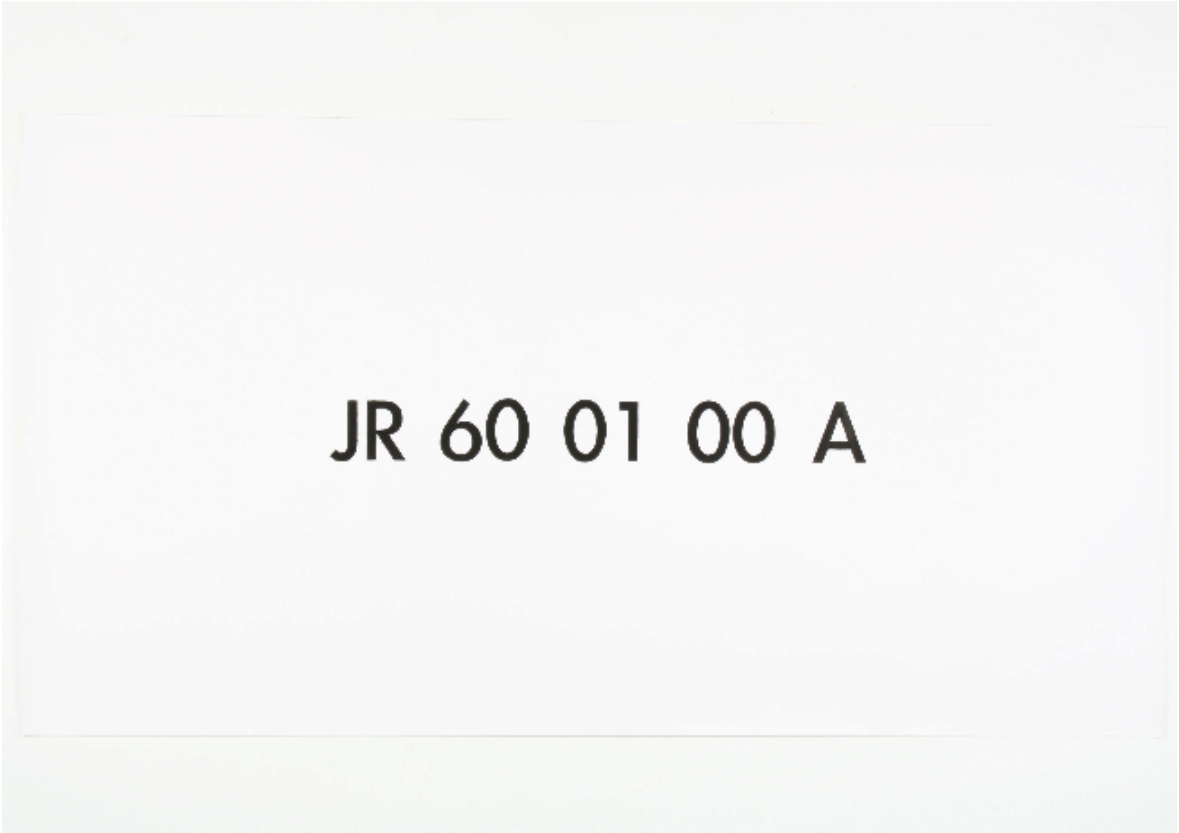
In X Marks the Bokship, Lucy Beynon and Lisa Jeschke unfurl a 2m x 1m drawing that is one part of Five Live Performances (Ink on Paper), a project which will take different forms in the exhibition and on this blog.
The different parts of this project range in scale from this large drawing to a box of sixty A5 pages and a text in 3pt font. What happens to scale across these different formats? When physical size and quantity is removed, what becomes invisible and what is emphasised?
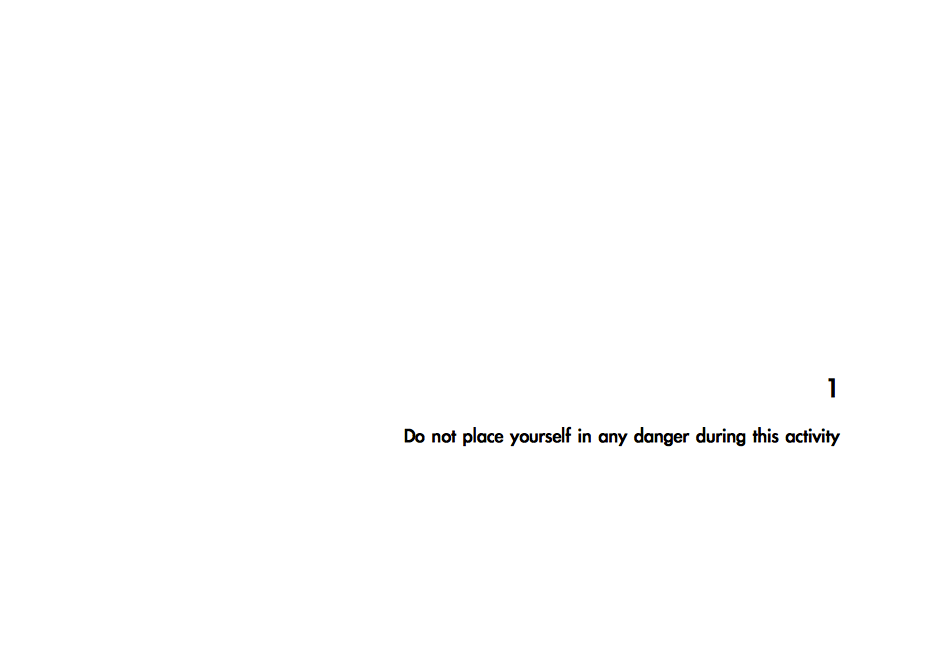
Five Live Performances began as a response to a set of workshop instructions from Chris Goode. The work produced becomes a score for its own movement across formats; a musical score for actual and conceptual performance; it scores itself into histories of black squares and blank/black pages.
It is looking at the different parts of Lisa and Lucy’s project that suggests PAGE as an organising principal for VerySmallKitchen’s contribution to this exhibition.
A page that mediates entry into space and conversation. Changes of meaning and emphasis from web page through page into sculpture. A page-facilitated space.
2. A LETTER TO ALEX, PAOLO, PAUL AND SARAH
Dear Alex, Paolo, Paul and Sarah,
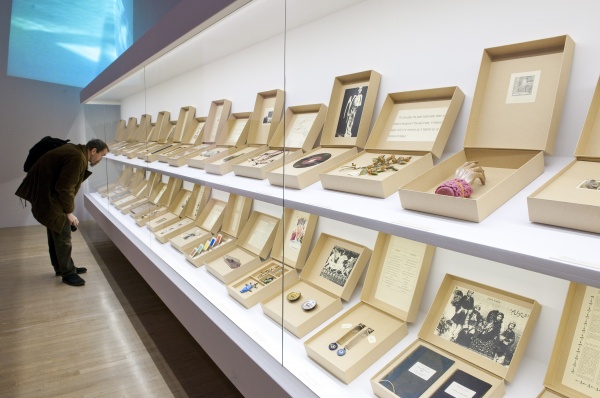
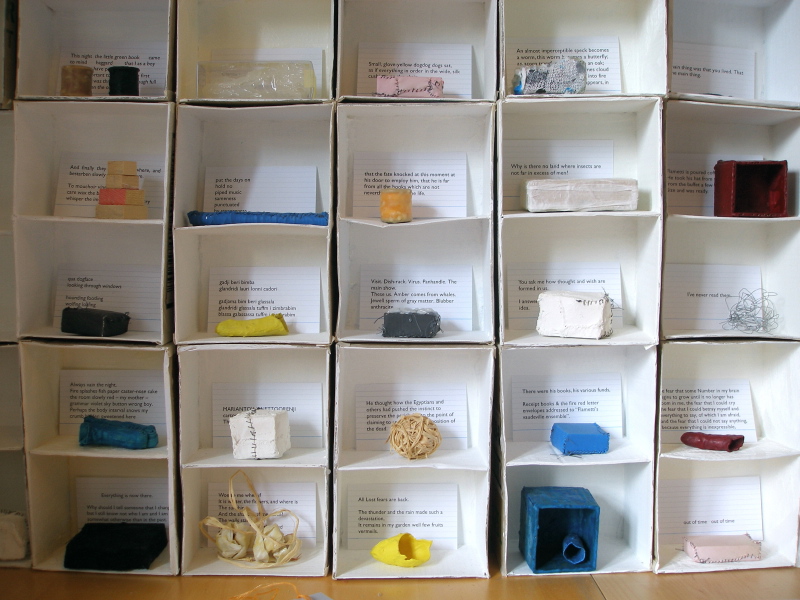
I have been thinking about how to present your projects for the exhibition. After various options, I have decided to present three archival boxes (photo attached) – one for each of you.
I would like to use the exhibition to both give a presence and a distribution to these works and also show something of the process and ambition of VerySmallKitchen. The exhibition provides a now that combines both past, new and potential projects. So for Sarah the box is an archive for a published book; for Paul an archive of virtual residency on the VerySmallKitchen site in 2011; for Alex and Paolo the box is an “archive” for a book to come later…
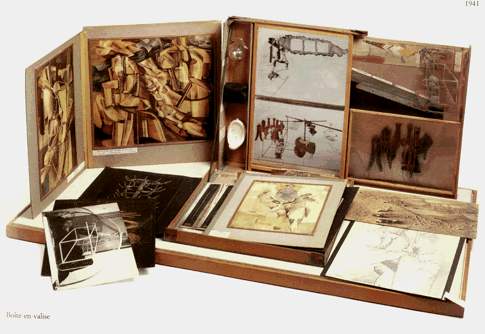
Some motivations: The (archive) box seems a useful container for thinking through what kind of space is being formed by this project. It can be an archive or not, an art work or not (Cornell’s boxes/ Duchamp’s boîte en valise/ Warhol’s Time Capsules, Hiller’s Freud Archive)….
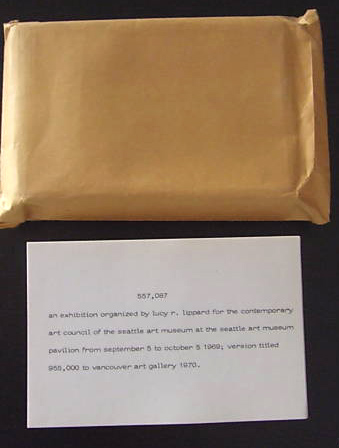
There are other historical examples I turn to as I think through this mediation of space and exhibition by the “page”: Mel Bochner’s Working Drawings and Other Visible Things on Paper Not Necessarily Meant to Be Viewed as Art; and the index card catalogues of Lucy Lippard’s 557,087 and 995,000 exhibitions
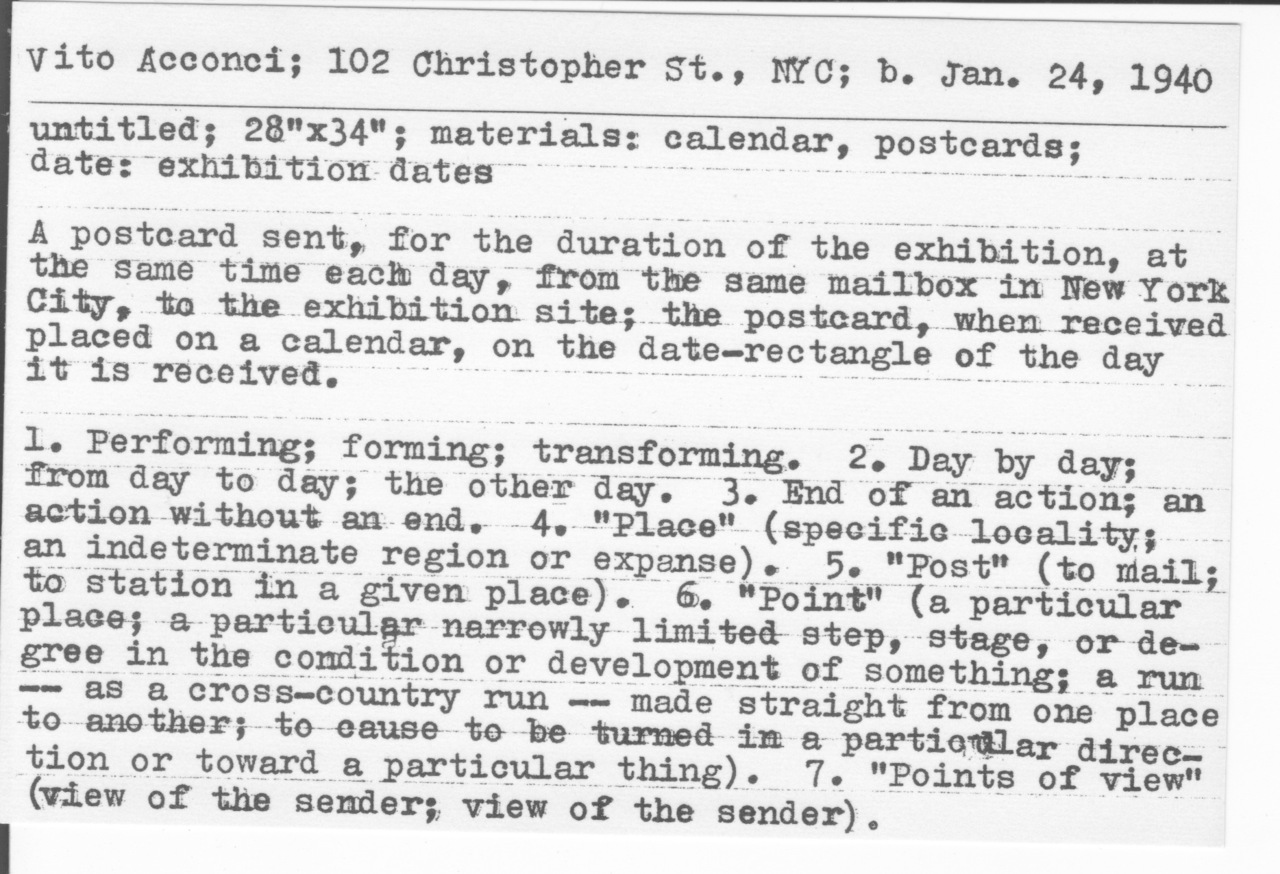
Top: Lucy Lippard, 557,087,” curated by Lucy Lippard for the Contemporary Art Council of the Seattle Art Museum, 1969. 10 x 15 cm, 100 - 138 artist's cards in brown envelope. Below: Vito Acconci’s contribution.
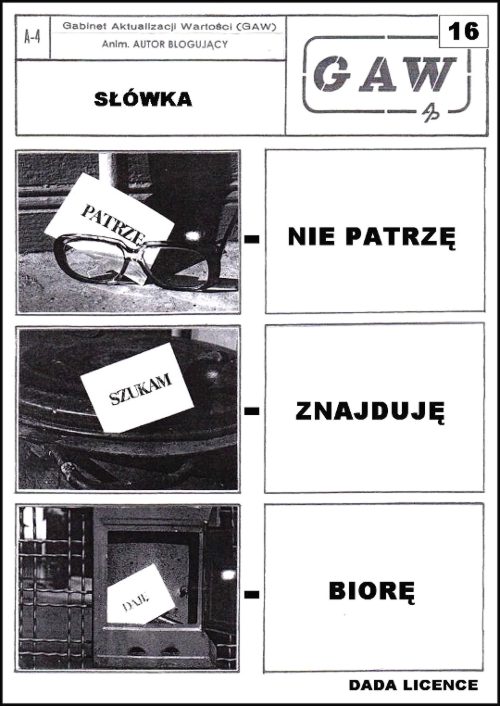
plus the index card writings of Lev Rubinstein; and the A4 Gallery, founded by Andrzej Pierzgalski in Lodz, Poland, in 1972 (whose shows comprised a single sheet of A4 paper placed within the 80×140 Gallery).
Andrzej Pierzgalski - Gabinet Aktualizacji Wartości (karta z Galerii A4)
All navigations between writing and art practice that are valuable sources whilst also highlighting the different emphases of your own work and this moment….
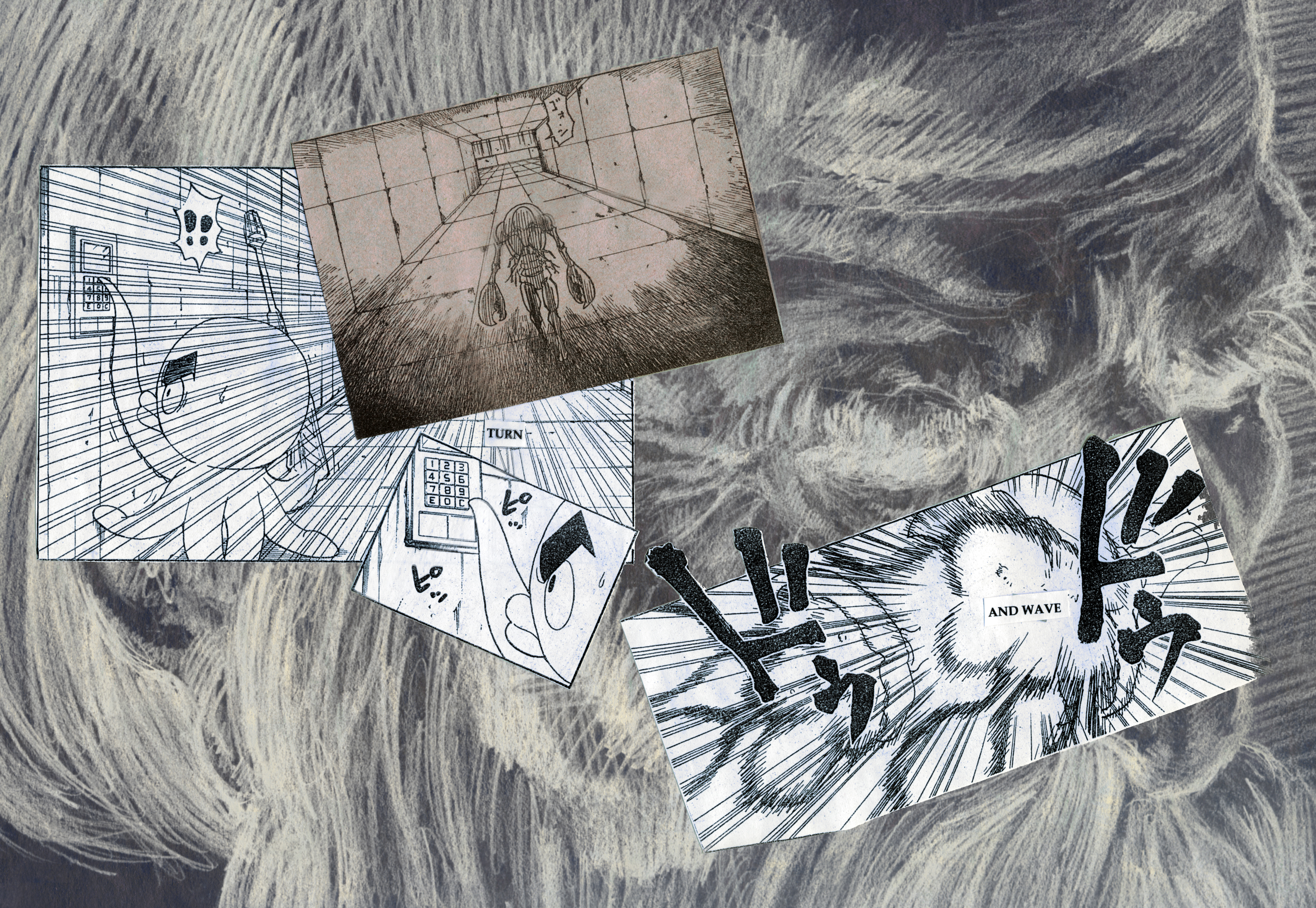
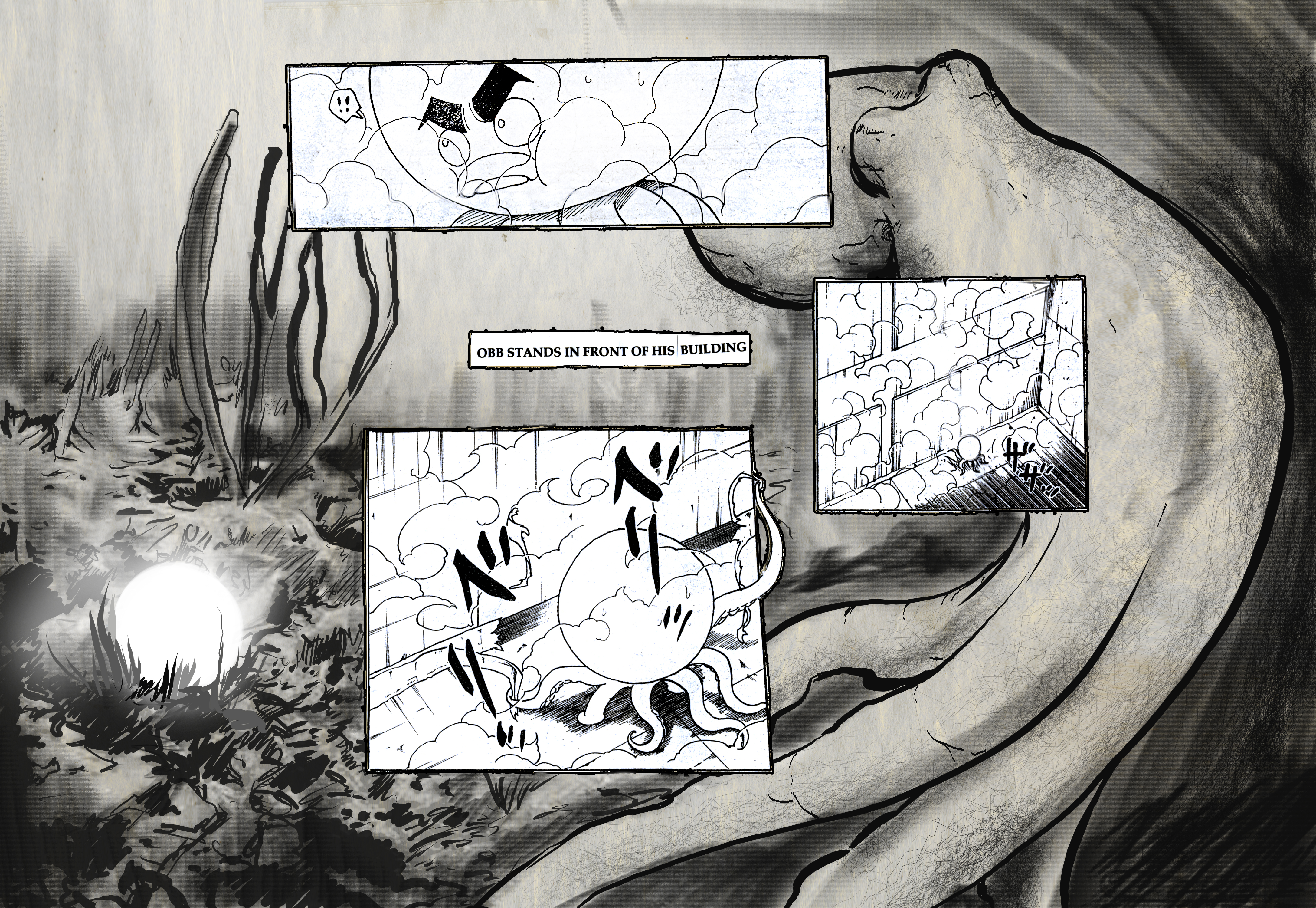
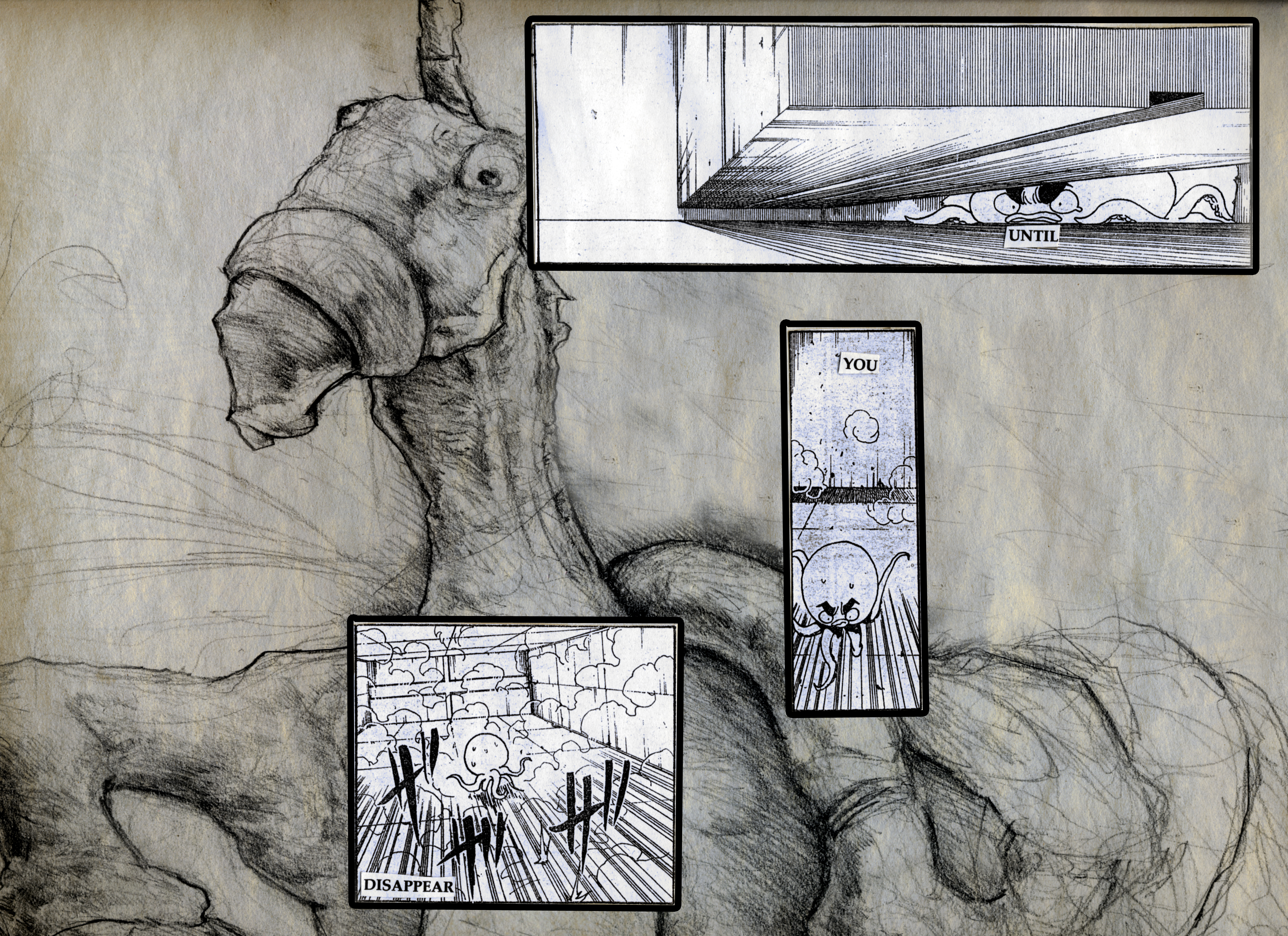
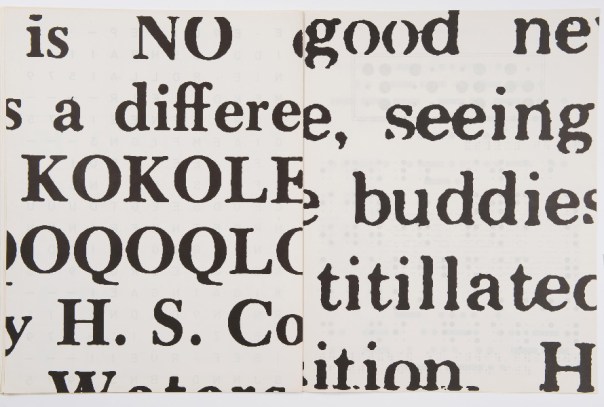
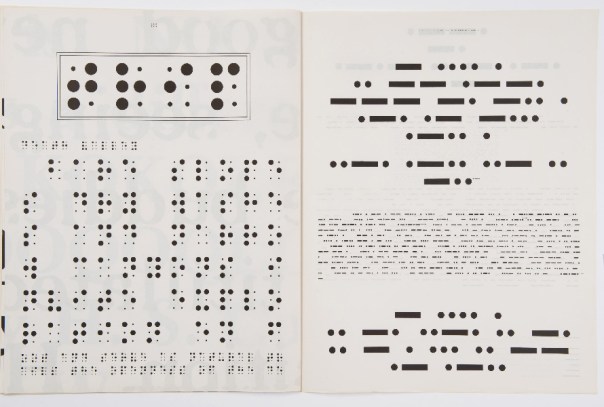
Alex and Paolo – I envisage the principal component of your box will be a print out of the OBB book. People will be able to look through the boxes – I am imagining an unbound stack of pages – and the exhibition will be used to “publish” the book so that it is available and distributed, but only within the Five Years gallery. Perhaps, Paolo, you imagine other publications in the box? Other books by yourself (those you have sent me?)? Other materials? Let me know if so.
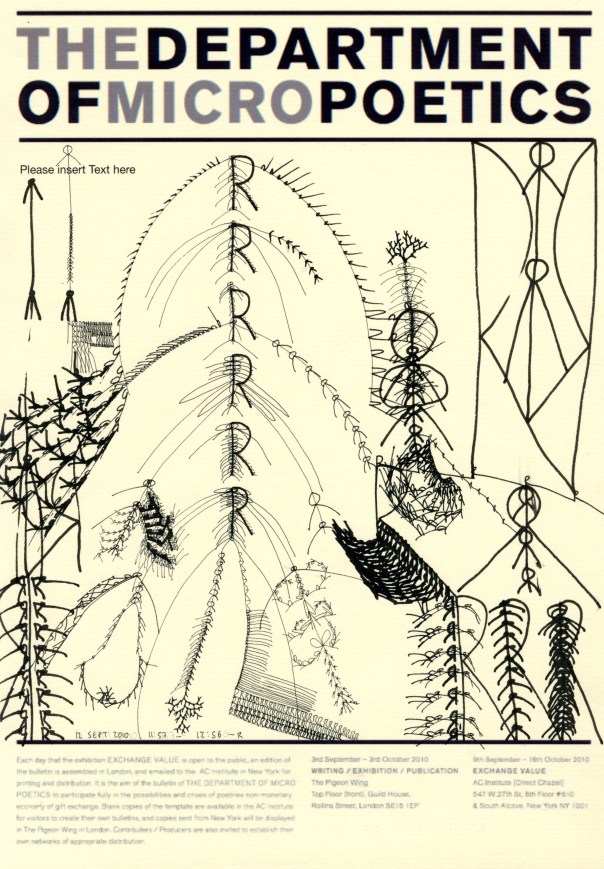
NOTE: This publishing of a book during/as an exhibition develops a trajectory from Paolo’s VerySmallKitchen residency at the AC Institute, New York for the Department of Micropoetics project in 2010, which used the gallery as a work space for finishing a collaborative project.
Sarah – I have tried displaying the printed pages of Uh Duh on the wall. I thought such a display might be a useful way to insist upon Uh Duh as a text to be read, but I don’t now think this is how I want to use the opportunity of this exhibition. Instead, I suggest we have a pile in the box (in chronological order) of all your printed books, topped by Uh Duh, along with a bibliography.
Sarah Jacobs, Uh Duh (LemonMelon/ VerySmallKitchen, 2011)
This idea both fits (conceptually) and does not fit (physically) the box, as (I remember from our conversation) it both expresses your affinity with and distance from the idea of being a book artist. It is sculptural at the same time as I hope it would be an invitation to visitors to look through the pile and read the books. The bibliography would make present an aspect of your work which I only know partially… let us know any thoughts…
Paul – I think one starting point for this project was the small card you sent me of one of the image-text pieces from your residency on the VerySmallKitchen blog. I was interested in the equal emphasis on both sides of this card (the image on one side/ text the other), and how – unlike the blog post’s downward scroll – to read the card required turning over, one side concealing the other in order to be comprehended.
This simple act of changing sides is contrary to the usual display of books in exhibitions – where the emphasis (when the publications are deemed too precious to be handled) is the spread, or where a closed book prioritises its role as object. That’s why I mentioned suspending this small card in some way. Maybe it also wants two readers who could each relay to the other what they were missing…
Actually, I think this card might be enough. But I offer the box space to you in this letter, whilst also wondering (and this applies to all of you) how two aspects of these boxes relate: how they are both an invitation to you and my own way of framing the work you have already contributed, taking into account budget, time, and the discussions I have had with Annexe, Pigeon and Ladies of the Press.
A key part of these discussions has been LOTP’s definition of themselves as “editors” rather than “curators” for this project. I am interested how each of us might define, imagine, choose between, combine, adapt, or outright reject these terms.
I think my own response here has been to foreground neither, seeing instead what identities and lexicon’s might in time emerge from thinking about the exhibition as a distinct form of publication and distribution for practices that also exist in many other locations.
The boxes will be displayed with this letter.
all best
David
3. A PIGEON AND AN ANNEXE
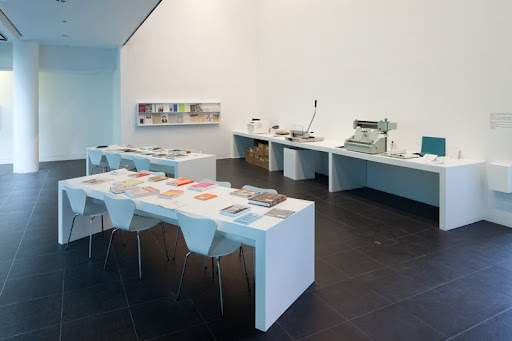
VerySmallKitchen’s contribution to the show takes shape alongside those by Annexe and Pigeon. We have met several times to talk about the show, and are working simultaneously so I have an incomplete knowledge of what these projects will be. In one meeting we agree an aesthetic of the overall space connected to ideas of press room.
Nick Murray of Annexe posts a preview of VOLUMES OF TEXT:
Pigeon write in an email:
…. We are completely following the idea of creating a live press room “Pigeon Press Room” within the Five Years space, in which the main activity will take place during the Private View on the 17th (and the residue of this will be left over to remain throughout the duration of the exhibition’s run). This press room will be a hectic process of creating outputs, edited and effectively ‘manned’ by the three of us as editors.
The set up will manifest itself as a ‘line of process’ running from Online/Digital to Offline/Analogue through three stages (tables) of process and intervention…
4. I USED TO CALL MYSELF AN ARTIST
seekers of lice sends me a photograph. We have been talking about both performing and installing a version of the talk piece A Minor Poet of the Twenty First Century which involves the shuffling, reading aloud and discarding (throwing down) of texts written on index cards.
Maybe the cards get left where they fall in performance? I was particularly fascinated by one card which notates an origin for the project:
I used to call myself an artist,
then someone said to me
“You’re not an artist. At best you’re a
minor poet and that’s much worse.”
I decided to become a Minor Poet of
the Twenty First Century.
In my mind I connect this to my recent reading of Wayne Kostenbaum’s Humiliation, where he observes that humiliation depends on a triad of humiliated, aggressor, and witness. Maybe, I think, this quote/ insult always provokes the “churning stomach. Dry heaves” that Kostenbaum sees as “humiliation’s soundtrack.” seekers of lice says that it does not.
…
I ask about the installation in the image. It no longer exists. but it offers a model for thinking through the nexus that has arisen:
poet- visual artist – index card – sculpture
In an email from seekers of lice : “The tower is progressing – 10 out of 16 units completed so far. I’ve just got back from scavenging more cardboard from Homebase.”
I reply I am reading FLUITEN IN HET DONKER which offers a case study of the exhibition unfolding out of etymology and an associative reading technique.
seekers of lice writes:
VAULT
It was called VAULT : vault, Voltaire, voltige, volte face, volatile
It came out of these connections: (this was written for the original curator)
Vault sb 1
3b. A burial chamber ( orig. with arched roof) usu. altogether or partly underground 1548
Vault v 2
1. to spring or leap; spec. to leap with the assistance of the hand resting on the thing to be surmounted
OED 1978
Voltaire chosen name of François Marie Arouet (1694 – 1778)
voltige Fr. acrobatics on a trapeze or horse
volte-face Fr. a spinning about to face one’s enemies
volatile originally, any winged creature
Cabaret Voltaire
nightclub in Zürich, Switzerland founded by Hugo Ball with Emmy Hennings on February 5, 1916 as a cabaret for artistic and political purposes.
At the first meeting Ball read aloud from Voltaire as well as from his own writing.
Hugo Ball (1886 – 1927) German author, poet and leading Dada artists
Die Flucht aus der Zeit (Flight Out of Time: A Dada Diary) 1927
Rainer Maria Rilke (1875 – 1926).
The Notebooks of Malte Laurids Brigge (1910)
Rilke’s only novel written while Rilke lived in Paris. The novel is semi-autobiographical, neurasthenic and claustrophobic, obsessed with the quest for individuality and artistic expression in the face of death.
I was interested in the juxtaposition of the romantic poet, and dada and the beginnings of conceptualism, of that particular historical moment, represented by the different meanings of the word vault…
5. WHO ARE YOUSSSSSS
Pigeons, seekers of lice, very small kitchens, annexes, ladies of the press… A litany of pseudonyms, heteronyms, strung between a novelists fever and outsider corporation. Playful, animal, neutrally and abundantly gendered, architecturally expectant, saying what is not as much as what is.
In an essay written for the Press Release this “character-fulness” of a VerySmallKitchen is unfolded by LOTP:
Necessity for selection, cannot have 100s of jars of jam if you have one shelf and one table, one chair one spoon, plate, cup and so on. This is what you might end up with if you use Haiku as inspiration for interior design. Economy of means. And intimacy. How many of us can actually fit into a very small kitchen at any one time? It says something about the type of relations that contingently have to happen in a very small kitchen. And activities. Like cooking, eating, and talking.
6. OBB
Paolo Javier and Alex Tarampi, from OBB (forthcoming VerySmallKitchen, 2012)
7. PRINT ON NO DEMAND
08/02/12 I visit Sarah Jacobs in Islington to collect her books and the bibliography. The bibliography is intended to make evident a body of work. It does this, but it also makes evident a set of questions mysteries. Part of the practice of bibliography, of course, but emphasised here by an artist for whom content is often related to a questioning and exploiting of a books potential and actual distribution.
Arnaud Desjardin, The Book on Books on Artists' Books, Bloomberg Space, London, 2011
Questions raised by the bibliography itself are expounded when I attempt to correlate the information on its two pages to the table of books Sarah has laid out. The “same” books recur in different formats; some books are missing (explorations of print on demand processes for which there was, it seems, no demand).
The exhibition is the only place to see these books. The bibliography is here.
In the introduction to his The Book on Books on Artists Books (The Everyday Press, 2011) Arnaud Desjardin cites Simon Ford’s observations – originally in the context of the situationists – concerning a “bibliographic moment”:
The bibliography appears at the point in a subject’s living death when criticism reaches critical mass. As such it indicates the death of any innocence in the face of the subject. The weight of material already published and documented will have to be carried by any subsequent writer. This will not, of course, restrict the field of interpretation; the bibliography opens the way for a multiplication of viewpoints from which the subject can be examined. (5)
9.WHAT COLOUR AM I? YOU ARE ORANGE
Thinking towards some sort of collaboratively authored text around the exhibition, Pigeon, Ladies of the Press, Annexe and VerySmallKitchen spend one evening writing a google document in response to pre-chosen questions. Different coloured cursors move across the screen as seven people in different locations across London and Brighton write, delete and edit.
I write: the reason for all these reading room exhibitions, displays of printed matter, is not so much proposing that people read in the gallery – a difficult thing to do because of time and situation – but to construct The Reader (in public) as an exemplary model of the gallery visitor.
Marcel Duchamp, Boîte-en-valise, 1935/41
Is this true? For myself, the live Google doc and the hour we have given ourselves for writing this text encourage such propositions to be later tested and unfolded.
Something else we talked about when we met in person was the notion of scene in relation to our different practices, how the exhibition constructs one that does not exist so distinctly at any other time and place.
*
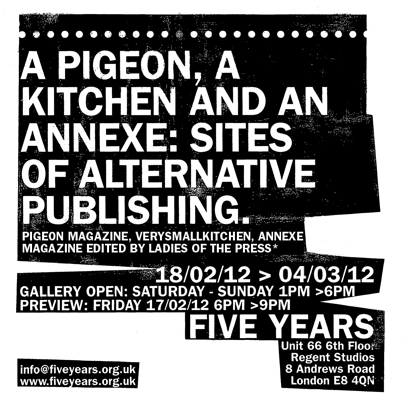
A PIGEON, A KITCHEN AND AN ANNEXE is at the Five Years Gallery, London, from 18th March. Please join us for the Private View on the 17th from 6-9pm. More about Annexe here, Ladies of the Press here, and Pigeon here.
The following exchange took place by email between David Berridge (VerySmallKitchen) and Marit Muenzberg (LemonMelon) in January 2012, alongside the production of Uh Duh by Sarah Jacobs, the first title in our collaborative publication series.
DAVID: To begin it seems that there are lots of connections between VerySmallKitchen and LemonMelon, and also differences. The similarities are an interest in the role of language in a contemporary art context as revealed through the methods foregrounded in art practice… Perhaps you would explain this differently?
Sarah Jacobs Uh Duh (LemonMelon/ VerySmallKitchen 2012)
MARIT: I fully agree! Perhaps another connection is that we both understand the book as a social/ performative space i.e. that books are grounded on a notion of performativity? I have to think here of Foucault writing ‘A book is produced, a minuscule event, a small malleable object.’
DAVID: Within this there are different priorities, different ways of working, maybe different languages for talking about that work, different training and histories, contexts, collaborations and reference points. In editing a book series together, are we exploring the place of overlap or are we looking to make some new territory?
MARIT: I think I would hope that the collaboration pushes us individually into new territory – out of the comfort-zone of what we each know and circulate in/around – therefore creating new methodologies of publishing?
Sigurdur Gudmundsson, Situations, Event, 1975
DAVID: What different methodologies are you thinking about? What would you like to change?
MARIT: I was just trying to think of publishing as research. What could that be/imply and how would that manifest itself? When could publishing be research? Does it imply some ‘unlearning’ of what we already know or of how we understand the terms ‘publishing’ or ‘books’?
Further – as you mentioned above – we could ask ‘why collaborate’ or ‘what does it mean to collaborate’? I.e. is our collaboration merely a sharing of knowledge? Is it – to paraphrase the Chamber of Public Secrets – us getting bored working alone? Is it sharing a discursive sphere? Or does our collaboration aim to – quoting Iris Dressler – presume rhizomatic structures where knowledge grows exuberantly and proliferates in a rather unforeseeable fashion?
And what is the role of this conversation as part of this collaboration, where does this conversation lead us? Or should I say ‘these conversations’ since it already appears as if this conversation contains multiple conversations?
…
MARIT: Mallarmé saw the experience of reading as a form of freedom. He compared it to meandering through a public, a decidedly popular space. I wonder where thinking about the surrealist errance or situationist dérive in relation to this would lead us?
DAVID: Making a book is a fixed, definite process in lots of ways, so the question becomes what part of the process the dérive operates in. I find it easiest to imagine this errance/dérive in terms of where the book comes from, picking up on hints, suggestions in someone’s work that might unfold into an as yet inconceivable book.
Uh Duh is one version of this. There was a conversation, which was never conceived of as a book, at least by me. Then two years later there is a text. For Sarah, in some ways, the whole thing was planned and executed – or at least hoped for – an idea for a book that was waiting for the right conversation to enact itself.
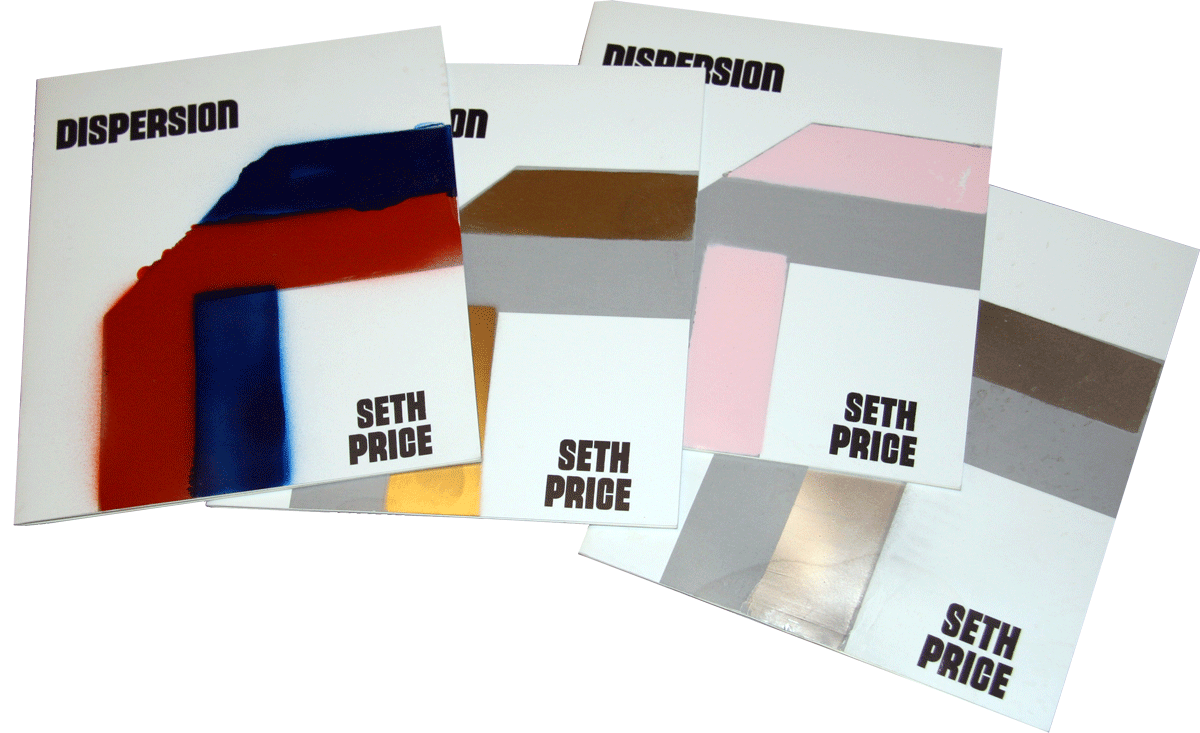
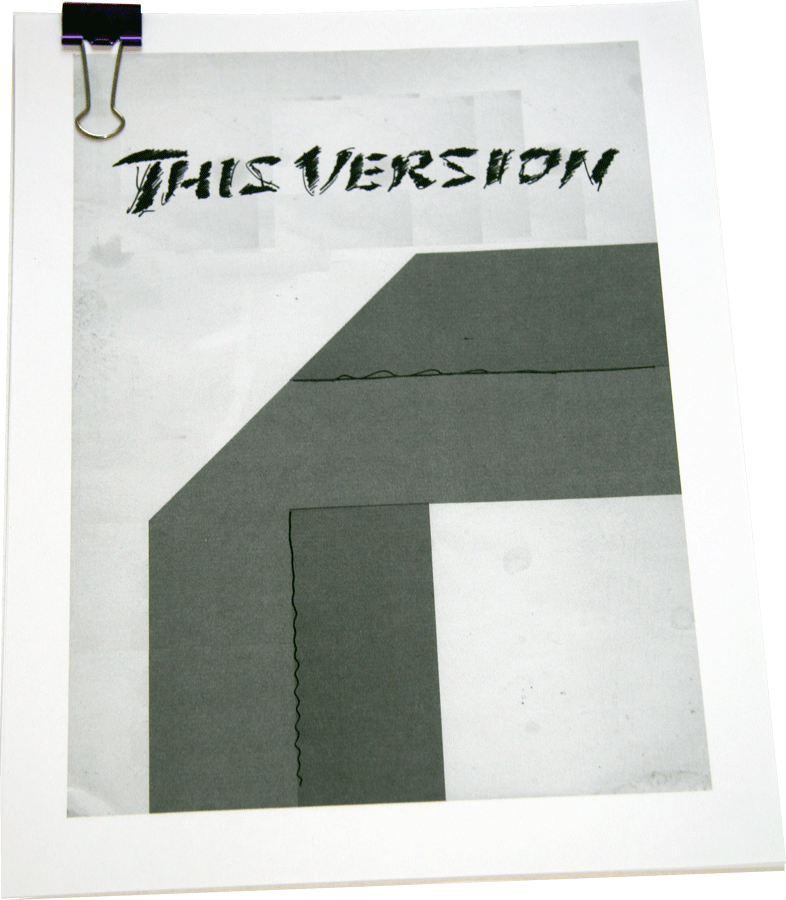
MARIT: I wonder whether this errance/dérive could also manifest itself in the way a book is distributed? Seth Price comes to mind here since he produced different versions of the ‘same’ work, Dispersion (2002–) being one of them.
Seth Price, Dispersion. (Top) 38th Street fascicles (2008) (Below) Ukrainian Art School bootleg (2006)
Or one could think about whether this idea of ‘loosing oneself’ – inherent to the situationist errance – could become part of the process of production. As you say a book has quite a fixed process but every process also has possible glitches, moments where things go wrong.
I guess I am thinking here particularly of the risograph. Every page printed on a risograph looks different, the printing process itself leaves traces on the pages etc… Maybe, rather than discarding faulty pages they become the basis of something new or lead to something else?
DAVID: I find it hard not to respond to Seth Price’s Dispersion as a reminder of the different attitudes to publication and distribution in contemporary art as opposed to poetry. To generalise, the art world’s ability to devote huge attention to a freely distributed PDF is rather baffling to the poet. From this perspective, I experience Dispersion as an impoverishment of generosity and distribution, an example of proprietorial control rather than freedom.
MARIT: I thought the attention more to be related to the different forms of publishing and therefore the different forms of distribution. Thus the distribution was not a disconnected process after the book was printed but became an integral part to the being and functioning of the book. So the process of production was a direct expression of the book itself. It is here that I see the connection to the situationist errance.
…
DAVID: The practical process of making a book daunts me. I don’t feel I have the skills to produce such a thing. It is exciting to me that, despite this, I can use the web to distribute books and projects, get an audience for that work, begin to give form to a field or scene of activity… which is also a list of some of my motivations. You?
MARIT: A book seems to be understood as something that belongs in and with people. To quote Matthew Stadler ‘Publication is the creation of a public … This public is created by deliberate acts …’ so yes the creation of that public is exciting for me as well as ‘giving form to a field or scene of activity’. I guess Deleuze also comes to mind here understanding the book as an active agent.
DAVID: I feel like I want to say ‘readers’ before I say ‘public.’ It’s the reader that often seems to be missing from art writing debates, which is perhaps why there’s often a fascination with books that either through sculptural manipulation or distribution/cost as art works are basically unreadable, from Marcel Broodthaers and John Latham to Oscar Tuazon.
Tuazon’s recent provocation The Social Life of the Book (in part a reflection on his involvement with Section 7 bookstore) claims that a publishing practice like ours is about navigating the exclusivity of such a practice, pushing the book and publishing towards the model of the commercial gallery. He suggests embracing this, producing a novel in an edition of one –
MARIT: I see the book becoming more and more an ‘art work’ because less and less books get physically produced since the production cost of an e-book is so much smaller. Not that I agree with that development, but there are a variety of reasons for such developments.
I guess that begs the question – when does a book still function as a book as we know it? Should the book function the way we know it and if it doesn’t does that then mean it is not a book anymore? How far can the term ‘book’ be stretched?
Pages from Sue Tompkins, Long hand (LemonMelon, 2011).
DAVID: Two inspiring examples for me are Ugly Duckling Presse and Dalkey Archive, both publishing concerns whose books I buy and read through an engagement with the press as a whole, as well as following up individual writers and texts.
Both have found an editorial and design identity (Dalkey by the designer/ poet Danielle Dutton) that instead of foregrounding a set of formal ideas about books, publishing and distribution – although these are of course evident – supports and develops practices, histories and expanded geographies of writing, translation, criticism…
…
DAVID: Looking through the stock of bookshops like Section 7, Motto and X Marks the Bökship, I see a field of activity mediated by graphic designers, where the designer becomes editor, author and curator in such cases as Dexter Sinister, Will Holder, Scott Joseph,Phil Baber and others…
At Thoughts on a Book last week the graphic designer as a producer/author of content was both celebrated and dismissed. I’d thought in questioning and thinking through this art writing – graphic design relationship I was revealing my identity as a writer, but actually the graphic designers seemed maybe more agitated!
The connection of art writing and graphic design means certain kinds of writing and publication get made, and perhaps the design process masquerades as the editorial process … the ‘literary’ is something different to this, a different sense of a practice, of publication – but you are also graphic designer! How do you see this?
MARIT: Yes the literary seems to be a different genre, although of course overlaps do exist I think.
Maybe one should quote here from the recently published ELEVEN STATEMENTS AROUND ART WRITING by Fusco, Lomax, Newman, Rifkin: ‘Art Writing addresses material literary forms, which draw attention to the spatiality of writing and the physicality of its support …’
Paolo Javier and Matt Jones, From the Occult DIary of Hosni Mubarak (VerySmallKitchen, 2011)
DAVID: ‘..but the interests of art writing diverge from those of literature.’ I wonder about this divergence. I see this working in a publication like Maria Fusco’sThe Mechanical Copula, for example, but I also find it most useful to understand such writing as holding to a space of literature within art practice.
MARIT: I am not yet sure how to position the importance of the relationship between art writing and graphic design or rather typography – evidently some forms of writing demands a certain typographic treatment or naturally bring a certain typographic form with them however since most ‘art writers’ are not necessarily typographers this is not always executed the best way …
DAVID: I think notions of ‘good design’ – as represented, say, by the press releases posted on Manystuff – obscure the eclectic ways writers have chosen to present their texts.
MARIT: I think that Manystuff has a very particular aesthetic understanding or style, which immediately excludes a lot of other things…
DAVID: The photocopied pamphlets of Bob Cobbing’s Writer’s Forum, or, a current example, Jared Shickling’s Ecolinguistics, a cut and paste A4 publication, stapled in the corner and distributed in the mail. I’ve been thinking of these as counter-examples. Styles of design, of course, but I’m thinking that although they might be seen as ‘bad design’ by graphic designers this isn’t actually an obstacle to their distribution or readership…
….
DAVID: The re-printing of texts is another dominant element of art writing publishing. When publications like Cannon and F.R.David re-print Stefan Themerson, I appreciate the enthusiasm that expresses, the circulation it gives to that writing, and its sense of the text practitioner as involved in a conversation about existing texts, not just the creation of new ones.
Neil Chapman, from Memo Seven (VerySmallKitchen, 2011)
But there is also a practice and craft of writing which is too all consuming in itself to be too interested in this non-writing writing (particularly when the economics of a writing practice are considered). I want to celebrate and maintain this space. Essay collections like Eileen Myles’ The Importance of Being Iceland and Chris Kraus’ Where Art Belongs give a sense of what I am trying to articulate here.
MARIT: Interestingly this element of re-printing does link to the next project we are currently thinking about (and about which we have not really talked about yet).
I am thinking of this act of re-printing in the context of the deconstructivist understanding of iterability which also links to the LemonMelon methodology of anagrammatical hesitation. I believe that re-appropriated texts as well as the above mentioned examples can be seen as re-prints. Both I feel are artistic/writerly acts, potentially just as interesting as the text/work they are based on – after all they are not claiming to be nothing but a re-printing but do gesture towards the other text.
….
MARIT: Is that where the social space of the book becomes political? And what happens if it does?
DAVID: I see the book as being the evidence of a certain set of relations, and also – in its contents, design, distribution – a proposition about certain forms of relation. Although, as you suggested recently by highlighting the notion of privishing, acts of giving visibility are always related to a language of invisibility…
Andrea Ayala Closa, The Keep My Arms Warm When I Read In Bed Thing
MARIT: How do you understand ‘a language of invisibility’?
DAVID: Notions of naming, of giving voice to, has connections to notions of marginalisation, voices silenced through class, race, and gender. I wonder if that social agenda is at all part of our rationale? How do such concerns become evident in this project?
MARIT: I was more thinking of the relationship(s) between writer/author and reader/public or – to open it up – the relationships and conversations the book could create, or the ones it could exclude, the ones it shuts down or …
But then I guess I also understood the political in relation to our handling of other texts (linking it back to our conversation on re-printing).
…
MARIT: For one I believe that there is some kind of system in thinking/thought and secondly I am personally very interested in notions of constraint – although I am not sure this is relevant in this context.
DAVID: Like the dérive or errance, I wonder how the constraint functions differently throughout the publication process. Financial constraints, of course, or constraints of creation, as with Cabinet’s new 24 hour book series.
These could be extended into distribution constraints, as with Oscar Tuazon’s edition of one. There’s a section of Ugly Duckling Presse for conceptual books – Paperless Book Department – although, interestingly, it is far less productive than the Paper Department!
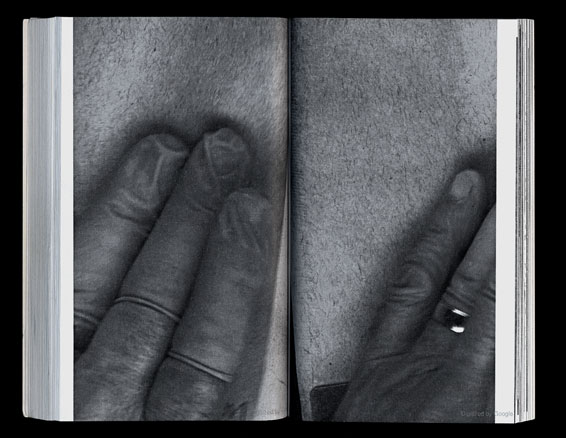
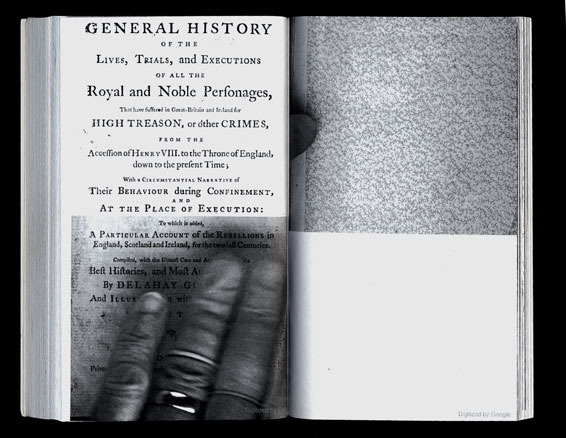
Jeremy Jansen, from Digitized by Google (2007)
MARIT: This makes me think of a book Coracle Press had on their stall on the recent RGAP fair. The principle was that it cost 100 of whatever currency the person wanted to pay in, ie. 100 Euro/100 Pound/100 US Dollar/100… the number 100 having some kind of significance for/in the book. Maybe this is not quite a constraint but could be understood as a rule-governed structure integral to the project.
…
DAVID: When organising an exhibition, the Ladies of the Press define their role as editors rather than curators. Being called Ladies of the Press, their process is rooted in such a constellation of metaphors, but this lexicon shift is made because of the different working methods and styles it implies, particularly regarding the relation between organizer and artist, frame and content. Which also seems to connect back to those questions we have explored here of relating to and diverging from the literary…
There is no more stage. There are no more footlights. You are among the people. Then be modest. Speak the words, convey the data, step aside. Be by yourself. Be in your own room. Do not put yourself on.
Speak the words with the exact precision with which you would check out a laundry list…The poem is nothing but information. It is the constitution of the inner country. If you declaim it and blow it up with noble intentions then you are no better than the politicians whom you despise. You are just someone waving a flag and making the cheapest kind of appeal to a kind of emotional patriotism. Think of the words as science, not as art. They are a report.
(Leonard Cohen, How To Speak Poetry, from Death of A Lady’s Man, 1979)
Writer Statement 1
What should a writer be stating? Should it be something rebellious like ‘Viva la revolution!’? Should it be something gentle like “I love you’ or should it be something morbid-smart-ass like ‘Writing is like death and death is the end and that is the limit and trying to go beyond that limit is futile’ and all that kind of stuff?
No, those don’t sound like real statements. They sound like somebody wanting attention.
Maybe a writer is somebody who wants attention? Maybe he is seeking attention? Maybe he just doesn’t want to be alone? Maybe that is the feeling he is transferring to the reader?
The writer writes.
The statement states.
That is the inherent contradiction in a Writer’s Statement.
A writer tries to hide by writing, not to state something.
So in fact he is not looking for attention. He is trying to draw attention to his writing so that he can escape in the meantime. It’s like a decoy. Writing is a decoy.
He writes in order to erase himself.
This should be my Writer Statement:
“I am a writer and I am going to disappear. While you are reading this I am already somewhere else. You will never find me.”
Portrait by Veniamin Kazachenko
Writer Statement 2
To write a Writer Statement means that I already admit that I am a writer in first place. Only a writer can write a writer statement. Someone who isn’t a writer shouldn’t be writing any kind of writer statement. But if I am already stating that I am a writer isn’t that what the statement should be proving? That I am a writer. That I write. It is a confession that I am a writer. A writer statement is a confession that one is a writer.
I confess.
I am a writer.
—
22.1.12
My nose hurts.
At first I thought it hurts because its growing,
growing from all of my lies like Pinocchio.
I imagined myself walking around a little Italian village
and meeting some guy who would promise to make me real,
to make me real famous.
Then I sat around and thought to myself that writing is like lying,
because it always misses the point
there is always something else I want to be talking about,
but I end up talking about what’s in front of my nose.
What if I were to stop writing?
Would my nose stop growing?
Would it stop hurting?
But writing is what makes me feel real.
And how would I become real,
how would I become real famous,
if I were to stop writing?
Would I be able to become real famous by stopping to write?
Maybe stopping to write would make me real?
Maybe It would make me focus more on life
and less on telling all these lies.
The Thinker (After Rodin), Ohad Ben Shimon, 2012
Maybe my nose will stop hurting,
and my lies would stop lying,
and I would be just ‘one of us’,
a good old jew boy with a big nose.
_
AN INDIRECT DIALOGUE
The following exchange took place by email from 23rd-25th January 2012.
VSK: That’s a very interesting statement by Leonard Cohen isn’t it! Particularly those ideas of “information” and “report” and how those might sit with us now.
I’m thinking about this alongside your previous residency writings – that sense in the last post of observation, reportage in some ways, in the bar…. the way that from post to post I feel as a reader I can follow a series of kinds of attentions, not a linear flow but a series of distinct positions…
Out of the Cohen comes a cluster of terms and concerns through which to think about writing – the ambiguity of how it feels and effects: “state” and “statement”, different notions of paying attention, being attentive, and wanting attention. How “attention” changes when it is something to be received not given!
The concerns of the writer leading to the creation of a text which has its own life to lead…
OHAD: I was thinking of the notion/definition of art, as such, and here referencing the Conceptual Art’ preoccupation with who defines Art. The problematic of the artist defining what is art in comparison to the writer stat-ing or the relation between the writer and the state.
Perhaps then we can say that the space between writing and art practice is defined by a double failed negation. The Artist in his or her attempt to define what is art or who is an artist and the writer on his or her behalf to make any clear statement about writing.
VSK: Given what we have been discussing about writing in an art context, I enjoy this sense of “writer’s statement” in relation to the more familiar “artist’s statement” and the particularities/ peculiarities/ contexts of that form… that writing is somehow counter to the writer or the writer’s thoughts and intention- how that “counter – to” works itself out…
So if this ‘writer statement’ is impossible even as it is acted out then it suggests there might be other ways we can talk about this, which also returns to certain literary forms such as fiction, poems, fables.. we also turn to everyday experiences and anecdotes to try and find another way of speaking this, or to find an energy that might feed into our ‘writer statement’ even as it escapes it…
OHAD: I like very much you pointing out that the impossibility of a writer’ statement being acted out (and indeed it is reminiscent for me of the artist statement) can lead to or suggest other detours to talk about it… you mention literary forms… and I think visual forms can also function as such detours… perhaps that’s the dance/oscillation between the textual and the visual in my practice.
VSK: In The Writing Life Annie Dillard tells a story of a writer who would repeatedly stop writing and go out for a walk, come back home, then type up the whole story again, hoping that each time the impetus of the walk followed by typing enabled the writer to build up a momentum that continued the story for a few lines or pages. In this way the novel was written…
OHAD: Well, it took me a while to figure out some images and I played with some options.. At last I came to three different portraits of me. I wanted to stay away from any kind of theatricality due to Cohen’s low-key reference but eventually I couldn’t…it was stronger than me.
VSK: I like the ending – a real punch line! Interesting to think of punch line as art writing strategy…
OHAD: I would like to suggest the figure of the philosopher/thinker here as perhaps an essential link in order to make the bridge and complete the ‘picture’.
readable even if the moment of its production is irrevocably lost and even if I do not know what its alleged author-scriptor intended to say at the moment he wrote it.
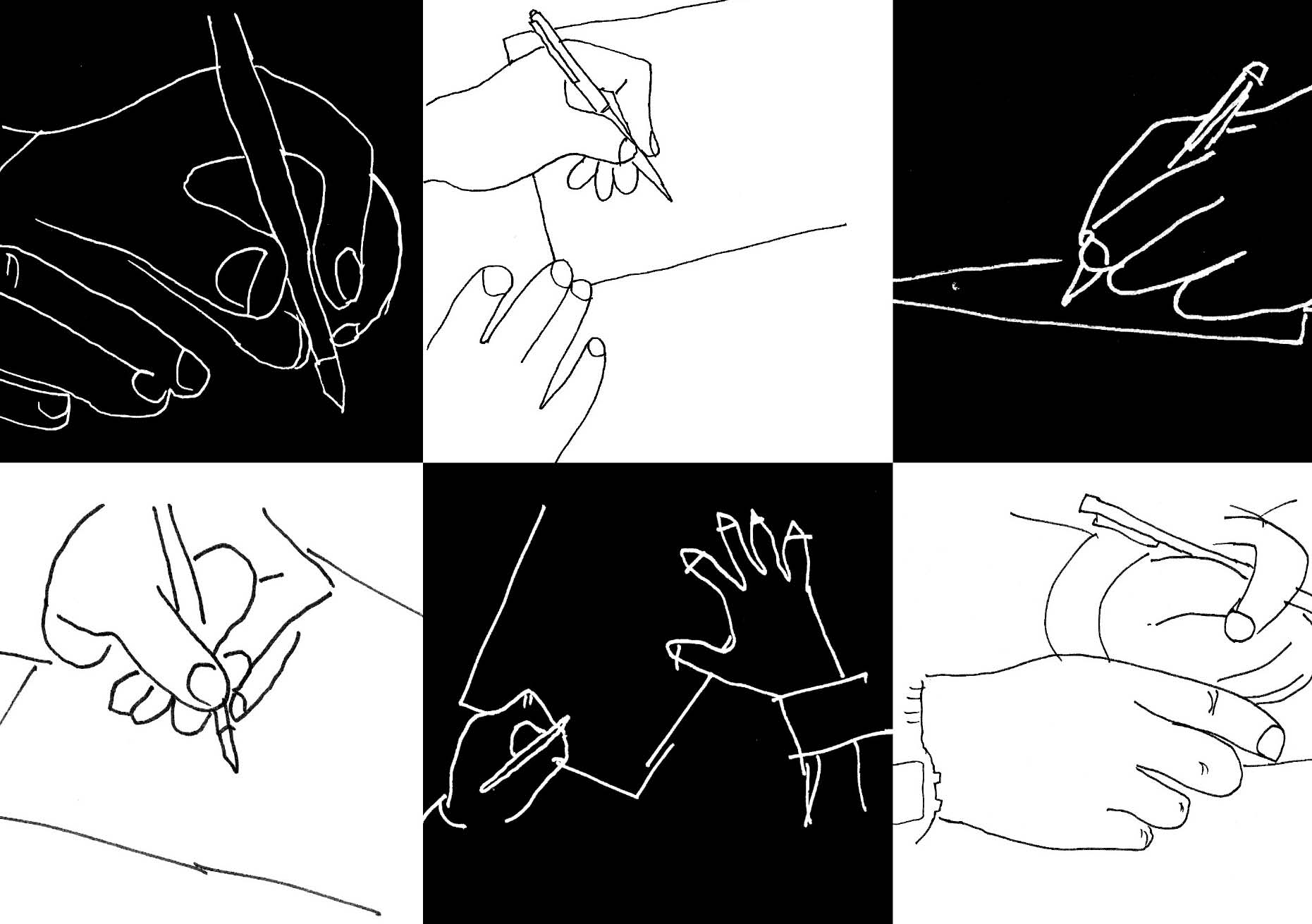
There’s something poetic about grasping a writing instrument and feeling it hit the paper as your thoughts flow through your fingers and pour into words… use a pen or a pencil to rekindle that creative feeling through a handwritten note, poem, letter or journal entry. Handwriting allows us to be artists and individuals… Throughout history, handwritten documents have sparked love affairs, started wars, established peace, freed slaves, created movements and declared independence.
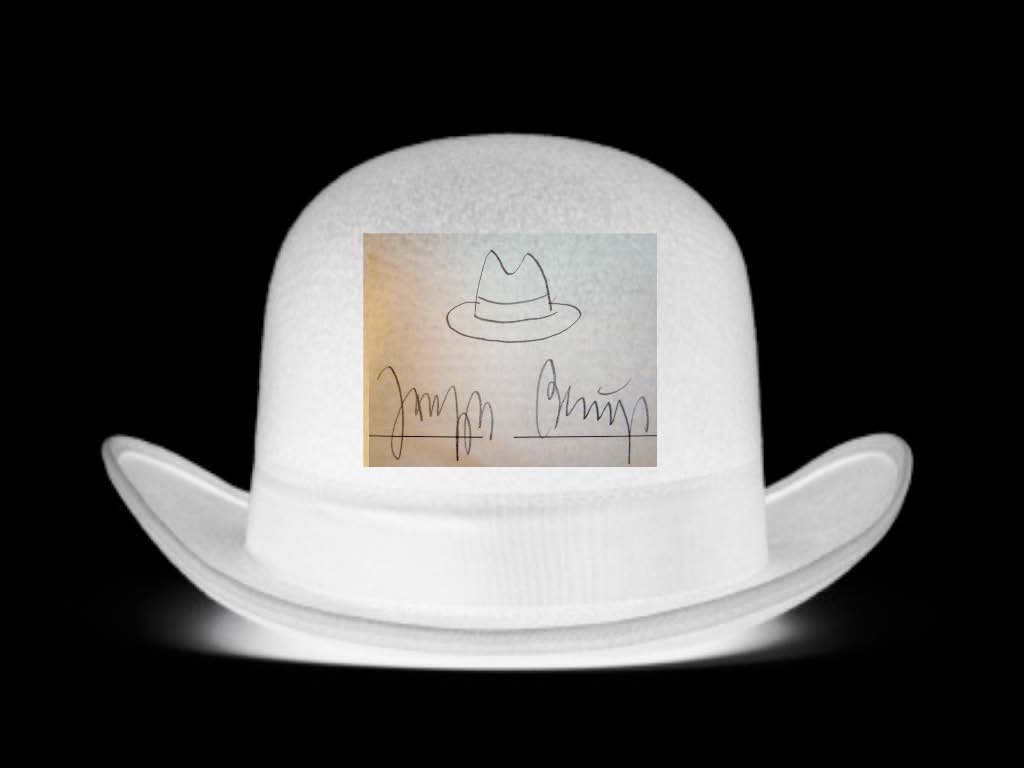
As WIMA remind us, January 23rd is also the birthday of John Hancock who “was the first to sign the Declaration of Independence and is famous for his large, bold signature.”
For Raven this celebratory e-book is the latest outcome of several projects exploring the play between signature and significant, including – after Pessoa, “a great sad hope for me” he writes – a group show of the self and a signing of the “significant natures” of Beuys, Goya, Picasso, Warhol and Rothko. Note the chronology.
Signatures copied, forged, repeated, photo shopped… In Raven’s projects a signature is both copy, forgery, image, and authentication. Aesthetic and philosophical questions, but artists’ estates, auction rooms and SOPA see it otherwise…
As Annette Messager writes in a short note published in her WORD FOR WORD monograph:
Many other collection albums are made throughout the day, for example, I try to find my best signature, the one that would best define me, I scribble my name hundreds of times with different handwriting on notepaper and then I classify them according to my preference.
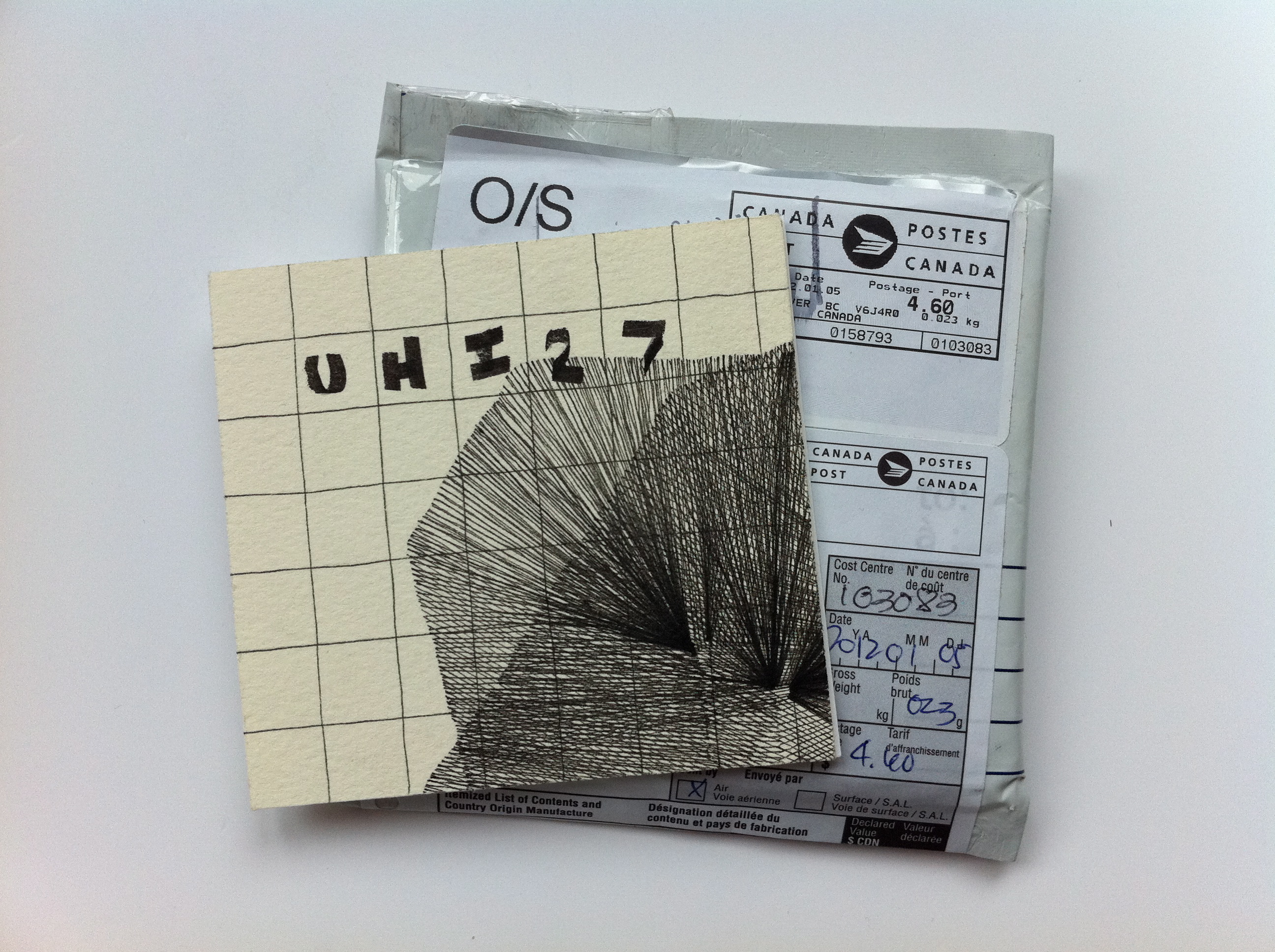
VerySmallKitchen and LemonMelon are delighted to announce the first title in their collaborative book series: Uh Duh by Sarah Jacobs. The author describes the book as follows:
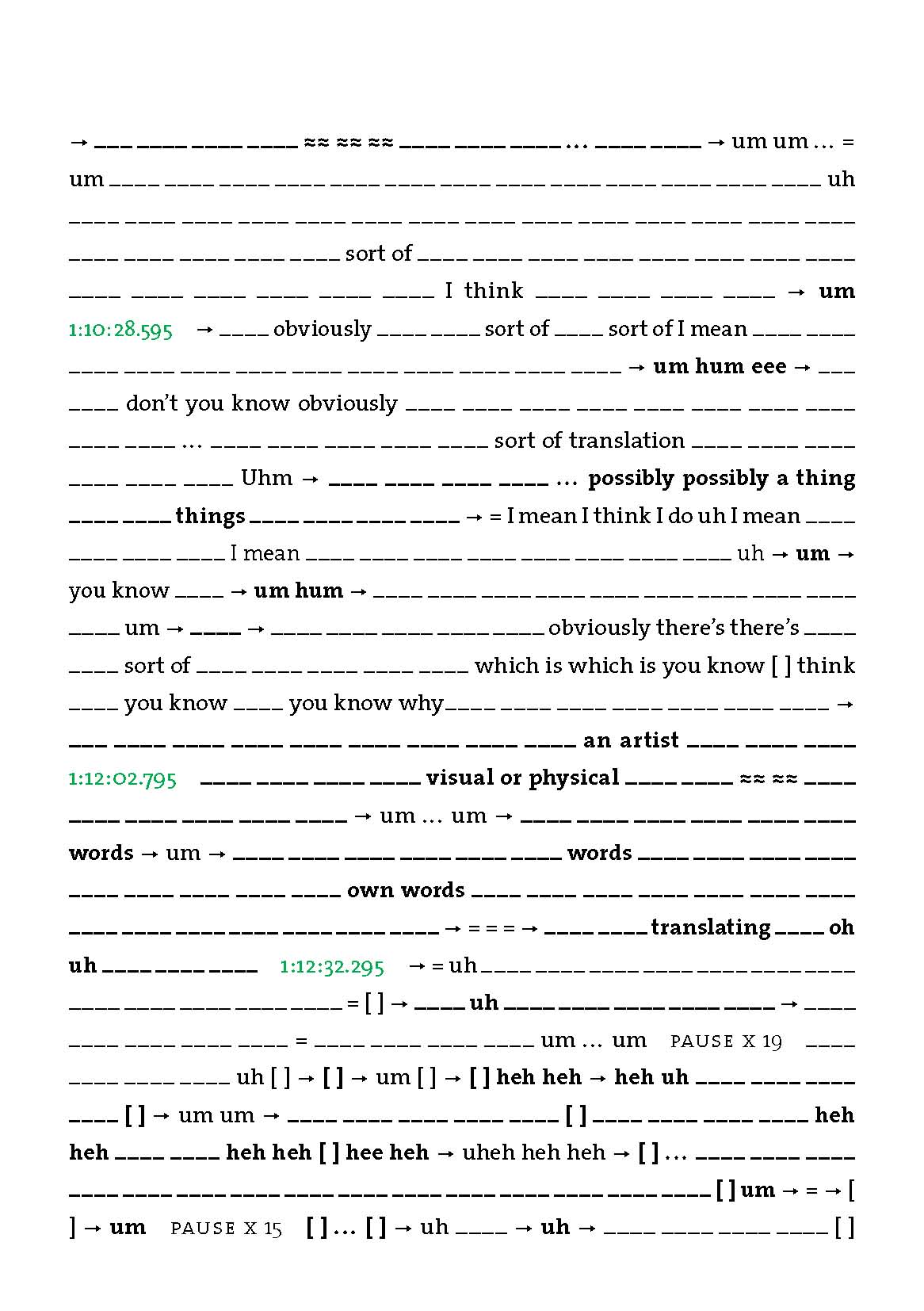
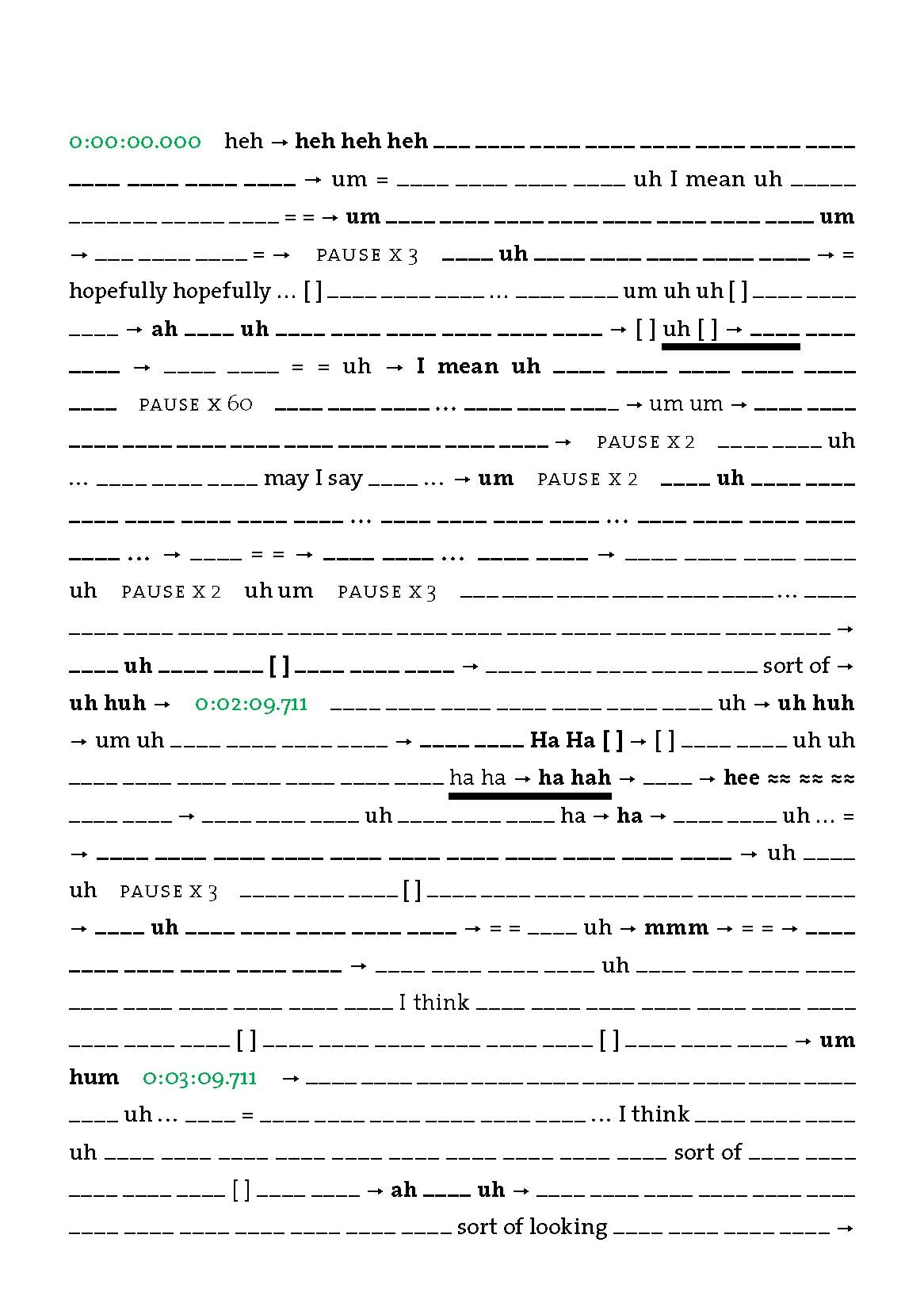
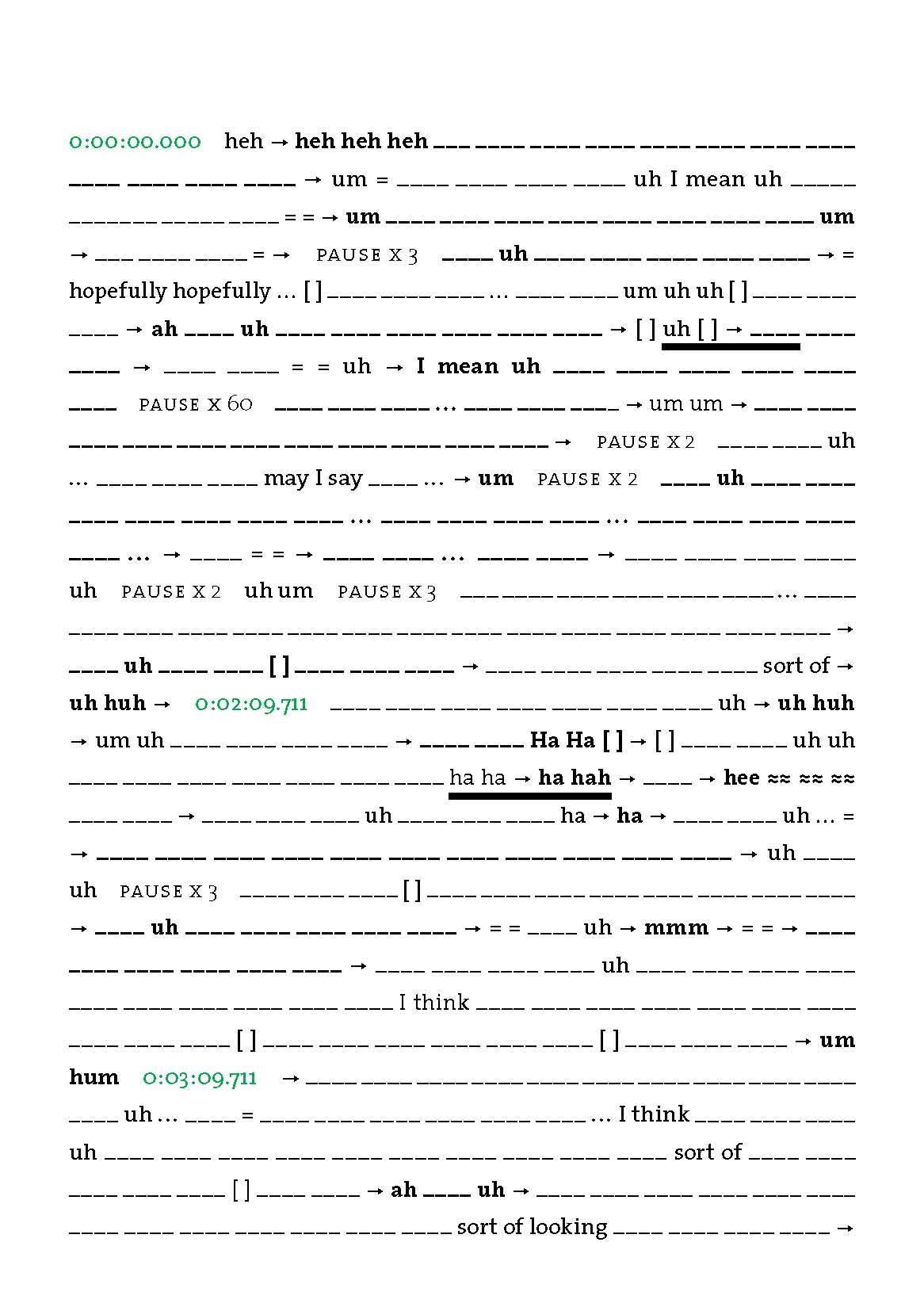
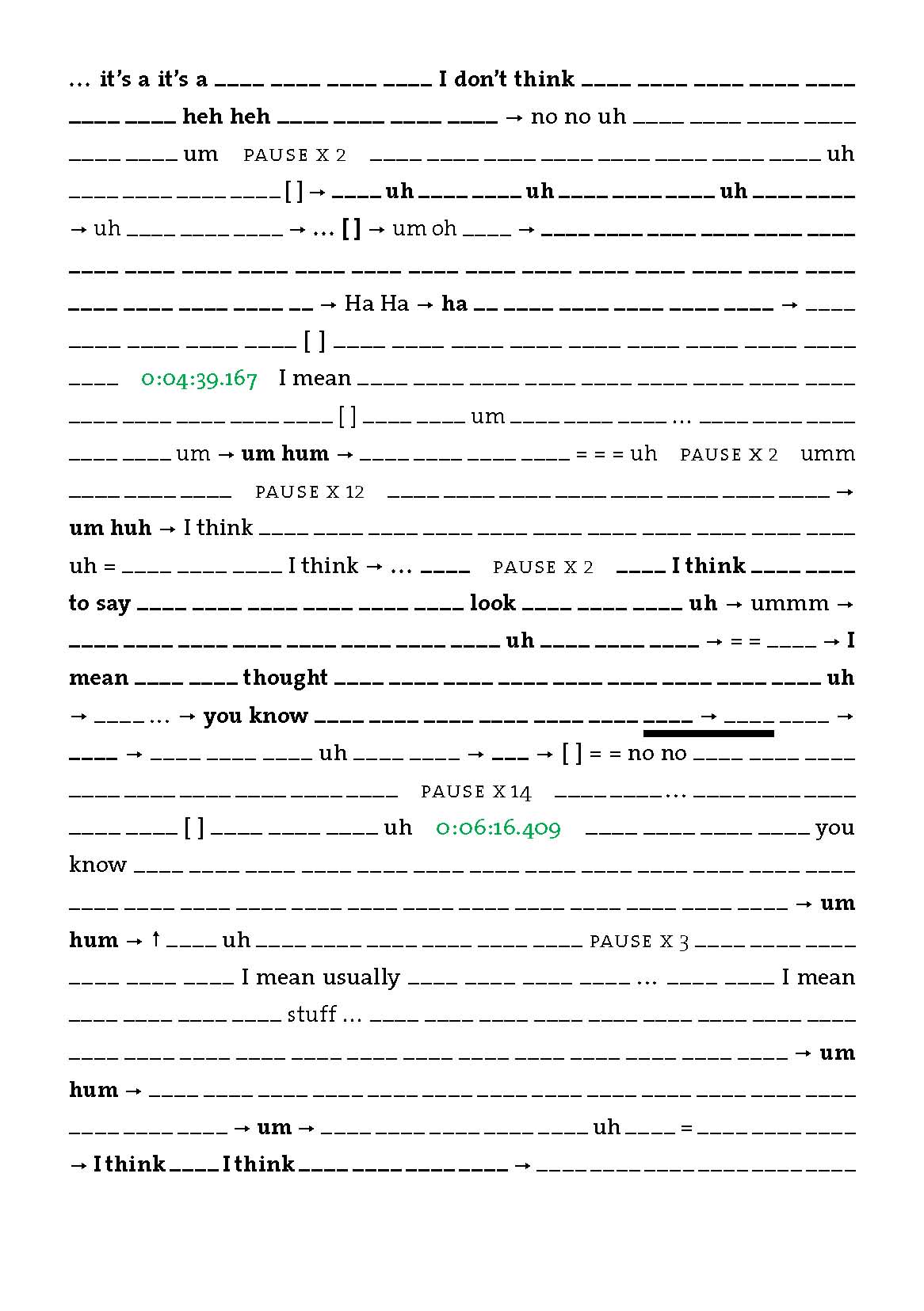
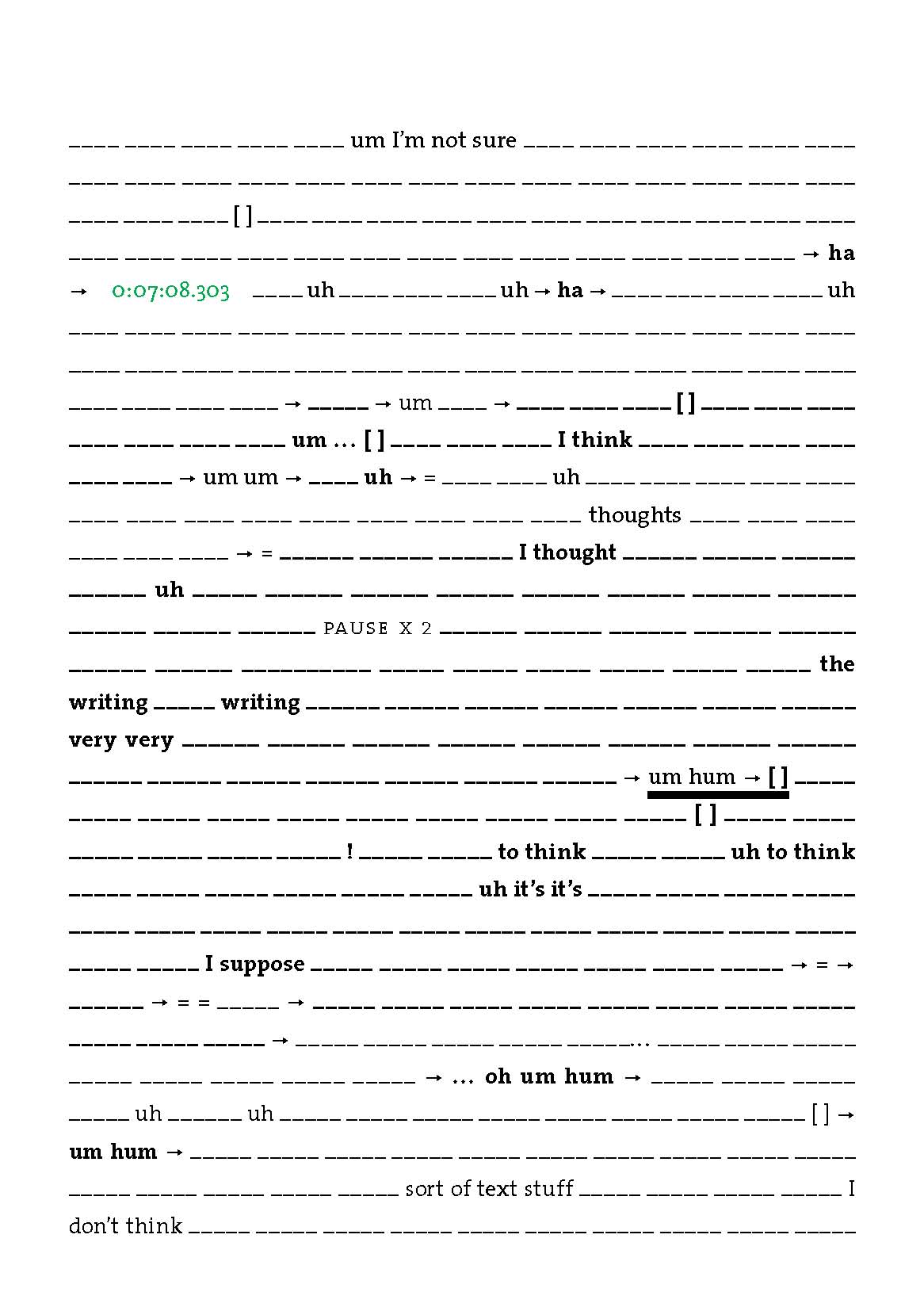
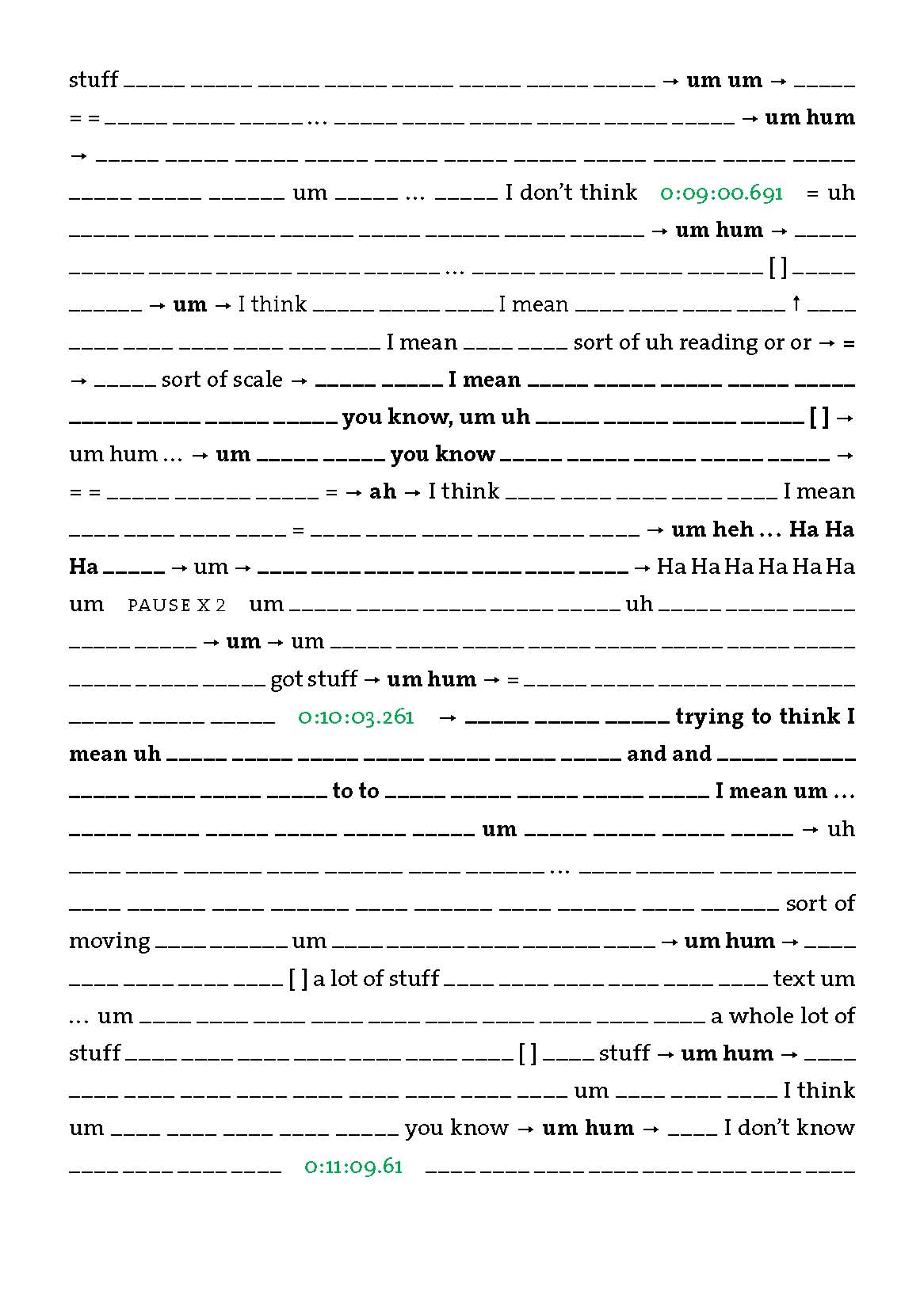
The conversation between a poet and an artist at their first meeting was recorded. An extract from the transcription is presented:
‘So how would you where would you how would you describe what you what you do?’
This poet and artist are a slippery pair. The gaps left by their absent presence are clearly visible on the page as a space for the reader to interact with the text. The particularity of their laughter disturbs me…ha, ha, ha…heh, heh, heh. Like David Bowie’s laughing gnome I can’t quite catch them yet at the same time get left imagining a scary encounter over lunch in which the pair squirt caviar and honey at one another in a Paul McCarthyesque carnival of filth, whilst their transparent words collide in mid-air, smash into one another and leave us quite spent. Writing this tough is a car crash.
Uh Duh by Sarah Jacobs, LemonMelon & VerySmallKitchen 2012 | £8 | Softback | 30pp | 15 x 21 cm | ISBN 978 1 908260 11 6
The conversation continues:
Please join us for a performance reading of Uh Duh at X Marks the Bökship on Wednesday 25th January at 7pm.
X marks the Bökship,
210/Unit 3 Cambridge Heath Road
London
E2 9NQ
Recent talks, exhibitions and workshops have lead VerySmallKitchen to consider its relationships to teaching and pedagogy, how its explorations of writing, language and art practice can suggest and take place within a diverse array of learning situations…
This document is a draft that will be revised as appropriate over the coming months, as well as supplemented with other materials (book lists, essays, notes…).
The STUDIO project is also part of VerySmallKitchen’s residency at London’s X Marks the Bokship, which involves compiling an essay and bibliography on the use of scripts and scores in contemporary art writing, to be published in March 2012.
nick e-melville's EDITORIAL for I AM NOT A POET invited public alteration of the day's news...
At the Talbot Rice Gallery in Edinburgh, Gerry Smith and nick e-melville curated THETEXTISTHETEXT, under the frame of “visual poetry vs text art exhibition match.”
nick e-melville, junk mail, 2011
FORTHCOMING
VerySmallKitchen starts 2012 with a new hard copy book series in collaboration with LemonMelon. Our first title is Uh-Duh by Sarah Jacobs, which she describes as follows:
The conversation between a poet and an artist at their first meeting was recorded. An extract from the transcription is presented: ‘So how would you where would you how would you describe what you what you do?’
As well as the LemonMelon series, other hard copy projects include titles by seekers of lice and Paolo Javier.
In collaboration with Maintenant/3AM and Szépírók Társasága, VerySmallKitchen also will host a London visit by Márton Koppány from 28th March to April 1st 2012. Details of publication, exhibition and performance to follow. A dialogue with Márton is here.
Finally, VerySmallKitchen is excited to be part of A Pigeon, A Kichen and an Annexe: Alternative Sites of Publishing at Five Years Gallery in February, curated by Ladies of the Press, who have invited VerySmallKitchen, Pigeon and Annexe to work collaboratively on an exhibition. More info soon.
Seeds were put into place to grow. Now they are sitting in a room above a garden with a radio on hum hum hum. An Eye sighs and cherry picks and gets lazy. A nudge please – I want to be lost please please carry on, look harder…
“Let’s make the deal. Let’s make the deal,” he keeps repeating.
He says something about needing to bring the papers and something about a flight and staying for a week somewhere.
He is serious.
He is well dressed and wears a golden wedding ring.
He places his other hand on the bar while continuing to negotiate how many days he will spend somewhere.
“When do I go back?” he continues asking.
“I need to work whether you like it or not. It’s as simple as that. Without discussion.”
(He has a Dutch accent.)
“I cannot leave without the papers for two and a half weeks.”
Then he says ‘New York’, ‘January’ and something about a position he needs to take whether someone likes it or not.
Then come some more words like ‘Paper’, ‘Flight’, ‘Christmas’ and ‘New Year’.
I think to myself that this guy is retarded. Whether he likes it or not.
He gets more and more angry and says he can over-bridge a week but not two weeks.
I wonder to myself if this guy is maybe just talking to himself. Maybe there is nobody else on the other side of the line.
Maybe he is just pretending so that nobody thinks he is alone.
The conversation seems to reach an end. Both sides agree that the guy comes without the papers.
All this about some papers. This guy means business. That’s for sure. He listens to the other guy a bit about the option of no papers and he points to Nare that is the bartender and hints for a new glass of beer.
This man is full of shit. ’Magazine’, ‘Mexico’ and ‘Television’ are the next words that he says.
He takes a sip from the beer and says “Anyway, I’m going to take the papers and two laptops.”
He has gel in his hair. His hair is pulled backwards.
“So the deal here is no papers and leave (sometime) in January or take the papers and leave (some other time I don’t hear).”
Then comes ‘New York’ and ‘Nairobi’.
“I need to be back in my office again on the 9th of January.”
…
I think to myself that I should just say to the guy: “Listen man. You cannot sit here on the bar and talk business the whole fucking time. Make the fucking deal and get on with your beer. Are you retarded? Are you seriously retarded or autistic? How can you be living like this man? This is sick. You are sick. Your life is sick. Your watch is sick. Your big fat white fingers are sick. Your mobile is sick. The way you talk is sick. Your whole fucking brain is sick.”
As his words come out of his mouth, I put words on the paper. Maybe my notebook pages are the papers he is talking about? Maybe I’m writing on the papers he needs in order to close the deal? Maybe I’m keeping him from signing the contract?
I look into his bright blue eyes.
His fine glasses are slightly tilted on his nose.
He looks sharp.
He looks like he knows what he is talking about.
He looks like everything is under control.
After about 15-20 minutes of talking on the phone he still hasn’t reached an agreement with the other person on the phone.
Then he says “Having said that,” and repeats the date 7th of january for the eleventh time.
His way of talking is abrupt, cut and with a bass tone.
Then he scratches his penis or balls and notices that I notice that.
“The bottom line is,” he says and then goes onto another round of negotiations with the guy.
He says “2 weeks..3 weeks..what?”
I decide to finish my beer and leave when I finish it.
I finish my beer and hear him say “You are talking a language I don’t understand.”
I decide to give up with this guy. Just stop paying attention to him. I take out some money, pay my beers and leave.
…
Nare at Home 21 December 2011
*
More about Ohad’s work is here. See also Post 1 and Post 2 of his VSK residency.
At London’s National Portrait Gallery one evening in June, Will Holder got up on the lecture theatre stage and quickly whispered “‘Do Nothing’ by Simon Amstell.” Then he took the microphone out of the stand and began walking around the space, for forty five minutes talking and moving in the manner of a stand up comic.
Holder’s confessional monologue was that of a young gay man, someone evidently younger than Holder himself, who seemed to have a different body shape (the monologue returned repeatedly to its speakers ultra-thinness). As these gaps appeared between spoken and speaker, Holder began fiddling with an ear piece. Was the monologue being spoken into his ear? In one moment, Holder held the microphone at arms length away from his mouth and continued to talk. The volume of sound remained the same.
The performance encouraged an (at least) double response. The monologue is sometimes funny, and the audience laugh, so it functions like straight stand up comedy (perhaps for some, wandering in as part of the National Portrait Gallery late night opening, that’s what it was). For those familiar with Holder’s work as writer, editor and designer, such laughs get moderated by a meta level where the artist explores form, voice, and persona. The tangle of all this, in Holder’s performance and beyond, is what this essay explores.
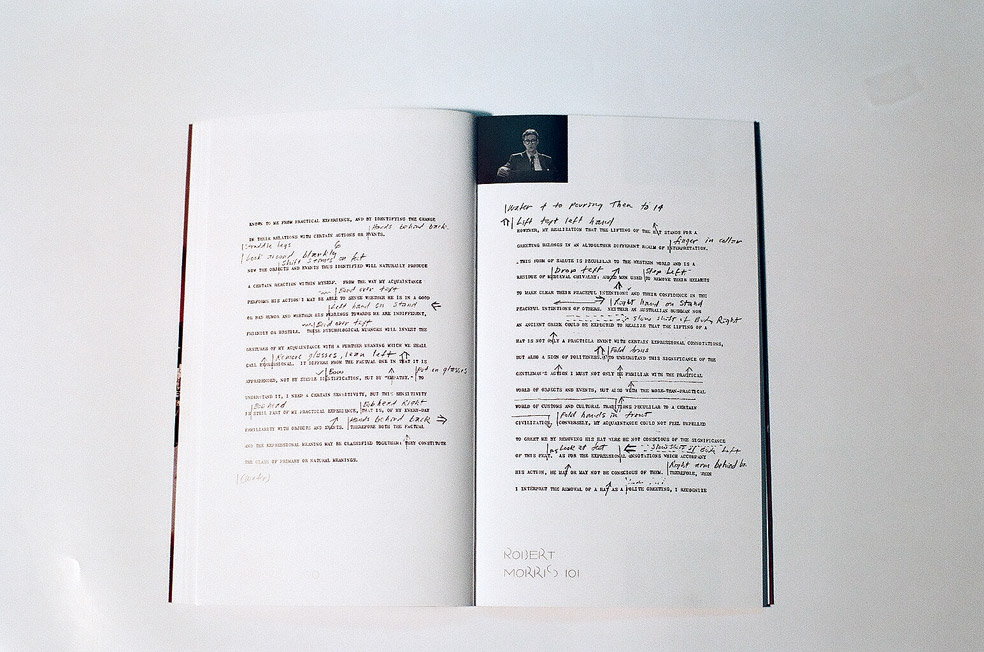
Before artists doing stand up, there was the lecture performance. “Lecture performance” was the framework of Characters, Figures & Signs, a 2009 conference at Tate Modern; and the title of a 2009-10 exhibition at the Kölnischer Kunstverein and MoCA Belgrade. It attained further prominence via Mark Leckey’s Cinema in the Round, part of his 2007 Turner prize installation, and had oft-cited historical precedents, including Robert Morris 1964 lecture piece 21.3.
Robert Morris, script for 21.3 (1964)
In such work, artists adapted to their own ends the format of the academic lecture, a template providing both particular performance techniques and a pedagogical function concerned with the transmission of information to an audience expectantly (or not) waiting to be filled with knowledge.
Morris, for example, read aloud an essay by the art historian Erwin Panofsky, whilst Leckey’s associative bricolage highlighted the associative and electic methodology often characterizing the form.
Stills from Falke Pisano, A Sculpture turning into a conversation
As with Holder, questions about how such talks work as knowledge are foregrounded. The artist Falke Pisano suggests “the act of speaking about something or someone, in the cultural field as much as in other fields, necessarily involves reflection on one’s own position and consequently on the conditions in which the utterance is made.” [1]
Pisano unfolds this idea in her 2010 artists bookFigures of Speech, whose title proposes a structural model for the artists lecture as mixing talk, sculpture, illustration, crowd, grammar, drawing, diagram… The ambiguity this produces is evident in Pisano’s Sculpture Turning into A Conversation, which (in its written form in the book as a progression of numbered points) I experience via multiple and contradictory logics of poem, proof, proposition, experiment and short story. If the title suggests a process with a definite conclusion, this compounding of logics foregrounds uncertainty and repetition.
Such dexterity is maybe one reason why performance-lectures are often framed through the framework of dance, as in, for example, Xavier Le Roy’s Product of Circumstances (1999) and Jérôme Bel’s The Last Performance – A Lecture (2004). Such framing foregrounds the body, and a view of both talking and thinking as (physical) gestures in space, to be shaped and arranged as (bodily) forms. This context of dance is useful for proposing the lecture performance as a way to confound expectations, with “dance” consisting of someone talking, sitting, or giving a power point presentation.
Will Holder’s (not) stand up – and aspects of other performances in electra’s Dirty Literature season by Tony White, Sue Tompkins and Francesco Pedraglio – suggests the academic lecture is now a less important paradigm than the stand up comic, particular as it intersects with storytelling and art history through the monologues of, say, Spalding Gray, John Cage and Laurie Anderson.
Unlike art practice, stand up has a highly clear criteria for success and failure (it’s funny I’m laughing/ it isn’t funny get off), which is a provocative intervention to the more muddied social dynamics of an art event. As Holder demonstrated, the single figure, holding a microphone, pacing the stage, producing casual seeming (fake) spontaneity through a crafted and memorised routine, is its dominant mode. What is it acceptable to say in a particular situation? A history of comedians such as Lenny Bruce or Richard Pryor propose anything is permissable as subject, as long as it is funny.
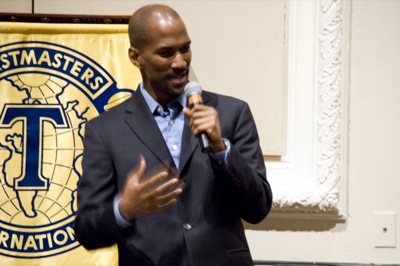
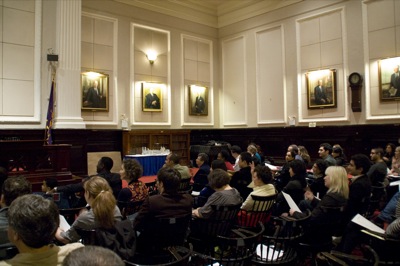
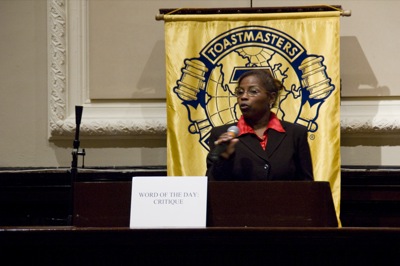
Other models for talking have a more specialist feel, such as Carey Young’sSpeechcraft, a series of events using the formats of the Toastmasters, an American organisation promoting arts of public speaking, principally designed for businessmen. Again, Young’s attraction to the toastmasters is its fixed forms where speakers talking on set topics are immediately evaluated by further speakers who also follow strict time and content limitations.
Carey Young, Speechcraft (2007) as staged in New York by Creative Time (2008). Photographs copyright Sam Horine.
If talking as dance focusses on the body, then viewing the lecture as a form of poetry enables a focus upon its language, whilst the format of the poetry reading offers new perspectives on the art and experience of the artist talking.
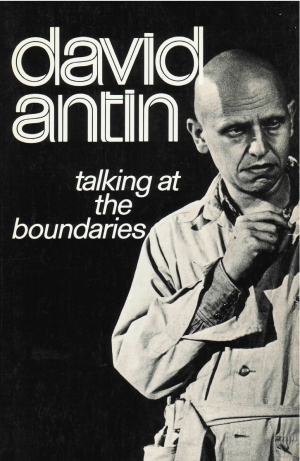
One example here is the work of David Antin, who began in 1972 to present “verbal improvisations that spun narratives out of arguments and arguments out of narratives. I had been looking for a poetry of thinking and what I found was a poetry of talking, because talking was as close as I could come to thinking.” [2] Antin’s attitudes to such talks can be seen in the format he adopted for their transcriptions, rejecting left and right margins and block capitals, with white spaces between words an alternative system of punctuation.
Antin’s printed texts begin by stating location and context, and any “improvisation” is always within such determinants. As Antin wrote after a 1976 performance: “I knew what I wanted to address quite well; I had some notion of the terms I was going to address it in, and what I was looking for was the way”. [3]
In Antin’s recent Radical Coherency: Selected Essays on Art and Literature 1966-2005, several talk poems appear amongst conventional critical essays and interviews. Such juxtaposition suggests oral and written as co-existent poetic strategies, in contrast to traditional poetic histories that have viewed the later as replacing and developing out of the former.
Antin’s focus is usefully viewed alongside Steve Benson, who, in the texts gathered in Open Clothes adopts a number of procedures for producing “poems” from improvised speaking. [4] This applies to both public and private performance, speaking aloud and acts of writing, with methods including speaking into hand-held tape recorders during road trips and improvising poems/talks with the rule that he will speak only questions. In a Q&A following one such performance, Benson observes:
… So there’s the quality of closure and of openness that occurs at every point, at least potentially. And so when you say this was a this kind of move or a that kind of move, I’m never sure until it’s all over what seems to be the dominant modality that would be registered for a certain move. It might appear to one person to be primarily a theme move or to another person to be a musical move or to another person to be a philosophical unhinging of the question, or whatever. [5]
Both Benson and Antin highlight what is also true of the stand up’s restless pacing of the stage: how talking connects to a particular quality and rhythm of the mind, which Leslie Scalapino describes as a mode of being where “The attention of the mind (of either the speaker’s, or the reader’s, or listener’s) in reading the text or during the performance, is neither in nor outside that experience.” [6]
Developing this further, a recent talk by London based artist Patrick Coyle sees the artist attempt to repeat a lecture by Allen Ginsberg that Coyle has sought to memorise. In performances such as Alphabetes, Coyle has worked previously with attempts at remembering, cultivating the improvisatory creativity and humor that often comes from such intentional failure.
His Ginsberg talk, which can be viewed below, has a different emphasis through Coyle’s attempted fidelity to the original. This produces large amounts of silence that can’t be redeemed by any on the spot inventiveness, provocatively posing the talking artist as a failed mnemonic rather than a skilled proponent of (improvisatory) verbal facility.
Talk, of course, should not and cannot be confined to the particular variants which take place in galleries or lecture theatres. The attraction to talking is in part its garrulousness. Many of us talk to ourselves. As the recent Susan Hiller show at Tate Britain demonstrated, even the dead are busy chattering through the static of radio hiss and white noise.
That a certain philosophy of talk can permeate an artists life and work, the voice unfolding as a marker or guide, both through what it says and in its timbre, is something Joan Retallack observes, both of her own extensive conversations with John Cage and the role of speaking in Cage’s lectures and performances. [7]
The poet Chris Cheek, like Benson an improviser of poems, has also developed a practice where talking is site specific, open to the the ever changing environment, which shifts his own identity from source to channel or receiver, a complex of factors cheek describes as a “doubting interface” (191) that must take into consideration:
scale, perspective, contradiction, deliberate misunderstanding, anecdote, vernacular obsession, fictive quoting, imposed character, cartoon depiction, carnivalesque interpretation, historicising, demonising, sports commentary, theoretical exposition, emergences (and emergencies) of catchprase, listening to prerecorded texts or previous talks on headphones whilst talking (thereby mobilising conflict between listening and uttering), overhearing fragments of passing conversations… [8]
In the work of Tino Seghal the artist is himself physically absent from the work, but scoring conditions for speaking by others. In This situation (2007), for example, five hired interpreters engage in an intellectual discussion in the gallery space, turning to gallery visitors as they enter to ask “What do you think?”
As has by now (as he intended) become a staple of contemporary art (oral and written) folklore, Seghal refuses photographic documentation of his work, both enacting, documenting, and selling work through oral transactions. Unlike cheek, Seghal’s works function solely within controlled gallery conditions, depending upon their particular rules. In their after life, however, works are orally passed on in multiple locations, verbal descriptions and narratives, as here, rumours and tale telling of a varied and promiscuous speech life.
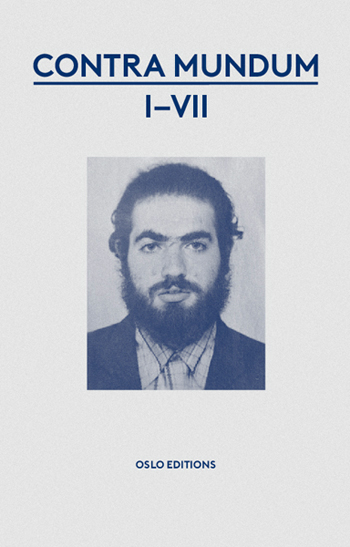
A series of talks at the Mandrake bar, Los Angeles in 2009, were organised under the banner of “Contra Mundum.” The phrase – translated as “against the world” – was taken from Evelyn Waugh’s 1945 novel Brideshead Revisited. In the book of transcriptions from the series, the editors observe of their frame how each of the invited speakers “attempt, in various ways, to retrieve this vision of social (non)relation and to take it seriously as a subject position, particularly now, in our current moment of geopolitical uncertainty.” [9]
Frances Stark, The New Vision, 2008
At the Mandrake Bar this meant – as I imagine the event from publication alone – prioritising a straightforward sharing of information and the creation of a particular social environment, with each speaker followed by a specially selected DJ set. Diverse themes operated against any false notion of commonality amongst the participants. Whilst none of the talks explored talks potential for destruction and cruelty, the notion of talk as contrary was key. In one Mandrake talk, Frances Stark suggests “Fuck the World” as a more appropriate translation.
In July this year, the South London Gallery hosted Performance as Publishing. If explorations like this essay can be over dependent on talks that attain some printed form, here was a curatorial frame (initiated by Nicole Bachmann and Ruth Beale) proposing to bring that act of publishing back into the moment of performance. In pieces by Annie Davey and Emma Kay this was matter of factly the case, with artists reading aloud texts printed on A4 paper, as if all the decisions, acts and costs of publishing became a matter for voice and site.
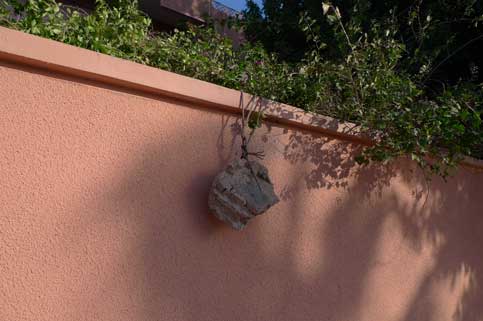
Francesco Pedraglio, Hanging Rock, 2011
Other works offered a less literal intepretation of “performance as publishing.” Francesco Pedraglio’sA few stories in the shape of abstract objects (2011) negotiated amongst both the absorptive, charismatic effects of a traditional storyteller and a set of elements chosen for their questioning of narrator and narrative coherence; whilst Jenny Moore’sProposal for a Rock Opera- Act Two (2011) sketched out a musical based on an artist residency in Norway.
Moore used song and hand drawn acetates on an overhead projector to convey sample songs and plot. The deliberately amateur clumsiness of these techniques was balanced by her clear musical prowess and confidence as a performer. Like Holder’s talk at the National Portrait Gallery, both Moore and Pedraglio asked us to become involved (and be entertained) by what was presented, whilst highly self-aware and destabilising of the structures and procedures involved in its manufacture. Something I can’t articulate yet about how these different strategies combine is what engages and excites here.
Ruth Beale, Lindgren & Langlois: The Archive Paradox, 2011
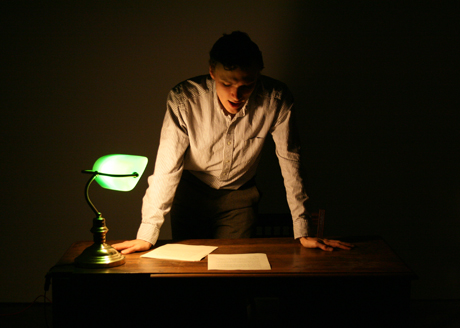
This doubleness (at least) unfolded differently in Beale’s own Lindgren & Langlois: The Archive Paradox (2011), which saw two male actors facing each other across desks ten metres apart, reading aloud their correspondence as, respectively, first curator of the BFI’s National Film Archive and co-founder of the Cinémathèque Française.
Unlike some of the night’s other work, Beale deployed traditional theatrical notions of scenography and the trained actor. Unlike Moore, Pedraglio and Holder, Beale did not (this time) use humour and absurdist inventiveness. Instead, such theatrical artificiality created a quiet concentration that opened up a gap between audience and performers.
This gap was composed of questions. Why this subject and not any other? Why now? What are we to do with this information? How does its specificity play with an audience presumably not out for an evening on early histories of film preservation? If Beale wasn’t offering laughs, this wasn’t necessarily a tactic to be valued over others, but another element of what is at stake in an artist talking, the multiple ways of inhabiting that doubting interface.
NOTES
[1]Falke Pisano, Figures of Speech (JRP Ringier, 2010), 19.
[2]David Antin: Radical Coherency: Selected Essays on Art and Literature 1966-2005 (University of Chicago Press, 2011), 11.
[3]Stephen Vincent and Ellen Zweig eds. The Poetry Reading: A contemporary compendium on language & performance (San Francisco, Momo’s Press, 1981), 191.
[4]Steve Benson, Open Clothes (Berkeley, Atelos, 2005).
Connections of language, writing, reading and art practice, inside and outside the VerySmallKitchen. Currently also inhabiting The Ruins of Hastings. Contact David Berridge at verysmallkitchen@gmail.com




 VerySmallKitchen